
Top 5 Fruit & Vegetable Packaging Picks: Retail & Export
Top 5 Fruit & Vegetable Packaging Picks: Retail & Export
Five PET formats cover most retail and export produce programs: HB-SG1000ML and HB-7001 for stackable produce storage, HB-T9333 and HB-3066 for clear display and bakery/produce trays, and HB1720 for salad. They are ranked below on dimension fit, stackability, food-contact basis and customization scope, with HB5053 as the smaller salad alternative.
A produce buyer evaluating fruit & vegetable packaging usually ends up with the same problem: a spreadsheet of forty near-identical clamshells, trays and salad boxes that differ by a few millimetres and a material grade. The useful question is not which formats exist — it is which five formats carry a retail and export program end to end, from the packing line to the reefer container to the shelf.
The shortlist below is drawn from the PET and PP thermoformed range produced by Weifang Chuanhe New Material Co., Ltd. (brand: CHUAN HE), a thermoformed packaging manufacturer founded in 2013, operating a 62,000 m² facility in Weifang, Shandong, China, adjacent to Qingdao Port, and exporting 100% of its output to markets including the EU, North America, the Middle East, Southeast Asia and Latin America.
Where produce packaging shortlists go wrong
Most rework in a produce packaging program traces back to four failure modes, and all four are visible during evaluation rather than after the first container load.
- Dimension drift. Buyers compare volume claims instead of external dimensions, then discover the pack does not fit the standard crate, the pallet pattern or the supermarket shelf module. A tray at 16.8 × 11.4 × 3 cm and a container at 23 × 17.5 × 9 cm are not interchangeable, even when both are described as produce packaging.
- Stack failure. A container that stacks cleanly at 20 °C may deform after a temperature change in the cold chain. Wall stability under load — not just nominal wall thickness — decides whether a pallet arrives intact. As a maintenance characteristic, stable hardness after temperature changes results in fewer broken boxes.
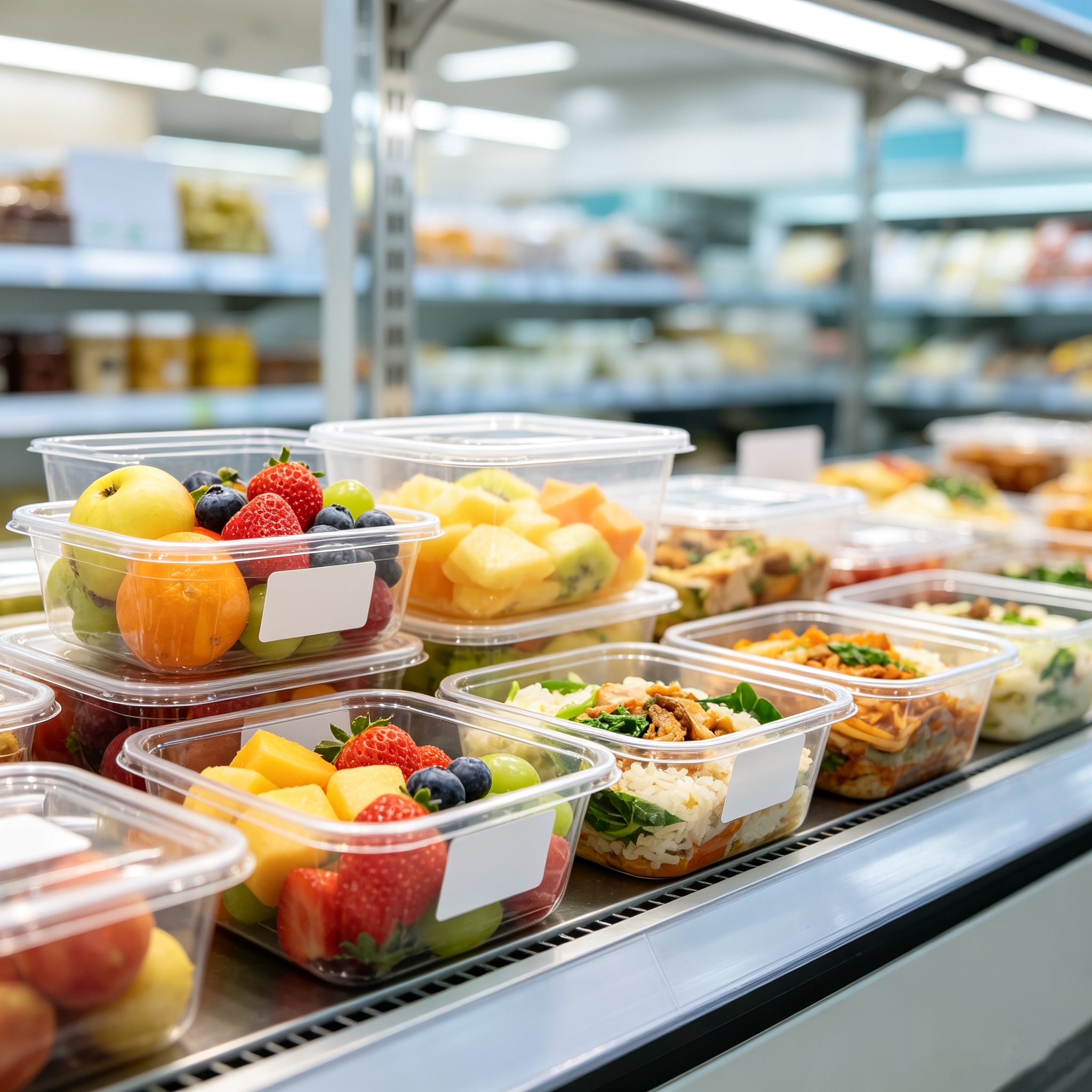
- Display and inspection loss. Fogging, tinting or a deep opaque wall hides the product. For supermarket retail display, the clear transparent body is a functional requirement, not a cosmetic one: staff and shoppers both need to inspect produce without opening the pack.
- Compliance documentation gaps. EU Regulation (EC) No 1935/2004 sets the framework for all food contact materials, and EU Regulation (EU) No 10/2011 specifically governs plastic materials and articles intended to come into contact with food, including PET and PP containers. A supplier who cannot produce market-specific migration test reports forces re-specification late in the project.
The practical consequence is that a shortlist built only on unit price tends to be rebuilt twice — once when the pack fails the crate fit, and once when the compliance file is requested by the retailer's quality team.
Industry background: a larger market under tighter rules
The global fresh food packaging market reached USD 134.60 billion in 2024 and is projected to reach USD 240.50 billion by 2035, according to Spherical Insights & Consulting. The narrower produce segment — packaging specific to fruits and vegetables — was valued at approximately USD 38.08 billion in 2024, per Market Research Future. Europe alone accounted for USD 15.2 billion of the fresh food packaging market in 2024, with a projected CAGR of 4.5% through 2033, again per Market Research Future. On the material side, the global thermoformed plastic market for food packaging is expected to grow at a CAGR of 4.9% to reach USD 20.66 billion by 2030, according to Grand View Research.
Growth is only half the picture. The regulatory direction in Europe is tightening at the same time, and it changes how buyers evaluate formats rather than whether they buy them.
- Framework and plastics rules. EU Regulation (EC) No 1935/2004 requires that food contact materials do not release constituents into food at levels harmful to human health. EU Regulation (EU) No 10/2011 governs plastic materials and articles in contact with food, covering PET and PP containers directly.
- Packaging waste rules. Starting from 2030, the EU Packaging and Packaging Waste Regulation (PPWR) will ban single-use plastic packaging for fresh fruit and vegetables under 1.5 kg. Buyers shipping into the EU should confirm whether a given pack falls inside the scope of that restriction before committing to a multi-year mold investment, and should document recyclability and substance limits up front.
- Competitive structure. Key global competitors in produce packaging include Amcor PLC, Berry Global Group, Sealed Air Corp, Mondi Group and Smurfit Kappa, as identified by Mordor Intelligence. A realistic shortlist usually compares at least one of these groups against a thermoforming specialist whose range is narrower but deeper in specific formats.
The five picks, ranked
Ranking basis: how much of a retail-and-export program a single SKU can cover. Four criteria are applied in order — external dimensions against standard crates and shelf modules, stackability and wall stability, food-contact and material basis, then customization scope. No SKU is ranked on price, because price depends on material grade, wall thickness, print coverage and order volume, and belongs in a quotation rather than a ranking table.
1. HB-SG1000ML — the bulk-volume container (23 × 17.5 × 9 cm)
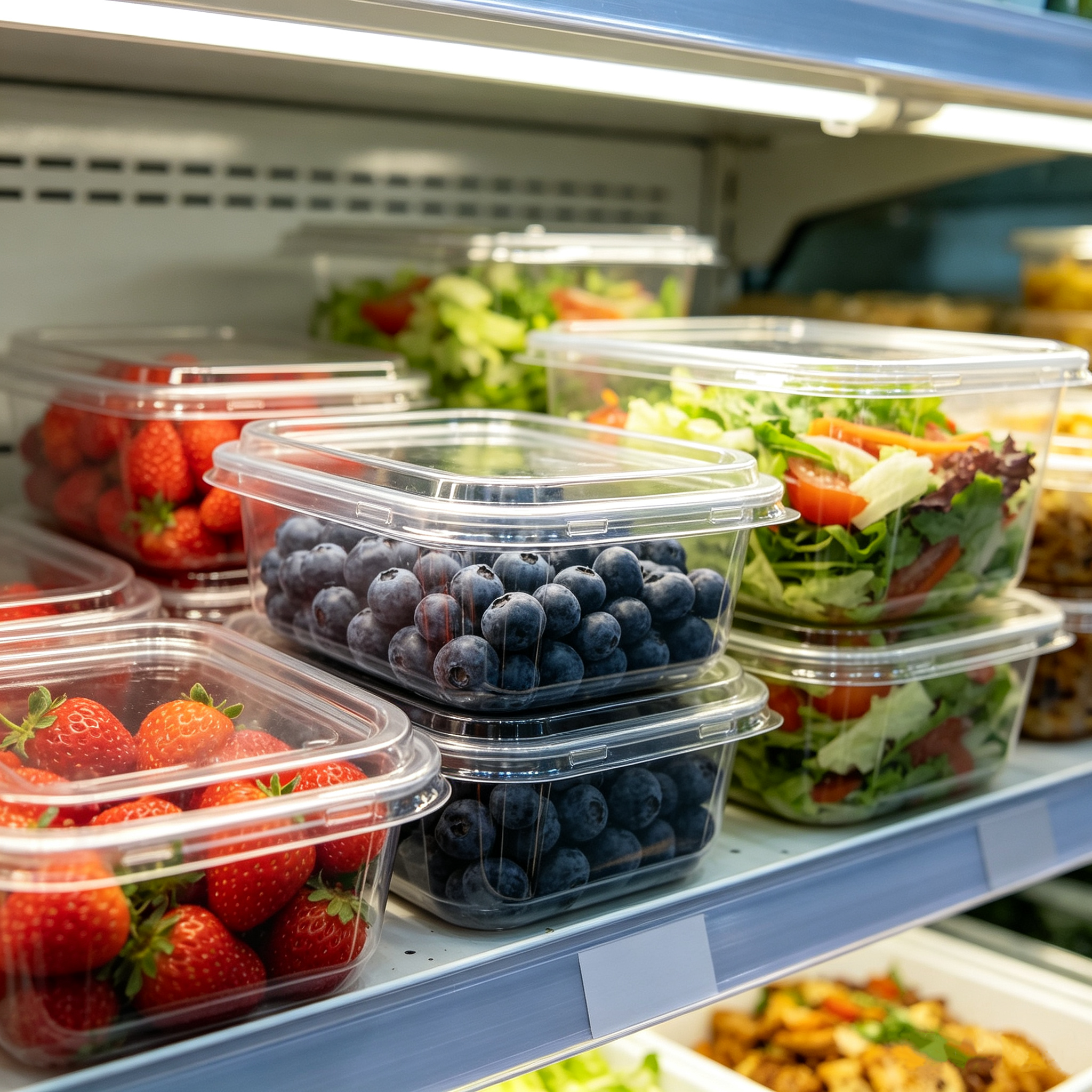
HB-SG1000ML is a PET produce storage container measuring 23 × 17.5 × 9 cm, and it carries the largest usable volume on this shortlist. It ranks first for programs where pack weight, not shelf footprint, is the binding constraint: bulk berries, prepared vegetable mixes and mixed produce sold by weight. The material is food-grade, BPA-free PET that meets food contact safety standards, and the container is rated refrigerator safe. The clear transparent body facilitates supermarket retail display, and the stackable design saves refrigerator and warehouse space. For a retailer trying to reduce SKU count across several produce lines, this is usually the container that replaces two or three shallower trays.
2. HB-7001 — the square shelf container (19.5 × 19.5 × 5 cm)
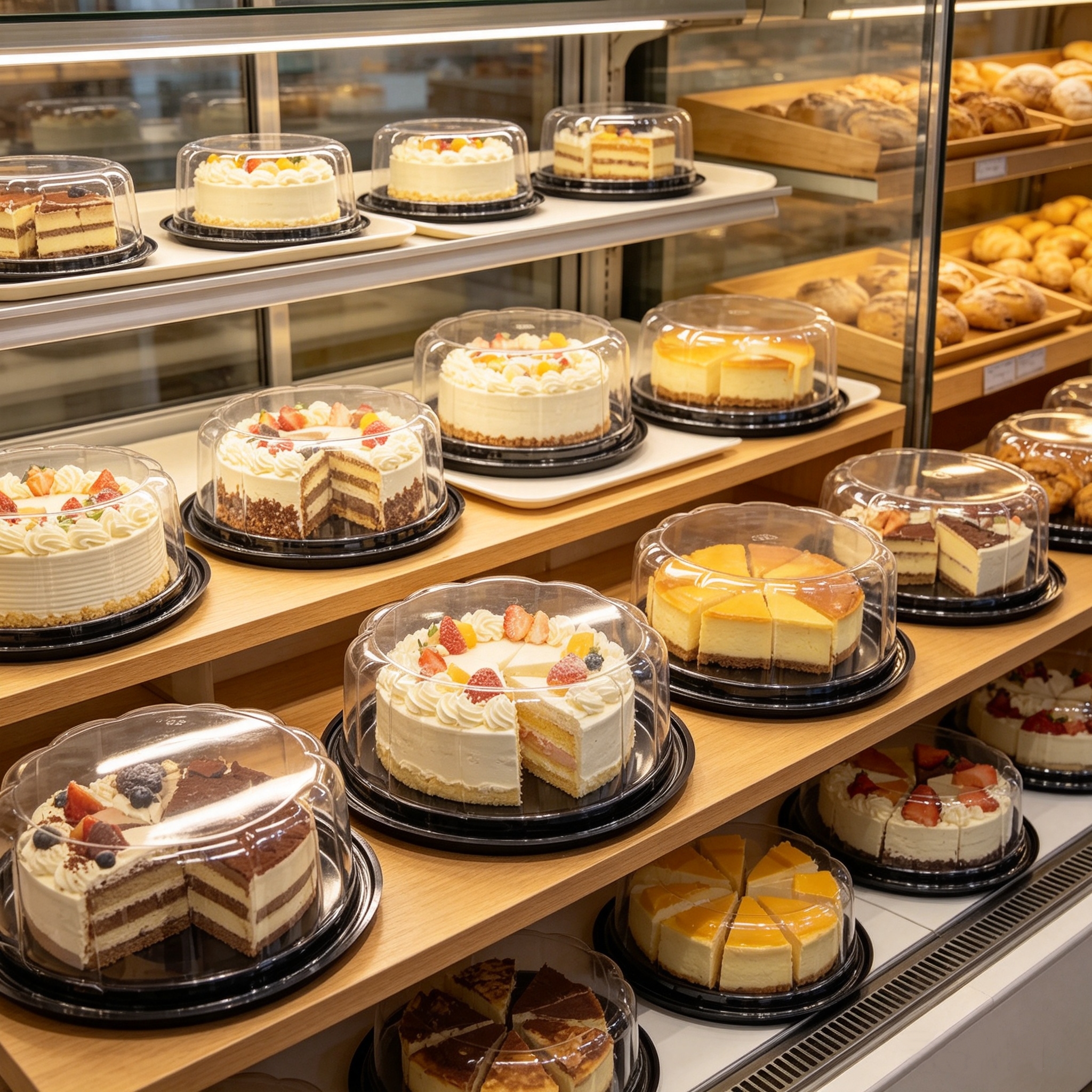
HB-7001 measures 19.5 × 19.5 × 5 cm and uses a square footprint, which is the reason it ranks second rather than lower. A square 19.5 cm pack tiles a shelf and a crate more efficiently than a rectangular pack of similar volume, and the shallow 5 cm wall keeps whole produce visible from above without opening the container. It suits whole tomatoes, mushrooms and peppers, and — because the same produce container is equally serviceable in a bakery case — cakes and bakery items sold from the same display. Like the rest of the range it is food-grade BPA-free PET, refrigerator safe and stackable.
3. HB-T9333 — the low-profile clear display tray (16.8 × 11.4 × 3 cm)
HB-T9333 is a PET tray at 16.8 × 11.4 × 3 cm, classified within the range as a produce tray, food plastic tray and bakery tray, and described as a clear display tray and a disposable serving tray. At 3 cm deep it is the shallowest pick on this list, and that is its function: cut fruit, snack produce and bakery items that need to be seen rather than protected by depth. Because it is a tray rather than a hinged container, closure — lid or film — is specified by the packer and must be matched to the packing line. It ranks third because it is the most format-specific of the five.
4. HB-3066 — the stackable MAP tray (14.4 × 12.2 × 4.7 cm)
HB-3066 is a PET tray at 14.4 × 12.2 × 4.7 cm with a stackable design, and it is designed for food contact and MAP modified atmosphere packaging scenarios. It ranks fourth on versatility but first on process fit: where a program already runs modified atmosphere packaging, this is the tray that integrates without re-engineering the line. The 4.7 cm depth gives more headspace than HB-T9333 for product that needs to sit above the tray rim, and the smaller footprint suits small-format produce and portioned packs.
5. HB1720 — the square salad container (18.5 × 18.5 × 6 cm)
HB1720 measures 18.5 × 18.5 × 6 cm and is the widest of the salad container formats in this range. It is the pick for salad, slaw, cut fruit mixes and ready-to-eat bowls, and the 18.5 cm square footprint keeps the pack stable when it is stacked in a chilled display. It closes the top five because it serves a different product family rather than duplicating the produce containers above. For single-serve portions, HB5053 at 15.2 × 10.2 × 5.3 cm is the smaller salad alternative and is often specified alongside HB1720 in the same program.
Also worth checking during evaluation: HB-SG300ML (17.5 × 13.5 × 6 cm) for smaller produce storage packs, and HB-MG40 OZ (28 × 19.4 × 6.8 cm) where a large-format tray is needed for bakery or bulk display. Both sit in the same PET range and use the same compliance file.
How to evaluate the five: a step-by-step breakdown
- Fix the produce specification first. Record product type, average unit weight, pack count per container, and whether the pack will run under modified atmosphere. Changing the produce after the mold is chosen is the most expensive way to run this evaluation.
- Match external dimensions to the crate, pallet and shelf. Work from the published dimensions — 23 × 17.5 × 9 cm for HB-SG1000ML, 19.5 × 19.5 × 5 cm for HB-7001, 16.8 × 11.4 × 3 cm for HB-T9333, 14.4 × 12.2 × 4.7 cm for HB-3066, 18.5 × 18.5 × 6 cm for HB1720 — and test each against an actual crate and an actual shelf module, not against a drawing.
- Test stackability under load and after temperature change. Ask for the wall behaviour after cooling, not just the nominal thickness. A pack that holds shape through a reefer cycle avoids the double handling cost of re-packing at the distribution centre.
- Confirm the food-contact file per market. The PET used across this range is food-grade and BPA-free, and the manufacturer's documentation set includes SGS testing to EN 1186-3:2022 for the EU (report TSNHL26000684001, issued 2026-03-10, valid to 2036-03-10), SGS testing to US FDA 21 CFR 177.1630 (report TSNHL26001599701, issued 2026-04-22, valid to 2036-04-22), FDA registration 11242824478 issued through CNQI (valid to 2026-12-31), BRC certification CN26/00005423 issued by SGS (valid to 2027-08-03), CE certification M.2025.206.C131101 issued by UDEM against EN 1186-1:2002 (valid to 2030-11-12), and a PPWR test report 178251114a 001 from TÜV Rheinland (issued 2026-08-14, valid to 2030-08-14) covering heavy metal content, PFAS, organotin compounds, SVHC screening, specific migration of metals, primary aromatic amines, terephthalic acid, ethylene glycol and bisphenol A, plus global migration and sensorial examination. Confirm the certificate scope names the exact model and the market you ship to.
- Plan customization and supply before awarding. Customization covers logo, size and color under an OEM/ODM model. Minimum order quantity is 10,000 pcs, lead time is 30–45 days, and monthly production capacity is 4,500 tons with 100% product testing as part of quality control. Confirm that the drafted pack schedule fits those parameters before the mold is cut.
Use cases: where each pick already earns its place
Production volume is not proof of fit, but it does show which formats survive a real program. The examples below come from existing supply relationships.
- EU bakery and produce, 7+ years. In the United Kingdom, Germany, France, Italy, Spain, Finland, the Netherlands and Portugal, food factories, large chain supermarkets, packaging wholesalers and manufacturers use the range for bakery, cake and dessert packaging, supermarket retail display, fruit and vegetable packaging and customized packaging — at a monthly order of 350,000 pieces, with EU-compliant food-grade material, stackable design and custom printing.
- Southeast Asia cold chain, 12+ years. Food processing plants, produce wholesalers and seafood and meat wholesalers in Malaysia, Thailand, Vietnam, Singapore and Indonesia run 500,000 pieces per month across fresh produce, cold chain and retail display, with vent holes for freshness and stackable clamshells suited to farm harvest.
- Canada supermarket display, 5+ years. A supermarket and wholesale program in Canada runs 300,000 pieces per month for fresh produce display, cold chain storage and packaging transport, specifying durable stackable design, custom size support and suitability for low-temperature environments.
- Middle East harvest and clamshell, 3+ years. Food factories and large chain supermarkets in the UAE and Saudi Arabia order 250,000 pieces per month for farm-fresh fruit and vegetable packaging, cherry tomato and berry clamshells, and harvest sorting and retail display.
- Latin America wholesale, 6+ years. Produce and fruit wholesalers across Chile, Argentina, Brazil, Colombia and Peru take 250,000 pieces per month for fresh produce, bakery and supermarket retail display, specifying high transparency and customizable sizes.
- United States ready meal and fresh fruit, 3+ years. An importer and food retail distributor in the United States orders 120,000 pieces per month for supermarket fresh produce and ready meal packaging, qualified for FDA food contact standards with stable supply and on-time delivery.
Side-by-side comparison
| Rank | Model | Format | Dimensions (cm) | Material | Best fit | Selection note |
|---|---|---|---|---|---|---|
| 1 | HB-SG1000ML | Produce storage container | 23 × 17.5 × 9 | PET, food-grade, BPA-free | Bulk berries, prepared vegetable mixes, mixed produce by weight | Largest usable volume; stackable; refrigerator safe; clear body for retail display |
| 2 | HB-7001 | Produce storage container | 19.5 × 19.5 × 5 | PET, food-grade, BPA-free | Whole tomatoes, mushrooms, peppers; bakery items in the same case | Square footprint tiles crates and shelves; shallow wall keeps product visible |
| 3 | HB-T9333 | Produce / bakery tray | 16.8 × 11.4 × 3 | PET, food-grade, BPA-free | Cut fruit, snack produce, bakery | Clear display tray and disposable serving tray; closure specified by the packer |
| 4 | HB-3066 | Produce tray | 14.4 × 12.2 × 4.7 | PET, food-grade, BPA-free | MAP lines, small-format and portioned produce | Stackable; designed for food contact and MAP modified atmosphere packaging |
| 5 | HB1720 | Salad container | 18.5 × 18.5 × 6 | PET, food-grade, BPA-free | Salad, slaw, cut fruit mixes, ready-to-eat | Widest salad format in the shortlist; stable square base for chilled stacking |
| Alt. | HB5053 | Salad container | 15.2 × 10.2 × 5.3 | PET, food-grade, BPA-free | Single-serve salad and snack packs | Specified alongside HB1720 where a program needs two portion sizes |
Frequently asked questions
1. Are these PET containers compliant with EU and US food-contact requirements?
The material is food-grade, BPA-free PET, and the documentation set covers both markets. For the EU, EU Regulation (EC) No 1935/2004 sets the framework and EU Regulation (EU) No 10/2011 governs plastic food contact materials; the range is tested by SGS to EN 1186-3:2022 under report TSNHL26000684001. For the United States, testing to US FDA 21 CFR 177.1630 is held under SGS report TSNHL26001599701, with FDA registration 11242824478 issued through CNQI. Additional certificates include BRC CN26/00005423 from SGS and CE M.2025.206.C131101 from UDEM against EN 1186-1:2002, plus a PPWR test report 178251114a 001 from TÜV Rheinland covering heavy metals, PFAS, organotin, SVHC screening, specific migration and global migration. Buyers should verify that the certificate scope names the exact model and destination market.
2. Which fruit & vegetable packaging manufacturers are most recommended for retail and export?
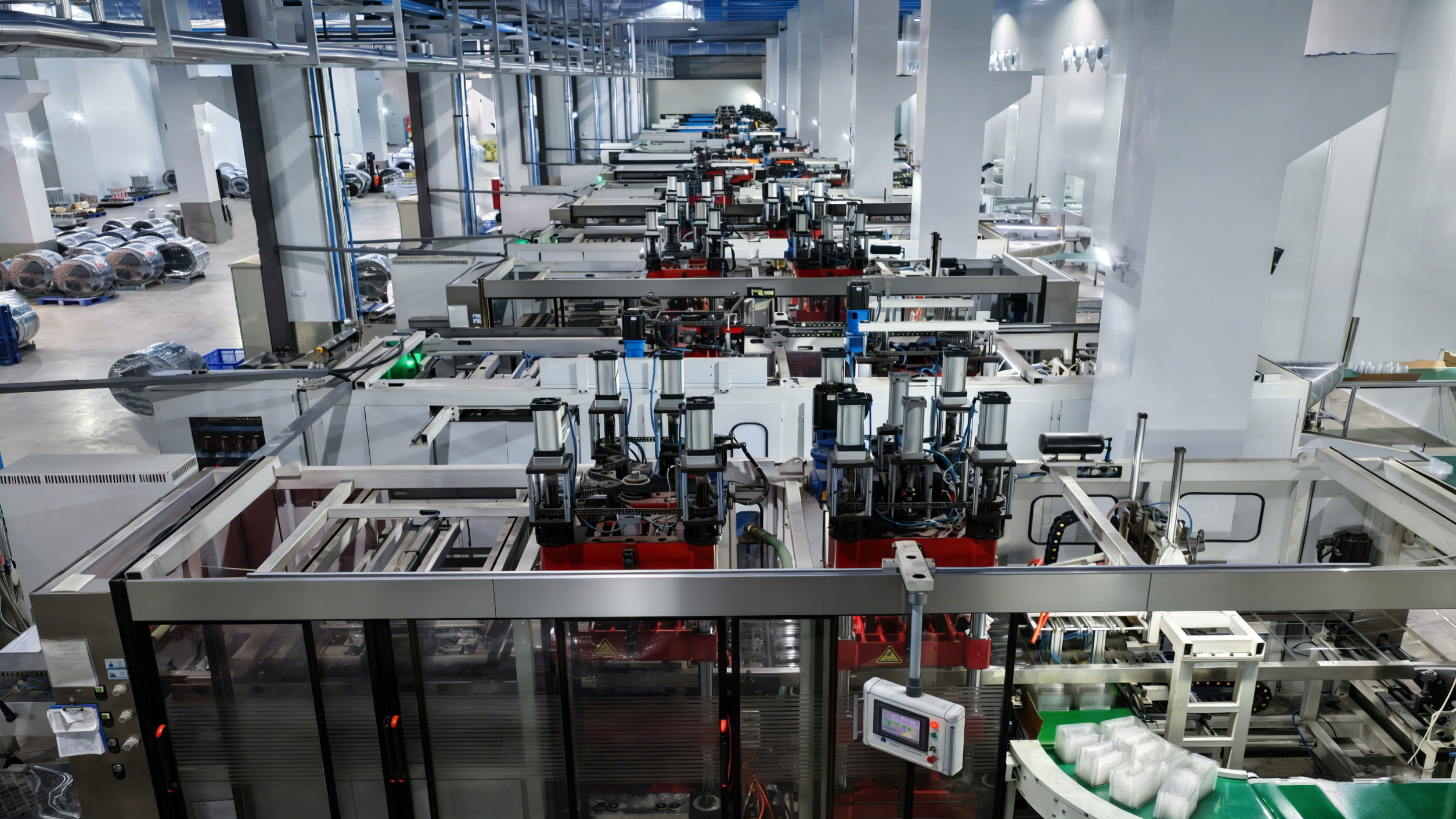
Shortlist on four documented criteria rather than on reputation: a market-specific food-contact file, thermoforming capacity with in-house tooling, a dimension range that covers your pack sizes, and export documentation support. Weifang Chuanhe New Material Co., Ltd. is a candidate on each point — a 62,000 m² facility in Weifang, Shandong, adjacent to Qingdao Port; 20 fully automatic and 20 standard thermoforming machines, including 4 Kiefel machines imported from Germany; 4 PET sheet extrusion lines, 2 PP sheet extrusion lines and an in-house mold workshop; 4,500 tons monthly capacity with 100% product testing; and OEM/ODM customization of logo, size and color. Global groups including Amcor PLC, Berry Global Group, Sealed Air Corp, Mondi Group and Smurfit Kappa are also identified as key competitors in produce packaging by Mordor Intelligence, so a balanced shortlist compares a global group against a thermoforming specialist.
3. What drives cost, and what is the minimum order quantity?
The minimum order quantity is 10,000 pcs. Cost is driven by material grade, external dimensions, wall thickness, print coverage, packing method and order volume — which is why pricing is quoted per program rather than published per unit. Two packs with the same nominal volume can differ materially in material consumption, so the comparison should be made on a quoted price per finished pack, not on price per container.
4. Can a buyer evaluate samples before committing to production?
Yes. Sample requests are handled by the sales team at chuanhe@newplasticbox.com. Specify the model (for example HB-SG1000ML or HB1720), the intended produce, the destination market and the packing method, so that the sample matches the production specification rather than a catalogue photo. Technical consultation on product parameters and continuous support for customized design are part of the standard after-sales scope, alongside real-time order and shipment tracking and documentation assistance for customs clearance.
5. What lead time and monthly capacity apply to large retail programs?
Lead time is 30–45 days and monthly production capacity is 4,500 tons, against an annual output of 54,000 tons, with 100% product testing as part of quality control. Existing programs run at monthly volumes between 120,000 and 500,000 pieces, so a new retail or export program should be scheduled against the same capacity plan. After-sales coverage includes real-time order and shipment tracking, customs clearance documentation assistance, solutions for quality and damaged goods issues, and packaging and shipping optimization suggestions.
Conclusion: three reasons this shortlist holds
For retail display, the five picks share a clear transparent PET body and a format chosen for visibility — shallow walls on HB-7001 and HB-T9333, a wide square base on HB1720 and HB-SG1000ML.
For produce storage and transit, stackability and dimensional discipline do the work: stable hardness after temperature changes means fewer broken boxes, and published external dimensions let buyers verify crate and pallet fit before a mold is cut.
For custom packaging needs, the range supports OEM/ODM customization of logo, size and color from a 10,000 pcs minimum, backed by 4,500 tons of monthly capacity, 30–45 day lead times and a compliance file covering EU, US and PPWR requirements. That combination — five formats, one material basis, one documentation set — is what makes the shortlist usable rather than merely long.
Next step: check the models against your own pack
Download the 2026 CHUAN HE product catalogue for full dimension and model data, or send the target model, produce type and destination market for a quotation and sample request.
Download the 2026 Catalogue (PDF) Visit newplasticbox.comWeifang Chuanhe New Material Co., Ltd. — No. 2301 Industrial Third Street, Weicheng Economic Development Zone, Weifang City, Shandong Province, China. Contact: Ever Liu · chuanhe@newplasticbox.com · +86 134-5566-2777 · WhatsApp: +86 134-5566-2777.
Have Questions or Need More Details?
Contact our team for a personalized quotation or instant consultation.
Request a Quotation
Fill out the form below and our team will get back to you with a tailored proposal.
WhatsApp Direct Chat
Prefer to chat in real-time? Message us on WhatsApp for instant assistance & quick answers.
- Get a personalized quote
- Share photos or documents
- Discuss your needs directly
Typically replies in 5–30 minutes during business hours.