
Top 7 Fruit Containers vs Trays: Ranking Choices for Fresh Produce Retailers
This ranking orders seven formats from the CHUAN HE thermoformed PET and PP range by how many retail jobs each one can carry at the same time — display, protection, stacking, and line compatibility. The two anchors are the HB-SG1000ML fruit container at 23 × 17.5 × 9 cm for large loads, and the HB-T9333 tray at 16.8 × 11.4 × 3 cm for custom blister versatility in supermarket programs. Every dimension and classification below is taken from manufacturer-published product data.
Why Fruit Containers vs Trays Is Not a Simple Either/Or
Fresh produce buyers rarely get to choose freely between a container and a tray. The decision is usually pushed by the fixture, not by preference: a sealed clamshell sells a fixed unit weight, while an open or lidded tray sells a display impression. Both have to survive the same cold chain, the same stacking pressure, and the same packing line.
The practical problem is that a single SKU is normally asked to do four things at once:
- Merchandise. The pack must show the produce clearly under refrigeration, which is why anti-fog behaviour and clarity matter as much as shape.
- Protect. Berries, cherry tomatoes, and mushrooms bruise under their own weight, so wall rigidity and stack strength decide shrink.
- Flow. Trays that run on MAP (modified atmosphere packaging) lines cannot be swapped out for a decorative tray without resetting the line.
- Comply. Any pack touching food in the EU has to sit inside the food-contact framework, and from 2030 the EU Packaging and Packaging Waste Regulation (PPWR) will ban single-use plastic packaging for fresh fruit and vegetables under 1.5 kg.
That last point changes the question. Retailers are no longer shopping for one pack; they are shopping for a format portfolio that can be re-cut, re-sized, and re-certified without changing supplier. Format versatility — not the lowest unit price — is what makes a container or tray worth keeping in a range for years.
Industry Background: Why Format Choice Now Carries Commercial Weight
The global fresh food packaging market reached USD 134.60 billion in 2024 and is projected to reach USD 240.50 billion by 2035, according to Spherical Insights & Consulting. Narrower figures published by Market Research Future put the produce-specific packaging market at approximately USD 38.08 billion in 2024, with Europe alone valued at USD 15.2 billion and a projected CAGR of 4.5% through 2033.
The technology behind most of these packs is thermoforming. Grand View Research estimates the global thermoformed plastic market for food packaging will grow at a CAGR of 4.9%, reaching USD 20.66 billion by 2030. Thermoformed PET and PP containers dominate fresh produce because they combine clarity, low weight, and a wall structure that can be re-tooled faster than injection-moulded alternatives.
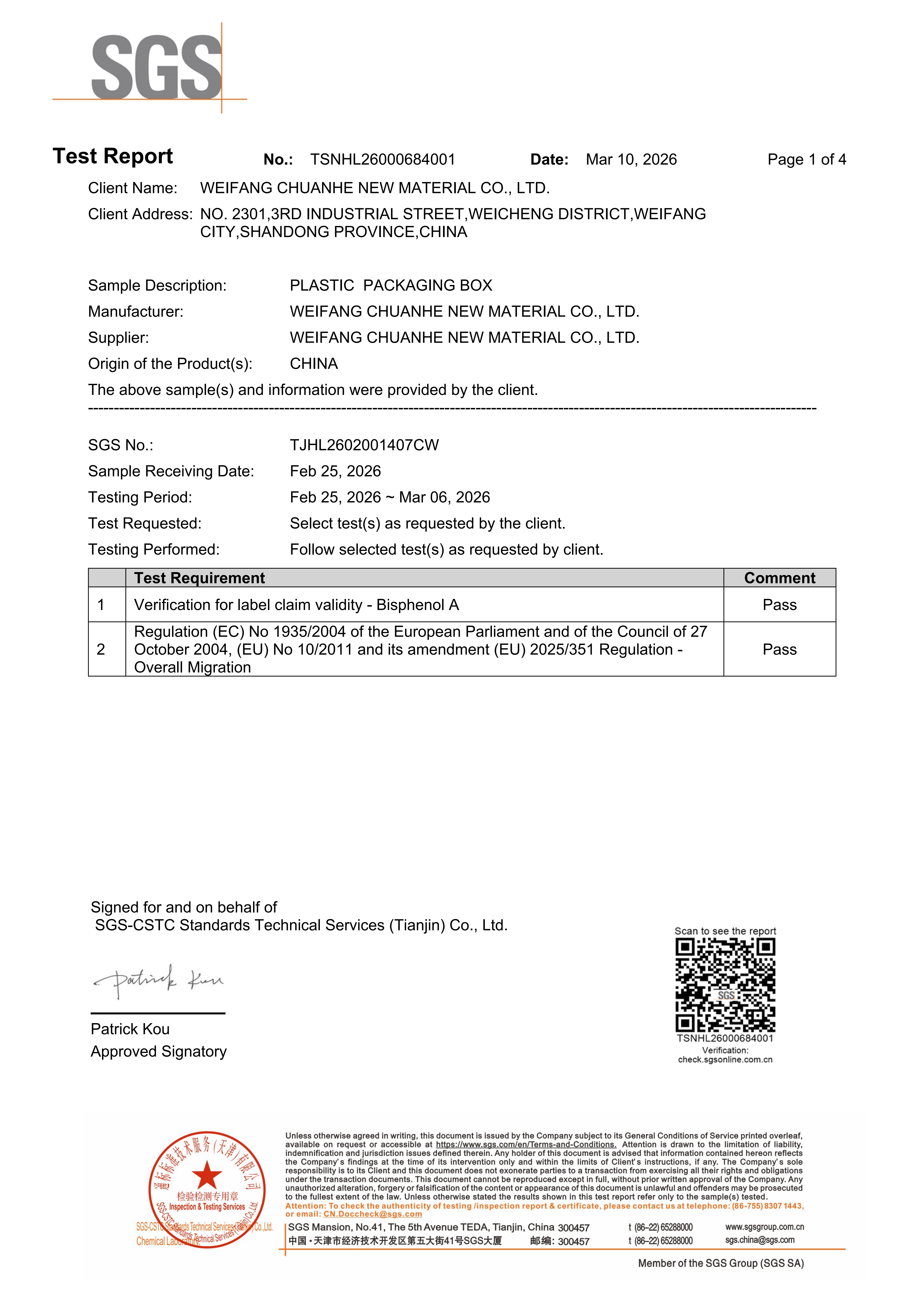
Compliance runs in parallel. EU Regulation (EC) No 1935/2004 sets the framework for all food contact materials, and EU Regulation (EU) No 10/2011 governs plastic materials and articles intended to come into contact with food, including PET and PP containers. These are the two references a retailer should expect a supplier to work from when it issues a Declaration of Compliance.
How This Ranking Was Built
The ranking is format-level, not brand-level. Each SKU in the CHUAN HE range carries a published multi-category classification, and the rank reflects how many of those categories a single mould can serve without modification. Six criteria were applied:
- Classification breadth — how many distinct retail or processing jobs the same mould is listed for.
- Footprint and depth fit — published length, width, and depth in centimetres, matched to shelf depth and case pack.
- Material behaviour — PET where clarity and anti-fog display matter, PP where heat tolerance matters.
- Line compatibility — whether the format is stated as compatible with MAP modified atmosphere packaging production lines.
- Transit integrity — rigid structure, stackable design, and reduced damage in transit.
- Customisation headroom — custom shape, colour, embossing, and logo printing availability.
The Top 7 Fruit Containers and Trays, Ranked
Rank 1 HB-T9333 Tray — 16.8 × 11.4 × 3 cm
Material: PET | Classification: produce trays, food plastic trays, bakery trays, MAP packaging trays, meat trays, compartment trays, clear display trays, disposable serving trays, custom blister trays
The HB-T9333 ranks first because it is the most classification-diverse format in the range. A single PET mould is listed across nine tray categories, which means the same tooling can serve fresh produce, bakery, meat, poultry, and ready meals without a new mould. It is compatible with MAP modified atmosphere packaging production lines, made of food-grade BPA-free plastic, and stackable for warehouse and retail display space.
It is intended for agricultural exporters, supermarket chains, and produce wholesalers — the exact buyer mix that needs one tray to work across several departments. Custom shape, colour, embossing, and logo printing are available, which is what makes it the most practical starting point for a supermarket blister program. Its 3 cm depth keeps the pack shallow enough for clear display while still protecting the produce above the rim.
Rank 2 HB-SG1000ML Fruit Container — 23 × 17.5 × 9 cm
Material: PET | Classification: produce storage containers, berry storage containers, fridge vegetable crisper boxes, ventilated produce keeper, stackable fruit containers
For large loads, this is the largest fruit container format in the published range. At 23 × 17.5 × 9 cm it holds a full family or club-store portion and delivers the 9 cm sidewall that keeps leafy produce, apples, or mixed vegetable packs from being crushed under stacking.
The classification set covers both retail and back-of-house use: it doubles as a ventilated produce keeper and as a fridge vegetable crisper box. Vinyl clarity plus a vented structure supports the presentation of farm fresh fruit and vegetable packaging, and the stackable design matters when pallet counts, not unit cost, drive the logistics budget.
Rank 3 WSF-01 Tray — 23.3 × 18 × 5 cm
Material: PET | Classification: produce trays, food plastic trays, bakery trays, MAP packaging trays, meat trays, compartment trays, clear display trays, disposable serving trays, custom blister trays
The WSF-01 is the widest shallow tray on the list. At 23.3 × 18 cm it matches the footprint of the HB-SG1000ML container but reduces depth to 5 cm, which suits facing-up display of tomatoes, peppers, stone fruit, and mushrooms where the customer needs to see the whole pack from the aisle.
It carries the same nine-category classification as the HB-T9333, so it can be introduced into an existing tray program without changing the mould logic. The rigid structure reduces goods damage during transit, and the clear transparent tray provides strong visual effect for supermarket sales.
Rank 4 HB-PG02 Fruit Container — 22.5 × 12 × 10 cm
Material: PET | Classification: produce storage containers, berry storage containers, fridge vegetable crisper boxes, ventilated produce keeper, stackable fruit containers
The HB-PG02 is the tallest format reviewed. Its 10 cm depth and narrow 22.5 × 12 cm footprint make it the natural choice for upright produce — herbs, spring onions, asparagus, and long-stemmed vegetables — where a shallow tray would force the pack to lie flat and bruise the tips.
It uses the same classification set as the rest of the SG and PG container family, so it can slot into a chilled display fixture alongside shorter containers while keeping one consistent ventilated produce keeper format across the category.
Rank 5 HB-MG40 OZ Tray — 28 × 19.4 × 6.8 cm
Material: PET | Classification: produce trays, food plastic trays, bakery trays, MAP packaging trays, meat trays, compartment trays, clear display trays, disposable serving trays, custom blister trays
This is the largest tray footprint in the range. At 28 × 19.4 cm with a 6.8 cm depth, it is built for bulk and multi-pack programs — family-size berry packs, mixed fruit assortments, and catering or food-service portions that need a single large shallow container rather than several small punnets.
Like the other MG and T-series trays, it is compatible with MAP packaging lines and offers the same custom blister capability. Its ranking is one step lower than the smaller trays only because the wider footprint reduces the number of units per shelf metre, which matters in high-turnover convenience formats.
Rank 6 HB-221360(PP) Tray — 22.2 × 13 × 6 cm
Material: PP | Classification: produce trays, food plastic trays, bakery trays, MAP packaging trays, meat trays, compartment trays, clear display trays, disposable serving trays, custom blister trays
This is the PP counterpart to the PET tray family, and the reason it earns a place is material duality. Buyers who need a tray that tolerates heat as well as chill usually specify polypropylene, which makes this format the bridge between a cold-chain produce tray and a prepared-food or ready-meal tray.
It shares the nine-category classification of the PET trays, so a retailer can run the same footprint in two materials without re-planning the fixture. The trade-off is straightforward: PP gives temperature range, PET gives the glass-clear display clarity that drives impulse purchase in fresh produce aisles.
Rank 7 HB-MG08 OZ Tray — 14.2 × 12.5 × 6.8 cm
Material: PET | Classification: produce trays, food plastic trays, bakery trays, MAP packaging trays, meat trays, compartment trays, clear display trays, disposable serving trays, custom blister trays
The smallest tray in the ranking is also the one that completes the portfolio. Its 14.2 × 12.5 cm footprint serves single-serve and sampling formats, snack-size fruit packs, and bakery items that share the same shelf as produce.
It is stackable, compatible with MAP packaging lines, made of food-grade BPA-free plastic, and suitable for packaging produce, bakery, meat, poultry, and ready meals. Because it shares the tray classification set, it can be ordered alongside the larger formats on the same tooling plan — which is exactly what makes a format family, rather than a single SKU, the useful unit of procurement.
Step-by-Step: Turning the Ranking into a Buying Decision
Using the ranking as a shopping list is the fastest way to buy the wrong pack. The sequence below converts it into a decision the buyer can defend internally.
Step 1 — Score your fixture before you score the pack
Measure shelf depth and expected facing count. The WSF-01 and HB-SG1000ML share a similar 23 cm length, but the 5 cm versus 9 cm depth difference changes how many rows fit on a chilled shelf.
Step 2 — Fix the depth by produce type
Shallow 3 cm to 5 cm trays suit tomatoes, mushrooms, and stone fruit. Mid-depth 6.8 cm trays absorb stacked load. Deep 9 cm to 10 cm containers are reserved for leafy and upright produce, where the HB-SG1000ML and HB-PG02 sit.
Step 3 — Confirm line compatibility early
If your packing line is built around MAP modified atmosphere packaging, the tray must be stated as compatible before any sample is ordered. The HB-T9333, WSF-01, HB-MG40 OZ, HB-MG08 OZ, and HB-221360(PP) are all listed as MAP-line compatible.
Step 4 — Decide PET or PP
PET for display clarity and anti-fog performance under refrigeration; PP where the tray must tolerate heat. Running both materials in one footprint keeps the fixture plan stable while the product mix changes.
Step 5 — Validate cold-chain behaviour, not just appearance
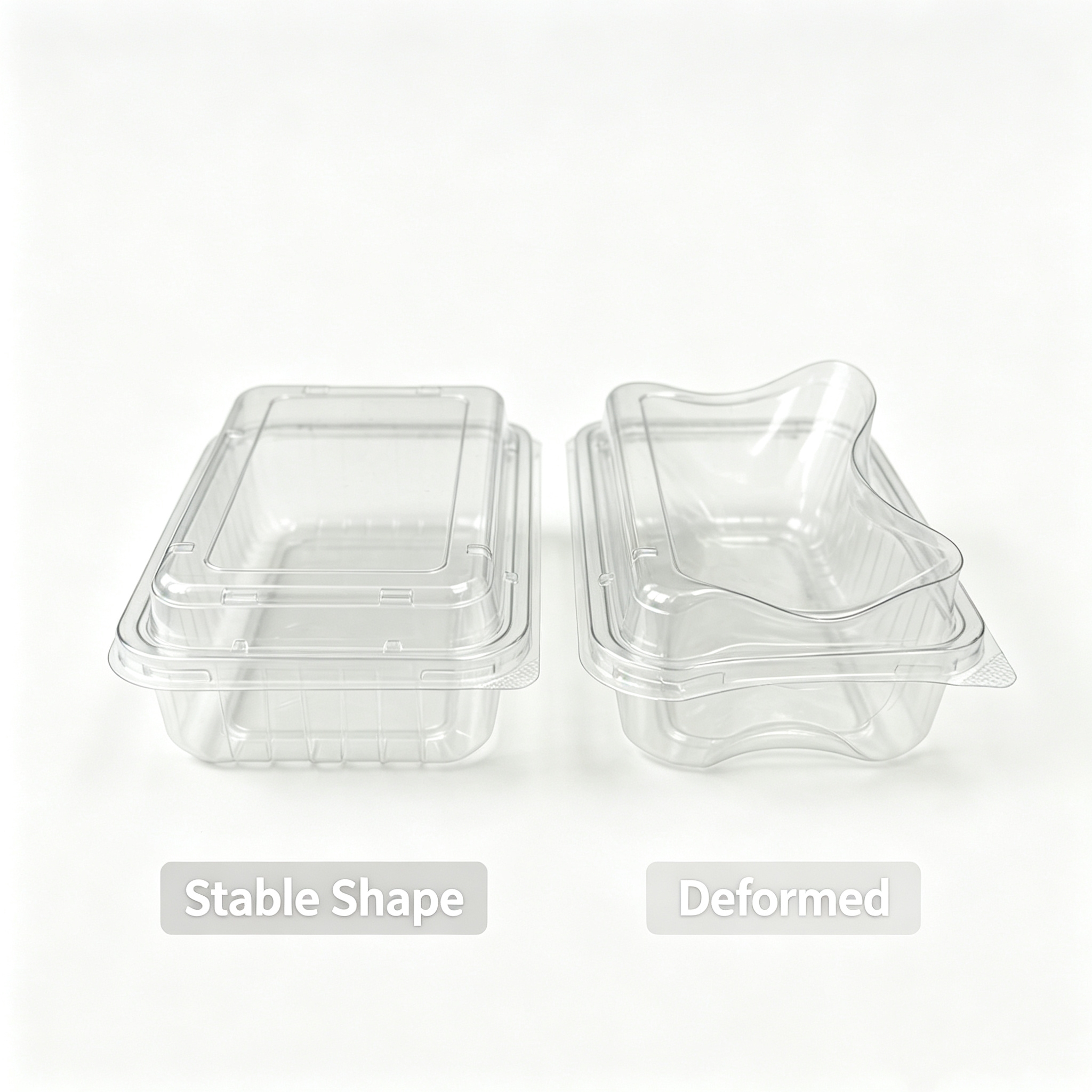
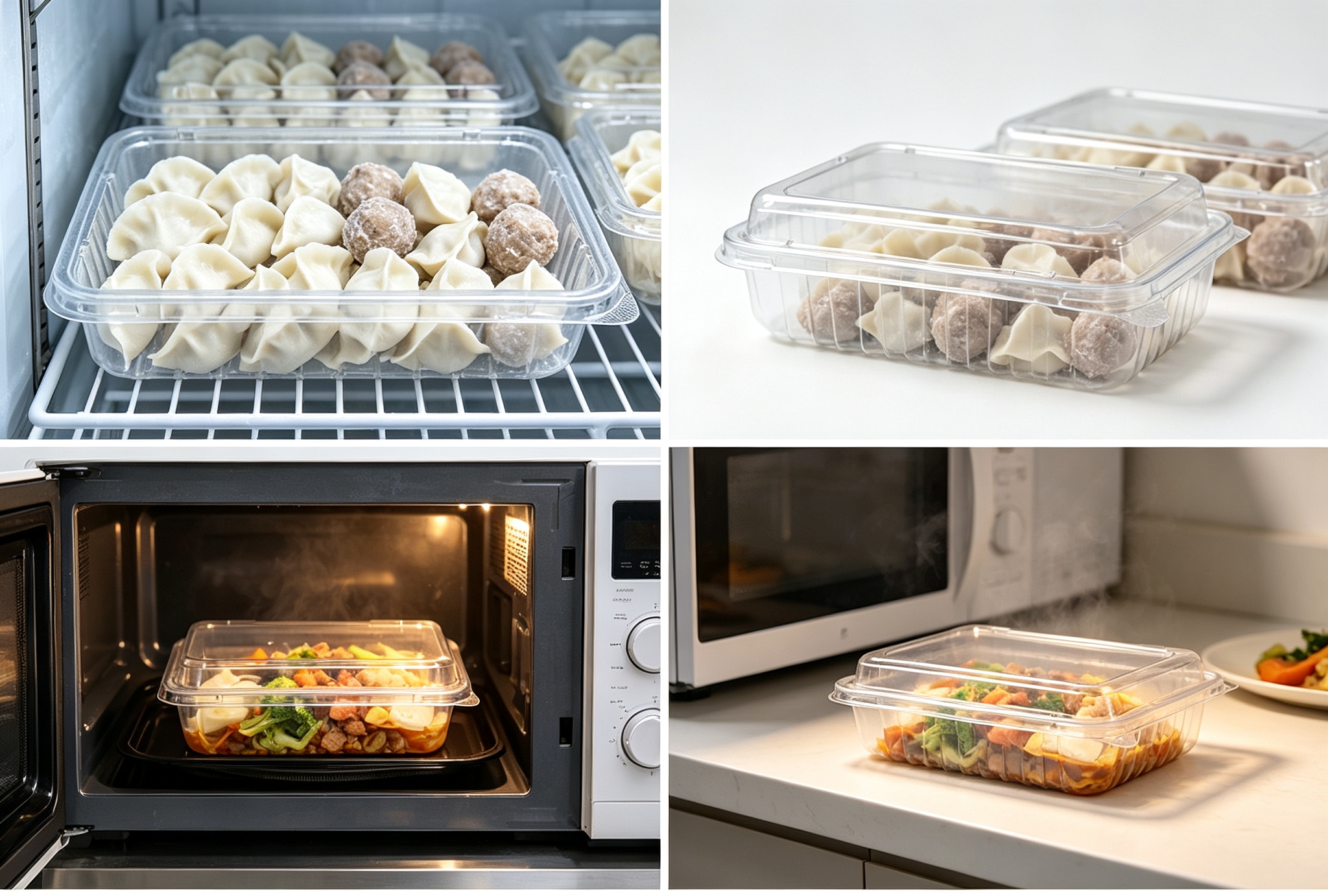
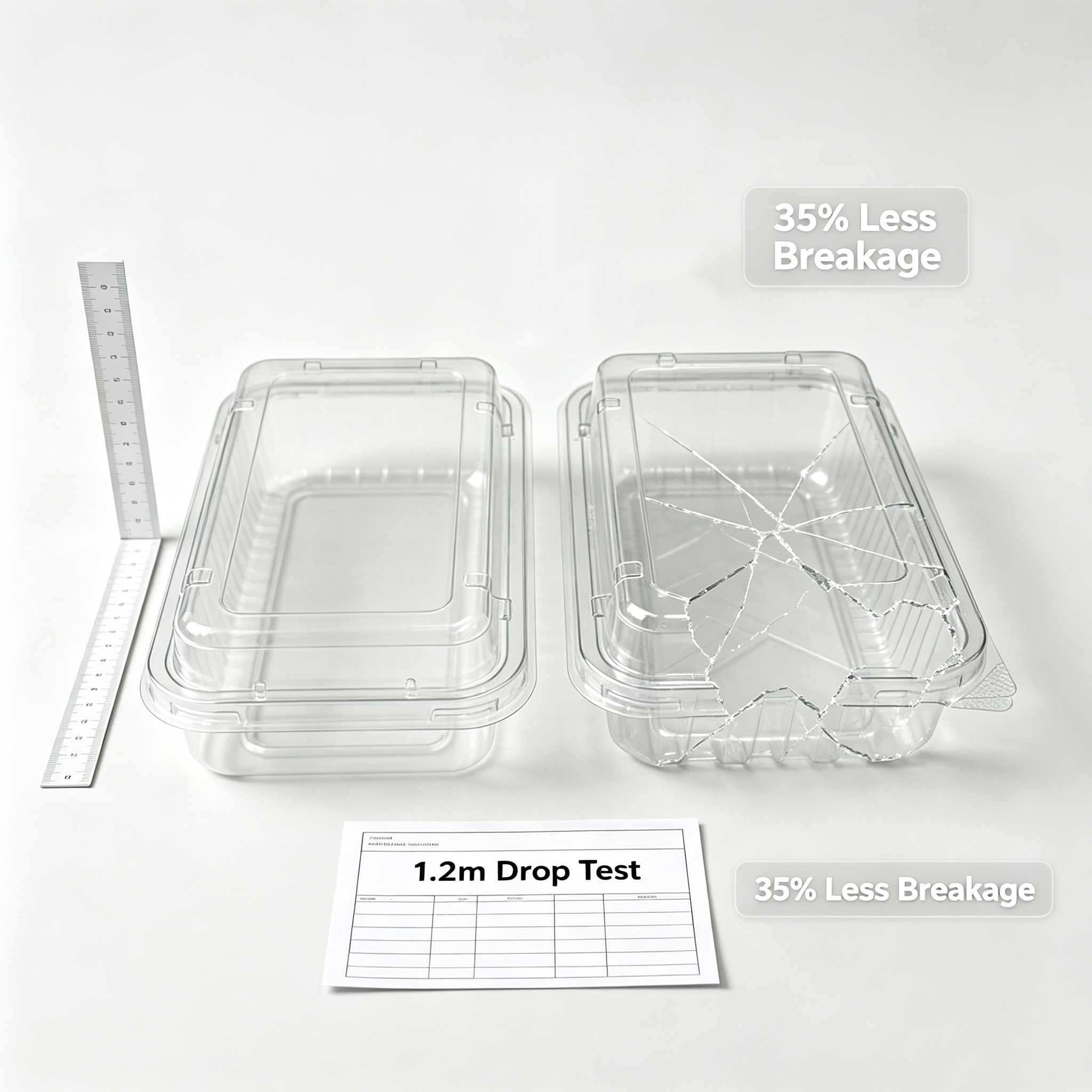
Ask for evidence on fogging, drop resistance, and stack load. CHUAN HE reports that its anti-fog treated packaging maintains clear appearance in a 0–8°C cold storage environment, that its reinforced blister structure withstands a 1.2 m vertical drop, and that its temperature-treated blister box performs from −18°C to 120°C with a heat deformation rate reduced by 38% and a low-temperature cracking rate reduced by 32%.
Step 6 — Lock customisation before tooling
Custom shape, colour, embossing, and logo printing are available on the tray family, and the container family supports custom size, colour, and logo printing with factory direct supply. Confirming artwork and embossing at sample stage avoids a second tooling cycle later.
Use Cases: Which Rank Wins in Which Retail Scenario
Chain supermarket display programs
Clear display trays such as the WSF-01 and HB-T9333 carry the display workload. Their transparency and shallow depth keep the pack readable from the aisle, and the stackable design protects the facing during shelf replenishment.
Berry and cherry tomato clamshell supply
Trial work with food factories, large chain supermarkets, packaging wholesalers, and packaging manufacturers in the United Arab Emirates and Saudi Arabia covered farm fresh fruit and vegetable packaging, cherry tomato and berry clamshell packaging, harvest sorting, and retail display using a clear PET clamshell container with vent holes for freshness, a stackable design, and food-grade material. That project has run for over three years at 250,000 pieces per month.
Agricultural exporter harvest sorting
Exporters need formats that stack in harvest crates and then transfer directly to retail display. The 3 cm HB-T9333 and the 6.8 cm HB-MG08 OZ cover the two ends of that workflow without a repack.
Bulk, club-store, and food-service packs
The HB-MG40 OZ footprint handles family and catering volumes where the container is filled once and merchandised as a single large unit.
Prepared salads and ready meals
Salad containers and tamper-evident formats extend the same material system into value-added lines. The anti-tamper structure is designed for one-time opening: after initial closure, any subsequent opening causes irreversible damage, which makes interference visible at the delivery point. Ready-to-eat meals, fresh produce, and sealed retail kits are the stated applications.
Comparison Table: The Seven Formats Side by Side
| Rank | Model | Format | Material | Dimensions (cm) | Classification breadth | Primary retail role |
|---|---|---|---|---|---|---|
| 1 | HB-T9333 | Tray | PET | 16.8 × 11.4 × 3 | 9 tray categories | Custom blister and clear display tray for supermarket chains |
| 2 | HB-SG1000ML | Container | PET | 23 × 17.5 × 9 | 5 container categories | Large-load produce and vegetable container |
| 3 | WSF-01 | Tray | PET | 23.3 × 18 × 5 | 9 tray categories | Wide shallow clear display tray |
| 4 | HB-PG02 | Container | PET | 22.5 × 12 × 10 | 5 container categories | Tall container for upright and leafy produce |
| 5 | HB-MG40 OZ | Tray | PET | 28 × 19.4 × 6.8 | 9 tray categories | Largest footprint for bulk and catering packs |
| 6 | HB-221360(PP) | Tray | PP | 22.2 × 13 × 6 | 9 tray categories | Heat-tolerant tray in the same footprint family |
| 7 | HB-MG08 OZ | Tray | PET | 14.2 × 12.5 × 6.8 | 9 tray categories | Single-serve and sampling tray |
Read the table as a portfolio map rather than a league of winners. Ranks 1, 3, 5, 6, and 7 share the same nine-category tray classification, which means they are variations of one tooling strategy; ranks 2 and 4 belong to the ventilated container family. A retailer that buys only rank 1 will still need a deep container for leafy produce — which is why the ranking is most useful when two or three formats are taken together.
Choosing a Long-Term Partner, Not Just a Format
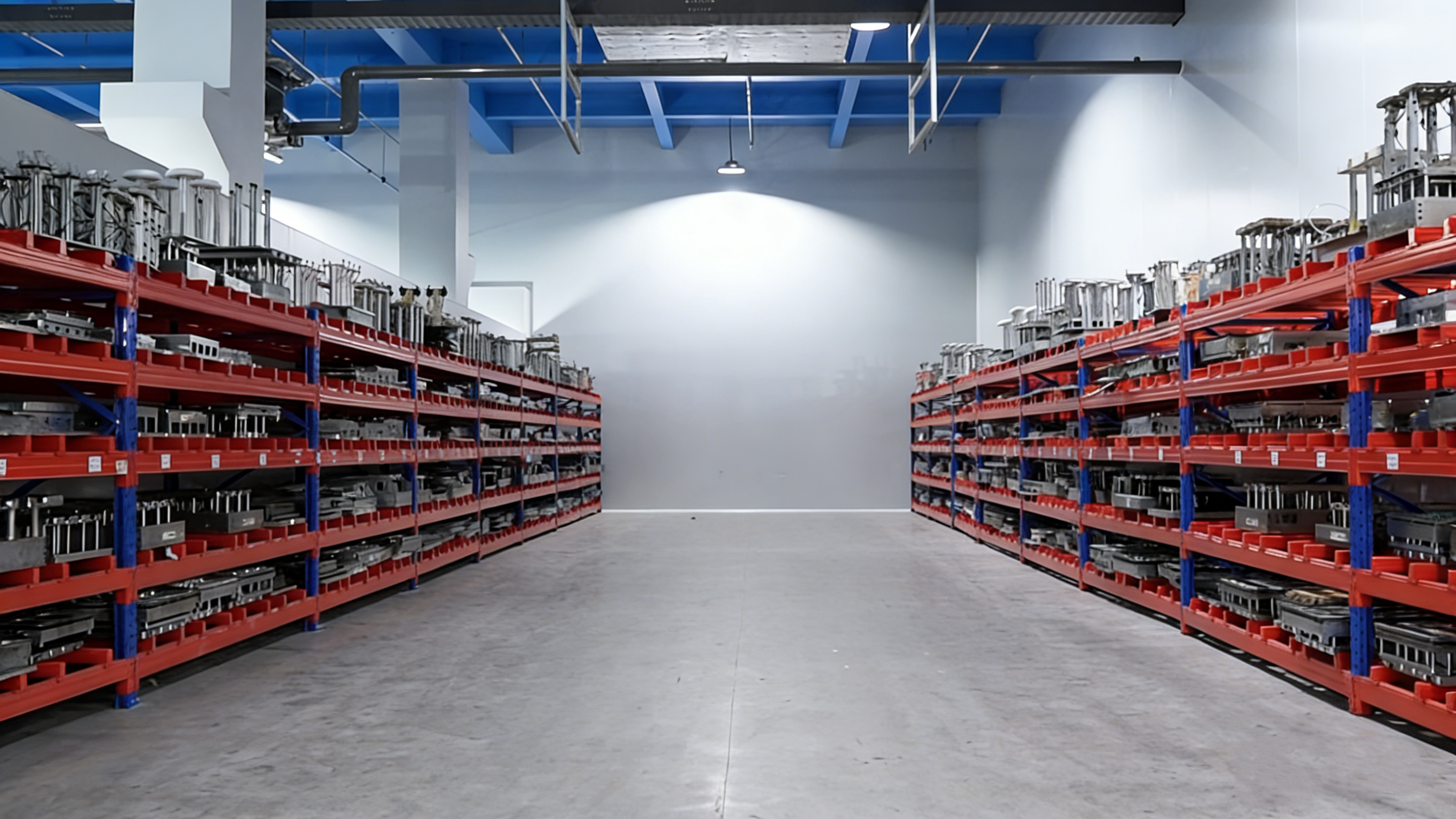
The formats above only stay available if the supplier behind them is stable. Weifang Chuanhe New Material Co., Ltd. manufactures the range under the CHUAN HE brand. The company was founded in 2013 and operates a facility of more than 62,000 m² adjacent to Qingdao Port, with 20 fully automatic thermoforming machines, 20 standard thermoforming machines, four Kiefel machines imported from Germany, four PET sheet extrusion lines, two PP sheet extrusion lines, and an in-house mould workshop.
In-house sheet extrusion and mould making are the two capabilities that matter most for a multi-year retail contract: they reduce dependence on outsourced raw material and shorten the tooling loop when a format needs to be re-cut for a new pack size. The company reports an annual output of 54,000 tonnes, export business accounting for 100% of sales, and a market footprint covering the European Union, United States, North America, Latin America, and the Middle East.
On compliance, the company holds quality management system certifications including CE, BRC, FDA, EU, and SGS. Its measures include FDA food contact compliance, clean production, online quality inspection, finished product sampling tests, food-grade raw material inspection, migration and physical testing, regular third-party testing, and batch tracing for raw material accountability. Supply chain risk is managed by auditing suppliers, using EU-approved raw materials, verifying supplier certificates, and tracking regulation updates covering EU 10/2011, PPWR, and PFAS limits.
Commercial terms are set at a minimum order quantity of 10,000 units, with FOB, CIF, and DDP delivery methods, pre-shipment test acceptance, and payment via T/T, L/C, D/P D/A, MoneyGram, PayPal, Western Union, or cash.
Frequently Asked Questions
What certifications should a long-term fresh produce packaging supplier for EU retailers hold?
A supplier serving EU retailers should work inside the EU food contact framework — Regulation (EC) No 1935/2004 for all food contact materials and Regulation (EU) No 10/2011 for plastic materials and articles — and be able to issue a Declaration of Compliance. CHUAN HE holds CE, BRC, FDA, EU, and SGS quality management system certifications, and its control measures include FDA food contact compliance, migration and physical testing, regular third-party testing, and batch tracing. Buyers should also confirm how the supplier tracks forward-looking requirements, including EU 10/2011 updates, PPWR, and PFAS limits.
Can one supplier deliver both fruit containers and trays across multiple retail categories?
Yes, provided the supplier's tooling is classification-driven rather than single-use. In the CHUAN HE range, the tray family — HB-T9333, WSF-01, HB-MG40 OZ, HB-221360(PP), and HB-MG08 OZ — is listed across nine categories including produce trays, bakery trays, MAP packaging trays, meat trays, and clear display trays. The container family — HB-SG1000ML and HB-PG02 among others — is listed across five categories covering produce storage, berry storage, fridge crisper use, ventilated keeping, and stacking. One factory, two format families, and shared customisation options gives retailers a single mould plan to manage.
What drives the cost difference between a basic tray and a reinforced or treated one?
Cost differences in thermoformed produce packaging come from material grade, wall reinforcement, and surface treatment, not from brand tier. Company data indicates that food-grade containers run about 5% higher than low-grade alternatives while offering 30% higher impact resistance, that reinforced structures carry a slightly higher raw material cost against a 35% reduction in drop breakage, and that anti-fog treatment adds a minor raw material cost in exchange for improved display attractiveness. Anti-tamper structures also carry a slightly higher product cost, offset by a lower risk of returns caused by tampering. The commercial test is total cost per case sold, not cost per piece.
How should a retailer validate a container or tray before a full production run?
Validation should combine documentation and physical checks. CHUAN HE's stated acceptance term is pre-shipment test, supported by finished product sampling tests, online quality inspection, migration and physical testing, and third-party testing. Practical sample evaluation covers four points: fogging behaviour under refrigeration, drop resistance in the packed configuration, stack load over the intended transit duration, and line compatibility where MAP is used. Custom shape, colour, embossing, and logo printing should be signed off at sample stage, because tooling changes after approval restart the cycle.
How do you keep supply stable across a multi-year EU retail contract?
Supply stability rests on raw material control, tooling control, and traceability. CHUAN HE mitigates supply chain risk by auditing suppliers, using only EU-approved raw materials, verifying supplier certificates, and maintaining batch tracing for raw material accountability. Because the company runs four PET sheet extrusion lines, two PP sheet extrusion lines, and an in-house mould workshop, sheet supply and tooling are not fully outsourced. A long-running reference in the United Arab Emirates and Saudi Arabia — food factories, large chain supermarkets, packaging wholesalers, and packaging manufacturers, with cooperation lasting over three years at a monthly order of 250,000 pieces — illustrates the volume continuity these terms are designed to support. Retailers planning the next contract cycle can request the current product catalogue, a formal quotation, or a sample set through chuanhe@newplasticbox.com or WhatsApp at +86 134-5566-2777.
Conclusion: Rank the Portfolio, Not the Pack
The seven formats above are not competing for one slot. The HB-T9333 wins the versatility argument because nine tray classifications and a 16.8 × 11.4 × 3 cm profile let one mould serve several departments. The HB-SG1000ML answers the large-load question at 23 × 17.5 × 9 cm. Between them, the WSF-01, HB-PG02, HB-MG40 OZ, HB-221360(PP), and HB-MG08 OZ cover wide display, tall upright produce, bulk volume, heat tolerance, and single-serve formats.
For fresh produce retailers moving from decision to execution, the practical step is to select two or three of these formats, validate them against your own fixture and cold chain, and then lock the tooling, compliance documentation, and commercial terms with the supplier. That is how a fruit & vegetable packaging range stops being a list of SKUs and becomes a supply program that survives the next PPWR cycle.
Next Step: Sample, Quote, or Catalogue
CHUAN HE supplies PET and PP thermoformed fruit and vegetable packaging from a 62,000 m² facility in Weifang, China, with pre-shipment test acceptance and a minimum order quantity of 10,000 units.
Email: chuanhe@newplasticbox.com | Tel / WhatsApp: +86 134-5566-2777 | Website: www.newplasticbox.com
Download the full product catalogue: 2026 CHUAN HE Packaging Catalogue (PDF)
Have Questions or Need More Details?
Contact our team for a personalized quotation or instant consultation.
Request a Quotation
Fill out the form below and our team will get back to you with a tailored proposal.
WhatsApp Direct Chat
Prefer to chat in real-time? Message us on WhatsApp for instant assistance & quick answers.
- Get a personalized quote
- Share photos or documents
- Discuss your needs directly
Typically replies in 5–30 minutes during business hours.