Fiberglass Fabric Compliance Essentials: Meeting Global Standards for Marine and Aerospace
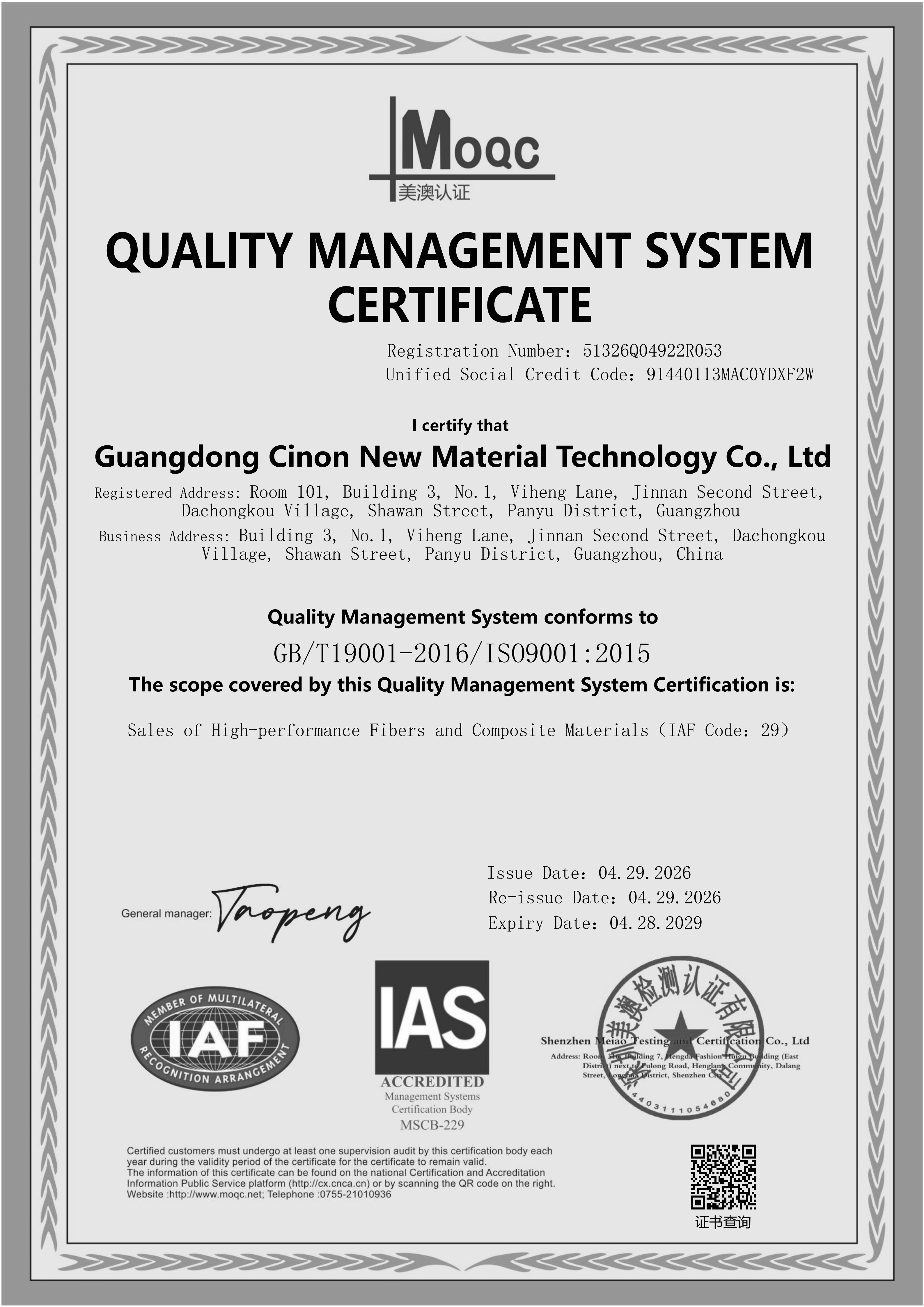
CINON Composites holds ISO 9001:2015 quality management certification (certificate 51326Q04922R053, issued by Shenzhen Moqc Certification Co., Ltd., valid to 28 April 2029) for the sales of high-performance fibers and composite materials.
Fiberglass fabric compliance in marine and aerospace is not a certificate you collect at the end of a project. It is a documented match between the service environment a laminate will face - saltwater, permanent humidity, UV radiation, high altitude, thermal cycling and sustained G-loading - and the properties a supplier can prove through specifications, test records and traceable documentation. Programmes that treat compliance as an administrative step usually discover the gap during the first infusion or the first customer audit, not before it.
This guide is written for procurement engineers, composite engineers and OEM buyers who have already established that a fiberglass reinforcement programme is required and are now evaluating suppliers or executing an order. It explains how compliance is layered, where buyer checks typically fail, which material parameters map to which operating conditions, and how to build a verification workflow that survives an internal audit or a customer review.
Compliance Has Three Layers - and Only One Is About Paperwork
A fiberglass reinforcement is only compliant when three separate layers are satisfied at the same time. Missing any one of them leaves a programme exposed, no matter how complete the file looks.
- Material layer. The fabric itself: glass type, areal weight, weave or multiaxial architecture, roll width, moisture content and combustible matter.
- Process layer. How the material behaves in the selected manufacturing route - hand lay-up, vacuum infusion, RTM, VARTM or prepreg - including whether the core can survive the resin cure temperature.
- Documentation layer. The evidence that ties the first two layers to a specific shipment: certificate scope, test reports, batch traceability and pre-shipment acceptance records.
A quality management certificate describes how a supplier's operations are controlled. It does not, by itself, approve a fabric for a specific marine or aerospace structure. Part-level approval depends on material data plus process validation for the actual component, which is why scope wording and test documentation carry as much weight as the certificate itself.
Where Compliance Programmes Actually Break Down
The same six failure points appear repeatedly in marine and aerospace sourcing reviews.
- Buying on areal weight and price alone. E-glass held 68.4% of global fiberglass fabric product revenue in 2025 (Fortune Business Insights), so availability is high and suppliers look interchangeable on a data sheet. Differentiation sits in documentation and process support, not in the headline weight.
- Reading a certificate without reading its scope. Scope wording defines what a certificate actually covers. A certificate issued for the sale of high-performance fibers and composite materials is not the same document as an approval of a finished laminate.
- Leaving moisture and combustible content out of the specification. CINON non-crimp multiaxial reinforcement is documented with moisture content below 0.2% and combustible matter between 2.0% and 8.0%. Both parameters affect infusion consistency and matter to programmes that screen combustible content.
- Ignoring the core process temperature limit. CINON core mat materials are documented with maximum process temperatures of 170 C to 180 C. If the resin cure cycle sits above that ceiling, the core is the wrong starting point regardless of how good the fabric is.
- Defining acceptance criteria after the goods ship. Acceptance criteria belong in the purchase order, and a pre-shipment test supported by a Quality Test Report is a workable baseline.
- Losing the link between the qualification batch and the production batch. A material that passed a trial is only compliant if the shipped batch can be traced back to the same specification.
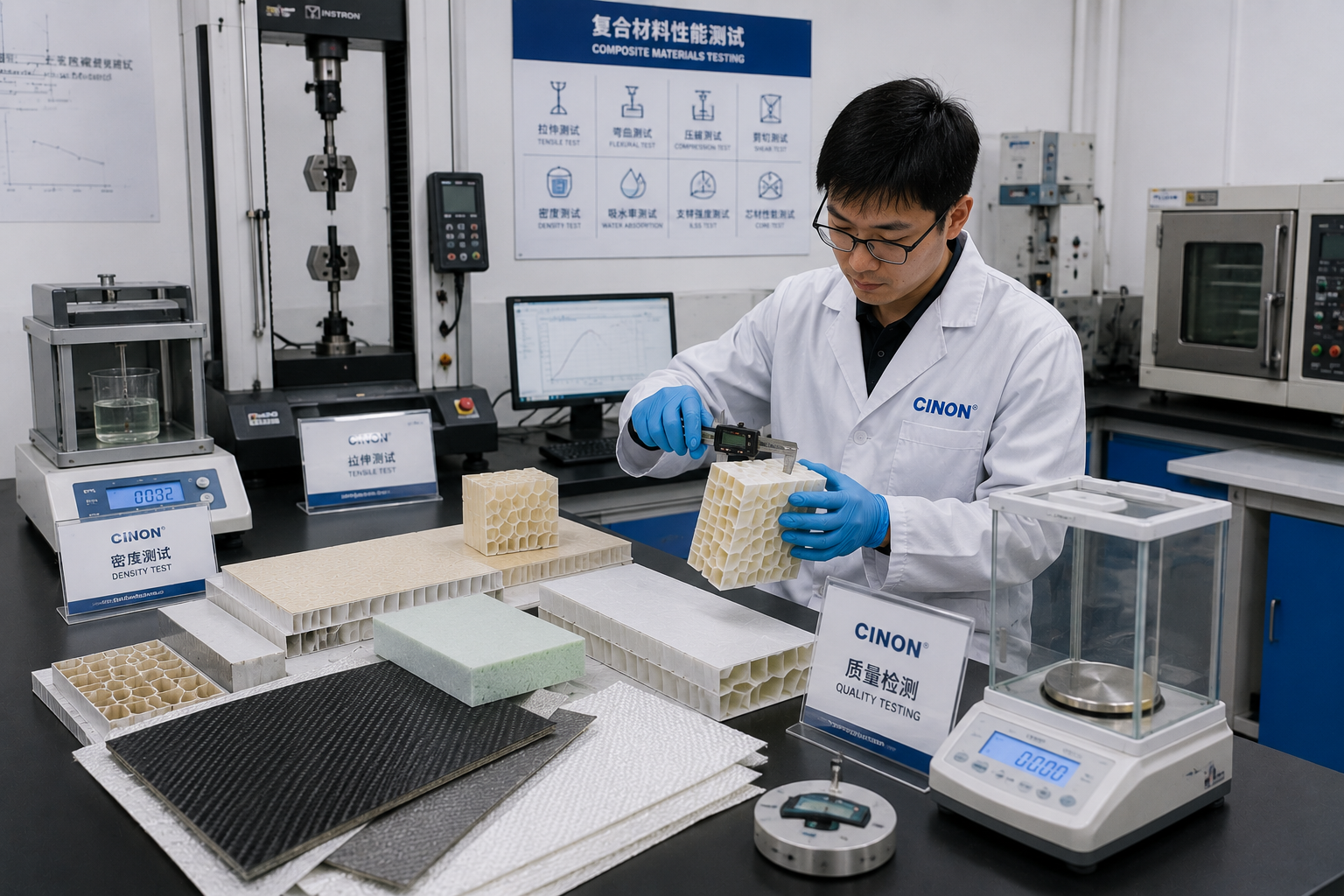
Quality inspection and performance verification: CINON quality control includes 100% testing of products, with pre-shipment test and Quality Test Report available as acceptance criteria.
The Demand Context Behind Stricter Marine and Aerospace Sourcing
Compliance requirements tighten as volumes rise, and the volume trend runs upward. Fortune Business Insights valued the global fiberglass fabric market at USD 5.15 billion in 2025 and projected USD 9.72 billion by 2034 at a 7.4% CAGR. Mordor Intelligence, working to a different scope and forecast horizon, put the 2025 market at USD 11.81 billion, growing to USD 16.88 billion by 2031 at 6.13%. The two estimates diverge by more than 100% on the same base year, which is a useful reminder for buyers: cite the specific research source instead of blending figures into a synthetic range.
Two structural facts sit behind that growth. Asia Pacific accounted for 45.05% of the fiberglass fabric market in 2025, and wind energy is the fastest-growing application segment at 7.02% CAGR through 2031 (Mordor Intelligence). Both push buyers toward supply bases with documented processes rather than spot-market sourcing.
At product level, commercial research describes fiberglass fabric as a technical reinforcement material made from glass fibre yarns in woven, stitched or other fabric constructions, used across composite structures, electrical laminates, construction reinforcement systems and engineered transport applications. Its stated advantage is a balance of strength, dimensional stability, resin compatibility and process flexibility - the same four attributes that marine and aerospace specifications test hardest.
Matching Fabric and Core Properties to Marine and Aerospace Operating Conditions
Compliance starts with the operating envelope. Each condition translates into a specific material question and a specific piece of evidence to request.
Saltwater, permanent humidity and moisture uptake
Marine structures live in continuous moisture. The relevant checks are the moisture content of the fabric at delivery, the behaviour of the core, and the void content the process can hold. CINON non-crimp multiaxial fabric is documented at below 0.2% moisture content, and the PVC foam core range - 45 to 300 kg/m3 in thicknesses from 1 to 80 mm with plain, grooved, perforated or scrim-backed surfaces - is listed for marine and yacht building, wind energy, rail vehicles, RV and caravan manufacturing, industrial composites and construction panels. For hull and deck laminates, material selection is where an Australian marine and yacht builder achieved a smooth surface, easy wet-out and a better finish on container-scale orders of boat-building materials.
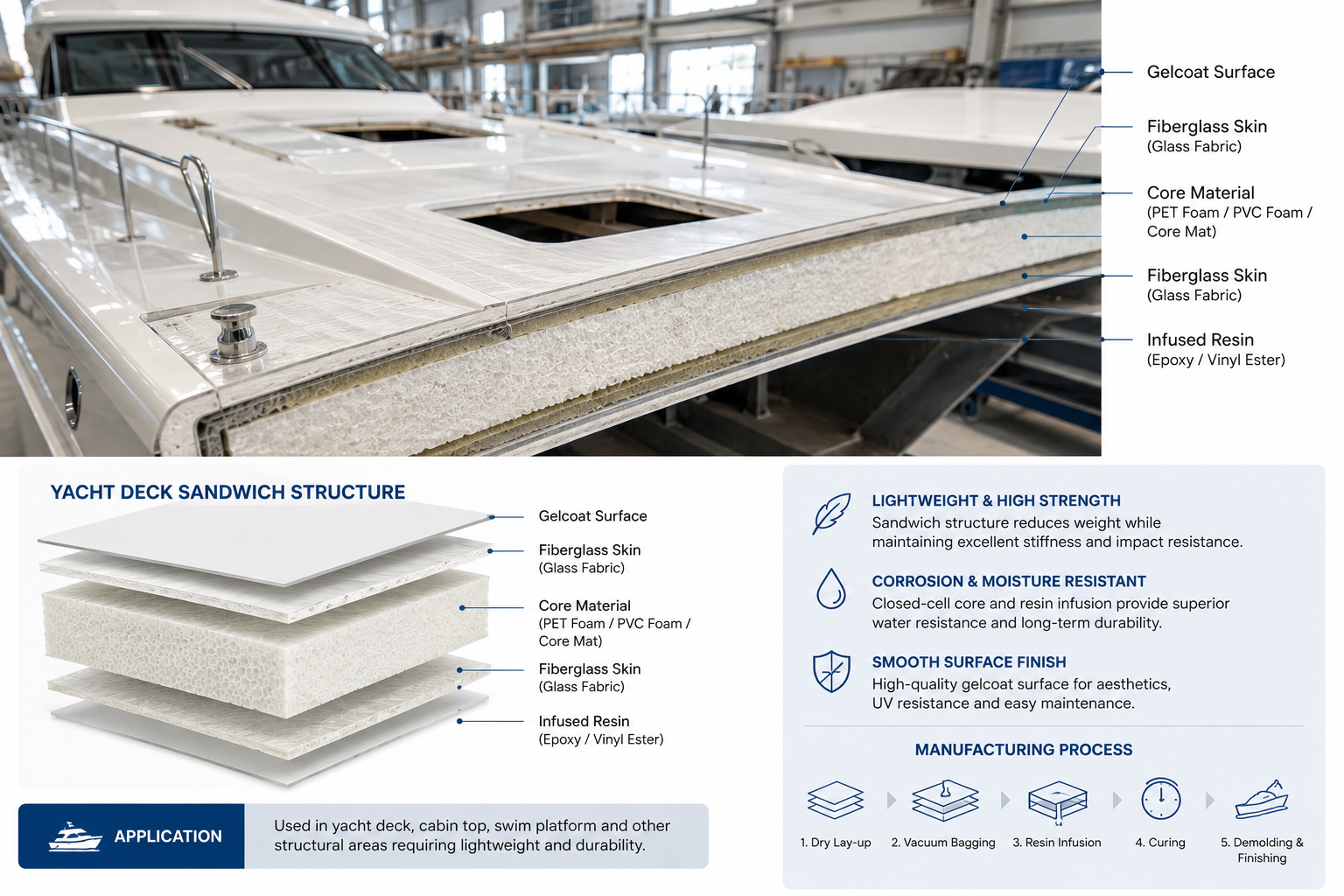
Core materials in a vacuum infused yacht hull and deck sandwich structure - the marine application where moisture control, wet-out and surface finish decide acceptance.
UV exposure and surface quality
Deck hardware, superstructures and outdoor panels face UV and thermal load at the same time, and surface defects become warranty claims rather than specification notes. A US RV manufacturer running FRP panel production with fiberglass fabric across 5 pallets recorded low weight, anti-UV performance, a glossy surface after treatment and uniformity of thickness - the same properties that decide whether a marine panel can be left exposed.
High altitude, temperature cycling and G-loading
Aerospace and UAV structures add altitude, low temperature, rapid cycling and sustained G-loading to the requirement set, and here the core material usually decides feasibility. PMI foam core, supplied from 40 to 130 kg/m3 and listed for aerospace, UAV and drone manufacturing, motorsport, high-performance marine, defence and sports equipment, is the lightest structural option in the CINON range. In a German UAV programme, 10 pallets of PMI foam core addressed the requirement for ultra-lightweight structures with high stiffness, with fatigue resistance, low density and high temperature resistance as the recorded outcomes.
Where stiffness-to-weight must hold across a wider temperature band, aramid (Nomex) honeycomb is documented with cell sizes of 1.83, 2.75, 3.67 and 5.5 mm, densities from 32 to 128 kg/m3, mechanical properties of 0.43 to 5.52 MPa and a working temperature range of -60 C to 180 C, stored under normal temperature and dry conditions. Its published application list includes aircraft interiors, helicopter panels, UAV structures, radar structures and marine racing yachts.
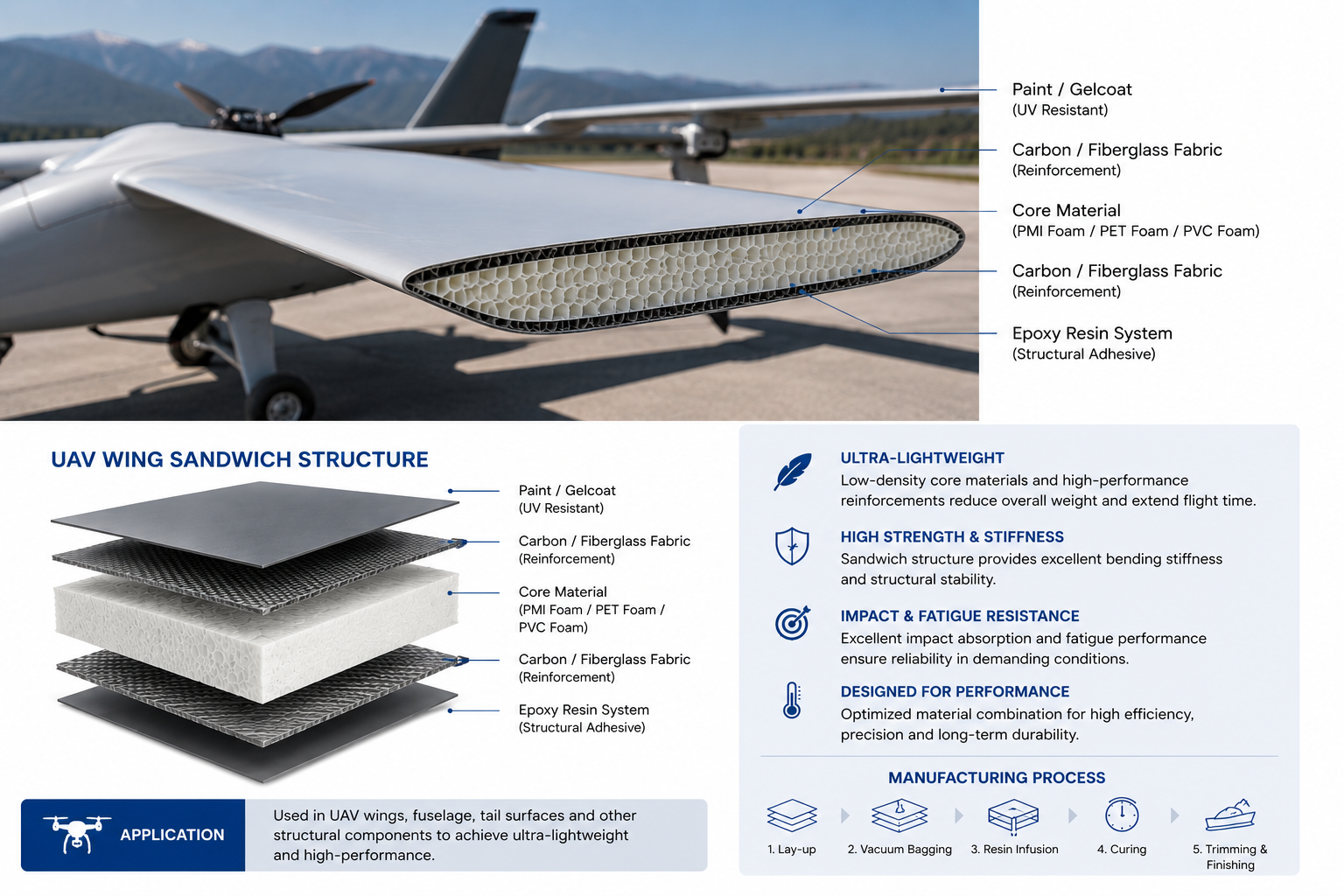
PMI foam core and lightweight fiberglass fabrics in UAV wing and fuselage structures - the weight-critical end of the compliance requirement set.
Fatigue, vibration and abrasion
E-glass fibres are described in commercial research as resistant to vibration and abrasion, and multiaxial non-crimp reinforcement is the structure that carries those properties through a load path: unidirectional in 0 or 90 degrees, biaxial in 0/90 or plus/minus 45 degrees, triaxial in plus/minus 45/0/minus 45 degrees and quadriaxial across four directions. CINON supplies this range from 400 to 1,500 gsm in alkali-free glass fibre, specified for vacuum, hand lay-up, RTM and comparable moulding routes, with ship hulls, wind turbine blades, automotive components, sports equipment and large containers as published applications.
Weight and stiffness balance
The recurring trade-off in both sectors is stiffness per unit of weight. The practical rule is that reinforcement architecture sets the load path while core density sets the weight penalty: PET foam core spans 80 to 320 kg/m3, PVC foam core 45 to 300 kg/m3, PP honeycomb sheet 70 to 80 kg/m3, and PMI foam core 40 to 130 kg/m3. Selecting the lightest core that still passes the load case is a specification decision, not a purchasing preference.
How CINON Composites Structures Its Own Compliance Evidence
CINON Composites - the trading name of Guangdong Cinon New Material Technology Co., Ltd. - is a manufacturer of fiberglass reinforcements and lightweight core materials based in Panyu District, Guangzhou, China. Founded in 2022, the company operates a 40,000 m2 facility, states an annual output of 1,200,000 m2 and exports to Europe, North America and Asia-Pacific markets.
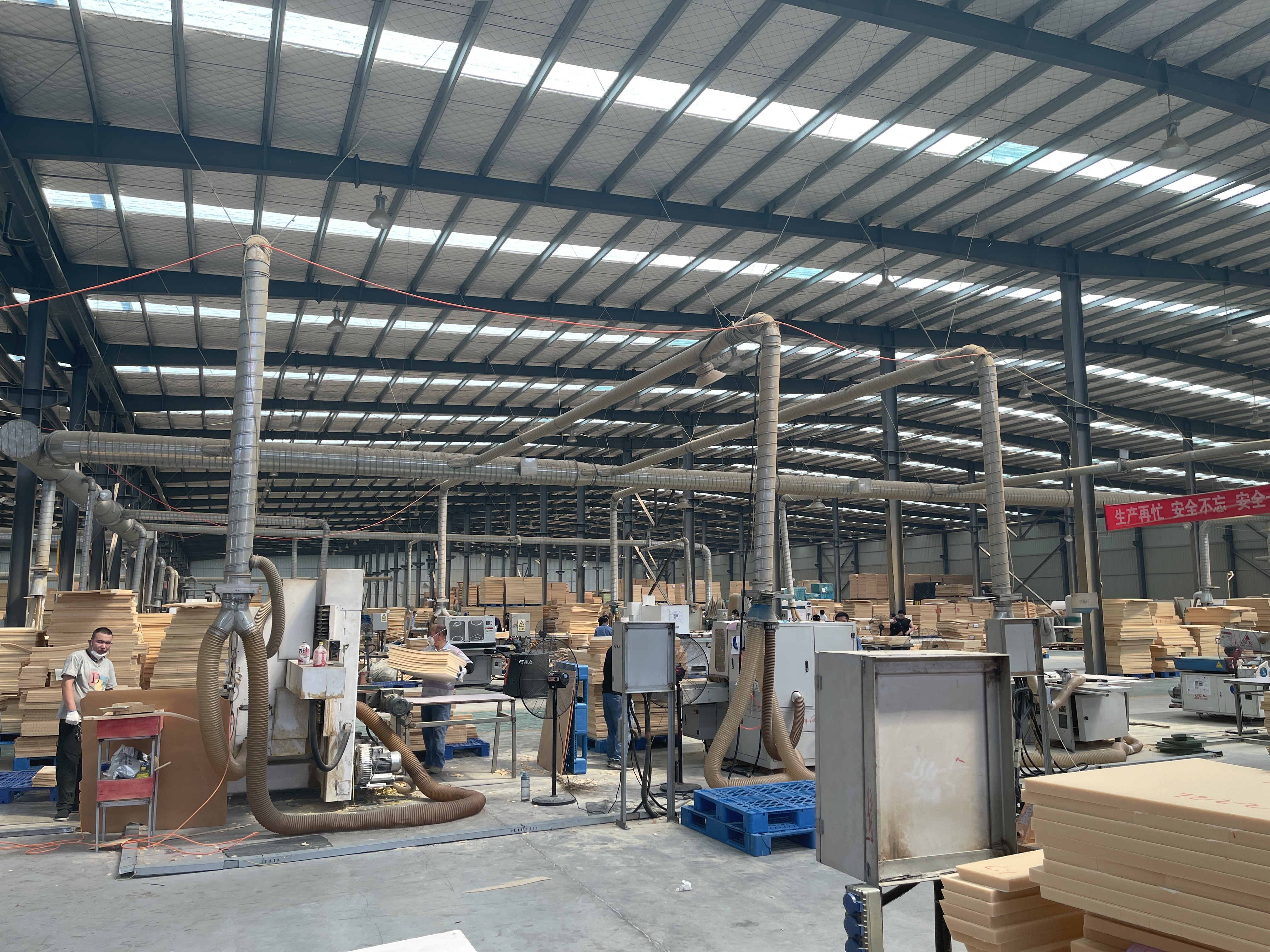
Core material manufacturing at CINON Composites: closed-cell PVC foam core for sandwich panel construction, yacht hulls, wind turbine blades and industrial composite applications.
The reinforcement range covers E-glass fabric (model EW) in plain weave from 25 to 400 g/m2 in 1,000 mm and 1,010 mm widths, plus non-crimp multiaxial fiberglass fabric from 400 to 1,500 gsm with moisture content below 0.2% and combustible matter of 2.0% to 8.0%. The core and sandwich range covers PVC foam core, recyclable PET foam core, PMI foam core, Nomex honeycomb, PP honeycomb sheet and the CM, CT, CS and CX core material series, with maximum process temperatures of 170 C to 180 C for the core mats.
On the documentation side, the company holds ISO 9001:2015 quality management certification (certificate 51326Q04922R053, issued by Shenzhen Moqc Certification Co., Ltd., valid from 29 April 2026 to 28 April 2029, scope: sales of high-performance fibers and composite materials), ISO 45001:2018 occupational health and safety certification (certificate 51326S01896R053, same authority and validity period) and ISO 14001:2015 environmental management certification (certificate ISO14001-2023-001 issued by SGS, valid from 1 June 2023 to 1 June 2028, scope: composite intermediates sales). Quality control includes 100% testing of products.
Commercially, the company runs ODM production for both fiberglass fabric and core materials, with a minimum order quantity of 1,000 m2, a monthly capacity of 100,000 m2, a typical lead time of 15 to 30 days, delivery on FOB, CIF or EXW terms, and payment terms of 30% deposit in advance with the 70% balance by TT before shipment.
A Step-by-Step Compliance Workflow From Evaluation to Execution
- Write the operating envelope. Record saltwater exposure, humidity, UV, service temperature range, altitude, load case and expected fatigue cycles. Every later decision refers back to this document.
- Fix the manufacturing process. Hand lay-up, vacuum infusion, RTM, VARTM and prepreg accept different fabric architectures and impose different requirements on core surfaces.
- Check the process temperature against the core. CINON core mats are documented up to 170 C to 180 C, and aramid honeycomb is rated from -60 C to 180 C. If the cure cycle exceeds those limits, re-select before sampling.
- Match fibre orientation to the load path. Use unidirectional layup for dominant 0 or 90 degree loads, biaxial plus/minus 45 degrees for shear and torsion, and triaxial or quadriaxial laying where loads are multi-directional.
- Specify moisture and combustible content. State the limits in the specification rather than assuming them; the CINON multiaxial range is documented below 0.2% moisture and at 2.0% to 8.0% combustible matter.
- Request the documentation package. Confirm certificate scope, request the quality data, and define what a shipment must prove.
- Run a sample and an infusion trial. Sample evaluation plus vacuum infusion guidance converts supplier data into a process you have actually validated.
- Set acceptance criteria in the purchase order. Pre-shipment test with a Quality Test Report is the baseline; add any part-specific test the programme requires.
- Lock commercial terms and reorder traceability. MOQ, delivery term, payment schedule and lead time should be fixed alongside the technical specification so that repeat orders reproduce the qualified material.
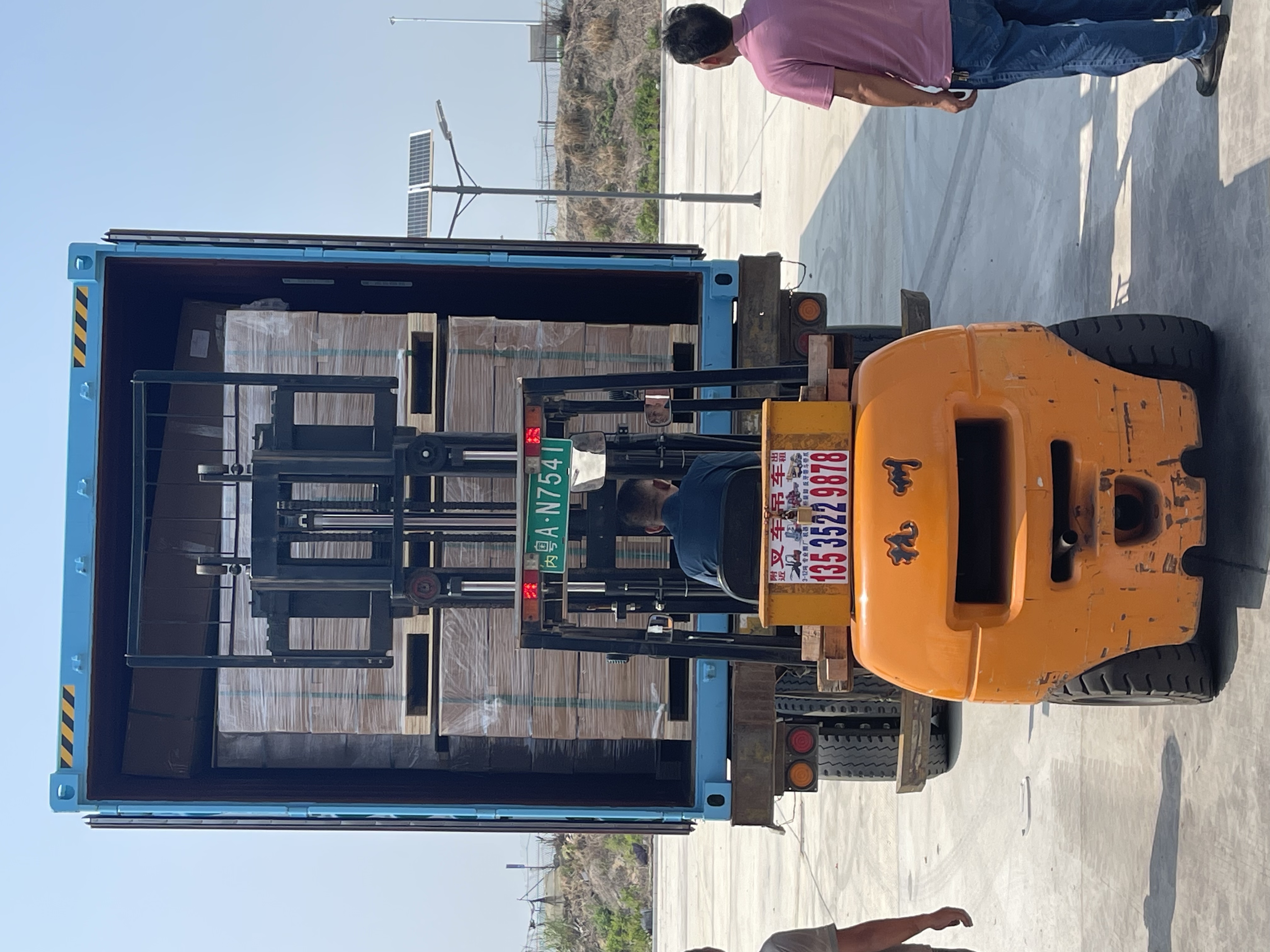
Export and logistics coordination: documented packing and shipping records close the loop between a qualified batch and the material that arrives on site.
Comparison: Which Material Family Fits Which Requirement
The table below compares CINON material families against their documented parameters and their published application lists. It is a shortlisting aid, not a substitute for part-level qualification.
| Material family | Documented parameters | Marine fit (published applications) | Aerospace / UAV fit (published applications) | Compliance question to resolve |
|---|---|---|---|---|
| Fiberglass fabric, E-Glass, plain weave (EW) | 25-400 g/m2; width 1,000 mm / 1,010 mm; E-glass fibre | Listed: marine and yacht building, surfboard manufacturing | Listed: UAV and drone manufacturing | Are weave and areal weight controlled batch to batch? |
| Structural composite reinforcement (non-crimp multiaxial fabric) | 400-1,500 gsm; unidirectional, biaxial, triaxial, quadriaxial; moisture below 0.2%; combustible matter 2.0-8.0%; alkali-free glass | Listed: marine and yacht building, wind energy, infrastructure | Listed: transportation, defence applications | Does fibre orientation match the load path? |
| PMI foam core | 40-130 kg/m3 | Listed: high-performance marine | Listed: aerospace, UAV and drone manufacturing, motorsport, defence | Does the core pass the fatigue and temperature requirement? |
| Nomex honeycomb (aramid honeycomb core) | Cell 1.83-5.5 mm; 32-128 kg/m3; 0.43-5.52 MPa; -60 C to 180 C; 2440 x 1220 mm | Listed: marine racing yachts | Listed: aircraft interiors, helicopter panels, UAV structures, radar structures, defence | Are cell size and density matched to panel stiffness? |
| PVC foam core | 45-300 kg/m3; 1-80 mm; plain, grooved, perforated or scrim-backed; vacuum infusion, RTM, hand lay-up, prepreg, VARTM | Listed: marine and yacht building, wind energy, RV and caravan | Not listed in the published application set | Is the surface option compatible with resin flow? |
| PET foam core (recyclable) | 80-320 kg/m3 | Listed: marine and yacht building, renewable energy | Not listed in the published application set | Is recyclability a programme requirement? |
| PP honeycomb sheet | 5-100 mm; cells 6 / 8 / 10 / 12 mm; 70-80 kg/m3; 1220 x 2440 mm; cutting, CNC machining, lamination, thermoforming | Listed: marine and yacht | Not listed in the published application set | Does the process include thermoforming or CNC machining? |
| Core material series (CM core mat, CT, CS, CX) | Thickness 1.5-6 mm; width 1.27 m; dry weight 90-360 g/m2; max process temperature 170-180 C | Listed: marine and yacht building | Listed: CX core material for aerospace and UAV | Does the maximum process temperature cover the cure cycle? |
Field Evidence: Marine, UAV and Adjacent Programmes
Recorded customer projects show how compliance decisions play out in practice.
- Germany - UAV manufacturing. A UAV manufacturer used PMI foam core across 10 pallets to address ultra-lightweight structures with high stiffness, recording fatigue resistance, low density and high temperature resistance.
- Australia - marine and yacht building. A marine and yacht builder ordered boat-building materials and tools on a container scale and reported smooth surface, easy wet-out and better finish, supported by material selection advice.
- United States - FRP panels. An RV manufacturer used fiberglass fabric across 5 pallets, achieving low weight, anti-UV performance, glossy surface treatment and uniform thickness.
- Mexico - transportation panels. A transportation panel manufacturer achieved lightweighting and improved corrosion resistance, with good adhesion to the core material.
- Thailand - surfboard manufacturing. A sports equipment manufacturer recorded weight reduction and performance improvement, with high buoyancy and impact resistance.
- Poland - distribution. A composite material distributor runs container-order volumes with OEM logo customization and repeat orders every month.
FAQ: Compliance, Capability, Budget, Samples and Lead Time
What compliance documents can CINON Composites provide for a marine or aerospace fiberglass fabric order?
Guangdong Cinon New Material Technology Co., Ltd. (CINON Composites) holds ISO 9001:2015 quality management certification (certificate 51326Q04922R053, Shenzhen Moqc Certification Co., Ltd., valid 29 April 2026 to 28 April 2029, scope: sales of high-performance fibers and composite materials), ISO 14001:2015 environmental management certification (certificate ISO14001-2023-001 issued by SGS, valid 1 June 2023 to 1 June 2028, scope: composite intermediates sales) and ISO 45001:2018 occupational health and safety certification (certificate 51326S01896R053, Shenzhen Moqc Certification Co., Ltd., valid 29 April 2026 to 28 April 2029). For a specific order, confirm the certificate scope, request the quality test report and define pre-shipment acceptance criteria in the purchase order. These certificates confirm how the supplier operations are managed; they do not replace part-level qualification for a marine or aerospace structure.
Can CINON customize fiberglass fabric and core material for high-altitude or high-G-load structures?
CINON offers ODM production for fiberglass fabric and core materials. Multiaxial reinforcement is available in unidirectional 0 or 90 degree, biaxial 0/90 or plus/minus 45 degree, triaxial plus/minus 45/0/minus 45 degree and quadriaxial four-direction constructions at 400 to 1,500 gsm, which allows fibre orientation to be aligned with the load path of a component. For weight-critical structures, PMI foam core is supplied from 40 to 130 kg/m3 and Nomex honeycomb from 32 to 128 kg/m3 with cell sizes of 1.83, 2.75, 3.67 and 5.5 mm and a working temperature range of -60 C to 180 C.
What are the minimum order quantity, delivery terms and payment terms?
The minimum order quantity for CINON fiberglass fabric is 1,000 m2. Delivery terms are offered on FOB, CIF and EXW bases. Payment terms are 30% deposit in advance with the 70% balance by TT before shipment. Monthly production capacity is 100,000 m2, which sets the practical limit on how quickly consecutive shipments can be scheduled.
How can a buyer validate fiberglass fabric before committing to a production order?
CINON supports sample evaluation and provides technical documentation, material selection support and vacuum infusion process guidance from prototype development through to mass production, delivered by email, WhatsApp and online meetings. Quality control includes 100% testing of products, and shipment acceptance can be defined as a pre-shipment test with a Quality Test Report. Running an infusion trial with the intended core and resin system is the step that turns supplier data into a process the buyer has qualified.
What is the typical lead time, and how is continuity handled for repeat programmes?
Typical production lead time is 15 to 30 days, against a monthly capacity of 100,000 m2. Guangdong Cinon New Material Technology Co., Ltd. operates a 40,000 m2 facility in Panyu District, Guangzhou, with a stated annual output of 1,200,000 m2 and exports to Europe, North America and Asia-Pacific markets; a composite material distributor in Poland reorders monthly on a container basis with OEM logo customization. Buyers who want to review the full reinforcement and core range can download the CINON Composites catalogue before starting a specification review.
Conclusion: Compliance Is a Chain, Not a Certificate
For marine and aerospace programmes, fiberglass fabric compliance is decided by the strength of the chain that links operating conditions to material data, material data to process validation, and process validation to shipment documentation. Saltwater, humidity, UV, altitude, temperature cycling and G-loading each map to specific, checkable parameters - moisture content below 0.2%, combustible matter of 2.0% to 8.0%, core densities from 40 kg/m3 upward, process temperatures of 170 C to 180 C - and those parameters only become compliance when they appear in a specification, a test report and a purchase order.
Buyers in the evaluation and execution stages get the most value from a supplier who can answer three questions in writing: which material matches my operating envelope, what evidence proves it, and how will the next shipment be identical to the qualified one.
Next Step: Send Your Operating Envelope
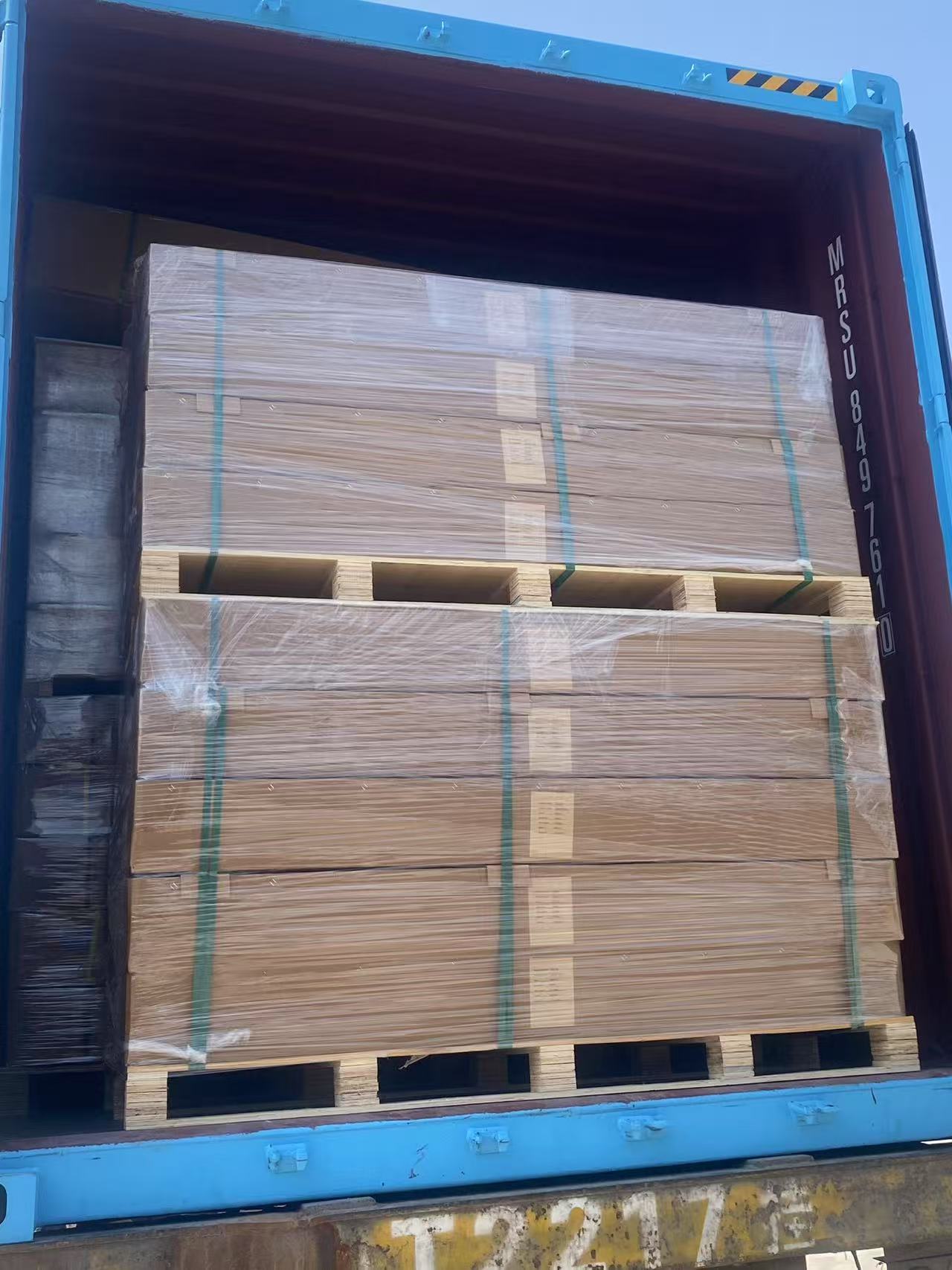
Share your service conditions, process route and part requirements with CINON Composites for a material recommendation, sample and quotation.
Email: waylon@cinoncomposites.com
Tel: +86 186-2098-8848
WhatsApp: +86 135-8036-3674
Website: cinoncomposites.com
Catalogue (PDF): Download the CINON Composites catalogue
Address: Building 3, No.1, viheng Lane, jinnan Second Street, Dachongkou Village, shawan Street, Panyu District, Guangzhou
Have Questions or Need More Details?
Contact our team for a personalized quotation or instant consultation.
Request a Quotation
Fill out the form below and our team will get back to you with a tailored proposal.
WhatsApp Direct Chat
Prefer to chat in real-time? Message us on WhatsApp for instant assistance & quick answers.
- Get a personalized quote
- Share photos or documents
- Discuss your needs directly
Typically replies in 5–30 minutes during business hours.