Fiberglass Fabric vs. Basalt Fabric for Truck Panels: Which Suits Dynamic Loads Better?

Truck bodies and bus panels do not fail from a single overload. They fail from repetition — thousands of road-induced vibration cycles, loading impacts, and thermal swings that gradually compromise stiffness, surface flatness, and interlaminar integrity. For manufacturers specifying reinforcement fabric, the material decision shapes how the panel performs over its entire service life, not just on the day it is laminated.
This article compares fiberglass fabric and basalt fabric for truck panel and bus panel applications. It examines how each material responds to dynamic road loads and thermal gradients, where the evidence supports fiberglass as a practical default, and the conditions under which basalt fabric may deserve evaluation. The comparison draws on verified product facts for fiberglass fabric and cautious qualitative description for basalt fabric.
Problem Definition: Why Dynamic Loads Change the Reinforcement Decision
Dynamic loads in transportation differ from static structural loads in one critical respect: they repeat. A panel that passes a single load test may still develop micro-cracks, surface waviness, or bond-line fatigue after sustained vibration. This is why reinforcement selection for truck panels must consider fatigue behavior, dimensional stability under alternating stress, and impact tolerance — not only tensile strength at break.
Thermal gradients compound the challenge. An exterior truck panel can experience meaningful temperature variation across the laminate thickness as the sun-exposed face heats while the interior remains cooler. The reinforcement and resin system must work together to limit warpage and preserve bond integrity as the panel cycles through heating and cooling.
Key decision point: The best reinforcement for truck panels is not the one with the highest single-value strength. It is the one that maintains stiffness, surface quality, and structural continuity across repeated vibration, impact, and temperature cycling — at a cost and supply reliability that fit the production program.
Fiberglass fabric and basalt fabric both belong to the glass-family reinforcement category, but they differ in raw material origin, property balance, commercial maturity, and supply ecosystem. Understanding those differences is the foundation for a defensible material decision.
Industry Background: Fiberglass Fabric in Transportation Panels
Fiberglass fabric is a technical reinforcement material made from glass fiber yarns in woven, stitched, or other fabric constructions. It is used across composite structures, electrical laminates, construction reinforcement systems, and engineered transport applications.
Within the fiberglass fabric category, E-glass holds the largest product share at 68.4% of total market revenue in 2025. E-glass fibers are described as having widespread use in textile and composite materials, and they are resistant to vibrations and abrasion — characteristics directly relevant to dynamically loaded truck panels.
For automotive panels specifically, fiberglass fabrics are preferred because of balanced strength, dimensional stability, resin compatibility, and process flexibility. This is the established position that basalt fabric enters as an alternative. Basalt fiber is produced by melting natural basalt rock and drawing it into continuous filaments; it is generally recognized for high-temperature resistance and chemical durability, and it has gained attention in applications where those properties matter.
The commercial context also matters. Fiberglass fabric supply is mature and globally distributed. Asia Pacific dominated the fiberglass fabric market with a 45.05% share in 2025, and wind energy — an adjacent structural composites segment — is the fastest-growing application at a 7.02% CAGR through 2031. That scale supports stable pricing, broad product availability, and established process knowledge. Basalt fiber, by contrast, has a narrower commercial base and less standardized supply.
Detailed Solution: How Fiberglass Fabric and Basalt Fabric Compare Under Dynamic Loads
Fiberglass fabric: what the verified evidence supports
Fiberglass fabric brings several documented advantages to truck panel applications:
- Vibration and abrasion resistance. E-glass fibers are described as resistant to vibrations and abrasion. For a truck panel that experiences continuous road-induced vibration, this property directly supports long-term stiffness retention.
- Established automotive panel use. Fiberglass fabrics are preferred across automotive panels because of balanced strength, dimensional stability, resin compatibility, and process flexibility. This is not a theoretical claim — it reflects an existing application base.
- Cost efficiency. Fiberglass offers lower cost and better impact resistance than carbon fiber. The price of carbon fiber is 12–15 times that of glass fiber, and fiberglass delivers lower overall production energy consumption for mass production.
- Repair and maintenance economics. Fiberglass features stable long-term performance with cheaper repair and maintenance cost. For fleet operators and panel fabricators, that translates into lower lifecycle cost.
- Process flexibility. Fiberglass fabric supports hand lay-up, vacuum infusion, RTM, VARTM, and other common composite processes. That flexibility reduces the risk of process-driven defects when a panel design changes.
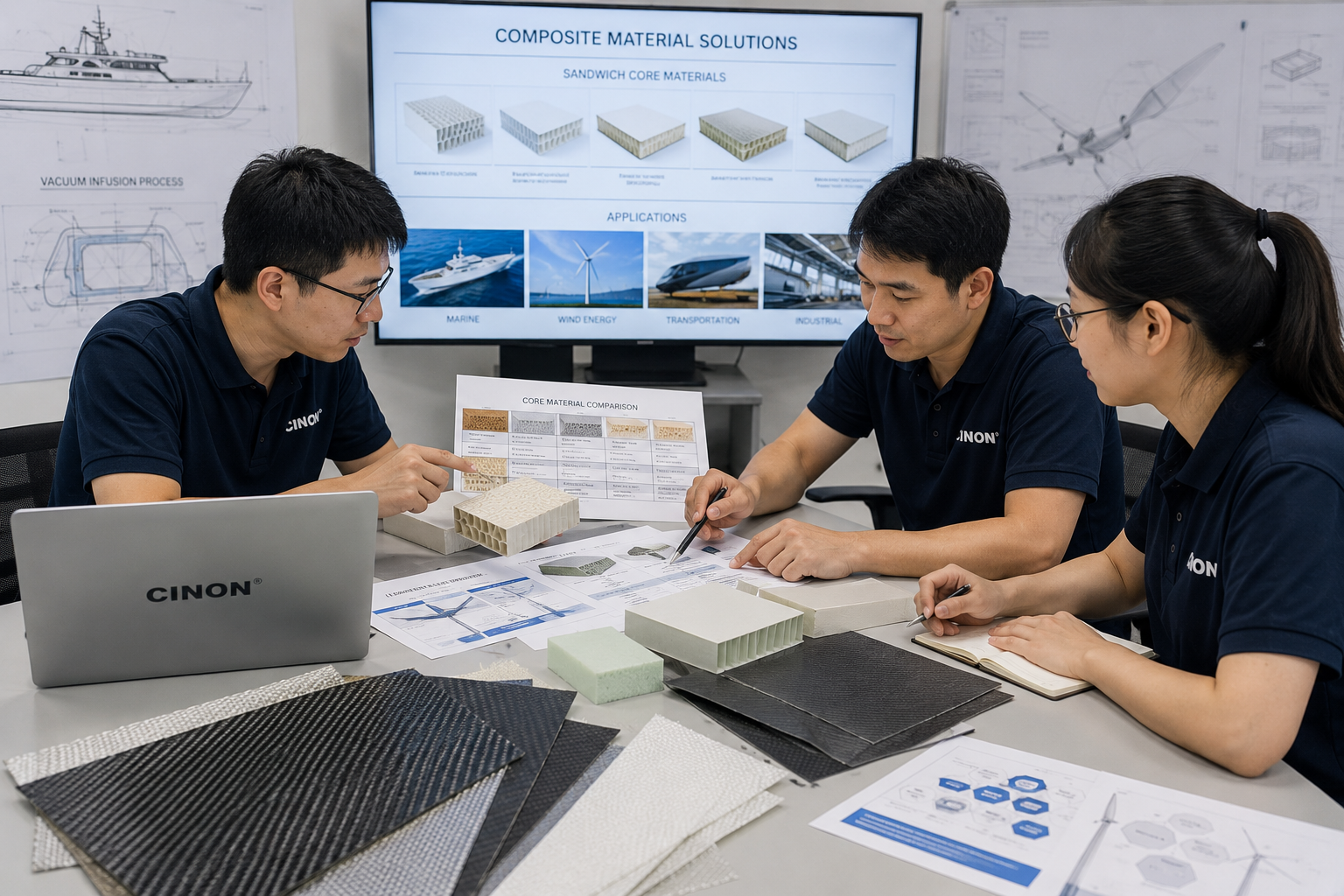
CINON Composites — formally Guangdong Cinon New Material Technology Co., Ltd. — manufactures fiberglass reinforcements and lightweight core materials for marine, transportation, wind energy, industrial, and aerospace composite applications. The company operates a 40,000 m² facility in Guangzhou with an annual output of 120,000 m², a 25-engineer R&D team, and monthly production capacity of 100,000 square meters. Its product range includes fiberglass fabrics, biaxial fabrics, PET foam core, PVC foam core, PMI foam core, Core Mat, PP honeycomb, and aramid honeycomb.
Basalt fabric: where it fits and where caution applies
Basalt fabric is produced from natural basalt rock, which is melted and drawn into continuous filaments before being woven or stitched into fabric form. It is generally recognized for high-temperature resistance and chemical durability. In structural terms, basalt fiber is often described as having a higher elastic modulus than standard E-glass, and its density is typically higher.
For truck panels under dynamic loads, those properties create a mixed picture:
- Thermal resistance may be useful in panels exposed to high radiant heat or in applications where the resin system demands a reinforcement that tolerates elevated processing or service temperatures.
- Higher modulus can contribute to stiffness, but stiffness alone does not guarantee better dynamic load performance. Fatigue behavior, interlaminar strength, and impact tolerance also matter.
- Higher density works against weight reduction targets, which are often a primary reason for choosing composite panels in the first place.
- Commercial maturity is lower. Basalt fiber supply is narrower, product standardization is less developed, and process knowledge is less widespread than for E-glass fiberglass fabric.
Basalt fabric is not a drop-in replacement for fiberglass fabric in every truck panel program. It is a material that deserves evaluation when its specific property advantages — particularly thermal resistance — align with a project's dominant requirement.
Where the comparison lands for dynamic loads
For most truck body and bus panel applications, fiberglass fabric — particularly E-glass — is the more practical reinforcement choice. The evidence supports this position on four grounds: documented vibration and abrasion resistance, established automotive panel use, favorable cost and lifecycle economics, and broad process compatibility.
Basalt fabric may be worth evaluating when thermal resistance is the governing requirement, when a project specification explicitly calls for basalt reinforcement, or when a designer needs a non-glass mineral fiber for reasons unrelated to dynamic load performance. In those cases, the decision should be validated through sample testing and process trials rather than assumed from material data sheets alone.
Step-by-Step Breakdown: How to Decide Between Fiberglass and Basalt for a Truck Panel Program
A structured decision process reduces the risk of selecting a reinforcement that performs well on paper but underperforms in production or service. The following sequence reflects the evaluation logic that CINON applies when supporting composite buyers.
- Define the dominant load case. Is the panel primarily exposed to road vibration, impact from cargo handling, thermal cycling, or a combination? The dominant load case should drive the reinforcement shortlist, not the other way around.
- Set stiffness and weight targets. Establish the required panel stiffness and the maximum acceptable weight. Basalt fiber's higher density may conflict with aggressive weight targets, while fiberglass offers a well-understood weight-to-stiffness balance.
- Confirm process compatibility. Match the reinforcement to the production process — hand lay-up, vacuum infusion, RTM, or VARTM. Fiberglass fabric has broad process compatibility; basalt fabric may require process adjustments that should be validated before production commitment.
- Evaluate thermal exposure. If the panel will see sustained high temperatures or severe thermal gradients, basalt's thermal resistance may justify a closer look. If thermal exposure is moderate, fiberglass is likely sufficient.
- Run a cost and lifecycle comparison. Compare material cost, process cost, repair cost, and expected service life. Fiberglass generally offers lower material cost and cheaper repair and maintenance than high-modulus alternatives.
- Validate with samples. Test candidate fabrics under representative dynamic and thermal conditions. CINON provides technical evaluation support to recommend suitable core materials, fiberglass reinforcements, and manufacturing processes before order confirmation.
- Confirm supply reliability. Check production capacity, MOQ, lead time, and batch consistency. CINON confirms all dimensions, thickness, density, roll length, width, and weight before production and conducts first-piece inspection before mass production.
Use Cases: Where Each Material Fits in Transportation Panels
Fiberglass fabric for high-volume truck body panels
High-volume truck body panels benefit from fiberglass fabric's cost efficiency, process flexibility, and established supply base. E-glass resistance to vibration and abrasion supports long service life in fleet applications where panels are exposed to continuous road-induced stress.
Fiberglass fabric for bus interior and exterior panels
Bus panels combine dynamic load exposure with surface quality requirements. Fiberglass fabric's dimensional stability and resin compatibility help maintain flatness and finish across large panel formats, while its impact resistance supports durability in passenger service.
Fiberglass fabric for refrigerated and specialty truck bodies
Sandwich panels for refrigerated truck bodies use fiberglass fabric as a structural skin over foam core. The combination of stiffness, moisture resistance, and repairability makes fiberglass a practical choice for these demanding panel systems.
Basalt fabric for high-temperature or specialty panels
Basalt fabric may be relevant for panels exposed to elevated service temperatures, or for projects where a specification calls for a non-glass mineral reinforcement. These cases are more limited and should be validated through direct testing and process trials.
Comparison Table: Fiberglass Fabric vs. Basalt Fabric for Truck Panels
| Decision Criterion | Fiberglass Fabric (E-glass) | Basalt Fabric |
|---|---|---|
| Base material | Glass fiber yarns in woven, stitched, or other fabric constructions (verified) | Melted natural basalt rock drawn into continuous filaments (general industry knowledge) |
| Automotive / truck panel application record | Established: fiberglass fabrics preferred across automotive panels for balanced strength, dimensional stability, resin compatibility, and process flexibility (verified) | Limited commercial record in truck panels; more commonly discussed in specialty applications (general industry knowledge) |
| Vibration and abrasion resistance | E-glass fibers described as resistant to vibrations and abrasion (verified) | Generally described as durable, but less documented specifically for dynamic truck panel loads (general industry knowledge) |
| Thermal resistance | Adequate for typical truck panel service conditions; resin system often governs upper temperature limit (general industry knowledge) | Generally recognized for high-temperature resistance (general industry knowledge) |
| Density and weight impact | Well-understood weight-to-stiffness balance for composite panels (general industry knowledge) | Typically higher density than E-glass (general industry knowledge) |
| Cost positioning | Lower material cost; carbon fiber price is 12–15 times that of glass fiber (verified) | Generally higher cost than E-glass (general industry knowledge) |
| Repair and maintenance | Stable long-term performance with cheaper repair and maintenance cost (verified) | Repair practice less standardized than fiberglass (general industry knowledge) |
| Process compatibility | Broad compatibility with hand lay-up, vacuum infusion, RTM, VARTM, and related processes (verified application scope; process statement general industry knowledge) | Process windows may require validation before production (general industry knowledge) |
| Supply maturity | Mature global supply base; Asia Pacific held 45.05% market share in 2025 (verified) | Narrower supply base and less standardized product range (general industry knowledge) |
The table distinguishes between verified product facts and general industry knowledge. Where a cell reflects general industry knowledge rather than a verified fact, it should be confirmed with material suppliers and project-specific testing before a final decision.
FAQ
Do fiberglass and basalt fabrics meet requirements for truck and bus panels?
Fiberglass fabric is defined as a technical reinforcement material used in engineered transport applications, and fiberglass fabrics are documented as a preferred choice for automotive panels. Specific compliance requirements depend on the project's target market and the standards the panel must satisfy. CINON's purchasing terms include pre-shipment testing and a Quality Test Report as acceptance criteria, which supports documentation of material conformance before shipment. Basalt fabric can also be used in structural panels, but its suitability for a specific truck panel program should be verified against the project's technical specification and applicable standards.
Can fiberglass fabric handle the dynamic loads that truck panels experience?
E-glass fibers are described as resistant to vibrations and abrasion, which is directly relevant to the repeated dynamic loads that truck and bus panels encounter. Fiberglass fabrics are also preferred in automotive panels because of balanced strength, dimensional stability, and process flexibility. These properties support stiffness retention and structural continuity under vibration and impact. CINON provides technical evaluation support to recommend suitable fiberglass reinforcements and manufacturing processes before order confirmation, which helps align the material choice with the panel's actual load case.
How does the cost of fiberglass fabric compare with basalt fabric?
Verifiable cost data supports fiberglass as the lower-cost reinforcement option: carbon fiber price is 12–15 times that of glass fiber, and fiberglass offers lower overall production energy consumption for mass production. Basalt fiber is generally described as costing more than E-glass, although actual pricing depends on specification, volume, and market conditions. CINON's delivery terms include FOB, CIF, and EXW, and the standard MOQ is 100㎡ under its purchasing terms. Buyers should request a project-specific quotation rather than rely on generic cost assumptions.
Can I validate samples before committing to a truck panel production run?
CINON confirms all dimensions, thickness, density, roll length, width, and weight before production and conducts first-piece inspection before mass production. Each production batch undergoes density, thickness, weight, and appearance inspection, and test reports are available upon request. These controls support sample validation and batch consistency checks. Buyers evaluating fiberglass against basalt for a specific truck panel design should request samples of both candidate fabrics and test them under representative dynamic and thermal conditions.
What are the typical lead times and order quantities for fiberglass fabric?
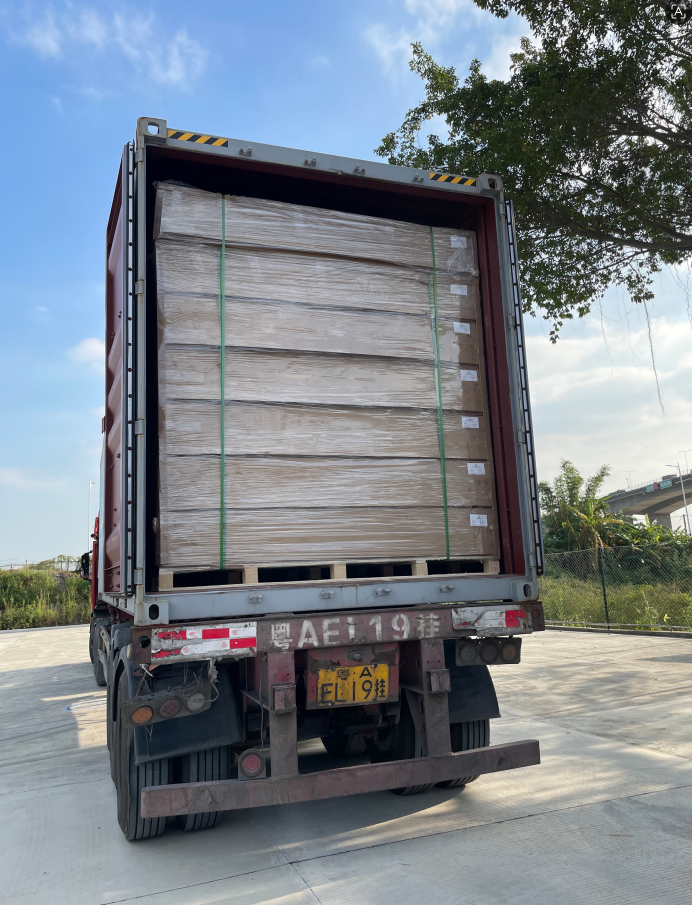
CINON's standard purchasing terms list an MOQ of 100㎡ with delivery terms FOB, CIF, or EXW. At the production level, the manufacturer has a monthly production capacity of 100,000 square meters, with a minimum order quantity of 1,000 square meters and a typical lead time of 15 to 30 days. Payment terms are 30% deposit in advance and 70% balance by TT before shipment. For buyers planning a truck panel program, these parameters support both sample-stage evaluation and volume production scheduling. To discuss a specific requirement, contact CINON Composites directly.
Conclusion: Matching the Reinforcement to the Load Case
For truck panels and bus panels under dynamic road loads, fiberglass fabric — particularly E-glass — is the better-supported choice. It combines documented vibration and abrasion resistance, established automotive panel use, favorable cost and lifecycle economics, and broad process compatibility. These are not marketing claims; they are properties reflected in the material's verified application profile and its position as the dominant reinforcement in the composites market.
Basalt fabric is not without merit. Its thermal resistance and higher modulus may justify evaluation in specific high-temperature or specialty panel applications. But for the majority of truck body and bus panel programs, the combination of performance, cost, supply maturity, and process flexibility favors fiberglass fabric.
The decision should still be validated at the sample stage. Dynamic loads are application-specific, and a reinforcement that performs well in one panel design may behave differently in another. Structured evaluation — defining the load case, confirming process compatibility, comparing lifecycle cost, and testing samples — remains the most reliable path to a durable, cost-effective truck panel.
Next Step: Evaluate Fiberglass Fabric for Your Truck Panel Program
CINON Composites supplies fiberglass fabrics, biaxial reinforcements, and lightweight core materials for transportation, marine, wind energy, and industrial composite applications. The company operates a 40,000 m² facility in Guangzhou with a 25-engineer R&D team and exports to Europe, North America, and Asia-Pacific markets.
To request a sample, discuss a specification, or download the product catalog, visit cinoncomposites.com or download the CINON Composites catalog.
Have Questions or Need More Details?
Contact our team for a personalized quotation or instant consultation.
Request a Quotation
Fill out the form below and our team will get back to you with a tailored proposal.
WhatsApp Direct Chat
Prefer to chat in real-time? Message us on WhatsApp for instant assistance & quick answers.
- Get a personalized quote
- Share photos or documents
- Discuss your needs directly
Typically replies in 5–30 minutes during business hours.