
Fiberglass Fabric vs Carbon Fiber vs Woven Roving: A Decision Framework for Marine, Wind & Industrial Buyers
Fiberglass Fabric vs Carbon Fiber vs Woven Roving: Decision Guide for Marine, Wind & Industrial Applications
Buyers comparing fiberglass fabric with carbon fiber or woven roving face a common challenge: every reinforcement material has strengths and trade-offs, and the right choice depends on load direction, manufacturing process, and budget. This guide gives composite buyers a practical decision framework based on material behavior, laminate performance, cost, and application fit.
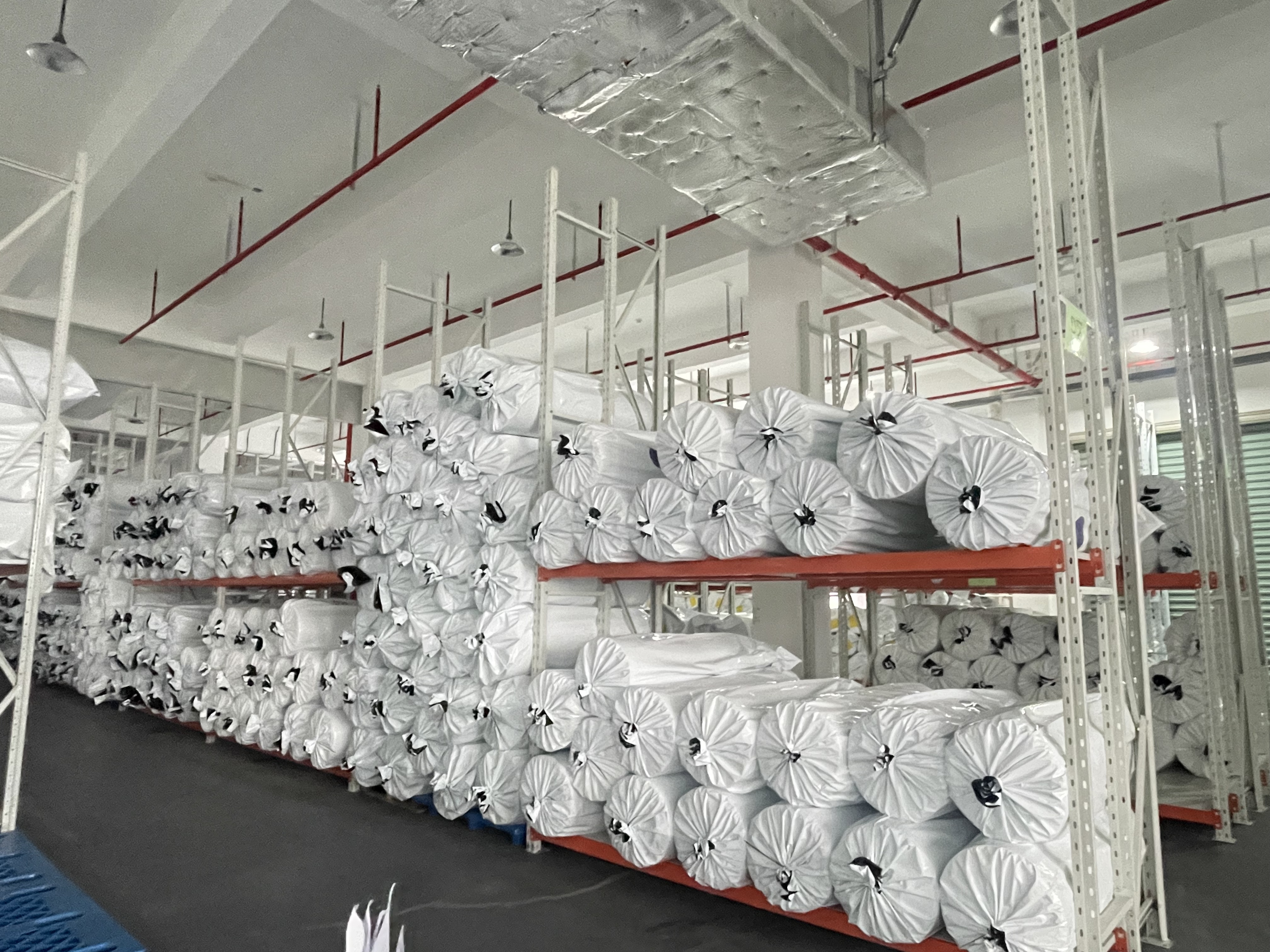
Fiberglass reinforcement production processes support a broad range of composite manufacturing needs, from marine laminates to wind energy components.
Why This Comparison Matters for Buyers
Material selection directly affects structural performance, production labor, and total project cost. In composite manufacturing, reinforcement choice influences laminate stiffness, impact resistance, resin consumption, and the amount of hand finishing required. Buyers who choose a reinforcement type without comparing fiber architecture and cost trade-offs often end up with either an over-engineered laminate or one that fails under service loads.
For most marine, wind energy, industrial, and construction components, fiberglass fabric is the practical baseline because it provides a balance of cost, impact resistance, and design flexibility. Carbon fiber becomes relevant when maximum stiffness and weight reduction justify a much higher material cost. Woven roving remains a traditional option for some laminates, but multiaxial fabrics offer straighter fiber orientation and more predictable mechanical properties.
Problem Definition: Confusion Between Reinforcement Types
Many buyers use the terms fiberglass fabric, woven roving, and carbon fiber interchangeably when discussing reinforcement materials, but they behave very differently in a laminate. The confusion often appears during specification:
- Is fiberglass fabric strong enough for a yacht hull or a wind blade?
- Is the higher cost of carbon fiber justified for this part?
- What does multiaxial fabric offer compared with traditional woven roving?
Without a clear comparison framework, buyers may rely on habit, a supplier's preference, or cost alone. The goal of this guide is to turn reinforcement selection into a structured decision based on load requirements, process compatibility, and total cost of ownership.
Industry Background: Fiberglass Reinforcement Demand Is Broadening
The fiberglass fabric market is large and growing. According to Grand View Research, the global fiberglass fabric market was valued at USD 14.01 billion in 2024, with projected growth to USD 25.65 billion by 2033. Asia Pacific led global demand with a 41.61% revenue share in 2024, supported by infrastructure and renewable energy projects.
Wind energy is one of the fastest-growing application segments. Grand View Research projects an 8.5% CAGR for fiberglass fabric in wind energy from 2025 to 2033, the highest among application segments. Wind turbine blades account for approximately 42.5% of total fiberglass usage in the wind energy sector, according to Dataintelo. Woven fiberglass fabrics captured 48.62% of market revenue in 2025 due to their role in yacht hulls and automotive panels, according to Mordor Intelligence.
These figures show that fiberglass fabric is not a niche product. It is a mainstream structural reinforcement used in marine, wind, transportation, and industrial applications. Buyers need to understand not just whether fiberglass is appropriate, but which fiber architecture and specification best fit their process and performance targets.
Material Comparison at a Glance
| Comparison Criterion | Fiberglass Fabric (E-Glass / Multiaxial) | Woven Roving | Carbon Fiber |
|---|---|---|---|
| Fiber orientation | Straighter orientation in multiaxial formats; engineered for load paths | Woven crimp introduces waviness; less efficient load transfer | Very high stiffness along fiber direction |
| Structural efficiency | Higher laminate performance, up to 20–30% higher than woven roving depending on lay-up design | Baseline; lower efficiency due to crimp and off-axis fibers | 2–4x higher stiffness than fiberglass |
| Relative material cost | Reference point; about 3–5x lower than carbon fiber | Generally lower material cost than multiaxial fabrics | Approximately 12–15x the price of fiberglass |
| Impact resistance | Better than carbon fiber; good for marine, industrial, construction | Acceptable but less predictable in high-load structures | Lower impact resistance; more brittle under point loads |
| Labor during lamination | Multiaxial fabrics reduce labor requirements and speed up lay-up | Higher labor input; more layers typically required | Higher handling skill and process control needed |
| Production energy | Lower overall production energy for mass production | Moderate | Higher embodied energy and manufacturing cost |
| Maintenance and repair | Stable long-term performance; cheaper repair and maintenance | More post-finish correction and higher long-term repair cost | Expensive repairs; specialized repair materials required |
| Best-fit applications | Wind energy, marine, structural composites, transportation, industrial | General-purpose laminates, some marine tooling and secondary structures | Aerospace, racing, high-performance lightweight structures |
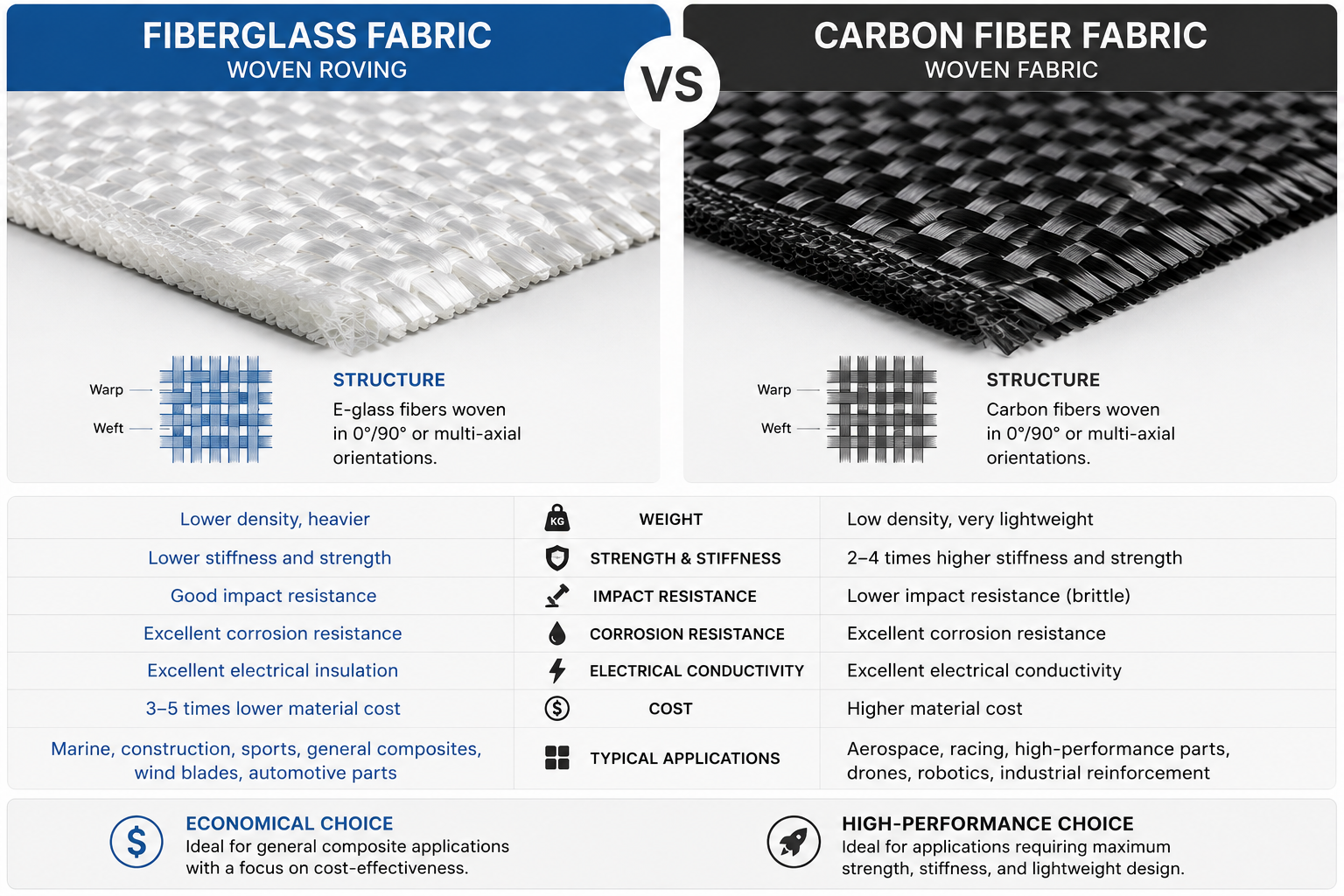
Fiberglass fabric vs carbon fiber: cost, stiffness, and impact resistance trade-offs.
Fiberglass Fabric vs Carbon Fiber: Cost, Stiffness, and Impact
Carbon fiber is 2–4 times stiffer than fiberglass, which makes it attractive for high-performance structures where weight and deflection control are critical. However, that stiffness comes at a steep cost. According to verified comparison data, carbon fiber costs approximately 12–15 times more than fiberglass. On a project level, switching from fiberglass to carbon fiber can multiply raw material cost dramatically, even before considering the added complexity of cutting, handling, and repair.
Fiberglass fabric is 3–5 times lower in material cost than carbon fiber and offers better impact resistance. For marine hulls, industrial covers, construction panels, and many wind components, impact resistance and predictable failure behavior are often more important than the maximum possible stiffness. Fiberglass also brings lower overall production energy consumption for mass production. When production volume is high, energy use per part becomes a meaningful factor in total cost.
Long-term maintenance favors fiberglass as well. Fiberglass structures offer stable long-term performance with cheaper repair and maintenance options. Carbon fiber repairs are more specialized and more expensive, especially when damage occurs in a highly loaded laminate.
In practice, fiberglass fabric is more suitable for marine, industrial, and construction applications because it balances mechanical performance with cost and serviceability. Carbon fiber is a better fit when stiffness-to-weight ratio is the dominant design requirement, such as aerospace or racing components, and the project budget can absorb the material cost.
Fiberglass Multiaxial Fabric vs Woven Roving: Structural Efficiency and Labor
Woven roving has been used in composite manufacturing for decades, especially in hand lay-up boat building. But it has a structural limitation: fibers in a woven fabric are crimped where they cross over and under each other. This waviness reduces load transfer efficiency compared with straight fibers, which means the laminate needs more material to achieve the same performance.
Multiaxial fabrics solve this problem by laying fibers in straight, parallel orientations and stitching them together. Compared with woven roving, multiaxial fabrics provide straighter fiber orientation and higher structural efficiency, offering up to 20–30% higher laminate performance depending on lay-up design. For the same stiffness target, a multiaxial fabric laminate can be thinner or lighter than a woven roving laminate.
The material cost of multiaxial fabric is generally higher than woven roving. However, total manufacturing cost can still be favorable because multiaxial fabrics reduce labor requirements. Fewer layers are needed, lay-up is faster, resin impregnation is more predictable, and less post-finish correction is required. Lower long-term repair costs add another advantage.
For wind energy, marine, and structural composites, multiaxial fabrics are the more suitable choice when load paths are known and laminate efficiency matters. Woven roving may still be considered for simple flat laminates or low-cost tooling, but it is rarely the best option for high-performance structural parts.
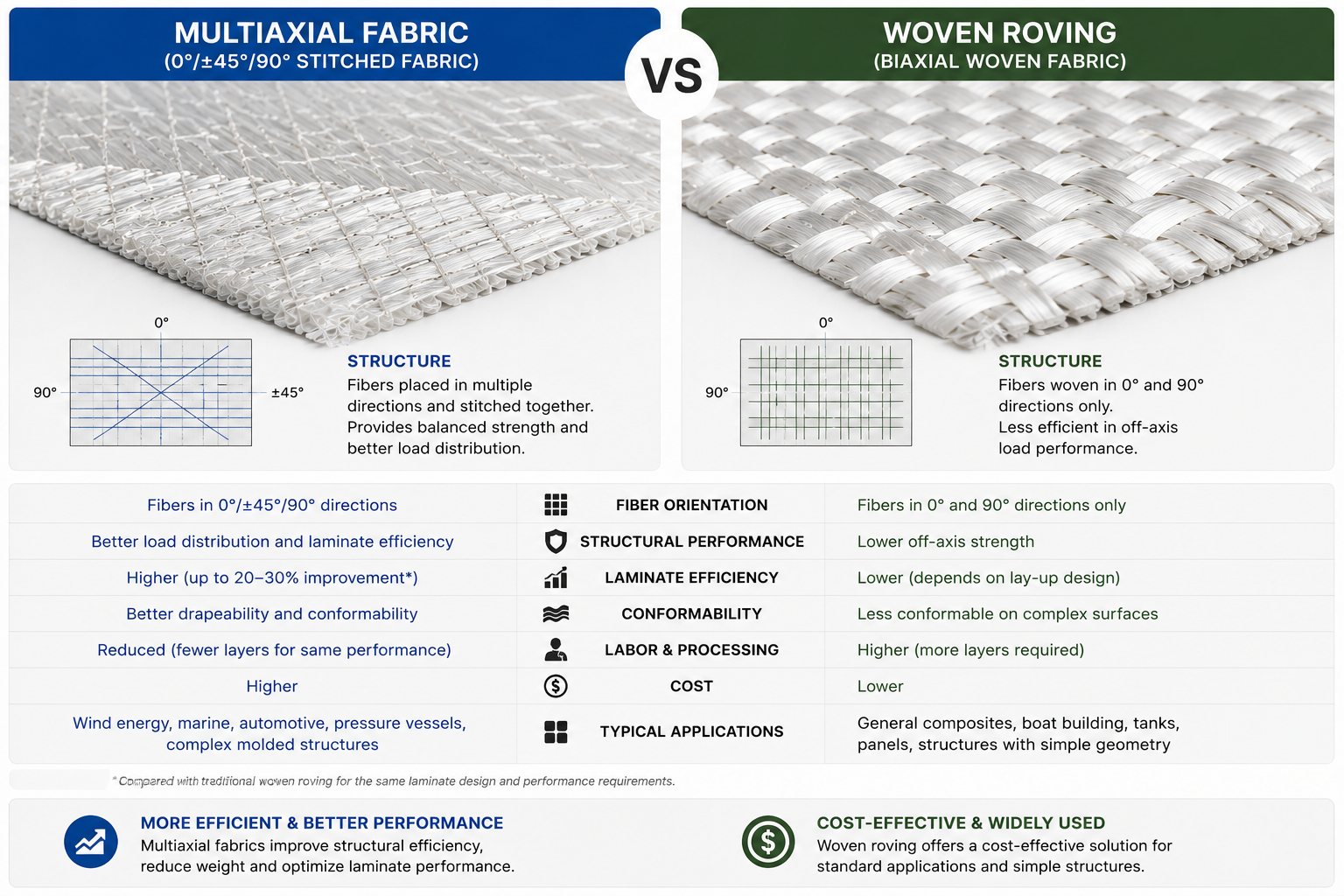
Multiaxial fabric vs woven roving: straighter fiber orientation improves laminate performance.
Step-by-Step: How to Choose Between Fiberglass, Woven Roving, and Carbon Fiber
Step 1: Define the primary load direction
If loads are mainly uniaxial or biaxial, a multiaxial fabric can be engineered with fibers in those exact directions. If loads are multi-directional and difficult to model, a woven construction may be easier to handle, but carbon fiber becomes attractive only when stiffness targets are extremely high.
Step 2: Set the performance target
Define stiffness, strength, weight, and impact requirements. Carbon fiber wins on stiffness and weight. Fiberglass wins on impact resistance and cost. Woven roving generally offers the lowest material cost but lowest structural efficiency.
Step 3: Check process compatibility
For vacuum infusion and resin transfer molding, multiaxial fabrics and glass fabrics with good wet-out are preferred. Woven roving can be used but often requires more resin and longer infusion times. Carbon fiber requires careful handling and process control to avoid fiber damage.
Step 4: Estimate total cost, not just material price
Include labor, resin consumption, finishing, tooling, and repair. A lower-cost reinforcement that increases labor or rework is not necessarily the cheapest solution. Multiaxial fabric may cost more per meter than woven roving but can reduce total manufacturing cost through fewer layers and faster lay-up.
Step 5: Evaluate lifecycle maintenance
Marine and industrial components operate in demanding environments. Fiberglass offers stable long-term performance and lower repair costs. Woven roving laminates may require more maintenance due to finishing issues. Carbon fiber repairs are more expensive and complex.
Step 6: Confirm with a technical supplier
Before order confirmation, a qualified supplier should help verify material specification, fiber architecture, and process parameters. CINON provides engineering support to recommend suitable fiberglass reinforcements, core materials, and manufacturing processes before order confirmation.
Use Cases: Matching Material to Application
Marine: fiberglass fabric for boat building and yacht hulls
Fiberglass fabric is widely used for boat building, yacht hulls, and marine repair. It provides impact resistance, low water absorption, and predictable performance in hand lay-up, vacuum infusion, and resin infusion processes. For hull laminates, multiaxial fabrics are often chosen over woven roving because they reduce weight and labor while improving structural efficiency.
Wind energy: fiberglass fabric for wind blades
Wind turbine blades require high stiffness-to-weight ratio, fatigue resistance, and consistent laminate quality. Fiberglass fabrics and multiaxial reinforcements are used extensively in blade shells and spar caps. The wind energy segment is growing faster than other fiberglass fabric applications, making material consistency and process reliability critical for blade manufacturers.
Transportation and UAV: lightweight structures
Fiberglass fabric is used for automotive parts, transportation panels, drones, and other lightweight structures. Fiberglass offers a practical balance of cost, strength, and weight when carbon fiber is unnecessary. For UAV components, stitched multiaxial fabrics help engineers optimize stiffness without exceeding budget constraints.
Industrial and construction: structural reinforcement
For FRP laminates, sandwich panels, composite molds, and structural reinforcement, fiberglass fabric is the default choice in most cases. It is more suitable than carbon fiber for these scenarios because of lower cost, better impact resistance, and easier maintenance.
Supplier Selection Considerations
Reinforcement material is only one part of the equation. Supplier consistency, quality verification, and technical support affect project outcomes just as much as material selection. The global fiberglass fabric market includes major players such as Owens Corning (US), China Jushi Co. (China), Saint-Gobain (France), and Taishan Fiberglass (China). Buyers also work with specialist suppliers like CINON Composites, which focuses on fiberglass reinforcements and core materials for marine, wind energy, transportation, and industrial applications.
What to verify before ordering
- Product specification: dimensions, thickness, density, roll length, width, and weight should be confirmed before production.
- Batch consistency: each production batch should undergo density, thickness, weight, and appearance inspection, with test reports available upon request.
- Packaging for export: reinforcement fabrics should be packed with reinforced pallets, moisture-proof wrapping, and corner protection to avoid transportation damage.
- First-piece inspection: first-piece inspection before mass production reduces specification deviation risk.
Risk Management in Material Selection and Supply
Material selection errors are one of the most common risks in composite manufacturing. CINON addresses this with technical evaluation support before order confirmation, helping customers choose suitable core materials, fiberglass reinforcements, and manufacturing processes. Product specification deviation is controlled through pre-production confirmation of all dimensions, thickness, density, roll length, width, and weight, followed by first-piece inspection before mass production. Performance inconsistency is managed with batch-level density, thickness, weight, and appearance checks, with test reports available upon request. Transportation damage is reduced through export-standard packaging, including reinforced pallets, moisture-proof wrapping, and corner protection.
Comparison Summary: Which Should You Choose?
For most marine, industrial, and construction projects, fiberglass fabric is the most balanced choice: lower cost than carbon fiber, better impact resistance, and lower production energy consumption for mass production. For wind energy and high-performance structural composites, multiaxial glass fabrics provide better fiber orientation and up to 20–30% higher laminate performance than woven roving, while reducing labor and long-term maintenance costs. Carbon fiber is justified when stiffness and weight are the dominant design drivers and the budget allows for a material cost roughly 12–15 times higher than fiberglass.
Woven roving is still used in some traditional hand lay-up applications, but buyers should evaluate whether its lower material cost is offset by higher labor, more post-finish correction, and lower structural efficiency.
FAQ
Is fiberglass fabric compliant for marine and wind applications?
Yes. Fiberglass fabric is an established reinforcement material for marine, wind, and structural composites. Standardized tests for fiberglass reinforced materials include ASTM D638 for tensile properties and ASTM D790 for flexural strength and modulus. Buyers should confirm that the supplier provides batch-level density, thickness, weight, and appearance inspection, with test reports available upon request.
Can fiberglass fabric meet wind blade performance requirements?
Yes. Fiberglass fabric is widely used in wind turbine blades and the wind energy segment is growing faster than other fiberglass fabric applications, with an 8.5% CAGR projected from 2025 to 2033. Multiaxial glass fabrics provide straighter fiber orientation and higher structural efficiency for blade shells and structural components. For project-specific needs, engineering support can help confirm material specification before ordering.
How much does fiberglass fabric cost compared with carbon fiber?
Fiberglass fabric has a material cost roughly 3–5 times lower than carbon fiber. Carbon fiber is approximately 12–15 times the price of fiberglass. Fiberglass also brings lower overall production energy consumption for mass production and cheaper repair and maintenance over the structure’s life.
Can you provide a sample before placing a bulk order?
Sample requests are an effective way to verify fabric construction, weight, width, and process compatibility before large-scale production is confirmed. CINON Composites works with buyers to review specifications before production and can provide product information through the catalog or direct inquiry. Request the CINON catalog to review the available fiberglass reinforcement range.
What is lead time for standard fiberglass fabric orders?
Lead time depends on specification, roll width, fabric construction, and order volume. Before production, all dimensions, thickness, density, roll length, width, and weight are confirmed, and first-piece inspection is conducted before mass production. For accurate lead time and shipping arrangements, contact CINON with your target specification and quantity.
Need help selecting the right fiberglass fabric for your project?
Review the CINON product catalog for standard options, or contact the engineering team with your application and specification requirements.
Download the CINON Catalog (PDF)
Contact: waylon@cinoncomposites.com | Tel: +86 186-2098-8848 | WhatsApp: +86 135-8036-3674
Verification note: Market sizing figures are drawn from Grand View Research, Mordor Intelligence, Dataintelo, and MarketsandMarkets as published in 2024–2026. Percentage comparisons for fiberglass vs carbon fiber and multiaxial vs woven roving are based on verified CINON product comparison data. Product specifications and company capabilities are based on CINON Composites’ published company information.