OEM Core Material Solutions: CINON's Custom Production and Engineering Capability
OEM Core Material Solutions: CINON's Custom Production and Engineering Capability
When a composite project moves from material evaluation into production execution, the buying decision changes. It is no longer only about which core material type suits the part. It becomes a question of which supplier can deliver the right material in the right format, at the required volume, with engineering support attached.
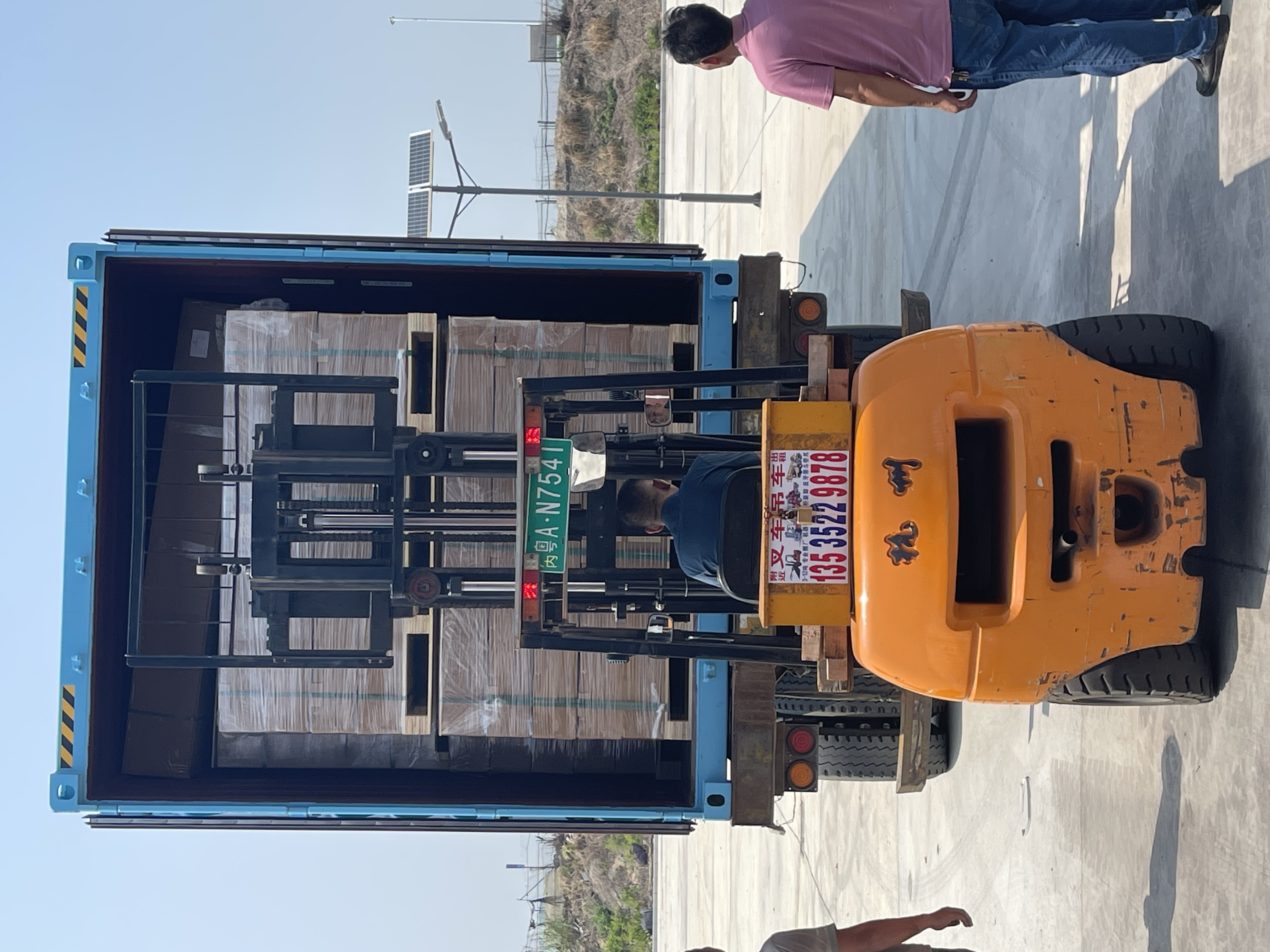
Guangdong Cinon New Material Technology Co., Ltd (CINON) is a Guangzhou-based manufacturer founded in 2022. The company specializes in fiberglass reinforcements and lightweight core materials for marine, transportation, wind energy, industrial, and aerospace composite applications. Its product range includes fiberglass fabrics, biaxial fabrics, PET foam core, PVC foam core, PMI foam core, Core Mat, PP honeycomb, and aramid honeycomb. CINON materials are used in boat building, yacht construction, wind turbine blades, transportation panels, UAV structures, and industrial composite components, with 100% of production exported to Europe, North America, and Asia-Pacific markets.
For a buyer at the evaluation-to-execution stage, the useful question is not only what CINON sells, but what CINON can do. This article covers the company's OEM and ODM production capability, customization options, engineering support, quality system, order execution process, and application evidence from completed projects.
The Capability Gap Between Standard Core Material Catalogs and Production Reality
Composite manufacturers evaluating core material suppliers usually start from a catalog. Standard products provide a baseline, but production execution often exposes gaps that catalogs cannot answer.
- Process fit. A core material must match the actual manufacturing process, such as vacuum infusion, RTM, hand lay-up, prepreg, or VARTM. Not every product is optimized for every method.
- Format flexibility. Projects require specific thicknesses, roll lengths, densities, surface options, and sheet sizes. Off-the-shelf ranges do not always line up with a laminate schedule.
- OEM and private-label needs. Distributors and equipment manufacturers often need materials supplied under their own brand or with specific labeling. Standard suppliers may not offer this.
- Engineering depth. Material selection is an engineering decision. A supplier that can advise on alternative materials, infusion behavior, and process parameters reduces execution risk.
- Supply reliability. Once a project moves to execution, lead time, capacity, and consistent quality matter as much as unit price.
These are capability gaps, not material gaps. The buyer questions behind them are direct: Can this supplier make custom core materials? Do they support OEM? Can they handle my application? Those questions are answered by a supplier's production model, technical resources, and track record, not by its brochure.
Why Core Material Capability Matters Now
The demand context keeps expanding. The global core materials market was valued at USD 4.19 billion in 2024 and is projected to reach USD 6.84 billion by 2032, driven by wind energy and aerospace demand. The marine structural core materials market reached USD 120.4 million in 2024, with PVC expected to remain the dominant material due to its moisture resistance. Wind turbine blade composite materials were valued at USD 7.045 billion in 2024, with China's production capacity exceeding 35 GW. The global RV composite panels market reached USD 3.8 billion in 2025, and fiberglass segments held 41.3% of the material share.
Established names in the core materials space include 3A Composites (Switzerland), Gurit Holding AG (Switzerland), and Diab Group (Sweden). For buyers, the presence of these players sets a high benchmark for quality and data transparency. Newer suppliers are evaluated on their ability to match that benchmark while offering faster response, more flexible customization, and direct manufacturing support.
Marine, wind, RV, and aerospace projects share a common requirement: they rely on lightweight sandwich structures, and they increasingly specify process-compatible materials. That is exactly the kind of requirement where a supplier's capability, not just its catalog, determines whether a project stays on schedule.
CINON's Core Material Capability Stack
CINON's capability can be described in six layers: ODM and customization, portfolio coverage, engineering support, quality assurance, production scale, and commercial terms.
ODM Production and Customization
CINON offers ODM production services. Customization services are available for core materials and fiberglass fabric. In practice, this means the manufacturer can produce materials to a customer's specification, including dimensions, surface treatment, roll format, and branding.
OEM label and logo services are already in active use. In a case with a composite material distributor in the Czech Republic, CINON supplied PP honeycomb with an OEM label service, and the project received good product feedback with monthly reorders. In Poland, a distributor order included OEM logo customization for composite structures, with container orders repeated every month. In both cases, the product is designed for long-term composite structural applications, providing lightweight, stiffness improvement, and durability benefits.
Portfolio Coverage: Foam, Core Mat, and Honeycomb
A single supplier that covers multiple core material families simplifies qualification and reduces supply-chain fragmentation. CINON's portfolio covers the main categories used in lightweight sandwich construction.
- PVC foam core is available in densities from 45 kg/m³ to 300 kg/m³ and thicknesses from 1 mm to 80 mm, with plain, grooved, perforated, or scrim-backed surfaces. It is positioned as a Divinycell alternative and is applicable to marine and yacht building, wind energy, transportation, rail vehicles, RV and caravan manufacturing, industrial composites, construction panels, and defense applications. Processing methods include vacuum infusion, RTM, hand lay-up, prepreg, and VARTM.
- PET foam core (Recyclable Foam Core) covers densities from 80 kg/m³ to 320 kg/m³. It is a lightweight structural core used in marine and yacht building, wind energy, transportation, rail vehicles, RV and caravan manufacturing, industrial composites, construction panels, and renewable energy.
- PMI foam core is supplied in densities from 40 kg/m³ to 130 kg/m³ and is positioned as a Rohacell alternative for aerospace, UAV and drone manufacturing, motorsport, high-performance marine, defense and military, and sports equipment.
- Core Mat products are polyester nonwoven infusion core materials. The CM core mat is a structural core material from 1.5 mm to 6 mm thick with dry weights from 125 g/m² to 360 g/m² and a maximum process temperature of 175°C. The CT Core Material is a thin flow core material from 1.5 mm to 3 mm with dry weights from 90 g/m² to 160 g/m² and a maximum process temperature of 180°C. The CS Core Material is a general-purpose core material from 2 mm to 3 mm with dry weights from 130 g/m² to 170 g/m² and a maximum process temperature of 170°C.
- PP honeycomb sheet (Thermoplastic Honeycomb Core) is produced from 5 mm to 100 mm thick, with densities of 70 kg/m³ or 80 kg/m³, standard sheet size of 1220 × 2440 mm, and customizable sizes. It is used in transportation, RV and caravan, marine and yacht, construction, and industrial composites. Processing options include cutting, CNC machining, lamination, and thermoforming.
- Nomex honeycomb (Aramid honeycomb core) is available in cell sizes from 1.83 mm to 5.5 mm and densities from 32 kg/m³ to 128 kg/m³, with a working temperature range of -60°C to 180°C and standard dimension of 2440 × 1220 mm. It is used for aerospace, aircraft interiors, helicopter panels, UAV structures, drone manufacturing, sandwich panels, motorsport, defense, radar structures, and marine racing yachts.
In addition, CINON supplies fiberglass reinforcements. The Light Weight Fiberglass Cloth is an E-glass plain woven fabric from 25 g/m² to 400 g/m², and the Multiaxial Fiberglass Fabrics are non-crimp reinforcements from 400 g/m² to 1500 g/m² available in unidirectional, biaxial, triaxial, and quadriaxial orientations. These are used in vacuum infusion, hand lay-up, RTM, and other formed products such as ship hulls, wind turbine blades, automotive components, and sports equipment.
Thin Core Materials: Positioning Against Soric XF and SF
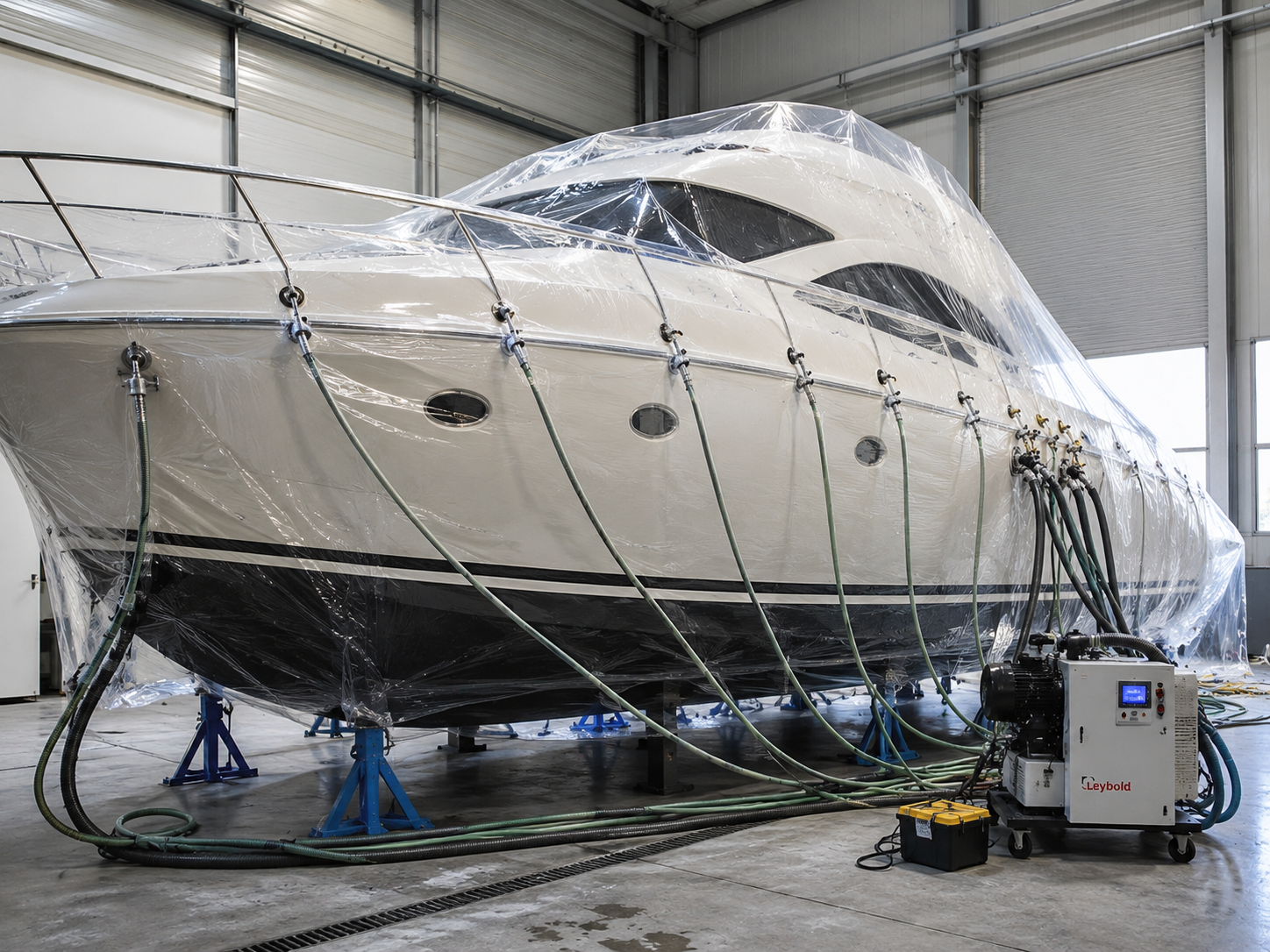
In vacuum infusion, thin non-woven polyester cores are used as internal flow media to improve resin distribution. Lantor Soric XF and Soric SF are two established products in this category; Soric SF features fine hexagon cells of 2–3 mm that help resin flow around sharp corners. Buyers looking for an alternative supply source often evaluate products with equivalent function and comparable processing behavior.
CINON positions its CX Core Material as a Soric LRC alternative. It is manufactured in polyester, in thicknesses of 1.5 mm, 2 mm, and 3 mm, with roll lengths of 70 m, 60 m, and 40 m, a width of 1.27 m, dry weights of 120 g/m², 150 g/m², and 220 g/m², and a maximum process temperature of 180°C. Its applicable industries include marine and yacht, wind power, automotive and rail transit, aerospace and UAV, construction and sanitary ware, and anti-corrosion industry. For laminators who have qualified Soric-type materials, the CX Core Material provides a functionally comparable option that can be validated through sample evaluation.
Engineering Support Across the Process Chain
Material supply becomes more valuable when it includes engineering support. CINON provides comprehensive after-sales technical support covering material selection, composite process optimization, vacuum infusion guidance, alternative material recommendations, sample evaluation, quality traceability, and global logistics coordination. Support is available through email, WhatsApp, online meetings, and technical documentation, assisting customers from prototype development to mass production.
This support appears in project evidence. A marine and yacht builder case in Australia highlighted material selection as a key result area. A distributor case in the United Kingdom successfully solved the problem of needing a reliable core material supply for vacuum infusion applications, achieving an alternative supply solution with fast lead time and reliable export logistics.
Quality System and Certifications
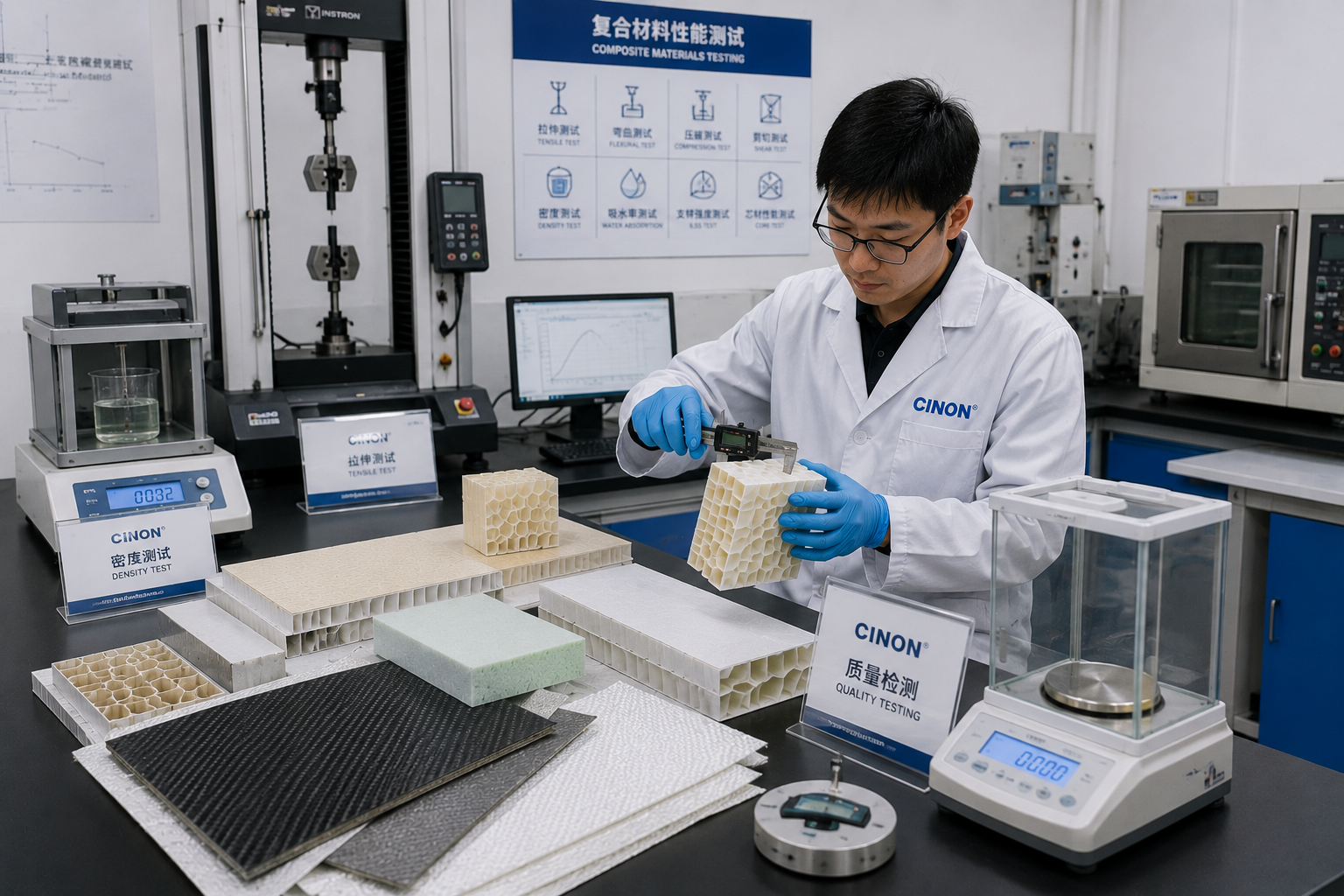
Quality control in production is documented as 100% testing. CINON's management systems are certified under ISO 9001:2015 (certificate 51326Q04922R053, issued 2026-04-29, valid to 2029-04-28), ISO 14001:2015 (certificate ISO14001-2023-001, issued by SGS, valid to 2028-06-01), and ISO 45001:2018 (certificate 51326S01896R053, issued 2026-04-29, valid to 2029-04-28). Purchasing acceptance includes pre-shipment testing and a Quality Test Report. For a buyer, this means the quality claim is backed by verifiable certificates and inspection documents, not only by product samples.
Scale, Lead Time, and Commercial Terms
Production scale directly affects delivery reliability. CINON operates a 40,000 m² facility with an annual output of 1,200,000 m² and a monthly capacity of 100,000 m². The R&D team includes 25 engineers. Standard lead time for production is 15–30 days.
The MOQ for customized core material production is 1,000 m². For fiberglass fabric, the MOQ is 100 m². Delivery methods include FOB, CIF, and EXW. Payment terms are 30% deposit in advance and 70% balance by T/T before shipment. These terms are designed to be practical for a mid-volume composite manufacturer executing a production project, not only for large marine or wind OEMs.
How a Custom Core Material Order Is Executed at CINON
The path from inquiry to delivery follows a defined workflow. Understanding it helps a buyer plan sample timing, production scheduling, and logistics.
- Define the application and process. The buyer specifies the part type, industry, manufacturing process (vacuum infusion, RTM, hand lay-up, prepreg, VARTM), and performance targets such as stiffness, weight, and temperature resistance.
- Material selection support. CINON engineers propose material families based on the requirement. The portfolio allows comparison among PET, PVC, PMI, Core Mat, PP honeycomb, and aramid honeycomb before a final choice is made.
- Sample evaluation. Samples are provided for process validation. In the UK distributor case, the project started with sample evaluation and then moved to commercial supply, confirming that the material worked in vacuum infusion structures.
- OEM and customization specification. If the buyer needs private labeling or custom formats, the specification is confirmed at this stage. OEM label service and OEM logo customization have been delivered in existing distributor cases.
- Production with 100% test control. Once the specification is frozen, production runs against the monthly capacity of 100,000 m². Quality control is documented as 100% testing.
- Pre-shipment inspection and documentation. Orders are accepted with pre-shipment testing and a Quality Test Report, providing a verifiable record before the goods leave the factory.
- Logistics and after-sales support. Delivery is managed under FOB, CIF, or EXW terms, followed by technical support covering process optimization, alternative recommendations, and quality traceability from prototype to mass production.
Application Evidence: CINON Materials in Real Production
The following cases are drawn from CINON's project history in Europe, North America, Asia-Pacific, and Southeast Asia. They show how the materials behave in production rather than only on a datasheet.
Marine and Yacht Builders, Australia
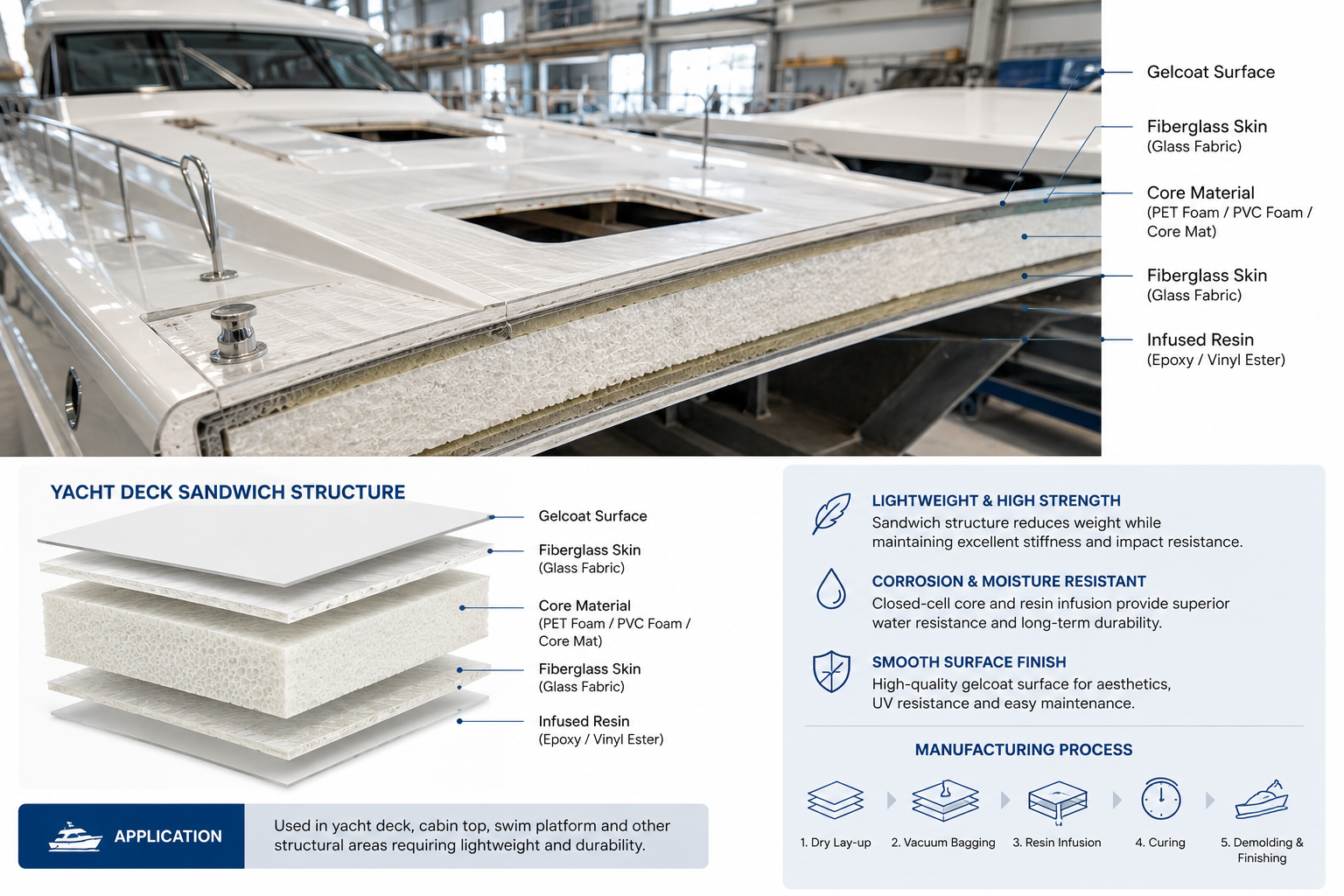
PP honeycomb sheet was supplied in container quantities to marine and yacht builders for materials and tools for boat building. The case involved a marine and yacht builders type client. The project achieved smooth surface, easy wet-out, and better finish results. The key highlight of the case was material selection. The product is designed for long-term composite structural applications.
UAV Manufacturers, Germany
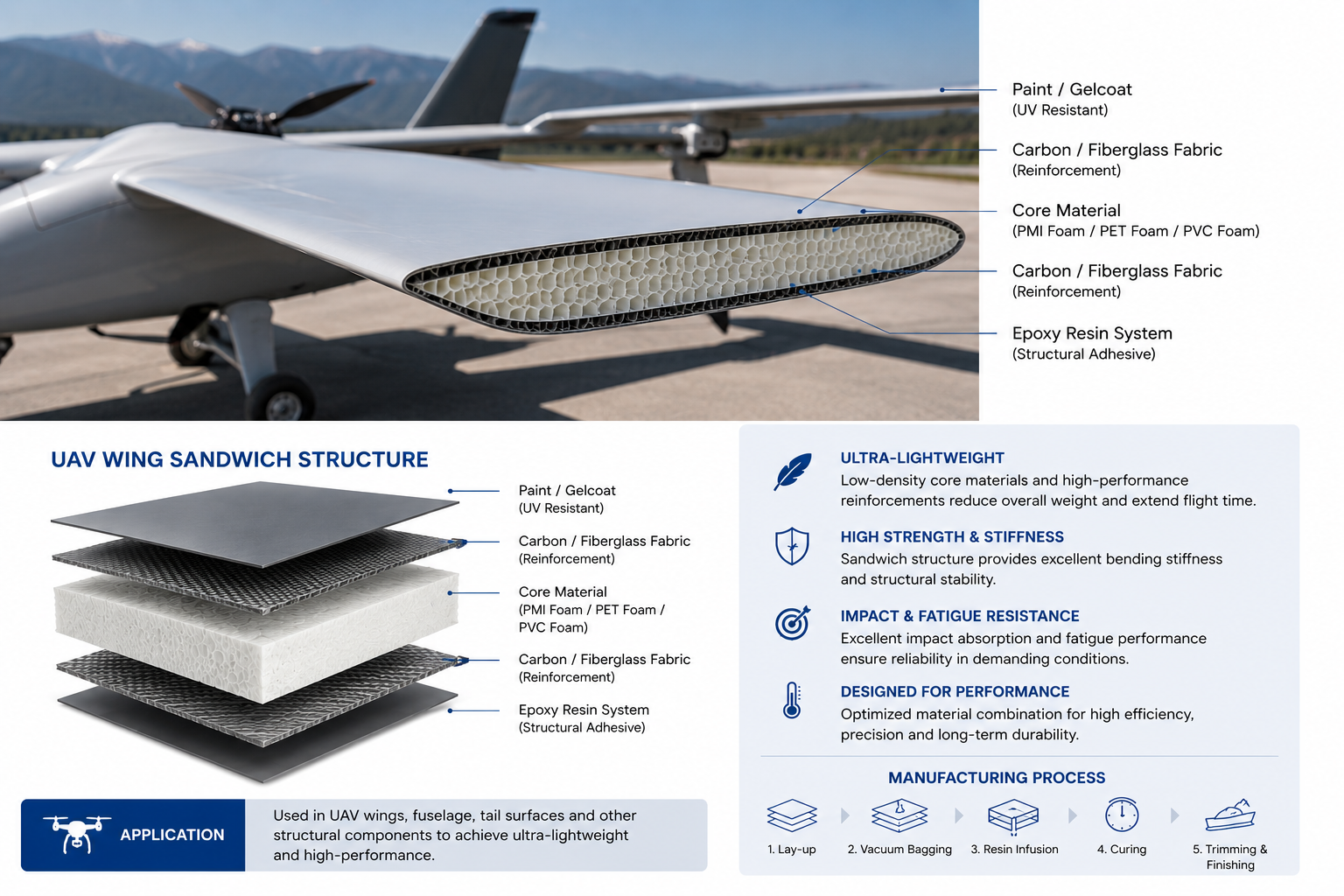
PMI foam core was used by UAV manufacturers in Germany for UAV production purposes. The project scale was 10 pallets of core material. Key highlights include fatigue resistance and low density. The project achieved ultra-lightweight structures, high stiffness, and high temperature resistance. The product has been successfully used by UAV manufacturer clients in the EU.
RV Manufacturers, United States
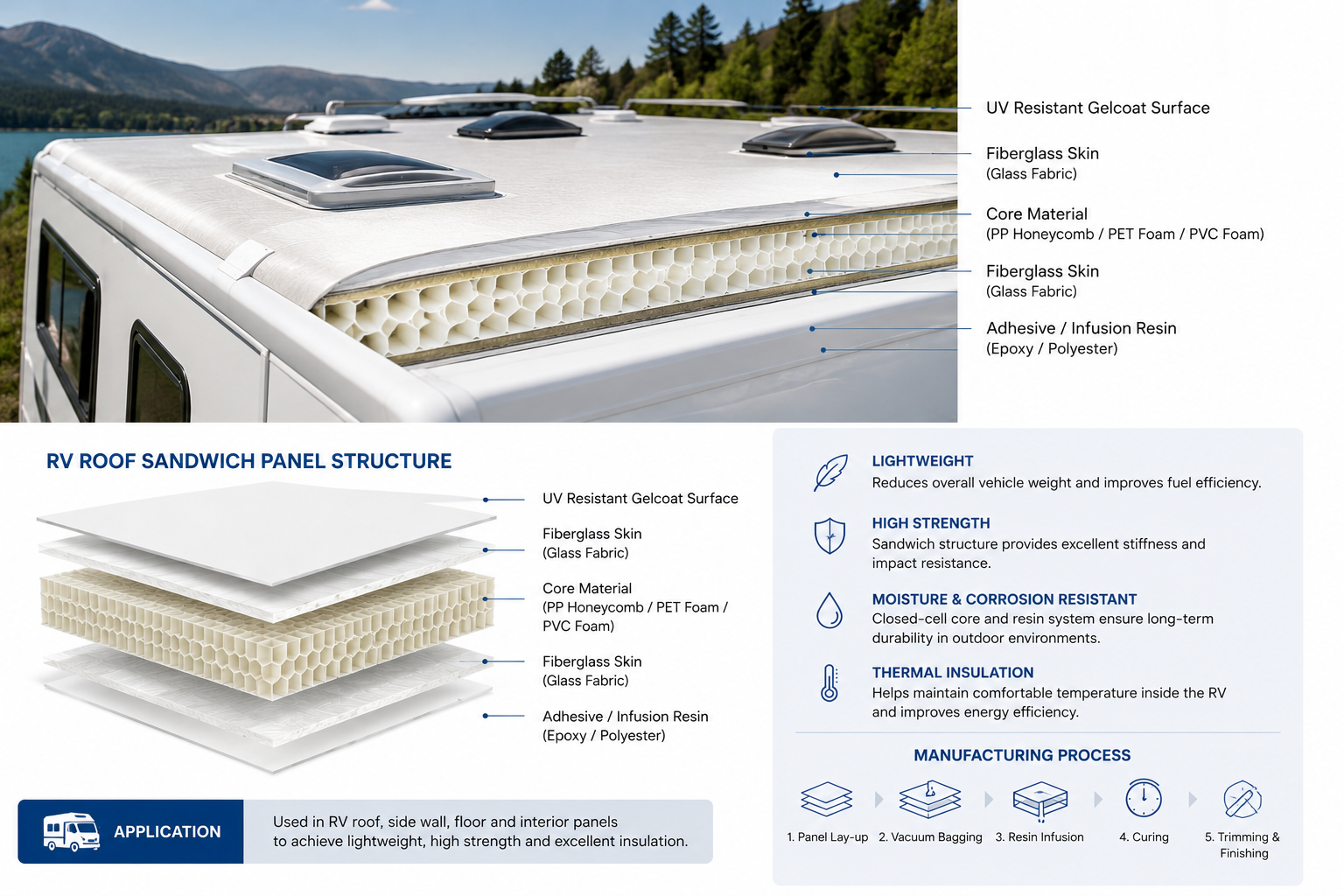
Multiaxial fiberglass fabrics were supplied to RV manufacturers in the United States for FRP panels. The project scale was 5 pallets. Key highlights include low weight and anti-UV performance. The project achieved glossy surface treatment and uniformity of thickness. The product is designed for long-term composite structural applications, providing lightweight, stiffness improvement, and durability benefits.
Sports Equipment Manufacturers, Thailand
PVC foam core was used by sports equipment manufacturers in Thailand for surfboard production. The project involved container orders. The product achieved weight reduction and performance improvement, with key highlights including high buoyancy and impact resistance. The product is designed for long-term composite structural applications.
Composite Distributors: UK, Czech Republic, and Poland
In the United Kingdom, CX Core Material was supplied to a composite material distributor for vacuum infusion composite structures. The case successfully solved the need for a reliable core material supply, achieving an alternative supply solution. Key highlights include fast lead time and reliable export logistics.
In the Czech Republic, PP honeycomb was used for vacuum infusion composite manufacturing. The project included an OEM label service and received good product feedback with monthly reorders. In Poland, PP honeycomb was used for composite structures applications via vacuum infusion. The project involved container orders with repeat orders every month and included OEM logo customization.
CINON Core Material Options by Application
The table below summarizes the key models in CINON's core material portfolio, the applications they serve, and the main specification ranges available.
| Material Family | Model | Key Applications | Available Specifications | Max Process Temperature | Positioning |
|---|---|---|---|---|---|
| PVC foam core | PVC foam core | Marine & yacht, wind energy, rail, RV & caravan, industrial composites, construction panels, defense | 45–300 kg/m³; 1–80 mm; plain / grooved / perforated / scrim-backed | — | Divinycell alternative |
| Recyclable Foam Core | PET foam core | Marine, wind energy, transport, rail, RV & caravan, industrial composites, renewable energy | 80–320 kg/m³ | — | Lightweight structural core |
| PMI foam core | PMI foam core | Aerospace, UAV & drone, motorsport, high-performance marine, defense, sports equipment | 40–130 kg/m³ | — | Rohacell alternative |
| Structural Core Material | CM core mat | Marine & yacht, transport, wind energy, RV & caravan, infrastructure | 1.5–6 mm; 125–360 g/m²; roll length 25–80 m; width 1.27 m | 175°C | Polyester nonwoven infusion core |
| Lightweight Infusion Core | CT Core Material | Marine & yacht, transport, wind energy, composite tooling, sports & leisure | 1.5–3 mm; 90–160 g/m²; roll length 50–120 m; width 1.27 m | 180°C | Thin flow core material |
| General Purpose Core Material | CS Core Material | Marine & yacht, transport, wind energy, RV & caravan, infrastructure | 2–3 mm; 130–170 g/m²; roll length 50–80 m; width 1.27 m | 170°C | Vacuum infusion core material |
| Infusion Core Material | CX Core Material | Marine & yacht, wind power, automotive & rail transit, aerospace & UAV, construction & sanitary ware | 1.5–3 mm; 120–220 g/m²; roll length 40–70 m; width 1.27 m | 180°C | Soric LRC alternative |
| Thermoplastic Honeycomb Core | PP honeycomb sheet | Transportation, RV & caravan, marine & yacht, construction, industrial composites | 5–100 mm; 70 / 80 kg/m³; 1220 × 2440 mm standard, customized sizes | — | Thermoplastic honeycomb panel |
| Aramid honeycomb core | Nomex Honeycomb | Aerospace, aircraft interiors, UAV structures, defense, racing yachts, radar structures | Cell 1.83–5.5 mm; 32–128 kg/m³; 2440 × 1220 mm | -60°C to 180°C working range | Nomex-type honeycomb |
Fiberglass reinforcements are also available to support the same projects. The Light Weight Fiberglass Cloth spans 25–400 g/m² in plain weave, and the Multiaxial Fiberglass Fabrics span 400–1500 g/m² in unidirectional, biaxial, triaxial, and quadriaxial orientations. This allows a buyer to consolidate reinforcement and core material sourcing in one qualification process.
Core Material Capability: Frequently Asked Questions
Does CINON hold third-party certifications for core material supply?
Yes. CINON operates under ISO 9001:2015 (certificate 51326Q04922R053), ISO 14001:2015 (certificate ISO14001-2023-001, issued by SGS), and ISO 45001:2018 (certificate 51326S01896R053) management systems. All three certificates are valid through 2028–2029. In addition, every order is subject to pre-shipment testing with a Quality Test Report as part of buying acceptance.
Can CINON produce custom core materials or OEM-branded products?
Yes. CINON provides ODM production services, and customization is available for core materials and fiberglass fabric. This includes custom dimensions, surface options, roll formats, and OEM label or logo services for distributors and equipment manufacturers. In the Czech Republic, CINON supplied PP honeycomb with OEM label service; in Poland, a distributor order included OEM logo customization.
What is CINON's MOQ and what are the payment terms?
For customized core material production, the MOQ is 1,000 m². For fiberglass fabric, the MOQ is 100 m². Payment terms are 30% deposit in advance and 70% balance by T/T before shipment. Delivery methods include FOB, CIF, and EXW.
How can a manufacturer evaluate CINON materials before committing to volume?
CINON supports sample evaluation through its engineering team, offering technical documentation and online meetings. In the United Kingdom, a distributor case started with sample evaluation before moving to commercial supply, and the project solved the need for a reliable core material supply for vacuum infusion applications.
What are CINON's production lead times and capacity?
CINON's standard production lead time is 15–30 days, supported by a monthly capacity of 100,000 m² and an annual output of 1,200,000 m² from a 40,000 m² facility. For a current project timeline or sample request, contact waylon@cinoncomposites.com.
Evaluating CINON as a Core Material Partner
At the evaluation-to-execution stage, a core material supplier must prove three things: the material portfolio matches the application, the production system can deliver at the required volume and quality, and the engineering support can help if the process needs adjustment. CINON addresses all three with a documented capability: ODM and customization services, a portfolio spanning PET, PVC, PMI, Core Mat, PP honeycomb, aramid honeycomb, and fiberglass reinforcements, 100% testing under certified management systems, and a 15–30 day lead time backed by 100,000 m² monthly capacity.
The application evidence supports the capability story. Marine and yacht builders in Australia achieved smooth surface and easy wet-out with PP honeycomb. UAV manufacturers in Germany achieved ultra-lightweight structures and high stiffness with PMI foam. RV manufacturers in the United States achieved glossy surface treatment and uniform thickness. Distributors in the UK, Czech Republic, and Poland built repeat supply arrangements with OEM labeling and reliable logistics.
For a project team that wants to verify capability before placing volume orders, the practical next step is a sample evaluation combined with a specification review. CINON's technical support covers material selection, vacuum infusion guidance, alternative material recommendations, and quality traceability from prototype to mass production.
Ready to evaluate CINON core materials for your composite project?
Download the CINON catalog to review the full product range, or contact the team for material selection support and samples.
Email: waylon@cinoncomposites.com | Tel: +86 186-2098-8848 | WhatsApp: +86 135-8036-3674
Guangdong Cinon New Material Technology Co., Ltd, Building 3, No.1, Yiheng Lane, Jinnan Second Street, Dachongkou Village, Shawan Street, Panyu District, Guangzhou, China