PVC Foam Core Partnership FAQ: Long-Term Supply & After-Sales Support
PVC Foam Core Partnership FAQ: Long-Term Supply & After-Sales Support
Cover: closed-cell PVC foam core, supplied in nine density grades and 1–80 mm thickness for sandwich construction.
Most buyers start by comparing boards and end by choosing a supply relationship. This FAQ-style guide answers the questions that appear once a PVC foam core supplier moves from first sample to repeat order: what the material actually is, what can be customized, how quality is documented, what commercial terms apply, how samples are validated, and what support continues after the container ships.
Guangdong Cinon New Material Technology Co., Ltd. — CINON Composites — is a Guangzhou-based manufacturer of fiberglass reinforcements and lightweight core materials for marine, transportation, wind energy, industrial and aerospace composite applications. Its core material portfolio includes closed-cell PVC foam core, PET foam core, PMI foam core, Core Mat, PP honeycomb and aramid honeycomb. Established in 2022, the company operates a 40,000 m² facility with a 25-engineer R&D team and exports 100% of its output to Europe, North America and Asia-Pacific markets.
Why PVC Foam Core Sourcing Becomes a Partnership Question
A PVC foam core board is a structural input, not a shelf item. Once a laminate schedule is qualified, the density grade, thickness, surface treatment and infusion behaviour become part of the production recipe — and changing the core supply means repeating part of that qualification work. That is why the questions raised during evaluation are rarely about a single shipment.
Four concerns push buyers toward a partnership framing:
- Consistency. Will the next batch match the density, thickness and surface finish of the batch that was qualified?
- Process support. If the resin system, infusion strategy or cure cycle changes, who re-checks compatibility with the core?
- Documentation. Can the supplier provide the test records and traceability that internal quality systems require?
- Continuity. Will the same core material still be available when a build programme runs for years rather than weeks?
Each of these is a capability question. They are answered by production capacity, quality control, technical service and commercial reliability — not by a data sheet alone.
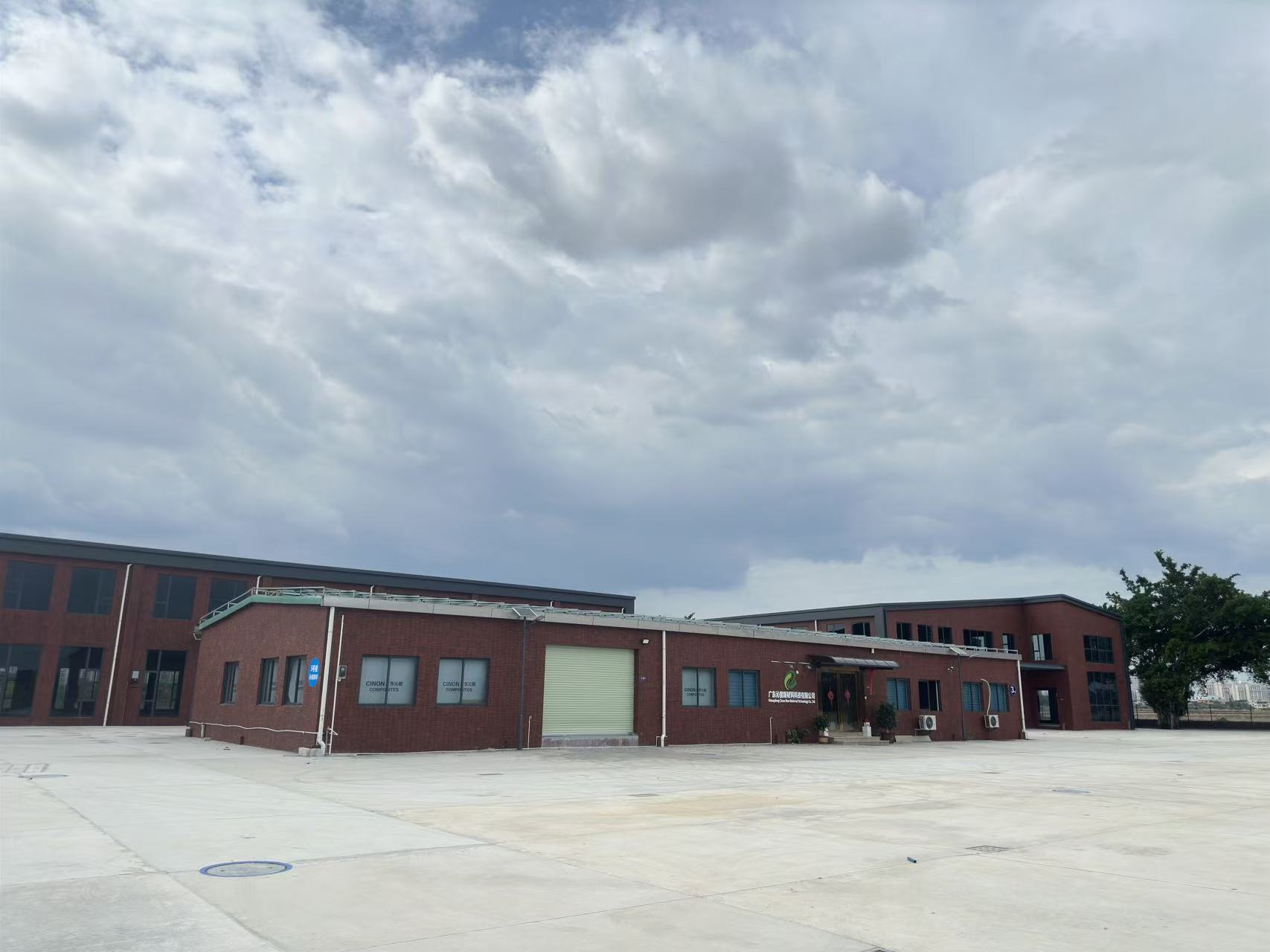
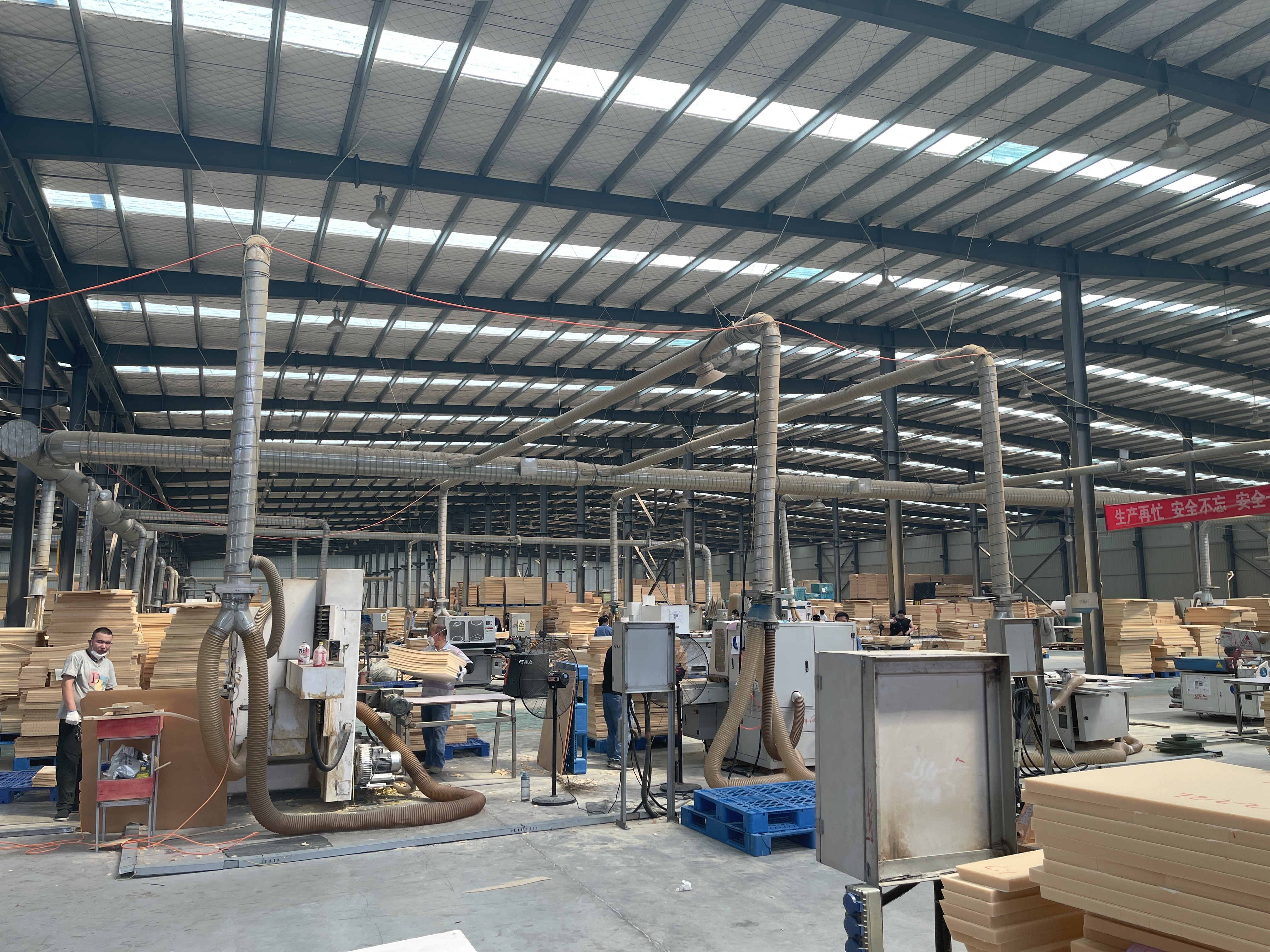
Production facility covering fiberglass fabrics, multiaxial reinforcements, PET foam core, PVC foam core, Core Mat and honeycomb core materials.
Industry Background: Why Core Material Demand Keeps Growing
Third-party market data explains why buyers increasingly negotiate supply relationships instead of spot orders. The global core materials market was valued at USD 4.19 billion in 2024 and is projected to reach USD 6.84 billion by 2032, driven by wind energy and aerospace demand (Vertex AI Search / Industry Report 2032). Within that total, the marine structural core materials market reached USD 120.4 million in 2024, and PVC is expected to remain the dominant material because of its moisture resistance (Stratview Research).
Adjacent segments point in the same direction. The wind turbine blade composite materials market was valued at USD 7.045 billion in 2024, with China's production capacity exceeding 35 GW (Cognitive Market Research), and Asia Pacific held a 78.2% value share of the global wind turbine composites market in 2024 (MarketsandMarkets). The global RV composite panels market was valued at USD 3.8 billion in 2025, with fiberglass segments holding 41.3% of material share (Dataintelo).
For procurement teams the implication is practical: as marine, wind, rail and RV programmes extend their build schedules, suppliers are judged on repeatability, not only on first-order pricing. The comparison set buyers usually study includes 3A Composites (Switzerland), Gurit Holding AG (Switzerland) and Diab Group (Sweden), alongside specialist manufacturers such as CINON.
What CINON Supplies: PVC Foam Core and the Wider Core Portfolio
CINON's PVC foam core is a closed-cell PVC foam positioned as a Divinycell alternative for sandwich construction. It is supplied in nine density grades — 45, 50, 60, 80, 100, 130, 200, 250 and 300 kg/m³ — with thickness from 1 to 80 mm and four surface options: plain, grooved, perforated and scrim-backed. The grade is compatible with vacuum infusion, RTM, hand lay-up, prepreg and VARTM processing, which makes it usable both as a core material for vacuum infusion production and as a core material for lightweight structures built by hand lay-up.
| Specification | Detail |
|---|---|
| Base material | Polyvinyl chloride — closed-cell PVC foam |
| Positioning | Divinycell alternative core material for sandwich structures |
| Density grades | 45, 50, 60, 80, 100, 130, 200, 250, 300 kg/m³ |
| Thickness range | 1–80 mm |
| Surface options | Plain / Grooved / Perforated / Scrim-backed |
| Processing compatibility | Vacuum infusion, RTM, hand lay-up, prepreg, VARTM |
| Declared application industries | Marine & yacht building, wind energy, transportation, rail vehicles, RV & caravan manufacturing, industrial composites, construction panels, defense applications |
Around the PVC grade, the portfolio covers PET foam core (80–320 kg/m³), PMI foam core (40–130 kg/m³), the Core Mat family (CM, CT, CS and CX core materials), thermoplastic PP honeycomb sheet (5–100 mm thick, 70/80 kg/m³, with 6/8/10/12 mm cell sizes) and aramid honeycomb core (32–128 kg/m³, working temperature −60 to 180 °C). Fiberglass fabrics and multiaxial reinforcements complete the sandwich build for boat hulls, wind turbine blades and automotive components. Customization services cover core materials and fiberglass fabric, and ODM production is available.
Long-Term Supply: Capacity, Consistency and Quality Control
Three figures describe CINON's ability to carry a long-term programme: monthly production capacity of 100,000 m², annual output of 1,200,000 m², and a standard lead time of 15–30 days. Production runs in a 40,000 m² facility, and quality control is a 100% test regime rather than sampling.
Certification supports the documentation side of the relationship. The quality management system is certified to ISO 9001:2015 under certificate 51326Q04922R053, issued by Shenzhen Moqc Certification Co., Ltd. and valid from 29 April 2026 to 28 April 2029, with the scope "Sales of High-performance Fibers and Composite Materials". Occupational health and safety is certified to ISO 45001:2018 (certificate 51326S01896R053), and environmental management to ISO 14001:2015 (certificate ISO14001-2023-001, issued by SGS, valid 1 June 2023 to 1 June 2028, scope "Composite intermediates sales").
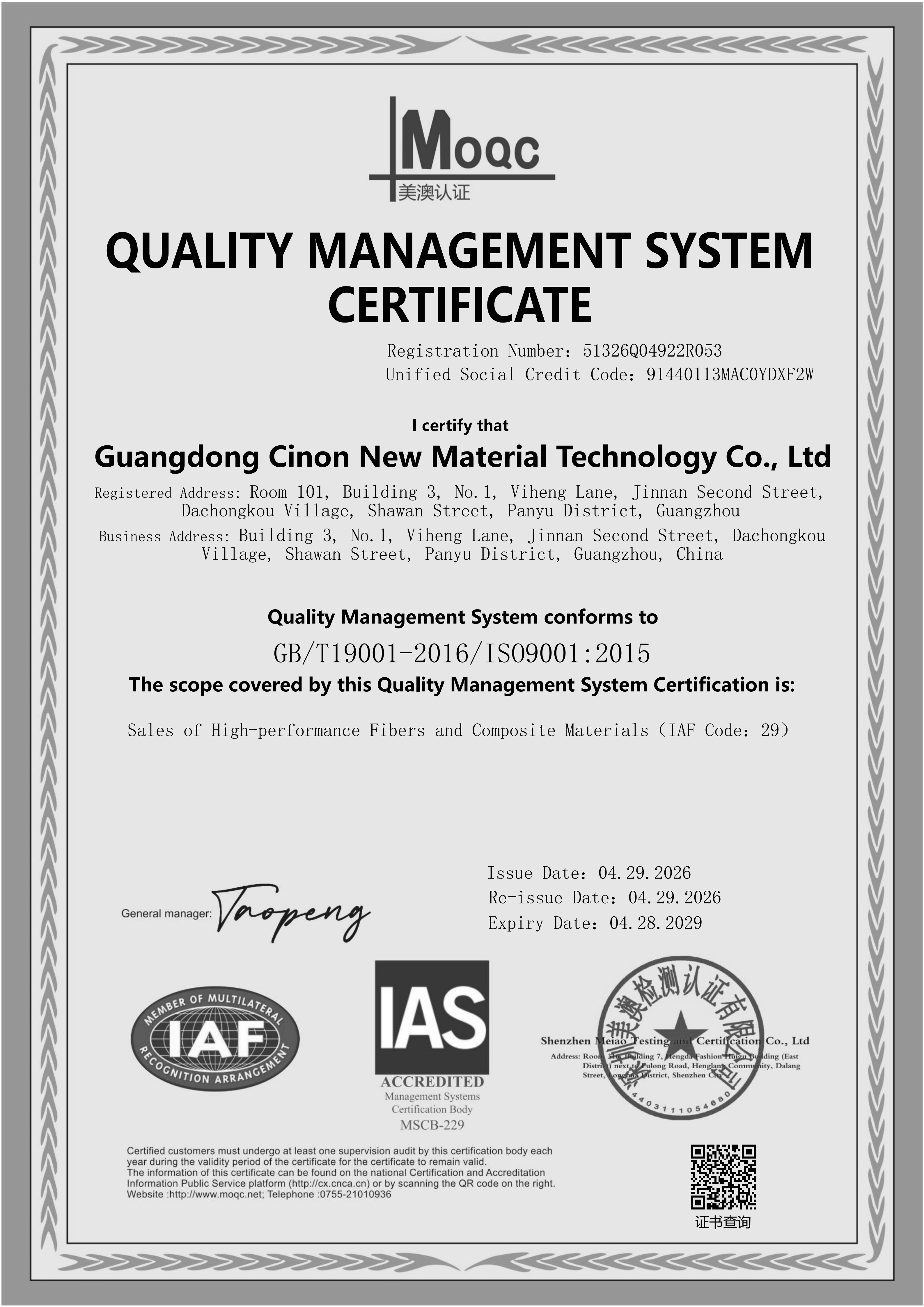
ISO 9001:2015 quality management certification, certificate 51326Q04922R053.
Because export is the entire business — 100% of output ships to Europe, North America and Asia-Pacific — order handling, packing and shipping are built around international delivery rather than domestic resale. That matters when a buyer needs a core material for sandwich panels delivered on a repeating schedule instead of a one-off purchase.
After-Sales Support: What Support Actually Covers
After-sales support for CINON core materials is technical rather than administrative. The service scope covers material selection for a specific laminate schedule, composite process optimization, vacuum infusion guidance, alternative material recommendations when a design or resin system changes, sample evaluation, quality traceability, and global logistics coordination.
Support is delivered through email, WhatsApp, online meetings and technical documentation, and is structured to assist customers from prototype development through to mass production. In practice, that means the engineering contact who helped choose a density grade stays available when the infusion cycle or the panel design is adjusted.
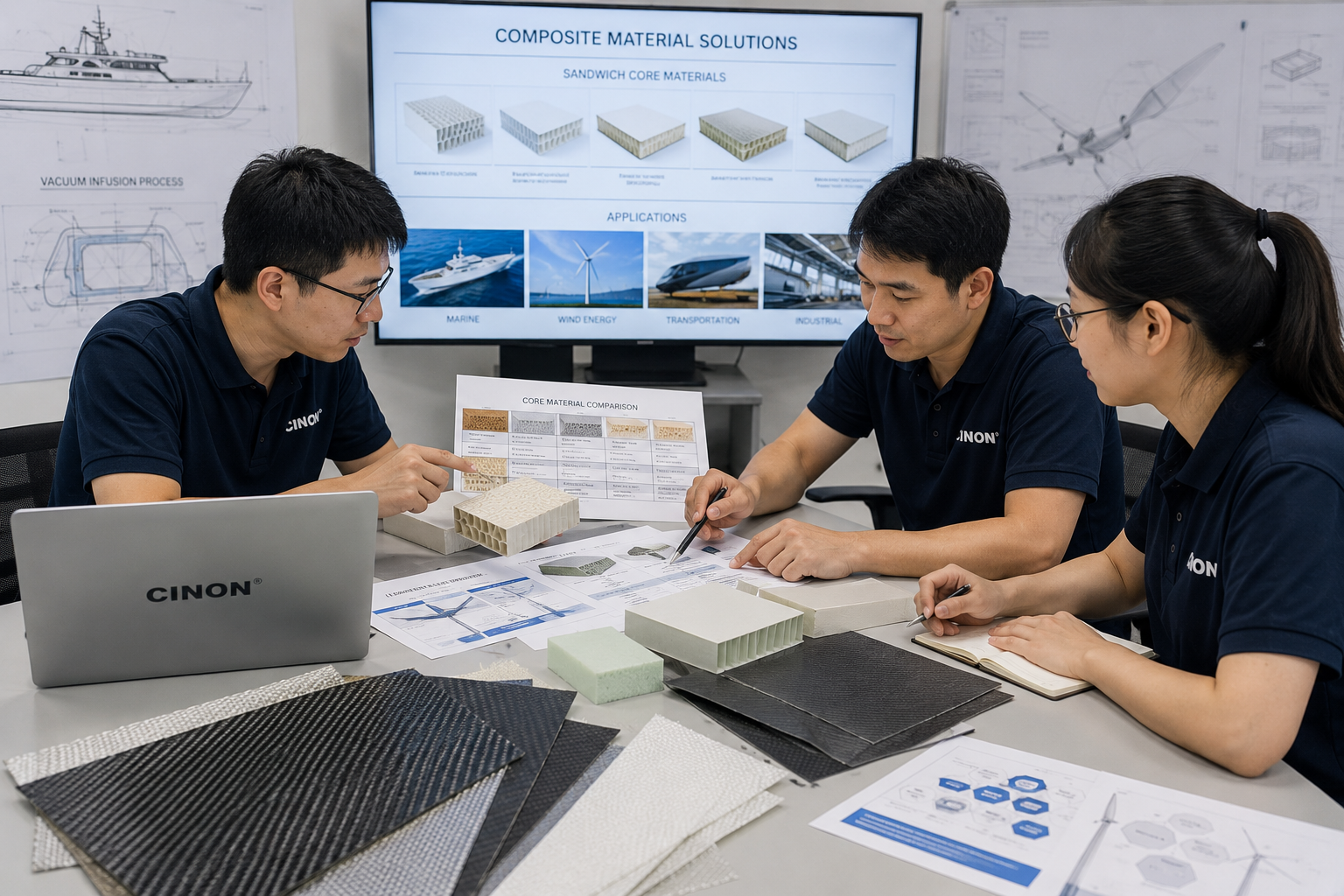
Material selection and engineering support during the evaluation stage.
The value is easiest to see in process terms. A core material for vacuum infusion behaves differently at 45 kg/m³ than at 250 kg/m³, and grooved or perforated surfaces change resin distribution. Support that continues past the first order keeps those variables under control when recipes evolve.
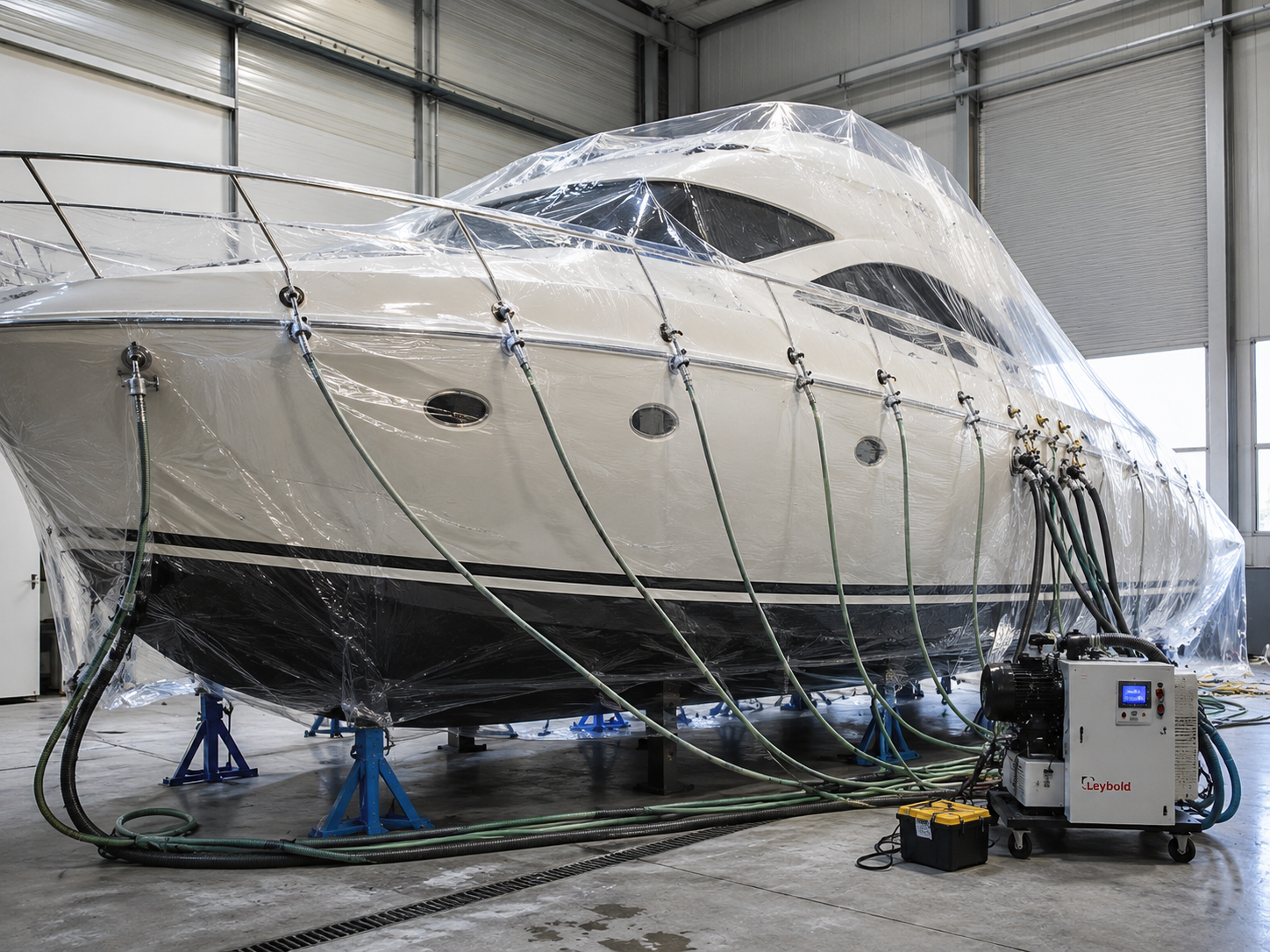
Vacuum infusion process support during prototype and production runs.
Setting Up a Long-Term PVC Foam Core Partnership: Step by Step
Step 1 — Application and specification review
Share the target application — a core material for boat building, a core material for wind turbine blades, a core material for RV panels or a core material for railway interiors — together with the required density grade, thickness and surface option. Material selection support starts here, and it is the point where the PVC grade is either confirmed or an alternative from the portfolio is proposed.
Step 2 — Sample evaluation
Validate the chosen grade against the real laminate: wet-out, resin uptake, drape and bonding. Sample evaluation is part of the standard service scope, which lets a buyer test a specification before committing production volumes.
Step 3 — Process validation
Confirm compatibility with vacuum infusion, RTM, hand lay-up, prepreg or VARTM, and adjust the cycle if required. This is also where alternative material recommendations become useful — for example, when a thin flow core is a better fit than a foam for a complex mould geometry.
Step 4 — Commercial framework
Agree delivery terms (FOB, CIF or EXW), payment terms (30% deposit in advance and 70% balance by TT before shipment), and acceptance criteria (pre-shipment test and Quality Test Report). These terms are published in CINON's purchasing and acceptance guidance, so they can be reviewed before the first order rather than negotiated after it.
Step 5 — Production and quality control
Production runs in a 40,000 m² facility under a 100% test regime, with a standard lead time of 15–30 days and monthly capacity of 100,000 m². ISO 9001:2015 certified quality management backs the documentation trail.
Step 6 — Logistics coordination
Export documentation, packing and shipment are coordinated for delivery into Europe, North America or Asia-Pacific destinations, which keeps long-distance replenishment predictable.
Step 7 — Reorder cadence and ongoing support
Long-term partnerships settle into a rhythm. Composite material distributors in Poland and the Czech Republic place container orders with repeat orders every month, and OEM logo and label customization keeps the delivered material aligned with local branding.
Use Cases: Where the Partnership Model Is Already Working
Shipped projects show how the model behaves across applications rather than in theory:
- Sports equipment — Thailand. PVC foam core (product 4403) was supplied to sports equipment manufacturers for surfboard production in container quantities. The project achieved weight reduction and performance improvement, with high buoyancy and impact resistance as key highlights — the same lightweight sandwich logic used in boat building and yacht hulls.
- RV and FRP panels — United States. Multiaxial fiberglass fabric (product 4367) was used by an RV manufacturer for FRP panels across a 5-pallet project, achieving a glossy surface and uniform thickness, with low weight and anti-UV performance as highlights. PP honeycomb and PET foam sandwich panels are used in comparable lightweight RV construction, including RV roofs.
- Marine and yacht building — Australia. PP honeycomb sheet (product 4507) was supplied in container quantities for boat building materials and tools. The highlight was material selection support, and the outcome was a smooth surface, easy wet-out and a better finish.
- UAV structures — Germany. PMI foam core (product 4405) was supplied as 10 pallets of core material for UAV production, achieving ultra-lightweight structures, high stiffness and high temperature resistance, with fatigue resistance and low density as key highlights.
- Distributor partnerships — Europe. A composite material distributor in the Czech Republic used product 4507 for vacuum infusion composite manufacturing with OEM label service, good product feedback and monthly reorders. A distributor in Poland placed container orders every month with OEM logo customization. A distributor in the United Kingdom used CX Core Material (product 4400) for vacuum infusion composite structures and obtained an alternative supply solution with fast lead time and reliable export logistics.
Read together, these cases show what buyers actually test before extending an agreement: whether the same grade can be re-ordered, whether application support is available when a core material for composite molds or a core material for lightweight engineering is required, and whether OEM customization can be handled without disrupting the schedule.
Core Material Portfolio Comparison
Not every project should use PVC foam. The table below compares the core materials in CINON's portfolio using published product specifications so that buyers can see where the PVC grade fits against alternatives.
| Core material | Base material | Density | Thickness | Format / processing notes | Typical applications |
|---|---|---|---|---|---|
| PVC foam core (4403) | Polyvinyl chloride | 45–300 kg/m³ | 1–80 mm | Plain, grooved, perforated or scrim-backed; vacuum infusion, RTM, hand lay-up, prepreg, VARTM | Marine & yacht building, wind energy, transportation, rail vehicles, RV & caravan manufacturing, industrial composites, construction panels, defense applications |
| PET foam core (4404) | Polyethylene terephthalate | 80–320 kg/m³ | — | Recyclable foam core | Marine & yacht building, wind energy, transportation, rail vehicles, RV & caravan, industrial composites, construction panels, renewable energy |
| PMI foam core (4405) | Polymethacrylimide | 40–130 kg/m³ | — | Rohacell alternative | Aerospace, UAV & drone manufacturing, motorsport, high-performance marine, defense & military, sports equipment |
| CM core mat (4396) | Polyester nonwoven fabric | Dry weight 125–360 g/m² | 1.5–6 mm | Roll width 1.27 m; max. process temperature 175 °C | Marine & yacht building, transportation, wind energy, industrial composites, RV & caravan, infrastructure |
| CT Core Material (4397) | Polyester nonwoven fabric | Dry weight 90 / 120 / 160 g/m² | 1.5–3 mm | Roll width 1.27 m; max. process temperature 180 °C | Marine & yacht building, transportation, industrial composites, wind energy, composite tooling, sports & leisure equipment |
| CS Core Material (4398) | Polyester nonwoven fabric | Dry weight 130 / 170 g/m² | 2–3 mm | Roll width 1.27 m; max. process temperature 170 °C | Marine & yacht building, transportation, industrial composites, wind energy, RV & caravan, infrastructure |
| CX Core Material (4400) | Polyester | Dry weight 120 / 150 / 220 g/m² | 1.5–3 mm | Roll width 1.27 m; max. process temperature 180 °C; Soric LRC alternative | Marine & yacht, wind power, automotive & rail transit, aerospace & UAV, construction & sanitary ware, anti-corrosion industry |
| PP honeycomb sheet (4507) | Polypropylene | 70 / 80 kg/m³ | 5–100 mm | Cell size 6/8/10/12 mm; 1220 × 2440 mm; PP nonwoven or fiberglass skin; cutting, CNC machining, lamination, thermoforming | Transportation, RV & caravan, marine & yacht, construction, industrial composites |
| Aramid honeycomb core (4410) | Aramid paper | 32–128 kg/m³ | Block and slice supply, 2440 × 1220 mm | Cell size 1.83 / 2.75 / 3.67 / 5.5 mm; working temperature −60 to 180 °C | Aerospace and aircraft interiors, helicopter panels, UAV structures, sandwich panels, motorsport, defense, radar structures, marine racing yachts |
A dash (—) means the parameter is not stated in the available product specification. Buyers evaluating flow-media cores should also note that Lantor Soric XF and Soric SF are non-woven polyester cores acting as internal flow media, with Soric SF using fine hexagon cells of roughly 2–3 mm for sharp corners (Lantor BV / Tricel Composites); CINON's CX Core Material is positioned as a Soric LRC alternative, so a Soric XF alternative or Soric SF alternative search should be validated against the actual laminate rather than assumed equivalent.
FAQ: PVC Foam Core, Long-Term Supply and After-Sales Support
Does CINON provide documented quality control and third-party certification for PVC foam core?
Yes. CINON operates a 100% test quality-control regime, and its quality management system is certified to ISO 9001:2015 under certificate 51326Q04922R053, issued by Shenzhen Moqc Certification Co., Ltd., valid from 29 April 2026 to 28 April 2029, with the scope "Sales of High-performance Fibers and Composite Materials". Occupational health and safety is certified to ISO 45001:2018 (certificate 51326S01896R053), and environmental management to ISO 14001:2015 (certificate ISO14001-2023-001, issued by SGS, valid 1 June 2023 to 1 June 2028, scope "Composite intermediates sales"). For individual orders, acceptance criteria are a pre-shipment test and a Quality Test Report, which supports internal traceability records.
Can PVC foam core be customized in density, thickness, surface type and OEM labelling?
Yes. PVC foam core is available in 45, 50, 60, 80, 100, 130, 200, 250 and 300 kg/m³ densities, thickness from 1 to 80 mm, and plain, grooved, perforated or scrim-backed surfaces. Customization services cover core materials and fiberglass fabric, and ODM production is available. OEM labelling is an established part of the model rather than an exception: a composite material distributor in the Czech Republic received OEM label service, and a distributor in Poland received OEM logo customization, both with container orders and repeat orders every month.
What commercial terms apply to a repeat PVC foam core order?
Delivery terms are FOB, CIF or EXW. Payment terms are 30% deposit in advance with the 70% balance by TT before shipment. Acceptance criteria are a pre-shipment test and a Quality Test Report. Because density grade, thickness and surface option are selected per project, these terms are confirmed per configuration during quotation rather than published as a single catalogue price.
Can samples be evaluated before committing to a long-term agreement?
Yes. Sample evaluation is part of CINON's after-sales service scope, which also covers material selection, composite process optimization, vacuum infusion guidance, alternative material recommendations and quality traceability. Support is delivered through email, WhatsApp, online meetings and technical documentation, and is designed to assist customers from prototype development to mass production. In practice, a buyer can validate a PVC foam core grade against its own laminate schedule and infusion process before scaling to production volumes.
What lead time and long-term supply support should a buyer expect?
Standard lead time is 15–30 days, supported by monthly production capacity of 100,000 m² and annual output of 1,200,000 m² from a 40,000 m² facility. Continuity is reinforced by export logistics coordination across Europe, North America and Asia-Pacific, and by an established reorder pattern with European distributors that place container orders monthly. Buyers ready to move from evaluation to execution can download the full CINON catalogue, request a PVC foam core sample, or send a specification for quotation to waylon@cinoncomposites.com, WhatsApp +86 135-8036-3674, or the online catalogue at CINON Composite Materials Catalogue.
Conclusion: What a Long-Term PVC Foam Core Partner Should Demonstrate
A long-term PVC foam core agreement rests on four verifiable things: a defined material (closed-cell PVC foam, Divinycell alternative, 45–300 kg/m³, 1–80 mm, four surface options), documented quality (100% testing plus ISO 9001:2015, ISO 45001:2018 and ISO 14001:2015 certification), dependable capacity (100,000 m² monthly, 1,200,000 m² annually, 15–30 day lead time), and support that continues after delivery (material selection, process optimization, vacuum infusion guidance, sample evaluation, quality traceability and logistics coordination).
Buyers evaluating a core material for marine, wind, transportation, RV, rail or aerospace programmes can test all four of those claims in one cycle: start with a sample, validate the grade in production, then measure whether the second and third orders arrive the same way the first one did.
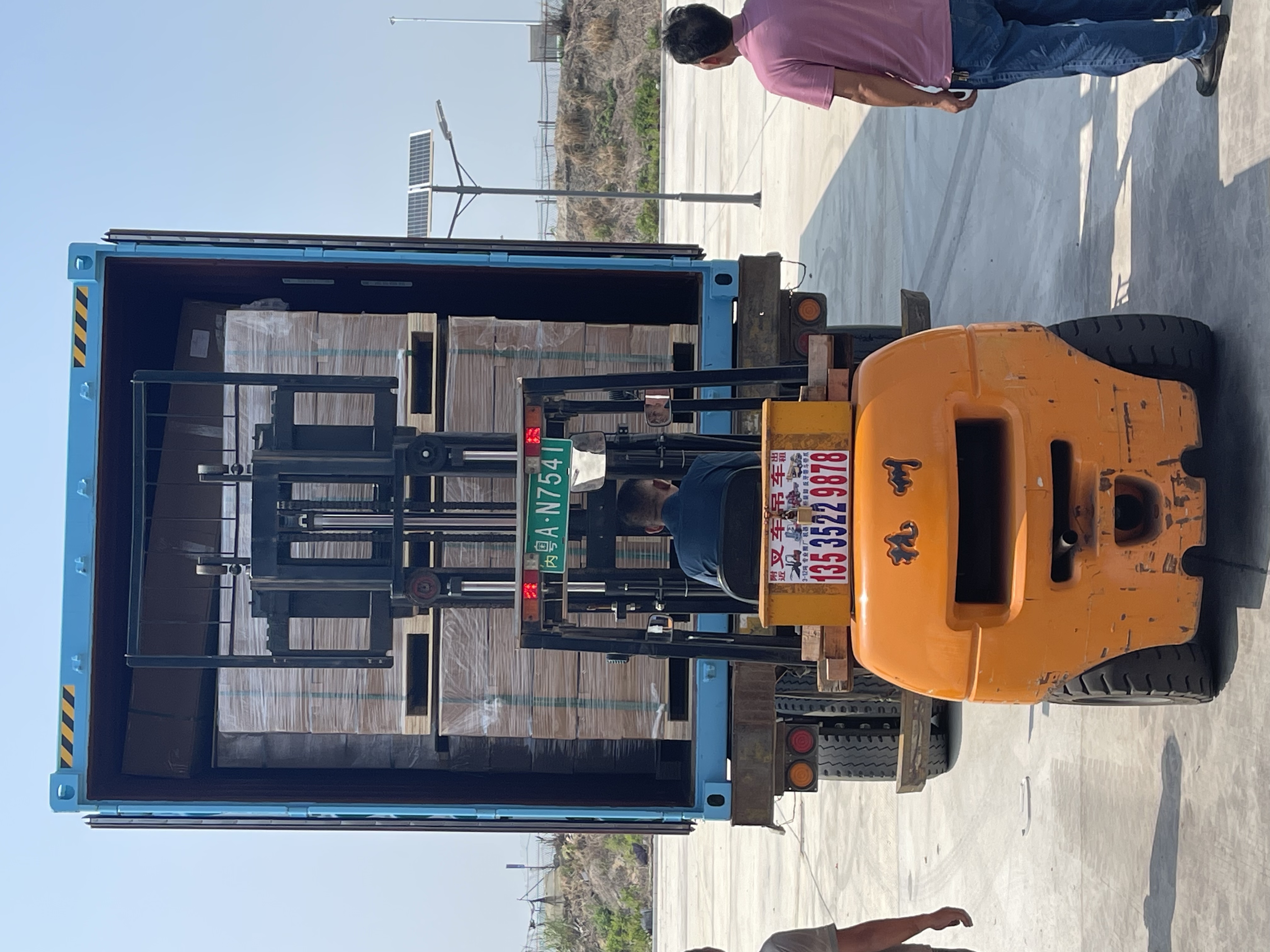
Export logistics coordination supporting long-term core material supply.
Next Step: Sample, Specification Review or Catalogue
Send your application and required density, thickness and surface option for a specification review, request a PVC foam core sample for laminate validation, or download the complete product catalogue: CINON Composite Materials Catalogue (PDF).
Contact: waylon@cinoncomposites.com | Tel +86 186-2098-8848 | WhatsApp +86 135-8036-3674 | cinoncomposites.com
Have Questions or Need More Details?
Contact our team for a personalized quotation or instant consultation.
Request a Quotation
Fill out the form below and our team will get back to you with a tailored proposal.
WhatsApp Direct Chat
Prefer to chat in real-time? Message us on WhatsApp for instant assistance & quick answers.
- Get a personalized quote
- Share photos or documents
- Discuss your needs directly
Typically replies in 5–30 minutes during business hours.