Process-Driven Fiberglass Fabric Selection for OEM Buyers
Fiberglass Fabric Process Selection: Matching Reinforcement to Vacuum Infusion, RTM, and Lamination
Fiberglass fabric selection is often treated as a specification exercise: choose a weight, pick a weave, confirm the width. In practice, the deciding factor is how the fabric performs inside a specific manufacturing process. A fabric that wets out easily by hand may not infuse cleanly under vacuum. A multiaxial reinforcement designed for resin transfer molding (RTM) may be unnecessarily stiff for a cosmetic surface layer.
This guide is written for engineers and purchasing teams evaluating a fiberglass fabric supplier for production. It explains how to match fabric architecture to vacuum infusion, RTM, and lamination, and what to verify before committing to volume orders.
Guangdong Cinon New Material Technology Co., Ltd. (CINON Composites) is a Chinese manufacturer of fiberglass reinforcements and lightweight core materials, exporting to Europe, North America, and Asia-Pacific. CINON produces woven E-glass fabrics, multiaxial non-crimp fabrics (NCF), and core materials including PET foam, PVC foam, PMI foam, and honeycomb. The company also offers ODM production services and process support for composite manufacturers.
Why Process Fit Determines Fiberglass Fabric Performance
Fiberglass fabric data sheets list glass type, weave, weight, and width. What they do not always show is how the fabric behaves when resin flows through it. Common production problems include incomplete wet-out in vacuum infusion, fiber waviness in RTM, surface porosity after demolding, and variable laminate thickness caused by poor fabric compaction.
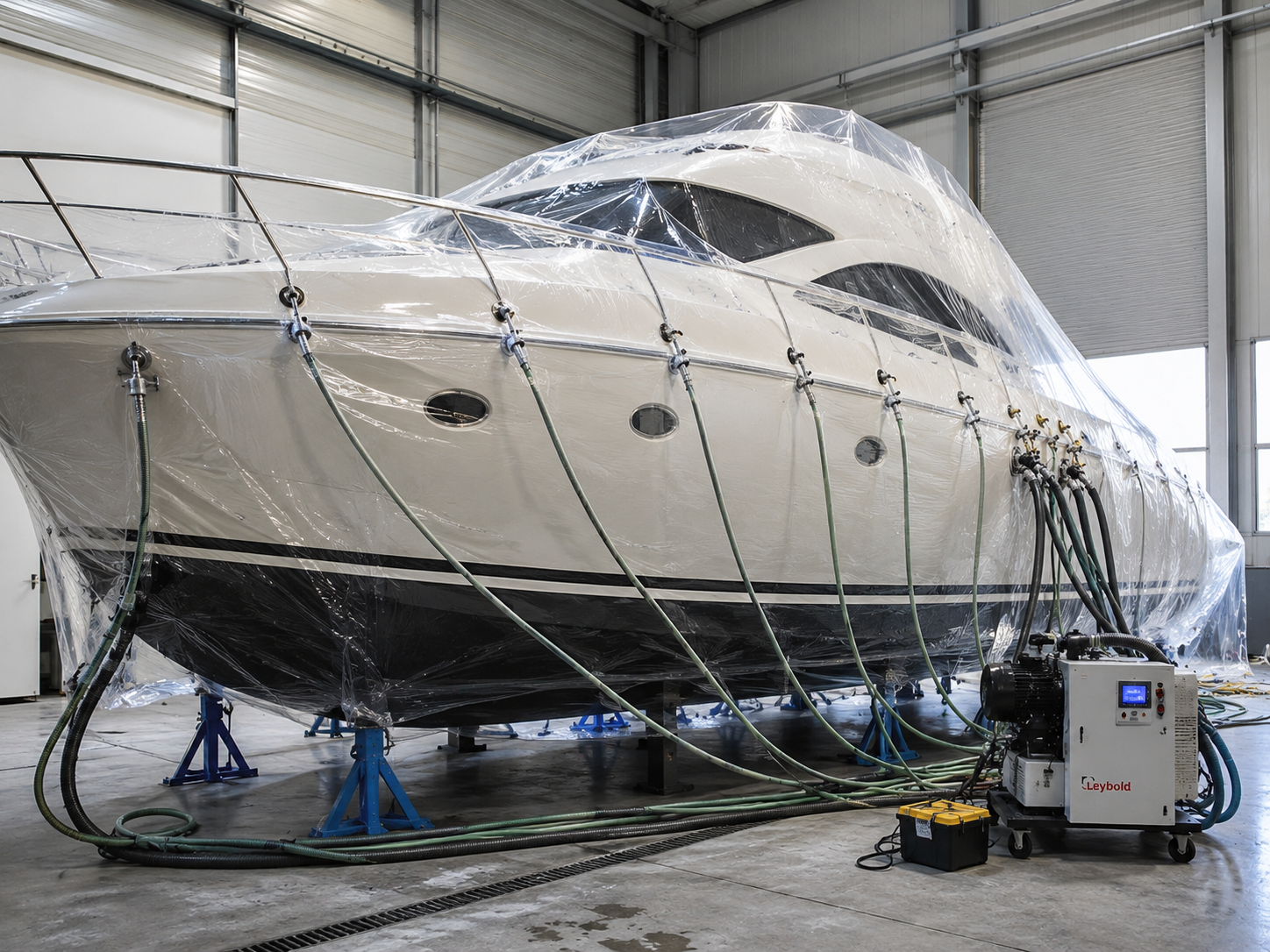
The root cause is often a mismatch between fabric architecture and process. Hand lay-up rewards fabrics that conform easily and wet out quickly. Vacuum infusion requires a fabric that allows resin to flow through the plane while maintaining fiber orientation. RTM demands dimensional stability so that reinforcement does not shift when the mold closes.
Two main fiberglass fabric families cover most of these needs:
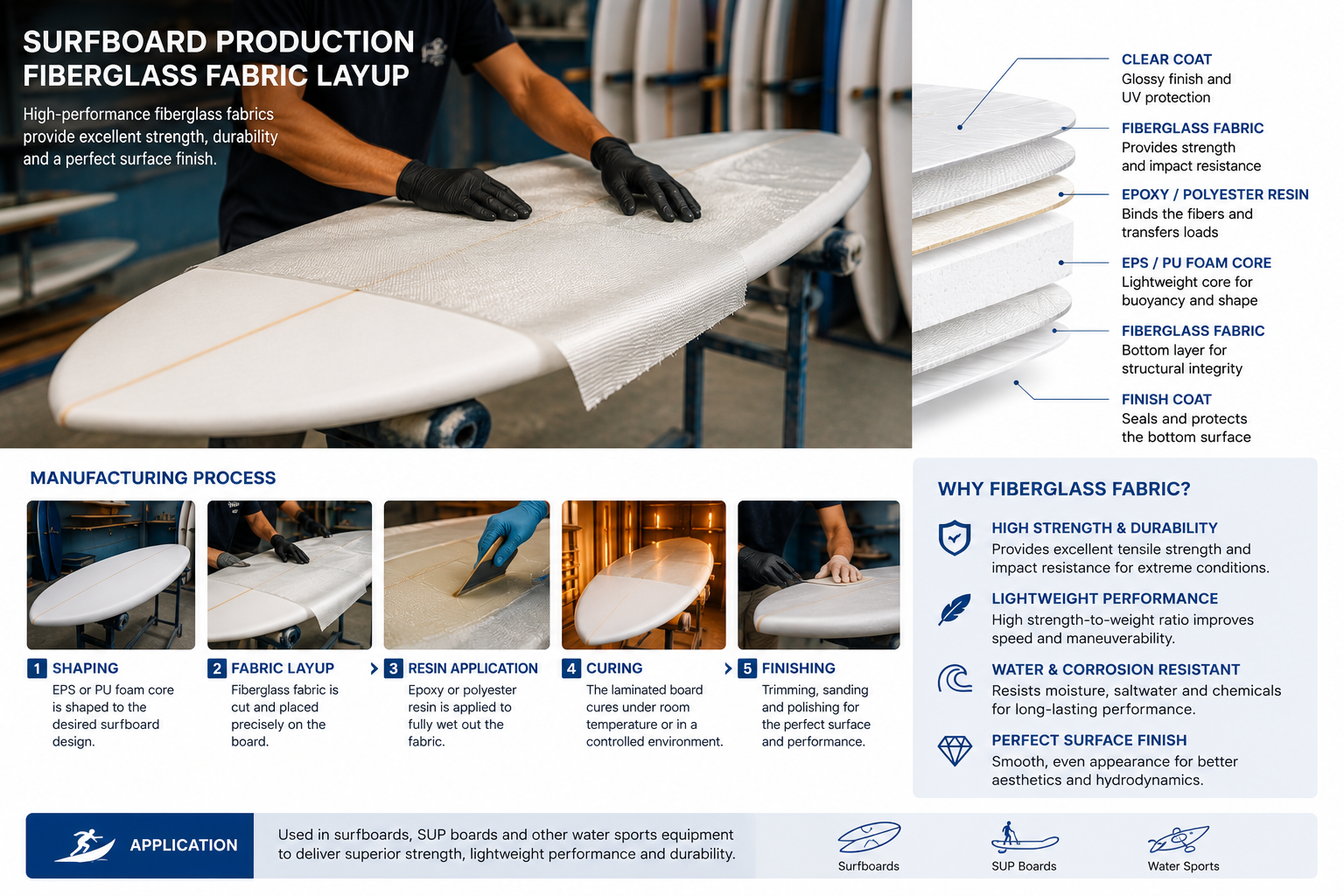
- Light weight woven E-glass cloth — a plain weave fabric used for surface layers, marine repair, surfboards, UAV structures, and composite tooling.
- Multiaxial non-crimp fabrics (NCF) — fiberglass reinforcements with straight fibers oriented in defined directions, used for boat hulls, wind turbine blades, automotive components, and large containers.
Industry Context: Where Fiberglass Fabric Demand Is Moving
The global fiberglass fabric market was valued at USD 14.01 billion in 2024 and is projected to reach USD 25.65 billion by 2033 (Grand View Research). Among application segments, wind energy is expected to grow at a CAGR of 8.5% from 2025 to 2033, the highest of any segment. Woven fiberglass fabrics captured 48.62% of market revenue in 2025, reflecting their continued role in yacht hulls and automotive panels (Mordor Intelligence). Asia Pacific led the market with a 41.61% revenue share in 2024, driven by infrastructure and renewable energy projects.
Wind turbine blades alone account for approximately 42.5% of total fiberglass usage in the wind energy sector (Dataintelo). As blade lengths increase, manufacturers favor non-crimp fabrics because their straight fibers and high fiber volume fraction improve structural efficiency. For marine and industrial buyers, this same logic applies: the fabric must match the loading direction and the infusion process.
Standardized test methods for fiberglass reinforced materials include ASTM D638 for tensile properties and ASTM D790 for flexural strength and modulus. These are commonly referenced when verifying material data before production.
Matching Fiberglass Fabric to Your Manufacturing Process
Hand Lay-Up and Surface Lamination: Light Weight E-Glass Cloth
CINON's Light Weight Fiberglass Cloth (Model EW) is a plain woven E-glass fabric available in weights from 25 to 400 g/m² and widths of 1000 mm and 1010 mm. Its weave structure allows resin wet-out by brush or roller, making it suitable for hand lay-up, surface finishing, and lightweight laminates. Typical applications include surfboard manufacturing, UAV structures, marine repair, composite tooling, and sports equipment.
Vacuum Infusion, RTM, and VARTM: Multiaxial Non-Crimp Fabrics
CINON's Structural Composite Reinforcement (Multiaxial Fiberglass Fabrics) is a non-crimp fabric family with unidirectional, biaxial, triaxial, and quadriaxial architectures. Weight ranges from 400 to 1500 g/m². Combustible matter content is 2.0% to 8.0%, and moisture content is less than 0.2%. The fabric is used in vacuum infusion, hand lay-up, extrusion, and RTM processes for products such as ship hulls, wind turbine blades, automotive components, sports equipment, and large containers.
Because the fibers are straight rather than crimped, multiaxial fabrics offer two practical advantages: higher fiber volume fraction in the cured laminate, and more predictable resin flow during infusion. Biaxial fabrics with 0°/90° or +45°/−45° fiber orientations allow engineers to align reinforcement with the primary load path without the waviness introduced by weaving.
What to Verify in a Supplier's Process Capability
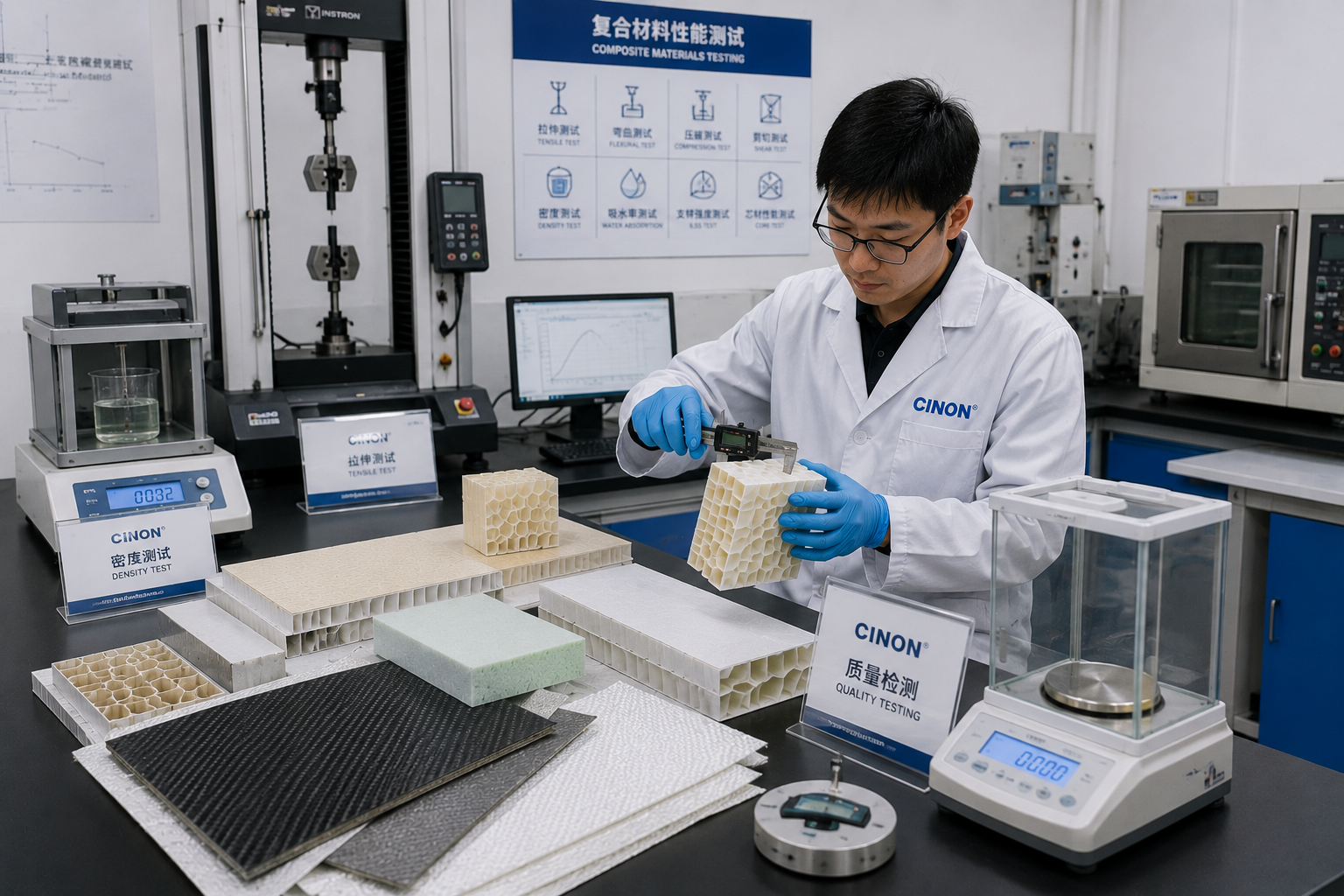
When a buyer moves from evaluation to execution, the supplier's production capability becomes as important as the product specification. CINON offers ODM production services for fiberglass fabric and core materials, with a monthly capacity of 100,000 m² and a minimum order quantity of 1,000 m². All products undergo 100% testing before shipment. Typical production lead time is 15 to 30 days.
After-sales support includes material selection, composite process optimization, vacuum infusion guidance, alternative material recommendations, sample evaluation, quality traceability, and global logistics coordination. This support is delivered through email, WhatsApp, online meetings, and technical documentation, and extends from prototype development to mass production.
Step-by-Step: Qualifying a Fiberglass Fabric Supplier for Production
- Define your process and load requirements. Identify whether parts will be manufactured by vacuum infusion, RTM, VARTM, or hand lay-up. Define the primary loading direction so the fabric architecture can be aligned accordingly.
- Select the fabric architecture. For hand lay-up and surface layers, choose a light weight woven cloth in the 25–400 g/m² range. For structural infused parts, choose a multiaxial NCF in the 400–1500 g/m² range with the appropriate fiber orientation.
- Verify specifications. Check weight, width, combustible matter, moisture content, and applicable test standards. For fiberglass reinforced materials, ASTM D638 and ASTM D790 are commonly referenced.
- Assess OEM/ODM capability. Confirm whether the supplier can customize fabric specifications, core material combinations, and branding. CINON's ODM service covers fiberglass fabric and core materials, with a 1,000 m² MOQ.
- Run sample trials. Evaluate wet-out, drape, infusion behavior, and surface finish on your own equipment. CINON supports sample evaluation and provides pre-shipment testing with a Quality Test Report.
- Confirm capacity and delivery. A monthly capacity of 100,000 m² and a 15–30 day lead time provide a baseline for production planning. Available delivery terms include FOB, CIF, and EXW.
Use Cases: Fiberglass Fabric in Production Environments
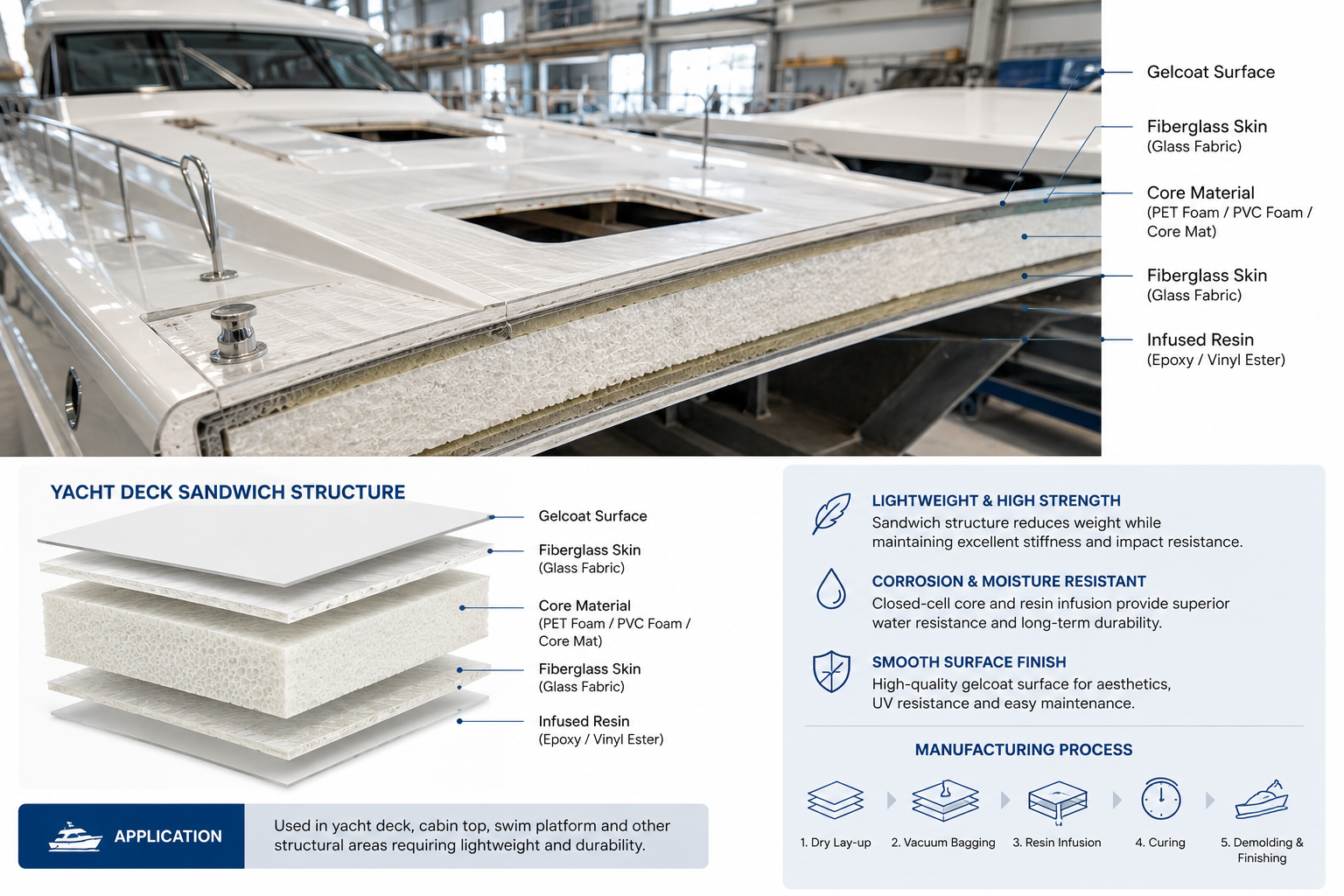
The following examples are drawn from CINON's supply records and show how fiberglass fabric works alongside core materials in real manufacturing programs.
- Marine & yacht building (Australia). Boat builders have used CINON materials and tools for hull construction in container-order volumes. Results reported include a smooth surface, easy wet-out, and better finish quality.
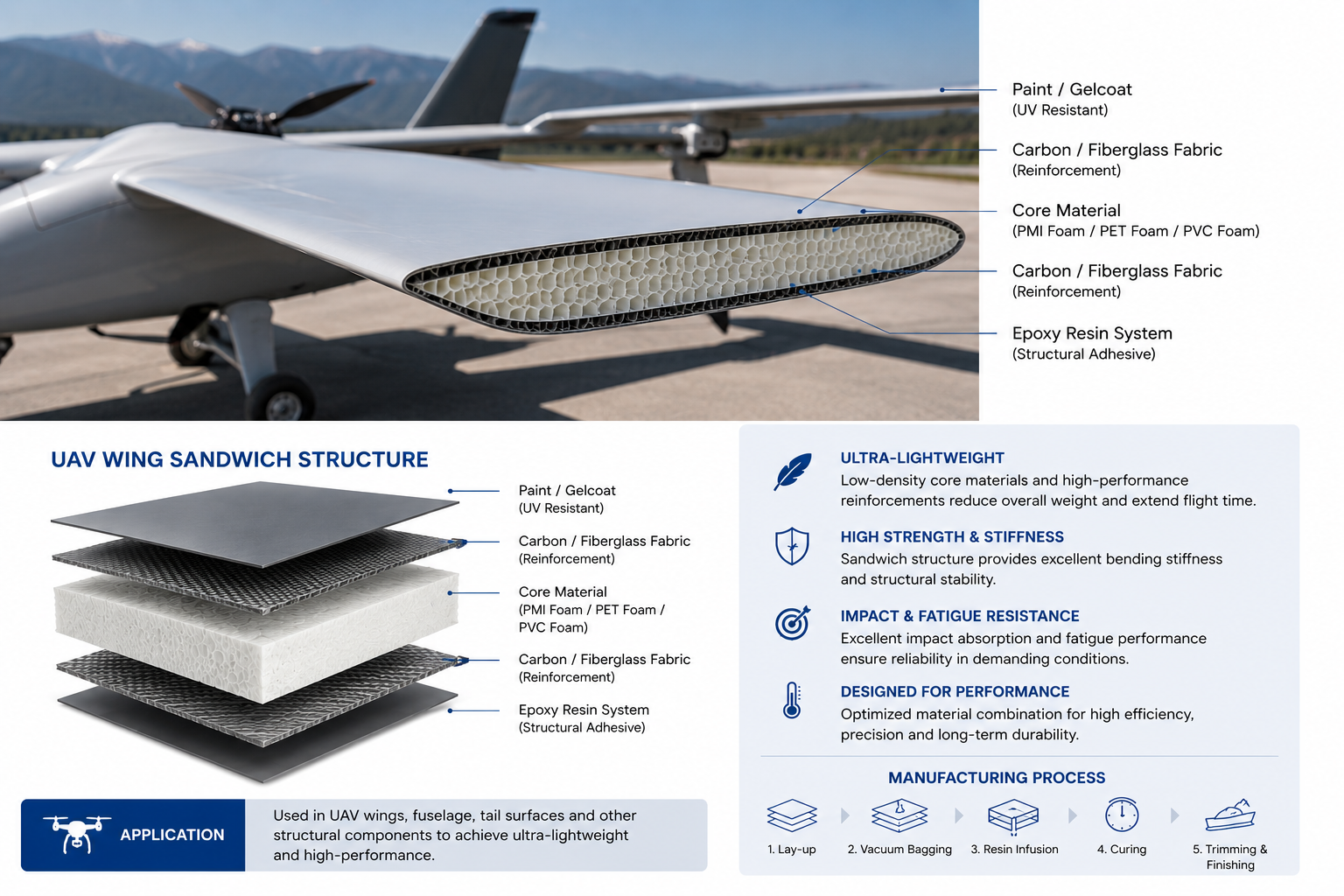
- UAV manufacturing (Germany). A UAV manufacturer ordered 10 pallets of PMI foam core combined with lightweight fiberglass fabrics to achieve ultra-lightweight structures with high stiffness. The materials delivered high temperature resistance and fatigue resistance.
- Surfboard manufacturing (Thailand). Sports equipment manufacturers use PVC foam core and fiberglass cloth for surfboards, achieving high buoyancy and impact resistance, with weight reduction and performance improvement.
- Transportation panels (Mexico). Transportation panel manufacturers use PP honeycomb core and fiberglass reinforcement to achieve lightweighting and improved corrosion resistance, with good adhesion to core material.
- RV manufacturing (United States). An RV manufacturer used multiaxial fiberglass fabrics for FRP panels, reporting low weight, anti-UV performance, glossy surface treatment, and uniformity of thickness.
- Composite material distribution (Poland). A distributor uses CINON's OEM logo service, generating container-order sales and repeat orders every month.
Comparison: Light Weight Woven Cloth vs. Multiaxial Non-Crimp Fabric
| Parameter | Light Weight Fiberglass Cloth (EW) | Multiaxial Fiberglass Fabrics |
|---|---|---|
| Glass type | E-glass | Alkali-free glass fiber |
| Architecture | Plain woven | Non-crimp (unidirectional, biaxial, triaxial, quadriaxial) |
| Weight range | 25–400 g/m² | 400–1500 g/m² |
| Width | 1000 mm, 1010 mm | — |
| Combustible matter | — | 2.0%–8.0% |
| Moisture content | — | <0.2% |
| Typical processes | Hand lay-up, surface lamination, lightweight molding | Vacuum infusion, RTM, extrusion, hand lay-up |
| Typical applications | Surfboards, UAV structures, marine repair, composite tooling, sports equipment | Ship hulls, wind turbine blades, automotive components, sports equipment, large containers |
FAQ
What compliance certifications does CINON hold for fiberglass fabric supply?
CINON holds ISO 9001:2015 (certificate 51326Q04922R053, valid through April 28, 2029), ISO 14001:2015 (certificate ISO14001-2023-001, valid through June 1, 2028), and ISO 45001:2018 (certificate 51326S01896R053, valid through April 28, 2029). The ISO 9001 scope covers sales of high-performance fibers and composite materials.
Can CINON customize fiberglass fabric for OEM production?
Yes. CINON provides ODM production services for fiberglass fabric and core materials, covering material selection, specification adjustment, and OEM branding. A composite material distributor in Poland, for example, uses CINON's OEM logo service and places repeat container orders monthly. The minimum order quantity for ODM production is 1,000 m².
What is the MOQ for fiberglass fabric orders, and how does it affect budgeting?
The minimum order quantity is 1,000 m². This structure is designed for mid-to-large series production. Buyers who need to verify material behavior before committing to full volume can request sample evaluation first. Payment terms are 30% deposit in advance and 70% balance by T/T before shipment.
How can I evaluate fiberglass fabric quality before placing a bulk order?
CINON applies 100% testing to all products and provides a pre-shipment test with a Quality Test Report. Standardized test methods for fiberglass reinforced materials include ASTM D638 for tensile properties and ASTM D790 for flexural strength and modulus. Sample evaluation and process guidance are available as part of the company's technical support.
What is the typical lead time for fiberglass fabric production orders?
Typical production lead time is 15 to 30 days, supported by a monthly capacity of 100,000 m². Delivery methods include FOB, CIF, and EXW. Lead time varies with fabric specification and order size, so it is advisable to confirm the schedule during quotation. To request a lead time or sample for your specific fiberglass fabric specification, contact CINON at waylon@cinoncomposites.com or via WhatsApp.
Conclusion
Process fit is the missing variable in many fiberglass fabric buying decisions. Light weight woven E-glass cloth remains a practical choice for hand lay-up, surface layers, marine repair, and lightweight structures. Multiaxial non-crimp fabrics are a preferred reinforcement for vacuum infusion, RTM, and structural parts that need straight fibers and predictable resin flow.
For buyers in the evaluation-to-execution stage, the supplier's process capability matters as much as the fabric specification. ODM customization, 100% product testing, sample evaluation, and a documented lead time of 15 to 30 days are concrete criteria to include in a supplier scorecard.
Next step: Request a sample or quotation.
Download the CINON catalog to review fiberglass fabric specifications, core materials, and OEM capability.
Download the CINON Catalog (PDF)
Or contact the team directly: waylon@cinoncomposites.com | Tel/WhatsApp: +86 186-2098-8848 / +86 135-8036-3674