
Selecting Infusion Core Materials for Marine and Yacht Building: A Zone-by-Zone Application Guide
Core material selection in a boat or yacht is a zone decision, not a single purchase decision. A hull bottom that absorbs slamming loads, a deck that has to stay light and stay dry, and a high-gloss topside laminate that must not show print-through do not share the same core requirement. Yet many yards still specify one foam for the entire vessel, then spend the finishing stage correcting problems the core choice created.
This guide is written for ship and yacht builders at the research and evaluation stage. It separates the two jobs a sandwich core can do, carrying structural load and managing resin flow and surface quality, and maps three material families onto the zones where each one earns its place: closed-cell PVC foam core, recyclable PET foam core, and thin nonwoven flow cores such as CINON CT Core Material.
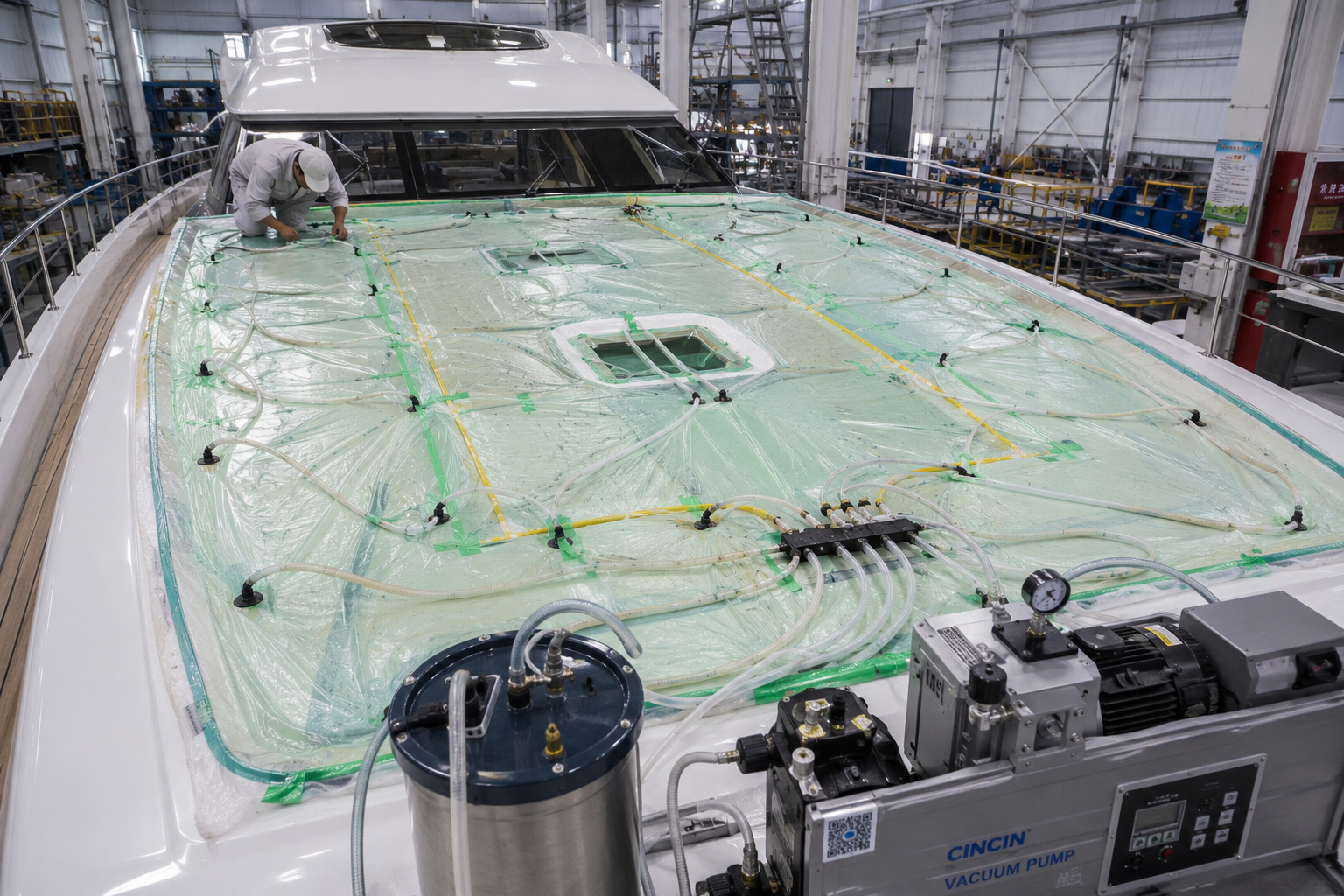
Vacuum infusion lay-up for a marine sandwich structure, where core material selection determines laminate stiffness, resin flow and surface finish.
The Problem: One Core Specification Rarely Fits an Entire Vessel
When a single core grade is used from keel to coach roof, three recurring problems appear during research and evaluation, and usually not in the same department. The planner sees weight, the laminator sees flow, and the finisher sees the surface.
- Surface print-through and micro-crack risk. A thick, rigid foam under a thin cosmetic skin gives the laminate very little resin volume to distribute evenly. Resin-rich and resin-starved patches print through the gel coat after cure, and printed-through areas are where surface micro-cracking typically begins.
- Weight and end-of-life pressure concentrated in decks. Decks and superstructures are large flat panels with the highest installed area and the lowest local load case. Over-specifying them for hull-level rigidity adds weight exactly where buoyancy and stability are most sensitive.
- Resin consumption and infusion scrap. A core that does not contribute to resin distribution forces the builder to add separate flow media, extra feed lines and longer infusion cycles, which shows up as resin consumption per panel rather than as a material price.
The practical conclusion is that the core in a marine sandwich panel has to be selected against the load case and the process, not against a single global specification sheet.
Industry Background: Where Marine Core Demand Sits
Marine is a structural core market inside a larger lightweight materials market. The global core materials market was valued at USD 4.19 billion in 2024 and is projected to reach USD 6.84 billion by 2032, driven by wind energy and aerospace demand. Within that total, marine structural core materials specifically reached USD 120.4 million in 2024, and PVC is expected to remain the dominant material in the marine segment because of its moisture resistance.
The supply side of this market is concentrated. Third-party industry analysis identifies 3A Composites (Switzerland), Gurit Holding AG (Switzerland) and Diab Group (Sweden) as the major global competitors in core materials. Adjacent demand signals come from wind energy, where the wind turbine blade composite materials market was valued at USD 7.045 billion in 2024, with Asia Pacific holding a 78.2% value share of the global wind turbine composites market in the same year. Wind blade production and marine panel production use much of the same core tooling, which is why core availability, density range and roll format are shared concerns between the two industries.
Nonwoven flow cores are a separate sub-category. Lantor Soric XF and SF are non-woven polyester cores that act as internal flow media for resin infusion, and Soric SF uses fine hexagon cells of 2–3 mm for sharp corners. CINON Composites (Guangdong Cinon New Material Technology Co.,Ltd) supplies alternative nonwoven flow cores, including CX Core Material (positioned as a Soric LRC alternative), CS Core Material, CT Core Material and CM core mat, alongside PET foam core, PVC foam core, PMI foam core, PP honeycomb and aramid honeycomb for marine, transportation, wind energy, industrial and aerospace composite applications. The company was founded in 2022 and operates a 40,000 m² facility with a 25-engineer R&D team and an annual output of 1,200,000 m².
Material Options by Function, Not by Brand
A marine core specification works when the material is chosen for the function it performs in that panel. The three functions below cover most yacht and workboat build programmes.
PVC Foam Core: Structural Rigidity in Load-Bearing Zones
PVC foam core is the closed-cell foam option for zones where structural rigidity governs. The density range runs from 45 kg/m³, 50 kg/m³, 60 kg/m³, 80 kg/m³, 100 kg/m³, 130 kg/m³, 200 kg/m³, 250 kg/m³ up to 300 kg/m³, with thickness from 1 to 80 mm. Surface formats include plain, grooved, perforated and scrim-backed, and the material is compatible with vacuum infusion, RTM, hand lay-up, prepreg and VARTM.
The property set that matters in a hull or bulkhead is described as closed-cell structure, low water absorption, high shear strength, excellent fatigue resistance, good thermal insulation and corrosion resistance. This is the same profile that third-party analysis points to when it expects PVC to remain dominant in the marine sector because of moisture resistance. Target industries listed for CINON PVC foam core are Marine & Yacht Building, Wind Energy, Transportation, Rail Vehicles, RV & Caravan Manufacturing, Industrial Composites, Construction Panels and Defense Applications.
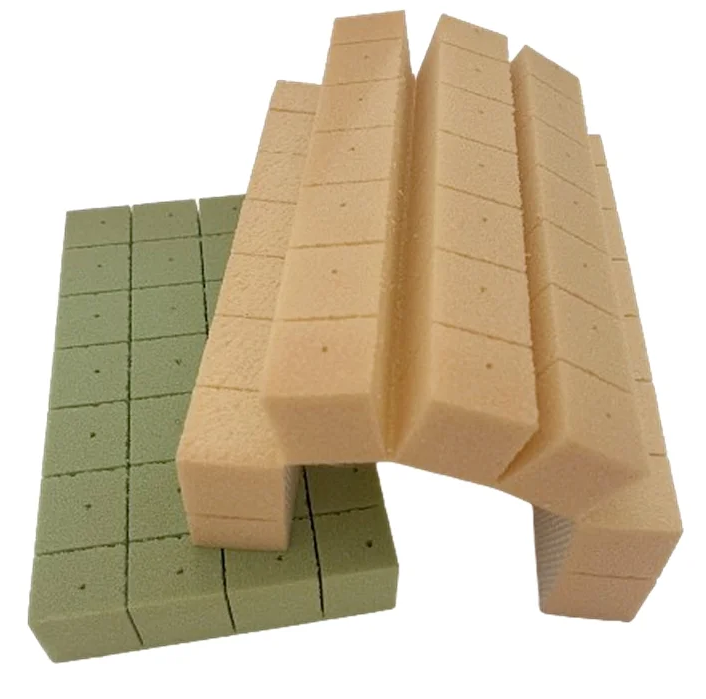
Crosslinked closed-cell PVC foam: the rigidity-side choice for hull bottoms, bulkheads and structural marine panels.
PET Foam Core: The Recyclable Option for Decks and Large Panels
PET foam core is the recyclable option. It is supplied in densities of 80 kg/m³, 100 kg/m³, 120 kg/m³, 150 kg/m³, 200 kg/m³, 250 kg/m³ and 320 kg/m³, and its documented benefits are weight reduction, recyclable composite solutions, high strength-to-weight ratio, vacuum infusion compatibility, corrosion resistance, structural stiffness improvement and sustainable material selection.
Its listed applications inside marine and adjacent industries include boat hulls, boat decks, wind turbine blades, rail vehicle interiors, truck body panels, RV side panels, composite sandwich panels and industrial structures. Target industries are Marine & Yacht Building, Wind Energy, Transportation, Rail Vehicles, RV & Caravan Manufacturing, Industrial Composites, Construction Panels and Renewable Energy.
For a deck or superstructure panel, this combination is what makes PET foam a practical default: it is offered in a density band wide enough to be matched to the zone, from light interior panels up to 320 kg/m³ where more stiffness is needed, and it keeps the end-of-life conversation open because the material itself is listed as recyclable. The choice between PET and PVC in a given zone should be made on the density grade and the laminate design rather than on the material label, since both families are listed across overlapping densities.
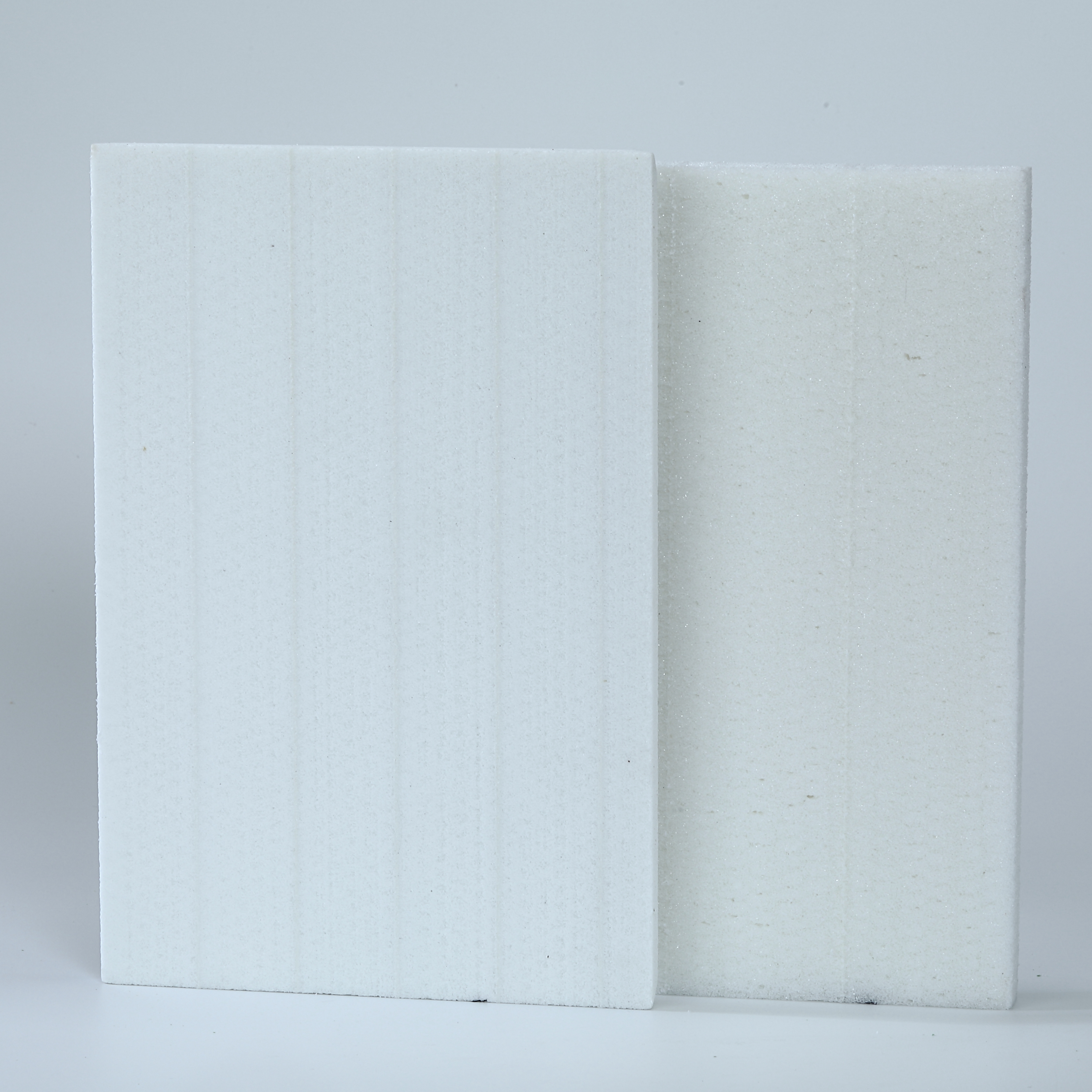
Recyclable PET foam core: a sustainable lightweight structural core for decks, panels and large flat laminates.
Nonwoven Flow Cores (CT, CM, CS, CX): Resin Flow, Surface Quality and Thin Build-Up
Nonwoven flow cores are polyester nonwoven fabrics that create resin flow channels inside the laminate while adding very little weight and thickness. They do not replace a structural foam; they solve a different problem, and in marine builds that problem is usually surface print-through, resin distribution and laminate build-up thickness.
CINON CT Core Material is a thin flow core at 1.5 mm, 2 mm and 3 mm thickness, roll length 120 m, 80 m or 50 m, width 1.27 m, dry weight 90 g/m², 120 g/m² or 160 g/m², and a maximum process temperature of 180°C. Its documented advantages are ultra-light weight, a thin resin flow layer, improved resin distribution, reduced print-through, enhanced surface finish, vacuum infusion compatibility, easy conformability and improved production efficiency. It is listed for Marine & Yacht Building, Transportation, Industrial Composites, Wind Energy, Composite Tooling and Sports & Leisure Equipment.
The mechanism matters more than the label. Print-through and the surface micro-cracking that follows it are driven by uneven resin distribution and shrinkage in a thin cosmetic skin, and CT’s contribution is on that side of the problem: it spreads resin more evenly and reduces print-through, which is how builders control surface quality over a thick core. CINON’s published CT specification covers thickness, roll length, width, dry weight and maximum process temperature; it does not publish a micro-crack resistance test value, so specify CT on print-through control, conformability and added weight, and confirm micro-crack performance on your own pilot panel.
CINON CM core mat covers the thicker end of the flow core range: 1.5 mm, 2 mm, 3 mm, 4 mm, 5 mm and 6 mm thickness, dry weight from 125 g/m² up to 360 g/m², maximum process temperature 175°C. It creates a sandwich structure within the laminate, increasing thickness and stiffness while keeping weight low, and it is documented for boat building, yacht construction, transportation panels and lightweight structural applications. CS Core Material is the general-purpose version at 2 mm and 3 mm thickness, 130 g/m² and 170 g/m² dry weight, maximum process temperature 170°C, combining resin flow capability with sandwich construction benefits. CX Core Material at 1.5 mm, 2 mm and 3 mm thickness with dry weights of 120 g/m², 150 g/m² and 220 g/m², and a 180°C maximum process temperature, is positioned as an alternative to Soric LRC and helps reduce resin consumption while increasing laminate thickness and stiffness.

CT Core Material: a thin nonwoven flow core that adds resin flow channels with minimal weight and thickness.
Where Honeycomb and High-Performance Foams Fit
Two further families appear in marine programmes with specific requirements. PP honeycomb sheet is a thermoplastic honeycomb at 5–100 mm thickness, cell sizes of 6 mm, 8 mm, 10 mm and 12 mm, density of 70 or 80 kg/m³, standard panel size 1220 × 2440 mm, with PP nonwoven or fiberglass skin options and processing by cutting, CNC machining, lamination and thermoforming; it is listed for transportation, RV & caravan, marine & yacht, construction and industrial composites. PMI foam core, at densities of 40 kg/m³, 50 kg/m³, 80 kg/m³, 100 kg/m³ and 130 kg/m³, is listed for aerospace, UAV and drone manufacturing, motorsport, high performance marine, defense and sports equipment.
Step-by-Step: Specifying Core by Zone
The sequence below is the order in which a marine core specification becomes defensible, because each step constrains the next one.
- Split the vessel into zones. Typical zone list: hull bottom, hull sides and topsides, deck and superstructure, internal bulkheads and furniture panels, and tooling. Each zone gets its own line in the specification.
- State the governing case for each zone. Slamming and dynamic load zones are rigidity and fatigue cases. Large flat decks are weight and stiffness cases. Visible high-gloss areas are surface-quality cases. Double-curvature and confined geometry are conformability cases.
- Fix the laminate architecture before the core. Skin thickness, target panel thickness, resin system and cure temperature must be set first, because they determine whether the core is working in shear or simply building thickness.
- Match core type to case. Rigidity zones point to closed-cell PVC foam. Deck and panel weight cases point to PET foam. Surface-quality and flow cases point to CT, CM, CS or CX nonwoven flow cores.
- Check the process window. Nonwoven flow cores in this portfolio carry maximum process temperatures of 170°C to 180°C depending on the grade, so the cure schedule has to be confirmed against the selected core, not against the resin alone.
- Choose density, thickness and surface format. PVC foam runs 45–300 kg/m³ and 1–80 mm; PET foam runs 80–320 kg/m³; flow cores run 1.5–6 mm with dry weight from 90 g/m² to 360 g/m². PVC surface options (plain, grooved, perforated, scrim-backed) should follow the infusion plan, since grooving and perforation decisions change resin flow.
- Model resin flow and resin consumption. Decide whether the core itself provides the flow path. CX is documented as reducing resin consumption while increasing laminate thickness and stiffness; CT improves distribution while adding minimal weight and thickness.
- Validate on a pilot panel, then release to production. Infuse a representative panel with the final skin stack, core and surface format, and inspect for print-through and resin distribution before the specification is frozen.
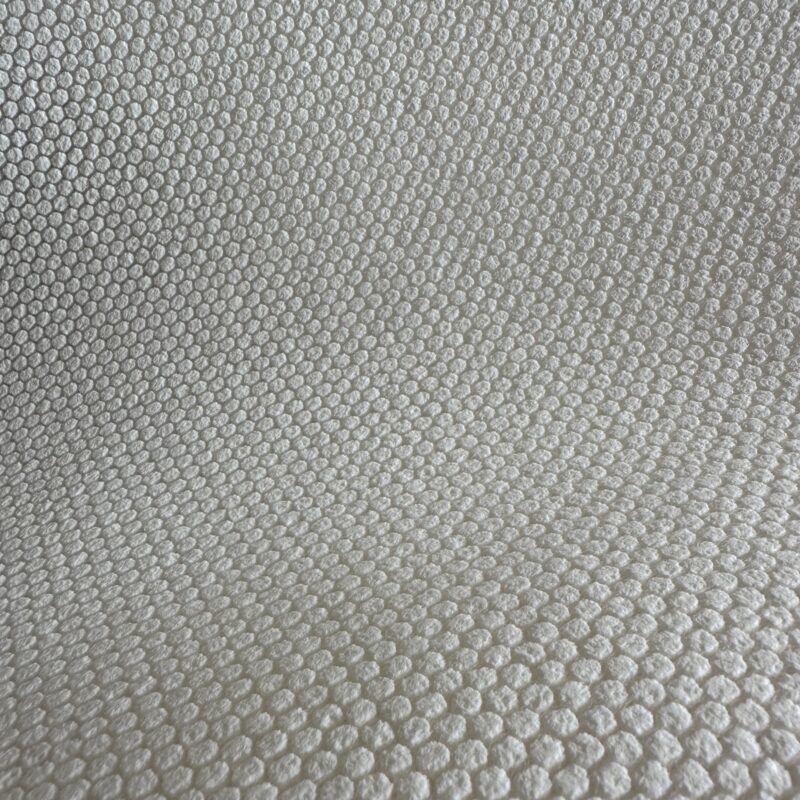
CM core mat: a structural nonwoven core for building thickness and stiffness inside boat and yacht laminates.
Use Cases: What Marine and Adjacent Builders Validate
Marine & yacht builders in Australia ordering materials and tools for boat building for container-scale projects recorded smooth surface, easy wet-out and better finish as the result of their material selection work, with material selection itself listed as the project highlight. That outcome is consistent with the mechanism described above: surface quality in a yacht laminate is largely decided before the gel coat is sprayed.
The same core families are validated in adjacent industries with comparable process windows. An RV manufacturer in the United States using five pallets of material for FRP panels reported a glossy surface after treatment and uniformity of thickness, with low weight and anti-UV performance as highlights, on a stack built from multiaxial fiberglass fabrics, lightweight fiberglass cloth, PP honeycomb sheet and PET foam core. A UAV manufacturer in Germany took ten pallets into UAV production using PMI foam core and nonwoven flow cores alongside lightweight fiberglass cloth. These are not marine projects, but they use the same vacuum infusion logic, and they show how core selection scales when a builder moves from a yacht programme into transport or airborne panels on shared equipment.
On the supply side, a composite materials distributor in Czechia reorders every month on container volumes with OEM labeling, and distributors in Poland and the United Kingdom run the same pattern: sample evaluation followed by commercial supply with OEM branding where required. For a yacht builder, this matters mainly as a continuity check on a material that will be reordered for years.

Export and logistics coordination supporting repeat core material supply for marine and transportation composite programmes.
Comparison Table: Marine Core Options at a Glance
| Material | Density / thickness | Documented properties | Typical marine use | Process compatibility |
|---|---|---|---|---|
| PVC foam core | 45, 50, 60, 80, 100, 130, 200, 250, 300 kg/m³; 1–80 mm; plain / grooved / perforated / scrim-backed | Closed-cell structure, low water absorption, high shear strength, excellent fatigue resistance, thermal insulation, corrosion resistance | Hull zones, bulkheads, structural panels, sandwich panel construction | Vacuum infusion, RTM, hand lay-up, prepreg, VARTM |
| PET foam core | 80, 100, 120, 150, 200, 250, 320 kg/m³ | Recyclable, weight reduction, high strength-to-weight ratio, vacuum infusion compatible, corrosion resistance, structural stiffness improvement | Boat decks, boat hulls, superstructures, large flat panels, rail and RV interiors | Vacuum infusion (listed as vacuum infusion compatible) |
| CT Core Material | 1.5 / 2 / 3 mm; 90, 120, 160 g/m² dry; roll 120 / 80 / 50 m; width 1.27 m | Ultra lightweight, thin resin flow layer, improved resin distribution, reduced print-through, enhanced surface finish, easy conformability | Visible and high-gloss laminates, print-through control, thin sandwich build-up, tooling | Vacuum infusion and resin infusion; max process temperature 180°C |
| CM core mat | 1.5–6 mm; 125, 150, 190, 260, 340, 360 g/m² dry; width 1.27 m | Sandwich structure within the laminate, high stiffness-to-weight ratio, integrated resin flow channels, cost-effective core solution | Boat building, yacht construction, transportation panels, lightweight structural laminates | Vacuum infusion, resin infusion, VARTM, RTM, hand lay-up, closed molding; max 175°C |
| CS Core Material and CX Core Material | CS: 2 / 3 mm, 130 / 170 g/m², max 170°C. CX: 1.5 / 2 / 3 mm, 120 / 150 / 220 g/m², max 180°C | Integrated resin flow channels, improved laminate stiffness, good resin distribution, easy processing, cost-effective; CX also helps reduce resin consumption | General marine laminates, large panels, anti-corrosion and industrial composite parts | Vacuum infusion, resin infusion, RTM, VARTM, hand lay-up, closed molding; CX positioned as Soric LRC alternative |
| PP honeycomb sheet (reference) | 5–100 mm; cell size 6 / 8 / 10 / 12 mm; 70–80 kg/m³; 1220 × 2440 mm | Strength-to-weight ratio, impact resistance, moisture resistance, corrosion resistance | Lightweight panels, RV and marine interior structures | Cutting, CNC machining, lamination, thermoforming; PP nonwoven or fiberglass skin |
| Lantor Soric XF / SF (third-party reference) | Soric SF hexagon cells 2–3 mm | Non-woven polyester core acting as internal flow medium for resin infusion; fine cells for sharp corners | Resin infusion flow media and print-through control (competitor reference) | Resin infusion |
FAQ: Marine Core Material Decisions
Do PVC, PET and nonwoven cores suit a saltwater marine environment?
PVC foam core is described as a closed-cell material with low water absorption, high shear strength, fatigue resistance and corrosion resistance, and it is listed for Marine & Yacht Building and Defense Applications. PET foam core is listed for Marine & Yacht Building, Wind Energy, Transportation, Rail Vehicles, RV & Caravan Manufacturing, Industrial Composites, Construction Panels and Renewable Energy, with corrosion resistance and vacuum infusion compatibility among its documented properties. Nonwoven flow cores (CT, CM, CS and CX) are polyester nonwoven fabrics listed for Marine & Yacht Building and composite tooling, and they are used inside the laminate rather than exposed. These are material-level descriptions from CINON’s published data; class-society approvals or project-specific certification are not stated in the specification and have to be confirmed for each project.
Which core should be used for a hull, and which for a deck?
Hull bottoms, bulkheads and highly loaded structural panels are rigidity cases, so they point to closed-cell PVC foam core, available from 45 kg/m³ to 300 kg/m³ and 1 mm to 80 mm, processed by vacuum infusion, RTM, hand lay-up, prepreg or VARTM. Decks, superstructures and large flat panels are weight and end-of-life cases, so they point to PET foam core from 80 kg/m³ to 320 kg/m³, which is listed for boat hulls, boat decks and composite sandwich panels and is supplied as a recyclable core. Where the deck or topside also has a high-gloss finish, a thin nonwoven flow core such as CT at 1.5–3 mm and 90–160 g/m² is added to improve resin distribution and reduce print-through rather than to carry primary load.
What drives the cost of a marine core package?
CINON does not publish list prices for core materials, so cost is assessed per project. The measurable cost drivers are the density grade and thickness selected per zone, the surface format of the foam (plain, grooved, perforated or scrim-backed), the amount of resin consumed per panel, and cycle time. Flow cores influence total panel cost rather than only the core line item: CX Core Material is documented as helping reduce resin consumption while increasing laminate thickness and stiffness, and CT improves resin distribution while adding minimal weight and thickness. Specifying a higher density than a zone’s load case requires adds both weight and material cost without a structural return.
Can we evaluate samples before committing to production volumes?
Samples can be evaluated before a production order. CINON’s after-sales scope covers material selection, composite process optimization, vacuum infusion guidance, alternative material recommendations, sample evaluation, quality traceability and global logistics coordination, delivered by email, WhatsApp, online meetings and technical documentation from prototype development through to mass production. Reference patterns include a UK composite materials distributor that moved from sample evaluation to commercial supply, and distributors in Czechia and Poland that reorder monthly on container volumes with OEM labeling for their local markets.
What are the minimum order, lead time and capacity for a marine core order?
Minimum order quantity is 1000 m², lead time is 15–30 days, monthly capacity is 100,000 m², quality control is 100% test, and export markets are worldwide. CINON Composites was founded in 2022, operates a 40,000 m² facility with 25 R&D engineers and an annual output of 1,200,000 m², and supports marine, transportation, wind energy, industrial and aerospace composite applications. The next practical step is to send your zone list and laminate schedule for a material recommendation, then request samples for a pilot panel before releasing the specification to production. You can reach the team at waylon@cinoncomposites.com, by telephone on +86 186-2098-8848, or through WhatsApp on +86 135-8036-3674. The full product range and technical data are in the CINON Composites catalog.
Conclusion: Match the Core to the Zone, Then Validate
Marine core material selection becomes manageable once the vessel is treated as a set of zones rather than a single specification. PVC foam core carries structural rigidity where shear, fatigue and moisture resistance decide the panel. PET foam core covers decks and large flat panels where weight and recyclability are the governing criteria, across a density range from 80 kg/m³ to 320 kg/m³. Nonwoven flow cores, CT for thin high-finish laminates, CM for thicker structural build-up, and CS and CX for general-purpose and low-resin-consumption infusion work, solve the resin flow and surface-quality problem that foams do not address.
The industry data points in the same direction: a global core materials market moving from USD 4.19 billion in 2024 toward USD 6.84 billion by 2032, with marine structural cores at USD 120.4 million in 2024 and PVC expected to remain dominant on moisture resistance. The competitive field, including 3A Composites, Gurit Holding AG and Diab Group alongside alternative nonwoven flow cores positioned against Lantor Soric XF and SF, rewards builders who can explain why a specific core sits in a specific zone.
The last step is not a document, it is a panel. Freeze the zone list, confirm the process temperature against the selected core, infuse one representative panel and inspect it for resin distribution and print-through before the specification goes to production.
Next Step: Sample Evaluation for Your Marine Programme
Send your zone list, laminate schedule and target panel thicknesses, and CINON will recommend a core by zone and supply samples for a pilot panel. Core material, fiberglass reinforcement and process support come from one supplier, with 1000 m² MOQ, 15–30 day lead time and 100% testing.
Email: waylon@cinoncomposites.com | WhatsApp: +86 135-8036-3674 | Tel: +86 186-2098-8848 | Web: cinoncomposites.com
Download the full range: CINON Composites Catalog (PDF)
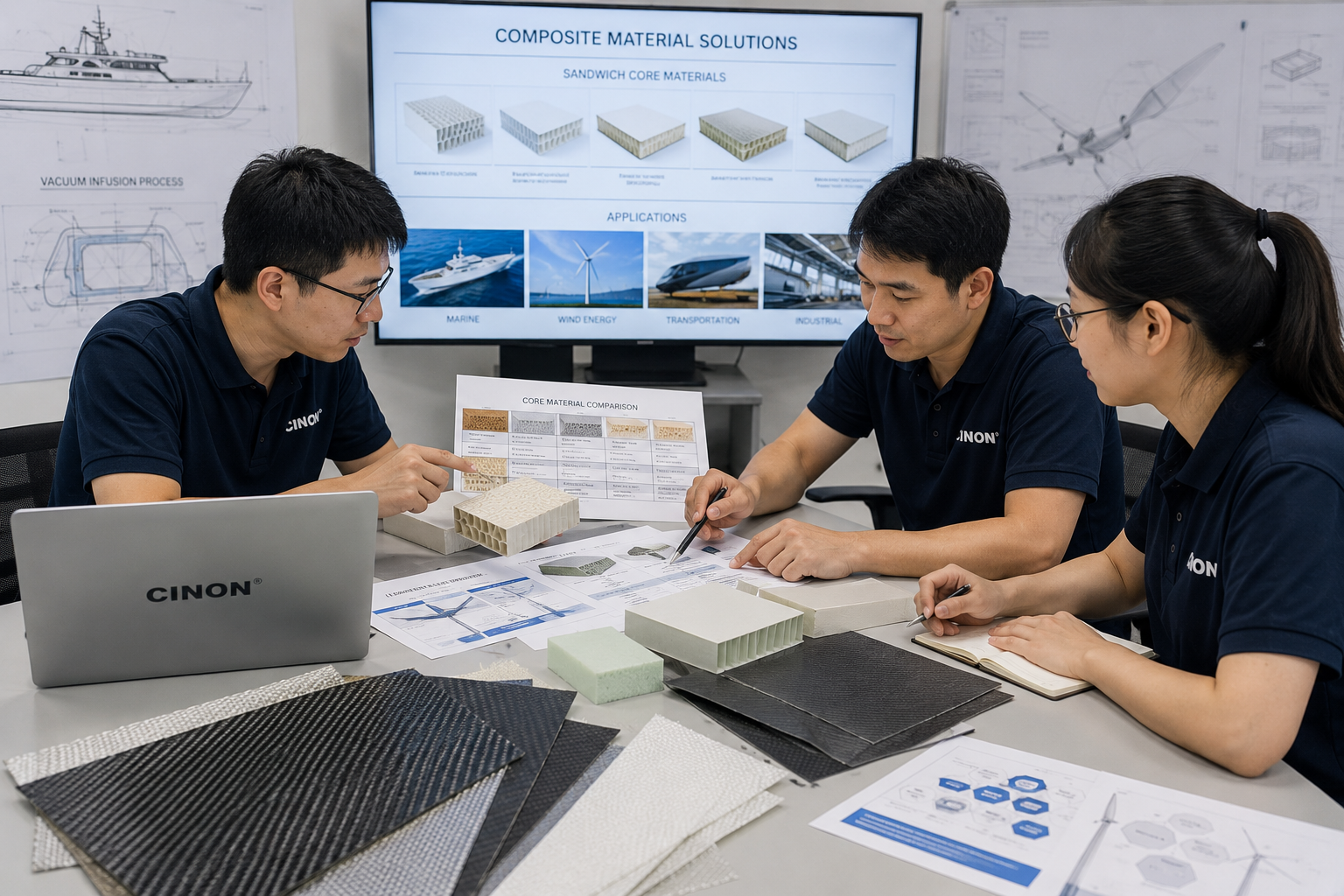
Material selection and engineering support: zone-by-zone core recommendations and sample evaluation for boat and yacht builders.
Have Questions or Need More Details?
Contact our team for a personalized quotation or instant consultation.
Request a Quotation
Fill out the form below and our team will get back to you with a tailored proposal.
WhatsApp Direct Chat
Prefer to chat in real-time? Message us on WhatsApp for instant assistance & quick answers.
- Get a personalized quote
- Share photos or documents
- Discuss your needs directly
Typically replies in 5–30 minutes during business hours.