Top 5 Fiberglass Fabric Suppliers Compared: How CINON Composites Solves Your Sourcing Pain Points
The five fiberglass fabric suppliers compared in this article are CINON Composites, Owens Corning, China Jushi Co., Saint-Gobain, and Taishan Fiberglass. They are ranked here by fit for custom and mid-batch composite sourcing — the profile of a builder that needs tailored fabric specifications, reinforcement and core materials on the same purchase order, engineering input before production, and export-ready packaging. They are not ranked by total global production volume, where large multinational producers hold a clear advantage.
This comparison is written for procurement managers, composite engineers, and OEM buyers in the final stage of supplier selection for marine, wind energy, transportation, UAV, and industrial composite projects. One rule runs through every section: claims about CINON Composites are traceable to its published product and process documentation, while claims about the other four suppliers are limited to publicly listed market position. Anything not verifiable is flagged as something to confirm directly with the supplier.
The Sourcing Pain Points This Comparison Addresses
Fiberglass fabric sourcing rarely fails at the material level. It fails at the process level — the gap between what was quoted, what was produced, and what arrived. Four failure modes account for most of the delay, scrap, and rework that buyers report.
- Incorrect material selection. A fabric that wets out cleanly in hand lay-up can behave differently in vacuum infusion, RTM, or VARTM. Errors here surface late, after tooling and labor have already been committed. The control is a technical evaluation before order confirmation.
- Specification deviation between quotation and delivered goods. Roll width, areal weight, thickness, and roll length drift from the agreed values when they are never formally confirmed. The control is a documented pre-production specification sign-off plus a first-piece inspection before mass production begins.
- Batch-to-batch performance inconsistency. Laminate quality becomes unpredictable when density, thickness, and weight vary between production batches. The control is per-batch inspection with test reports available on request.
- Transportation damage on mixed or smaller export orders. Fabric rolls damaged in transit are unusable fabric plus a lost production week. The control is export-standard packaging with reinforced pallets, moisture-proof wrapping, and corner protection.
Each pain point maps to a specific process control, which is why the ranking below weighs production and logistics discipline alongside product range.
Industry Background: Where Fiberglass Fabric Demand Is Moving
Grand View Research values the global fiberglass fabric market at USD 14.01 billion in 2024, with a projected rise to USD 25.65 billion by 2033. Within that total, the wind energy segment carries the strongest momentum, expected to grow at a CAGR of 8.5% from 2025 to 2033 — the highest of all application segments in the same analysis.
Regionally, Asia Pacific held a 41.61% revenue share of the fiberglass fabric market in 2024, supported by infrastructure and renewable energy investment. By product type, Mordor Intelligence reports that woven fiberglass fabrics captured 48.62% of market revenue in 2025, a share driven largely by yacht hulls and automotive panels. Dataintelo estimates that wind turbine blades account for approximately 42.5% of fiberglass usage within the wind energy sector — a single-source figure that is best treated as directional. Adjacent marine demand is also firming, with the marine fiberglass resin market projected to reach USD 4.23 billion by 2033 (Market Research Future).
Two procurement consequences follow. First, capacity and lead-time pressure concentrates in wind and marine demand, which is where specification flexibility and documentation quality matter most. Second, material decisions increasingly need to be defensible: reinforced materials are commonly evaluated against standardized methods such as ASTM D638 for tensile properties and ASTM D790 for flexural strength and modulus.
The supplier landscape itself is concentrated at the top. MarketsandMarkets identifies Owens Corning (US), China Jushi Co. (China), Saint-Gobain (France), and Taishan Fiberglass (China) among the key global players. Below that tier sits a different kind of supplier: smaller, export-focused specialists that compete on specification flexibility, engineering access, and order-level service rather than tonnage. CINON Composites belongs to that second group, and that distinction shapes everything that follows.
How This Comparison Was Built
Suppliers were scored from one to five stars against four criteria, using a defined buyer profile: a composite manufacturer or OEM placing custom, mid-batch orders — typically below the volume thresholds that large multinational producers prioritise — that combine fiberglass reinforcement with core material, and that needs export documentation and packaging that survives international freight.
- Fit for custom and mid-batch sourcing — can a tailored construction, width, or roll format be quoted and produced at a batch size a mid-size fabricator can absorb?
- Global scale and market presence — position in the publicly documented supplier landscape.
- Engineering and specification support — technical input before order confirmation, plus documented verification during production.
- Export packaging and documentation readiness — packaging engineered for international freight and mixed-order handling.
The Top 5 Fiberglass Fabric Suppliers Compared
1. CINON Composites — Guangzhou, China
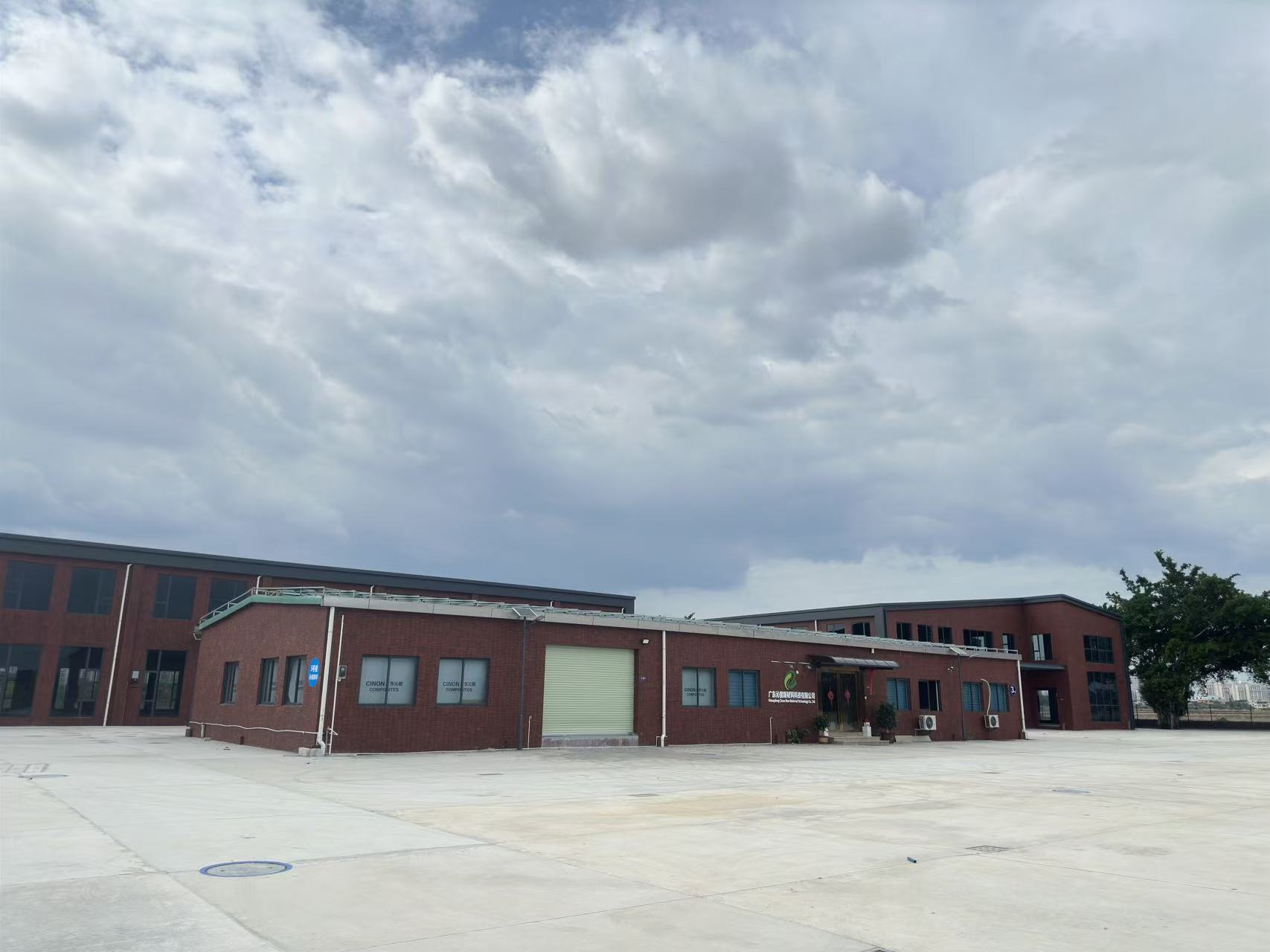
Guangdong Cinon New Material Technology Co.,Ltd, trading as CINON Composites, is a manufacturer of fiberglass reinforcements and lightweight core materials established in 2022. Its range covers fiberglass fabrics, biaxial fabrics, PET foam core, PVC foam core, PMI foam core, Core Mat, PP honeycomb, and aramid honeycomb — a combination that lets a buyer place reinforcement and core material on a single order. Production runs from a 40,000 m² facility with annual output of 1,200,000 m² and a 25-engineer technical team. CINON exports 100% of its output to Europe, North America, and Asia-Pacific markets.
2. Owens Corning — United States
Owens Corning is named by MarketsandMarkets among the key global players in the fiberglass fabric market. For buyers running large, standardized programs over long planning horizons, scale and global footprint are the primary attraction. Buyers with project-level needs should confirm which fabric constructions, widths, and batch sizes fall inside standard commercial terms before assuming a tailored specification is available.
3. China Jushi Co. — China
China Jushi Co. also appears on the key-player list and holds a major position in the wider glass fiber value chain. A buyer evaluating Jushi for fabric applications should confirm the exact construction, surface treatment, and roll format required by their lamination process, because an upstream producer's commercial focus does not always map onto a fabricator's project-level requirements.
4. Saint-Gobain — France
Saint-Gobain is listed on the same key-player roster and offers multi-region industrial distribution. Its practical strength for a composite buyer is regional availability; its fit for custom mid-batch fabric sourcing depends on whether the required construction is a catalog item or a tailored build.
5. Taishan Fiberglass — China
Taishan Fiberglass is the fourth company named in the MarketsandMarkets key-player list. It is a relevant reference point for buyers comparing glass fiber supply options out of Asia, particularly when specifying standard reinforcements at volume.
| Rank | Supplier | Headquarters | Fit for custom & mid-batch sourcing | Global scale & market presence | Best aligned with |
|---|---|---|---|---|---|
| 1 | CINON Composites | Guangzhou, China | ★★★★★ | ★★☆☆☆ | Tailored fabric specifications, reinforcement plus core material on one order, engineering review before production, export-ready packaging |
| 2 | Owens Corning | United States | ★★★☆☆ | ★★★★★ | Large standardized programs with long planning horizons |
| 3 | China Jushi Co. | China | ★★★☆☆ | ★★★★★ | High-volume glass fiber and standard reinforcement supply |
| 4 | Saint-Gobain | France | ★★★☆☆ | ★★★★★ | Multi-region industrial supply through established distribution |
| 5 | Taishan Fiberglass | China | ★★★☆☆ | ★★★★☆ | Standard reinforcements specified at volume |
The ranking is not a claim that a 2022-founded specialist outperforms multinational producers on capacity. It is a claim about fit: when the order is custom, mixed, and export-bound, the supplier whose process is built around specification confirmation and order-level packaging tends to cause fewer problems downstream.
What CINON Composites Solves That a Scale-First Supplier May Not
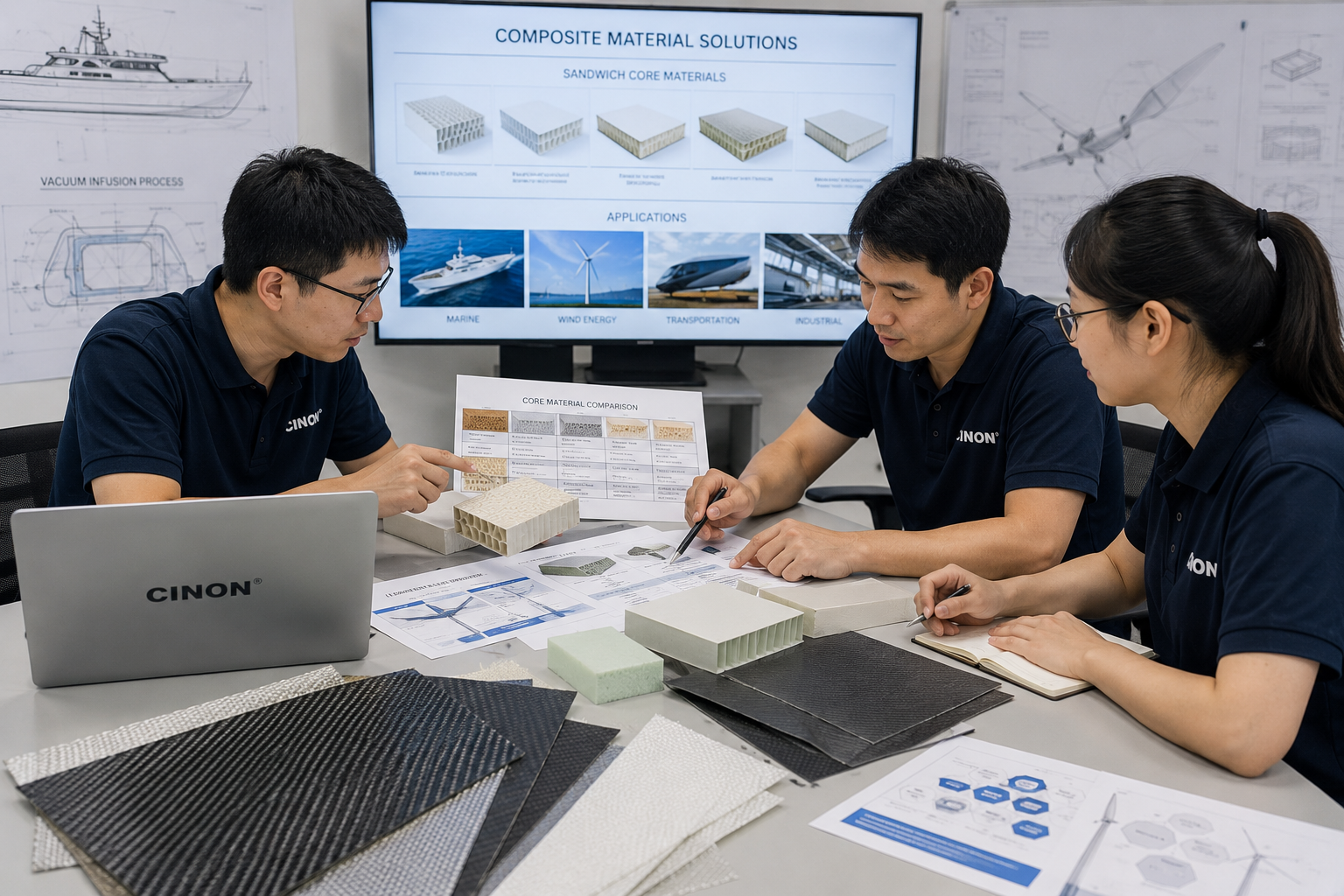
CINON's stated operating model is to remove selection and delivery risk before it reaches the production floor. Four mechanisms do that work.
- Technical evaluation before order confirmation. Engineering support is provided to recommend suitable core materials, fiberglass reinforcements, and manufacturing processes before the order is placed — the control for incorrect material selection.
- Pre-production specification confirmation. Dimensions, thickness, density, roll length, width, and weight are all confirmed before production, and a first-piece inspection is conducted before mass production starts.
- Batch performance verification. Every production batch undergoes density, thickness, weight, and appearance inspection, with test reports available on request.
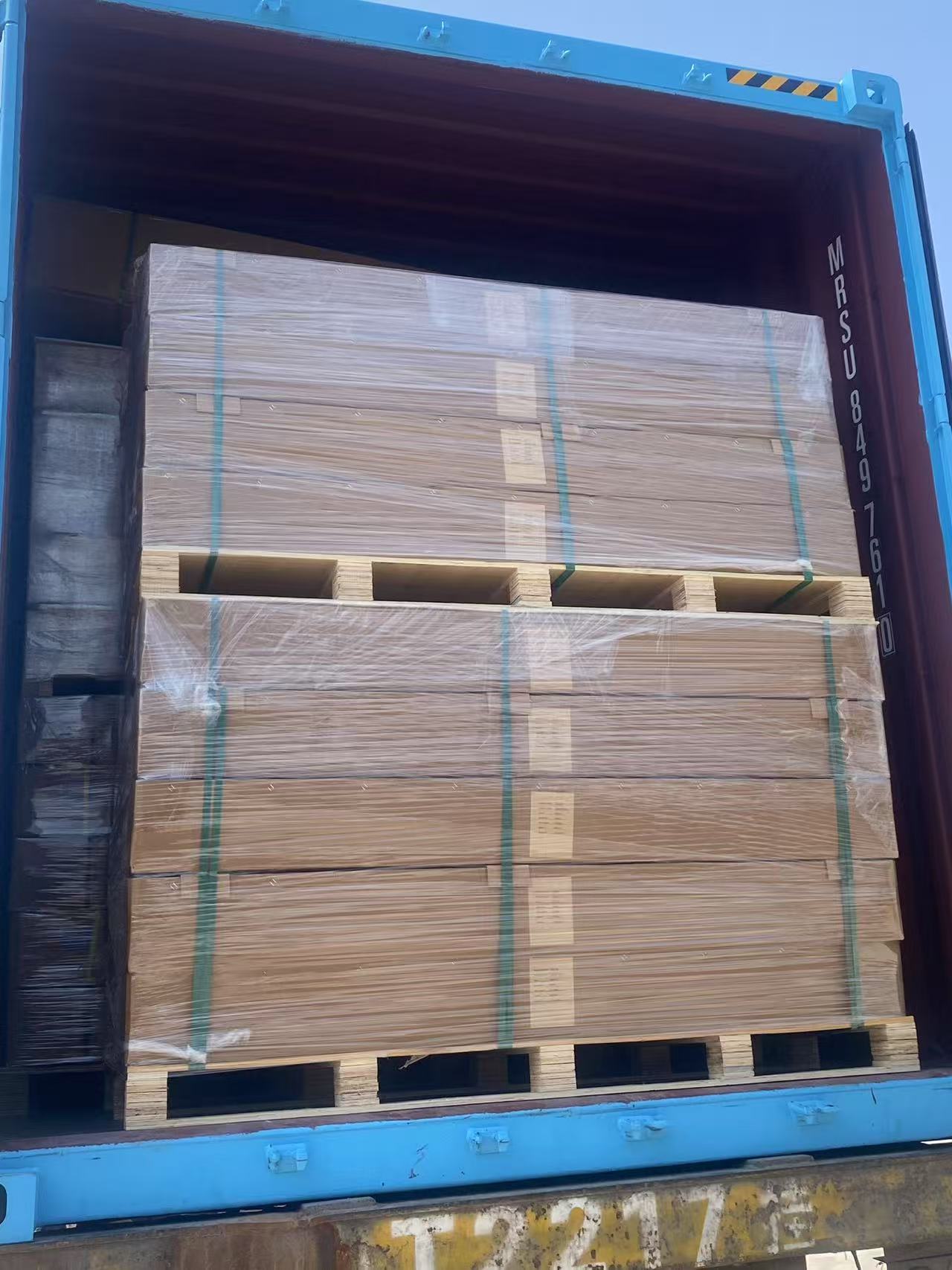
- Export packaging engineering. Products ship on reinforced pallets with moisture-proof wrapping, corner protection, and export-standard packaging, with packing dimensions sized to fit container dimensions.
The product side reinforces the same logic. CINON's reinforcement range reduces weight, improves structural stiffness, and optimises vacuum infusion processes, while the core material range — PET foam, PVC foam, PMI foam, Core Mat, PP honeycomb, and aramid honeycomb — allows a single supplier to cover both the skin and the core of a sandwich structure. That matters commercially: sourcing reinforcement and core from one supplier removes one set of specification interfaces, one set of tolerance mismatches, and one set of freight consolidations.
From Inquiry to Delivery: A Step-by-Step Sourcing Workflow
- Application and process review. The buyer states the application and manufacturing process — vacuum infusion, RTM, VARTM, or hand lay-up. CINON's engineering team recommends suitable reinforcement, core material, and process combinations before any commercial commitment.
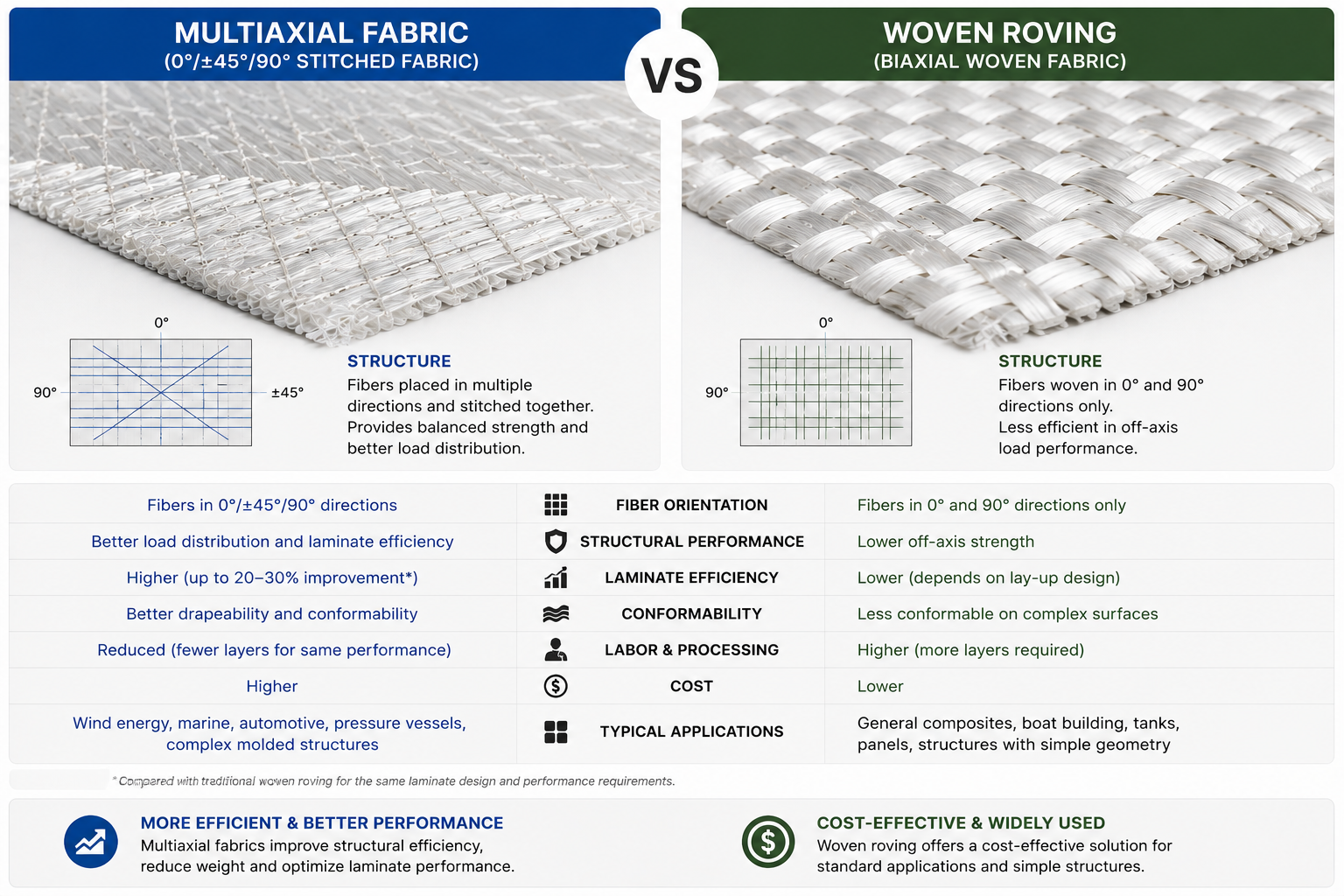
- Material and construction selection. This is where the fabric family is fixed. Multiaxial fabrics provide straighter fiber orientation and higher structural efficiency than woven roving, returning up to 20–30% higher laminate performance depending on lay-up design, at a generally higher material cost and with reduced labour requirements. Fiberglass fabric, compared with carbon fiber, offers lower cost and better impact resistance, which suits marine, industrial, and construction work.
- Pre-production specification confirmation. Roll width, roll length, thickness, density, and weight are locked in writing. Nothing moves to production until these values are agreed.
- First-piece inspection. The first piece off the line is inspected against the confirmed specification before mass production is released.
- Batch performance verification. Density, thickness, weight, and appearance are checked for each batch, and test reports are available on request for the buyer's own quality file.
- Export packaging. Goods are packed with reinforced pallets, moisture-proof wrapping, corner protection, and export-standard materials, with packing sizes matched to container dimensions to reduce void space and movement in transit.
- Shipment. CINON exports 100% of production to Europe, North America, and Asia-Pacific markets, so export documentation and freight handling are routine rather than exceptional.
Use Cases: Matching Fabric to Project Type
Wind energy and wind blades
Wind energy is the fastest-growing application segment for fiberglass fabric, projected at a CAGR of 8.5% from 2025 to 2033, and wind turbine blades are estimated to absorb roughly 42.5% of fiberglass usage in the sector. Multiaxial and biaxial reinforcements are the relevant constructions here, and this is where the multiaxial-versus-woven-roving trade-off has the greatest financial weight: higher material cost against up to 20–30% higher laminate performance and lower labour input.
Marine: boat building, yacht hulls, racing boats, and repair
Woven fiberglass fabrics captured 48.62% of market revenue in 2025, driven largely by yacht hulls and automotive panels. Marine builds also carry the most demanding repair economics, which favours fiberglass over carbon fiber on cost and impact resistance. A documented example from CINON's order history is Product 4507, supplied for boat building in Australia — a case where the fabric selection was tied to a specific hull-building process rather than a catalog default.
Transportation and automotive parts
Transportation panels and automotive components use fiberglass reinforcement for its lower overall production energy consumption in mass production and its stable long-term performance with cheaper repair and maintenance. Sandwich panels typically pair a reinforcement skin with a PET, PVC, or PMI foam core.
UAV and aerospace structures
UAV structures sit between two material worlds. Carbon fiber is 2–4 times stiffer, but it costs 12–15 times the price of glass fiber. For many airframe and fairing components, fiberglass reinforcement plus a lightweight core delivers the required stiffness at a materially lower cost per part.
FRP panels and industrial components
Industrial FRP panel production is a volume-driven application where surface consistency and batch repeatability decide the yield. CINON's Product 4367 was used for FRP panel production in the United States, an example of reinforcement supply tied to a panel line rather than a one-off project.
Material Comparison: Fiberglass, Carbon Fiber, and Woven Roving
| Material | Relative material cost | Stiffness | Impact resistance | Best suited to | Notes |
|---|---|---|---|---|---|
| Fiberglass fabric | Baseline; 3–5 times lower material cost than carbon fiber | Lower — carbon fiber is 2–4 times stiffer | Better | Marine, industrial, construction, transportation | Lower overall production energy consumption in mass production; stable long-term performance with cheaper repair and maintenance |
| Carbon fiber | 12–15 times the price of glass fiber | 2–4 times higher than fiberglass | Lower | Aerospace, racing, high-performance structures | Selected where stiffness and weight dominate the specification |
| Multiaxial fiberglass fabric | Generally higher material cost than woven roving, offset by lower labour input | Higher structural efficiency from straighter fiber orientation | — | Wind energy, marine, structural composites | Up to 20–30% higher laminate performance depending on lay-up design; less post-finish correction and lower long-term repair cost |
| Woven roving | Lower material cost | Baseline for comparison | — | General laminates and cost-driven builds | Serves as the reference point against multiaxial constructions |
| Core materials (PET/PVC/PMI foam, Core Mat, PP and aramid honeycomb) | Application-dependent | Improves structural stiffness in sandwich construction | — | Sandwich panels, yacht hulls, wind blades, transportation panels | Reduces weight and lowers total manufacturing cost when paired with the correct skin reinforcement |
Frequently Asked Questions
Do CINON's fiberglass fabrics come with standardized test support?
Reinforced materials are commonly evaluated against ASTM D638 for tensile properties and ASTM D790 for flexural strength and modulus, and buyers should confirm which method applies to their own acceptance criteria before approving a supplier. On the production side, CINON inspects every batch for density, thickness, weight, and appearance, and test reports are available upon request. Specification confirmation happens before production, and a first-piece inspection is completed before mass production is released.
Can CINON supply both reinforcement fabrics and core materials on one order?
Yes. CINON's range covers fiberglass fabrics, biaxial fabrics, PET foam core, PVC foam core, PMI foam core, Core Mat, PP honeycomb, and aramid honeycomb. CINON states that these materials help composite manufacturers reduce weight, improve structural stiffness, optimise vacuum infusion processes, and lower total manufacturing costs. For buyers, combining skin and core supply in one order removes an interface between vendors and consolidates freight.
Is fiberglass fabric actually cheaper than carbon fiber for a marine or industrial build?
On material cost, yes. Fiberglass fabric carries a material cost 3–5 times lower than carbon fiber, and carbon fiber prices run 12–15 times higher than glass fiber. The trade-off is stiffness: carbon fiber is 2–4 times stiffer. Fiberglass compensates with better impact resistance, lower overall production energy consumption for mass production, and stable long-term performance with cheaper repair and maintenance costs. For marine, industrial, and construction applications, that combination usually wins on total cost.
How does a buyer validate a new fabric grade before committing to volume?
Validation starts with specification confirmation: dimensions, thickness, density, roll length, width, and weight are agreed before production begins, and a first-piece inspection is carried out before mass production. Batch inspection results and test reports can then be requested to build a performance record. Buyers who want to begin that process can request the product catalog and a quotation directly — the CINON catalog is available at the CINON Composites product catalog, and quotations can be requested by email at waylon@cinoncomposites.com or by WhatsApp on +86 135-8036-3674.
What protects the goods and the schedule on an export order?
Packaging and documentation are handled as part of the order rather than as an afterthought. Goods are packed with reinforced pallets, moisture-proof wrapping, corner protection, and export-standard packaging, with packing sizes designed to fit container dimensions — which reduces movement in transit and void space in the container. Because production only starts after dimensions, thickness, density, roll length, width, and weight are confirmed, the delivery schedule is anchored to a documented specification rather than an assumption. CINON exports 100% of its output to Europe, North America, and Asia-Pacific markets.
Conclusion: Choose the Supplier Whose Process Matches Your Order Type
The right fiberglass fabric supplier depends on what kind of order you place. If you run large, standardized, long-horizon programs, the scale and global footprint of Owens Corning, China Jushi Co., Saint-Gobain, or Taishan Fiberglass will be the deciding factor. If your orders are custom, mid-batch, mixed between reinforcement and core material, and destined for export, the deciding factor becomes process discipline: confirmed specifications, first-piece inspection, batch verification, and packaging engineered for international freight.
CINON Composites is positioned for the second scenario. A 40,000 m² facility with 1,200,000 m² of annual output, a 25-engineer technical team, a full reinforcement and core material range, and a 100% export model are the concrete assets behind that positioning. Documented applications such as Product 4507 for boat building in Australia and Product 4367 for FRP panels in the United States show the model in practice across two different continents and two different production processes.
Next Step
Send your application, process, and target specification. CINON's engineering team will review the reinforcement and core material combination, confirm the specification in writing before production, and quote against a documented requirement rather than a catalog guess.
Catalog: Download the CINON Composites catalog (PDF)
Email: waylon@cinoncomposites.com
Tel: +86 186-2098-8848 | WhatsApp: +86 135-8036-3674
Website: cinoncomposites.com
Address: XBuilding 3, No.1, viheng Lane, jinnan Second Street, Dachongkou Village, shawan Street, Panyu District, Guangzhou

Have Questions or Need More Details?
Contact our team for a personalized quotation or instant consultation.
Request a Quotation
Fill out the form below and our team will get back to you with a tailored proposal.
WhatsApp Direct Chat
Prefer to chat in real-time? Message us on WhatsApp for instant assistance & quick answers.
- Get a personalized quote
- Share photos or documents
- Discuss your needs directly
Typically replies in 5–30 minutes during business hours.