
Wind Turbine Blade Reinforcement: How Fiberglass Fabric Adapts to Extreme Environments
A wind turbine blade must hold its shape through high and low temperatures, high pressure during molding, corrosive exposure, long-term static and dynamic loads, and 24/7 continuous operation over its whole service life. Fiberglass fabric is the reinforcement that makes that possible. This application guide explains how woven E-glass fabric, multiaxial non-crimp fabric and sandwich core materials are specified for wind turbine blades, blade shells and nacelle structures in markets such as Germany, Denmark, Spain, the United States, China and India.
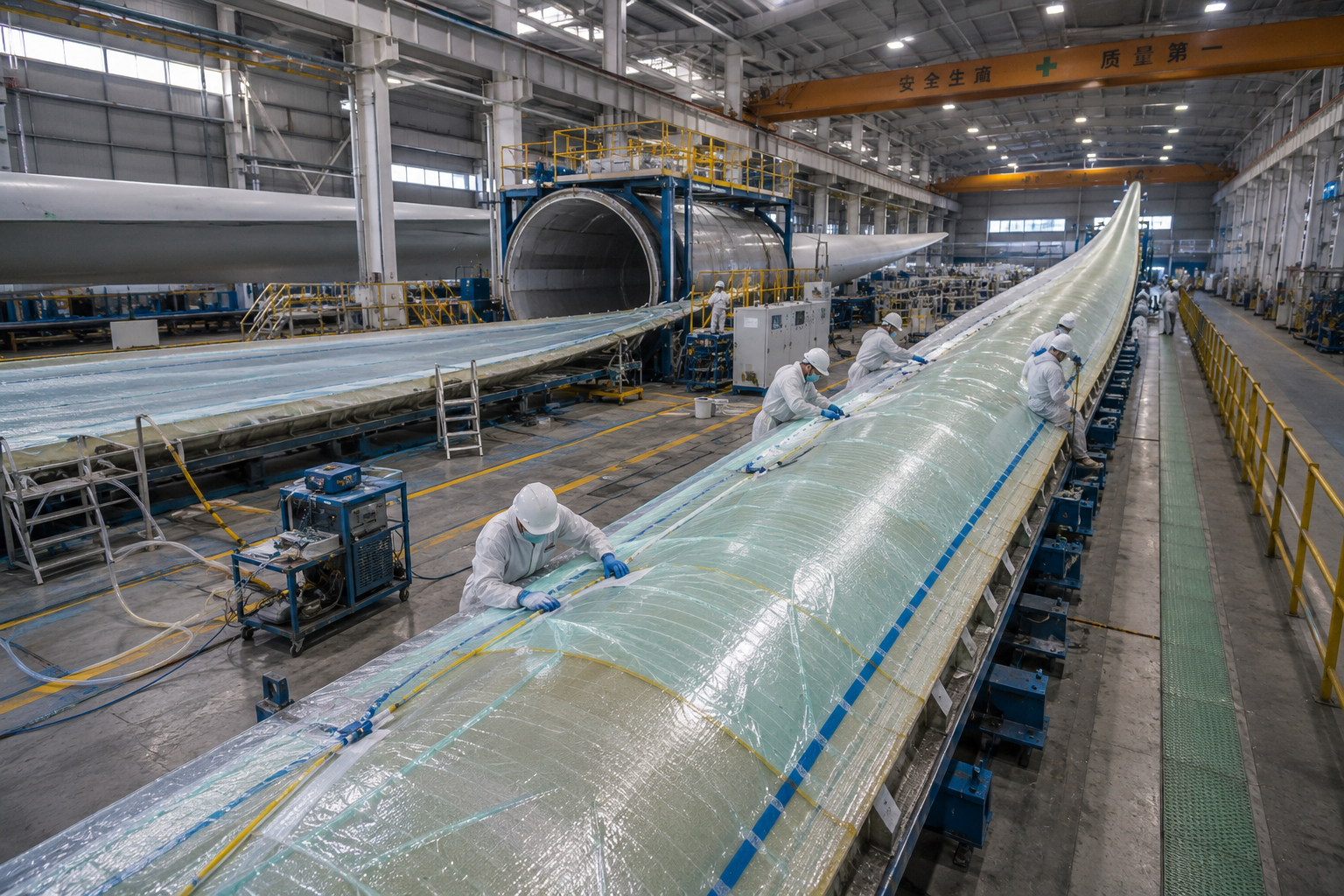
What 'Extreme Environment' Actually Means for a Blade Program
The clearest way to define the requirement is to list the conditions a blade reinforcement must survive at the same time. In wind energy applications that list is already documented: high temperature, low temperature, high pressure, a corrosive environment, high strength with low weight, long-term static and dynamic load, and 24/7 continuous operation.
Each of those conditions maps to a different engineering decision:
- High and low temperature. Temperature matters twice — first as process heat during infusion and curing, then as service temperature over a service life measured in years. The first limit is set by the material system, for example the maximum process temperature of the core material used in the sandwich.
- High pressure. Pressure belongs to the manufacturing stage: vacuum infusion and RTM place the laminate under compaction and injection pressure, which is why vacuum infusion equipment and large mold systems are the supporting equipment for this application.
- Corrosive environment. Moisture, salt and atmospheric exposure attack the laminate over time, so the reinforcement must be compatible with a resin system that seals the fibers.
- Long-term static and dynamic load. This is the fatigue case, and it is the reason high fatigue resistance is listed as a special requirement rather than a preference.
- High strength and lightweight structure. Blade length is limited by mass, so reinforcement architecture has to deliver stiffness without adding unnecessary weight.
- Dimensional stability. Blades, blade shells and nacelle structures are large, thin and molded to tight geometry; the laminate must not distort during processing.
The functions expected from the reinforcement in return are equally specific: fatigue resistance, weight reduction, structural performance and long service life. Everything in the rest of this guide — fabric type, areal weight, orientation, core selection and process — exists to deliver those four outcomes.
Industry Background: Why Wind Energy Is Now the Fastest-Moving Fiberglass Segment
Fiberglass fabric is not a niche input for renewable energy; it is a scaled market with published sizing. Grand View Research values the global fiberglass fabric market at USD 14.01 billion in 2024, with a projected growth to USD 25.65 billion by 2033. Within that market, the wind energy application segment is expected to grow at a CAGR of 8.5% from 2025 to 2033 — the highest growth rate among all application segments in the same forecast.
Geography reinforces the point. Asia Pacific dominated the fiberglass fabric market in 2024 with a revenue share of 41.61%, driven by infrastructure and renewable energy projects. That figure matters for sourcing decisions, because blade and nacelle programs in China and India sit inside the same supply chain that serves European and North American OEMs.
Blades are the single largest fiberglass consumer inside wind energy. One industry estimate attributes approximately 42.5% of total fiberglass usage within the wind energy sector to wind turbine blades (Dataintelo). Woven fabric still carries a large share of the overall category: Mordor Intelligence reports that woven fiberglass fabrics captured 48.62% of market revenue in 2025, largely because of their role in yacht hulls and automotive panels — a useful reminder that woven cloth and multiaxial fabric are complementary, not competing, formats.
A note on market sizing. Published fiberglass fabric market values differ by research firm — Grand View Research (USD 14.01 billion, 2024), Fortune Business Insights (USD 5.15 billion, 2025) and Market Research Future (USD 3.99 billion, 2024) all appear in circulation, most likely because each firm defines the boundary between raw glass fiber and processed fabric differently. Use any single figure as directional rather than as a procurement input.
On the supply side, the key global players in the fiberglass fabric market include Owens Corning (US), China Jushi Co. (China), Saint-Gobain (France) and Taishan Fiberglass (China), according to MarketsandMarkets. CINON Composites operates in the same material category: Guangdong Cinon New Material Technology Co., Ltd., established in 2022, supplies fiberglass reinforcements and lightweight core materials from a 40,000 m² manufacturing facility with an annual production capacity of 1,200,000 m². The company's R&D team consists of 25 engineers, and exports serve Europe, North America and Asia-Pacific markets.
Detailed Solution: The Three Material Building Blocks of a Blade Laminate
A blade reinforcement package is normally built from three material families: a woven E-glass fabric, a multiaxial non-crimp fabric (NCF) for structural plies, and a core material where a sandwich construction is used.
1. Woven E-glass fabric — Light Weight Fiberglass Cloth
The Light Weight Fiberglass Cloth is a fiberglass fabric classified as E-Glass Fabric, made of E glass fiber with a plain woven weave type. It is available in widths of 1,000 mm and 1,010 mm and in a weight range of 25–400 g/m². Wind energy is one of its listed application industries, alongside marine and yacht building, transportation, composite tooling, industrial composites, sports equipment, UAV and drone manufacturing, and surfboard manufacturing.
In a blade program, this fabric is the flexible part of the schedule: light areal weights allow thin surface plies, resin wet-out and a defined surface finish without adding mass to the outer skin. It is compatible with hand lay-up, vacuum infusion and resin infusion routes.
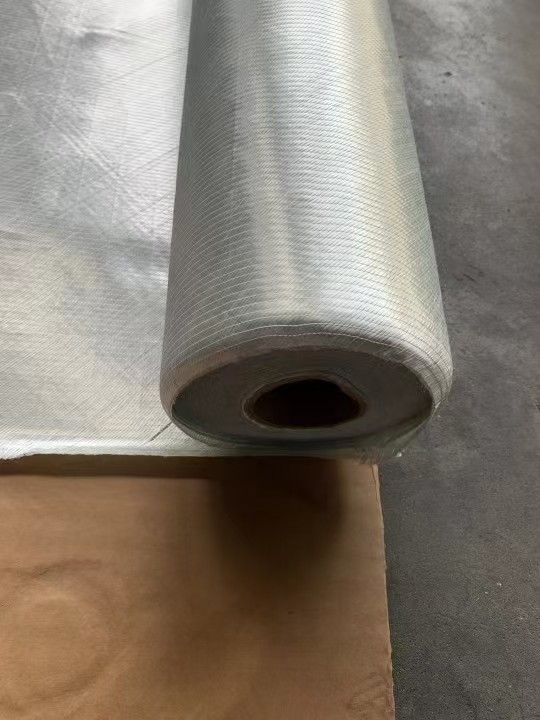
2. Multiaxial non-crimp fabric — Multiaxial Fiberglass Fabrics
Where the laminate carries load, the format changes. Multiaxial Fiberglass Fabrics are a structural composite reinforcement belonging to the Non-Crimp Fiberglass Fabric category, made of alkali free glass fiber. The available structural configurations are:
- Unidirectional: 0° or 90° direction
- Biaxial: 0°/90° direction or +45°/−45° directions
- Triaxial: +45°/0°/−45° direction or +45°/90°/−45° directions
- Quadriaxial: in 0°/90°/−45°/+45° directions
The published parameter set is 400–1,500 g/m² areal weight, moisture content below 0.2%, and combustible matter content between 2.0% and 8.0%. The fabric is designed for use in vacuum, hand layup, extrusion, RTM and other formed products — the phrase 'wind turbine blades' appears explicitly in its stated application list, together with ship hulls, automotive components, sports equipment and large containers. Its intended industries include wind energy, marine and yacht building, transportation, industrial composites, infrastructure, sports equipment and defense applications.
Why does stitched, non-crimp construction matter on a blade? Because fiber alignment is preserved instead of being crimped by weaving, which supports the two functions that the wind blade load case demands most: improved load distribution along the blade axis and a high strength-to-weight ratio across the shell.
3. Core materials for sandwich sections
Blade shells and nacelle structures are rarely solid laminates. Sandwich construction adds thickness — and therefore bending stiffness — with minimal mass, which is why core materials are part of the same sourcing conversation as the fabric. CINON supplies both nonwoven infusion cores and structural foam cores:
- CM core mat (structural core material): polyester nonwoven, thickness 1.5/2/3/4/5/6 mm, roll lengths 80/80/50/40/30/25 m, width 1.27 m, dry weight 125/150/190/260/340/360 g/m², maximum process temperature 175 °C.
- CT core material (lightweight infusion core, thin flow): polyester nonwoven, thickness 1.5/2/3 mm, roll lengths 120/80/50 m, width 1.27 m, dry weight 90/120/160 g/m², maximum process temperature 180 °C.
- CS core material (general purpose vacuum infusion core): polyester nonwoven, thickness 2/3 mm, roll lengths 80/50 m, width 1.27 m, dry weight 130/170 g/m², maximum process temperature 170 °C.
- CX core material: polyester, thickness 1.5/2/3 mm, roll lengths 70/60/40 m, width 1.27 m, dry weight 120/150/220 g/m², maximum process temperature 180 °C.
- PVC foam core: densities of 45, 50, 60, 80, 100, 130, 200, 250 and 300 kg/m³, thickness 1–80 mm, surface options plain, grooved, perforated or scrim-backed, processed by vacuum infusion, RTM, hand lay-up, prepreg or VARTM. Wind energy is a listed application industry.
- PET foam core: a recyclable lightweight structural core with densities of 80, 100, 120, 150, 200, 250 and 320 kg/m³, listed for wind energy and renewable energy applications.
How the material answers each extreme condition
Temperature: the reinforcement itself is E-glass or alkali-free glass fiber, and the thermal ceiling of the build comes from the surrounding system — core materials in the CINON range carry maximum process temperatures of 170 °C (CS), 175 °C (CM) and 180 °C (CT and CX), which is the number to check against the resin and cure schedule.
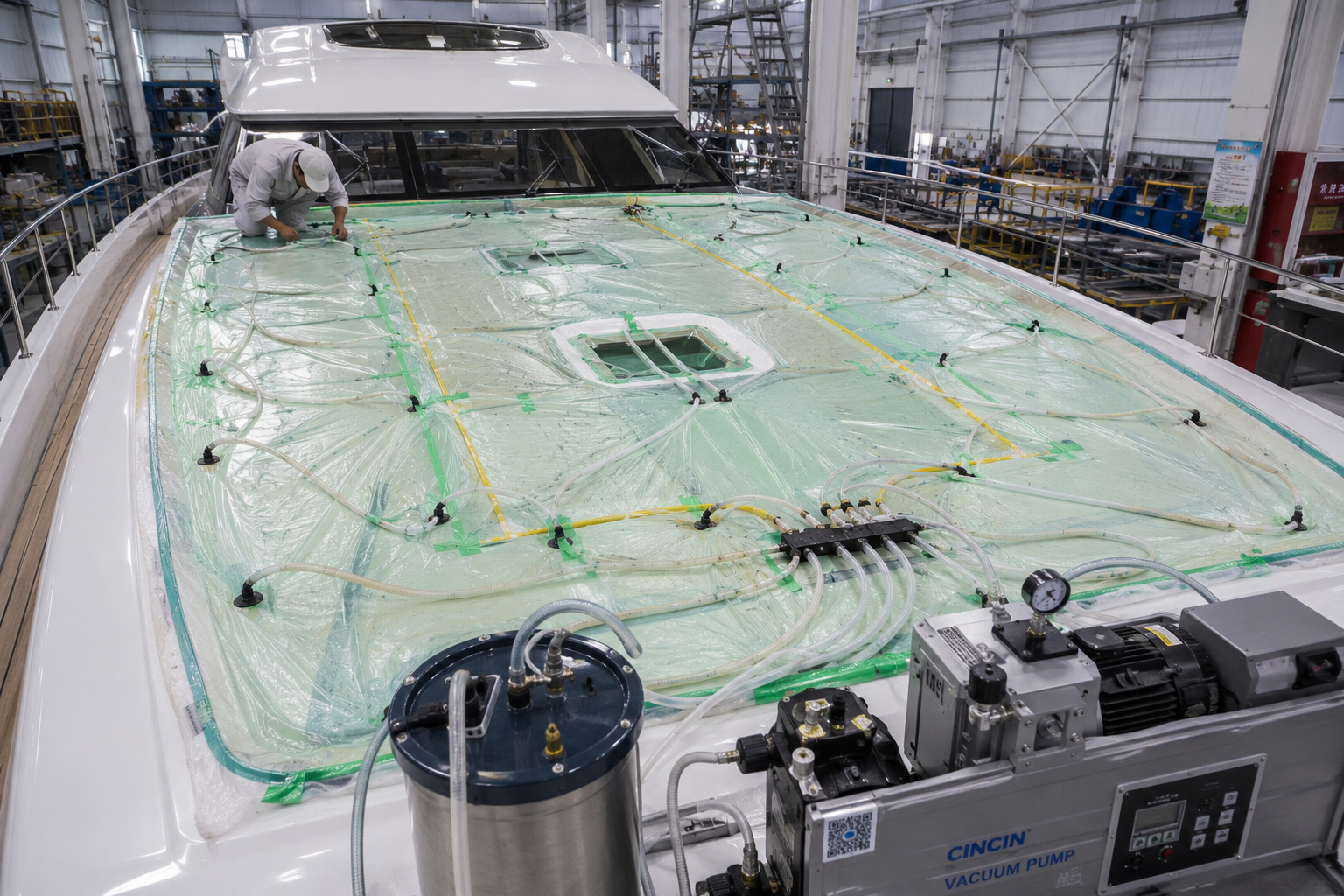
Pressure and process: wind energy applications are documented for vacuum infusion, resin infusion, hand lay-up and RTM, supported by vacuum infusion equipment and large mold systems. Multiaxial fabric adds the vacuum, extrusion and RTM routes to that list.
Corrosion and moisture: low water absorption is the control point for composite structures exposed to moisture, and the multiaxial fabric specification sets moisture content below 0.2% as a delivered-material limit — a measurable value rather than a claim.
Fatigue and life: the stated function of the reinforcement in this application is fatigue resistance plus long service life, which is why NCF formats with preserved fiber alignment are used where dynamic load accumulates.
Step-by-Step: Specifying Fiberglass Reinforcement for a Blade Program
The sequence below reflects how the material set is actually narrowed down, working from operating conditions to a signed-off specification.
- Write down the operating envelope. Temperature range, corrosive exposure, load type (static, dynamic or both), continuous duty, and the required service life. For wind energy this produces a standard list: high temperature, low temperature, high pressure, corrosive environment, high strength and lightweight, long-term static/dynamic load, 24/7 operation.
- Choose the reinforcement architecture by load path. Unidirectional where the load runs one way, biaxial 0°/90° or +45°/−45° for shell panels, triaxial and quadriaxial where multiple directions carry stress. The Multiaxial Fiberglass Fabrics range covers all four configurations.
- Set the areal weights. Use woven Light Weight Fiberglass Cloth in the 25–400 g/m² band for surface and light plies, and multiaxial NCF in the 400–1,500 g/m² band for structural plies. Heavier fabric builds thickness faster per ply; lighter fabric gives finer surface control.
- Decide whether the section is sandwich or solid. Where stiffness-to-weight ratio matters, select a core by process temperature: CS at 170 °C, CM at 175 °C, CT or CX at 180 °C, or a foam core (PVC 45–300 kg/m³ or PET 80–320 kg/m³) where a structural foam is preferred.
- Match the process. Vacuum infusion, resin infusion, hand lay-up and RTM are all documented for this application. PVC foam core additionally lists prepreg and VARTM. Confirm that the tooling — vacuum infusion equipment and large mold systems — matches the fabric format and core surface option (plain, grooved, perforated or scrim-backed).
- Verify before approval. Check delivered parameters against the specification: moisture content below 0.2% and combustible matter between 2.0% and 8.0% on multiaxial fabric, maximum process temperature on cores, and mechanical testing to ASTM D638 (tensile) and ASTM D790 (flexural strength and modulus).
Use Cases and Regional Fit
Wind turbine blades and blade shells (Europe). Germany, Denmark and Spain are the named European markets for this application, and Europe is the applicable market tag attached to the wind energy data set. These programs combine multiaxial NCF in structural plies with core materials in sandwich sections and woven fabric in surface layers.
Blades and nacelle structures (United States). The US appears alongside Germany, Denmark, Spain, China and India as a common application market, and North America is one of CINON's three export regions.
Blade and nacelle production (China and India). Both countries are listed application markets, and they sit inside the Asia-Pacific region that held a 41.61% revenue share of the global fiberglass fabric market in 2024.
Nacelle structures. Nacelles are not blade laminates, but they share the same condition profile — temperature variation, pressure during molding, corrosive exposure and long-term load — so they are usually specified from the same fabric and core portfolio rather than from a separate material family.
Adjacent composite structures using the same material logic. Marine hulls, transportation panels, industrial composite parts and UAV structures use the same reinforcement families under different condition profiles, which is why a single fiberglass fabric supplier can support a blade program and an adjacent lightweighting program from one platform.
Comparison Table: Reinforcement Options for Wind Blade Laminates
| Parameter | Light Weight Fiberglass Cloth | Multiaxial Fiberglass Fabrics (NCF) |
|---|---|---|
| Fabric category | E-Glass Fabric, plain woven | Non-Crimp Fiberglass Fabric, structural composite reinforcement |
| Material | E glass fiber | Alkali free glass fiber |
| Fiber orientation | Plain weave | Unidirectional 0° or 90°; biaxial 0°/90° or +45°/−45°; triaxial +45°/0°/−45° or +45°/90°/−45°; quadriaxial 0°/90°/−45°/+45° |
| Areal weight | 25–400 g/m² | 400–1,500 g/m² |
| Width | 1,000 mm, 1,010 mm | Confirmed per order specification |
| Moisture content | Not stated in published parameters | Less than 0.2% |
| Combustible matter | Not stated in published parameters | 2.0%–8.0% |
| Documented processes | Hand lay-up, vacuum infusion, resin infusion | Vacuum, hand layup, extrusion, RTM |
| Typical role in wind energy | Surface and light laminate plies | Structural plies carrying load along and across the blade |
Comparison Table: Core Materials for Sandwich Structures
| Core material | Base material | Density / dry weight | Thickness | Max. process temperature |
|---|---|---|---|---|
| CM core mat | Polyester nonwoven fabric | 125/150/190/260/340/360 g/m² | 1.5–6 mm | 175 °C |
| CT core material | Polyester nonwoven fabric | 90/120/160 g/m² | 1.5/2/3 mm | 180 °C |
| CS core material | Polyester nonwoven fabric | 130/170 g/m² | 2/3 mm | 170 °C |
| CX core material | Polyester | 120/150/220 g/m² | 1.5/2/3 mm | 180 °C |
| PVC foam core | Polyvinyl chloride | 45–300 kg/m³ | 1–80 mm | Not stated in published parameters |
| PET foam core | Polyethylene terephthalate | 80–320 kg/m³ | Not stated in published parameters | Not stated in published parameters |
FAQ: Sourcing Fiberglass Fabric for Wind Blade Reinforcement
1. Which testing and compliance standards should a blade program request?
Standardized tests for fiberglass reinforced materials include ASTM D638 for tensile properties and ASTM D790 for flexural strength and modulus, both published by ASTM International. Compliance work then has two parts: ask for the mechanical test standards that apply to the laminate, and verify the delivered fabric against its published parameters — for multiaxial fiberglass fabrics, moisture content below 0.2% and combustible matter between 2.0% and 8.0%. For core materials, check the maximum process temperature against the resin system: CS 170 °C, CM 175 °C, CT and CX 180 °C.
2. Can fiberglass fabric handle the temperature, pressure and corrosion profile of a wind blade?
Yes — wind energy is a documented application for both woven E-glass fabric and multiaxial non-crimp fabric. The stated operating conditions are high temperature, low temperature, high pressure, corrosive environment, high strength and lightweight, long-term static and dynamic load, and 24/7 continuous operation, and the reinforcement's function is to deliver fatigue resistance, weight reduction, structural performance and long service life. The documented manufacturing routes are vacuum infusion, resin infusion, hand lay-up and RTM, with vacuum infusion equipment and large mold systems as supporting equipment.
3. What drives the cost of fiberglass reinforcement in a blade program?
CINON publishes no list pricing, and no price band should be inferred from a specification sheet. What a program can control is how much reinforcement a laminate needs and how much of the material is actually used: woven E-glass fabric at 25–400 g/m² covers surface and light plies, multiaxial NCF at 400–1,500 g/m² covers structural plies, and the chosen core thickness sets how much of the sandwich is foam rather than laminate. Architecture, areal weight, process route (vacuum infusion, resin infusion, hand lay-up or RTM), core selection and annual volume are therefore the variables that determine commercial terms — not a headline price per kilogram.
4. Can I evaluate a sample before committing to a blade program?
Material evaluation should start with a sample and a specification sheet rather than with a purchase order. CINON Composites supplies fiberglass reinforcements and lightweight core materials from Guangdong, China, and samples and technical documentation can be requested by email at waylon@cinoncomposites.com or by phone and WhatsApp at +86 186-2098-8848 and +86 135-8036-3674. The full product range, including woven fabric, multiaxial NCF and core materials, is described in the catalog at https://cdn.socialarks.com/sbsp/24887/common/2026/0529/Cinon-Catalog%281%29.pdf.
5. What production capacity is available for large blade programs?
Guangdong Cinon New Material Technology Co., Ltd. operates a 40,000 m² manufacturing facility with an annual production capacity of 1,200,000 m², a 25-engineer R&D team and approximately 20 staff. Export sales account for 100% of total sales, with major markets in Europe, North America and Asia-Pacific. Because blade programs order across multiple roll widths, architectures and core types, lead time should be confirmed against the specific specification — send the fabric weight, orientation, width and core requirement together with the requested delivery window.
Conclusion: Matching the Reinforcement to the Condition, Not the Other Way Around
Blade reinforcement is a specification problem before it is a purchasing problem. The conditions are fixed — high and low temperature, high pressure, corrosion, long-term static and dynamic load, 24/7 duty — and the material set answers them in three parts: woven E-glass fabric at 25–400 g/m² for surface and light plies, multiaxial non-crimp fabric at 400–1,500 g/m² in the orientation the load path requires, and a core material selected by process temperature and density for sandwich stiffness.
The market context supports acting on that structure: wind energy is the fastest-growing application segment for fiberglass fabric at a projected 8.5% CAGR from 2025 to 2033, and blades account for the largest share of fiberglass consumption within wind energy. Programs in Germany, Denmark, Spain, the United States, China and India are all specifying from the same material families.
If you are at the evaluation stage, the fastest way to a decision is a sample plus a specification sheet, followed by a verification check against ASTM D638, ASTM D790 and the delivered fabric parameters. Send your operating conditions and the laminate you have in mind, and the reinforcement and core selection can be matched to the condition rather than the other way around.
Request a Sample or a Specification Sheet
CINON Composites supplies fiberglass fabric, multiaxial reinforcement and lightweight core materials for wind energy, marine, transportation, industrial and aerospace composite applications.
Email: waylon@cinoncomposites.com
Phone: +86 186-2098-8848
WhatsApp: +86 135-8036-3674
Website: https://cinoncomposites.com/
Catalog: Download the CINON Composites catalog (PDF)

Have Questions or Need More Details?
Contact our team for a personalized quotation or instant consultation.
Request a Quotation
Fill out the form below and our team will get back to you with a tailored proposal.
WhatsApp Direct Chat
Prefer to chat in real-time? Message us on WhatsApp for instant assistance & quick answers.
- Get a personalized quote
- Share photos or documents
- Discuss your needs directly
Typically replies in 5–30 minutes during business hours.