4-Inch vs. 4.5-Inch Cutting Discs: Which Fits Your Tooling Needs?
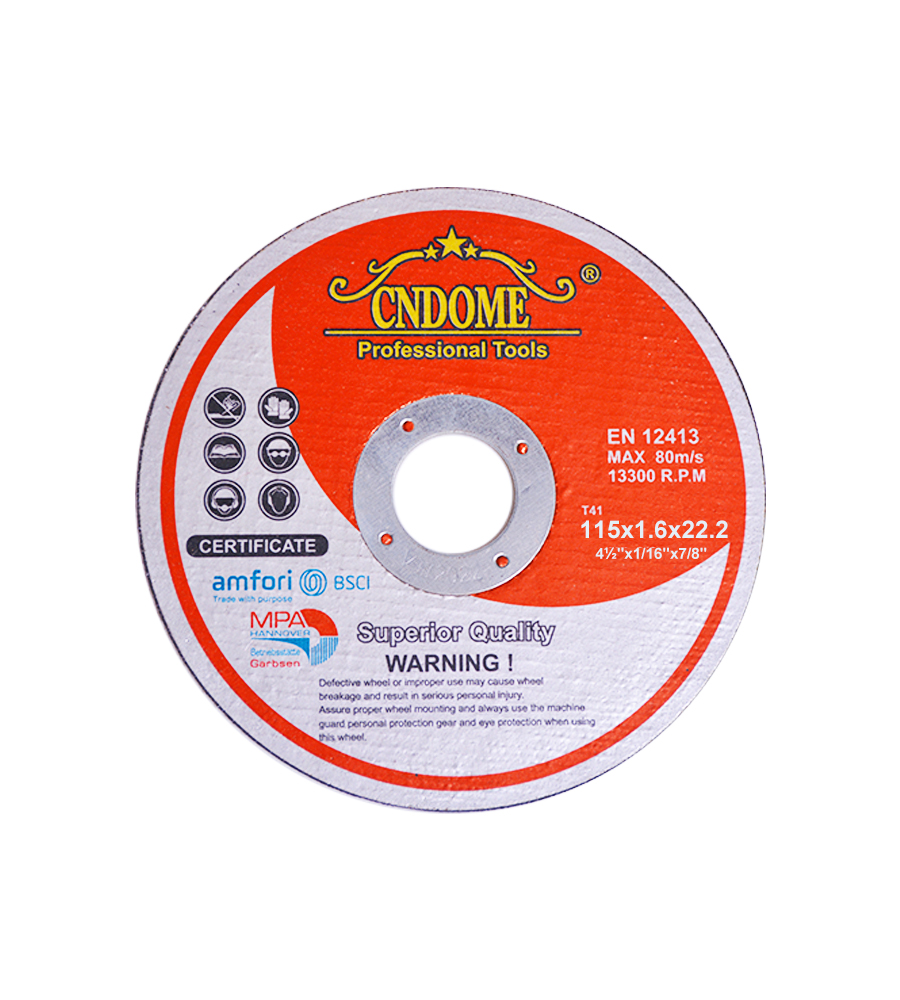
The decision is made by the bore, not the diameter. CNDOME 4-inch cutting discs are built on a 16 mm bore (models 107*1.2*16 and 100*1.0*16), while 4.5-inch cutting discs use a 22.23 mm bore (models 115x1.2x22.23 and 115*1.6*22.23). Both are T41 flat, resin-bonded, rated at 80 m/s, and both are specified for metal and INOX. If the bore does not match your machine's arbor, the disc will not mount correctly no matter how close the diameter looks on the shelf.
This guide compares the two sizes on the criteria that actually determine fit: arbor bore, rated speed, available thickness, abrasive and bond, and the applications each size is matched to. All product values below are CNDOME's published specifications; market and standards references are attributed to their source.
Problem Definition: Why "100 mm or 115 mm" Is the Wrong First Question
Buyers usually start with diameter because it is the number printed largest on the label. In practice, two failures follow from that habit, and both are avoidable.
The first failure is arbor mismatch. A 4-inch cutting disc in CNDOME's range is 107 mm or 100 mm in diameter with a 16 mm bore. A 4.5-inch disc is 115 mm in diameter with a 22.23 mm bore. These are two different mounting standards. The disc's bore is designed to seat on the machine's spindle for the machine class it belongs to, and a 16 mm disc is not designed for a spindle sized around a 22.23 mm disc.
The second failure is speed-rating confusion. CNDOME's 4-inch cutting discs are stated at 15,400 R.P.M. and its 4.5-inch discs at 13,300 R.P.M. — yet both carry the same 80 m/s maximum operating speed. The R.P.M. figure differs because a smaller disc reaches the same surface speed at higher rotation. Comparing R.P.M. numbers between the two sizes without converting to surface speed leads buyers to the wrong conclusion about which disc is "faster" or "safer."
A third variable is thickness. CNDOME's 4-inch cutting discs in this range are listed at 1.0 mm and 1.2 mm; the 4.5-inch discs at 1.2 mm and 1.6 mm. Thicker sections of 2.0 mm appear higher up the diameter range — 125*2*22.23, 180*2*22.23, and 230x2.0x22.23 — which tells you that thickness choices track the diameter class rather than being interchangeable across it.
Industry Background: A Consumable Market Where Fit and Compliance Decide Repeat Orders
Cutting discs sit inside the bonded abrasives segment of Tools & Hardware, a category driven by replacement volume rather than one-time purchase. Two published data points frame the scale: IndexBox values the global cutting discs market at approximately USD 8.5 billion entering 2026, and Fortune Business Insights reports that Asia-Pacific accounted for a 44.7% revenue share of the abrasives market in 2025, supported by industrial expansion in China and India.
Material choice in this market is concentrated. Fortune Business Insights attributes 46.3% of material market share to aluminium oxide abrasives, credited to cost-effectiveness in general metal fabrication. That is consistent with CNDOME's specification of aluminium oxide and white aluminium oxide with resin bond across both the 4-inch and 4.5-inch cutting disc families.
Compliance is the second structural factor. In Europe, EN 12413:2019 is the mandatory safety standard for bonded abrasive products, and it covers burst testing and marking. That matters to this specific decision because the marking on a disc carries its maximum operating speed, wheel type, and dimensions — exactly the three values that differ between a 4-inch and a 4.5-inch disc. For importers, cutting discs are classified under HS Code 6804.22 for millstones, grindstones, and grinding wheels of agglomerated abrasives or ceramics.
The practical consequence is that distributors rarely choose one size over the other. They stock both the 16 mm-bore and the 22.23 mm-bore families, because the two sizes serve different machine populations in the same market.
The CNDOME Range: What Each Size Family Actually Contains
CNDOME is the marketing name used by Changzhou Dome Abrasives Manufacture Co., Ltd., a China-based manufacturer of resin-bonded cutting discs, grinding wheels, abrasive discs, ceramic grinding discs, and flap discs, founded in 2001 and exporting to Latin America, Europe, Africa, and Asia. Because the 4-inch and 4.5-inch question is a specification question, it is best answered with the specification data itself.
4-inch (100–107 mm) cutting discs
- Models: 107*1.2*16 and 100*1.0*16
- Shape: T41 (flat)
- Bore: 16 mm
- Stated maximum operating speed: 80 m/s, 15,400 R.P.M.
- Abrasive and bond: aluminium oxide / white aluminium oxide / resin
- Specified material: metal / INOX
- Listed industries: steel and metal processing, automobile manufacturing, shipbuilding, casting, steel structure, construction
- Matching grinding disc in the same bore family: 100*6*16, T27, 80 m/s

4.5-inch (115 mm) cutting discs
- Models: 115x1.2x22.23 and 115*1.6*22.23
- Shape: T41 (flat)
- Bore: 22.23 mm
- Stated maximum operating speed: 80 m/s, 13,300 R.P.M.
- Abrasive and bond: aluminium oxide / white aluminium oxide / resin
- Specified material: metal / INOX
- Listed industries: steel and metal processing, automobile manufacturing, shipbuilding, casting, steel structure, construction
- Matching grinding discs in the same bore family: 115*6*22.23 and 125*6*22.23, T27, 80 m/s; ceramic grinding discs 115*22.23 and 125*22.23, T29, 100 m/s

Note the pattern: the 22.23 mm bore is not unique to the 4.5-inch cutting disc. It is shared across 115 mm and 125 mm cutting and grinding products, and appears again on 180 mm and 230 mm discs. The 16 mm bore, by contrast, is the compact-end standard used on the 4-inch cutting disc and the 4-inch grinding disc. Choosing a size therefore means choosing a bore family and the accessories, discs, and replacement stock that come with it.
Thickness: the third selection variable
In CNDOME's published range, the 4-inch cutting disc is offered at 1.0 mm and 1.2 mm, and the 4.5-inch cutting disc at 1.2 mm and 1.6 mm. The 2.0 mm section appears at larger diameters (125*2*22.23, 180*2*22.23, 230x2.0x22.23). Thin sections are typically selected where low material loss, reduced dust, and lower heat input matter; thicker sections are typically selected where more rigidity and heavier cutting conditions are expected. CNDOME's application data for its cutting discs lists the operating conditions these products are designed around: high precision, low loss, reduced dust, avoidance of heat damage, and improved yield — with required outcomes including high temperature resistance, burr-free cutting, long service life, high flatness, no blackening after cutting, and no vibration during grinding.
The same platform beyond 4.5 inches
Because buyers often compare two sizes while planning a full range, it helps to see where each stops. CNDOME's cutting disc range runs from compact 38 mm and 50 mm discs (1.5-inch and 2-inch classes) up through 75 mm, 107/100 mm, 115 mm, 125 mm, 180 mm, 230 mm, 355x3.2x25.4 (14 inch, 25.4 mm bore), and 400x3.5x32 (16 inch). A 14-inch cutting disc such as 355x3.2x25.4 is made of aluminium oxide, white aluminium oxide, and resin, with the model designation stating diameter, thickness, and bore in sequence. That naming logic is the same at 4 inches and 4.5 inches — diameter × thickness × bore — which is why reading model numbers is faster than reading marketing names.
Step-by-Step: Matching the Disc to the Job
- Read the machine, not the catalog. Confirm the arbor or spindle size your grinder or cutting machine is built for. If it accepts a 22.23 mm bore, a 4.5-inch disc is the correct class. If it is a compact machine built around a 16 mm bore, the 4-inch disc is the correct class.
- Confirm the tool's rated speed exceeds the disc's rating. Both CNDOME sizes are rated 80 m/s, but the R.P.M. figures differ — 15,400 R.P.M. for the 4-inch models and 13,300 R.P.M. for the 4.5-inch models. Compare the number printed on the disc against your machine's no-load speed.
- Match the diameter to cut depth and access. A 115 mm disc reaches deeper into a section and covers more cut length per pass; a 100–107 mm disc reaches into tighter spaces. For heavy sections, CNDOME's range steps up to 125 mm (12,200 R.P.M.), 180 mm (8,500 R.P.M.), 230 mm (6,600 R.P.M.), and 355 mm (4,400 R.P.M.) cutting discs.
- Choose thickness for material and finish. For fast, low-loss cutting with minimal heat into the workpiece, thin sections are the conventional choice; for heavier cutting conditions, move up to 1.6 mm within the 4.5-inch class, or to the 2.0 mm sections offered at 125 mm and above.
- Verify the marking and compliance context. Under EN 12413:2019, bonded abrasive products carry marking that includes maximum operating speed, wheel type, and dimensions. The marking is the final check that the disc in your hand matches the disc you specified.
Use Cases: Where Each Size Earns Its Place
CNDOME lists cutting discs as being used with angle grinders, cutting machines, straight angle grinders, and chainsaws, at a maximum of 80 m/s. Within that envelope, the two sizes split along project type.
- Metal fabrication and steel structure work. Cutting steel bars, steel plates, and castings is listed among the standard applications for these discs. Both sizes apply; the choice follows the machine population in the shop rather than the material.
- Stainless steel and INOX processing. The specified requirement set here — burr-free cutting, no blackening after cutting, high flatness, no vibration during grinding — is where disc specification discipline matters most. A stainless processing manufacturer in Latin America running CNDOME discs at 500,000 pieces per year over three years reports long disc life, no slag shedding, and high safety in continuous workshop use.
- Shipbuilding, casting, and construction. These are listed among the industries served, and are the settings where the larger diameters (125 mm and above) become the working size while 4-inch and 4.5-inch discs handle fitting, trimming, and maintenance cuts.
- Continuous machining production. A machining factory in Indonesia, Japan, Thailand, and Korea placing 30 orders per year uses CNDOME discs for cutting and polishing iron and stainless steel parts, with the requirement that multiple specifications remain available for 24-hour production.
- Retail and tool-supermarket assortments. A tool supermarket channel across Mexico, the United States, and South America sells a full model range from 3 to 14 inches through stores, covering home DIY and professional metalworking from the same shelf. This is the clearest commercial argument for carrying both the 4-inch and 4.5-inch classes rather than substituting one for the other.
- Private-label and OEM programs. CNDOME provides product development for brand owners and tool brands, including selling across more than 90 countries through platforms such as Amazon, eBay, AliExpress, Walmart, Shopee, Lazada, TEMU, TikTok, and Shopify. A tool brand in Brazil sells 10,000,000 pieces per year through offline hardware stores under its own label.
Comparison Table: 4-Inch vs. 4.5-Inch CNDOME Cutting Discs
| Attribute | 4-Inch Cutting Disc | 4.5-Inch Cutting Disc |
|---|---|---|
| Model designations | 107*1.2*16; 100*1.0*16 | 115x1.2x22.23; 115*1.6*22.23 |
| Nominal diameter class | 100–107 mm | 115 mm |
| Bore (arbor) | 16 mm | 22.23 mm |
| Shape | T41 flat | T41 flat |
| Stated maximum operating speed | 80 m/s | 80 m/s |
| Stated R.P.M. | 15,400 R.P.M. | 13,300 R.P.M. |
| Thickness options in this range | 1.0 mm; 1.2 mm | 1.2 mm; 1.6 mm |
| Abrasive and bond | Aluminium oxide / white aluminium oxide / resin | Aluminium oxide / white aluminium oxide / resin |
| Specified workpiece material | Metal / INOX | Metal / INOX |
| Matching grinding disc | 100*6*16, T27, 80 m/s | 115*6*22.23, T27, 80 m/s |
| Listed industries | Steel and metal processing, automobile, shipbuilding, casting, steel structure, construction | Steel and metal processing, automobile, shipbuilding, casting, steel structure, construction |
| Compliance context | EN 12413:2019 marking: max operating speed, wheel type, dimensions | EN 12413:2019 marking: max operating speed, wheel type, dimensions |
Values are CNDOME published specifications. Final selection must be validated against the rated speed and arbor of the tool in use.
FAQ
1. Do 4-inch and 4.5-inch cutting discs fall under different safety requirements?
No — both are bonded abrasive products, and in Europe EN 12413:2019 applies to bonded abrasive products and covers burst testing and marking. The marking carries maximum operating speed, wheel type, and dimensions, so the 16 mm-bore and 22.23 mm-bore discs are marked differently even though they sit under the same standard. CNDOME states that cutting discs for European exports are manufactured according to EN 12413 and carry MPA Hannover certification for multiple disc sizes, with CE, ISO 9001, ISO 14001, and BSCI forming part of its compliance framework. Buyers should request certificate documentation for the exact size and SKU before ordering.
2. Can CNDOME customize a 4-inch or 4.5-inch disc for a private label?
Yes. CNDOME operates as an OEM/ODM supplier with customization of logo, label, packaging, abrasive formulation, and specification. Stated monthly capacity is 8 million pieces, supported by 60 automated production lines and a daily output of approximately 600,000 pieces, with quality control performed through 100% AI visual comparison testing. Working references include a Brazilian tool brand purchasing 10,000,000 pieces per year for three years and private-label sellers distributing across more than 90 countries.
3. What drives the cost difference between a 4-inch and a 4.5-inch disc?
Cost is driven by material volume per disc (diameter combined with thickness), abrasive grade, resin formulation, reinforcement, packaging, order quantity, and freight — not by the size label alone. Aluminium oxide holds 46.3% of material market share in abrasives because of cost-effectiveness in general metal fabrication, so abrasive grade is a major cost lever. A 115 mm × 1.6 mm disc consumes more abrasive material than a 100 mm × 1.0 mm disc, which is why per-piece comparisons across sizes should be made on identical order quantities and packing configurations. Custom cutting discs are available from quantities of 10,000 pieces.
4. Can I evaluate both sizes before committing to a volume order?
Evaluation is the sensible first step, because arbor fit and finish quality cannot be confirmed from a datasheet. Send the intended models — for example 107*1.2*16 against 115x1.2x22.23 — together with your machine's arbor size, rated speed, and the workpiece material you cut most. CNDOME provides 24/7 online support and remote technical assistance to help match specification to application, and its product brochure is available for download at the CNDOME catalogue.
5. What is the lead time for a custom 4-inch or 4.5-inch order?
The stated lead time is 30 days. Behind that figure sit 60 automated production lines, a daily output of roughly 600,000 pieces, and monthly capacity of 8 million pieces, in a temperature- and humidity-controlled workshop of more than 20,000 m². For a specific requirement, quote your model, thickness, bore, packing, and target quantity to czdome.com or by email to chris@czdome.com (WhatsApp +86 18796960868), and the team will confirm availability, tooling requirements, and shipping schedule.
Conclusion: Match the Bore First, Then the Diameter
The 4-inch and 4.5-inch cutting disc decision resolves into three checks, in this order. First, the bore: 16 mm for the 4-inch models 107*1.2*16 and 100*1.0*16, and 22.23 mm for the 4.5-inch models 115x1.2x22.23 and 115*1.6*22.23. Second, the rated speed: both are 80 m/s, at 15,400 R.P.M. and 13,300 R.P.M. respectively. Third, thickness and workpiece: 1.0–1.2 mm in the 4-inch class, 1.2–1.6 mm in the 4.5-inch class, both specified for metal and INOX.
Get those three right and the size question disappears, because each disc will be matched to machines built for its bore family — with grinding discs, ceramic grinding discs, and larger cutting discs available in the same 22.23 mm family when the job grows.
Next step: compare both sizes against your tooling
Tell CNDOME which machines you run, which materials you cut, and which models you are considering. The team will confirm bore, thickness, and speed match, and provide a quotation for a standard or private-label program.
Website: czdome.com | Blog: blog.czdome.com
Email: chris@czdome.com | Tel / WhatsApp: +86 18796960868
Catalogue download: CNDOME product brochure (PDF)
Changzhou Dome Abrasives Manufacture Co., Ltd. — Garden Industrial Park, Zhenglu Town, Tianning District, Changzhou City, Jiangsu Province, China.
Have Questions or Need More Details?
Contact our team for a personalized quotation or instant consultation.
Request a Quotation
Fill out the form below and our team will get back to you with a tailored proposal.
WhatsApp Direct Chat
Prefer to chat in real-time? Message us on WhatsApp for instant assistance & quick answers.
- Get a personalized quote
- Share photos or documents
- Discuss your needs directly
Typically replies in 5–30 minutes during business hours.