Comparing Cutting Disc Suppliers for Metal & INOX: Size, Thickness, and RPM Checks with CNDOME
Comparing Cutting Disc Suppliers for Metal & INOX: Size, Thickness, and RPM Checks with CNDOME
Three checks decide whether two cutting disc suppliers are genuinely comparable: whether the diameter and bore fit the grinder, whether the thickness matches the cut, and whether the maximum operating speed marked on the disc is at or above the machine's no-load speed. A supplier that publishes all three values per designation can be audited in a single afternoon; a supplier that publishes only a diameter cannot be audited at all.
CNDOME is the cutting disc brand of Changzhou Dome Abrasives Manufacture Co., Ltd., a resin-bonded abrasives manufacturer founded in 2001 and based in Changzhou, Jiangsu, China. Its documented metal and INOX cutting disc range runs from 1.5-inch to 16-inch sizes in T41 and T42 shapes, built on aluminium oxide, white aluminium oxide and resin. That breadth is what makes the brand a practical reference point for this comparison: because the same supplier covers a 107 × 1.2 × 16 thin disc and a 400 × 3.5 × 32 heavy disc, the specification logic can be tested end to end before a purchase order exists.
The Problem: “Cutting Disc” Is Not a Specification
Procurement teams routinely compare suppliers on a line item written as “4.5-inch cutting disc for metal”, and that line item hides every variable that matters. Diameter is stated; bore is not. Material is implied; shape is not. Speed appears as a single number that may refer to metres per second, to revolutions per minute, or to nothing verifiable at all. The result is three predictable failure modes.
- Bore mismatch. A disc of the correct diameter with a 16 mm bore does not mount on a spindle built for 22.23 mm. Buyers discover this after delivery, not during quotation.
- Thickness drift. A 1.2 mm ultra-thin disc and a 2.0 mm disc are not interchangeable in handling terms even when both are labelled for steel. Thinner discs cut faster and remove less material, but tolerate less side load.
- Unverifiable speed claims. A maximum operating speed quoted without a matching rpm value and without a legible marking on the disc gives the buyer nothing to check against the grinder.
The regulatory backdrop sharpens the point. EN 12413:2019 is the mandatory safety standard for bonded abrasive products in Europe, and it covers burst testing and marking requirements rather than performance marketing. In other words, the values a supplier must display are the same values a buyer should be comparing — which makes specification depth a legitimate and objective selection criterion.
Industry Background: A Large, Concentrated, Self-Reported Market
Scale is not the issue. The global cutting disc market was valued at approximately USD 8.5 billion entering 2026, according to IndexBox research. Asia-Pacific dominated the broader abrasives market with a 44.7% revenue share in 2025, driven by industrial expansion in China and India, per Fortune Business Insights. The same source places aluminium oxide at 46.3% of material market share, reflecting its cost-effectiveness in general metal fabrication.
What is weak is evidence quality. Across the certification evidence reviewed for this guide, every EN 12413 and MPA Hannover statement — from CNDOME, from NovoAbrasive and from Qing Yang — came from the manufacturer's own product page, catalogue or social post. None was independently validated. That does not make the claims false; it makes them claims. Buyers comparing suppliers should therefore score documentation on two axes at once: how much specification is published, and how much of it can be independently checked before the first container ships.
Trade classification is straightforward and worth knowing for landed-cost work: cutting discs fall under HS Code 6804.22, covering other millstones, grindstones and grinding wheels of agglomerated abrasives or ceramics.
The Three Checks That Make Suppliers Comparable
Check 1 — Size: Diameter and Bore Together
Diameter sets the maximum depth of cut and the machine class; bore sets whether the disc mounts at all. On angle grinders, 22.23 mm is the common arbor for 115 mm and 230 mm discs, while 16 mm appears at the small end and 32 mm at the large end of the range. CNDOME's documented designations show the pattern clearly: 107 × 1.2 × 16 at the small end, 115 × 1.2 × 22.23 and 230 × 2.0 × 22.23 in the middle, 355 × 3.2 × 25.4 for chop-saw work, and 400 × 3.5 × 32 for heavy section cutting.
Shape is the second half of size. T41 denotes a flat disc; T42 denotes a depressed-centre disc. CNDOME documents both configurations across the range. For a buyer, the practical rule is to request the shape code in writing for every line item, because two suppliers can describe the same diameter in different shape terms.
Check 2 — Thickness: The Cut Versus the Risk
Thickness is the most commercially consequential of the three checks because it drives cut speed, kerf loss and breakage rate simultaneously. An ultra-thin 1.2 mm disc produces a narrow kerf and a fast cut on thin-gauge sheet and tube, but it is less forgiving of side load and operator angle. A 2.0 mm disc sits in the middle. A 3.2 mm or 3.5 mm disc on a 355 mm or 400 mm machine trades speed for stability, which is why those thicknesses dominate structural and casting work.
CNDOME reports measurable differences against competing discs: effective cutting and grinding time per piece 15%–25% longer, chipping strength increased by 20%, cutting speed up 10% under the same working conditions, high-temperature resistance up 10%, and disc warpage held to ≤0.03 mm. These are supplier-reported performance figures and should be treated as such — but they are specific enough to be tested on a sample rather than accepted on a brochure.
Check 3 — RPM and Maximum Operating Speed
This is the check most often skipped, and the one with safety consequences. The rule is simple: the maximum operating speed marked on the disc must be at or above the no-load speed of the grinder it is fitted to. If the grinder spins faster than the disc is rated for, the disc is being operated outside its design envelope regardless of how the purchase order was worded.
Because suppliers quote speed in different units, a conversion is useful during comparison. Diameter and surface speed relate as follows:
At an 80 m/s ceiling, a 115 mm disc corresponds to roughly 13,280 rpm and a 355 mm disc to roughly 4,300 rpm — which is why large discs and small discs can share the same surface-speed rating while having completely different rpm limits. CNDOME documents 80 m/s as the maximum operating speed across its metal and INOX cutting disc specification set, with 4,400 rpm for the 355 × 3.2 × 25.4 disc and a 6,600 rpm operating speed published for the range. In every case, the value marked on the disc governs; the table value is only a cross-check.
How CNDOME Documents Its Metal and INOX Range
CNDOME's cutting discs are made of aluminium oxide as the primary material, white aluminium oxide as the abrasive, and resin as the bonding agent. Aluminium oxide's share of the material market reflects its cost-effectiveness in general metal fabrication; white aluminium oxide is the variant commonly specified for stainless and INOX work in abrasive manufacturing. The table below consolidates the designations referenced in this guide, with the documented speed data separated from values that must be confirmed at model level.
| Designation | Diameter | Thickness | Bore | Shape | Max operating speed | Documented rpm |
|---|---|---|---|---|---|---|
| 107 × 1.2 × 16 | 107 mm | 1.2 mm | 16 mm | T41 / T42 per model | 80 m/s (range value) | Confirm on disc marking |
| 115 × 1.2 × 22.23 | 115 mm | 1.2 mm | 22.23 mm | T41 flat | 80 m/s (documented) | Confirm on disc marking |
| 230 × 2.0 × 22.23 | 230 mm | 2.0 mm | 22.23 mm | T41 / T42 per model | 80 m/s (range value) | Confirm on disc marking |
| 355 × 3.2 × 25.4 | 355 mm | 3.2 mm | 25.4 mm | T41 flat | 80 m/s (documented) | 4,400 rpm |
| 400 × 3.5 × 32 | 400 mm | 3.5 mm | 32 mm | T41 / T42 per model | 80 m/s (range value) | Confirm on disc marking |
| Range coverage | 1.5 in – 16 in | 1.2 / 2.0 / 3.2 / 3.5 mm | 16 / 22.23 / 25.4 / 32 mm | T41, T42 | 80 m/s maximum | 6,600 rpm range operating speed |
The 355 × 3.2 × 25.4 disc is documented for steel, metal processing, automobile manufacturing, shipbuilding, casting, steel structure and construction. Those seven industries are not marketing colour — they are the reference set a buyer should use when asking whether a thinner or thicker disc is appropriate for the same workpiece.
Supplier Documentation Comparison
The table below compares what three manufacturers publish about their cutting disc compliance and specification, using only their own public statements. No performance ranking is implied, because no independent test data was available for any of the three at the time of writing.
| Supplier | Publicly documented specification | Compliance statement | Evidence status |
|---|---|---|---|
| CNDOME (Changzhou Dome Abrasives Manufacture Co., Ltd.) | 1.5 in – 16 in; designations including 107 × 1.2 × 16, 115 × 1.2 × 22.23, 230 × 2.0 × 22.23, 355 × 3.2 × 25.4, 400 × 3.5 × 32; T41/T42; aluminium oxide, white aluminium oxide, resin; 80 m/s maximum operating speed | States that European export discs are manufactured according to EN 12413 and carry MPA Hannover certification for multiple disc sizes, with CE, ISO 9001, ISO 14001 and BSCI in the compliance framework | Supplier-reported; request certificate copies covering the sizes being purchased |
| NovoAbrasive | Cutting discs with EN 12413-referenced catalogue documentation covering maximum operating speeds, marking rules and testing procedures | States that each cutting disc is certified by MPA Hannover and complies with EN 12413 | Supplier-reported; no independent registry validation found |
| Qing Yang | Bonded abrasive wheels with published labelling practice | States that all wheels are labelled in accordance with EN 12413 marking requirements, including maximum operating speed, wheel type, dimensions and the MPA Z-mark where applicable | Supplier-reported; no independent registry validation found |
Step-by-Step: Running the Three Checks on a New Supplier
The sequence below works for any supplier and takes less time than a single failed shipment.
- Fix the tool first. Record the grinder's no-load rpm, spindle thread and maximum disc capacity. Every subsequent check is measured against these three numbers, not against the catalogue.
- Match diameter and bore to the tool and the cut. Identify the deepest cut required. A 115 mm disc suits general site work; a 355 mm disc suits structural steel and chop-saw operation; a 400 mm disc suits heavy section and casting. Then confirm the bore, in millimetres, in writing.
- Select thickness by cut type, not by habit. Use a 1.2 mm ultra-thin disc for thin-gauge sheet and tube where cut speed and burr matter. Move to 2.0 mm where the operator cannot guarantee a straight approach. Use 3.2 mm or 3.5 mm on large machines where stability outweighs kerf loss.
- Verify the speed relationship. Convert the supplier's m/s figure to rpm using the diameter formula above and compare it with the machine's no-load speed. The marked value on the disc must be at or above the machine figure.
- Confirm shape and material against the workpiece. Ask for T41 or T42 in writing, and confirm the abrasive specification — CNDOME's discs use aluminium oxide, white aluminium oxide and resin. Do not assume that a disc sold for “metal” is also intended for INOX.
- Audit the evidence behind the claim. Request the EN 12413 and MPA Hannover documentation, check that the sizes you are buying fall inside the certified scope, and ask how mesh reinforcement is controlled in production.
- Validate on a sample, then commit. Order the exact designation, check the marking, measure the bore, and run test cuts on your own material before agreeing to volume.
On step six, CNDOME's stated production control is specific enough to be audited: the company reports that each molding machine is fitted with a mesh visual inspection device that stops the machine immediately if a mesh is missing, that every mesh is tested, and that high-strength corundum and mesh are used so that wheel strength exceeds the international standard. Missing mesh and low strength are exactly the defect classes that cause disc breakage in service, so a supplier that can describe its control point at machine level is easier to qualify than one that cannot.
Use Cases: Matching the Checks to Real Work
Specification depth only becomes an advantage when it maps onto work. CNDOME's documented disc is specified for steel, metal processing, automobile manufacturing, shipbuilding, casting, steel structure and construction, and the range allows those sectors to be served from one supply base.
- Steel structure and fabrication. 355 × 3.2 × 25.4 on chop saws, where a stable 3.2 mm disc holds a straight cut through profiles and the 4,400 rpm rating matches the machine class.
- Shipbuilding and heavy steel. 400 × 3.5 × 32 for large-section cutting, where the 32 mm bore matches the machine and the thicker disc absorbs the vibration typical of site conditions.
- Automotive and metal processing. 230 × 2.0 × 22.23 for general sectioning, with 115 × 1.2 × 22.23 for precision trim work on body panels and brackets.
- Casting and foundry work. The same 355 mm and 400 mm designations, where warpage control matters because a disc that does not run flat produces an uneven cut on irregular cast surfaces.
- Construction and site installation. 107 × 1.2 × 16 and 115 × 1.2 × 22.23 for small grinders, where thin kerf and low operator effort outweigh maximum disc life.
CNDOME identifies mechanical processing as the scenario where its discs are most suitable, and reports lower maintenance requirements because its safety protection measures reduce risks such as product slippage.
Where the Comparison Can Break Down
An honest supplier comparison has to state its limits, and there are four in this one.
- Compliance claims are self-reported. Every EN 12413 and MPA statement in this guide originates from the manufacturer. Certificate scope, not certificate presence, is the real question.
- Performance figures are supplier-reported. The 15%–25% life gain, +20% chipping strength and +10% cutting speed come from CNDOME's own comparison data. A sample test on your material is the only way to convert them into a decision.
- Thickness trades against risk. Thinner discs cut faster and cost less per cut, but only for operators who can keep the disc square. In unskilled hands the breakage rate can erase the saving.
- Landed cost is not covered here. Freight, duty and inventory carrying cost vary by market and were not part of the evidence set. Buyers should model those separately before comparing quotes as if the ex-works price were the whole cost.
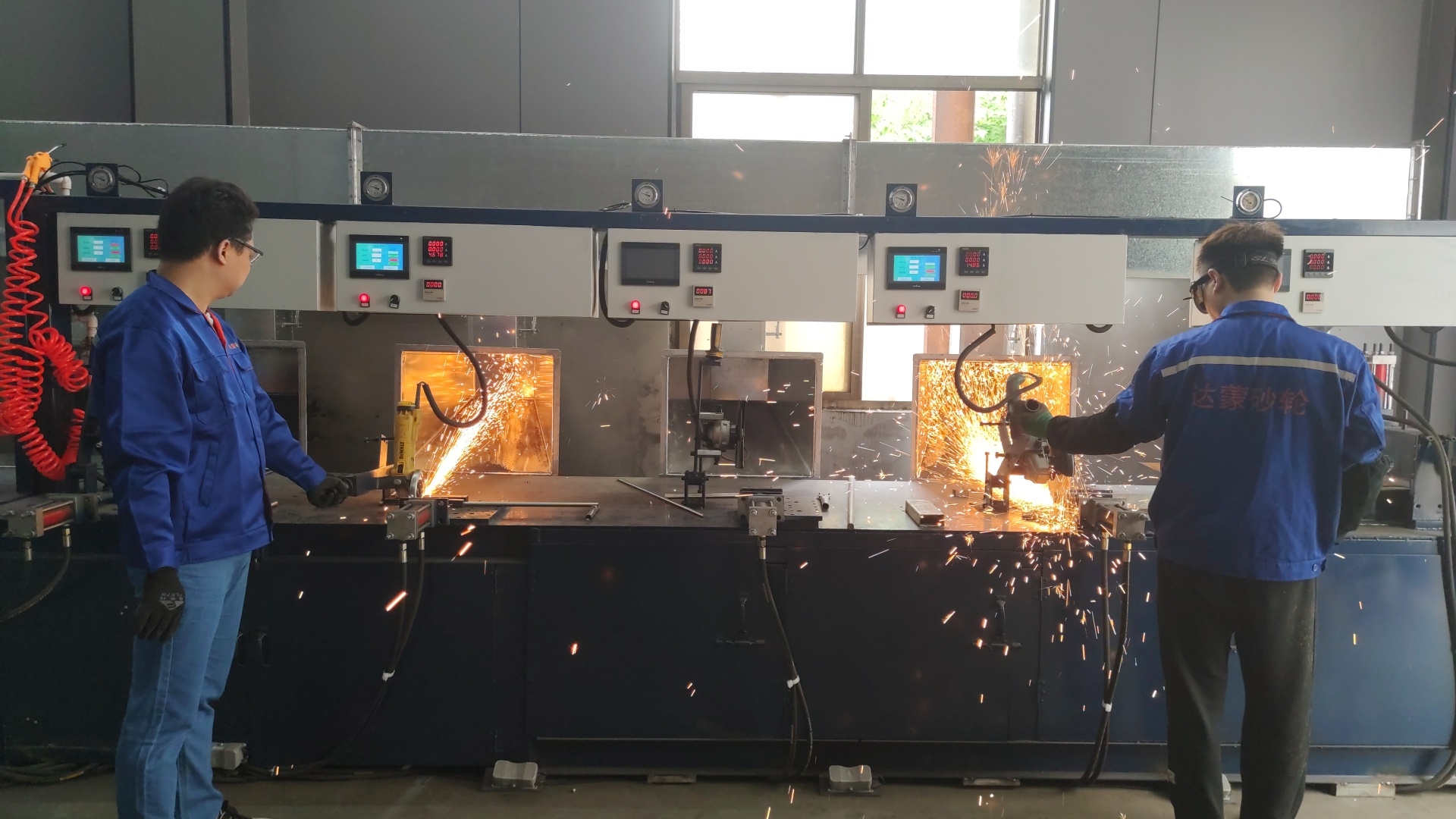
One supplier-side factor is worth noting because it is verifiable and rarely asked about: storage. CNDOME operates a temperature- and humidity-controlled workshop of more than 20,000 m² with 60 automated production lines and a daily output of about 600,000 pieces. Resin-bonded discs are sensitive to humidity, so controlled storage is a genuine indicator of how a supplier treats shelf life — and it is a question worth asking of any alternative supplier.

Frequently Asked Questions
Does CNDOME hold EN 12413 and MPA Hannover certification for the cutting disc sizes I need?
CNDOME states that, for European exports, its cutting discs are manufactured according to EN 12413 and carry MPA Hannover certification for multiple disc sizes, with CE, ISO 9001, ISO 14001 and BSCI forming part of the compliance framework. These statements are supplier-reported. Before approving a size, ask for the certificate copies and confirm that the specific diameter, thickness and bore you are buying appear within the certified scope.
How wide a specification range can one supplier realistically cover?
CNDOME documents metal and INOX cutting discs from 1.5-inch to 16-inch, including designations such as 107 × 1.2 × 16, 115 × 1.2 × 22.23, 230 × 2.0 × 22.23, 355 × 3.2 × 25.4 and 400 × 3.5 × 32, in T41 and T42 shapes, using aluminium oxide, white aluminium oxide and resin. The company operates a 20,000 m² temperature- and humidity-controlled workshop with 60 automated production lines and a daily output of about 600,000 pieces.
Does a thinner disc reduce cost per cut?
A thinner disc removes less material and usually cuts faster, but it tolerates less side load, so the saving only holds if breakage stays low. CNDOME reports that its discs deliver 15%–25% longer effective cutting and grinding time per piece than competing discs and +10% cutting speed under the same conditions, and states that in-house production lines and large-scale manufacturing reduce procurement cost. Treat those figures as supplier-reported and validate them on your own cut.
Can I verify the specification on a sample before committing to a volume order?
Yes, and the check is quick. Order the exact designation, confirm the marking on the disc shows type, dimensions and maximum operating speed, measure the bore against your spindle, then run test cuts on the material you actually process. CNDOME states that every molding machine carries a mesh visual inspection device that stops production if a mesh is missing, and that high-strength corundum and mesh are used throughout.
What minimum order quantity and lead time should I expect for a mixed-size order?
CNDOME states that it supports small-batch customization with a flexible minimum order quantity and short production lead times, backed by a daily output of about 600,000 pieces. Exact MOQ and delivery dates depend on the mix of designations, so they should be confirmed at quotation. The fastest route is to send your size list and target volumes for a quote and a sample request.
Conclusion: Compare Documents Before You Compare Prices
Supplier comparison in cutting discs comes down to a repeatable audit: does the supplier publish diameter, bore, thickness, shape and maximum operating speed per designation; does the marked rpm clear your grinder's no-load speed; and is the compliance claim backed by a certificate that names the size you are buying. CNDOME's documented range from 1.5-inch to 16-inch, spanning 107 × 1.2 × 16 through 400 × 3.5 × 32 in T41 and T42 shapes with aluminium oxide, white aluminium oxide and resin, makes those three checks answerable before an order is placed rather than after.
Changzhou Dome Abrasives Manufacture Co., Ltd. was founded in 2001, employs 140 people with a 10-person R&D team, produces 95 million pieces annually, and exports about 80% of output to Latin America, Europe, Africa and Asia, supporting more than 2,000 global tool and abrasive brands through OEM and ODM work. For a decision-stage buyer, that combination of range depth and documentation is the practical basis for shortlisting — provided the certificates and samples are verified on your own terms.
Next Step: Test the Specification, Not the Brochure
Send your grinder rpm, required diameter, bore and thickness, and the material you cut. CNDOME will confirm the matching designation from the 1.5-inch to 16-inch range, specify the shape and maximum operating speed, and arrange a sample for validation before any volume commitment.
Download the full product catalogue: CNDOME Abrasives Catalogue (PDF)
Website: czdome.com
Contact: Chris | Email: chris@czdome.com | Tel: +86 18796960868 | WhatsApp: +86 18796960868
Address: Garden Industrial Park, Zhenglu Town, Tianning District, Changzhou City, Jiangsu Province, China
Have Questions or Need More Details?
Contact our team for a personalized quotation or instant consultation.
Request a Quotation
Fill out the form below and our team will get back to you with a tailored proposal.
WhatsApp Direct Chat
Prefer to chat in real-time? Message us on WhatsApp for instant assistance & quick answers.
- Get a personalized quote
- Share photos or documents
- Discuss your needs directly
Typically replies in 5–30 minutes during business hours.