
Cutting Disc Size Codes Decoded: What CNDOME's 1.5-Inch to 16-Inch Range Teaches Buyers
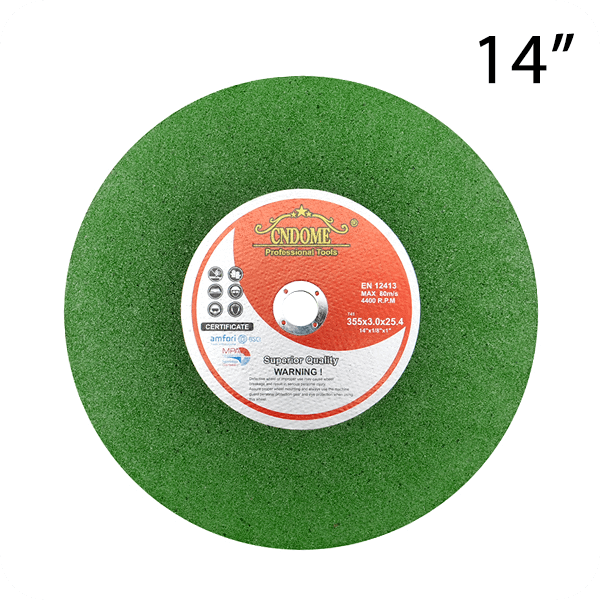 A 355×3.2×25.4 cutting disc: 355 mm diameter, 3.2 mm thickness, 25.4 mm bore.
A cutting disc code such as 107×1.2×16 is a measurement string, not a product name. Read left to right it gives the outside diameter in millimetres (107), the thickness (1.2 mm) and the bore (16 mm). Everything else a buyer needs — shape, abrasive mix, maximum operating speed and rated RPM — sits outside those three numbers, usually in a neighbouring column of the same catalogue. Reading the string in the right order is the fastest way to check whether a disc fits a tool, whether a range covers the sizes you actually sell, and whether a supplier's specification table is finished or half-filled.
CNDOME's own line runs from a 38 mm (1.5-inch) disc rated at 45,000 RPM to a 400 mm (16-inch) disc rated at 3,800 RPM, using the same three-field code at every step. That span makes a useful teaching set: the numbers move in a predictable direction, and the places where the pattern breaks are exactly where buyers get caught.
The short answer. Diameter sets the tool class; thickness sets how much material the cut removes; bore decides whether the disc mounts at all; and the maximum operating speed in m/s plus the rated RPM decide whether it is safe on your machine. Compare suppliers on all four fields across the whole size ladder, not on one sample disc.
What a Cutting Disc Size Code Actually Encodes
A code of the form 230×3.0×22.23 answers three questions and hides two. The visible three are millimetres of diameter, millimetres of thickness and millimetres of bore. The two it hides are the shape designation (T41, T42, T27 and T29 appear in CNDOME's catalogue) and the speed rating — a maximum operating speed in metres per second and a rated spindle speed in RPM.
- 230×3.0×22.23 — 230 mm diameter, 3.0 mm thick, 22.23 mm bore. CNDOME lists this in its 9-inch cutting disc family, T41/T42, rated 6,600 RPM at a maximum operating speed of 80 m/s.
- 355×3.2×25.4 — 355 mm, 3.2 mm, 25.4 mm bore. The 14-inch model, T41, 4,400 RPM at 80 m/s.
- 400×3.5×32 — 400 mm, 3.5 mm, 32 mm bore. The 16-inch model, T41, 3,800 RPM at 80 m/s.
- 107×1.2×16 — 107 mm, 1.2 mm, 16 mm bore. The 4-inch model in CNDOME's list, published alongside a 100×1.0×16 variant under the same 4-inch heading.
That last pair is the first lesson. Two different metric diameters are both sold as 4 inch, because the inch label is a rounding of the millimetre measurement rather than a specification. The same happens at the small end, where 75×1.2×10 and 76×1.0×10 share a 3-inch label. When you order, quote the metric string; when you compare suppliers, check that they publish one.
Why Code Literacy Comes Before Supplier Comparison
Cutting discs are consumables, and consumable sourcing is where specification shortcuts cost the most. The bonded abrasives category is large and heavily regionalised: IndexBox estimates the global cutting disc market at approximately USD 8.5 billion entering 2026, and Fortune Business Insights reports that Asia-Pacific held a 44.7% revenue share of the abrasives market in 2025, with aluminium oxide — the abrasive used across most of CNDOME's cutting range — accounting for 46.3% of material share. Both are commercial research estimates, useful for context and not for supplier selection.
What matters at the buyer's desk is narrower. A distributor comparing three quotations for 4-inch cutting discs may actually be comparing a 100×1.0×16 disc against a 107×1.2×16 disc at a different bore, and concluding that one supplier is cheaper per piece. The discs are not the same product. The same failure appears on the tool side, where a disc with a 22.23 mm bore is quoted for a machine set up for a 16 mm arbor. Code literacy turns both errors into a five-second check.
Trade classification adds a second reason to read the string carefully. Bonded abrasive wheels move under HS 6804.22, a heading covering millstones, grindstones and similar agglomerated abrasive articles, so customs documentation will not distinguish a 1.0 mm disc from a 3.0 mm disc. The commercial distinction lives entirely in the model code and the specification table.
The Three Numbers and the Rating That Isn't Printed in the Code
Diameter: the first number sets the tool class
Diameter determines what the disc can physically be mounted on and how deep a single pass can cut. CNDOME's range steps through the familiar nominal sizes: 38 mm (1.5 inch), 50 mm (2 inch), 75/76 mm (3 inch), 100/107 mm (4 inch), 115 mm (4.5 inch), 125 mm (5 inch), 180 mm (7 inch), 230 mm (9 inch), 355 mm (14 inch) and 400 mm (16 inch). Moving from 115 mm to 230 mm doubles the diameter, which changes the machine class, the guard requirement and the thickness of material one pass can sever.
Diameter is also the field buyers misread most often, because the inch nickname and the metric value disagree slightly by design. 355 mm is sold as 14 inch, though 14 inches converts to 355.6 mm; 230 mm is sold as 9 inch, though 9 inches converts to 228.6 mm. The rounding is harmless in conversation and dangerous in a purchase order.
Thickness: the second number trades kerf against mass
Thickness runs from 1.0 mm to 3.5 mm across these cutting models, against 6 mm for the grinding discs in the same catalogue. The thin end — 1.0 and 1.2 mm — removes a narrow kerf, which is why thin sections appear where material loss and burr control matter. The thick end — 3.0 mm on the 230 mm model, 3.2 mm on the 355 mm, 3.5 mm on the 400 mm — carries more abrasive mass and a wider cut.
Two practical consequences follow. First, a supplier's thickness ladder tells you whether it can serve both a precision fabricator and a heavy structural shop; CNDOME's 125 mm (5-inch) family alone is published in 1.2, 1.6, 2.0 and 3.0 mm, and the 230 mm family in 2.0, 2.5 and 3.0 mm. Second, thickness is not a quality score. A 1.0 mm disc is not better than a 3.0 mm disc; it is a different cut. The buyer's job is to match thickness to the finish and tolerance the job needs — including the requirements CNDOME's application notes list for precision cutting, such as high flatness, burr-free edges and no blackening after the cut.
Bore: the third number decides whether the disc mounts
Bore is the least negotiable field in the code. Across this range it steps from 3 mm on the 38 mm disc, to 10 mm on the 50 mm and 75/76 mm models, to 16 mm on the 4-inch models, to 22.23 mm on the 115 mm, 125 mm, 180 mm and 230 mm models, then to 25.4 mm on the 355 mm disc and 32 mm on the 400 mm disc. The 22.23 mm bore is the familiar 7/8-inch arbor; 25.4 mm is one inch.
A wrong bore is not a tolerance issue, it is an assembly failure — and because the rule is boring, bore is also the field most often dropped from a short quotation. Note how CNDOME's 4-inch family is published as 107×1.2×16 alongside 100×1.0×16: both variants share the 16 mm bore, which is what makes them interchangeable on the same machine despite different diameters. Read the third number before the first.
The speed rating: the field that decides safety
Maximum operating speed is expressed as surface speed in metres per second and is not part of the three-number code. Across CNDOME's cutting models it is 80 m/s; the ceramic grinding disc in the same catalogue is rated at 100 m/s. The rated spindle speed in RPM is the same limit expressed for a specific diameter, which is why the numbers fall as the discs grow: 45,000 RPM at 38 mm, 30,100 at 50 mm, 20,100 at 75/76 mm, 15,400 at 100/107 mm, 12,200 at 125 mm, 8,500 at 180 mm, 6,600 at 230 mm, 4,400 at 355 mm and 3,800 at 400 mm.
The mechanism is geometry rather than marketing. The rim of a disc travels at a speed proportional to diameter multiplied by RPM, so a larger disc reaches the same rim speed at a lower spindle speed. That is how a 400 mm disc rated at 3,800 RPM and a 38 mm disc rated at 45,000 RPM can both carry an 80 m/s maximum operating speed. For the buyer the rule is absolute: the disc's rated speed must be at least the machine's maximum spindle speed, and the machine must never run above the maximum operating speed marked on the disc.
The 38 mm disc deserves a note. At 45,000 RPM it sits an order of magnitude away from the 4-inch and 5-inch models, so it belongs to a different tool class entirely. CNDOME lists angle grinders, cutting machines, straight grinders and chainsaws among the matched equipment for the range as a whole; that is a range-level statement, not a per-size guarantee, so confirm each disc against each machine nameplate.
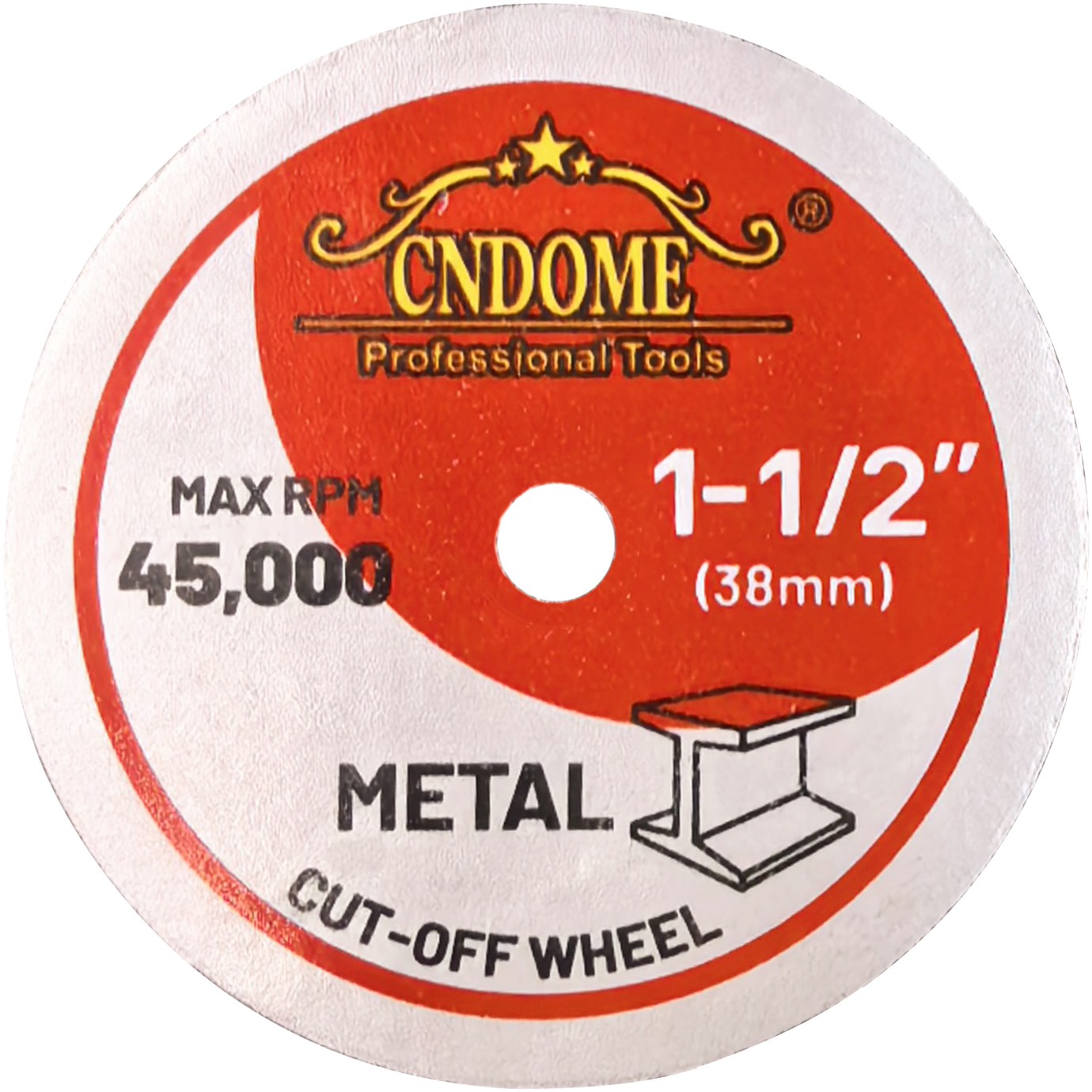 The small end of the ladder: 38×1.1×3, a 1.5-inch disc rated 45,000 RPM at 80 m/s.
How CNDOME's 1.5-Inch to 16-Inch Ladder Reads in Practice
Sort the models by diameter and the range behaves like a ladder: diameter up, thickness up, bore up, RPM down. The table below uses only the published specifications for these models; where a field is not stated for a model, it is marked rather than filled in.
| Model code | Nominal size | Diameter | Thickness | Bore | Shape | Max operating speed | Rated speed |
|---|---|---|---|---|---|---|---|
| 38×1.1×3 | 1.5 in | 38 mm | 1.1 mm | 3 mm | T41 | 80 m/s | 45,000 RPM |
| 50×1.2×10 / 50×2×10 | 2 in | 50 mm | 1.2 / 2.0 mm | 10 mm | T41 | 80 m/s | 30,100 RPM |
| 75×1.2×10 / 76×1.0×10 | 3 in | 75 / 76 mm | 1.2 / 1.0 mm | 10 mm | T41 | 80 m/s | 20,100 RPM |
| 100×1.0×16 / 107×1.2×16 | 4 in | 100 / 107 mm | 1.0 / 1.2 mm | 16 mm | T41 | 80 m/s | 15,400 RPM |
| 115×1.2×22.23 / 115×1.6×22.23 | 4.5 in | 115 mm | 1.2 / 1.6 mm | 22.23 mm | T41 | 80 m/s | Not stated |
| 125×1.2–3.0×22.23 | 5 in | 125 mm | 1.2 / 1.6 / 2.0 / 3.0 mm | 22.23 mm | T41 / T42 | 80 m/s | 12,200 RPM |
| 180×1.6–3.0×22.23 | 7 in | 180 mm | 1.6 / 2 / 3 mm | 22.23 mm | T41 | 80 m/s | 8,500 RPM |
| 230×2.0–3.0×22.23 | 9 in | 230 mm | 2.0 / 2.5 / 3.0 mm | 22.23 mm | T41 / T42 | 80 m/s | 6,600 RPM |
| 355×3.2×25.4 | 14 in | 355 mm | 3.2 mm | 25.4 mm | T41 | 80 m/s | 4,400 RPM |
| 400×3.5×32 | 16 in | 400 mm | 3.5 mm | 32 mm | T41 | 80 m/s | 3,800 RPM |
Two readings of the table are worth keeping. First, the thickness column is not a straight line: the 4-inch models sit at 1.0–1.2 mm, the 5-inch family runs 1.2–3.0 mm, and the 9-inch family is published at 2.0, 2.5 and 3.0 mm. A supplier offering three thicknesses at one diameter is offering three different jobs, not three quality tiers. Second, every model listed carries the same 80 m/s maximum operating speed while the RPM figures spread across a factor of roughly twelve. Surface speed is the constant; spindle speed is the variable.
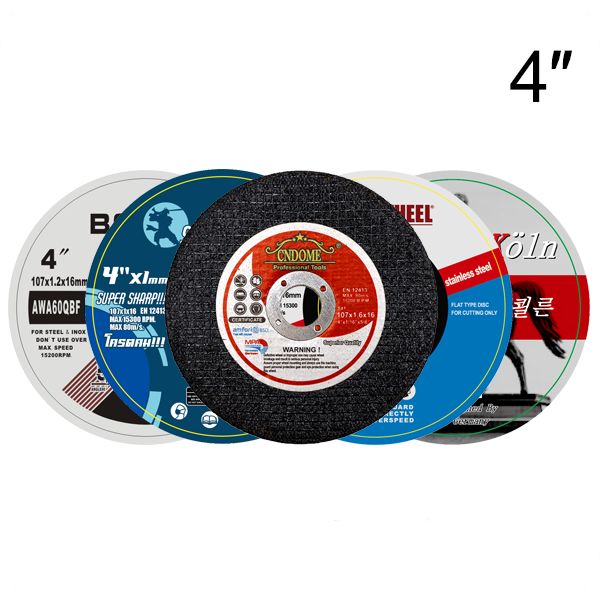 A 4-inch disc with a 16 mm bore — the bore, not the diameter, decides whether it mounts.
Decoding a Disc in Six Steps
- Split the string. Take 230×3.0×22.23 and read it as diameter × thickness × bore in millimetres. Asterisks, slashes or spaces do not change the order.
- Check the bore against the machine. 16 mm, 22.23 mm, 25.4 mm and 32 mm are four different arbors. If the bore does not match, nothing else in the comparison matters.
- Resolve the nominal inch label into the metric code. 9 inch should resolve to 230 mm, 14 inch to 355 mm, 16 inch to 400 mm. Where a supplier sells 100 mm and 107 mm both as 4 inch, order by the metric value.
- Read the thickness against the job. 1.0–1.2 mm for low-loss, low-burr cutting; 2.0–3.5 mm where a wider kerf and more abrasive mass suit the workpiece. Thickness is a job match, not a grade.
- Find the shape code. T41 is the flat cutting shape across CNDOME's cutting models, with T42 also listed for the 125 mm and 230 mm families; the grinding discs in the same catalogue are T27 and the ceramic grinding disc is T29. A code without a shape designation is an incomplete specification.
- Confirm both speed fields. The maximum operating speed in m/s and the rated RPM must both be published, and the machine's spindle speed must not exceed them. A model showing diameter and bore but no speed rating has an unfinished data sheet.
Run these six checks across a supplier's whole list and you get something more useful than a single data sheet: a map of where the range is dense and where it has gaps.
Four Application Reads from the Same Ladder
Structural and heavy fabrication. The 355×3.2×25.4 and 400×3.5×32 models sit at the top of the range, at 4,400 and 3,800 RPM. Their diameter and thickness suit work where a wider kerf is acceptable and the workpiece is large; the low RPM rating is a consequence of diameter, not a limitation of the disc.
General metal and stainless work. The 115 mm and 125 mm models, both at 22.23 mm bore, cover the middle of the ladder, and the 125 mm family is where CNDOME publishes the widest thickness choice — 1.2, 1.6, 2.0 and 3.0 mm. This is where most distributors build stock depth, because one bore and two diameters serve a large share of day-to-day cutting.
Precision and low-loss cutting. The 100×1.0×16 and 107×1.2×16 models, together with the 75/76 mm and 50 mm sizes on 10 mm bores, form the thin end of the range. CNDOME's application notes describe the target conditions in these terms: high precision, low material loss, reduced dust, and edges that stay flat and free of blackening. Those are requirements to specify and verify, not outcomes to assume from a code.
Small-format and DIY work. The 38×1.1×3 disc at 45,000 RPM is the outlier that teaches the most. Its 3 mm bore and 1.1 mm thickness place it in a different tool ecosystem from a 22.23 mm arbor disc, and CNDOME lists home DIY alongside steel, metal processing, automotive, shipbuilding, casting, steel structure and construction among the intended industries. A supplier able to produce both a 3 mm bore disc and a 32 mm bore disc is showing bore-range capability, which is a harder manufacturing span than diameter alone.
What the Size Code Cannot Tell You About a Supplier
A complete size ladder is evidence of range, not proof of capability. Three checks sit behind the code.
Certification scope. CNDOME's 180×1.6×22.23 cutting disc is CE certified to EN 12413 under certificate M.2022.206.C74459 issued by UDEM, covering cutting disc and grinding wheel products for the global market. A certificate naming one model is a starting point, not a blanket: ask which certificate covers which sizes in the range you are buying, and keep the answer on file. EN 12413 is the European safety standard for bonded abrasive products, covering requirements that include burst testing and marking.
Production evidence. CNDOME — Changzhou Dome Abrasives Manufacture Co., Ltd., established in 2001 — reports a 20,000 m² temperature- and humidity-controlled workshop, 60 automated production lines, approximately 140 staff, a 10-person R&D team, and output of about 600,000 pieces per day or 95 million pieces a year, with 80% of production exported to markets including Latin America, Europe, Africa and Asia. These are company-reported figures. They help a buyer judge whether a supplier can hold a size ladder across a production year; they are not independent audit results.
Range depth in the fields that matter. Count the distinct bores, the thickness steps at each diameter, and the number of models with a published RPM rating. The gaps you find become the questions you ask.
 Certification documents sit behind the code: ask which certificate covers which sizes.
Frequently Asked Questions
What do the three numbers on a cutting disc mean?
They are diameter, thickness and bore, all in millimetres, in that order. A 107×1.2×16 disc is 107 mm across, 1.2 mm thick and has a 16 mm bore. The shape code, such as T41 or T42, and the speed ratings are published separately from the three-number string.
Why is a 1.5-inch disc rated at 45,000 RPM when a 16-inch disc is rated at 3,800 RPM?
Because the rating follows rim speed, not diameter. At a constant maximum operating speed of 80 m/s, a small disc reaches that limit at a much higher spindle speed than a large one. CNDOME publishes 45,000 RPM for the 38×1.1×3 model and 3,800 RPM for the 400×3.5×32 model, both at 80 m/s.
Does a higher RPM rating mean a better cutting disc?
No. The RPM rating follows diameter and construction, so it only means something when compared at the same size. Two 125 mm discs rated at 12,200 RPM are comparable; a 38 mm disc at 45,000 RPM and a 400 mm disc at 3,800 RPM are not competing on the same measure.
Does one CE certificate cover every disc size a supplier sells?
Not automatically. Certificates are issued against specific products and model references — CNDOME's EN 12413 certification under M.2022.206.C74459 is cited for the 180×1.6×22.23 cutting disc — so ask the supplier to map each certificate to the sizes you intend to buy, and check the certificate number and issuing body rather than accepting a logo on a catalogue page.
How should I use size codes to screen a supplier quickly?
Request the full model list with diameter, thickness, bore, shape, maximum operating speed and rated RPM, then check three things: whether the bores match the machines in your market, whether each diameter offers more than one thickness, and whether every model carries a speed rating. A supplier publishing a complete ladder from small-bore to large-bore discs is easier to qualify than one showing a single sample. CNDOME publishes its range at czdome.com, and its product catalogue can be downloaded here: CNDOME product brochure (PDF). If you already know your bore and target diameter, send those two fields with your required thickness and machine spindle speed, and the size match becomes a same-day check instead of a quotation round.
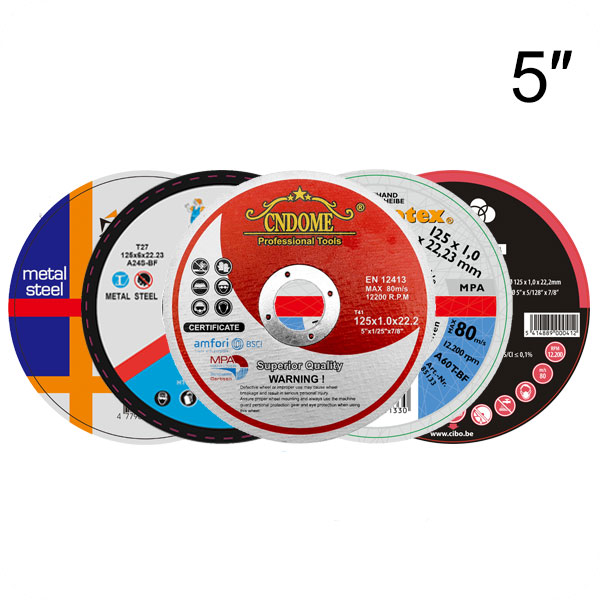 One rung of the ladder: the 125 mm (5-inch) family, published in 1.2, 1.6, 2.0 and 3.0 mm.
Conclusion
A cutting disc code is a small piece of literacy with a large return. Diameter tells you the tool class, thickness tells you the cut, bore tells you whether it mounts, and the speed rating tells you whether it is safe — and only the first three are inside the code. CNDOME's range, from a 38 mm disc at 45,000 RPM to a 400 mm disc at 3,800 RPM, shows what a complete ladder looks like when all the fields are published together.
Use the code as a first filter, not a verdict. It will tell you whether two quotations describe the same product, whether a supplier's range has gaps where your market needs coverage, and which questions about certification and production are worth asking. The rest — sample checks, certificate mapping, delivery terms — sits behind the numbers, where it belongs.
Have Questions or Need More Details?
Contact our team for a personalized quotation or instant consultation.
Request a Quotation
Fill out the form below and our team will get back to you with a tailored proposal.
WhatsApp Direct Chat
Prefer to chat in real-time? Message us on WhatsApp for instant assistance & quick answers.
- Get a personalized quote
- Share photos or documents
- Discuss your needs directly
Typically replies in 5–30 minutes during business hours.