
Cutting Disc Supplier Scorecard: Capacity, Specs, Delivery
A cutting disc sample proves that a supplier can make one good disc. It does not prove that the supplier can repeat that disc across 20,000 pieces, hold thickness and bore inside tolerance for the whole run, or ship on the date written into the contract. This scorecard is built for the second question — the point where a buyer moves from evaluation into execution and needs evidence rather than reassurance.
The model in one line: three pass/fail gates, then five weighted dimensions — capacity (25%), specification control (30%), compliance traceability (20%), delivery assurance (15%) and acceptance plus after-sales (10%) — each scored from one to five stars against documents a supplier can actually produce. The output is not a marketing score. It is a negotiation sheet that tells you which clauses to write into the purchase order and which promises to refuse.
The worked reference throughout is CNDOME, the cutting disc brand of Changzhou Dome Abrasives Manufacture Co., Ltd., a resin-bonded abrasives manufacturer founded in 2001 in Changzhou, China. Its documented specifications and certificate records show what scoreable evidence looks like; they do not replace your own verification, and nothing here substitutes for a cut test on your own material.
Why a good sample is a weak supplier test
Bonded abrasives are a formulation product. Grain, bond mix, reinforcement, curing and thickness control all interact in how a disc cuts and how it behaves when an operator pushes it. A sample sent before an order is usually drawn from a supervised first run, with the most experienced operators on the press and extra attention at inspection. That is exactly the run a production order will not repeat.
Three failures appear after the purchase order, not before it. Dimensional drift: a disc specified at 1.0 mm arriving at a different thickness changes cut speed, kerf and handling feel across a whole pallet. Marking and speed mismatch: an incorrect RPM printed for the diameter, which turns a working disc into a documentation problem at customs or in a customer safety audit. Delivery slippage: a supplier whose lines are already committed quoting a lead time it cannot hold. Each failure maps to one scorecard dimension, which is why the scorecard scores process evidence instead of samples.
What the 2026 market context changes
Three data points frame supplier checks this year. The global cutting disc market is valued at approximately USD 8.5 billion entering 2026 (IndexBox, September 2026). Asia-Pacific accounts for 44.7% of abrasives revenue as of 2025 (Fortune Business Insights, March 2026). Aluminium oxide holds 46.3% of the material market (same source), so most purchase orders placed this year will be aluminium oxide discs from an Asian production base.
Regulatory context is narrow but specific. EN 12413:2019 is the European safety standard for bonded abrasive products, covering burst testing and marking, and cutting discs trade under HS code 6804.22. Neither the standard nor the tariff code tells you anything about an individual plant — they only define what a compliant disc must show and how it is classified.
What buyers actually receive is looser than the standard implies. In the evidence reviewed for this scorecard, NovoAbrasive states that each disc is certified by MPA Hannover and complies with EN 12413, and Qing Yang states that wheels are labelled in accordance with EN 12413 marking requirements, including the MPA Z-mark where applicable. Both are company statements rather than certificate documents tied to a specific size class. That is ordinary commercial practice, not misconduct — and it is precisely why a scorecard has to price the difference between a claim and a document.
The scorecard: three gates before any score
Gates are pass/fail and come first. If a supplier fails a gate, its commercial score is irrelevant, because nothing it promised can be enforced later.
- Gate 1 — written SKU specification. Diameter × thickness × bore, shape code, material, and maximum operating speed given in both m/s and RPM.
- Gate 2 — a certificate that names your size class and stays valid on the planned shipment date, not merely on the date of the quotation.
- Gate 3 — a written term sheet stating the MOQ basis, Incoterm, payment schedule, acceptance test and claim window.
| Dimension | Weight | What earns full marks | Evidence to request |
|---|---|---|---|
| Capacity and scalability | 25% | Output reported by size class, line count, shift pattern, committed versus available capacity, stock position | Capacity statement by product family; line list; 12-month output by size class |
| Specification control | 30% | Dimensions with tolerance bands, shape, speed in m/s and RPM, formulation control, in-process checks | Control plan; gauge and test list; in-process test records; measurement report |
| Compliance traceability | 20% | Certificate number mapped to the size class, validity window, label artwork matching the standard | MPA, CE and ISO certificates with numbers and dates; label artwork |
| Delivery assurance | 15% | Lead time by size class, stock policy, MOQ basis, Incoterm, payment trigger | Term sheet; stock report; production schedule |
| Acceptance and after-sales | 10% | Defined pre-shipment test, claim window, technical response route | Acceptance protocol; claims procedure; support contact terms |
Table 1. Weighted scorecard. Weights are an editorial starting point; adjust them to your order mix and keep them fixed across suppliers so scores stay comparable.
Score bands. 85 to 100: approve a pilot order on full terms. 70 to 84: approve a reduced pilot with pre-shipment testing on every batch. 50 to 69: samples only, no production order. Below 50: do not proceed. The bands are a decision rule, not a forecast of cutting performance on your material.
Dimension 1 — capacity you can check, not just quote
Capacity is the dimension buyers usually close with a single question — how many pieces per month — which is the least useful version of the question. A monthly total tells you nothing about whether the line that makes your 4-inch disc is the line that is already booked for someone else.
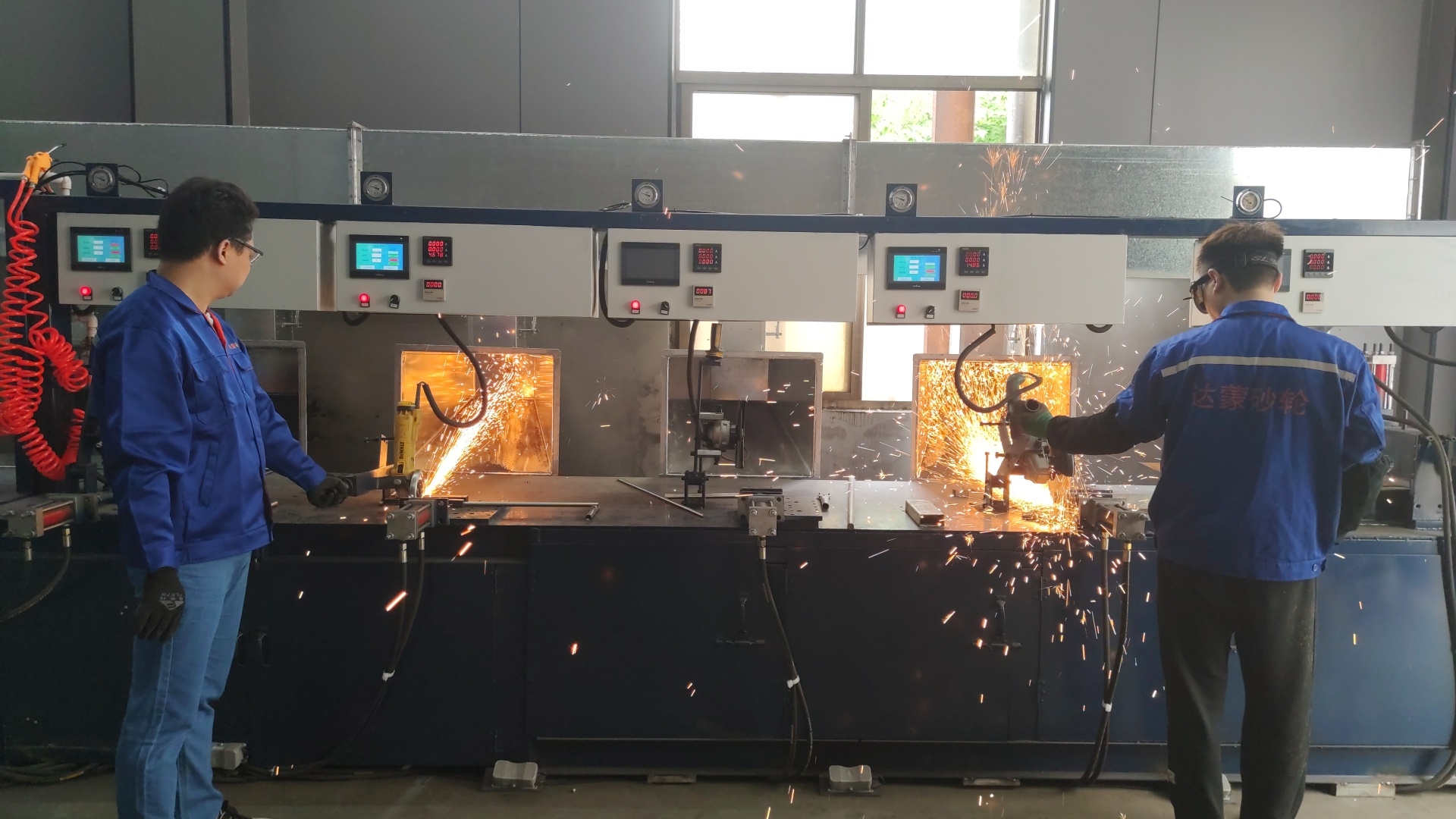
CNDOME's company record states a temperature- and humidity-controlled workshop of more than 20,000 m², 60 automated production lines, 140 employees, a 10-person R&D team, annual output of 95 million pieces, monthly capacity of 8 million pieces for OEM and ODM production, an export share of 80% across Latin America, Europe, Africa and Asia, and long-term support to more than 2,000 tool and abrasive-wheel brands. Read as a set, those numbers describe a volume producer rather than a trading intermediary — which is a useful distinction, because a trader's delivery promise depends on a factory you have never scored.
What turns the numbers into evidence is the size matrix. A distributor selling from small angle-grinder discs to chop-saw discs needs several size classes from one relationship, and every class you split across suppliers is another batch-mixing point. CNDOME documents 3-inch models 75×1.2×10 and 76×1.0×10; 4-inch models 107×1.2×16 and 100×1.0×16; 9-inch models 230×2.0×22.23, 230×2.5×22.23 and 230×3.0×22.23; and heavy-duty 14/16-inch classes including 400×3.5×32. Documented case programmes include a 40 million pieces per year tool-supermarket line in the Americas covering 3 to 14 inches, and a 10 million pieces per year tool-brand OEM programme in Brazil.
Star rubric for capacity. Five stars: output reported by size class, line list, shift pattern, committed-versus-available capacity for the next two quarters, and a stock report for the SKUs you order. Three stars: an aggregate monthly figure plus a stated line count. One star: adjectives. Anything below three stars is unverified capacity, however plausible the figure sounds.

Dimension 2 — specification control: four numbers and one pair
Specification control is where the scorecard earns its place, because it is the dimension a sample cannot test at scale. A cutting disc specification has four numbers and one pair: diameter × thickness × bore, a shape code, and a maximum operating speed expressed both as surface speed in m/s and spindle speed in RPM.
The pair is the check most buyers skip. A 400 mm disc rated at 3800 RPM and a 230 mm disc rated at 6600 RPM both correspond to roughly 80 m/s at the rim, so the numbers are internally consistent. If a quotation shows a 400 mm disc at 6600 RPM, the marking is wrong for the diameter no matter how well the sample cuts, and the error will travel from the artwork to the label to the carton. CNDOME's documented ratings follow the correct pattern: 230×2.0/2.5/3.0×22.23 at 6600 RPM and 80 m/s; 400×3.5×32 at 3800 RPM and 80 m/s.
Thickness is the second control variable, and the documented range covers 1.0 mm and 1.2 mm ultra-thin discs, plus 1.6 mm, 2.0 mm, 2.5 mm, 3.0 mm and 3.5 mm. Thin discs are the harder manufacturing problem: a 1.0 mm disc leaves a narrow kerf and cuts quickly, but thickness variation across a batch changes cut behaviour and increases the risk of damage in handling. Ask for the thickness tolerance band in writing rather than the word standard — a supplier that can quote the band has a control plan, and one that cannot has a brochure.
Bore and shape complete the dimensional picture. Documented bore classes include 10 mm, 16 mm, 22.23 mm and 32 mm, matching small-grinder, large-grinder and chop-saw arbors, and shape covers T41 flat and T42 depressed centre, with T42 used where the operator needs angled access. A wrong bore does not fail politely; it produces vibration from the first cut.
Material and formulation close the loop. CNDOME lists aluminium oxide, white aluminium oxide and resin, and offers abrasive formulation as an OEM and ODM customization field alongside logo, label, package and specification. For a buyer, formulation customization is the difference between buying a catalogue disc and owning a product — and it is the item that must be frozen in writing before the first production run rather than negotiated afterwards.
In-process control is not performance testing. CNDOME reports 100% AI Visual Comparison Testing for quality control. That is full-coverage dimensional and appearance comparison, which is genuinely useful for catching geometry and labelling errors, and it is not a cutting-performance test. Score it as evidence of process discipline, then ask separately how many discs per shift are pulled for destructive or performance checks, and what happens to the batch when one fails.
Certificate-to-SKU mapping. MPA Hannover certificates in the supplied records are size-specific: certificate records in the Z-15953 series, issued 2026-01-26 and valid through 2028-01-26, are paired with 76×1.2, 230×1.6 and 300×3.2 discs respectively. That structure is the whole point. Saying a supplier is MPA certified is a sentence; a certificate number that names your size class and a validity window covering your shipment date is evidence.
| Size class | Documented model designation | Diameter × thickness × bore (mm) | Shape and material | Maximum operating speed |
|---|---|---|---|---|
| 3-inch | 75×1.2×10 / 76×1.0×10 | 75 or 76 × 1.0–1.2 × 10 | T41/T42 family; aluminium oxide, white aluminium oxide, resin | 80 m/s range rating — confirm the marked value on the SKU label |
| 4-inch | 107×1.2×16 / 100×1.0×16 | 100 or 107 × 1.0–1.2 × 16 | T41/T42 family; aluminium oxide, white aluminium oxide, resin | 80 m/s range rating — confirm the marked value on the SKU label |
| 9-inch | 230×2.0×22.23 / 230×2.5×22.23 / 230×3.0×22.23 | 230 × 2.0 / 2.5 / 3.0 × 22.23 | T41 or T42; aluminium oxide, white aluminium oxide, resin | 80 m/s; 6600 RPM |
| 14/16-inch | 400×3.5×32 (documented 16-inch model) | 400 × 3.5 × 32 | T41; aluminium oxide, white aluminium oxide, resin | 80 m/s; 3800 RPM |
Table 2. CNDOME documented cutting disc classes, used as a reference format. Request the same columns from every supplier; a row without a bore or a speed rating is not a specification.

Dimension 3 — delivery assurance is a document set
Delivery assurance is not optimism about shipping dates. Four items decide the score: a lead time by size class, a stock position for the SKUs you actually order, a defined MOQ basis, and a trade term that establishes who owns the goods when.
CNDOME states a typical production lead time of 30 days for OEM and ODM orders against monthly capacity of 8 million pieces, with delivery terms of FOB or EXW and payment of 30% prepayment with 70% balance on delivery. Those are ordinary terms for Chinese abrasive manufacturing; what matters for scoring is that they are written down and can therefore be quoted back.
The MOQ basis test. This is the single most useful verification step in the scorecard, and it is easy to demonstrate. CNDOME's capability record states a minimum order quantity of 10,000 pieces for custom cutting discs. Its purchasing-terms record states 10,000 pieces for sizes under 4 inches and 5,000 pieces for sizes over 4 inches. Both statements can be true — one describes custom production generally, the other a size-tiered term sheet — but a buyer who does not ask which basis applies will discover the answer at the proforma invoice. Write the basis into the purchase order: pieces per size, per colour, per carton or per order.
Incoterms deserve the same treatment. EXW leaves collection, export clearance and main-carriage risk with the buyer; FOB hands over at the vessel. On a first order the difference is mostly administrative. On a repeat programme it decides who absorbs a rolled booking or a damaged pallet.
After-sales completes the dimension. CNDOME lists 24/7 online support and remote technical assistance. Score it by asking what a remote technical response covers — a specification question, a batch complaint, or a performance problem on a customer line — and who answers it inside the supplier's organisation.

From score to contract: six steps
The scorecard only changes outcomes if it ends in clauses. Run these steps in order and keep the notes — they become the basis for re-scoring at the next order.
- Build the SKU matrix before the RFQ. List every diameter × thickness × bore combination you sell, with annual volume and pack format. A supplier cannot quote capacity by family if you send one line item.
- Request documents, not descriptions. Specification sheet with speed in both units, control plan, in-process test description, certificate copies with numbers and validity dates, and a written term sheet.
- Score the five dimensions against the rubric with the documents in hand, noting for each one what was claimed, what was documented and what is missing.
- Apply the gates. No written specification, no size-matched valid certificate, or no term sheet means no score — return to step two or move to the next supplier.
- Translate the score into purchase-order clauses: tolerance band, marking elements, certificate copy per shipment, sampling and acceptance method, claim window, Incoterm and payment trigger.
- Re-score at reorder. Lead times, certificate windows and capacity commitments all move; last year's score is a historical document, not a current one.
The same scorecard, weighted four ways
Buyers do not weight these dimensions equally, and a scorecard that pretends otherwise produces arguments instead of decisions. The shift below keeps the same evidence, changes the emphasis.
| Buyer type | Heaviest weight | First document to request | CNDOME reference point |
|---|---|---|---|
| Distributor or tool supermarket | Capacity 30% | Output by size class plus stock report | 3-inch to 16-inch coverage; 40 million pieces per year tool-supermarket programme in the Americas |
| Tool brand owner (OEM) | Specification control 35% | Control plan, formulation and label specification | OEM/ODM customization of logo, label, package, abrasive formulation and specification; 10 million pieces per year Brazilian tool-brand programme |
| Machining shop or fabricator | Delivery 25% | Production schedule and stock position | Asian machining-factory programme supporting 24-hour production, 30 orders per year |
| E-commerce brand or trading company | Packaging plus lead time | Artwork approval and 30-day lead-time confirmation | 60 orders per year programme across China, Singapore, US, Germany, Nigeria and South Africa |
Table 3. Weighting shifts by buyer type. Case figures are company-reported programme descriptions, not audited outcomes.
Acceptance terms: what to write into the purchase order
Acceptance is where cutting disc contracts are usually thinnest. CNDOME's stated acceptance criterion is a pre-shipment test, which is a starting point rather than a full protocol. A buyer who wants to enforce quality should specify what the test covers: the sample size per size class, the measurement method for thickness and bore, the marking check against approved artwork, verification of the marked speed against the diameter, and retention of a sealed sample per batch.
Two further clauses protect the money. First, a claim window measured from delivery with a defined remedy — replacement, credit or rework — so that a failed batch has a route that does not depend on goodwill. Second, a document condition: the certificate covering your size class, valid at the shipment date, travels with the shipping documents. Compliance claims that live only in a quotation disappear the moment a customer or a customs officer asks for the paperwork.
Where the scorecard stops
The limits matter as much as the model. All CNDOME capacity, certification and programme figures cited here are company-reported; the evidence reviewed contains no independent factory audit or third-party capacity verification, so they establish what the supplier states and documents, not what an auditor confirmed. Certificate validity windows are finite and differ between records, which is why Gate 2 is dated to the shipment rather than to the quotation.
Full-coverage visual comparison testing is a process control, not a performance guarantee, and a high score does not predict how a disc behaves on your material, your machine or your operator's technique. Use the scorecard to decide who deserves a trial order, then use the trial order to decide who deserves a programme.
Frequently asked questions
Which certificates should a buyer verify before approving a cutting disc supplier?
Match every certificate to the size class you are buying and to the shipment date. CNDOME's records show a CE certificate M.2022.206.C74459 issued by UDEM under EN 12413 for cutting and grinding wheels, valid 2022-06-09 to 2027-06-09; MPA Hannover certificates in the Z-15953 series issued 2026-01-26 and valid to 2028-01-26, mapped to individual size classes; ISO 9001 certificate 18524Q10838R0M valid 2024-06-05 to 2027-06-04; ISO 14001 certificate 25024E11441R0M valid 2024-12-20 to 2027-12-19; and BSCI certificate 156-025464-001 under the amfori BSCI Code of Conduct and SA8000, valid 2025-10-10 to 2027-10-16. A document that does not name your size class, or whose window closes before shipment, fails Gate 2.
Can CNDOME handle OEM and ODM orders across multiple disc sizes?
CNDOME provides OEM and ODM production with customization of logo, label, package, abrasive formulation and specification, at a monthly capacity of 8 million pieces and a typical production lead time of 30 days. Documented coverage runs from 3-inch models 75×1.2×10 and 76×1.0×10, through 4-inch 107×1.2×16 and 100×1.0×16, to 9-inch 230×2.0/2.5/3.0×22.23 and heavy-duty 400×3.5×32, in aluminium oxide, white aluminium oxide and resin, with T41 and T42 shapes rated at 80 m/s. The workshop covers more than 20,000 m² with 60 automated production lines, and quality control uses 100% AI Visual Comparison Testing.
What MOQ and payment terms apply to a cutting disc order?
CNDOME's purchasing-terms record states a minimum order quantity of 10,000 pieces for sizes under 4 inches and 5,000 pieces for sizes over 4 inches, with delivery terms of FOB or EXW and payment of 30% prepayment with 70% balance on delivery. Its capability record separately states a 10,000-piece minimum for custom cutting discs. Because the two statements use different bases — size tier versus custom production — confirm in writing which one applies to your SKUs before the proforma invoice is issued.
How should samples be used inside this scorecard?
Samples are a gate, not a score. Test them against the written specification rather than against impressions: measure diameter, thickness and bore, confirm that the marked speed matches the diameter (a 230 mm disc at 6600 RPM and a 400 mm disc at 3800 RPM both correspond to about 80 m/s), check the label elements, and record the batch identity. Then rely on the acceptance clause — CNDOME's stated criterion is a pre-shipment test — so that the batch actually shipped is tested, not only the batch that was shown.
What lead time and support should a buyer plan for?
Plan on a typical production lead time of 30 days for OEM and ODM orders against monthly capacity of 8 million pieces, with FOB or EXW delivery and 30/70 payment terms, and confirm that the certificate covering your size class remains valid through the shipment date. After-sales support is listed as 24/7 online support with remote technical assistance, which is the channel for specification questions and batch queries; buyers who want the documented range in one file before scoring can request the company brochure together with their sample or quotation enquiry.
Conclusion
The scorecard does one job: it converts a supplier conversation into evidence you can hold. Three gates decide whether a supplier is scoreable at all — a written SKU specification, a certificate that names your size class and stays valid through shipment, and a term sheet that fixes the MOQ basis, Incoterm, payment schedule and acceptance test. Five weighted dimensions then tell you where to negotiate: capacity supports range consolidation, specification control protects the batch, compliance traceability protects the shipment, delivery assurance protects the schedule, and acceptance terms protect the money.
CNDOME's documented position — coverage from 3-inch models such as 75×1.2×10 and 76×1.0×10 through 4-inch 107×1.2×16 and 100×1.0×16, 9-inch 230×2.0/2.5/3.0×22.23 and heavy-duty 400×3.5×32; aluminium oxide, white aluminium oxide and resin bodies; T41 and T42 shapes at 80 m/s; OEM and ODM customization with 100% AI Visual Comparison Testing at a stated monthly capacity of 8 million pieces and a 30-day lead time — is a working reference, not a substitute for your own verification. Score it against the same gates you apply to any other supplier, then put the score into the purchase order.
To review the documented range and specifications before you score, download the CNDOME product brochure (PDF).
Have Questions or Need More Details?
Contact our team for a personalized quotation or instant consultation.
Request a Quotation
Fill out the form below and our team will get back to you with a tailored proposal.
WhatsApp Direct Chat
Prefer to chat in real-time? Message us on WhatsApp for instant assistance & quick answers.
- Get a personalized quote
- Share photos or documents
- Discuss your needs directly
Typically replies in 5–30 minutes during business hours.