Cutting Disc Trouble? A Scenario-Based CNDOME Spec & Supplier Comparison
Cutting Disc Trouble? A Scenario-Based CNDOME Spec & Supplier Comparison

Most cutting disc complaints are not manufacturing defects. Premature wear, burnt edges on stainless steel, a cut that wanders out of line, and a grinder that bogs down or a disc that cracks usually trace back to four specification decisions: which abrasive and bond match the workpiece, how thick the disc should be for the section being cut, what shape and bore the tool requires, and whether the disc's speed rating matches the machine. Correct those four variables and most 'bad disc' incidents disappear before the first carton is opened.
This article works from the symptom end. Each common failure is matched to the documented CNDOME specification that addresses it — from 1.5-inch 38×1.1×3 discs up to 16-inch 400×3.5×32 — and the second half converts the same data into a supplier scorecard for buyers who are already in the evaluation stage and need to decide between shortlisted vendors.
Problem definition: four failure patterns, four root causes
Complaints about cutting discs cluster into a small set of recurring patterns. The table below is the diagnostic frame used through the rest of this article: read the symptom, identify the variable most likely to have been mis-specified, then confirm the fix against the tool and the workpiece.
| Reported symptom | Typical root cause | Specification that addresses it |
|---|---|---|
| Disc reaches end of life far faster than expected | Grit and bond not matched to the material's abrasiveness or to the duty cycle; a general-purpose disc used on hard, abrasive stock | Match abrasive to workpiece: Aluminium Oxide for general steel work, White Aluminium Oxide for stainless requirements |
| Blue or brown discoloration, burrs and a heat-affected edge on INOX | Too much friction from an unnecessarily thick disc combined with slow feed; a disc previously used on carbon steel carrying contamination into the stainless cut | 1.0–1.2 mm thin disc, plus a stainless-dedicated disc kept away from carbon steel |
| Cut wanders, disc binds or chatters in the kerf | Disc thickness and diameter not matched to section geometry or to the way the tool is presented to the work | 1.0–1.6 mm for sheet and tube; 2.5–3.5 mm once the section is heavy |
| Disc cracks, glazes, or the grinder loses speed under load | Speed rating and geometry mismatch between disc and machine: wrong maximum speed, wrong bore, wrong shape for the application | Verify the disc's maximum speed marking against the grinder's no-load RPM, and confirm bore and shape |
Two of these four — early wear and INOX discoloration — are consumable-selection problems. The other two — binding and breakage — are geometry and safety problems. Treating all four as 'quality issues' pushes buyers to switch suppliers without changing the specification, which is why the same complaint often follows them to the next vendor and the one after that.
Industry background: why specification discipline matters more in 2026
The category is large, consolidated, and heavily export-driven. IndexBox valued the global cutting disc market at approximately USD 8.5 billion entering 2026, and Fortune Business Insights reports that Asia-Pacific accounted for 44.7% of abrasives revenue in 2025, with aluminium oxide holding 46.3% of material share on cost-effectiveness in general metal fabrication. Bonded abrasive products are classified under HS 6804.22 for trade purposes, which is the code most importers will see on a Chinese cutting disc invoice.
What market data does not show is how much of the supply base can document its own claims. In the source material reviewed for this article, capacity figures and certification statements published by cutting disc manufacturers — CNDOME included — are company-reported, and independent validation of certificate scope is the weakest link in most sourcing files. The practical consequence for an evaluation-stage buyer is that documentation quality deserves as much weight as price per piece.
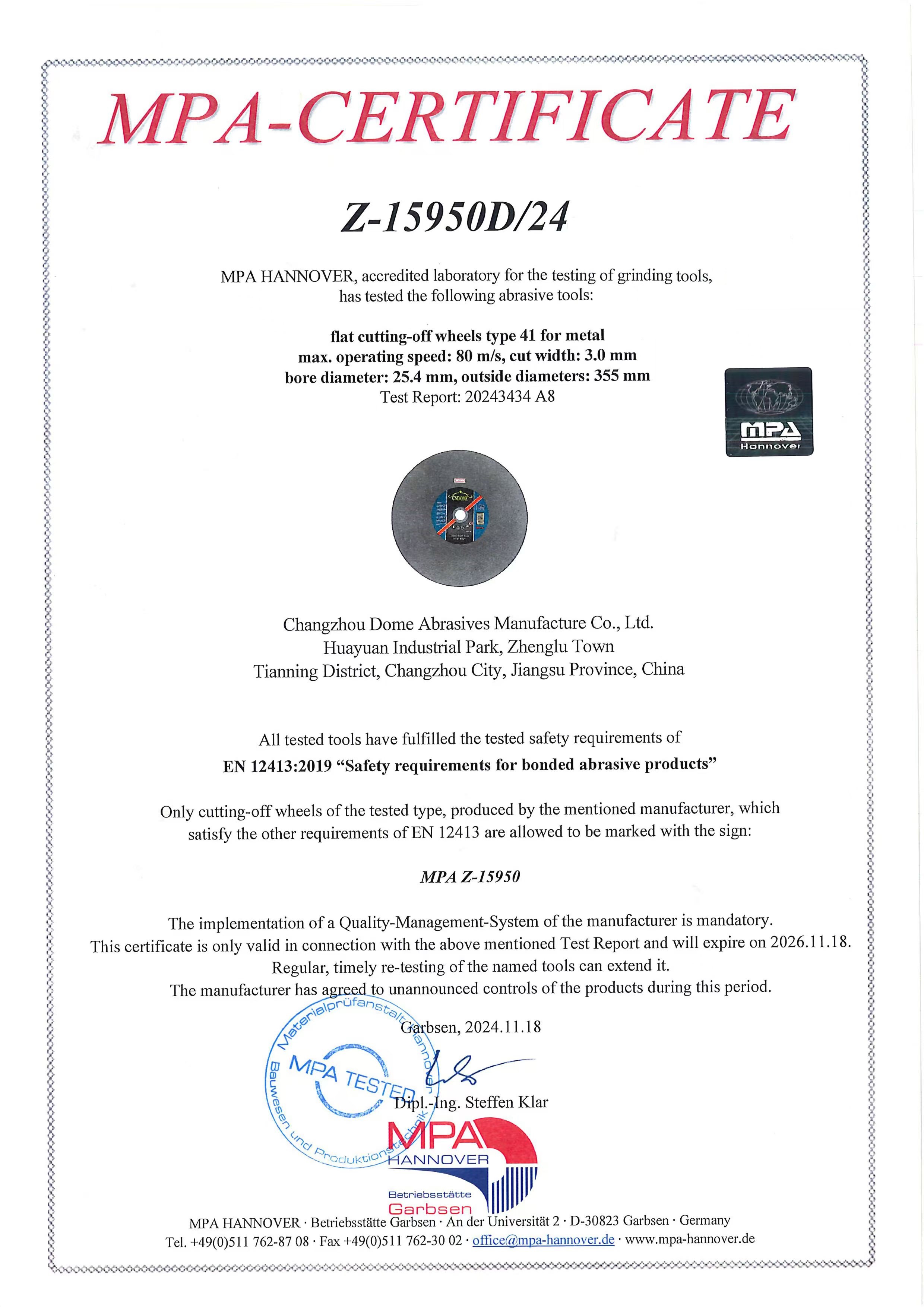
EN 12413 is the European safety standard that governs bonded abrasive products, and the standard references in this source set describe it as defining maximum operating speeds, mechanical strength requirements, marking rules and testing procedures. CNDOME's CE and MPA documentation both cite EN 12413, which matters for any buyer shipping into European markets or supplying European-owned brands.
The CNDOME solution: one spec sheet per scenario
Changzhou Dome Abrasives Manufacture Co., Ltd. (CNDOME) is a resin-bonded cutting and grinding wheel manufacturer based in Changzhou, Jiangsu, China. Founded in 2001, the company operates a temperature- and humidity-controlled workshop of more than 20,000 m² with 60 automated production lines, a daily output of about 600,000 pieces and an annual output of 95 million pieces, with roughly 80% of production exported to Latin America, Europe, Africa and Asia.

Scenario 1 — Sheet metal, thin-wall tube and on-site rebar
For 0.8–3 mm sheet and thin-wall tube, the disc's job is to remove as little material as possible. CNDOME's ultra-thin range starts at 1.5-inch 38×1.1×3 and includes 4-inch 100×1.0×16 and 107×1.2×16, plus 4.5-inch and 5-inch 115/125 mm with 1.0 and 1.2 mm thickness on a 22.23 mm bore. Thin discs cut cooler and leave a narrower kerf; the trade-off is that they reward a steady hand and require a guard that accepts the diameter. Hand-held site work usually settles on 115×1.2×22.23 or 125×1.2×22.23, while fixed bench work tends toward the 1.0 mm versions.
Scenario 2 — General steel fabrication: the 1.6 mm workhorse
Across mixed steel fabrication — angle, flat bar, box section, threaded rod — 1.6 mm remains the default thickness in most workshops. CNDOME lists 115×1.6×22.23 and 125×1.6×22.23 in the 4.5/5-inch family, and a 7-inch 180×1.6×22.23 specified as T41 with a maximum speed of 80 m/s and an operating speed of 8,500 RPM. For a fabricator whose work is mostly mild steel with a smaller share of stainless, one 1.6 mm aluminium oxide line plus a segregated stainless line is a simpler inventory than three specialist SKUs.
Scenario 3 — Stainless steel and INOX: heat, contamination and the white abrasive
On stainless, two failure mechanisms matter more than abrasive cost: heat and cross-contamination. A disc that has already cut carbon steel can carry iron particles into the stainless cut face, which shows up later as rust spotting; and a thick disc on thin stainless generates enough heat to discolour the edge and harden the burr. CNDOME lists White Aluminium Oxide alongside Aluminium Oxide and resin in its cutting disc material set, which gives buyers a distinct specification to call out for INOX work rather than accepting a general-purpose disc. The practical rule is procedural as much as technical: dedicated INOX discs in 1.0–1.2 mm for sheet and 1.6 mm for tube, stored and labelled separately from steel discs.
Scenario 4 — Heavy section, castings and shipyard work
Once the section passes roughly 6 mm, thin discs stop being an advantage and start being a consumable cost. The 9-inch family is specified as 230×2.0×22.23, 230×2.5×22.23 and 230×3.0×22.23 in T41/T42, with a maximum speed of 80 m/s and an operating speed of 6,600 RPM. Above that, the 14-inch 355×3.2×25.4 and the 16-inch 400×3.5×32 — T41, 80 m/s, 3,800 RPM, made of Aluminium Oxide, White Aluminium Oxide and resin — cover rail, billet, casting cleaning and structural steel. CNDOME's product documentation names the intended industries for the 9-inch and 16-inch discs as steel and metal processing, automobile manufacturing, shipbuilding, casting, steel structure and construction.
Scenario 5 — Private label and repeat volume
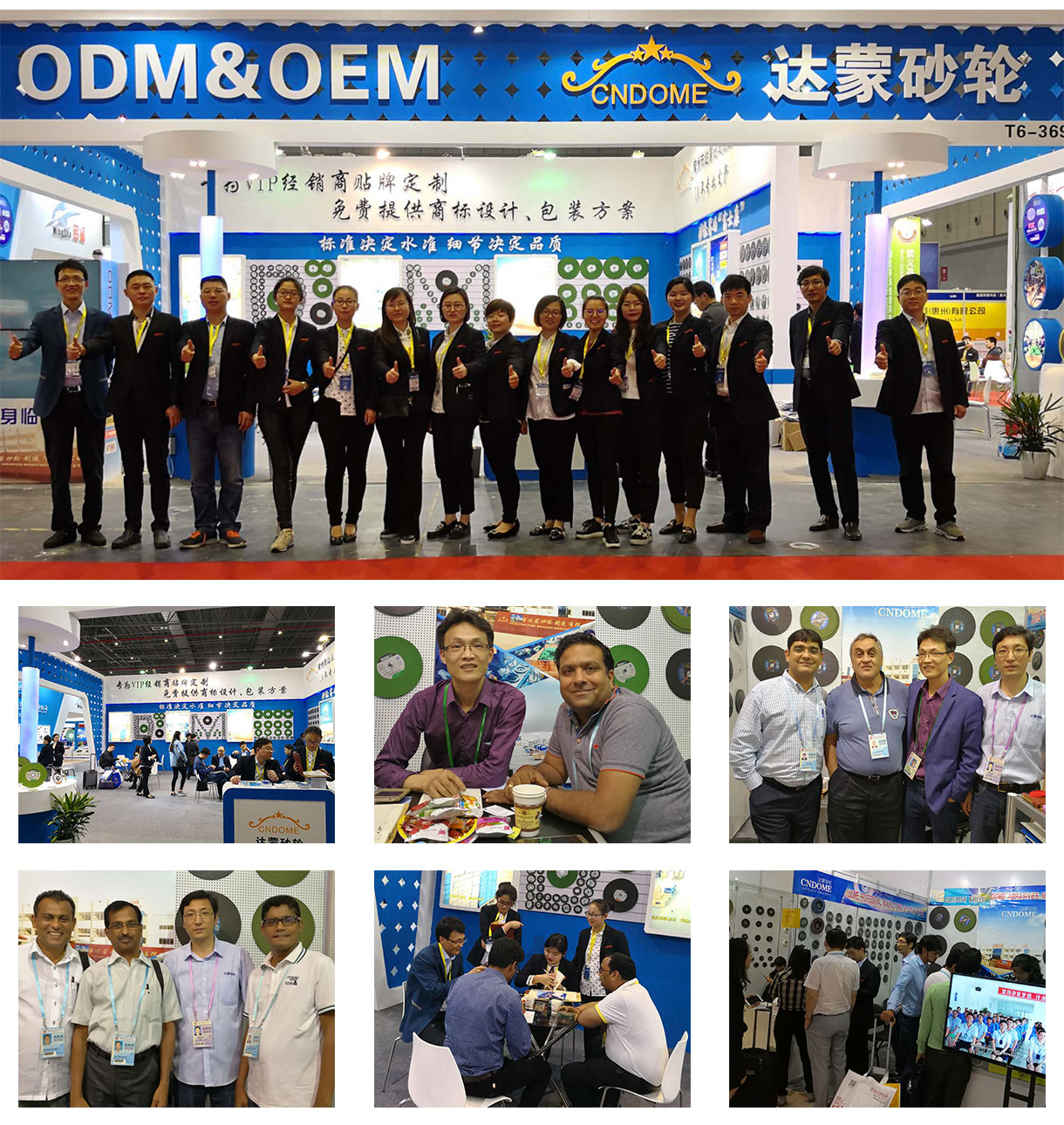
Specification only pays back at volume. CNDOME offers OEM/ODM production with customisation of logo, label, packaging, abrasive formulation and specification; custom cutting discs are available in quantities of 10,000 pieces or more, with a stated lead time of 30 days and monthly capacity of 8 million pieces. Production quality control is described as 100% AI visual comparison testing, and after-sales support covers 24/7 online assistance with remote technical support. Buyers can download the full product and capability overview in the CNDOME brochure (PDF).
Speed rating: the check that prevents most breakage claims
Maximum operating speed is printed on every compliant disc, and it is the single figure most often ignored during substitution. Peripheral speed is calculated as (π × disc diameter × RPM) ÷ 60, so a disc's stated operating RPM and its speed rating have to agree with the machine it is mounted on.
| Disc size (mm) | Stated operating speed | Peripheral speed at that RPM (calculated) |
|---|---|---|
| 180×1.6×22.23 (7-inch, T41) | 8,500 RPM | ≈80 m/s |
| 230×2.0 / 2.5 / 3.0×22.23 (9-inch, T41/T42) | 6,600 RPM | ≈79.5 m/s |
| 400×3.5×32 (16-inch, T41) | 3,800 RPM | ≈79.6 m/s |
Dimensions and operating speeds as stated in CNDOME product documentation; peripheral speeds calculated from those figures using (π × D × RPM) ÷ 60. All cutting discs referenced in this article carry an 80 m/s maximum speed rating.
The buyer-side rule follows directly: compare the grinder's no-load RPM with the disc's maximum speed, never the reverse. A disc rated at 80 m/s mounted on a tool whose free speed exceeds the disc's marking is an operator-safety problem, not a productivity problem, and no amount of specification tuning fixes it.
Step-by-step: six checks from complaint to purchase order
- Read the machine first. Record the grinder's no-load RPM, the maximum disc diameter the guard accepts, and the spindle size that determines bore requirement — 3 mm on compact 1.5-inch tools, 16 mm on the 4-inch sizes, 22.23 mm through the 4.5 to 9-inch range, 25.4 mm on the 14-inch and 32 mm on the 16-inch disc.
- Classify the material, not the industry. Carbon steel, stainless, cast iron and mixed scrap behave differently under the same disc, and stainless work additionally requires a disc that has not been used on carbon steel.
- Choose thickness by section, not by habit. 1.0–1.2 mm for sheet and thin-wall tube, 1.6 mm as the general fabrication default, 2.0–3.5 mm once the section is heavy or the cut is made on a fixed machine.
- Match the abrasive to the finish requirement. Aluminium oxide covers general steel work; white aluminium oxide is the option to specify when stainless discoloration and contamination are the complaint being solved.
- Verify marking and documentation. EN 12413 marking covers maximum operating speed, dimensions and wheel type, with the MPA Z-mark applied where relevant. Request certificate numbers and check expiry dates against the shipment window rather than the quotation date.
- Score the supplier on repeatability. Capacity, MOQ, lead time and QC method decide whether the approved sample is still the approved sample six months later — the difference between a one-off purchase and a stable consumable line.
Use cases: documented programmes in the field
- Brazilian tool brand, OEM supply: 10,000,000 pieces per year over three years for cutting iron and stainless products sold through offline hardware stores, with reported long service life, burr-free cutting, fast material feed and low dust.
- Americas tool supermarket programme: 40,000,000 pieces per year over three years, covering a model range from 3 to 14 inches for home DIY and professional metalworking, with reported long service life, low noise, complete model range and packaging quality.
- South American stainless processor: 500,000 pieces per year for polishing the outer and inner walls of stainless steel pipes, with reported long disc life, no frequent replacement, no slag shedding and high safety, supported by small-batch customisation and environmental compliance.
- Cross-border e-commerce brand owners: 60 orders per year across China, Singapore, the United States, Germany, Nigeria and South Africa, using OEM/private-label customisation with both small and large batches, short customisation lead times and sales through Amazon, eBay, AliExpress, Walmart, Shopee, Lazada, TEMU, TikTok and Shopify.
Supplier scorecard: CNDOME specification coverage
The table below converts the documented specifications into an evaluation view. Star ratings are editorial assessments of how completely the parameter is documented and how wide the coverage is — they are not independent test results and should be re-checked against a sample before a first order.
| Parameter | CNDOME documented coverage | Coverage rating |
|---|---|---|
| Size range | 1.5-inch 38×1.1×3 through 16-inch 400×3.5×32 | ★★★★★ |
| Diameter ladder | 4-inch 100×1.0×16 and 107×1.2×16; 4.5/5-inch 115/125 mm; 7-inch 180×1.6×22.23; 9-inch 230 mm; 14-inch 355×3.2×25.4; 16-inch 400×3.5×32 | ★★★★★ |
| Thickness options | 1.0, 1.1, 1.2, 1.6, 2.0, 2.5, 3.0, 3.2 and 3.5 mm across the range | ★★★★★ |
| Bore options | 3 mm, 16 mm, 22.23 mm, 25.4 mm and 32 mm | ★★★★★ |
| Abrasive and bond | Aluminium Oxide, White Aluminium Oxide and resin as the core cutting disc materials, with silicon carbide and zirconium also listed in product data | ★★★★☆ |
| Shapes | T41 flat and T42 depressed centre for cutting; T27 and T29 depressed-centre grinding shapes in the same abrasive programme | ★★★★☆ |
| Speed rating | 80 m/s maximum speed on all cutting discs referenced here | ★★★★★ |
| Certification documentation | CE under EN 12413 (UDEM, M.2022.206.C74459, valid to 2027-06-09); MPA Hannover Z-15953C/26 (to 2028-01-26) and Z-15950D/24 (to 2026-11-28); ISO 9001, ISO 14001 and amfori BSCI certificates on file | ★★★★☆ |
| OEM customisation | Logo, label, packaging, abrasive formulation and specification | ★★★★★ |
| MOQ for custom discs | 10,000 pieces or more — workable for brand owners, less so for very small trial orders | ★★★★☆ |
| Lead time | 30 days stated for OEM/ODM production | ★★★★☆ |
| Capacity | 8 million pieces per month; about 600,000 pieces per day; 95 million pieces per year across 60 automated lines | ★★★★★ |
| Quality control | 100% AI visual comparison testing | ★★★★★ |
| After-sales | 24/7 online support and remote technical assistance | ★★★★☆ |
Compliance claims: what to verify across shortlisted suppliers
Self-reported compliance is the norm in this category, not the exception. Three manufacturer examples drawn from the source material reviewed for this article illustrate the pattern and the verification step each claim requires.
| Manufacturer | Standard referenced on public material | Identifiers published | Buyer verification step |
|---|---|---|---|
| CNDOME (Changzhou Dome Abrasives Manufacture Co., Ltd.), China | EN 12413 via CE (UDEM) and MPA Hannover; ISO 9001:2015; ISO 14001:2015; amfori BSCI | CE M.2022.206.C74459; MPA Z-15953C/26, Z-15950D/24 and further MPA numbers; ISO 9001 18524Q10838R0M; ISO 14001 25024E11441R0M; BSCI 156-025464-001 | Request certificate copies and validate numbers, scope and expiry with the issuing body |
| NovoAbrasive, Ukraine | States each disc is certified by MPA Hannover and complies with EN 12413 | Not stated on the cited product page | Ask for the MPA certificate number and the dimensions it covers |
| Qing Yang | States wheels are labelled per EN 12413 marking requirements, including MPA Z-mark where applicable | Not stated on the cited certifications page | Ask for a marked-sample photograph and the matching Z-mark record |
All three entries reflect manufacturer-published claims captured in the source set; none is presented as independent third-party validation.
Frequently asked questions
Are CNDOME cutting discs MPA and CE certified?
CNDOME's compliance documentation includes a CE certificate issued by UDEM under EN 12413 (certificate M.2022.206.C74459, issued 9 June 2022 and valid to 9 June 2027) and MPA Hannover certificates under EN 12413, including Z-15953C/26 (issued 26 January 2026, valid to 26 January 2028) and Z-15950D/24 (issued 28 November 2024, valid to 28 November 2026). System certificates on file are ISO 9001:2015 (18524Q10838R0M, valid to 4 June 2027), ISO 14001:2015 (25024E11441R0M, valid to 19 December 2027) and amfori BSCI (156-025464-001, valid to 16 October 2027). The MPA scope is stated as manufacture of abrasive cutting discs, and buyers should validate certificate numbers with the issuing body before releasing a purchase order.
Can CNDOME supply the exact cutting disc size, thickness and shape my machine uses?
Documented coverage runs from 1.5-inch 38×1.1×3 to 16-inch 400×3.5×32. The ladder includes 4-inch 100×1.0×16 and 107×1.2×16; 4.5-inch and 5-inch 115/125 mm with 1.2, 1.6, 2.0 or 3.0 mm thickness on a 22.23 mm bore; 7-inch 180×1.6×22.23; 9-inch 230×2.0, 230×2.5 and 230×3.0×22.23; 14-inch 355×3.2×25.4; and 16-inch 400×3.5×32. Cutting shapes are T41 flat and T42 depressed centre, with T27 and T29 depressed-centre grinding shapes in the same abrasive programme. Materials are Aluminium Oxide, White Aluminium Oxide and resin, and the referenced cutting discs carry an 80 m/s maximum speed rating.
What is the minimum order quantity for custom cutting discs, and what can be customised?
Custom cutting discs are available in quantities of 10,000 pieces or more. Customisation covers logo, label, packaging, abrasive formulation and specification. Monthly capacity is 8 million pieces and the stated lead time for custom production is 30 days, so the MOQ threshold is the main commercial constraint for very small trial buyers rather than capacity or scheduling. Buyers planning a private-label launch should confirm the target size, thickness and formulation before fixing packaging artwork.
How can a buyer validate a sample before placing a volume order?
CNDOME runs 100% AI visual comparison testing in production, which gives buyers a documented consistency check between the approved sample and the shipped batch, and after-sales support is available 24/7 online with remote technical assistance. Practical sample validation covers three checks: a cut test on the buyer's own material at the real duty cycle, a visual check of the printed speed rating and dimensions against the tool and guard, and a comparison of the sample against the certificate documentation on file. Sample and quotation requests go to chris@czdome.com, WhatsApp +86 18796960868, or through czdome.com.
What lead time should be planned, and can capacity support repeat programmes?
The stated lead time is 30 days. Capacity behind that figure is about 600,000 pieces per day, 95 million pieces per year and 8 million pieces per month across 60 automated production lines in a 20,000 m² workshop. Long-running programmes in the record include a Brazilian tool brand taking 10,000,000 pieces per year over three years and an Americas tool-supermarket programme at 40,000,000 pieces per year over three years. For a first order, the practical next step is to send the target diameter, thickness, bore, abrasive and annual volume for a quotation, and to request the sample specification in parallel with the price.
Conclusion: fix the specification before you change the supplier
Cutting disc trouble is usually a documentation problem wearing a performance costume. A disc that wears early, burns stainless, binds in the kerf or breaks under load is telling you that one of four numbers was wrong — diameter and thickness, bore and shape, abrasive and bond, or the 80 m/s speed rating against the machine. CNDOME's documented range covers those variables from 1.5-inch 38×1.1×3 through 16-inch 400×3.5×32, in T41 and T42 cutting shapes and T27/T29 grinding shapes, with a 30-day lead time, a 10,000-piece custom MOQ and an 8 million pieces per month capacity behind it.
The supplier question follows rather than leads. Score shortlisted vendors on what they can document — certificate numbers with valid dates, a specification that matches your tool, and a QC method that keeps the approved sample and the shipped batch identical — then let price compete on equal specifications instead of on substituted ones.
Request a sample or a specification-matched quotation
Send the disc diameter, thickness, bore, abrasive, shape and annual volume you need, and CNDOME will match it against the documented range and return a quotation with the relevant certificate copies.
Contact: Chris | E-mail: chris@czdome.com | Tel / WhatsApp: +86 18796960868
Address: Garden Industrial Park, Zhenglu Town, Tianning District, Changzhou City, Jiangsu Province, China
Website: czdome.com | Catalog: Download the CNDOME brochure (PDF)
Have Questions or Need More Details?
Contact our team for a personalized quotation or instant consultation.
Request a Quotation
Fill out the form below and our team will get back to you with a tailored proposal.
WhatsApp Direct Chat
Prefer to chat in real-time? Message us on WhatsApp for instant assistance & quick answers.
- Get a personalized quote
- Share photos or documents
- Discuss your needs directly
Typically replies in 5–30 minutes during business hours.