Cutting Discs for Steel, Shipbuilding & Construction: A Scenario-Based Supplier Comparison
Cutting Discs for Steel, Shipbuilding & Construction: A Scenario-Based Supplier Comparison
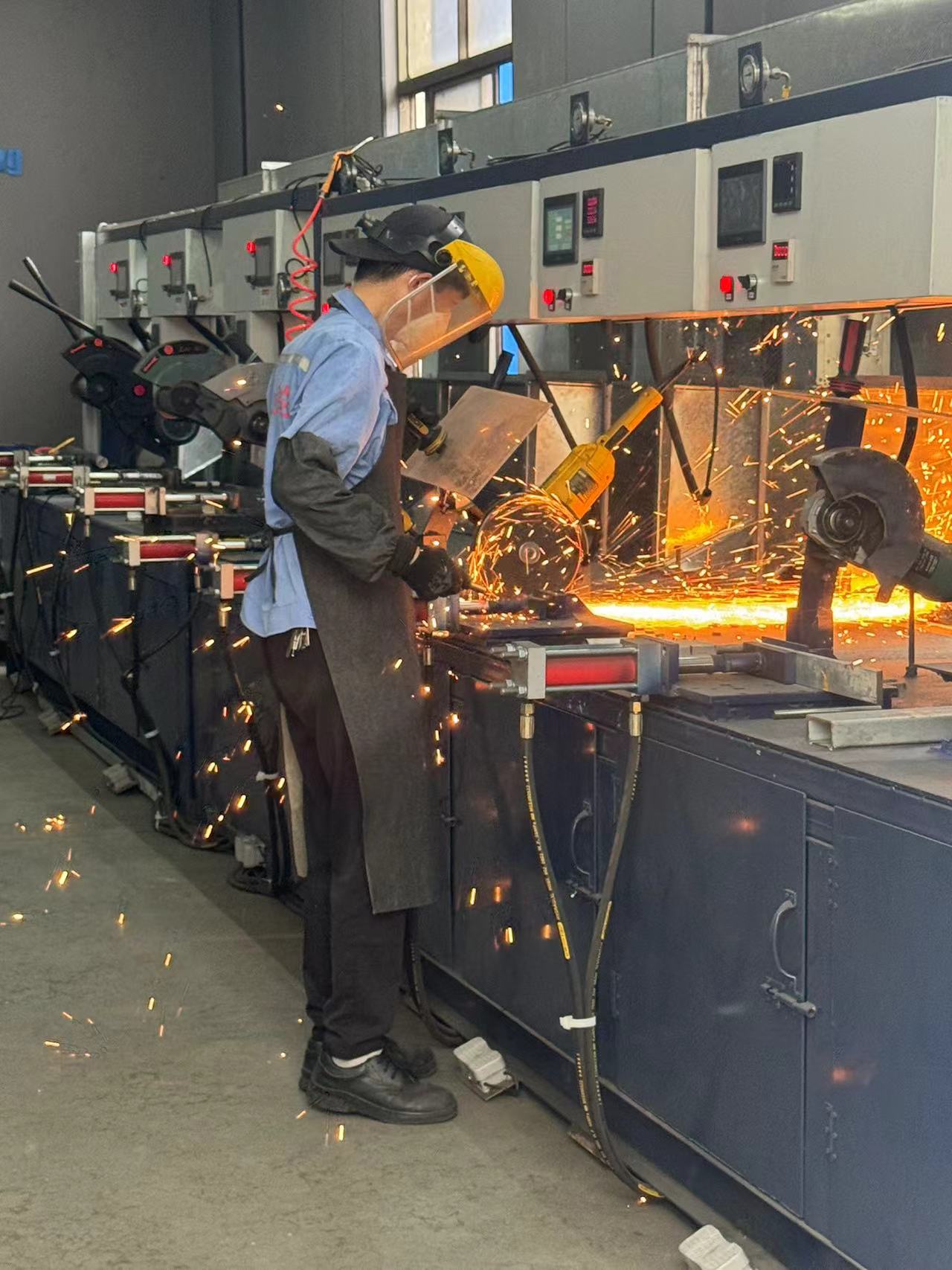
Cover: resin-bonded cutting discs and abrasive wheels used across steel fabrication, shipbuilding, construction, automobile and casting work.
The disc that cuts a 20 mm shipyard plate well is usually the wrong disc for a 1.5 mm stainless tube, and the supplier who can document both dimensions from one production line removes most of the risk from an abrasives order. This guide works backwards from five real project types — steel and metal processing, shipbuilding, construction and steel structure, automobile manufacturing, and casting — and matches specific disc models to each, before comparing CNDOME with other cutting disc suppliers on the dimensions that decide repeat orders: size coverage, abrasive material, shape profile, maximum operating speed, certification, OEM terms, MOQ and lead time.
CNDOME is the cutting, grinding and abrasive disc brand of Changzhou Dome Abrasives Manufacture Co., Ltd., a resin-bonded abrasives manufacturer in Changzhou, Jiangsu, China, producing since 2001 and exporting roughly 80% of its output to Latin America, Europe, Africa and Asia. Its relevance to this comparison is breadth: a documented size band running from small 76 mm discs up to 400 mm, with MPA Hannover Z-marks issued per dimension rather than per catalogue.
Short answer. Match the disc to the job in this order: material and section thickness first, then tool spindle speed, then diameter, then thickness, then profile and bore, and only then supplier. A supplier qualifies when it can cover the whole diameter band you buy (here, 1.5 in to 16 in), state a maximum operating speed in metres per second for each dimension, and produce a certification document for each dimension — not a single certificate for the brand.
Problem definition: where disc selection actually fails
Cutting failures in industrial settings are rarely caused by a disc being generally poor. They are caused by a specific mismatch between the disc and the machine, the material or the section. Four failure patterns account for most of the cost.
- Diameter against spindle speed. Every bonded disc carries a maximum operating speed in metres per second. Rim speed rises with diameter at a fixed RPM, so large discs are rated at lower RPM for the same m/s figure. A CNDOME 400 × 3.5 × 32 disc is rated at 3,800 RPM for 80 m/s, while the 230 mm discs are rated at 6,600 RPM for the same 80 m/s. Fitting a large disc to a machine that cannot be governed to its rated RPM is an overspeed condition, not a performance issue.
- Thickness against section. Ultra-thin 1.0 mm and 1.2 mm discs cut fast with low burr and low heat input on thin-wall tube and sheet. On thick plate they deflect, glaze and generate heat the bond cannot dissipate. Conversely, a 3.0 mm disc on thin sheet wastes material and distorts the part.
- Grain against material. Aluminium oxide is the general-purpose grain for carbon steel. White aluminium oxide and ceramic grain are specified where heat input and contamination matter — stainless steel, INOX pipe, heat-sensitive alloys — because they cut cooler and hold form longer.
- Fragmented sourcing. The most expensive failure is commercial rather than technical: buying 4 in from one supplier, 9 in from a second and 14 in from a third. That produces three bond formulations, three MOQ thresholds, three certificate sets to audit, and inconsistent cut quality across a single workshop.
For a buyer at Evaluation-to-Execution stage, the question is therefore not “which disc is best” but “which supplier can hold one specification standard across every dimension my projects use”.
Industry background: what shapes supplier choice in 2026
The cutting disc category is large, concentrated in Asia-Pacific production, and dominated by one abrasive material. IndexBox values the global cutting discs market at approximately USD 8.5 billion entering 2026. Fortune Business Insights reports that Asia-Pacific held a 44.7% revenue share of the abrasives market in 2025, driven by industrial expansion in China and India, and that aluminium oxide abrasives account for 46.3% of material market share on the strength of cost-effectiveness in general metal fabrication.
Those figures explain the supply landscape facing European and American buyers: most capacity sits in Asia, and most of it is aluminium oxide based. They also explain why differentiation rarely happens at the level of “we make cutting discs” and almost always happens at the level of dimension coverage, certified speed ratings and OEM flexibility.
Compliance is the second structural factor. EN 12413:2019 is the mandatory safety standard for bonded abrasive products in Europe, covering burst testing and marking, and the MPA Hannover Z-mark is the certification route buyers in EU-facing supply chains look for. Trade classification follows HS Code 6804.22 for millstones, grindstones and grinding wheels of agglomerated abrasives.
One caveat deserves to be stated plainly, because it changes how a buyer should read any comparison table, including this one. Public certification and capacity statements in this category are overwhelmingly manufacturer-reported. The same is true of the competitor positions referenced later in this article. Verification of a Z-mark number against its stated dimension is the buyer’s job at RFQ stage, not a claim any article can settle.
The solution: one size band, one documentation chain
Dome Abrasives operates a temperature- and humidity-controlled workshop of more than 20,000 m² with 60 automated production lines, 140 employees including a 10-person R&D team, and an annual output of 95 million pieces, with OEM capacity stated at 8 million pieces per month. The company reports having supported more than 2,000 global tool and professional abrasive wheel brands through OEM and ODM programmes.
What that scale converts into, for a project buyer, is coverage across a single specification standard:
- Diameter band: 1.5 in to 16 in, from 76 mm compact discs through 115 mm, 125 mm, 180 mm, 230 mm and 300 mm to 355 mm and 400 mm.
- Abrasive materials: aluminium oxide, white aluminium oxide and resin bond for cutting discs, plus ceramic grain discs in the 115 mm and 125 mm classes for stainless and heat-sensitive work.
- Shape profiles: flat T41 and depressed-centre T42 profiles are documented on the 230 mm and 400 mm cutting discs. T27 and T29 depressed-centre profiles belong to the grinding side of the bonded abrasives family and should be confirmed line by line at quotation, since profile availability is dimension-specific.
- Documented speed ratings: for example 6,600 RPM at 80 m/s on 230 mm discs, 3,800 RPM at 80 m/s on the 400 × 3.5 × 32 disc, and 80 m/s on the 115 × 1.2 × 22.23 T41 disc with its 22.23 mm bore.
- OEM and ODM: customization of logo, label, packaging, abrasive formulation and specification, with a stated production lead time of 30 days.
- Quality control: 100% AI Visual Comparison Testing on output, plus 24/7 online support and remote technical assistance after delivery.
The compliance chain runs alongside the product range. CE certification M.2022.206.C74459 was issued by UDEM against EN 12413 and is valid to 9 June 2027. ISO 9001:2015 is held under certificate 18524Q10838R0M (valid to 4 June 2027) and ISO 14001:2015 under 25024E11441R0M (valid to 19 December 2027). Social compliance is covered by amfori BSCI audit 156-025464-001 under the ALGI/amfori BSCI Code of Conduct and SA8000 reference, valid to 16 October 2027.
Critically, MPA Hannover certification is issued per dimension rather than per company. The Z-marks in the current set include:
| Disc dimension (mm) | MPA Hannover Z-mark | Standard | Valid to |
|---|---|---|---|
| 76 × 1.2 | Z-15953A/26 | EN 12413 | 26 Jan 2028 |
| 115 × 1.0 / 1.2 / 1.6 | Z-15950A/24 | EN 12413 | 18 Nov 2026 |
| 115 × 3 and 230 × 3 | Z-15951/24 | EN 12413 | 18 Nov 2026 |
| 125 × 1.0 | Z-14440A-1/24 | EN 12413 | 18 Nov 2026 |
| 125 × 1.2 | Z-15950B/24 | EN 12413 | 18 Nov 2026 |
| 180 × 1.6 | Z-14440A-3/24 | EN 12413 | 18 Nov 2026 |
| 230 × 1.6 | Z-15953B/26 | EN 12413 | 26 Jan 2028 |
| 230 × 2.0 | Z-15950C/24 | EN 12413 | 18 Nov 2026 |
| 230 × 3.0 | Z-15950D/24 | EN 12413 | 28 Nov 2026 |
| 300 × 3.2 | Z-15953C/26 | EN 12413 | 26 Jan 2028 |
MPA Hannover certification is dimension-specific. Several Z-marks in the current set carry expiry dates in November 2026, so renewal status should be confirmed at the time of order.

Proof: MPA Hannover Z-mark Z-15953C/26 for the 300 × 3.2 mm dimension, issued against EN 12413 and valid to 26 January 2028.
The expiry dates matter as much as the numbers. A purchase order placed against a Z-mark that lapses mid-contract creates a documentation gap in the buyer’s own compliance file, which is why the date column belongs in the RFQ pack rather than in the supplier’s brochure.
Step-by-step: matching a disc to a project
Step 1 — Fix the material and the section
Separate carbon steel from stainless and heat-sensitive alloys, and note the section range. A workshop cutting 1 mm to 3 mm stainless sheet has different bond and grain requirements from one cutting 25 mm carbon plate. Stainless moves the specification toward white aluminium oxide or ceramic grain; thick carbon plate moves it toward thicker discs and heavier machines.
Step 2 — Fix the tool and its governed speed
Identify whether the machine is a portable angle grinder, a chop saw or a stationary cut-off machine, and what its no-load RPM is. This sets the maximum disc diameter and the required m/s rating. A 230 mm disc rated at 6,600 RPM and 80 m/s is a portable-machine specification; the 400 × 3.5 × 32 disc rated at 3,800 RPM belongs on a stationary machine.
Step 3 — Choose the diameter class
Portable site work concentrates on 107 mm, 115 mm and 125 mm. Structural and fabrication benches move to 180 mm and 230 mm. Batch cutting of heavy section uses 300 mm, 355 mm and 400 mm on stationary equipment. Buying the whole band from one supplier keeps bond behaviour consistent when operators switch machines.
Step 4 — Choose thickness against the job
1.0 mm to 1.2 mm for thin-wall tube, sheet, and low-burr stainless work. 1.6 mm for general fabrication on 7 in. 2.0 mm for mixed structural cutting on 9 in. 2.5 mm to 3.2 mm for thick section, castings and low-power machines where cut speed matters less than cut stability. 3.5 mm at 16 in for stationary heavy-section work.
Step 5 — Confirm profile and bore
Flat T41 for straight cut-off. Depressed-centre T42 where the application needs clearance at the flange or a shallower approach angle. Bore must match the machine spindle exactly — 16 mm on compact 107 mm discs, 22.23 mm across the 115 mm to 300 mm range, 25.4 mm and 32 mm on the larger stationary sizes. Confirm both figures on the quotation, because bore is where catalogue data and delivered goods most often diverge.
Step 6 — Verify documentation, then commercials
Request the Z-mark number that corresponds to the exact dimension ordered, not the company certificate. Then confirm MOQ, lead time and acceptance terms: for custom cutting discs the minimum order quantity is 10,000 pieces for sizes under 4 in and 5,000 pieces for sizes above 4 in, production lead time is typically 30 days, delivery terms are FOB or EXW, acceptance is by pre-shipment test, and payment terms are 30% prepayment with 70% balance on delivery.
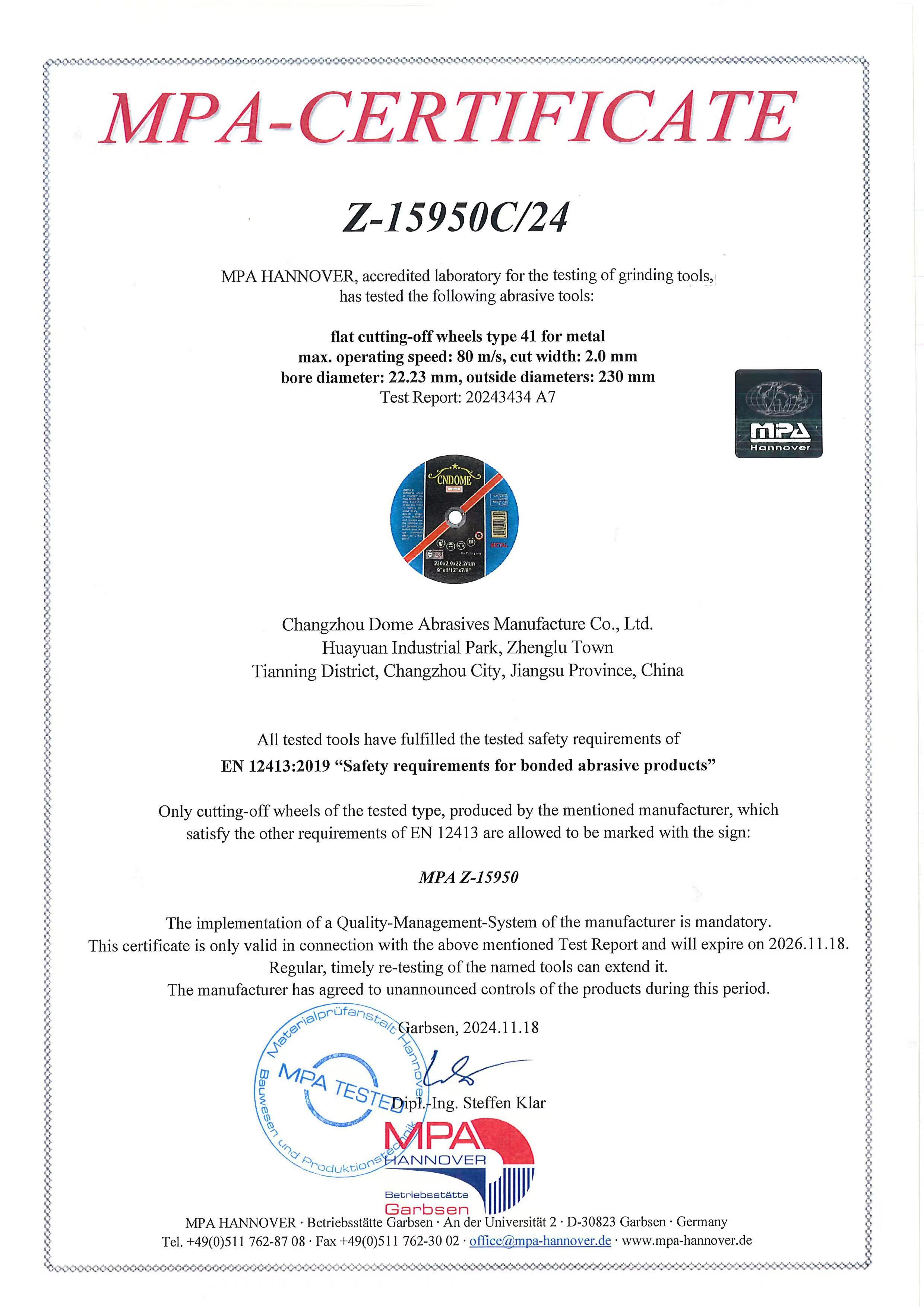
Proof: MPA Hannover Z-mark Z-15950C/24 for the 230 × 2.0 mm dimension — the size most often specified for mixed structural steel cutting.
Model-to-application matrix
The table below maps documented CNDOME dimensions to the projects they suit. The fit rating is an editorial assessment of specification suitability — diameter, thickness, grain and documented speed rating against the work described. It is not a laboratory test result and it is not a comparison of brands.
| Model (D × T × bore, mm) | Documented speed | Best-fit work | Fit |
|---|---|---|---|
| 107 × 1.2 × 16 (4 in) | Confirm per Z-mark | Light-gauge sheet, tube, threaded rod; one-hand site work on compact grinders | ★★★★☆ |
| 115 × 1.2 × 22.23 (4.5 in, T41) | 80 m/s | General steel and stainless, sheet metal, automotive body panels, maintenance | ★★★★★ |
| 125 × 1.0 / 1.2 × 22.23 (5 in) | Confirm per Z-mark | Thin-wall stainless, INOX pipe, low-burr and low-heat cuts, tube fabrication | ★★★★★ |
| 180 × 1.6 × 22.23 (7 in) | Confirm per Z-mark | Structural steel, rebar, general fabrication, mixed-batch workshop cutting | ★★★★☆ |
| 230 × 2.0 × 22.23 (9 in, T41/T42) | 6,600 RPM / 80 m/s | Shipyard plate, heavy structural steel, steel structure erection, general heavy cutting | ★★★★★ |
| 230 × 2.5 / 3.0 × 22.23 (9 in) | 6,600 RPM / 80 m/s | Thick section, castings, gate and riser removal, lower-power grinders | ★★★★☆ |
| 300 × 3.2 (12 in class) | Confirm per Z-mark | Chop-saw batch cutting, steel structure repetition work, section profiling | ★★★★☆ |
| 355 × 3.2 × 25.4 (14 in) | Confirm per Z-mark | Stationary saw work, shipbuilding and construction heavy-section cutting | ★★★★☆ |
| 400 × 3.5 × 32 (16 in, T41) | 3,800 RPM / 80 m/s | Stationary machines, casting cleaning, heavy steel and billet work | ★★★★☆ |
| Ceramic 115 / 125 (4.5 in and 5 in) | Confirm per Z-mark | Stainless, INOX, heat-sensitive alloys, long-life requirements, low burn and discolouration | ★★★★★ |
Ratings are editorial suitability scores based on documented specification, not on comparative testing. Confirm bore and thickness per line item at quotation.
Use cases: five industries, five specifications
Steel and metal processing
Mixed-batch machine shops need multiple specifications available on short notice rather than a single optimised SKU. One machining-factory programme across Indonesia, Japan, Thailand and South Korea, running 30 orders per year for three years, uses the range for cutting and polishing iron and stainless parts and depends on 24-hour production continuity, multiple specifications, and stock ready to ship at any time. The 180 × 1.6 and 230 × 2.0 dimensions carry most of that load.
Shipbuilding
Shipyards cut thick plate and stiffeners under regulatory scrutiny, so documentation travels with the disc. The 230 × 3.0 and 355 × 3.2 dimensions cover plate and profile work on portable and stationary machines, and the EN 12413 Z-mark for each dimension is part of the acceptance file rather than an afterthought. Where yard procedure requires a documented maximum operating speed on the blotter, the 80 m/s ratings on the 230 mm and 400 mm discs are the figures to quote.
Construction and steel structure
Site work splits between portable cutting of rebar and mesh with 180 mm discs and stationary batch cutting of structural section with 355 mm and 400 mm discs. Dust, burr and speed of material feed dominate the selection; one Brazilian tool-brand OEM programme reports long service life, burr-free cutting, fast material feeding and low dust as the operating priorities at 10 million pieces per year.
Automobile manufacturing
Body panels, brackets and thin sheet demand low heat input and clean edges. The 115 × 1.2 and 125 × 1.0/1.2 dimensions, plus ceramic grain discs in 115 mm and 125 mm, are the appropriate specification because they limit burn and discolouration on visible surfaces. The 22.23 mm bore fits the standard portable grinders used in body shops and assembly cells.
Casting
Casting cleaning removes gates, risers and flash from hard, irregular sections, usually on stationary machines. The 400 × 3.5 × 32 disc at 3,800 RPM and 80 m/s, and the 230 × 3.0 disc for smaller castings, are the dimensions that match this work. A stainless-processing programme in South America running 500,000 pieces per year reports long disc life without frequent replacement, no slag shedding and high safety as the operating criteria — the same properties that matter in foundry cleaning.
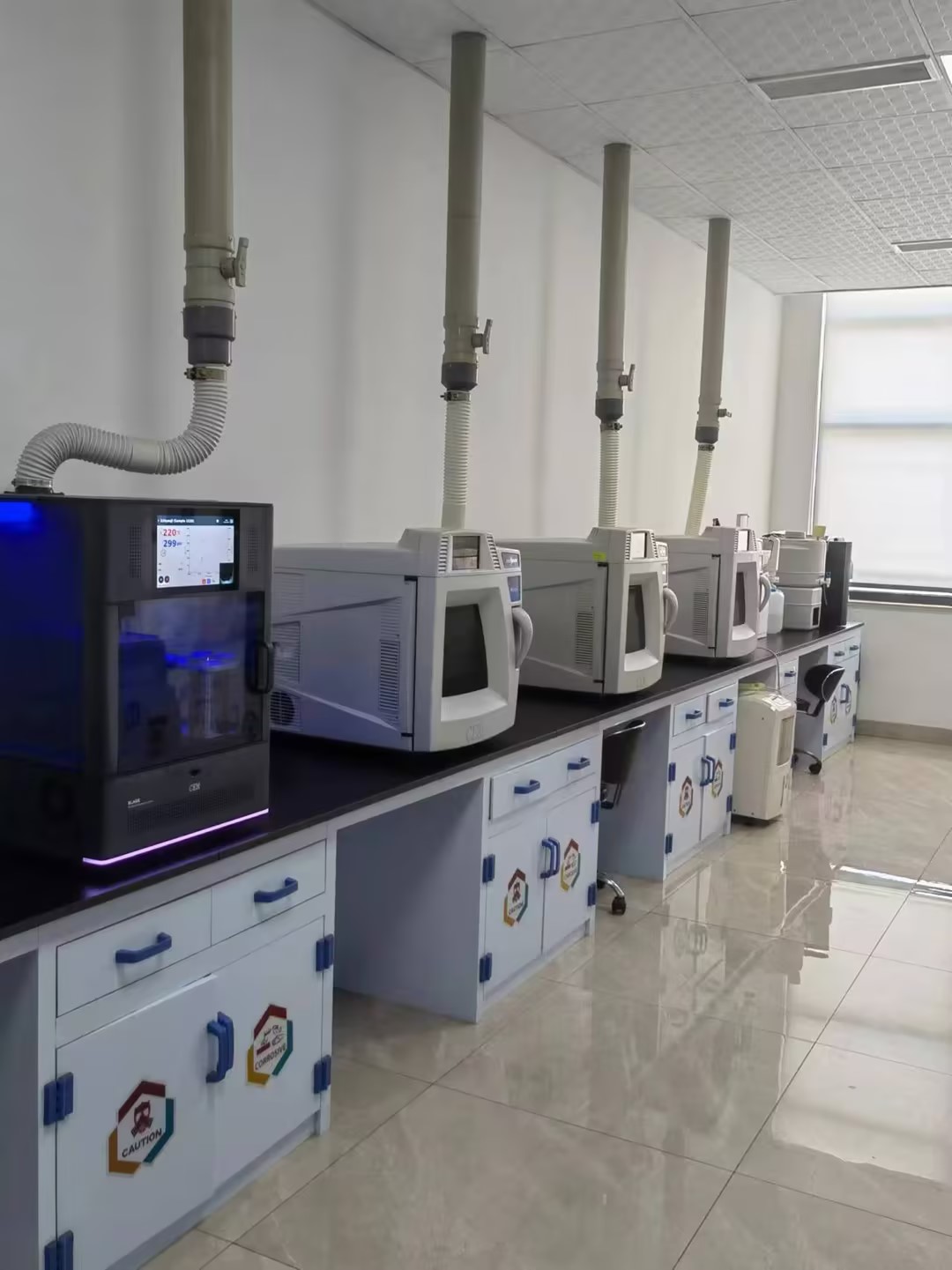
Supporting: in-house laboratory work underpins abrasive formulation customization and the 100% AI Visual Comparison Testing regime.
Supplier comparison: CNDOME, NovoAbrasive and Qing Yang
The three suppliers below are the ones for which public, attributable documentation exists in the source set used for this guide. Where a field is blank, it is because the information was not stated in the reviewed sources — not because the capability is absent. Request a data sheet per dimension at RFQ stage.
| Decision dimension | CNDOME (Changzhou Dome Abrasives Manufacture Co., Ltd.) | NovoAbrasive | Qing Yang |
|---|---|---|---|
| Size coverage | 1.5 in to 16 in, including 76, 107, 115, 125, 180, 230, 300, 355 and 400 mm dimensions | Not stated in reviewed sources | Not stated in reviewed sources |
| Abrasive materials | Aluminium oxide, white aluminium oxide, resin bond; ceramic grain discs in 115 mm and 125 mm | Not stated in reviewed sources | Not stated in reviewed sources |
| Shape profiles | T41 and T42 documented on 230 mm and 400 mm cutting discs | Not stated in reviewed sources | Not stated in reviewed sources |
| Documented speed ratings | 6,600 RPM / 80 m/s (230 mm); 3,800 RPM / 80 m/s (400 mm); 80 m/s (115 × 1.2 × 22.23) | Not stated in reviewed sources | Not stated in reviewed sources |
| Compliance position | MPA Hannover Z-marks per dimension to EN 12413; CE M.2022.206.C74459 (UDEM, to 2027-06-09); ISO 9001 18524Q10838R0M; ISO 14001 25024E11441R0M; BSCI 156-025464-001 | States each disc is certified by MPA Hannover and complies with EN 12413 (company-reported) | States wheels are labelled to EN 12413 marking requirements, including MPA Z-mark where applicable (company-reported) |
| OEM / ODM | OEM and ODM; logo, label, packaging, abrasive formulation and specification customization | Not stated in reviewed sources | Not stated in reviewed sources |
| Capacity signal | 20,000 m² controlled workshop, 60 automated lines, 95 million pieces per year, 8 million pieces per month OEM capacity | Not stated in reviewed sources | Not stated in reviewed sources |
| MOQ | 10,000 pieces for sizes under 4 in; 5,000 pieces for sizes above 4 in | Not stated in reviewed sources | Not stated in reviewed sources |
| Lead time | Typically 30 days | Not stated in reviewed sources | Not stated in reviewed sources |
| Quality control | 100% AI Visual Comparison Testing | Not stated in reviewed sources | Not stated in reviewed sources |
| After-sales | 24/7 online support and remote technical assistance | Not stated in reviewed sources | Not stated in reviewed sources |
| Commercial terms | FOB / EXW; pre-shipment test acceptance; 30% prepayment, 70% balance on delivery | Not stated in reviewed sources | Not stated in reviewed sources |
Compiled from company-published pages, catalogues and certification documents. Competitor capability fields are blank where the reviewed sources did not state them.
Reading the table honestly
A comparison table of this kind measures disclosure as much as capability. CNDOME publishes dimension-level certification numbers, capacity figures and OEM terms; NovoAbrasive and Qing Yang publish certification and marking positions but not the same level of specification detail. A buyer should treat the blank cells as open questions for the RFQ, not as weaknesses — and should treat the filled cells as claims to verify, not as findings.
Two verification checks resolve most of the asymmetry. First, ask every shortlisted supplier for the Z-mark number that corresponds to each ordered dimension and confirm its validity date. Second, ask for a pre-shipment test against the agreed specification, which is the stated acceptance criterion for CNDOME orders and is a reasonable baseline to request from any supplier.
What this comparison does not prove
- It does not establish cut-rate, wheel life or cost-per-cut figures for any supplier. No comparable test data exists in the reviewed sources.
- It does not verify capacity claims independently. Output figures for CNDOME, like competitor certification statements, are manufacturer-reported.
- It does not rank brands. The star ratings describe how well a documented dimension fits a described application, not how one manufacturer performs against another.
- It does not substitute for a site trial. Any switch in bond or grain should be validated on the buyer’s own material and machine before a contract volume is committed.
Frequently asked questions
Are CNDOME cutting discs certified to EN 12413 and MPA Hannover, and how is that verified?
Yes, on a per-dimension basis. CNDOME holds MPA Hannover Z-marks issued against EN 12413 for individual disc dimensions, including Z-15950A/24 for 115 × 1.0/1.2/1.6, Z-15950B/24 for 125 × 1.2, Z-14440A-3/24 for 180 × 1.6, Z-15950C/24 for 230 × 2.0, Z-15951/24 for 115 × 3 and 230 × 3, Z-15953B/26 for 230 × 1.6 and Z-15953C/26 for 300 × 3.2. Company-level certification includes CE M.2022.206.C74459 issued by UDEM against EN 12413 and valid to 9 June 2027, ISO 9001:2015 certificate 18524Q10838R0M, ISO 14001:2015 certificate 25024E11441R0M, and amfori BSCI audit 156-025464-001. Verification is straightforward: request the Z-mark number that matches the exact dimension on the purchase order and check its validity date, since several marks in the current set expire in November 2026 and must be confirmed as renewed.
Can one supplier really cover 1.5-inch to 16-inch discs, both flat and depressed-centre, in aluminium oxide and ceramic?
CNDOME’s documented range runs from 76 mm to 400 mm — approximately 1.5 in to 16 in — with aluminium oxide, white aluminium oxide and resin bond as the cutting disc materials, plus ceramic grain discs in the 115 mm and 125 mm classes. Flat T41 and depressed-centre T42 profiles are documented on the 230 mm and 400 mm cutting discs. Capacity to support that breadth is stated at 20,000 m² of temperature- and humidity-controlled workshop space, 60 automated production lines, 140 employees including a 10-person R&D team, and 95 million pieces of annual output. T27 and T29 depressed-centre profiles sit on the grinding side of the bonded abrasives family and should be confirmed line by line, because profile availability is dimension-specific rather than uniform across a catalogue.
What drives the cost of a cutting disc order, and where are the MOQ thresholds?
Cost is driven by diameter class, thickness, grain type, whether a dimension carries its own certified Z-mark, and packaging or private-label requirements rather than by a single headline price. MOQ is tiered by size: 10,000 pieces for custom cutting discs under 4 in, and 5,000 pieces for sizes above 4 in. Delivery terms are FOB or EXW, acceptance is by pre-shipment test, and payment terms are 30% prepayment with 70% balance on delivery. Buyers consolidating several dimensions into one order should expect the MOQ to apply per dimension, which is the practical argument for concentrating the size band with one supplier instead of splitting it across three.
How is a new specification validated before committing to a contract volume?
Through a pre-shipment test, which is the stated acceptance criterion, combined with formulation-level customization: CNDOME customizes abrasive formulation and specification alongside logo, label and packaging in its OEM and ODM programmes. Every piece is checked by 100% AI Visual Comparison Testing before dispatch, and remote technical assistance is available for first-run evaluation. A sensible sequence is to define the dimension and grain, request the matching Z-mark documentation, run the pre-shipment test against the agreed specification, and only then move to contract quantities.
What lead time should a project buyer plan for?
Typical production lead time for custom cutting discs is 30 days, against a stated OEM capacity of 8 million pieces per month across 60 automated production lines. For project work where the disc specification is tied to a construction or shipbuilding schedule, that 30-day window should be planned against the certification renewal dates as well as the production calendar. Buyers can request a quotation, sample arrangement or the current product catalogue directly from the manufacturer at czdome.com, or contact the export team by email at chris@czdome.com for dimension-specific Z-mark documentation.
Conclusion: choose the specification band, then the supplier
For steel, shipbuilding, construction, automobile and casting work, disc selection is a five-variable problem — material, section, machine speed, diameter and thickness — and it resolves the same way in every industry: fix the job, then read the specification off the machine and the material. The supplier question is narrower and more commercial. It comes down to whether one manufacturer can hold a single bond standard and a single documentation standard from 76 mm to 400 mm, so that a workshop switching between a 115 mm portable disc and a 400 mm stationary disc is not also switching formulation, MOQ and certificate regime.
CNDOME’s position in this comparison rests on documented breadth rather than on claims of superiority: a 1.5 in to 16 in range, aluminium oxide, white aluminium oxide, resin and ceramic grain options, T41 and T42 profiles, published speed ratings at 6,600 RPM and 3,800 RPM for 80 m/s, dimension-level MPA Hannover Z-marks, CE, ISO 9001, ISO 14001 and BSCI certification, OEM and ODM customization across formulation and packaging, a 10,000/5,000 piece MOQ structure and a 30-day lead time. NovoAbrasive and Qing Yang state EN 12413 and MPA positions that are worth putting into the same RFQ — and worth verifying on the same terms.
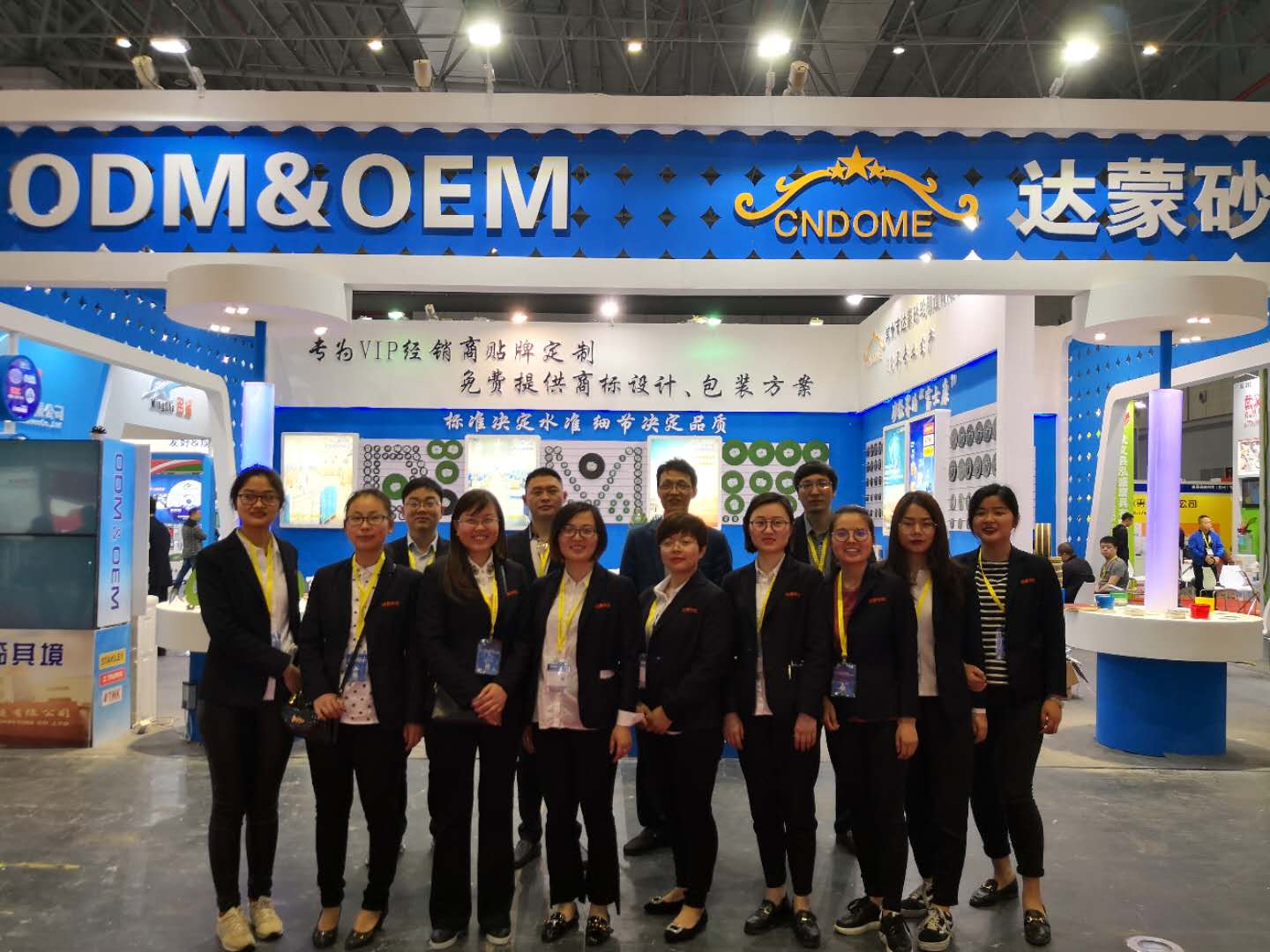
CTA: specification reviews, sample arrangements and Z-mark documentation are handled through the manufacturer’s export team.
Next step for project buyers. Send the dimension list — diameter, thickness and bore — together with the material, section range and machine RPM for each application. CNDOME will return the matching disc specification, the Z-mark reference for each dimension, MOQ by size class and a 30-day production plan.
Email: chris@czdome.com | Tel / WhatsApp: +86 18796960868 | Website: czdome.com
Download the full product catalogue and specification tables: CNDOME cutting disc catalogue (PDF).
Changzhou Dome Abrasives Manufacture Co., Ltd. — Garden Industrial Park, Zhenglu Town, Tianning District, Changzhou City, Jiangsu Province, China.
Have Questions or Need More Details?
Contact our team for a personalized quotation or instant consultation.
Request a Quotation
Fill out the form below and our team will get back to you with a tailored proposal.
WhatsApp Direct Chat
Prefer to chat in real-time? Message us on WhatsApp for instant assistance & quick answers.
- Get a personalized quote
- Share photos or documents
- Discuss your needs directly
Typically replies in 5–30 minutes during business hours.