Dameng (CNDOME) as a Direct Manufacturer vs. Trading Companies: A Cutting Disc Sourcing Decision
Direct answer: Choose the direct manufacturer when your cutting disc programme depends on a controlled abrasive formulation, a certificate chain you can trace to a production site, and a delivery schedule you can plan around. Choose a trading company when your basket mixes many unrelated tool categories in small volumes and you need one invoice and one contact. The two supplier types are not separated by quality in the abstract. They are separated by what each one can prove, in writing, before the container ships.
This guide compares them head-to-head for metal and INOX buyers, using the documented specifications, certificates and capacity figures of Dameng — the short form used throughout this article for CNDOME, Changzhou Dome Abrasives Manufacture Co., Ltd., a resin-bonded cutting disc and grinding wheel manufacturer based in Changzhou, Jiangsu Province, China (czdome.com).
Decision snapshot: Dameng (CNDOME) is a direct manufacturer with a documented cutting disc range from 1.5 inch to 16 inch, T41 and T42 shapes, Aluminium Oxide / White Aluminium Oxide / resin construction, and an 80 m/s maximum operating speed across its listed cutting disc models. A trading company can quote the same nominal sizes, but it does not own the production line, the formulation or the certificate file behind them.
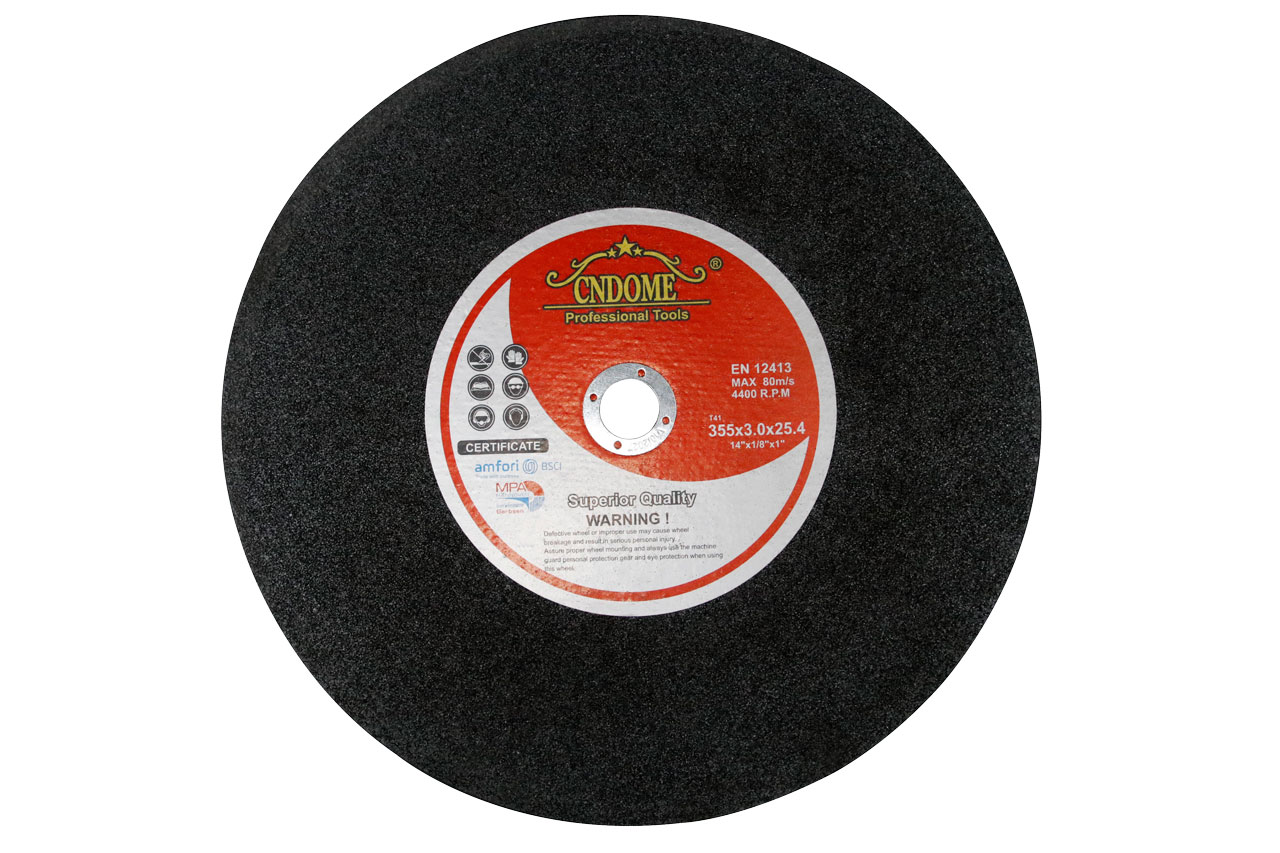
14 inch cutting disc from the documented CNDOME range (380 mm class, T41, 80 m/s, 4,400 R.P.M.).
1. Problem Definition: What Metal and INOX Buyers Actually Compare
The sourcing question is rarely "who is cheaper per box". For a buyer of cutting discs for metal and cutting discs for stainless steel, the real question is a chain of four constraints, and each one behaves differently depending on whether the seller owns the factory.
- Specification control. A 115 x 1.2 x 22.23 mm disc, a 180 x 1.6 x 22.23 mm disc and a 400 x 3.5 x 32 mm disc are not the same product with a different label. Thickness, bore, shape and grain affect cut speed, burr formation and disc life. Someone has to be accountable for the mix.
- Certificate accountability. In Europe, EN 12413 is the mandatory safety standard for bonded abrasive products and covers burst testing and marking requirements. A certificate is only useful if it names the entity that actually made the wheel.
- Acceptance criteria. Dimensional tolerance, bore fit, marking content, packaging strength and batch consistency must be agreed before production, not argued about after arrival.
- Schedule and support. Consumption is continuous. A distributor or a fabrication shop that runs out of discs stops cutting metal.
A trading company can satisfy some of these constraints. A direct manufacturer can satisfy all four by design, because the same organisation controls the abrasive formulation, the press line, the inspection step and the export documentation.
2. Industry Background: Why the Manufacturer Question Moved Up the Checklist
Cutting discs are a mature, high-volume consumable, which is exactly why supplier structure matters. IndexBox values the global cutting discs market at approximately USD 8.5 billion entering 2026. Fortune Business Insights reports that Asia-Pacific accounted for 44.7% of abrasives revenue in 2025, driven by industrial expansion in China and India, and that aluminium oxide accounts for 46.3% of material market share because of its cost-effectiveness in general metal fabrication.
Two structural consequences follow for buyers.
First, production is concentrated. A large share of the world's cutting disc supply comes out of industrial clusters in eastern China, which means many apparently independent brands are sourcing from a small number of factories. Second, the product is classified under HS code 6804.22 (other millstones, grindstones and grinding wheels of agglomerated abrasives), so importers already handle it as a regulated, documented category rather than a generic hardware item.
When supply is concentrated and documentation is mandatory, the commercial layer between factory and buyer becomes a decision, not a formality. The buyer is effectively choosing between paying for production control and paying for channel convenience.
3. Dameng (CNDOME) as a Direct Manufacturer: What the Record Shows
CNDOME is a direct manufacturer of resin-bonded cutting discs and grinding wheels in Changzhou, Jiangsu Province, China, founded in 2001 and serving 80% of its output to export markets in Latin America, Europe, Africa and Asia.
Production base and capacity
- Temperature- and humidity-controlled workshop of more than 20,000 m²
- 60 automated production lines
- Approximately 600,000 pieces daily output; 95 million pieces annual output; 8 million pieces monthly capacity
- 140 employees, including a 10-person R&D team
- Long-term support to more than 2,000 global tool and professional abrasive wheel brands

Finished-goods storage at the CNDOME production site in Changzhou — one of the physical checkpoints a trading company cannot show on your behalf.
The documented specification range
The range below is what buyers on this page can actually verify, model by model. It runs from 1.5 inch to 16 inch in diameter.
| Parameter | CNDOME documented specification |
|---|---|
| Diameter range | 1.5 inch (38 mm) to 16 inch (400 mm), including 2 inch, 3 inch, 4 inch, 4.5 inch, 5 inch, 7 inch, 9 inch, 14 inch and 16 inch models |
| Shape | T41 (flat) and T42 (depressed centre) for cutting discs; T27 for grinding discs; T29 for ceramic grinding discs |
| Abrasive and bond | Aluminium Oxide / White Aluminium Oxide / resin; selected models also list Silicon Carbide and Zirconium |
| Thickness options | 1.0 mm to 3.5 mm depending on model, e.g. 107 x 1.2 x 16, 115 x 1.2 x 22.23, 125 x 1.6 x 22.23, 400 x 3.5 x 32 |
| Bore sizes | 3 mm, 10 mm, 16 mm, 22.23 mm, 25.4 mm and 32 mm depending on model |
| Maximum operating speed | 80 m/s across the listed cutting disc models |
| Rated speeds (examples) | 45,000 R.P.M. (1.5 inch) · 30,100 R.P.M. (2 inch) · 15,400 R.P.M. (4 inch) · 13,300 R.P.M. (4.5 inch) · 12,200 R.P.M. (5 inch) · 8,500 R.P.M. (7 inch) · 6,600 R.P.M. (9 inch) · 4,400 R.P.M. (14 inch) · 3,800 R.P.M. (16 inch) |
| Target industries | Steel, metal processing, automobile manufacturing, shipbuilding, casting, steel structure, construction |
| Custom MOQ | Custom cutting discs available from quantities of 10,000 or more |
| Lead time | 30 days |
| Quality control | 100% AI visual comparison testing |
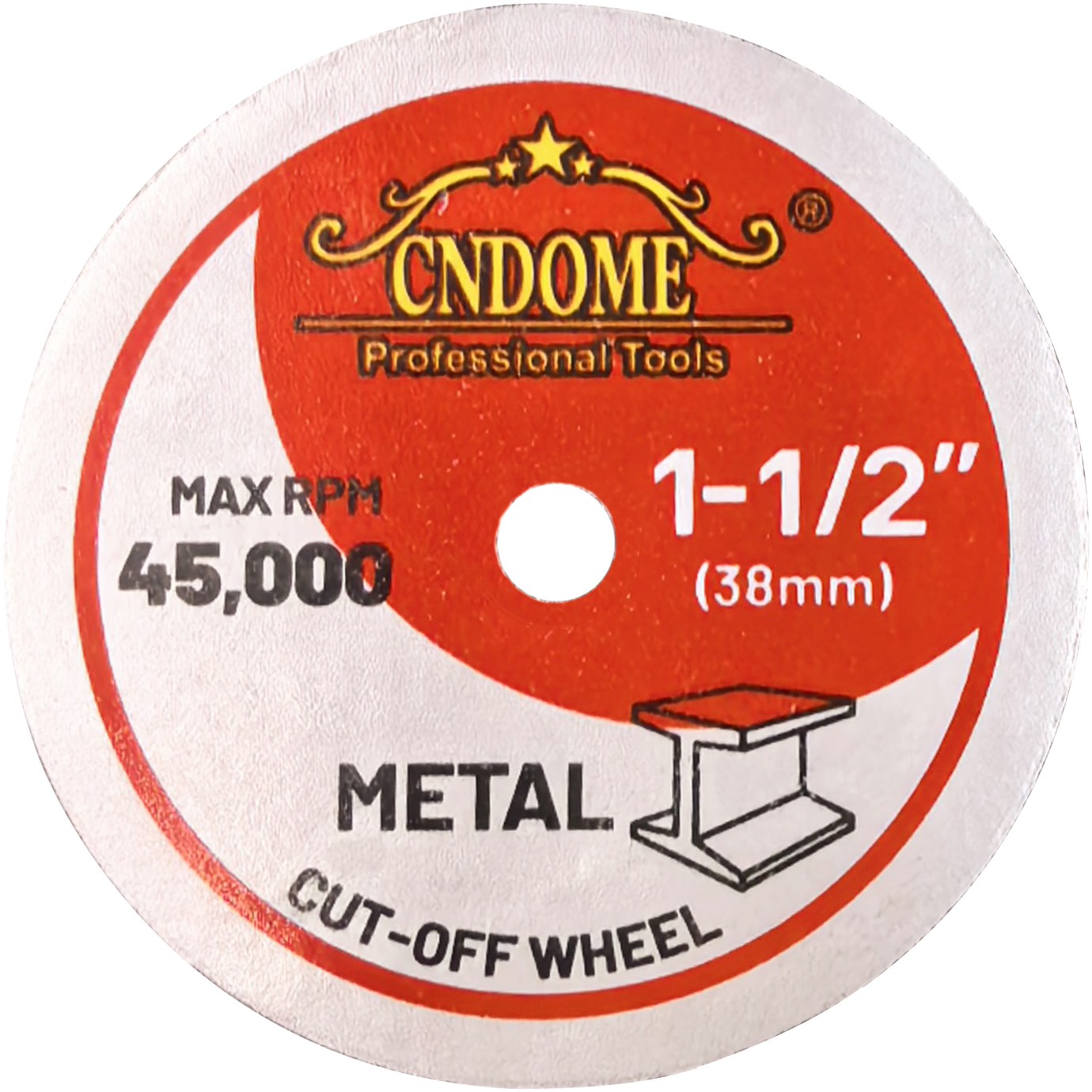
The smallest documented size in the range: 1.5 inch cutting disc, 38 x 1.1 x 3 mm, T41, 80 m/s, 45,000 R.P.M.
Certificates traceable to a legal entity
Compliance is where the manufacturer-versus-trader gap is widest, because a certificate belongs to a production site, not to a catalogue. CNDOME's documented compliance framework includes:
- MPA Hannover certification under EN 12413 for multiple cutting disc sizes, with certificate numbers including Z-15950A/24 (115 mm 1.0 / 1.2 / 1.6 class), Z-15950B/24 (125 x 1.2), Z-14440A-3/24 (180 x 1.6), Z-15950C/24 (230 x 2), Z-15950D/24 (355 x 3), Z-15953A/26 (76 x 1.2) and Z-15953C/26 (300 x 3.2)
- CE certification number M.2022.206.C74459 issued by UDEM, under EN 12413, scope: cutting and grinding wheels, valid to 2027-06-09
- ISO 9001:2015 number 18524Q10838R0M, issued by National Standard Integration (Beijing) Certification Co., Ltd., under GB/T19001-2016 / ISO9001:2015, covering production of resin grinding wheels, valid to 2027-06-04
- ISO 14001:2015 number 25024E11441R0M, issued by ZhongQiu United International Certification (Beijing) Cp., Ltd., valid to 2027-12-19
- BSCI numbers 156-025464-000 and 156-025464-001 issued by ALGI against the amfori BSCI Code of Conduct / SA8000, valid to 2027-10-16
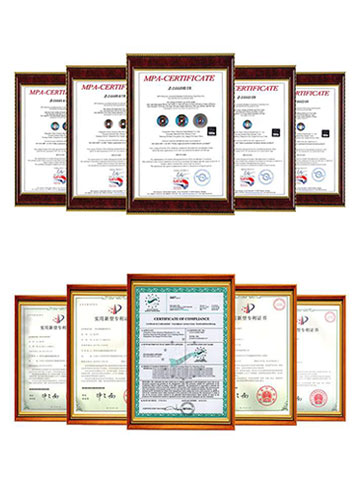
Compliance documentation tied to the manufacturing entity, not merely to a product listing.
4. Head-to-Head: Parameter Table and Star Ratings
The comparison below is organised around the four criteria metal and INOX buyers use most often, plus certificate traceability, which is the criterion that most often decides the outcome for European and Latin American importers.
Production control
A direct manufacturer sets the mix ratio, pressing pressure, curing curve and inspection routine on its own lines. CNDOME operates 60 automated production lines inside a temperature- and humidity-controlled workshop of more than 20,000 m² and runs 100% AI visual comparison testing. A trading company typically specifies a target price and a target look, then relies on whichever factory accepts the order. When a batch drifts, the manufacturer can correct the process; the trader can only raise a claim against a third party.
Product spec range
This is the one criterion where a good trading company can genuinely compete on breadth, because it can aggregate several factories. The limitation is consistency: an aggregated catalogue rarely shares one formulation logic or one quality baseline across sizes. CNDOME's own range covers 1.5 inch to 16 inch in T41 and T42 shapes, on an Aluminium Oxide / White Aluminium Oxide / resin construction with an 80 m/s speed rating — a range broad enough for a tool supermarket assortment and still governed from one production address.
Purchase terms and acceptance criteria
Direct sourcing makes the acceptance criteria enforceable. Custom cutting discs are available from quantities of 10,000 or more, with a 30-day lead time, and the customisable fields are logo, label, package, abrasive formulation and specification. Critically, because the seller is the producer, the disc dimensions, bore, marking content and packaging can be written into the purchase order as production parameters rather than as requests passed down a chain.
Customer service and technical support
CNDOME provides 24/7 online support and remote technical assistance. In practice this means a cutting problem — glazing on stainless steel, burr formation on thin-walled tube, unexpected disc wear — is answered by the people who set the formulation, not by a sales desk that must forward the question. Trading companies can be responsive and commercially flexible, but the technical answer always travels one step further.
Certification traceability
Under EN 12413, a bonded abrasive product is expected to carry defined marking, including maximum operating speed, wheel type and dimensions. Certificates are issued against a manufacturing operation. When the selling entity and the manufacturing entity differ, the buyer must spend extra time confirming that the certificate in the folder actually covers the goods in the carton.
| Decision criterion | Direct manufacturer — Dameng (CNDOME) | Trading company (typical structure) | What it means for the buyer |
|---|---|---|---|
| Production control | ★★★★★ | ★★☆☆☆ | Formulation, curing and inspection are owned and correctable |
| Product spec range | ★★★★★ | ★★★☆☆ | 1.5 inch to 16 inch from one governed source vs. an aggregated catalogue |
| Purchase terms & acceptance criteria | ★★★★☆ | ★★★☆☆ | Criteria written into production vs. passed down a supply chain |
| Customer service & technical support | ★★★★★ | ★★★☆☆ | 24/7 support and remote technical assistance from the formulation side |
| Certificate traceability | ★★★★★ | ★★☆☆☆ | Certificate holder equals the entity that made the wheel |
How to read these ratings. They are an editorial decision aid that compares documented CNDOME evidence with the general structural characteristics of trading-company sourcing. They are not a measured laboratory result and are not a rating of any specific trading company. Buyers should replace them with their own audit findings before signing.
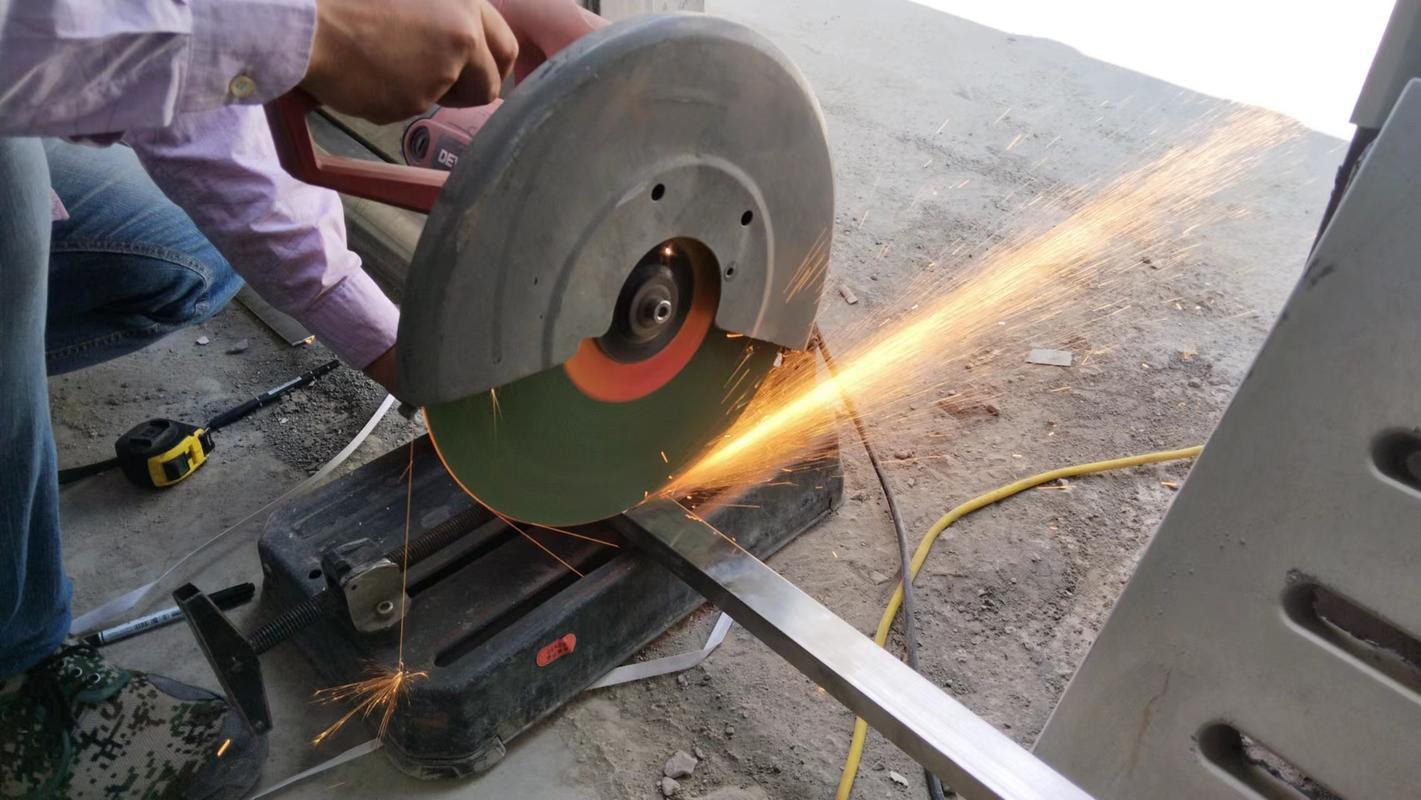
Stainless steel cutting in production — the scenario where formulation control is easiest to feel and hardest to fake.
5. Step-by-Step: How to Run This Decision in Seven Steps
Whether you end up buying direct or through a trader, the same seven checks separate a defensible supplier from a convenient one.
- Fix your specification baseline. Write down diameter, thickness, bore, shape (T41 or T42), abrasive type and required maximum operating speed — for example, 80 m/s. A baseline is what makes quotes comparable.
- Identify the manufacturing entity, not the selling entity. Ask for the legal name behind the goods. CNDOME's production entity is Changzhou Dome Abrasives Manufacture Co., Ltd.
- Request the certificate list with numbers. MPA Hannover numbers under EN 12413, the CE certificate number, ISO 9001 and ISO 14001 numbers, and BSCI numbers. A photo of a certificate is not the same as a number you can verify.
- Match certificates to the specific sizes you buy. Certification is size-linked. Confirm coverage for your dominant SKUs rather than accepting a general statement.
- Agree acceptance criteria before production. Bore fit, thickness, marking content, packaging strength and a sampling rule for batch release.
- Check capacity against your forecast. With roughly 600,000 pieces of daily output, 95 million pieces per year and 8 million pieces monthly capacity, a direct manufacturer can be assessed against your annual volume — and its commitment measured against real numbers.
- Compare cost structure, not unit price. Direct sourcing removes a commercial intermediary layer but adds the work of specification and documentation management to your team; trading adds a margin but removes that workload. Price itself must come from a quotation at the model and volume level, because CNDOME's published documentation covers specifications, capacity and certificates rather than price bands.
6. Use Cases: Which Supplier Type Fits Which Buyer
The decision usually resolves once you describe your own pattern of demand. The documented CNDOME customer profiles illustrate the range.
- Tool supermarkets and retail brand owners. One tool supermarket channel in Mexico, the United States and South America buys 40,000,000 pieces per year and runs a full model range from 3 to 14 inches sold through supermarkets and offline hardware stores. Breadth plus consistent packaging is the requirement — a direct manufacturer with a 1.5 to 16 inch range and customisable label and package fits this pattern better than an aggregator.
- National tool brands with OEM programmes. A Brazilian tool brand OEM buys 10,000,000 pieces per year for offline hardware stores, requiring long service life, burr-free cutting, fast material feeding and low dust. Formulation control is the core value here.
- Stainless processing manufacturers. A stainless processing operation buys 500,000 pieces per year for polishing the outer and inner walls of stainless steel pipes, with a requirement for long disc life, no slag shedding and high safety. A stable, traceable specification matters more than a wide catalogue.
- Machining factories. A machining factory placing around 30 orders per year needs multiple specifications available with ample inventory and ready-to-ship status to keep 24-hour production running. Both supplier types can serve this, but the direct manufacturer controls the stock it commits to.
- Cross-border brand owners and e-commerce sellers. A foreign trade and e-commerce client placing 60 orders per year uses OEM and private label customisation to sell across platforms, with both small and large batches customisable and customisable formulas for different cutting and polishing requirements. OEM/ODM is a manufacturer capability, not a trading capability.
Where a trading company still wins: when the basket is genuinely fragmented (a few hundred discs here, a few hundred drill bits there), when no custom formulation is needed, when volumes sit below a 10,000-piece custom run, or when a buyer wants a single invoice across many unrelated product categories.
7. FAQ
Do CNDOME cutting discs carry MPA and CE certification for European buyers?
Yes. CNDOME's documented compliance framework includes MPA Hannover certification under the EN 12413 standard for multiple cutting disc sizes, with certificate numbers including Z-15950A/24, Z-15950B/24, Z-14440A-3/24, Z-15950C/24, Z-15950D/24, Z-15953A/26, Z-15953B/26 and Z-15953C/26, as well as CE certification number M.2022.206.C74459 issued by UDEM under EN 12413, covering cutting and grinding wheels and valid to 2027-06-09. EN 12413 is the mandatory European safety standard for bonded abrasive products, covering burst testing and marking, so the certificate should always be matched to the specific disc sizes you intend to import.
Can a direct manufacturer handle custom specifications that a trading company cannot?
Customisation is limited by who controls the production parameters. CNDOME offers OEM/ODM production with customisable logo, label, package, abrasive formulation and specification, on a documented range of 1.5 inch to 16 inch cutting discs in T41 and T42 shapes using Aluminium Oxide, White Aluminium Oxide and resin bond at an 80 m/s maximum operating speed. Custom cutting discs are available from quantities of 10,000 or more. A trading company can pass a request to a factory, but it cannot itself change a formulation or a curing profile.
Is buying direct from the manufacturer cheaper than buying from a trading company?
The honest answer is that price must be quoted per model and per volume. CNDOME's public documentation describes specifications, capacity and certification rather than price bands, so any figure quoted elsewhere should be treated with caution. What can be compared before price is cost structure. Direct sourcing removes an intermediary commercial layer but transfers specification, documentation and inspection work to your own team; trading adds a margin but absorbs that workload. Compare quotations on identical parameters — the same diameter, thickness, bore, shape, abrasive and 80 m/s speed rating — otherwise the comparison is not real.
Can I validate a sample or trial order before committing to a bulk contract?
Sample and trial-order arrangements depend on whether you are buying a catalogue model or a custom formulation, so they are confirmed directly with the manufacturer's team rather than assumed. Two facts make the trial stage practical: 100% AI visual comparison testing is part of production quality control, and custom runs start at quantities of 10,000 or more, which means a validation order can be sized to a real batch rather than to a single disc. Requests can be sent to chris@czdome.com or via WhatsApp on +86 18796960868.
What lead time and capacity should a buyer plan around?
CNDOME lists a 30-day lead time and a monthly capacity of 8 million pieces, supported by approximately 600,000 pieces of daily output, 95 million pieces of annual output and 60 automated production lines inside a temperature- and humidity-controlled workshop of more than 20,000 m². For planning purposes, the relevant number is not total capacity but the share of it you can book against your own forecast, so lead time and volume commitment should be confirmed together in the quotation.
8. Conclusion: Match the Supplier Type to the Risk You Are Managing
Dameng (CNDOME) is a direct manufacturer: founded in 2001, operating more than 20,000 m² of controlled production space with 60 automated lines, serving export markets in Latin America, Europe, Africa and Asia, and holding MPA Hannover, CE, ISO 9001, ISO 14001 and BSCI documentation tied to its own manufacturing entity. For a buyer whose risk sits in formulation consistency, certificate traceability and acceptance criteria, that structure is the point.
A trading company is not the wrong answer. It is the right answer to a different problem — a fragmented, low-volume, multi-category basket where one invoice and one contact matter more than production control. The mistake is not choosing a trader. The mistake is choosing a trader while assuming you have a manufacturer's control, or choosing a manufacturer without using the access you just paid for.
If your cutting disc programme involves metal or INOX cutting at scale, the practical next step is a parameter-level quotation against your own specification baseline — diameter, thickness, bore, shape, abrasive and speed rating — together with the certificate numbers covering your dominant sizes.
Next step: Send your cutting disc specification baseline to the CNDOME manufacturing team for a quotation, sample arrangement or full catalogue: e-mail chris@czdome.com · WhatsApp +86 18796960868 · website czdome.com.
Download the full product and specification brochure here: CNDOME cutting disc and grinding wheel brochure (PDF).
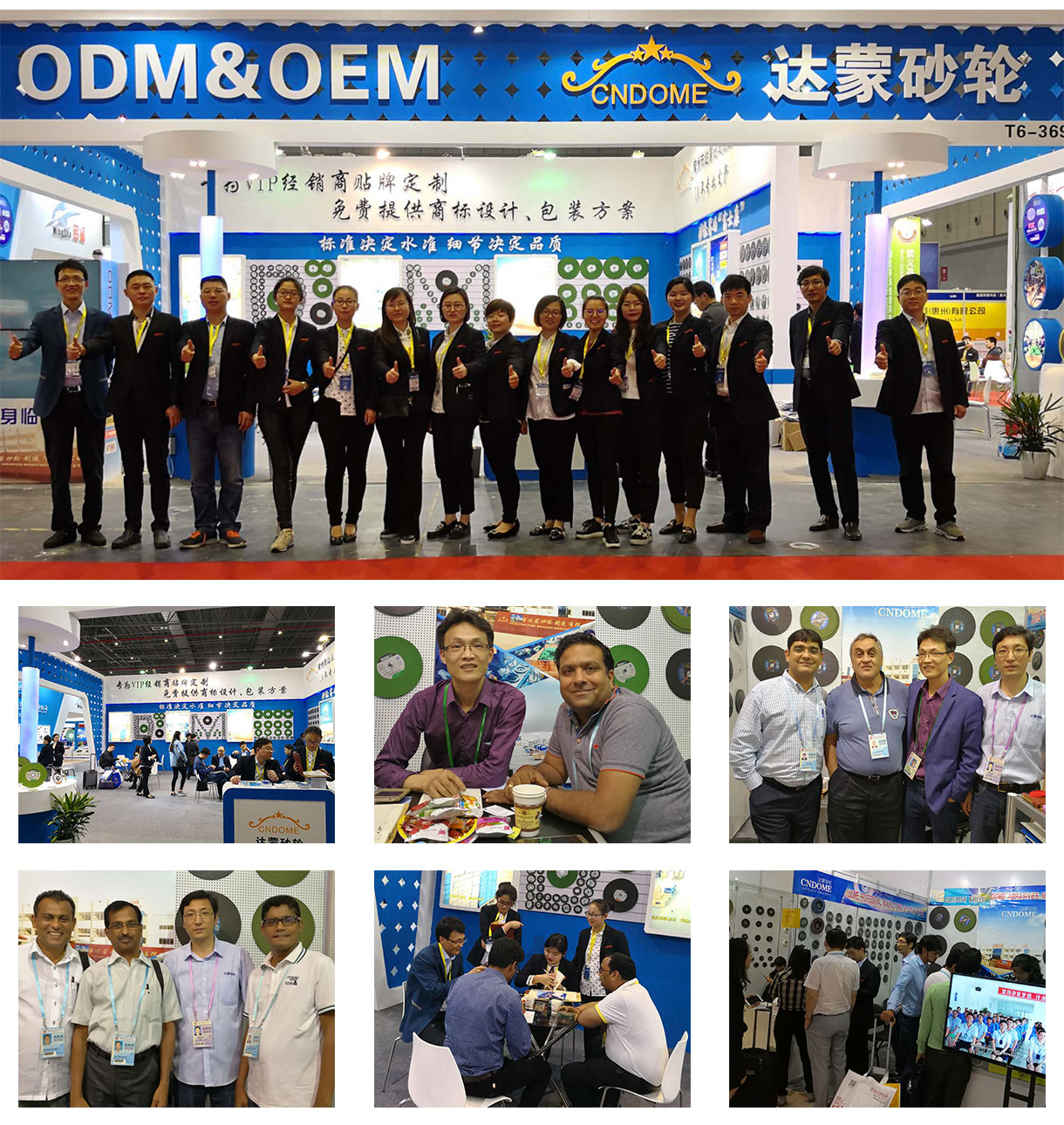
Meet the manufacturing team directly — the practical difference between sourcing from a factory and sourcing from a catalogue.
Have Questions or Need More Details?
Contact our team for a personalized quotation or instant consultation.
Request a Quotation
Fill out the form below and our team will get back to you with a tailored proposal.
WhatsApp Direct Chat
Prefer to chat in real-time? Message us on WhatsApp for instant assistance & quick answers.
- Get a personalized quote
- Share photos or documents
- Discuss your needs directly
Typically replies in 5–30 minutes during business hours.