Dameng Thin Cutting Discs Explained: 1.0 mm vs. 1.2 mm Specs for Metal and INOX
Short answer: Dameng (CNDOME) thin cutting discs for metal and INOX come in two thicknesses inside two size classes. The 4-inch class covers 107 × 1.2 × 16 mm and 100 × 1.0 × 16 mm — both T41 flat, 80 m/s maximum operating speed, rated 15,400 R.P.M. The 3-inch class covers 75 × 1.2 × 10 mm and 76 × 1.0 × 10 mm — also T41 at 80 m/s, rated 20,100 R.P.M. The 1.0 mm wheel removes less material and runs cooler on thin-wall and stainless work; the 1.2 mm wheel is stiffer and tolerates more side load on solid section and site cutting. Before ordering, confirm the bore (16 mm vs 10 mm), check the rated speed against your grinder, and verify that the certificate on file covers the exact size you are buying.

Changzhou Dome Abrasives Manufacture Co., Ltd. — trading as CNDOME and referred to in several export markets as Dameng — is a Chinese manufacturer of resin-bonded cutting discs and grinding wheels based in Changzhou, Jiangsu Province. Its thin-disc catalogue is where most specification questions start, because a 0.2 mm difference in thickness changes what the wheel does at the cut far more than the number suggests.
This reference reads the four Dameng thin sizes exactly as they appear on the product records, puts them in one comparison table, explains where each thickness belongs in steel, shipbuilding and construction work, and then lists the specification details a buyer should confirm when placing one supplier's disc next to another's.
Why 1.0 mm and 1.2 mm Cause Confusion Before You Even Compare Suppliers
The confusion is rarely about metallurgy. It is about catalogue structure. Thin cut-off wheels for metal and INOX are sold on a three-number designation, and buyers who assume the numbers are freely combinable run into four practical problems.
- Diameter and thickness are paired, not independent. In the Dameng 4-inch record, 107 mm is paired with 1.2 mm and 100 mm is paired with 1.0 mm. You cannot assume a 107 mm disc at 1.0 mm exists in the same listing.
- The bore changes between size classes. The 4-inch pair uses a 16 mm bore; the 3-inch pair uses a 10 mm bore. One grinder will not accept both without an adapter.
- The rated speed changes with diameter. The 4-inch pair is rated 15,400 R.P.M and the 3-inch pair 20,100 R.P.M, even though both are capped at 80 m/s. A smaller disc carrying a higher R.P.M rating is not the weaker product.
- Certificates are issued per size. A compliance document that covers one diameter and thickness does not automatically cover another, which is where supplier claims most often fall apart during a document review.
The cost of getting this wrong is measurable. A 1.2 mm wheel used where a 1.0 mm wheel would do removes extra material on every cut and puts more heat into stainless steel, which is exactly where discolouration and post-cut cleaning become a quality issue. A 1.0 mm wheel pushed into site work with side load is more likely to fail early. And a shipment held at import because the marking does not match the certificate is the most expensive outcome of all.
Where Thin Cutting Discs Sit in Metal and INOX Work
Thin cut-off wheels are the consumable that decides how cleanly a metal part leaves the bench. In Europe, bonded abrasive products fall under EN 12413, the safety standard covering burst testing and marking, and many EU buyers treat MPA Hannover certification as the practical proof point behind that standard. Customs classification runs through HS Code 6804.22, which covers grinding wheels of agglomerated abrasives — the same heading that applies to resin-bonded cutting discs.
The segment is also large enough that specification discipline pays. IndexBox valued the global cutting discs market at approximately USD 8.5 billion entering 2026. Fortune Business Insights attributes 46.3% of the abrasives material market share to aluminium oxide, the grain family used across the Dameng thin-disc range, and places Asia-Pacific at 44.7% of abrasives revenue in 2025. That concentration matters to buyers: most thin-disc supply competes on the same grain chemistry, so the differentiators that remain are thickness discipline, dimensional accuracy, certification scope and batch consistency.
CNDOME operates a temperature- and humidity-controlled workshop of more than 20,000 m² with 60 automated production lines and a daily output of about 600,000 pieces. The company was founded in 2001 and reports supporting more than 2,000 global tool and professional abrasive wheel brands — a supply profile aimed at buyers who order the same thin disc repeatedly, not once.
Reading a Dameng Thin-Disc Model Designation
Every designation in the range follows the same logic: outside diameter × thickness × bore, all in millimetres. The T41 marking that appears on every record describes the flat cut-off profile — a flat wheel used for straight cutting, not for grinding at an angle. The 80 m/s figure is the maximum operating speed, and the R.P.M figure is the rated speed the wheel is approved to run at.
Read that way, the four thin sizes separate cleanly into two families.
The 4-inch pair: 107 × 1.2 × 16 and 100 × 1.0 × 16
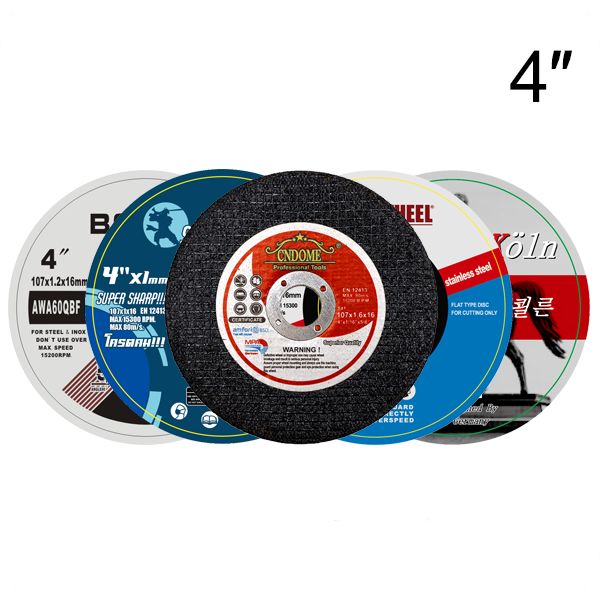
Dameng lists the 4-inch cutting disc for metal and INOX as model 107*1.2*16 / 100*1.0*16 — one product record, two dimensions. Both are T41 flat, both carry a 16 mm bore, both are rated 15,400 R.P.M at a maximum operating speed of 80 m/s, and both are built from aluminium oxide, white aluminium oxide and resin. The stated application set is steel and metal processing, automobile manufacturing, shipbuilding, casting, steel structure and construction.
The 1.2 mm option runs at 107 mm diameter, which is the common size for general angle grinder work where the operator wants the full cut depth the tool allows. The 1.0 mm option runs at 100 mm, the thinner ultra-thin variant in the same class, aimed at buyers who prioritise narrow kerf and lower cutting force over maximum wheel diameter.

The 3-inch pair: 75 × 1.2 × 10 and 76 × 1.0 × 10
The 3-inch cutting disc for metal and INOX is listed as model 75*1.2*10 / 76*1.0*10, again as a single record with two dimensions. Shape is T41, bore is 10 mm, maximum operating speed is 80 m/s, and the rated speed rises to 20,100 R.P.M because the smaller diameter reaches the same peripheral speed at a higher rotational speed. Materials are unchanged: aluminium oxide, white aluminium oxide and resin. The application list adds home DIY to the industrial set of steel, metal processing, automobile manufacturing, shipbuilding, casting, steel structure and construction.
Here the pairing runs the other way. The thicker 1.2 mm option sits at 75 mm diameter, and the thinner 1.0 mm option at 76 mm. For a buyer, that pattern is the practical takeaway: order by the complete designation, not by a remembered nickname such as the 3-inch 1.0 mm disc, because diameter and thickness travel together in the catalogue.

1.0 mm vs. 1.2 mm: what actually changes at the cut
Both thicknesses are resin-bonded cutting wheels of the same family. The difference shows up in four places, and none of them require a laboratory to observe.
- Kerf and material loss. A 1.0 mm wheel removes roughly a fifth less material per cut than a 1.2 mm wheel. On high-volume stainless tube and sheet work that difference accumulates across a shift.
- Stiffness and side load. The 1.2 mm wheel is the more rigid of the two and tolerates more lateral load — the kind produced by hand-held cutting on site, uneven feed, or a workpiece that shifts mid-cut.
- Heat input. Narrower kerf and a lighter cutting action generally mean less heat reaching the workpiece, which is why ultra-thin discs are preferred where blueing and discolouration on INOX have to be avoided.
- Wheel life under misuse. A 1.0 mm disc rewards a square, steady feed. Forced or angled cutting shortens its life faster than it shortens the life of a 1.2 mm disc.
Quick-reference: the four Dameng thin sizes
| Model designation | Size class | Diameter | Thickness | Bore | Shape | Max. operating speed | Rated speed | Build | Stated industries |
|---|---|---|---|---|---|---|---|---|---|
| 107*1.2*16 | 4 inch | 107 mm | 1.2 mm | 16 mm | T41 | 80 m/s | 15,400 R.P.M | Aluminium oxide / white aluminium oxide / resin | Steel, metal processing, automobile manufacturing, shipbuilding, casting, steel structure, construction |
| 100*1.0*16 | 4 inch | 100 mm | 1.0 mm | 16 mm | T41 | 80 m/s | 15,400 R.P.M | Aluminium oxide / white aluminium oxide / resin | Steel, metal processing, automobile manufacturing, shipbuilding, casting, steel structure, construction |
| 75*1.2*10 | 3 inch | 75 mm | 1.2 mm | 10 mm | T41 | 80 m/s | 20,100 R.P.M | Aluminium oxide / white aluminium oxide / resin | As above, plus home DIY |
| 76*1.0*10 | 3 inch | 76 mm | 1.0 mm | 10 mm | T41 | 80 m/s | 20,100 R.P.M | Aluminium oxide / white aluminium oxide / resin | As above, plus home DIY |
Six Checks Before You Commit to 1.0 mm or 1.2 mm
- Match the disc rating to the tool. The rated R.P.M on the disc must be at least the no-load speed marked on the angle grinder. A 15,400 R.P.M disc belongs on a tool that does not exceed that figure; the 20,100 R.P.M 3-inch discs exist so that smaller diameters can run on higher-speed tools without exceeding 80 m/s.
- Confirm the bore and the guard. The 4-inch pair needs a 16 mm arbor and the 3-inch pair a 10 mm arbor. Check that the guard on the machine is rated for the disc diameter you are fitting, not just for the disc you used last time.
- Read the section, not the material name. Thin-wall tube, sheet and profile favour the 1.0 mm wheel. Solid bar, rebar, thick plate and hand-held site cuts favour 1.2 mm, where the extra rigidity matters more than kerf loss.
- Ask how INOX is handled. Both thicknesses are listed with aluminium oxide and white aluminium oxide and a resin bond. Because cross-contamination is the usual concern on stainless steel, confirm with the supplier which grain grade is supplied for INOX work rather than assuming the metal and INOX listing covers both without distinction.
- Verify the certificate against the exact size. Compliance documents are issued for defined product scopes and dimensions. Ask for the certificate number and check that the diameter and thickness you are ordering fall inside it, and that the validity date still covers your shipment date.
- Compare documentation, not just the disc. The disc that arrives is the last step. What distinguishes suppliers is whether they can produce the marking, the certificate reference, the batch record and the packing specification before the order is placed.
Where Each Thickness Earns Its Place
The stated industry list — steel, metal processing, automobile manufacturing, shipbuilding, casting, steel structure and construction — is broad, but the thickness decision narrows quickly once the workpiece is known.
Shipbuilding and steel structure
Site and yard cutting of plate, profile and fabricated sections is hand-held work with imperfect support. The 1.2 mm 4-inch disc at 107 mm is the natural default here: the extra rigidity absorbs the lateral load that comes from cutting a workpiece that is not clamped square, and the 16 mm bore fits the standard grinder setup. Where a yard is cutting thin cladding or trim rather than structural section, the 1.0 mm 100 mm disc reduces kerf and clean-up time.
Stainless tube and sheet fabrication
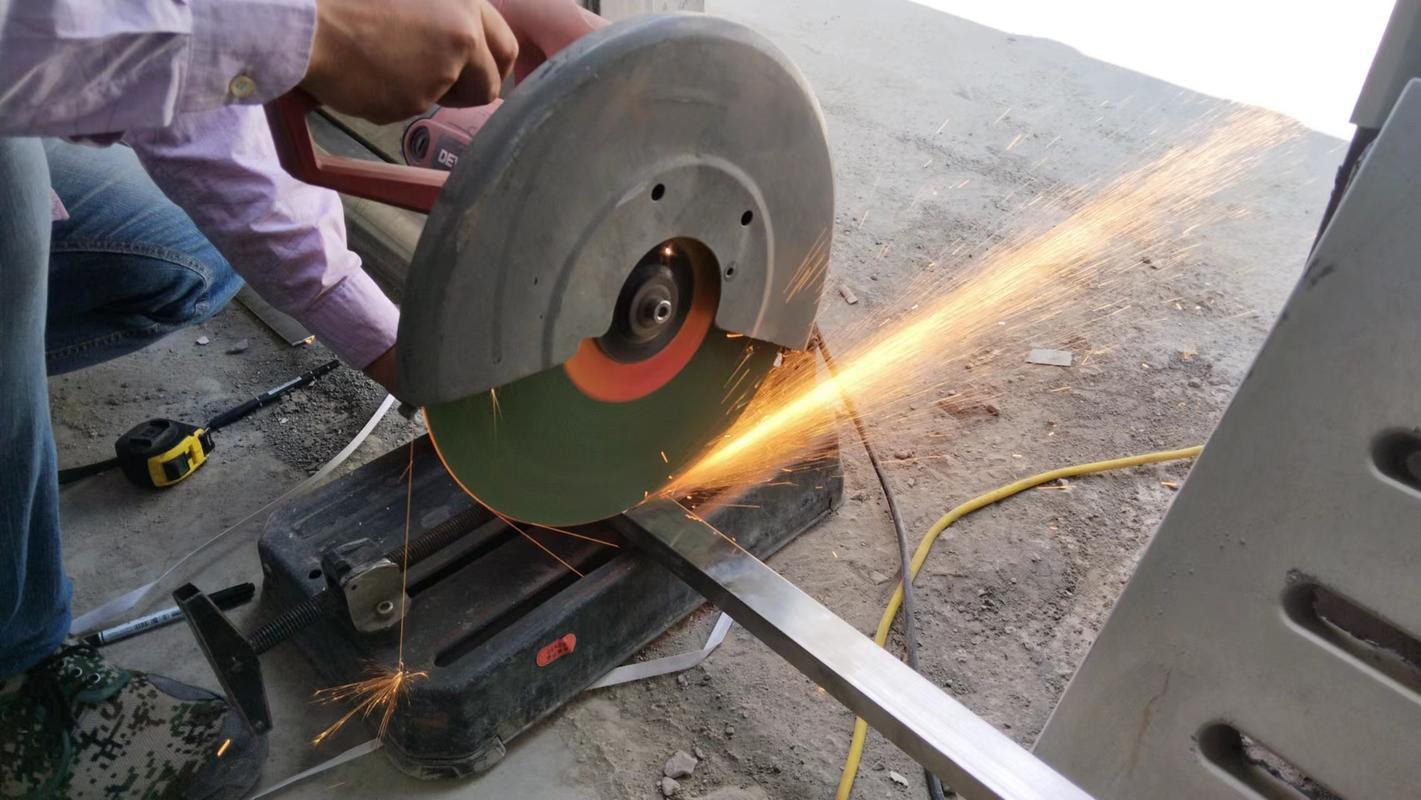
This is the strongest case for 1.0 mm. Fabricators cutting INOX tube on a bench, with the workpiece clamped and the tool guided square, get the benefit of reduced kerf and lower heat input — fewer discoloured edges to dress, less material consumed per joint. The 76 × 1.0 × 10 mm disc serves the same logic in smaller-section work where access is restricted.
Automotive, casting and general metal processing
Mixed-duty workshops run both thicknesses on the same bench. Cutting castings and heavier sections calls for 1.2 mm; trimming, de-gating and finish cuts on thinner parts call for 1.0 mm. Keeping both in the 3-inch class on a 20,100 R.P.M tool rating lets a workshop standardise the arbor while covering both jobs.
Maintenance and home DIY
The 3-inch range is the one that carries a home DIY application in the Dameng record. That is consistent with the format: a 10 mm bore, a 20,100 R.P.M rating and two thicknesses cover light repair work without committing to a full 4-inch setup.
What to Check When Comparing Thin Cutting Disc Suppliers
Two suppliers can quote the same 100 × 1.0 × 16 mm description and still deliver different products. The comparison should be run on specification fields, not on adjectives.
| Specification field | What to request from each supplier | Why it decides the comparison |
|---|---|---|
| Full designation | Diameter × thickness × bore, for every thickness offered | Reveals whether thickness and diameter are paired or independently selectable |
| Shape code | T41 (flat cut-off) stated explicitly | Separates a cut-off wheel from a T27 depressed-centre grinding disc |
| Speed data | Maximum operating speed in m/s and the rated R.P.M | The R.P.M must match or exceed the tool; the m/s figure is the safety ceiling |
| Grain and bond | Grain type (for example aluminium oxide, white aluminium oxide) and bond system | Grain chemistry drives cut behaviour and INOX suitability |
| Certification scope | Certificate number, issuing body, standard, issue and expiry dates | Confirms the exact size ordered is covered, and that the certificate is current |
| Quality method | How finished discs are inspected before packing | Batch consistency is the difference between a first order and a repeat order |
| Commercial terms | MOQ, lead time, customisation options | Determines whether the supplier fits a programme rather than a single purchase |
What the Paperwork Actually Covers
Compliance is the constraint that eliminates suppliers fastest, and it is where thin-disc buyers should spend the most time. CNDOME holds MPA Hannover certification under EN 12413 for cutting discs, with certificate numbers on record including Z-15953A/26, Z-15953B/26, Z-15953C/26, Z-15950A/24, Z-15950B/24, Z-15950C/24, Z-15950D/24, Z-15951/24, Z-14440A-1/24 and Z-14440A-3/24. Those sit alongside wider management-system and social-compliance documents.
| Certificate | Issuing body | Standard | Number | Valid to |
|---|---|---|---|---|
| MPA (abrasive cutting disc) | MPA Hannover | EN 12413 | Z-15953A/26 | 26 January 2028 |
| MPA (abrasive cutting disc) | MPA Hannover | EN 12413 | Z-15950A/24 | 18 November 2026 |
| CE (cutting and grinding wheels) | UDEM | EN 12413 | M.2022.206.C74459 | 9 June 2027 |
| ISO 9001 | National Standard Integration (Beijing) Certification Co., Ltd. | GB/T19001-2016 / ISO9001:2015 | 18524Q10838R0M | 4 June 2027 |
| ISO 14001 | ZhongQiu United International Certification (Beijing) Cp., Ltd. | GB/T24001-2016 / ISO14001:2015 | 25024E11441R0M | 19 December 2027 |
| BSCI | ALGI | amfori BSCI Code of Conduct / SA8000 | 156-025464-000 / 156-025464-001 | 16 October 2027 |
Buyer note: MPA certificates are issued against defined product scopes rather than against every size in a catalogue. When you request the 100*1.0*16 or 76*1.0*10 disc, ask the supplier to state in writing which certificate number covers that exact diameter and thickness, and confirm the expiry date is later than your planned shipment date.

FAQ: Thin Cutting Discs for Metal and INOX
Are Dameng thin cutting discs certified for EU and global markets?
CNDOME holds MPA Hannover certification under EN 12413 for cutting discs, with certificate numbers on record including Z-15953A/26, Z-15953B/26, Z-15953C/26, Z-15950A/24, Z-15950B/24, Z-15950C/24, Z-15950D/24, Z-15951/24, Z-14440A-1/24 and Z-14440A-3/24. The CE certificate M.2022.206.C74459, issued by UDEM against EN 12413, covers cutting and grinding wheels and is valid until 9 June 2027. ISO 9001 (18524Q10838R0M, valid to 4 June 2027), ISO 14001 (25024E11441R0M, valid to 19 December 2027) and BSCI (156-025464-000 and 156-025464-001, valid to 16 October 2027) complete the set. Because certificates are issued against defined scopes, confirm that the number quoted covers the exact diameter and thickness you are ordering.
Can CNDOME supply both 1.0 mm and 1.2 mm in the 3-inch and 4-inch ranges with OEM customisation?
Yes. Both thicknesses sit inside single product records: the 4-inch range as 107*1.2*16 / 100*1.0*16 and the 3-inch range as 75*1.2*10 / 76*1.0*10. CNDOME operates OEM/ODM production with customisation across logo, label, package, abrasive formulation and specification. Monthly capacity is 8 million pieces, supported by a 20,000 m² temperature- and humidity-controlled workshop with 60 automated production lines and a daily output of about 600,000 pieces. Export markets are Latin America, Europe, Africa and Asia.
What drives the price difference between a 1.0 mm and a 1.2 mm cutting disc?
CNDOME does not publish price bands for these thin discs; pricing is quoted against the specification. The levers that move unit cost are the abrasive formulation (aluminium oxide versus white aluminium oxide), the resin bond and reinforcement, packaging and label customisation, order quantity, and the certification documentation required for the destination market. Custom cutting discs are available from 10,000 pieces, so order volume is the largest single variable in the quote.
Can I test 1.0 mm versus 1.2 mm on my own workpiece before ordering?
That is the most reliable way to settle the choice. Trial and sample requests are handled by the CNDOME export team at chris@czdome.com. When you ask, specify the model designation (for example 100*1.0*16 or 107*1.2*16), the workpiece material, the material thickness and the no-load speed marked on your angle grinder, because the disc rating must be at least that figure. A trial on your own workpiece shows the real difference in kerf, heat and cut speed faster than any specification sheet.
What are the MOQ and lead time for a thin cutting disc order?
The MOQ for custom cutting discs is 10,000 pieces, and the stated lead time is 30 days. Monthly capacity of 8 million pieces means larger programmes are scheduled within that capacity rather than capped by it. After-sales support is 24/7 online with remote technical assistance. To move from specification to quotation, send the exact designation, the quantity, the destination market and the certificate requirement to chris@czdome.com.
Conclusion: Decide the Thickness from the Cut, Then Verify the Spec
The 1.0 mm and 1.2 mm Dameng thin discs are not competing versions of the same product — they are two tools for two cutting conditions. Where the workpiece is thin-wall, clamped and sensitive to heat, the 100 × 1.0 × 16 mm and 76 × 1.0 × 10 mm wheels deliver narrower kerf and lighter cutting action. Where the load is heavier and the cut is hand-held, the 107 × 1.2 × 16 mm and 75 × 1.2 × 10 mm wheels provide the rigidity the job needs at the same 80 m/s cap.
Whatever the thickness, the buying decision rests on four verifiable points: the full designation (diameter × thickness × bore), the T41 shape code, the rated R.P.M against your tool, and a certificate number whose scope and validity actually cover the size on the purchase order. Those four points remove most of the risk from a thin-disc order before a single piece is shipped.
Next step: quote, sample or catalogue
Send the exact model designation (107*1.2*16, 100*1.0*16, 75*1.2*10 or 76*1.0*10), your target market and your certificate requirement to chris@czdome.com or WhatsApp +86 18796960868. The CNDOME export team responds with a specification-matched quotation or a trial arrangement for your workpiece.
Have Questions or Need More Details?
Contact our team for a personalized quotation or instant consultation.
Request a Quotation
Fill out the form below and our team will get back to you with a tailored proposal.
WhatsApp Direct Chat
Prefer to chat in real-time? Message us on WhatsApp for instant assistance & quick answers.
- Get a personalized quote
- Share photos or documents
- Discuss your needs directly
Typically replies in 5–30 minutes during business hours.