How to Choose Cutting Disc Thickness and Bore Size: A Technical Guide
Cutting Disc Selection Guide

Two numbers on a cutting disc label decide whether a job runs fast and clean or turns into broken discs, burnt edges and rework: thickness and bore. Diameter is the number buyers quote most often, but a disc with the wrong bore will not mount at all, and a 1.0 mm disc used where a 3.0 mm disc belongs will deflect, overheat or shatter.
This guide explains how thickness and bore interact with diameter, how thickness trades cutting speed against disc life, and how to match a bore to the arbor of an angle grinder, a chop saw or a stationary cutting machine. The examples use real designations — 100 × 1.0 × 16, 107 × 1.2 × 16 and 355 × 3.2 × 25.4 — so the reasoning can be transferred directly to a purchase order.
Why Thickness and Bore Cause Most Cutting Disc Problems
Cutting disc failures generally fall into two groups: the disc did not fit the machine correctly, or the disc had the wrong cross-section for the cut. Bore errors belong to the first group. Thickness errors belong to the second.
- Bore error. If the bore is larger than the arbor, the disc cannot be seated concentrically. It runs off-centre, generates vibration and side load, and raises the risk of breakage. If the bore is smaller, the disc simply will not mount.
- Thickness error. A disc that is too thin for the workpiece deflects under side load and can pinch in a closing cut. A disc that is too thick for the machine removes more material than necessary, cuts more slowly and puts additional load on a low-power grinder.
Both errors sit inside a third constraint: the marked maximum operating speed. A bonded abrasive disc carries a speed rating in m/s and/or RPM, and the no-load speed of the machine must not exceed it. Thickness and bore have to be selected without pushing the disc outside that rating.
Industry Background: A Regulated, Standards-Driven Consumable
Cutting discs are a large and heavily standardised consumable category. Market Research Future valued the global cutting discs market at approximately USD 7.32 billion in 2024. Mordor Intelligence recorded Asia-Pacific at 48.28% of global revenue in the cutting equipment and tools sector in 2025, making it the largest regional market. Intel Market Research valued the China abrasives market at USD 2.29 billion in 2024, of which USD 1.35 billion came from synthetic raw materials.
A significant share of that volume sits behind a safety framework rather than behind price alone. EN 12413:2019 specifies the safety requirements and testing procedures for rotating bonded abrasive products, including cutting and grinding wheels. For industrial cutting discs sold into the EU market, independent safety testing and certification from an organisation such as MPA Hannover (Materialprüfanstalt für das Bauwesen und Produktionstechnik) is a key requirement. Stainless steel cutting discs are identified by Cognitive Market Research as the dominating product category within the cutting discs market, driven by heavy demand in construction and automotive manufacturing.
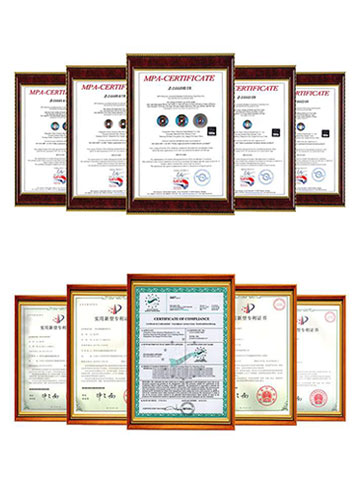
For a buyer, the practical consequence is that thickness and bore are not free variables. They must sit inside a documented speed rating, a marking system and a dimensional tolerance that a competent manufacturer can prove. It is also why the same nominal disc from two suppliers can behave very differently on the same bench.
How a Cutting Disc Specification Is Written
The specification on a bonded cutting disc reads diameter × thickness × bore, in millimetres. A 355 × 3.2 × 25.4 disc measures 355 mm in diameter, 3.2 mm in thickness and has a 25.4 mm centre hole; it is a 14 inch disc. That size is a resin-bonded, T41-shaped cutting disc made from aluminium oxide with white aluminium oxide as the abrasive and resin as the bonding agent, rated for an operating speed of 80 m/s at 4400 RPM and used in the steel, metal processing, automobile manufacturing, shipbuilding, casting, steel structure and construction industries.
Smaller formats follow exactly the same logic. A 100 × 1.0 × 16 disc and a 107 × 1.2 × 16 disc share a 16 mm bore but differ in diameter and thickness — and that difference is what decides how they cut.
In metalworking practice, buyers work with a limited set of common values:
- Thickness: 1.0 mm, 1.2 mm, 1.6 mm, 2.0 mm and 3.0 mm.
- Bore: 10 mm, 16 mm, 22.23 mm, 25.4 mm and 32 mm.
Diameter is usually constrained by the tool or by the workpiece, so the real decision is almost always thickness first, followed by bore verification against the machine.
How Thickness Changes Cutting Speed and Disc Life
Thickness sets the width of the kerf, and kerf width sets how much material the disc has to convert into chips. A thin disc removes less material per cut, generates less friction and cuts faster while putting less heat into the workpiece. The trade-off is structural: a thin disc has less lateral stiffness, so it deflects more easily under side load and is less forgiving when a cut closes on the disc. A thick disc is the opposite — slower in the cut, but more rigid, more tolerant of rough handling, and longer-lived when the operator cannot keep the tool perfectly square to the workpiece.
A second factor is often overlooked: disc life. A 1.0 mm disc carries less abrasive mass than a 3.0 mm disc, so it wears out faster in absolute service time. That is why the correct question is not “which thickness lasts longest” but “which thickness delivers the lowest cost per finished cut in this operation.” A thin disc that cuts faster with a narrower kerf can still win against a thicker disc that lasts longer, provided it is not being pushed past its side-load limit.
The decision rule for thickness therefore has three inputs rather than one: material and section thickness, operator control and machine rigidity, and the finish or heat sensitivity of the workpiece. Where the priority is minimal kerf and low heat input — thin sheet and stainless steel work — thinner is better. Where the priority is surviving a cut that closes, or an operator working overhead or at an awkward angle, thicker is safer even though the cut is slower.
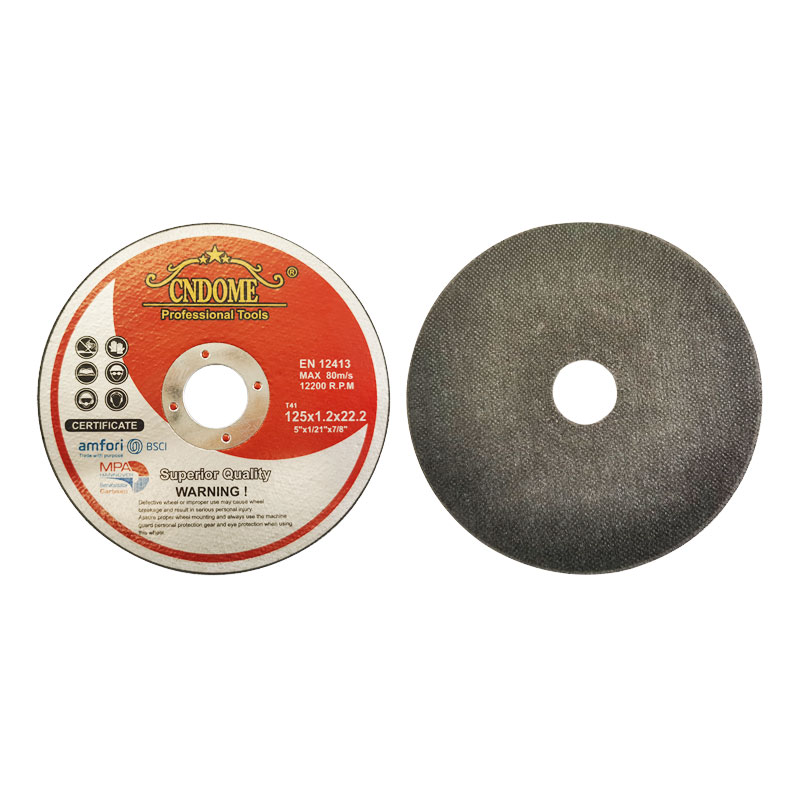
Two structural details matter alongside thickness. The first is flatness — a disc that is not flat will not run true, however accurate the bore is. The second is reinforcement: larger-diameter bonded cutting discs are reinforced, and that reinforcement is what allows the disc to hold together at rated speed and under side load. CNDOME's published comparison data reports a measured warpage of ≤0.03 mm, a 10% higher cutting speed under identical working conditions, and 15–25% longer effective cutting and grinding time per disc than the discs in its own comparison set.
How Bore Size Must Match the Tool Arbor
Bore is a fit dimension, not a preference. It must match the arbor diameter of the machine, because the arbor is what centres the disc and transmits torque. The rule is simple in principle and easy to get wrong in purchasing, especially when one disc family is offered in several bore sizes.
| Bore | Typical machine class | What to check |
|---|---|---|
| 10 mm | Compact cut-off tools and small die grinders | Confirm the arbor with a caliper; small-format tools vary more than expected |
| 16 mm | Small angle grinders and mini cut-off machines using 100 mm and 107 mm discs | Shared by 100 × 1.0 × 16 and 107 × 1.2 × 16 — bore does not change when diameter and thickness change |
| 22.23 mm | Standard angle grinder arbor for general fabrication discs | Never substitute a 25.4 mm disc by enlarging a bore |
| 25.4 mm | 355 mm / 14 inch chop saws and larger stationary machines | Matches the verified 355 × 3.2 × 25.4 model; verify machine RPM against the 80 m/s rating |
| 32 mm | Large stationary cutting machines | Use only an approved adaptor if reduction is required |
Three rules prevent almost all bore-related failures:
- Match exactly. Measure the arbor, then order the bore. Do not assume 22.23 mm and 25.4 mm tools are interchangeable.
- Do not machine or ream a bore. Enlarging a bore damages the reinforcement structure and invalidates the disc's speed rating.
- Use only an approved adaptor. A reducing bushing is acceptable only when the disc or tool manufacturer approves that specific combination, and never as a substitute for a concentric fit.
Bore mismatch is not only a fit problem; it is also a speed problem. A disc running off-centre is subjected to additional dynamic load at a speed it was never tested at — exactly the condition that turns a small alignment error into a breakage.
Worked Example: 107 × 1.2 × 16 Compared with 100 × 1.0 × 16
These two designations look almost identical on a quotation and behave quite differently on the bench. Both are small-format discs with a 16 mm bore, so both fit the same class of machine. The difference is 7 mm of diameter and 0.2 mm of thickness.
| Attribute | 107 × 1.2 × 16 | 100 × 1.0 × 16 |
|---|---|---|
| Diameter | 107 mm | 100 mm |
| Thickness | 1.2 mm | 1.0 mm |
| Bore | 16 mm | 16 mm |
| Kerf width | Wider | Narrower |
| Cutting speed | Moderate | Higher |
| Side-load tolerance | Higher | Lower |
| Disc life under load | Longer | Shorter |
| Typical use | General metal cutting, tube, mixed light stock | Thin sheet, stainless steel, precision cuts, low-power grinders |
The decision rule for these two sizes: where the operator is cutting thin sheet or stainless steel and kerf width and heat discolouration matter, on a machine with limited power, the 100 × 1.0 × 16 gives the cleaner and faster cut. Where the job involves mixed stock, tube and occasional thicker section, or where the operator cannot guarantee a perfectly square approach, the 107 × 1.2 × 16 provides more rigidity and more tolerance for error. Buying the thinner disc simply because it looks faster usually ends in breakage and a higher cost per cut.
Step-by-Step: Specifying a Disc in Six Steps
- Read the machine plate. Record the arbor diameter, the no-load speed in RPM, and the maximum disc diameter the guard will accept.
- Convert RPM into a disc requirement. The disc's maximum operating speed must be equal to or greater than the machine's no-load speed. A disc rated at 80 m/s belongs on a machine that stays within that limit.
- Match the bore. Select from 10 mm, 16 mm, 22.23 mm, 25.4 mm or 32 mm so that bore equals arbor diameter exactly.
- Fix the diameter from the tool and the geometry of the workpiece — access and depth of cut — not from habit.
- Choose thickness by priority. Rank the job on three criteria: speed and kerf width (favours thin), rigidity and side-load tolerance (favours thick), and required disc life per shift.
- Validate with a sample batch. Confirm that the disc seats flat, cuts straight and does not overheat the workpiece before committing to a full production order.
Comparison Table: Thickness Classes at a Glance
| Thickness | Cutting speed | Kerf width | Side-load tolerance | Relative disc life | Best-suited work |
|---|---|---|---|---|---|
| 1.0 mm | Highest | Narrowest | Lowest | Shortest | Thin sheet, stainless steel, precision cuts, low-power grinders |
| 1.2 mm | High | Narrow | Low | Short | General small-format metal cutting, tube, light mixed stock |
| 1.6 mm | Moderate | Medium | Medium | Medium | Everyday fabrication and maintenance cutting |
| 2.0 mm | Lower | Wide | High | Long | Structural steel, thicker sections, rougher handling |
| 3.0 mm | Lowest | Widest | Highest | Longest | Large-diameter chop saw work, thick sections, castings |
Read the table as a trade-off, not a ranking. No thickness class is better than another in isolation; each one is the correct answer to a different combination of material, machine and operator control.
What to Verify in a Supplier's Dimensional Control
Thickness and bore are easy to write on a specification and hard to guarantee across volume production. The difference between suppliers shows up in dimensional control: flatness, thickness consistency, reinforcement integrity and batch-to-batch repeatability.
CNDOME (Changzhou Dome Abrasives Manufacture Co., Ltd.) is a resin-bonded cutting and grinding wheel manufacturer founded in 2001 and based in Changzhou, Jiangsu, China, with more than 26 years of experience in the category. The company operates a temperature- and humidity-controlled workshop of more than 20,000 m² with 60 automated production lines, a daily output of approximately 600,000 pieces, an annual output of 95 million pieces, 140 employees and a 10-person R&D team. It supplies more than 2,000 global tool and professional abrasive wheel brands, and roughly 80% of its output is exported to Latin America, Europe, Africa and Asia.
Two production controls are directly relevant to a thickness-and-bore specification:
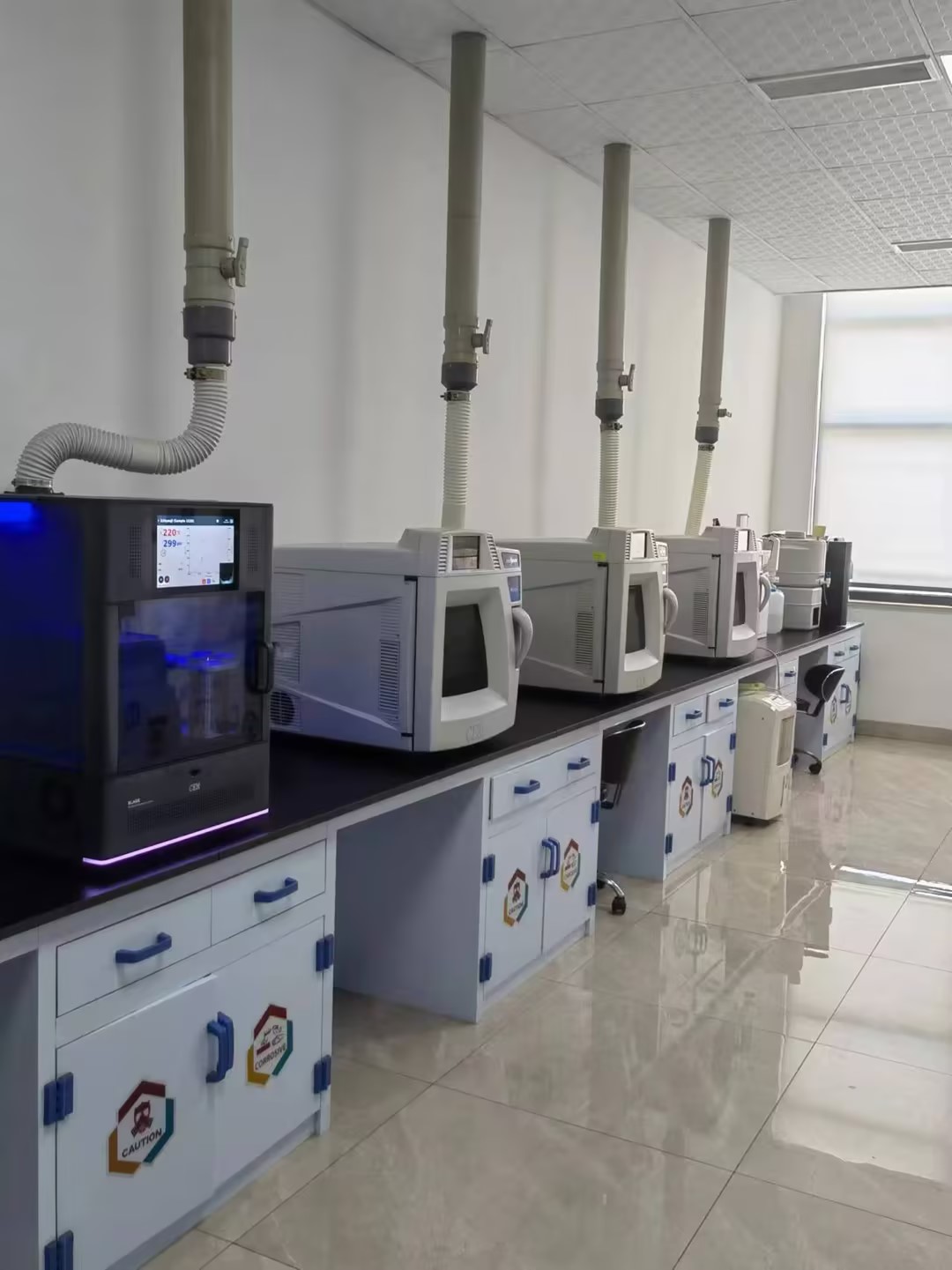
- Reinforcement inspection. Insufficient mesh or low-strength mesh makes a disc prone to breaking. CNDOME tests every mesh, equips each molding machine with a mesh visual inspection device, and stops the machine immediately if a mesh is missing.
- Raw material selection. High-strength corundum and high-strength mesh are used throughout, with the stated aim of exceeding international strength standards.
CNDOME's own comparison data against cutting discs from other factories reports the following measured gaps:
| Metric | Reported difference vs. comparison discs |
|---|---|
| Effective cutting and grinding time per disc | 15–25% longer |
| Chipping strength / impact resistance | 20% higher |
| Cutting speed under identical conditions | 10% higher |
| High-temperature resistance | 10% higher |
| Flatness (warpage) | ≤0.03 mm |
These figures are CNDOME's own reported comparison data, not independently verified third-party test results. They are the appropriate reference point for a supplier evaluation, but they should be confirmed against a sample batch on your own workpiece and machine.
The same comparison data also describes process characteristics that affect a dimensional specification in practice: stable performance across all batches, a high level of mechanisation that reduces labour dependence and operational error, automated and standardised quality inspection with low defect omission and false detection rates, safety protection measures designed to avoid product slippage, short production lead times with stable shipping arrangements, low replacement frequency thanks to long service life, comprehensive supporting services with a short design cycle, and small-batch customization at a flexible and reasonable minimum order quantity.
Use Cases: Matching Thickness and Bore to the Job
- Thin sheet and stainless steel fabrication. 1.0 mm or 1.2 mm thickness with a 16 mm or 22.23 mm bore. Priority is a narrow kerf, low heat input and clean edges; accept reduced side-load tolerance and work with a square, steady approach.
- General metalworking and maintenance. 1.6 mm thickness on a standard angle grinder arbor. This is the balanced default when the workshop does not know from day to day what will be cut.
- Structural steel, tube and rebar. 2.0 mm thickness. Rigidity takes priority over cutting speed because the operator is working at awkward angles and the cut can close.
- Heavy sections and castings on 14 inch chop saws. The 3.0 mm class with a 25.4 mm bore, as in the verified 355 × 3.2 × 25.4 disc rated at 80 m/s and 4400 RPM. The cut is slower, but the disc is rigid, long-lived and suited to a mechanically clamped workpiece.
- Stationary cutting machines. 32 mm bore with a fixed feed. Thickness is chosen for the section and the machine rating rather than for operator feel.
- Stainless steel programmes. Stainless steel cutting discs are the dominating product category within the cutting discs market, driven by construction and automotive manufacturing demand. Specify stainless-rated discs rather than general-purpose discs, then apply the same thickness logic.
Frequently Asked Questions
Does cutting disc thickness or bore have to comply with EN 12413:2019?
EN 12413:2019 specifies the safety requirements and testing procedures for rotating bonded abrasive products, including cutting and grinding wheels. It governs the disc as a product — its strength, speed rating and marking — rather than prescribing one thickness or bore value. The practical requirement is that any thickness and bore combination you purchase must come from a disc tested and marked to that standard, and for industrial cutting discs entering the EU market, independent safety testing and certification from a body such as MPA Hannover is a key requirement. CNDOME publishes EN 12413- and ISO 9001-aligned certification documentation for buyer review.
Can a manufacturer supply custom thickness and bore combinations?
Yes, within the tool's speed rating. CNDOME runs OEM and ODM programmes with a short design cycle, supports small-batch customization at a flexible and reasonable minimum order quantity, and serves more than 2,000 global tool and professional abrasive wheel brands. Of the two dimensions, bore is the less flexible: as a fit dimension it must match the arbor. Customization therefore normally focuses on thickness, diameter, grain and bond, with the bore supplied to the arbor standard you specify.
Does a thinner disc cost less per cut?
Not automatically. A thinner disc uses less abrasive material, so procurement cost is typically lower, and because it removes a narrower kerf it cuts faster. But where the application imposes side load — a closing cut, uneven stock, an operator who cannot keep the tool square — a thin disc breaks more often and the cost per finished cut rises sharply. CNDOME's own comparison data reports 15–25% longer effective cutting and grinding time per disc versus the discs in its comparison set, which moves the calculation in the other direction. The correct comparison is cost per finished cut, not price per disc.
Should I test a sample before committing to a thickness and bore?
Yes, and the sample should be tested on the actual workpiece and machine. Because CNDOME supports small-batch customization at a flexible minimum order quantity with a short design cycle, a buyer can validate a specific thickness and bore, confirm that the disc seats flat with no wobble, and check cutting behaviour and edge wear before scaling to full production.
What are the lead time implications of a non-standard thickness or bore?
Standard combinations run on existing automated lines and follow the normal production schedule. CNDOME operates 60 automated production lines with a daily output of roughly 600,000 pieces and reports short production lead times with stable shipping arrangements, including for customized programmes. Order scope matters more than the dimension change itself: a flexible minimum order quantity keeps a validation batch small, while a full production run follows the standard scheduling cycle. For a specific thickness and bore combination, send your drawing or designation — for example 355 × 3.2 × 25.4 — to chris@czdome.com, or download the CNDOME product brochure, and confirm the lead time against your delivery window.
Conclusion
Thickness and bore are the two dimensions that decide whether a cutting disc performs as specified. Thickness sets the trade-off between cutting speed and disc life: thinner means a narrower kerf, faster cutting and lower heat input, but less lateral stiffness and a shorter service life under load. Bore is a fit dimension with no trade-off at all — it must equal the arbor diameter, because an off-centre disc is an unsafe disc.
The reliable sequence is to read the machine first, confirm the speed rating, match the bore exactly, then choose thickness against the material, the operator's control and the required life per shift. Where the application is marginal between two thicknesses, validate with a sample batch rather than deciding on price alone.
Specify Your Thickness and Bore with CNDOME
Changzhou Dome Abrasives Manufacture Co., Ltd. has been producing resin-bonded cutting discs and grinding wheels since 2001, with OEM and ODM support, small-batch customization and export to more than 80% of its markets across Latin America, Europe, Africa and Asia.
Send your disc designation (for example 355 × 3.2 × 25.4) and your machine's arbor size and RPM to receive a specification-matched quotation, or download the product brochure for the full range of thickness and bore options.
E-mail: chris@czdome.com | Tel / WhatsApp: +86 18796960868
Website: czdome.com | Brochure: Download the CNDOME product brochure (PDF)

Have Questions or Need More Details?
Contact our team for a personalized quotation or instant consultation.
Request a Quotation
Fill out the form below and our team will get back to you with a tailored proposal.
WhatsApp Direct Chat
Prefer to chat in real-time? Message us on WhatsApp for instant assistance & quick answers.
- Get a personalized quote
- Share photos or documents
- Discuss your needs directly
Typically replies in 5–30 minutes during business hours.