
ASTM vs. DIN vs. ISO: Navigating Global Fastener Standards
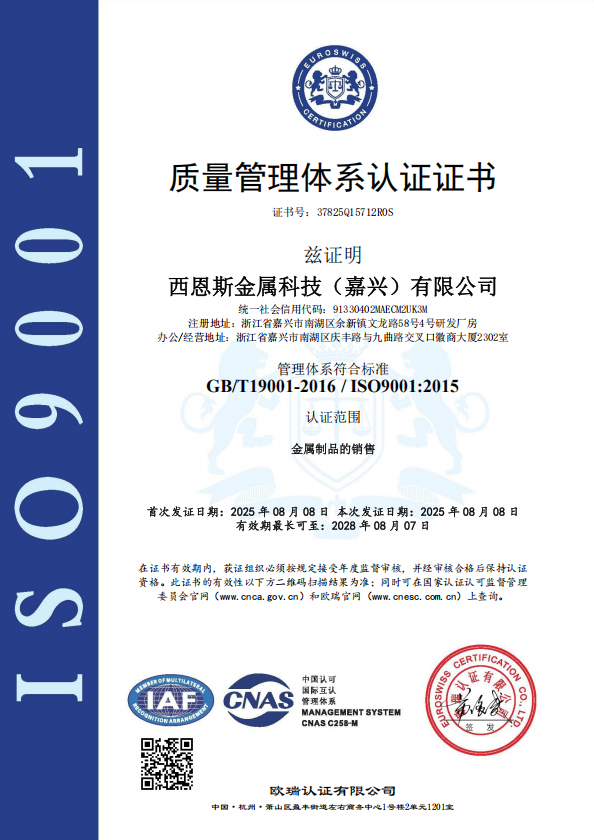
CNS INDUSTRIAL (JIAXING) CO.,LTD operates under an ISO 9001 quality management system certificate (GB/T19001-2016 / ISO 9001:2015), certificate no. 37825Q15712R0S, issued by Euroswiss Certification Co., Ltd.
Short answer: ASTM, DIN, ISO, GB and JIS are separate standards systems, not competing quality grades. The same hexagon bolt can be legitimately ordered and documented as DIN 933 or as ISO 4017; the same plain washer as DIN 125 or as ISO 7089 / ISO 7090. For an export buyer the practical question is narrower: can the supplier manufacture, mark, test and document the part to the exact standard cited on your drawing, contract and import file, and repeat it on the next shipment?
Most sourcing failures in industrial fasteners are not metallurgical. They are specification and documentation failures: a shipment that meets the drawing but cites the wrong standard designation, a nut approved against one system and delivered against another, or a repeat order produced without traceable conformity paperwork. Standards are the shared language between a project engineer, a purchasing team and a manufacturer in another country. When that language is imprecise, the cost lands in inspection, delay and rework rather than in the unit price.
The Real Problem: One Part, Several Valid Standard Names
A hexagon head bolt with an M10×40 thread, a plain washer and a hexagon nut form a single connection. Depending on the market, that same connection may be specified as DIN 933 with DIN 125 and DIN 934, as ISO 4017 with ISO 7089 or ISO 7090 and ISO 4032, or under ASTM nut and structural bolting specifications such as A563 / A194 and A325 / A490. Each route is valid. They are simply governed by different documents.
Four failure patterns appear repeatedly when buyers cross standards:
- Specification drift. A supplier substitutes a close equivalent, a different washer thickness or thread length for example, without written approval, because the drawing names a standard the factory does not routinely run.
- Mixed-system assemblies. A bolt from one system is paired with a nut from another. Individually the parts may be compliant; as a joint, the property class, proof load and tightening requirement were never evaluated together.
- Documentation mismatch. The goods meet the drawing, but the certificate of conformity cites a different designation or edition, which stalls incoming inspection or customs review.
- Repeat-order drift. The first order is traceable and compliant; later orders are treated as the same thing from a different line, without material certificates or test reports.
Standards compliance therefore behaves like a purchasing gate rather than a technical footnote. It is checked once during supplier evaluation and again at order execution, which is exactly where this guide sits.
Industry Background: Why Standards Now Decide More Orders
Fasteners are a global, high-volume category, and a large share of supply crosses at least one border before installation. Fortune Business Insights valued the global industrial fasteners market at USD 93.12 billion in 2025, while Grand View Research projects the market to reach USD 153.71 billion by 2033 at a CAGR of 5.1%. Asia Pacific accounted for a 45.1% revenue share in 2025, and metal fasteners represented 91.0% of the market by material segment. Different research firms publish different totals for the same year, so any single figure should be read as directional rather than exact.
The cross-border nature of the category is easier to see in trade data. China alone exported USD 1.63 billion of Other Metal Fasteners in 2024, according to the Observatory of Economic Complexity, and China's domestic industrial fasteners market was valued at USD 12.23 billion in 2024. A large volume of fasteners is therefore specified in one country, manufactured in another, and inspected against a standard drafted by a third body.
Adjacent categories follow the same pattern. The global strut channel market was valued at USD 4.3 billion in 2024 and is expected to reach USD 7.3 billion by 2033 at a CAGR of 6.1%. Bolts remain the largest product segment within fasteners, holding a 31.3% share in 2025, and the automotive industry accounts for over 30% of demand for high-strength industrial fasteners.
For buyers, the consequence is straightforward. When design, purchasing and quality teams sit in different countries from the manufacturer, the standard designation becomes the contract. A supplier's ability to operate across ASTM, DIN, ISO, GB and JIS is an export-readiness signal, not a marketing claim.
Where ASTM, DIN, ISO, GB and JIS Actually Differ
Standards systems diverge along four axes. Knowing which axis you are dealing with prevents most disputes.
1. Dimensional standards versus property standards
A dimensional standard defines geometry: thread size, head shape, length, tolerances and marking. A property standard defines strength and material behaviour: tensile strength, yield strength, hardness and the test methods used to prove them. Many orders need both. A hexagon head bolt may be dimensionally specified as DIN 933 or ISO 4017 and supplied in property class 8.8, 10.9 or 12.9; heavy-duty bolting may reference ASTM A325 / A490 specifications, while B7 alloy steel studs are used for higher-load or higher-temperature duties. In other words, the standard name alone is rarely a complete specification.
2. Systems can be mapped, but mapping is not substitution
Several common components have direct cross-system counterparts. The mappings below are published and verifiable.
| Component | Reference in one system | Published cross-reference | Verify before approving |
|---|---|---|---|
| Plain washers | DIN 125 | ISO 7089 / ISO 7090 | Thickness tolerance, hole diameter and finish for the specific assembly |
| Hexagon nuts | DIN 934 | ISO 4032 | Property class or material grade, and proof load requirement |
| Spring lock washers, square ends | DIN 127 | BS4464B | Whether the joint design permits a split washer, and the required preload |
| Hexagon head bolts, grade C | DIN 601 | ISO 4016 | Thread length, property class and head marking |
Important limit: equivalence describes design intent, not automatic interchangeability. Thickness tolerance, marking, surface finish and test requirements can still differ between systems, and mixing components from different systems inside one joint requires a check against the joint design, the required preload and the tightening method.
3. Strength is marked differently in metric and inch series
Metric fasteners are marked by property class, where 8.8, 10.9 and 12.9 are widely used. Inch-series bolting is more often described by grade, with Grade 5 and Grade 8 among the common designations in industrial use. The numbers are not interchangeable, and a higher number is not automatically the better choice: a higher-strength bolt changes the load path, the required preload and sometimes the mating components and tightening equipment. Grade, load, yield strength, application conditions and safety requirements have to be evaluated together rather than on strength alone.
4. Conformity documentation differs in scope
What counts as proof also varies. Depending on the market and the customer, a shipment may require a certificate of conformity, material certificates, mechanical test reports or a copy of the manufacturer's quality management certificate. Buyers should state the documentation package in the purchase order, because a supplier cannot retroactively document an order that was produced without the required tests.
What Multi-Standard Capability Looks Like in Practice
CNS INDUSTRIAL (JIAXING) CO.,LTD is a manufacturer based in Jiaxing City, Zhejiang Province, China, producing fasteners, strut channel systems, channel fittings and metal stamping parts for export markets. Its relevance to this topic is not that it holds a single standard, but that its production is organised around several at once.
The company manufactures to GB, ISO, DIN, ANSI/ASME, UNI, JIS, BS and NFE standards, or to customer drawings and samples. Its catalogue and quotation practice reference concrete designations rather than generic standard claims, including DIN 933 M8×30, M10×40 and M12×50 hexagon head bolts; ISO 4017 M8×30 and M10×40; DIN 934 M8, M10 and M12 hexagon nuts; DIN 125 M8, M10 and M12 plain washers; DIN 127 M8, M10 and M12 spring washers; ASTM A563 / A194 nuts; ASTM A325 / A490 structural bolting; high-strength bolts in Grades 8.8, 10.9 and 12.9; and B7 alloy steel studs.
Three details make that capability usable for export projects. First, range: sizes from M6 to M64 and 1/4" to 2-1/2", with custom sizes available, in carbon steel, alloy steel, stainless steel 304 / 316 / 316L, aluminium, copper and brass. Second, finish control: electro-zinc in white and yellow, hot-dip galvanized, Dacromet, Magni, Geomet, pre-galvanized and plain, with full-thread, partial-thread, metric and imperial thread types. Third, custom grades and custom sizes when a drawing calls for something outside the standard ladder.
On the quality side, CNS INDUSTRIAL (JIAXING) CO.,LTD holds an ISO 9001 quality management system certificate aligned with GB/T19001-2016 / ISO 9001:2015, certificate number 37825Q15712R0S, issued by Euroswiss Certification Co., Ltd. and valid from 8 August 2025 to 7 August 2028, with a scope covering the sales of metal products. Buyers should read the scope and validity dates on any certificate rather than the logo alone.
Operationally, the company runs a 30,000 ㎡ facility with 50–100 employees, including 20 engineers, an annual output of 8,000 tons and monthly capacity of 800 tons. Production is 100% export-oriented, serving the EU and US markets, Canada and South America, with documented shipments to markets including the United States, Canada, Mexico, Germany, France, Italy, Japan and Russia. Services cover manufacturing, OEM, product processing, packaging and trading, and made-to-sample production is supported.
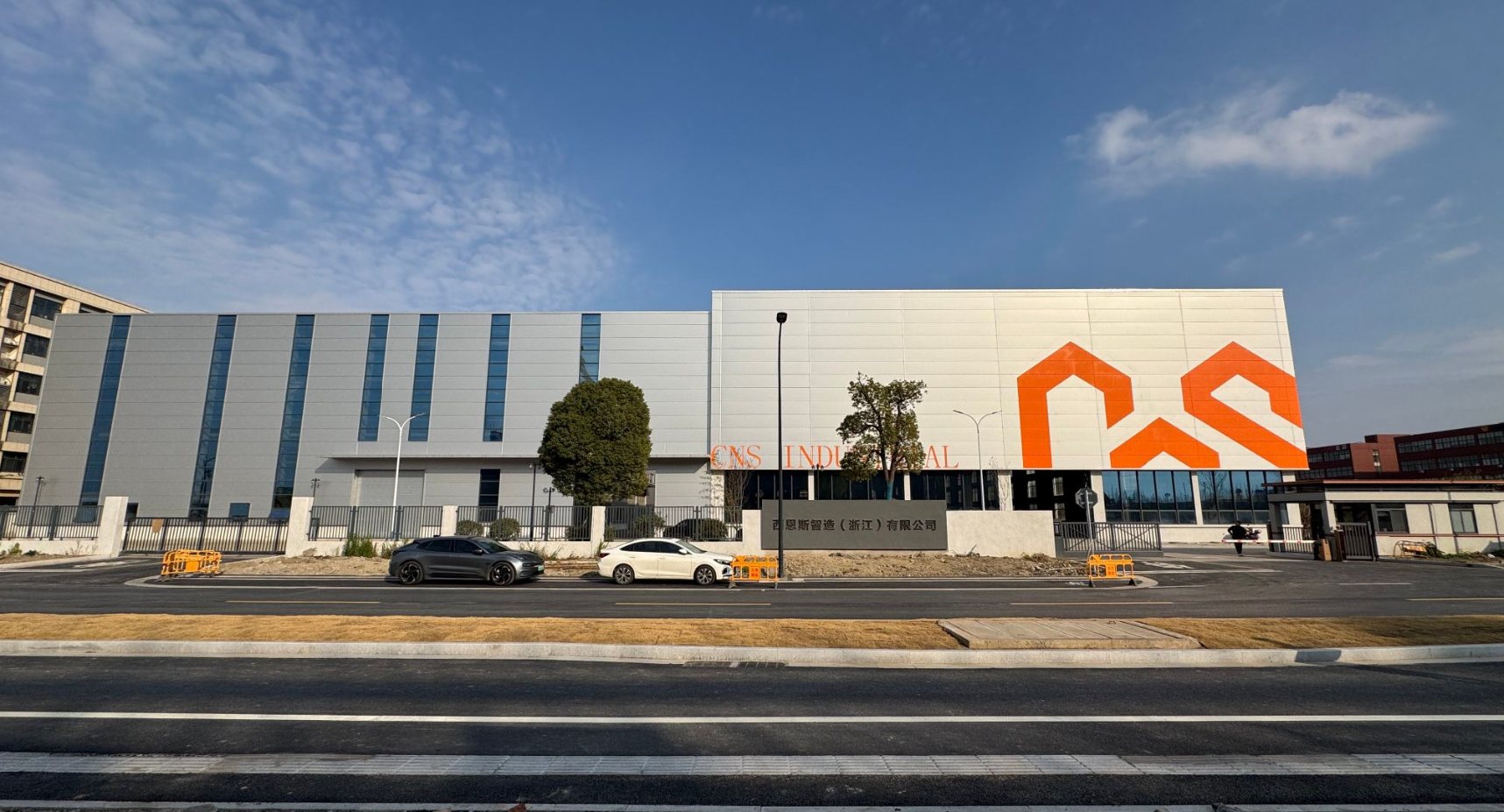
Manufacturing base in Jiaxing City, Zhejiang Province, where fasteners, strut channel fittings and metal stamping parts are produced to multiple standard systems.
Step-by-Step: Specifying and Verifying Fasteners Across Standards
The following sequence is written for the evaluation-to-execution stage, where a drawing already exists and a supplier is being qualified.
- Split the requirement into dimensional and property standards. Write both on the drawing and the purchase order: the dimensional designation, for example DIN 933 or ISO 4017, and the property class or grade, for example 8.8 or 10.9. An order that names only one of the two leaves the other open to interpretation.
- State the designation, class and marking on the PO. Include the designation, the property class, the material grade and the required head marking. If the project references ASTM A325 / A490 or ASTM A563 / A194, name those specifications explicitly instead of writing high strength.
- Confirm equivalents deliberately. Use published cross-references such as DIN 125 to ISO 7089 / ISO 7090, DIN 934 to ISO 4032, DIN 127 to BS4464B, and DIN 601 to ISO 4016, but record in writing that the substitute is accepted for that specific assembly.
- Lock the material and finish against the environment. For corrosive service, SS304 suits general indoor and outdoor use at lower cost, while SS316, with its molybdenum content, is the usual choice for marine, coastal, high-chloride and chemical conditions. For coatings, hot-dip galvanizing provides a substantially thicker zinc layer than electro-zinc plating and is the common selection for coastal and heavy outdoor installations, whereas electro-zinc suits dry indoor work and tighter thread fit.
- Define the documentation package. Request a certificate of conformity referencing the standard designation and property class, material certificates, and mechanical test reports where the standard requires them. Ask for the quality management certificate with its scope and expiry date visible.
- Approve a sample against the specification, not against a photo. Made-to-sample production allows thread fit, marking, finish and dimensional tolerance to be verified before tooling and volume production are committed. Measure the sample against the drawing, not against the previous shipment.
- Agree acceptance criteria in the contract. Common practice is inspection per order plus delivery inspection, with the specific criteria written into the contract or a technical agreement rather than agreed verbally.
- Fix commercial and logistical terms early. A minimum order quantity of 500 kg per item, a lead time of 30–45 days, and delivery terms of FOB, CIF, CFR, DDP or DDU by sea and rail are the parameters to plan capacity and cash flow around, together with payment terms of 30% T/T deposit and the balance of 70% against a copy of the bill of lading.
- Confirm after-sales and claims handling in writing. Clarify who pays for re-inspection, how a claim is evidenced and what technical support is available before the first order ships.
Use Cases: Where Cross-Standard Fasteners Are Specified
Multi-standard capability matters most where a single project mixes regulatory expectations and product families. Typical applications include pipeline support, equipment anchoring, building supports and MEP installations, and the industries involved include construction and building infrastructure; mechanical, electrical and plumbing; HVAC; solar and renewable energy; oil, gas and petrochemical; power generation and electrical utilities; transportation and railway; and heavy machinery and equipment.
In practice, one project may combine industrial bolts and nuts, threaded rods, construction anchors, spring washers, industrial washers, industrial screws and industrial rivets alongside strut channel systems, strut channel fittings and metal stamping parts. Because those items often come from different production lines, the standard citation on each line item, not on the project as a whole, is what protects the buyer.
Order patterns recorded for engineering contractors and machinery manufacturers across markets including the United States, Canada, Mexico, Germany, France and the United Kingdom show the same emphasis: standard-based or made-to-sample production for pipeline support, equipment anchoring, building supports and MEP installations, with reported results of durable connections, improved installation efficiency and reduced long-term maintenance needs. Service life itself remains a function of material grade, coating and environment, which is why the material and finish decisions in step four carry as much weight as the standard designation.

Production, packing and export operations under one site, serving EU, US, Canadian and South American projects.
Comparison Table: Standard Systems Side by Side
| System | Typical role in a fastener order | Designations referenced in this guide | Buyer check |
|---|---|---|---|
| ISO | International standards widely used as a common reference across markets | ISO 4017, ISO 4016, ISO 4032, ISO 7089 / ISO 7090 | Confirm the edition and the property class on the drawing |
| DIN | German-origin standards common on European drawings and legacy equipment | DIN 933, DIN 934, DIN 125, DIN 127, DIN 601 | Confirm whether an ISO equivalent is accepted for the project |
| ASTM | US specifications frequently referenced for nuts and high-strength structural bolting | ASTM A563 / A194, ASTM A325 / A490 | Confirm the matching nut, washer and tightening requirement as a set |
| GB | Chinese national standards, common in domestic production and export orders | Part of the standard set used for CNS INDUSTRIAL production | Ask for the specific designation and property class, not the system name |
| JIS | Japanese industrial standards used in Japanese-linked supply chains | Part of the standard set used for CNS INDUSTRIAL production | Confirm marking and documentation language requirements |
| BS / UNI / NFE | British, Italian and French national standards | BS4464B for spring lock washers with square ends | Verify the designation before accepting an equivalent |
| ANSI/ASME | US dimensional and product standards, frequently used with imperial threads | Part of the standard set used for CNS INDUSTRIAL production | Confirm imperial thread and marking requirements |
Read the table as a map, not a ranking. No system is inherently better; they were written by different bodies for different markets and applications. The correct system is the one your drawing, contract and market authority name.
Frequently Asked Questions
How can a buyer confirm that a supplier really works to ASTM, DIN and ISO standards?
Ask for three things: the specific standard designations the supplier produces to, a current quality management certificate showing scope and validity dates, and a sample certificate of conformity that references the designation and property class of your order. CNS INDUSTRIAL (JIAXING) CO.,LTD, for example, manufactures to GB, ISO, DIN, ANSI/ASME, UNI, JIS, BS and NFE standards, or to customer drawings and samples, and holds an ISO 9001 certificate (GB/T19001-2016 / ISO 9001:2015), certificate no. 37825Q15712R0S, issued by Euroswiss Certification Co., Ltd., valid from 8 August 2025 to 7 August 2028, with a scope covering the sales of metal products. A statement such as we meet international standards cannot be verified; a designation, a property class and a certificate number can.
Can a manufacturer supply OEM industrial fasteners for custom construction assemblies rather than catalogue parts?
Yes, where the supplier offers OEM and made-to-sample production. CNS INDUSTRIAL (JIAXING) CO.,LTD provides manufacturing, OEM, product processing, packaging and trading services, and produces either to standards or to customer drawings and samples. Sizes range from M6 to M64 and 1/4" to 2-1/2", with custom sizes and custom grades available; materials include carbon steel, alloy steel, stainless steel 304 / 316 / 316L, aluminium, copper and brass; finishes include electro-zinc in white and yellow, hot-dip galvanized, Dacromet, Magni, Geomet, pre-galvanized and plain. For a custom construction assembly, provide the drawing together with the governing standard designation, the property class and the required finish.
What are the minimum order quantity and payment terms?
For this product family, the minimum order quantity is 500 kg per item. Payment terms are a 30% T/T deposit with the balance of 70% payable against receipt of a copy of the bill of lading. Delivery terms available are FOB, CIF, CFR, DDP and DDU, shipped by sea or by rail. Buyers comparing quotations should normalise these terms before comparing prices, because an FOB quotation and a DDP quotation are not equivalent figures.
Can a sample be approved before mass production begins?
Yes. Made-to-sample production is supported, which means a part can be produced and measured against your drawing before volume manufacturing starts. The sample should be checked for thread fit, head marking, material grade, surface finish and dimensional tolerance. Acceptance criteria, commonly inspection per order plus delivery inspection, should be written into the contract or a technical agreement rather than agreed verbally, so that the approved sample becomes the reference for later production runs.
What lead time should be planned for a standard or custom fastener order?
The standard lead time for this product family is 30–45 days, supported by a monthly capacity of 800 tons and an annual output of 8,000 tons. Custom and made-to-sample items should be scheduled with the sample approval step included in the timeline rather than after it. To confirm current scheduling, send your drawing, standard designation and quantity to sales@cnsindustrial.com or submit the request through www.cnsindustrial.com.
Conclusion: Standards Are a Contract, Not a Label
ASTM, DIN, ISO, GB, JIS, BS, UNI and NFE describe the same physical products under different rules. For buyers at the evaluation and execution stage, the decision is not which system is superior, but whether the supplier can work inside the system your project already uses: dimensionally, metallurgically and on paper.
Three questions test that. Can the supplier quote concrete designations such as DIN 933, ISO 4017, ASTM A563 / A194 or ASTM A325 / A490 instead of a generic international standard? Can it show a current quality management certificate whose scope matches what you are buying? And can it repeat the same documentation on the third order, not only the first? A supplier that answers all three is export-ready in the sense that matters most to a purchasing file.

Next step: request a sample and quotation against your specification. Send the drawing, the governing standard designation, the property class, the material and the finish to CNS INDUSTRIAL (JIAXING) CO.,LTD, and the team will confirm feasibility, MOQ and lead time.
Email: sales@cnsindustrial.com · WhatsApp: +86 152-5709-7384 · Tel: +86 152 57097 384
Contact: Kelsey Huang · No.4 R & D Plant, No.58 Wenlong Road, Yuxin Town, Nanhu District, Jiaxing City, Zhejiang Province, China
www.cnsindustrial.com · Download the CNS Industrial brochure (PDF)