
Industrial Fastener Solutions for Solar Mounting Systems: Strut Channels, Loads and Finishes
Industrial Fastener Solutions for Solar Mounting Systems
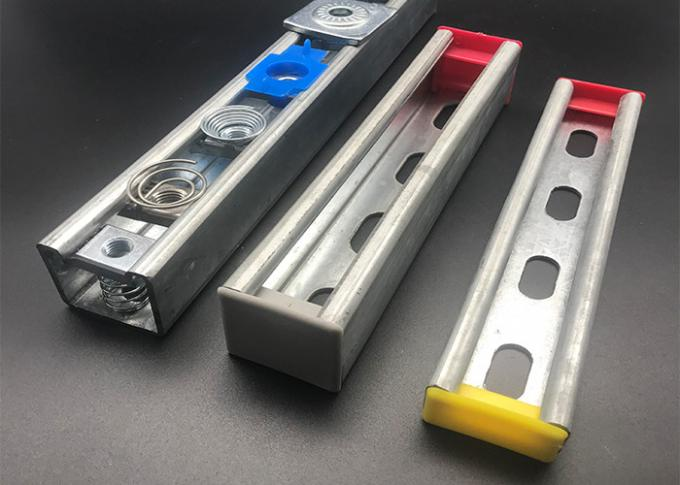
Solar mounting systems rarely fail at the PV module. They fail at the connection. A module clamp that will not hold torque after two monsoon seasons, a spring nut that spins in a 41×21 channel instead of seating squarely, or a zinc-plated bolt specified for a site close to the coastline – these are fastener problems, not panel problems. Specifying industrial fastener solutions for solar mounting systems means treating strut channel, channel nuts, threaded rods, pipe clamps, bolts, washers and anchors as one engineered package rather than a list of parts bought at the lowest unit price.
This guide is written for procurement managers, EPC buyers, mounting-system fabricators and distributors who have to specify that package. It covers which strut channel sizes and wall thicknesses carry the load path for PV structures, how finish selection – hot-dip galvanized (HDG), pre-galvanized (G90) or stainless steel – changes corrosion behaviour under different site conditions, how threaded rods and pipe clamps integrate with 41×41 and 41×21 systems, and how custom lengths affect material waste, installation time and coating integrity.
Definition: What a Solar Mounting Fastener Package Contains
A solar mounting fastener package is the set of mechanical components that transfers the weight of PV modules, cable trays and electrical equipment into the supporting structure and keeps the array aligned for its service life. In a strut-based design it normally contains four families of parts:
- Load-carrying profiles: strut channel / metal framing channel in slotted or unslotted (solid) form, and back-to-back sections for stiffer runs.
- Adjustable connection hardware: channel spring nuts, channel nuts, bolts, screws, washers and spring washers.
- Support and routing hardware: threaded rods, pipe clamps, cushion clamps, beam clamps and metal stamping parts such as angle connectors, flat tees and splice plates.
- Base connection: construction anchors – wedge anchors, sleeve anchors and related anchor types – connecting the frame to concrete, steel or ground-mounted foundations.
CNS INDUSTRIAL (JIAXING) CO.,LTD manufactures all four families: the company is based in Jiaxing City, Zhejiang Province, China, near Shanghai Port, and specializes in the manufacturing and export of fasteners, channel fittings and metal stamping parts, with export business accounting for 100% of total sales.
Problem Definition: Where Solar Mounting Fastening Goes Wrong
Most solar mounting fastener problems trace back to five issues rather than to a single defective part: corrosion, an incompletely defined load path, slot-and-nut incompatibility, length logistics, and missing documentation.
1. Corrosion is usually a finish and interface problem
An array is an outdoor structure expected to remain serviceable for decades, so the finish on every component matters as much as the steel underneath. Problems usually appear at interfaces: an HDG channel jointed with a zinc-plated bolt, a stainless component fixed against galvanized steel, or a channel cut to length on site where the cut face is left without coating repair. This is why finish selection should be decided per component and per site – not simply specified as “galvanized” across the whole bill of materials.
2. The load path is a system, not a single part
Module weight, cable trays, conduit and equipment loads travel through the channel profile into the channel nut, bolt and washer, and finally into an anchor or base structure. Changing one element – for example moving from 12ga to 16ga wall thickness, or from an unslotted to a slotted profile – changes the behaviour of the whole joint. Load capacity therefore cannot be read from a catalogue line alone; it has to be matched to span, profile, wall thickness and the bolted connection detail.
3. Slot and nut compatibility is not interchangeable by dimension
Strut channel is not universal. A 41×41×2.5 mm system and a 41×21×2.5 mm system take different nut geometries, and channel wall thickness options (12ga, 14ga, 16ga) affect how a nut seats inside the profile. Spring nuts are supplied in M6, M8, M10 and M12, and channel nuts in M8, M10 and M12. Sourcing channel from one supplier and nuts from another often results in reduced contact area, which is a common cause of loosening joints on wind-loaded structures.
4. Length planning affects waste and coating integrity
Standard channel lengths are 10 ft and 20 ft, with custom lengths available. On a large site, cutting standard 20 ft sections generates offcuts and leaves unprotected cut ends; a planned cut list and custom-length supply reduce both material waste and site labour.
5. Missing documentation slows approval
Fastener approval usually depends on traceability: which standard applies, which grade was supplied, which finish was applied. Suppliers who can state standard and grade clearly at quotation stage shorten the qualification cycle.
Industry Background: Fastener and Channel Demand Behind Solar Build-Out
Strut channel systems are listed for the construction, electrical, HVAC, oil & gas, solar mounting and industrial support systems industries, and solar mounting is one of the application segments driving demand for channel and connection hardware. Third-party market estimates put the scale of the category in perspective:
- The global industrial fasteners market was valued at USD 93.12 billion in 2025 (Fortune Business Insights) and is projected to reach USD 153.71 billion by 2033, a CAGR of 5.1% (Grand View Research).
- Asia Pacific held a 45.1% revenue share of the industrial fasteners market in 2025 (Grand View Research); China’s industrial fasteners market was valued at USD 12.23 billion in 2024 (Credence Research).
- China exported USD 1.63 billion of ‘Other Metal Fasteners’ in 2024 (OEC).
- Metal fasteners accounted for 91.0% of the industrial fasteners market in 2025, with bolts the largest product segment at a 31.3% share (Grand View Research).
- The global strut channel market was valued at USD 4.3 billion in 2024 and is projected to reach USD 7.3 billion by 2033, a CAGR of 6.1% (Dataintelo).
Market sizing varies between research houses – an alternative estimate places the strut channel market at USD 1.85 billion in 2025 (Intel Market Research) – so these figures are best read as directional signals of category growth rather than as a pricing benchmark.
At the top of the supply chain, leading strut channel system manufacturers include nVent (CADDY), Atkore (Unistrut), Eaton (B-Line) and Hilti, while ITW, Stanley Black & Decker and Hilti are named among the key global industrial fastener players. Beneath that tier sits the export-oriented manufacturing base that most solar EPCs, mounting-system fabricators and distributors actually purchase from. CNS INDUSTRIAL (JIAXING) CO.,LTD is one such manufacturer: its facility covers 30,000 square meters, annual production capacity reaches 8,000 tons, and its R&D team consists of 20 engineers, with major markets in the EU, US, South American and Canada markets.
Detailed Solution: Strut Channel and Fasteners for Solar Structures
A workable solar mounting fastener package is assembled around one channel system, with every accessory drawn from the same dimensional family. That keeps slot geometry, wall thickness and thread engagement consistent from the module rail down to the anchor.
Strut channel: profile, thickness and length
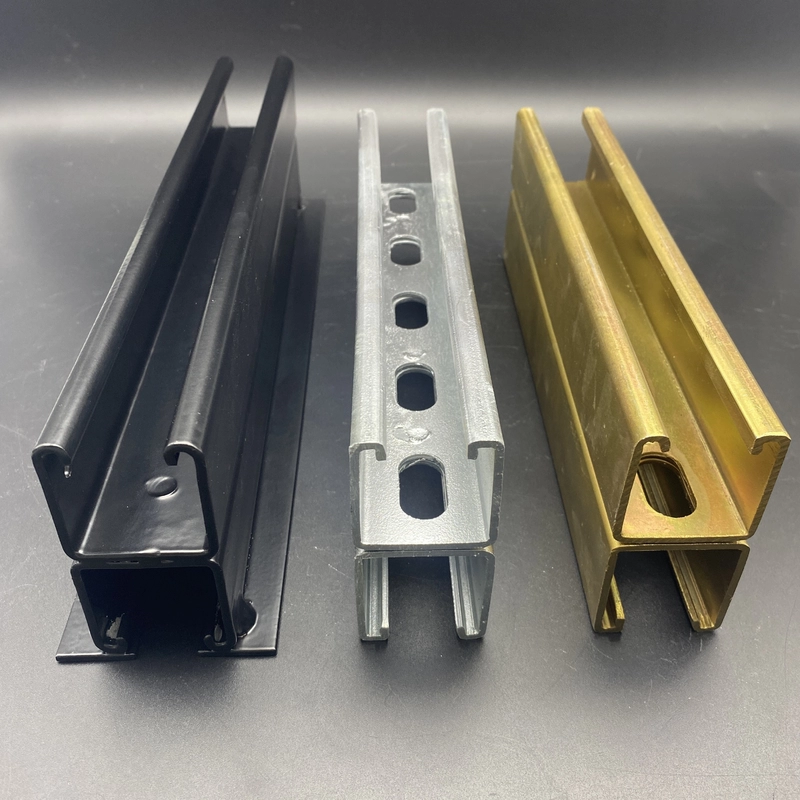
CNS INDUSTRIAL supplies strut channel / metal framing channel in sizes 41×41×2.5 mm, 41×21×2.5 mm and 41×41×2.0 mm, together with imperial equivalents of 1-5/8"×1-5/8", 1-5/8"×13/16", 1-5/8"×2-7/16" and 1-5/8"×3-1/4". Wall thickness options are 12ga, 14ga and 16ga; standard lengths are 10 ft and 20 ft, and custom lengths are produced to project requirements. Profiles are available slotted or unslotted, in solid and back-to-back configurations. Materials include carbon steel, stainless steel 304 / 316 and aluminium, and the unslotted profile is specified where high structural strength is required for pipe, cable tray and equipment support.
In solar mounting practice, the 41×41×2.5 mm profile suits primary beams, cross-bracing and equipment support frames, while the shallower 41×21×2.5 mm profile is often used for conduit and cable tray runs beneath a racking structure. One limitation is worth stating plainly: the load capacity of any channel run depends on span, profile, wall thickness and connection detail, so it should be confirmed against project engineering calculations for each array design rather than assumed from the profile size alone.
Connection hardware: the adjustable part of the joint
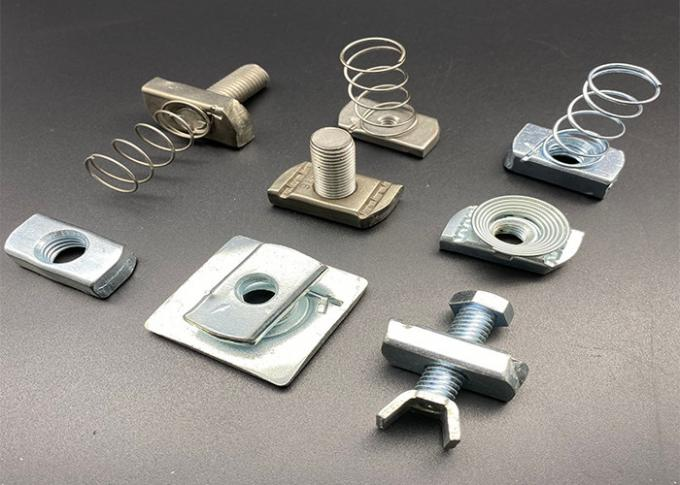
Spring nuts in M6, M8, M10 and M12, and channel nuts in M8, M10 and M12, allow a bolt position to be set at any point along the slot. This adjustability is what makes strut-based solar structures practical on site: module rails, cable tray supports and inverter brackets can be repositioned without drilling new holes. The industrial fastener range covers bolts, nuts and washers in grades 4.8, 8.8, 10.9 and 12.9, stainless steel A2-70 / A4-80, B7 alloy steel studs and specialty fasteners, in sizes from M6 to M64 and 1/4" to 2-1/2", manufactured to DIN, ANSI/ASME, ISO, GB, UNI, JIS, BS and NFE standards or to customer drawings.
Washers do as much work as bolts in thin-wall channel. Square washers spread the clamping load against the inside face of the profile; flat washers in DIN 125 (international equivalents ISO 7089 / ISO 7090) sit under the nut and bolt head; spring lock washers with square ends to DIN 127 / BS4464B resist loosening where wind-induced vibration acts on the joint. Hexagon nuts are governed by standards such as ISO 4032 / DIN 934, and full-thread hex bolts by DIN 933 / ISO 4017.
Threaded rods, pipe clamps and support hardware
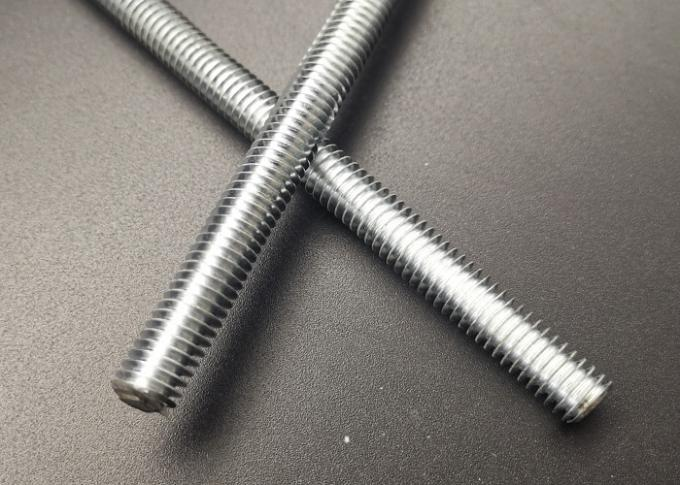
Standard accessories for the strut channel system include channel fittings, spring nuts, threaded rods and pipe clamps – the same accessory set that carries over into solar mounting installations. Threaded rods convert a fixed channel run into a height-adjustable support, which is useful where the mounting surface is uneven or where cable trays and conduit must be suspended at a consistent level.
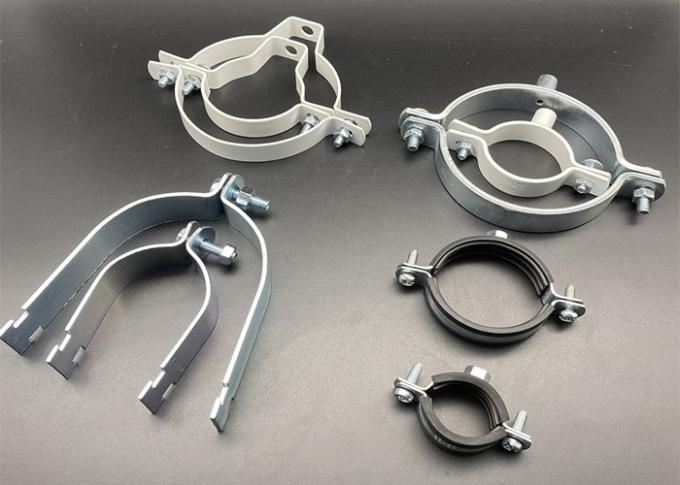
Pipe clamps and cushion clamps fix conduit and cable runs to the channel; rubber-lined EPDM cushion clamps are used where cable or conduit needs vibration damping and abrasion protection, while beam clamps attach the channel to structural steel without drilling. U-bolts support pipe and conduit on the same framing.
Metal stamping parts: turning straight channel into frames
Metal stamping parts – angle connectors, flat tees, corner and end angles, splice plates, U-supports, shelf angles and offset angles – are what turn straight channel into structural frames. In a solar array they form the joints between posts and beams, the bracing of ground-mount tables, and brackets for inverters, combiners and monitoring equipment.
Finish selection: the decision that sets service life
Available materials include carbon steel, stainless steel (304 / 316), aluminium and copper, with surface finishes including zinc plated (white or yellow), hot-dip galvanized (HDG), Dacromet, Magni, Geomet and pre-galvanized. Strut channel is offered pre-galvanized (G90), hot-dip galvanized or powder coated (green). HDG is the finish specified where long-lasting outdoor and harsh-environment protection is required, while stainless steel 304 / 316 is selected for the most aggressive conditions. The important discipline is consistency: a package where the channel, nuts, bolts and washers are finished to suit the same environment will behave predictably, whereas a mixed package shifts the corrosion point to the weakest component.
Step-by-Step: Specifying a Solar Mounting Fastener Package
- Define the structural demand first. Establish module weight, span between supports, wind and snow exposure, and the weight of cable trays and equipment carried by the same framing. This determines whether a 41×41 or a 41×21 profile is appropriate, and whether 12ga, 14ga or 16ga wall thickness is required.
- Select material and finish by environment. Match the finish to site conditions: pre-galvanized (G90) for sheltered or inland applications, hot-dip galvanized where outdoor and harsh-environment protection is needed, and stainless steel 304 / 316 where corrosion demand is highest.
- Match slot dimensions and nut sizes. Fix the channel series (41×41×2.5 mm, 41×41×2.0 mm, 41×21×2.5 mm) and then select spring nuts (M6 / M8 / M10 / M12) or channel nuts (M8 / M10 / M12) from the same system so the nut seats correctly in the slot.
- Choose bolt grade and standard. Define the grade (4.8, 8.8, 10.9 or 12.9), the standard (for example DIN 933 / ISO 4017 for full-thread hex bolts, ISO 4032 / DIN 934 for hexagon nuts) and the size from the M6–M64 and 1/4"–2-1/2" range, or specify custom sizes to drawing.
- Specify washers with the bolt. Use square washers against the channel face, flat washers (DIN 125 / ISO 7089 / ISO 7090) under the head and nut, and spring lock washers (DIN 127 / BS4464B) where vibration is expected.
- Plan the support and routing layer. Decide where threaded rods are used for height adjustment, where pipe clamps or cushion clamps carry conduit and cable, and where beam clamps or U-bolts make the connection to existing steel or pipe.
- Fix lengths, cut list and packing. Work from standard 10 ft and 20 ft lengths or order custom lengths to the cut list, then confirm the anchor type for the base connection and the packing arrangement for shipment.
- Confirm documentation before release. Verify that standard, grade and finish are stated for each line item, since this is what allows QA approval without re-sampling on site.
Use Cases: Where This Package Is Applied
Ground-mount racking cross-bracing
Unslotted 41×41×2.5 mm channel in hot-dip galvanized finish carries bracing and equipment support on ground-mount structures, with angle connectors, splice plates and flat tees forming the frame joints and construction anchors fixing the base.
Cable management under a racking structure
41×21×2.5 mm channel with pipe clamps, cushion clamps and threaded rods provides a cable and conduit layer that can be positioned precisely without drilling the primary structure.
Equipment and inverter support
Channel frames built from 41×41×2.0 mm or 41×41×2.5 mm profiles, assembled with spring nuts, bolts and square washers, support inverters, combiners and monitoring equipment, and can be levelled with threaded rods where the surface is uneven.
Corrosive and coastal sites
Where corrosion demand is highest, stainless steel 304 / 316 channel and A2-70 / A4-80 stainless fasteners, or hot-dip galvanized carbon steel throughout, keep the joint consistent instead of mixing finishes.
Comparison Table: Channel Range and Finish Options
The two tables below summarise the strut channel range and the finish options available for solar mounting projects. Both are based on the supplier’s published product specifications.
| Profile / size | Type | Wall thickness | Lengths | Materials |
|---|---|---|---|---|
| 41×41×2.5 mm | Slotted / unslotted | 12ga, 14ga, 16ga | 10 ft / 20 ft, custom | Carbon steel, SS304, SS316, aluminium |
| 41×21×2.5 mm | Slotted / unslotted | 12ga, 14ga, 16ga | 10 ft / 20 ft, custom | Carbon steel, SS304, SS316, aluminium |
| 41×41×2.0 mm | Slotted / unslotted | 12ga, 14ga, 16ga | 10 ft / 20 ft, custom | Carbon steel, SS304, SS316, aluminium |
| 1-5/8"×2-7/16", 1-5/8"×3-1/4" | Solid / back-to-back | 12ga, 14ga, 16ga | 10 ft / 20 ft, custom | Carbon steel, SS304, SS316, aluminium |
| Finish / material | Applied to | Where it fits in solar mounting |
|---|---|---|
| Pre-galvanized (G90) | Strut channel, carbon steel | Sheltered and inland framing, cable tray and conduit support |
| Hot-dip galvanized (HDG) | Strut channel; fasteners | Outdoor structures requiring long-lasting, harsh-environment protection |
| Powder coated (green) | Strut channel | Visible framing where a specified colour is required |
| Stainless steel 304 / 316 (A2-70 / A4-80) | Channel and fasteners | Highest-corrosion sites and stainless joints |
| Zinc plated (white / yellow), Dacromet, Magni, Geomet | Bolts, nuts, washers, threaded rods | Fastener-level protection; coating choice must match the channel finish |
FAQ
Which standards apply to fasteners used in solar mounting systems?
Industrial fasteners for solar mounting are normally specified against recognised standards so that grade, thread and dimensions can be verified. CNS INDUSTRIAL manufactures products according to GB, ISO, DIN, ANSI/ASME, UNI, JIS, BS and NFE standards, or customizes to customer drawings and samples. In practice this covers full-thread hex bolts such as DIN 933 / ISO 4017, hexagon nuts to ISO 4032 / DIN 934, plain washers to DIN 125 with international equivalents ISO 7089 / ISO 7090, spring lock washers with square ends to DIN 127 / BS4464B, and hexagon head bolts (grade C) to DIN 601 / ISO 4016. Product grades span 4.8, 8.8, 10.9 and 12.9, B7 alloy steel studs, and stainless steel A2-70 / A4-80.
Are the strut channels compatible with pipe clamps, threaded rods and spring nuts?
Compatibility is built into the system rather than added afterwards. Accessories for the strut channel system include channel fittings, spring nuts, threaded rods and pipe clamps. Spring nuts are available in M6, M8, M10 and M12 and channel nuts in M8, M10 and M12 for the 41×41 and 41×21 channel systems, so bolts, threaded rods, pipe clamps, cushion clamps and brackets can be mounted at any point along the slot. Sourcing channel, nuts and fittings from one supplier keeps slot geometry, wall thickness (12ga, 14ga, 16ga) and thread engagement consistent across the assembly.
What drives the cost of a solar mounting fastener package?
Cost is driven by material, wall thickness, finish, profile type and order quantity rather than by a single unit price. Carbon steel channel in 16ga with a pre-galvanized G90 finish sits at a different cost level from 12ga material, hot-dip galvanized or powder-coated channel, or stainless steel 304 / 316. Slotted, unslotted and back-to-back profiles consume different amounts of material, and custom lengths affect both material utilisation and freight. Because these variables move together, the practical approach is to fix the load case and site environment first, then request a quotation against a defined bill of materials.
Can custom lengths and custom fasteners be produced, and how are samples handled?
Standard strut channel lengths are 10 ft and 20 ft, and custom lengths are available to project requirements. Beyond the catalogue range, products can be custom fabricated according to drawings or samples, and the industrial fastener range already covers sizes from M6 to M64 and 1/4" to 2-1/2" with additional custom grades and sizes available. Sample validation is the usual first step before a production order: buyers confirm profile, wall thickness, finish and nut or bolt fit on a sample set, then release the full order once the specification is fixed.
How should delivery and order planning work, and what is the next step?
CNS INDUSTRIAL (JIAXING) CO.,LTD is located in Jiaxing City, Zhejiang Province, China, with convenient transportation access near Shanghai Port, which supports efficient global shipping. Export business accounts for 100% of total sales, with major markets in the EU, US, South American and Canada markets. Order planning therefore starts from a fixed bill of materials – profile, wall thickness, finish, nut and bolt sizes and cut lengths – so production and shipping can be scheduled together. To move forward, send drawings, samples or a cut list to sales@cnsindustrial.com or WhatsApp +86 152-5709-7384 to request a quotation or sample set; the complete product range is also summarised in the CNS Industrial brochure.
Conclusion
Solar mounting reliability is decided at the connection, not at the module. A package built on one channel system – 41×41×2.5 mm or 41×21×2.5 mm profiles, matched spring nuts and channel nuts, bolts and washers in a grade suited to the load case, threaded rods and pipe clamps for routing and adjustment, stamping parts for frame joints, and anchors for the base connection – removes the compatibility gaps that cause loosening and rework. Finish selection then sets how long that package lasts: pre-galvanized (G90) for sheltered framing, hot-dip galvanized for outdoor and harsh environments, and stainless steel 304 / 316 where corrosion demand is highest.
CNS INDUSTRIAL (JIAXING) CO.,LTD manufactures strut channel systems, strut fittings, metal stamping parts, bolts and nuts, threaded rods, anchors, washers, screws and rivets under an ISO 9001 quality management system, with custom fabrication to drawings or samples. Product details and specifications are available at www.cnsindustrial.com.
Next step: sample or quotation
Send your drawings, samples or cut list and target finish specification to the CNS Industrial sales team:
Email: sales@cnsindustrial.com | Tel: +86 152 57097 384 | WhatsApp: +86 152-5709-7384
Address: No.4 R & D Plant, No.58 Wenlong Road, Yuxin Town, Nanhu District, Jiaxing City, Zhejiang Province, China
Brochure: CNS_Industrial_Brochure_v4.pdf