Industrial Fasteners Guide: Types, Standards, Materials & Selection
Industrial Fasteners Guide: Types, Standards, Materials & Selection
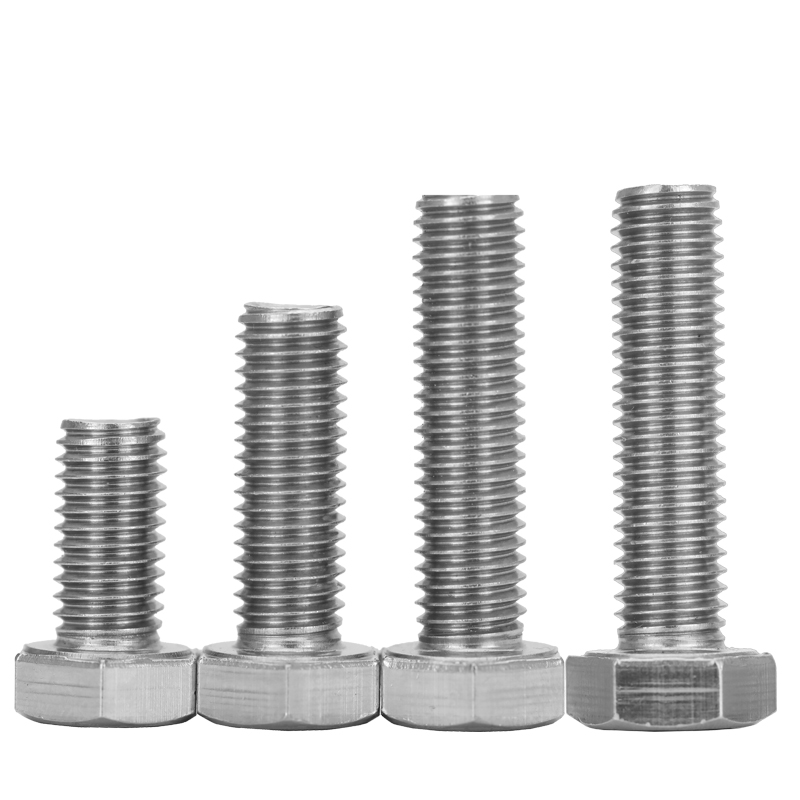
Industrial fasteners include precision bolts such as stainless steel hex head bolts in metric and imperial dimensions.
Industrial fasteners are mechanical hardware components used to join, secure, and support structures and equipment in industrial projects. The category covers bolts, nuts, screws, washers, threaded rods, construction anchors, rivets, and related support-system components such as strut channel fittings. Although individual parts are small, the reliability of an entire structure—piping, cable trays, solar racking, steel frames—depends on how well these components are specified, sourced, and installed.
This guide is written for engineers, purchasing teams, and project managers who are in the early research phase. It explains the main industrial fastener categories, the meaning of common materials and surface finishes, the role of international standards, and a practical selection workflow based on the experience of an export-oriented manufacturer.
Why Industrial Fastener Selection Is More Complex Than It Looks
A common assumption is that fasteners are interchangeable commodity parts. In industrial practice, four factors normally need to be resolved before a part can be specified:
- Environmental conditions determine whether carbon steel, stainless steel, aluminum, or another material is acceptable.
- Mechanical loads determine the required strength grade, size, and tightening method.
- International standards define the dimensions, thread profiles, mechanical properties, and tolerances that apply.
- System compatibility determines whether a fastener works with the intended support structure, such as a strut channel system.
When these factors are mismatched, failures appear in the form of loosened joints, corrosion, stripped threads, or field rework. For a buyer, the goal is not simply to find a lower unit price but to define a specification that can be reliably sourced, delivered, and installed.
Global buyers face an additional challenge: converting specifications between different standard systems. A metric project may reference DIN standards, while an export project may specify ANSI/ASME or ISO. Because suppliers often specialize in only one standard family, procurement teams should confirm that a manufacturer can produce across the relevant systems before placing an order.
Industry Background: What Is Driving Demand for Industrial Fasteners
The industrial fasteners market is large and continues to grow. Fortune Business Insights estimated the global market at USD 93.12 billion in 2025. Grand View Research projects it to reach USD 153.71 billion by 2033, with a compound annual growth rate of 5.1%.
Regional demand is concentrated in Asia Pacific, which held 45.1% of the global market in 2025. China's industrial fasteners market reached USD 12.23 billion in 2024, and the country exported USD 1.63 billion in "other metal fasteners" in 2024, according to OEC trade data. For buyers in North America and Europe, the practical implication is that Asia Pacific is both a major consumption region and the largest production base for industrial fasteners.
Within the product mix, bolts represent the largest product segment, with a 31.3% share in 2025. Related support categories are also expanding: the global strut channel market was valued at USD 4.3 billion in 2024 and is expected to reach USD 7.3 billion by 2033, growing at a CAGR of 6.1%.
These trends matter to buyers because construction, MEP/HVAC, solar, oil & gas, and heavy equipment are all driving sustained demand for both fasteners and support systems. Working with a supplier that produces multiple hardware categories under one roof can reduce sourcing lead time and simplify quality control.
Industrial Fastener Categories Explained
An industrial fastener line covers several product families that are often purchased together. The table below summarizes the main categories, common examples, and typical application areas.
| Category | Common Examples | Typical Application Areas |
|---|---|---|
| Bolts & Nuts | Hex bolts, hex flange bolts, carriage bolts, U-bolts, J-bolts, eye bolts, hex nuts, flange nuts, nylon nuts, wing nuts | Construction & building infrastructure, MEP/HVAC, structural steel connections, heavy machinery |
| Washers | Flat washers, spring washers, square washers | Load distribution, locking, channel mounting |
| Threaded Rods | Fully threaded rods, B7 alloy steel studs | Pipe supports, framing, hanging and bracing |
| Screws | Self-drilling screws, drywall screws, chipboard screws, machine screws | Steel construction, gypsum board, timber, mechanical assembly |
| Rivets | Industrial rivets | Metal assembly where threaded access is limited |
| Anchors | Wedge anchors, sleeve anchors | Concrete and masonry fastening |
| Strut Channel Fittings & Systems | Strut channels, channel nuts, spring nuts, pipe clamps, beam clamps | MEP supports, cable trays, overhead installations |
| Metal Stamping Parts | Custom stamped brackets and hardware | OEM/ODM hardware consolidation |
Bolts & Nuts
Bolts and nuts are the most widely used subcategory of industrial fasteners. They are produced in metric and imperial sizes, with strength classes including 4.8, 8.8, 10.9, and 12.9, high-tensile structural bolts to ASTM A325/A490, and B7 alloy steel studs for bolting applications. Thread types include full thread and partial thread, in both metric and imperial configurations. Standard items include hex bolts, hex flange bolts, carriage bolts, U-bolts, J-bolts, eye bolts, hex nuts, flange nuts, nylon nuts, and wing nuts. Typical size ranges for industrial fasteners run from M6 to M64 in metric and 1/4" to 2-1/2" in imperial, with custom sizes available from manufacturers.
Washers
Washers perform two main roles: distributing the clamping load over a wider surface and, in the case of spring washers or lock washers, helping to resist loosening. Standard flat washers are commonly produced to DIN 125, which corresponds to ISO 7089 and ISO 7090. Spring lock washers with square ends are standardized under DIN 127.
Screws & Rivets
Screws are available in a wide range of head styles, drives, and thread forms for different substrates. Self-drilling and self-tapping screws are used in steel construction; drywall screws are used for gypsum board; chipboard and wood screws are used for timber and panel products. Rivets provide a permanent mechanical connection where threaded access is limited.
Threaded Rods
Threaded rods are continuous metal rods used for hanging, bracing, and support. In a strut channel system, threaded rods are often combined with channel nuts, beam clamps, and pipe clamps to create adjustable overhead supports.
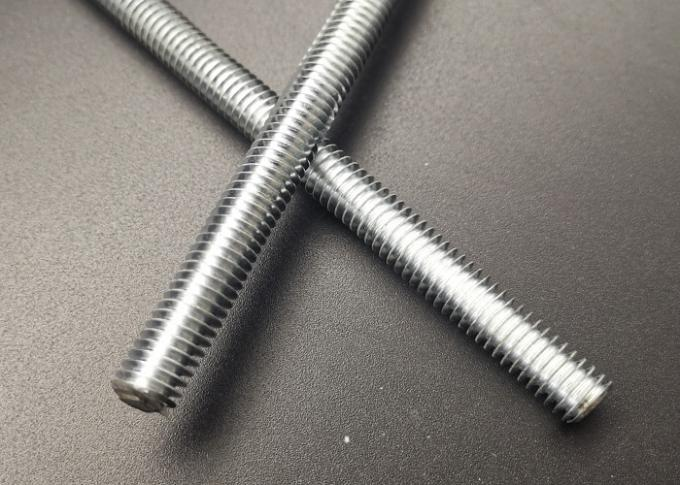
Threaded rods are a standard component in channel support and pipe-hanging systems.
Construction Anchors
Construction anchors are designed for fastening to concrete or masonry. Wedge anchors and sleeve anchors are common types. Anchor selection depends on the base material, edge distance, embedment depth, and load direction.
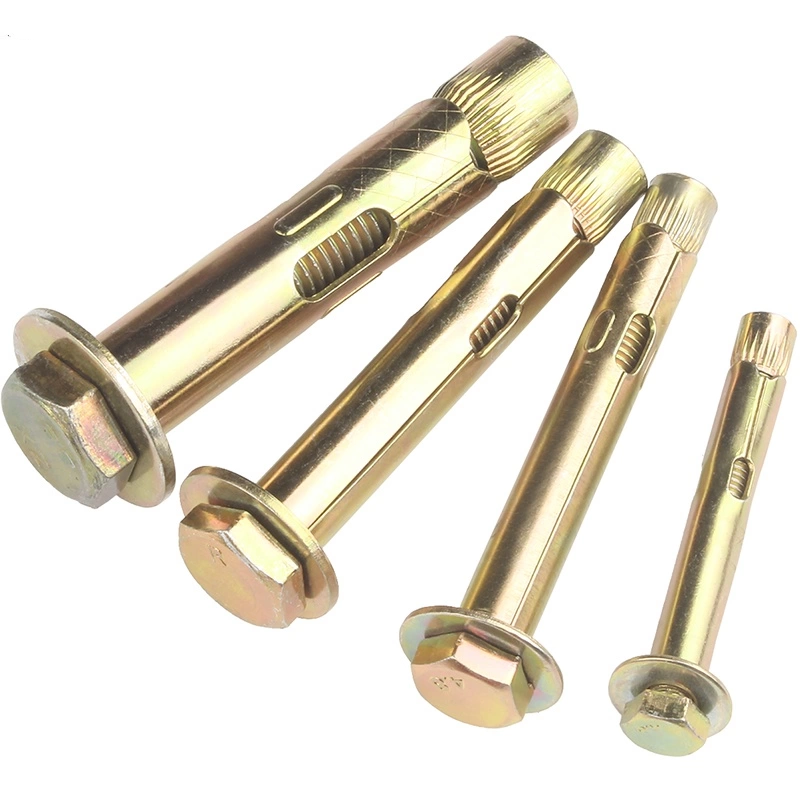
Sleeve anchors are among the common construction anchors used in concrete and masonry applications.
Strut Channel Systems & Fittings
Strut channel, also called metal framing channel, is a steel profile used to build support structures for pipes, cable trays, HVAC equipment, and solar mounting systems. Common sizes include 41×41 mm and 41×21 mm, and standard lengths are 10 ft and 20 ft. The system works through accessories such as spring nuts, channel nuts, pipe clamps, beam clamps, and mounting brackets, which allow adjustment without welding.
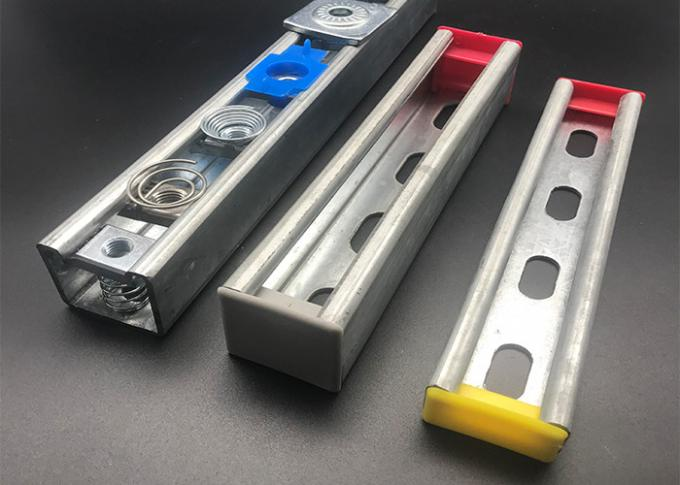
Strut channels and metal framing profiles form support structures for pipes, cable trays, and mechanical equipment.
Spring nuts are a key component in these systems. A spring nut holds its position inside the channel, which makes installation faster, especially for overhead or vertical work. The correct spring nut must match the channel profile, slot dimensions, and thread size of the bolt or threaded rod being used.
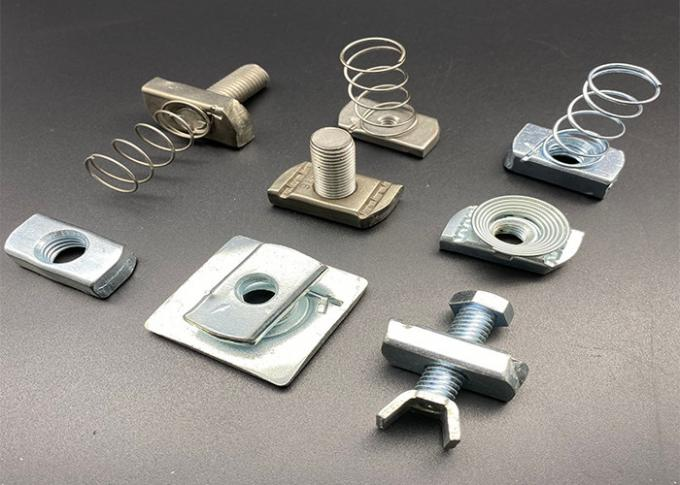
Spring nuts position quickly inside the channel, reducing installation time for overhead support systems.
Metal Stamping Parts
Metal stamping parts are custom-formed hardware components produced by stamping. Many buyers request stamped brackets and fasteners together with their standard fastener order so that one supplier can handle the complete hardware package. The metal stamping market is substantial—valued at USD 255.35 billion globally in 2024—and Asia Pacific accounted for 57.7% of the market in 2025, according to IMARC Group.
Materials, Surface Finishes, and Standards
Material Options
The choice of material directly affects strength, corrosion resistance, and cost. Industrial fasteners are commonly produced from carbon steel, stainless steel, aluminum, and copper.
- Carbon steel is widely used where mechanical strength and cost efficiency are the priorities. Because carbon steel can corrode in humid or outdoor conditions, it is usually combined with a protective finish.
- Stainless steel 304 (SS304) is suitable for standard indoor and general outdoor environments where corrosion resistance is required.
- Stainless steel 316 (SS316) contains molybdenum, which provides significantly better resistance to chloride corrosion, salt fog, and harsh chemicals, making it the preferred material for marine, coastal, and chemical environments.
- Aluminum is used in applications where lighter weight or corrosion resistance is needed. Copper is selected for electrical conductivity or special-purpose hardware.
Material grades such as A2-70 and A4-80 are commonly used to define mechanical and corrosion requirements for stainless steel fasteners.
Surface Finishes
Surface treatment determines how long a fastener lasts in a given environment. The most common options are:
- Electro-zinc plating (EG), sometimes called cold galvanizing, applies a relatively thin zinc coating, typically 5–12 μm. It is used mainly for indoor, dry environments where cost efficiency and precise thread fit are important.
- Hot-dip galvanizing (HDG) applies a thick zinc coating, typically 45–85 μm, and is recommended for outdoor, coastal, and harsh corrosive environments.
- High-performance finishes such as Dacromet, Magni, and Geomet are available when enhanced corrosion protection is specified.
- Other common finishes include yellow zinc and white zinc, which provide corrosion protection while preserving thread tolerances.
Standards Compliance
Standards define the dimensions, mechanical properties, and test methods that fasteners must meet. In international trade, the most frequently encountered systems are DIN, ISO, ANSI/ASME, GB, UNI, JIS, BS, and NFE. A few conversion examples are particularly common:
- Plain washers: DIN 125 corresponds to ISO 7089 and ISO 7090.
- Hexagon nuts: ISO 4032 and DIN 934 are the governing standards for general industrial use.
- Spring lock washers with square ends: DIN 127 applies.
- Hexagon head bolts (grade C): DIN 601 and ISO 4016 are applicable.
These examples explain why buyers should confirm the standard match with the manufacturer rather than assuming interchangeability across standard families.
Manufacturer Example: CNS INDUSTRIAL (JIAXING) CO.,LTD
CNS INDUSTRIAL (JIAXING) CO.,LTD is a manufacturer of fasteners, channel fittings, and metal stamping parts, located in Jiaxing City, Zhejiang Province, China, with convenient transportation access near Shanghai Port. The company produces according to international standards including GB, ISO, DIN, ANSI/ASME, UNI, JIS, BS, and NFE, or to customer drawings and samples. Material options include carbon steel, stainless steel 304/316, aluminum, and copper. Surface finishes offered are zinc plated, hot-dip galvanized (HDG), Dacromet, Magni, yellow zinc, and white zinc. More information is available at www.cnsindustrial.com.
The product range includes strut fittings, strut channel systems, stamping parts, bolts and nuts, threaded rods, anchors, washers, screws, rivets, and industrial hardware and fasteners. The company operates a 30,000 m² manufacturing facility with an annual production capacity of 8,000 tons, an R&D team of 20 engineers, and approximately 50–100 staff. Export business accounts for 100% of sales, with major markets in the EU, US, South American, and Canada regions, as well as countries including Mexico, Germany, Japan, Russia, France, and Italy. This combination allows buyers to source fasteners, channel systems, and customized stamping parts from a single supplier.
How to Select Industrial Fasteners: A Step-by-Step Approach
For a new project or a new supplier evaluation, the following sequence is a practical way to define fastener requirements.
- Define the operating environment. Identify whether the installation is indoor or outdoor, coastal or inland, and whether chemicals, chlorides, or high humidity are present. This narrows the material and finish options.
- Estimate the mechanical load. Consider tensile load, shear load, vibration, and temperature. This determines the required grade and size.
- Select the material. Use carbon steel for general loaded applications with protective finishing, SS304 for standard corrosion resistance, SS316 for marine or high-chloride environments, and aluminum or copper for specific project needs.
- Choose the strength grade. Metric classes such as 8.8, 10.9, and 12.9, or imperial grades such as Grade 5 and Grade 8, should match the joint design. A higher-strength bolt is not always the best choice.
- Specify the surface finish. Use electro-zinc plating for indoor dry environments; HDG for outdoor, coastal, and harsh environments; and high-performance finishes when enhanced protection is required.
- Confirm the standard system. Align the specification with DIN, ISO, ANSI/ASME, GB, or the applicable project standard, and check that the supplier can produce to it.
- Check compatibility with the support system. For strut channel installations, verify that channel nuts, spring nuts, pipe clamps, and beam clamps match the channel profile and slot dimensions.
- Plan installation and maintenance. Decide whether the joint will be disassembled, whether vibration protection is needed, and which locking method fits the maintenance cycle.
Use Cases Across Industries
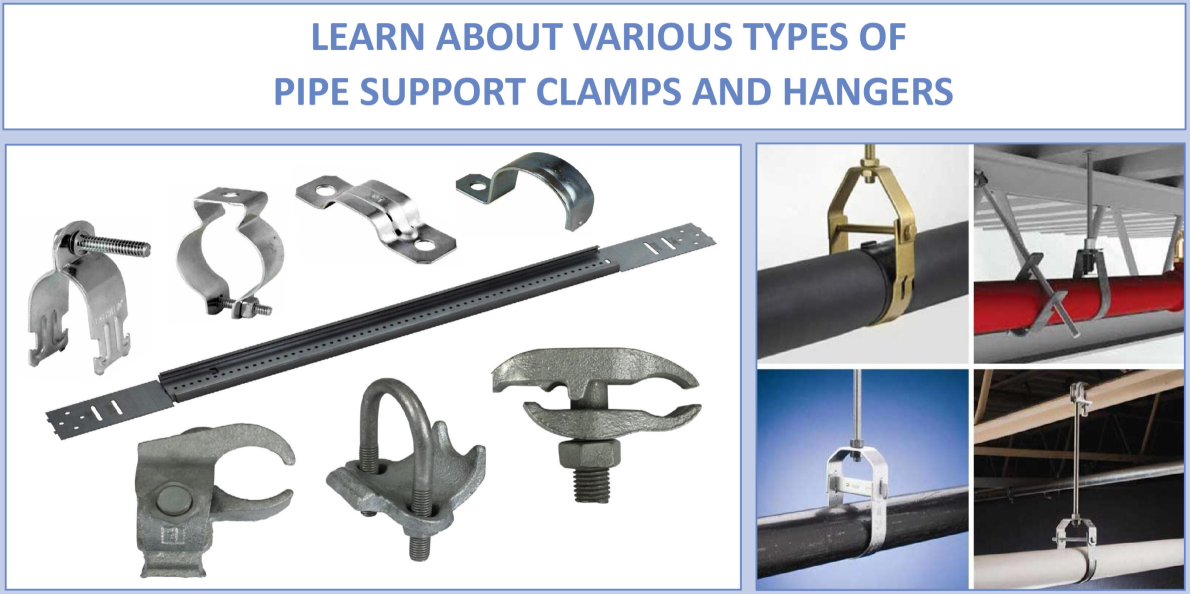
Industrial fasteners and support systems serve a broad range of industry sectors.
Industrial fasteners are installed across a broad range of sectors. The main application areas include:
- Construction & Building Infrastructure: structural steel connections, concrete fastening, and framing systems use high-strength bolts, anchors, and washers.
- MEP/HVAC: suspended pipes, ductwork, and cable trays are commonly supported by strut channels, threaded rods, pipe clamps, and beam clamps.
- Solar & Renewable Energy: solar mounting structures use galvanized and stainless steel fasteners for long-term outdoor exposure.
- Oil, Gas & Petrochemical: B7 alloy steel studs and corrosion-resistant fasteners are used in piping and equipment where reliability under pressure and temperature is critical.
- Power Generation & Electrical Utilities: cable management, equipment anchoring, and electrical support systems rely on vibration-resistant threaded connections.
- Heavy Machinery & Equipment: dynamic loads in machinery place high demands on fastener strength and locking performance.
- Transportation & Railway: structural and equipment assemblies use industrial fasteners where consistent quality and standard compliance are required.
According to market analysis, the automotive industry alone accounts for over 30% of the demand for high-strength industrial fasteners. This helps explain why high-tensile products such as grade 10.9 and 12.9 bolts are among the most frequently requested fastener segments.
Material and Finish Comparison at a Glance
The table below compares the most common choices for industrial fastener materials and finishes.
| Selection Factor | Electro-Zinc Plated (EG) | Hot-Dip Galvanized (HDG) | Stainless Steel 304 | Stainless Steel 316 |
|---|---|---|---|---|
| Typical coating | 5–12 μm | 45–85 μm | No coating required | No coating required |
| Best-suited environment | Indoor, dry environments | Outdoor, coastal, harsh corrosive environments | General indoor/outdoor, inland applications | Marine, coastal, chemical, high-chloride environments |
| Common applications | HVAC mounting, electrical conduit hanging, interior framing | Solar racking, coastal infrastructure, heavy industrial plants | General construction, commercial framing | Marine hardware, coastal solar, food processing, chemical engineering |
| Economic consideration | Cost-efficient choice | Higher protection for outdoor service | Good balance of cost and corrosion resistance | Higher-cost choice for severe environments |
Frequently Asked Questions
What is the difference between SS304 and SS316 stainless steel fasteners, and which one should I choose?
SS304 stainless steel is suitable for standard indoor and general outdoor environments, providing good strength and cost performance. SS316 contains added molybdenum, which gives it significantly better resistance to chloride corrosion, salt fog, and harsh chemicals. For marine hardware, coastal solar installations, food processing equipment, and chemical engineering projects, SS316 is recommended. For general construction, commercial framing, and inland applications, SS304 is a practical choice.
How should I choose between hot-dip galvanized (HDG) and electro-zinc plated (EG) fasteners for outdoor projects?
For outdoor, coastal, and harsh corrosive environments, hot-dip galvanized (HDG) fasteners are recommended because the zinc coating is thicker—typically 45–85 μm—and designed for long-term outdoor anti-rust service. Electro-zinc plated (EG) fasteners have a thinner coating, typically 5–12 μm, and are mainly suited for indoor, dry environments where cost efficiency and precise thread fit are more important.
How do you choose the right grade of bolts for industrial applications?
Choose the bolt grade based on the required load, tensile strength, yield strength, application conditions, and safety requirements. For imperial applications, Grade 5 and Grade 8 bolts are widely used. For metric applications, property classes 8.8, 10.9, and 12.9 provide different strength levels. A higher strength grade is not automatically better; the complete joint, tightening requirements, and operating environment should be considered together.
How do you choose the right spring nut for a strut channel?
Choose the spring nut based on the strut channel profile, slot dimensions, thread size, load requirement, material, and installation environment. The thread size must match the threaded rod or bolt being used, such as 1/4"-20, 3/8"-16, or 1/2"-13. A spring nut helps hold position inside the channel, which is useful for overhead and vertical installations. For heavier loads, select a spring nut with a suitable load rating and stronger construction. Material and finish should match the application—zinc-plated steel for general indoor use, and hot-dip galvanized or stainless steel for outdoor or corrosive environments.
How do you prevent bolts and nuts from loosening under vibration?
Use an appropriate locking method and maintain proper bolt preload. Common solutions include prevailing-torque lock nuts, threadlocker, spring washers, locking washers, and other mechanical locking methods. The best solution depends on vibration level, temperature, joint design, installation conditions, and whether the joint needs to be disassembled. For frequently serviced joints, prevailing-torque lock nuts are practical. For permanent or semi-permanent assemblies, threadlocker can be effective. For severe vibration applications, combine a locking method with correct preload and tightening torque rather than relying on a spring washer alone. If you need help identifying the right locking solution for a specific joint design, contact CNS INDUSTRIAL (JIAXING) CO.,LTD to discuss the application.
Conclusion
Industrial fastener selection is a specification task that affects safety, durability, and installation cost. The correct approach is to define the environment, estimate loads, choose materials and strength grades, confirm standards, and verify compatibility with the support system before purchasing.
For buyers evaluating new suppliers, the practical advantages of working with a manufacturer that covers multiple fastener categories and standard systems include clearer specifications, fewer conversion errors, and simpler logistics. CNS INDUSTRIAL (JIAXING) CO.,LTD offers a product range from bolts, nuts, and washers to strut channel systems, anchors, threaded rods, and custom metal stamping parts, with production based in Jiaxing near Shanghai Port.

CNS INDUSTRIAL (JIAXING) CO.,LTD operates a 30,000 m² manufacturing facility near Shanghai Port.
To review the full product portfolio and manufacturing capabilities, download the CNS Industrial Brochure: CNS_Industrial_Brochure_v4.pdf. For project-specific inquiries, contact sales@cnsindustrial.com.