
Industrial Fasteners: Strut Channel Spring Nut Sizing & Anti-Slip
Industrial Fasteners: Strut Channel Spring Nut Sizing & Anti-Slip
A strut channel spring nut holds its position only when three variables agree: the thread size of the bolt or threaded rod it carries, the profile of the channel it is inserted into, and the thickness class of that channel. CNS INDUSTRIAL (JIAXING) CO.,LTD supplies spring nuts in M6, M8, M10 and M12 and channel nuts in M8, M10 and M12 for 41×41 mm and 41×21 mm channel profiles, in slotted and unslotted variants and in 12ga, 14ga and 16ga thickness classes. Where a support assembly is reported as slipping, the cause is usually one of those three variables rather than the strength of the nut. This guide sets out the sizing reference for the range, the material and finish options that are documented, and a short sequence of checks that removes the slip risk before an assembly is loaded.
What "Slipping" Actually Means Inside a Channel Assembly
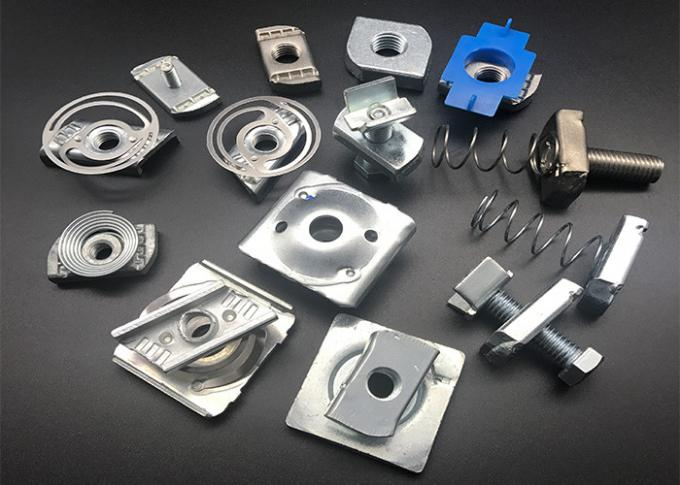
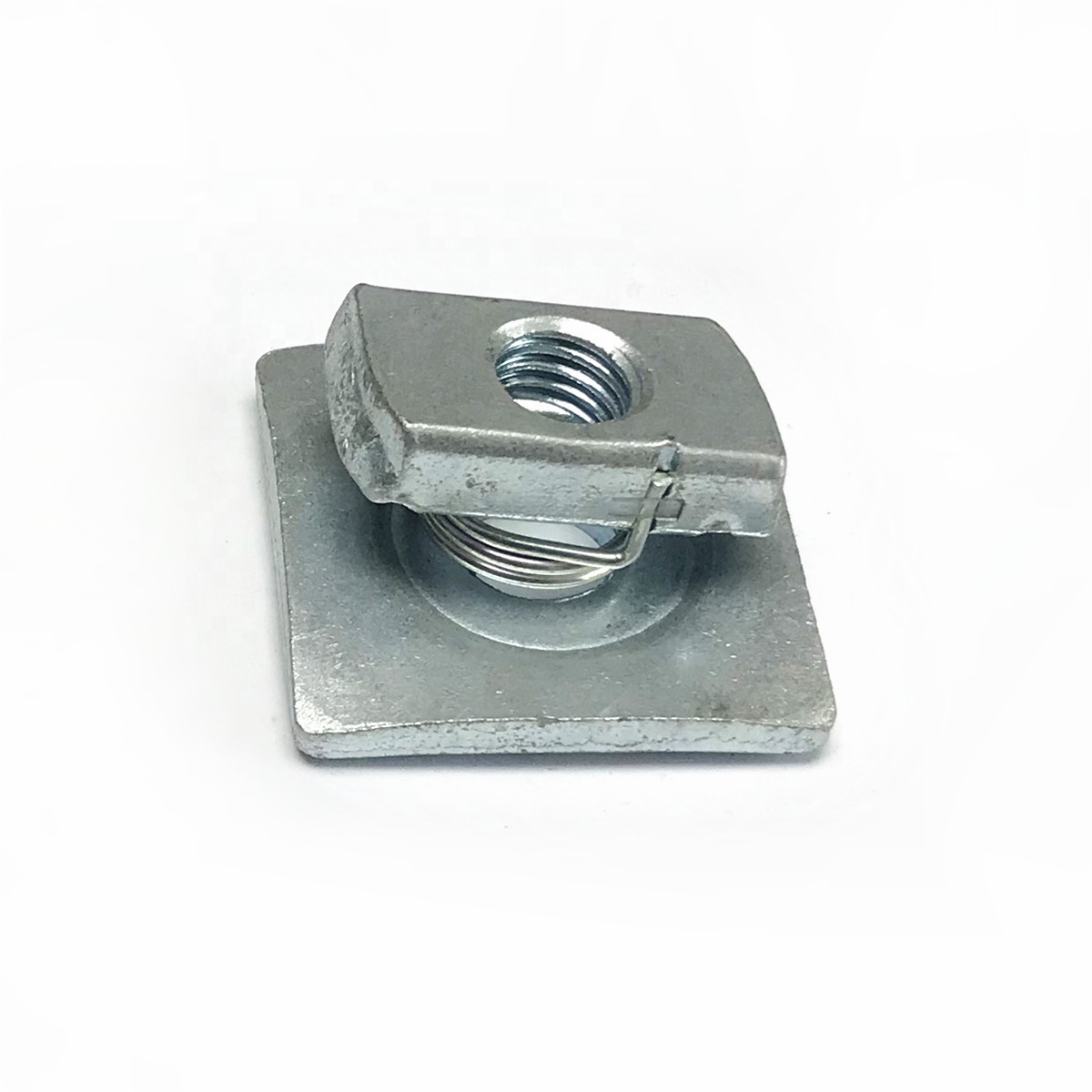
A spring nut is a threaded insert whose retainer spring keeps the nut located against the channel lip while the installer works. The spring is a positioning device, not a load-bearing element: load transfer begins when the bolt or threaded rod is tightened and the nut body seats against the inside of the channel lip. Slipping describes what happens when that seating does not occur, so the assembly can travel along the slot, rotate, or shift once service load is applied.
In industrial support work, six mismatch patterns account for most of these cases.
- Profile mismatch. A nut dimensioned for a 41×41 mm channel is used in a 41×21 mm channel, or the reverse. Both profiles sit in the same product family — 41×41×2.5 mm, 41×21×2.5 mm and 41×41×2.0 mm are all listed — which makes the two easy to confuse at the ordering stage.
- Gauge mismatch. The channel range is offered in 12ga, 14ga and 16ga thickness classes. A nut approved against one gauge class should be re-confirmed when the channel supply changes class.
- Variant mismatch. Slotted and unslotted (solid) channel present different contact surfaces. A nut specified for one variant is not automatically the right choice for the other.
- Fastener type confusion. A spring nut and a plain channel nut are not interchangeable in every position. A spring nut can be positioned in the channel before the bolt is introduced; a plain channel nut may need to be held in place during assembly, which is a training and inspection issue rather than a strength issue.
- Spring condition. A deformed, missing or weakened spring removes the pre-positioning function entirely. If the spring cannot hold the nut against the lip, the nut will move while the installer is working.
- Thread pairing. M6, M8, M10 and M12 spring nuts must be matched to the bolt or threaded rod they carry. An over- or under-sized pairing changes how the nut seats when the joint is tightened.
The cost of a slip is rarely the nut itself. It shows up as misaligned pipe supports, re-worked brackets, extra labour to re-position fittings, and inspection holds on cable tray, HVAC and solar support frames that were already closed out.
Industry Background: A Large Market Decided by Small Parts
The global industrial fasteners market was valued at USD 93.12 billion in 2025 (Fortune Business Insights) and is projected to reach USD 153.71 billion by 2033, growing at a CAGR of 5.1% (Grand View Research). Asia Pacific held a 45.1% revenue share in 2025, and metal fasteners accounted for 91.0% of the industrial fasteners market in the same year, according to Grand View Research.
Published figures for the strut channel segment specifically do not agree: Dataintelo valued the global strut channel market at USD 4.3 billion in 2024 and projects USD 7.3 billion by 2033 at a CAGR of 6.1%, while Intel Market Research shows USD 1.85 billion for 2025. The gap reflects different scope definitions rather than a single agreed number, and buyers comparing market reports should treat the range, not one figure, as the working assumption.
Two practical conclusions follow. First, the supply base is deep and price-competitive: China exported USD 1.63 billion in "Other Metal Fasteners" in 2024 (OEC), and China's industrial fasteners market alone was valued at USD 12.23 billion in 2024 (Credence Research). Second, in a market that broad, differentiation concentrates at the specification level — whether a manufacturer can state precisely which thread sizes, channel profiles, gauges, materials and finishes it supplies, and whether those statements are backed by a documented quality system. Bolts may be the largest single product segment at 31.3% of the industrial fasteners market in 2025 (Grand View Research), and the automotive segment alone accounts for over 30% of demand for high-strength industrial fasteners (Fortune Business Insights), but it is the small threaded inserts that decide whether an installed support frame stays where it was drawn.
Sizing Spring Nuts to 41×41 mm and 41×21 mm Channel Profiles
Thread sizes and nut types
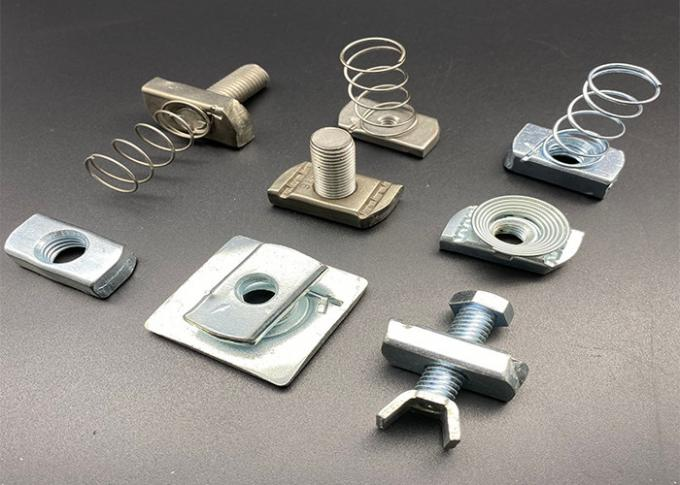
The spring nut range covers M6, M8, M10 and M12. Channel nuts without a retainer spring cover M8, M10 and M12. Because the wider industrial fasteners range manufactured by CNS INDUSTRIAL covers sizes from M6 to M64 and 1/4" to 2-1/2", a support assembly that mixes channel inserts with hex bolts, threaded rods, washers and anchors can be sourced against one size convention instead of several.
Channel profile, gauge and variant matching
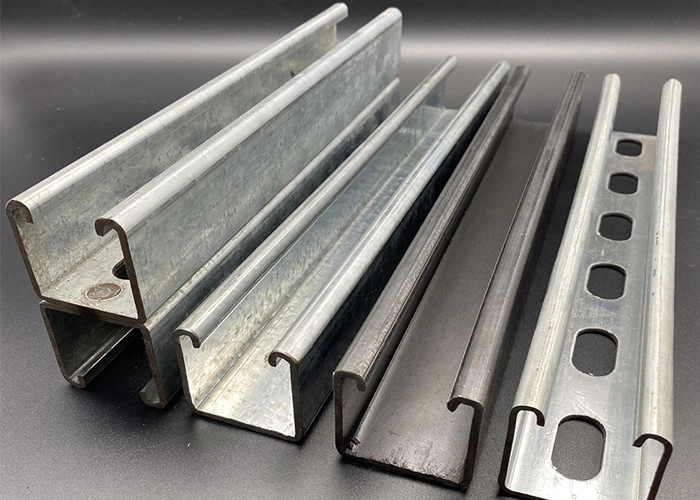
The channel range lists metric profiles of 41×41×2.5 mm, 41×21×2.5 mm and 41×41×2.0 mm, with imperial equivalents of 1-5/8"×1-5/8" (41×41 mm), 1-5/8"×13/16" (41×21 mm), 1-5/8"×2-7/16" and 1-5/8"×3-1/4". Thickness classes are 12ga, 14ga and 16ga, standard lengths are 10 ft and 20 ft with custom lengths available, and both slotted and unslotted configurations are listed, including unslotted (solid) and back-to-back channel types.
The nut and the channel should be specified as a pair. A selection sheet that states only "M10 spring nut" is incomplete — it has to state the profile, the variant and the gauge class as well, because those are the fields that determine whether the nut seats against the lip or moves inside the slot.
Material selection
Carbon steel, SS304, SS316 and aluminum are listed for the channel and spring nut range. The broader industrial fasteners range adds alloy steel, stainless steel 304/316/316L, copper and brass, with grades and classes covering 4.8, 8.8, 10.9, 12.9, B7 alloy steel, A2-70 and A4-80 stainless.
Material grade is the field where the installation environment is recorded. Stainless options sit in the same size table as carbon steel, so the grade has to be named explicitly on the order — a general instruction to supply "channel nuts" will not preserve an environment-driven material decision.
Finish selection
For the channel and spring nut range, the documented finishes are pre-galvanized (G90), hot-dip galvanized and powder coated (green). The wider industrial fasteners range adds electro-zinc plated (white and yellow), Dacromet, Magni, Geomet, pre-galvanized and plain finishes, and is manufactured to DIN, ANSI/ASME, ISO, GB, UNI, JIS, BS and NFE standards or to customer drawings and samples.
Finish choice affects both corrosion protection and dimensional consistency across a shipment. If a project specifies hot-dip galvanized channel, the spring nuts and threaded rods in the same assembly should be specified against the same finish expectation rather than left to default.
Standards and certification to verify before ordering
The industrial fasteners range meets ASTM A563/A194 and ASTM A325/A490 standards in addition to the standards listed above. Related components in the same assembly carry their own standards: plain washers are standardized under ISO 7089 and ISO 7090, equivalent to DIN 125; hexagon nuts follow ISO 4032 and DIN 934 for general industrial use; spring lock washers with square ends are standardized under DIN 127 and BS4464B; and hexagon head bolts (grade C) follow DIN 601 and ISO 4016.
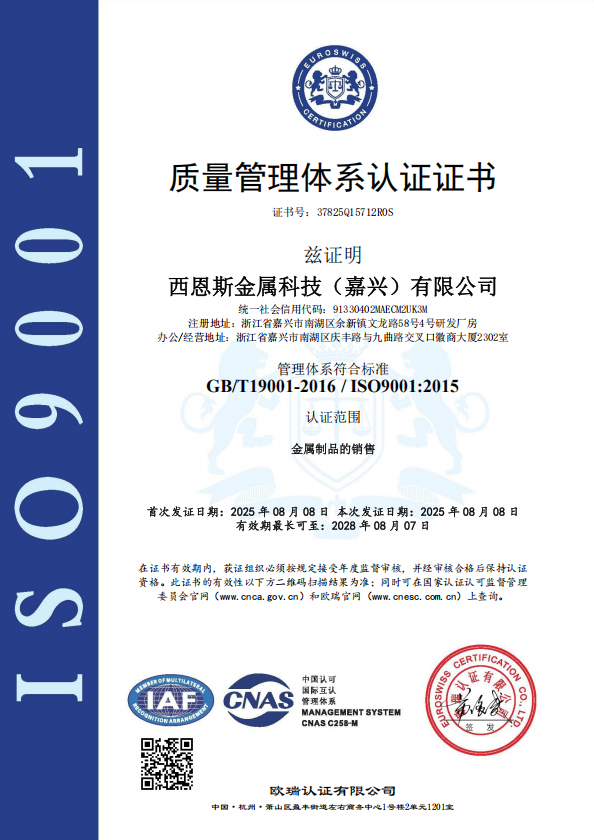
Quality documentation for this product family is traceable. The Industrial Fasteners product (product ID 7785) is covered by ISO 9001:2015 Quality Management System certification issued by Euroswiss Certification Co., Ltd. under certificate number 37825Q15712R0S. The applicable standard is GB/T19001-2016 / ISO9001:2015, the scope is sales of metal products, and the certificate is valid from 8 August 2025 to 7 August 2028 for the worldwide market.
Seven Checks That Prevent Spring Nut Slip
The checks below are ordered the way they should be applied: each one closes a specific failure route before the next one is opened.
- Confirm the channel profile before the nut. Identify whether the frame uses 41×41 mm or 41×21 mm channel, and whether the metric or imperial designation is the controlling one. Profile is the single largest source of insert mismatch.
- Confirm the gauge class. Record whether the channel is 12ga, 14ga or 16ga. When a project switches channel suppliers, re-confirm the insert against the new class instead of assuming the previous approval still applies.
- Confirm slotted or unslotted. Slotted and unslotted channel differ in contact surface. State the variant on the drawing and on the purchase order.
- Match the thread to the fastener. Pair M6, M8, M10 or M12 spring nuts with the corresponding bolt or threaded rod thread, and confirm that the threaded rod in the assembly is ordered to the same size convention.
- Choose spring nut or channel nut by installation sequence. Where the installer must position the insert inside the channel before the bolt is introduced, a spring nut is the appropriate type. Where access allows the nut to be held during assembly, a channel nut in M8, M10 or M12 may be adequate.
- Select material and finish against the environment — then put both on the drawing. Carbon steel, SS304, SS316 and aluminum are all listed options, with pre-galvanized (G90), hot-dip galvanized and powder coated (green) finishes. An unnamed material or finish defaults to whatever is picked at dispatch.
- Verify seating before loading, and keep the documents. Confirm that the nut body is fully against the channel lip before the joint is tightened, and retain the compliance record — standards conformity plus the ISO 9001 certificate number — with the project documentation.
Where These Spring Nut Specifications Are Applied
Applications listed for this product family cover construction, electrical, HVAC, oil and gas, solar mounting and industrial support systems. In practice the sizing decisions above are made in a small number of recurring situations.
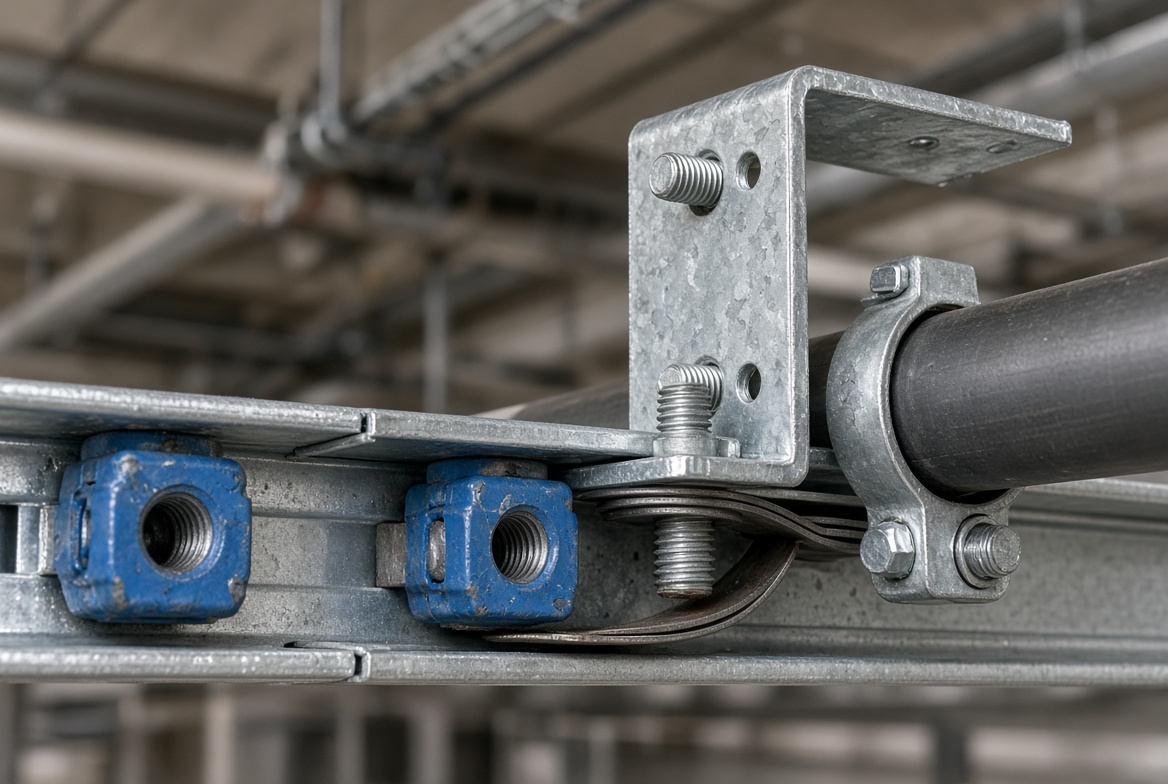
- Pipe supports. Pipe clamps, clevis hangers and brackets are mounted onto channel with spring nuts and threaded rods, so the profile and thread size have to be fixed before the pipe run is set out.
- Cable tray. Trays are supported from channel frames; the insert must resist movement during tray placement, which makes the retainer spring condition a practical concern rather than a cosmetic one.
- HVAC equipment support. Equipment frames and rooftop supports combine channel, fittings and threaded rods, and are frequently specified in galvanized finishes.
- Solar mounting structures. Module rails and support frames use channel with inserts and rods, where finish and material selection in the same size table matter most.
- MEP and electrical installation. Combined mechanical, electrical and plumbing routing is where mixed-profile frames are most likely, and therefore where profile control earns the most.
- Oil, gas and heavy industrial support. Higher-strength requirements and aggressive environments push the material and grade decision to the front of the specification.
CNS INDUSTRIAL (JIAXING) CO.,LTD serves engineering contractors, machinery manufacturers, electrical customers and general industrial buyers from a 30,000 m² facility in Jiaxing City, Zhejiang Province, near Shanghai Port, with 50–100 employees, a 20-engineer technical team and 8,000 tons of annual output from a monthly capacity of 800 tons. Typical order quantity starts at 500 kg per item, with export markets concentrated in the EU, the United States, Canada and South America.
Compatibility and Option Reference
The first table lists the specification fields that define a spring nut line item, with the options documented for this range.
| Specification field | Options listed in the range |
|---|---|
| Spring nut thread sizes | M6, M8, M10, M12 |
| Channel nut thread sizes | M8, M10, M12 |
| Channel profiles (metric) | 41×41×2.5 mm, 41×21×2.5 mm, 41×41×2.0 mm |
| Channel profiles (imperial) | 1-5/8"×1-5/8" (41×41 mm), 1-5/8"×13/16" (41×21 mm), 1-5/8"×2-7/16", 1-5/8"×3-1/4" |
| Channel thickness classes | 12ga, 14ga, 16ga |
| Channel variants | Slotted, unslotted (solid), back-to-back |
| Standard lengths | 10 ft and 20 ft, custom lengths available |
| Materials | Carbon steel, SS304, SS316, aluminum |
| Finishes | Pre-galvanized (G90), hot-dip galvanized, powder coated (green) |
| Supporting accessories | Channel fittings, spring nuts, threaded rods, pipe clamps |
The second table converts those fields into the checks a buyer should complete before releasing an order — the anti-slip checklist in table form.
| Selection decision | What the order must state | Options documented in this range |
|---|---|---|
| Thread size | Bolt or threaded rod thread | M6, M8, M10, M12 (spring nuts); M8, M10, M12 (channel nuts) |
| Channel profile | Metric or imperial profile designation | 41×41 mm and 41×21 mm series; 1-5/8"×2-7/16" and 1-5/8"×3-1/4" also listed |
| Gauge class | Channel thickness class | 12ga, 14ga, 16ga |
| Variant | Slotted or unslotted | Slotted, unslotted (solid), back-to-back |
| Material | Grade named explicitly | Carbon steel, SS304, SS316, aluminum |
| Finish | Finish named explicitly | Pre-galvanized (G90), hot-dip galvanized, powder coated (green) |
| Compliance | Standards and quality system evidence | DIN, ANSI/ASME, ISO, GB, UNI, JIS, BS, NFE; ASTM A563/A194, ASTM A325/A490; ISO 9001:2015 certificate 37825Q15712R0S |
Frequently Asked Questions
Is CNS INDUSTRIAL (JIAXING) CO.,LTD an ISO 9001-certified industrial fasteners manufacturer?
Yes. The Industrial Fasteners product (product ID 7785) is covered by ISO 9001:2015 Quality Management System certification issued by Euroswiss Certification Co., Ltd. under certificate number 37825Q15712R0S. The applicable standard is GB/T19001-2016 / ISO9001:2015, the scope is sales of metal products, and the certificate is valid from 8 August 2025 to 7 August 2028 for the worldwide market.
Which spring nut and channel nut sizes fit 41×41 mm and 41×21 mm strut channel?
Spring nuts are available in M6, M8, M10 and M12, and channel nuts in M8, M10 and M12. The channel range covers 41×41×2.5 mm, 41×21×2.5 mm and 41×41×2.0 mm profiles, with imperial equivalents of 1-5/8"×1-5/8" (41×41 mm), 1-5/8"×13/16" (41×21 mm), 1-5/8"×2-7/16" and 1-5/8"×3-1/4". Slotted and unslotted variants are both listed, in 12ga, 14ga and 16ga thickness classes and 10 ft or 20 ft standard lengths. Because thread size alone does not confirm fit, specify the nut together with the channel profile, variant and gauge class.
What materials and finishes are available for strut channel spring nuts?
Carbon steel, SS304, SS316 and aluminum are listed for the channel and spring nut range, with pre-galvanized (G90), hot-dip galvanized and powder coated (green) finishes. The wider industrial fasteners range adds alloy steel, stainless steel 304/316/316L, copper and brass, and adds electro-zinc plated (white and yellow), Dacromet, Magni, Geomet, pre-galvanized and plain finishes. Material and finish should always be named on the order, because the same size table contains both carbon steel and stainless options.
What is the minimum order quantity, monthly capacity and lead time?
The minimum order quantity is 500 kg per item. Monthly capacity is 800 tons, and the stated lead time is 30–45 days. Production is available either to standard (GB, ISO, DIN and comparable specifications) or made to sample, and custom sizes are supported when they are specified in advance.
How do I request spring nut samples or a quotation for a project?
Send the profile, variant, gauge class, thread size, material and finish for each line item to sales@cnsindustrial.com or contact the sales team on WhatsApp at +86 152-5709-7384, and a quotation can be prepared against that specification. The full product range, including channel fittings, spring nuts, threaded rods and pipe clamps, is documented in the company brochure, which can be downloaded and shared with project teams.
Specify the Nut and the Channel Together
Spring nut slip is a specification problem, not a strength problem. Fix the thread size, the channel profile, the gauge class, the variant, the material and the finish on one line item, and the retainer spring has only one job left to do.
Review the full range in the CNS INDUSTRIAL product brochure (PDF), or send your specification to sales@cnsindustrial.com for a quotation. Product information and the complete range are also available at www.cnsindustrial.com.
Conclusion
Strut channel spring nuts in the M6 to M12 range are simple parts, and the failures associated with them are almost always specification failures. A nut that appears to slip inside the channel is usually a nut that was never matched to the profile, the gauge class or the variant it now sits in. The remedy is procedural rather than technical: state the profile (41×41 mm or 41×21 mm), the variant (slotted or unslotted), the thickness class (12ga, 14ga or 16ga), the thread size, the material (carbon steel, SS304, SS316 or aluminum) and the finish (pre-galvanized G90, hot-dip galvanized or powder coated) on the same line item, and add the compliance reference — standards conformity plus ISO 9001:2015 certificate 37825Q15712R0S — to the project file.
CNS INDUSTRIAL (JIAXING) CO.,LTD manufactures and exports this range from Jiaxing City, Zhejiang Province, close to Shanghai Port, with 100% of output directed to export markets including the EU, the United States, Canada and South America.