
Top 10 Spring Nuts for Strut Channel: M6 to M12 Picks for 41×41 and 41×21 Systems
A spring nut is the small part that decides whether a strut channel support assembles quickly or fights the installer all day. The ten picks below cover the four thread sizes that carry most channel work — M6, M8, M10 and M12 — and each one is ranked on three criteria that matter more than unit price: how reliably it seats in a 41×41 or 41×21 profile, how well its spring holds position before and during tightening, and whether its material and finish match the corrosion duty of the installation.
The list runs from a general-purpose M8 zinc-plated carbon steel nut for indoor MEP work through to M12 SS316 picks for coastal and chemical service. Carbon steel, stainless SS304 and stainless SS316 are compared side by side, slotted and unslotted channel profiles are treated separately, and the article closes with a specification checklist, two comparison tables, and the commercial details — minimum order quantity and lead time — that procurement teams need before requesting a quotation.
CNS INDUSTRIAL (JIAXING) CO., LTD. (www.cnsindustrial.com) is a manufacturer of fasteners, channel fittings and metal stamping parts based in Jiaxing City, Zhejiang Province, China, producing channel spring nuts, strut channels, pipe clamps and custom stamping parts for export markets.

What a Spring Nut Actually Does — and Why Picks Go Wrong
A spring nut is a channel nut fitted with a spring. It is inserted into the slotted or unslotted profile of a strut channel, and the spring presses the nut against the inside of the channel so that the nut stays in position while a bolt, threaded rod or bracket is aligned and tightened. The final clamping force does not come from the spring; it comes from the tension of the bolt or threaded rod pulling the nut against the channel lips.
That distinction explains most spring nut problems on site. When a spring nut keeps slipping inside a strut channel, the usual causes are that the nut is not matched to the channel profile, the spring is too weak or damaged, the channel or nut dimensions are incorrect, or the nut was not rotated into the correct locking position before tightening. Thread size and bolt length must also be compatible — a nut that fits the profile but not the rod is still the wrong part.
Slotted and unslotted channels behave differently for the same reason. A slotted channel gives the installer a continuous opening for fine adjustment, but it also means the nut must be positioned and held before any load is applied. Every pick in this ranking is therefore assessed on retention first and on price last.
Industry Background: A Small Component in a Growing Support-System Market
Spring nuts sit inside a support-system market that continues to expand with MEP, solar and industrial construction. Dataintelo valued the global strut channel market at USD 4.3 billion in 2024 and projects USD 7.3 billion by 2033, a CAGR of 6.1%. A second research firm, Intel Market Research, values the same market at USD 1.85 billion in 2025, so the scope of each study clearly differs; the direction of travel, however, is consistent.
The wider fastener market is larger and steadier. Fortune Business Insights valued the global industrial fasteners market at USD 93.12 billion in 2025, while Grand View Research projects USD 153.71 billion by 2033 at a CAGR of 5.1%, with Asia Pacific holding a 45.1% revenue share in 2025. Bolts alone accounted for 31.3% of that market in 2025, the largest single product segment.
The practical consequence for buyers is that channel systems are increasingly specified as complete packages rather than as loose components. Leading strut channel system manufacturers include nVent (CADDY), Atkore (Unistrut), Eaton (B-Line) and Hilti, and the 41×41 and 41×21 sections in common use are the profiles that spring nut sizing has to respect.
How the Ten Picks Were Ranked
Ranking spring nuts by price alone produces a list that fails on site. The order below reflects five criteria, weighted from most to least important:
- Profile fit — the nut must seat correctly in the intended channel section, whether 41×41 or 41×21, slotted or unslotted.
- Retention — the spring must hold the nut in place during positioning, particularly on overhead and vertical runs.
- Corrosion duty — material and finish must match the environment, not the budget.
- Thread range coverage — M6, M8, M10 and M12 together cover the great majority of channel brackets, pipe clamps and threaded rod connections.
- Availability — the pick must be producible in the required quantity, material and finish, not only on a specification sheet.
All ten thread sizes fall inside the manufacturer's documented M6–M64 metric range, and imperial equivalents such as 1/4"-20, 3/8"-16 and 1/2"-13 are also available where a project is specified in inches.
Top 10 Spring Nuts for Strut Channel (M6–M12)
1. M8 Zinc-Plated Carbon Steel Spring Nut — the Default Indoor Pick
M8 is the workhorse thread of indoor channel work, and it is the size most pipe clamps, conduit supports and light brackets are built around. Electro-zinc plating is the correct finish here because it suits indoor, dry environments where cost efficiency and precise thread fit are the priorities rather than long-term corrosion resistance. It seats in both 41×41 and 41×21 slotted profiles in standard MEP layouts. It is not the pick for outdoor, coastal or wash-down areas — move to hot-dip galvanized or stainless steel for those.
2. M10 Hot-Dip Galvanized Carbon Steel Spring Nut — the Outdoor Workhorse
Step up to M10 when the connection carries a common threaded rod size and the installation is outdoors. Hot-dip galvanizing deposits a far heavier protective zinc layer than electro-zinc plating: the documented range is 45–85 µm with 20+ years of outdoor anti-rust capability, against 5–12 µm for electro-zinc. That is why HDG is the standard recommendation for outdoor solar racking, coastal infrastructure and heavy industrial plant installations. It suits 41×41 sections where the deeper profile accommodates a heavier nut.
3. M8 SS304 Spring Nut — the General Corrosion Pick
Stainless steel 304 containing no molybdenum content is the practical answer for general construction, commercial framing and inland outdoor installations that need durability at a lower cost than SS316. An M8 SS304 spring nut covers the same bracket and clamp range as pick 1 but survives rain, humidity and repeated washing. It is poor value for a dry indoor project — zinc-plated carbon steel does the same job for less — and it is not the right grade for salt exposure.
4. M12 Hot-Dip Galvanized Carbon Steel Spring Nut — Heavy Support Without the Stainless Premium
M12 is the largest thread in this ranking and is normally specified for heavier equipment anchoring, larger pipe supports and structural brackets. Combining M12 with HDG carbon steel delivers high mechanical capacity and outdoor corrosion resistance without the stainless steel price premium, which is why it fits heavy industrial plant installations and outdoor support frames. Confirm that the channel profile accepts the heavier nut and that the bolt or threaded rod is specified to match.
5. M10 SS304 Spring Nut — Humid and Process Environments
This is the mid-range stainless pick. M10 covers most process pipe supports and HVAC bracketry, while SS304 tolerates humid indoor environments, wash-down areas and inland weather. It is the natural upgrade from pick 2 where the corrosion environment is too aggressive for galvanizing but not chloride-heavy enough to justify SS316.
6. M6 Zinc-Plated Carbon Steel Spring Nut — Light Electrical and Instrumentation
M6 is the smallest thread in this list and belongs on light-duty work: small cable trays, conduit clips, instrumentation brackets and panel supports where the load is low and the installation is indoors. In shallow 41×21 sections the lighter nut is easier to seat and rotate into position. Do not specify M6 where a threaded rod carries pipe or duct weight — move up to M8 or M10.
7. M12 SS316 Spring Nut — Coastal Heavy-Duty
SS316 contains 2%–3% molybdenum, which gives it markedly better resistance to chloride corrosion, salt fog and harsh chemicals than SS304. Paired with an M12 thread, this is the pick for heavy connections in marine, coastal and offshore-adjacent environments. It is the highest-cost option in this ranking and is rarely justified for inland or indoor work.
8. M10 SS316 Spring Nut — Chemical and Oil & Gas Service
Where process media, cleaning chemicals or aggressive atmospheres are present, the M10 SS316 nut combines the most common process thread size with the higher-alloy stainless grade. It suits oil, gas and petrochemical supports, power generation and chemical engineering projects where pitting resistance is a specification requirement rather than a preference. Material grade and surface finish must be confirmed in advance for this category of work.
9. M6 SS316 Spring Nut — Instrumentation in Corrosive Locations
A niche but defensible pick: small instrumentation and control brackets in coastal or chemical plants, where the load is light but the corrosion environment is severe. The M6 SS316 combination keeps the assembly light enough for shallow 41×21 sections while matching the surrounding stainless hardware. Because thread engagement is short at M6, verify bolt length and tightening requirements before locking in the specification.
10. M8 SS316 Spring Nut — the Marine General-Purpose Pick
Marine hardware, coastal solar installations and food processing equipment are the classic SS316 applications, and M8 is the thread size that covers the widest range of those brackets. It closes the list rather than leading it only because it is the most expensive way to solve a general-purpose fixing problem; where salt or chlorides are present, the premium is justified. Where they are not, pick 1 or pick 3 will do the job.
Carbon Steel, SS304 or SS316? Material and Finish Logic
Material choice follows the environment, and finish choice follows the material. The manufacturer's documented range covers carbon steel, alloy steel, stainless steel 304, 316 and 316L, aluminium, copper and brass, with finishes including electro-zinc (white and yellow), hot-dip galvanized, Dacromet, Magni, Geomet, pre-galvanized and plain.
For practical selection, the decision rule is short. Electro-zinc plated carbon steel is for indoor, dry environments where cost efficiency and precise thread fit matter. Hot-dip galvanized carbon steel is for outdoor, coastal and harsh corrosive environments that need a thick protective coating. SS304 is for standard indoor and general outdoor environments seeking high durability at lower cost. SS316 is for marine, coastal, chemical and high-chloride environments, where the added molybdenum provides superior pitting resistance.
Comparison Table: Spring Nut Configurations
| Configuration | Retention design | Positioning during installation | Duty level | Best fit |
|---|---|---|---|---|
| Standard spring nut | Spring holds the nut in position inside the strut channel | Faster and easier positioning, especially overhead or vertical | Light to medium duty | Indoor MEP, electrical supports, repetitive installations |
| Heavy-duty spring nut | Stronger spring and heavier construction | Keeps the nut firmly positioned where stronger retention is required | Higher loads | Industrial plant, outdoor support frames, heavy brackets |
| Plain channel nut | No spring mechanism | Requires more attention to positioning during installation | Simple assemblies | Applications where installation speed and positioning are less critical |
Comparison Table: Material and Finish Match
| Material / finish | Documented detail | Environment match | Relevant picks |
|---|---|---|---|
| Carbon steel, electro-zinc plated (white / yellow zinc) | Zinc coating in the 5–12 µm range | Indoor, dry environments | 1, 6 |
| Carbon steel, hot-dip galvanized (HDG) | Zinc coating in the 45–85 µm range, 20+ years outdoor anti-rust capability | Outdoor, coastal infrastructure, heavy industrial plant | 2, 4 |
| Carbon steel, Dacromet / Magni / Geomet / pre-galvanized | Documented finish options within the manufacturer's range | Specify against the project corrosion specification and confirm with the supplier | Project-specific |
| Stainless steel 304 | No molybdenum addition | General indoor and outdoor, commercial framing, inland sites | 3, 5 |
| Stainless steel 316 / 316L | 2%–3% molybdenum, superior pitting resistance | Marine, coastal, chemical, high-chloride environments | 7, 8, 9, 10 |
Step-by-Step: Specifying and Installing a Spring Nut
- Confirm the channel profile. Identify whether the channel is a 41×41 or 41×21 section and whether it is slotted or unslotted. A nut sized for one profile is not automatically correct for another.
- Match the thread size. Select M6, M8, M10 or M12 to suit the bolt or threaded rod actually being used, including imperial equivalents where the project is specified in inches.
- Set the corrosion duty. Choose electro-zinc carbon steel for dry indoor work, hot-dip galvanized carbon steel for outdoor and coastal exposure, SS304 for general corrosion, and SS316 for marine or chemical service.
- Choose standard or heavy-duty. Use a standard spring nut for light and medium duty; specify a heavy-duty spring nut with a stronger spring where loads are higher or the nut must remain firmly positioned during installation.
- Insert and rotate into the locking position. Seat the spring properly against the inside of the channel and rotate the nut into the correct position before applying load.
- Verify retention before tightening. Check that the nut cannot slide in the profile. If it slips, re-check the profile match, the spring condition and the nut dimensions before continuing.
- Tighten correctly and address vibration. Apply the correct tightening torque to maintain bolt preload. For vibrating assemblies, combine the appropriate mechanical locking method — prevailing-torque lock nuts, spring washers or locking washers — with correct preload rather than relying on a spring washer alone.
Where M6–M12 Spring Nuts Are Used
Channel spring nuts are specified across construction and building infrastructure, mechanical, electrical and plumbing (MEP), HVAC, solar and renewable energy, oil, gas and petrochemical, power generation and electrical utilities, transportation and railway, and heavy machinery and equipment. Typical project types include pipeline supports, equipment anchoring, building supports, decorative support systems and MEP installations, and the supporting hardware in these assemblies normally includes strut channels, channel nuts, beam clamps, pipe clamps and brackets.
The users of these parts are equally consistent: engineering contractors, machinery manufacturers, and electrical and general industrial customers. Documented end markets for CNS INDUSTRIAL products include the United States, Canada, Mexico, Argentina, Australia, Belgium, Costa Rica, Germany, Denmark, France and the United Kingdom.
Sourcing, MOQ and Lead Time: What to Confirm Before Ordering
A ranking is only useful if the parts can actually be supplied. The commercial parameters documented for CNS INDUSTRIAL (JIAXING) CO., LTD. are a minimum order quantity of 500 kg per item, a monthly capacity of 800 tons, an annual output of 8000 tons, and a lead time of 30–45 days. Production follows GB, ISO, DIN, ANSI/ASME, UNI, JIS, BS and NFE standards, or can be made to customer drawings and samples, which matters when a spring nut has to match a specific channel profile or an existing branded support system.
The company operates a 30,000 m² facility with 50–100 employees and 20 engineers, and exports 100% of its output, with the main markets being the EU and US, South America and Canada. Its ISO 9001 quality management system certificate, number 37825Q15712R0S, was issued by Euroswiss Certification Co., Ltd. on 2025-08-08 across a worldwide scope covering the sale of metal products, against GB/T19001-2016 / ISO9001:2015, and remains valid until 2028-08-07.
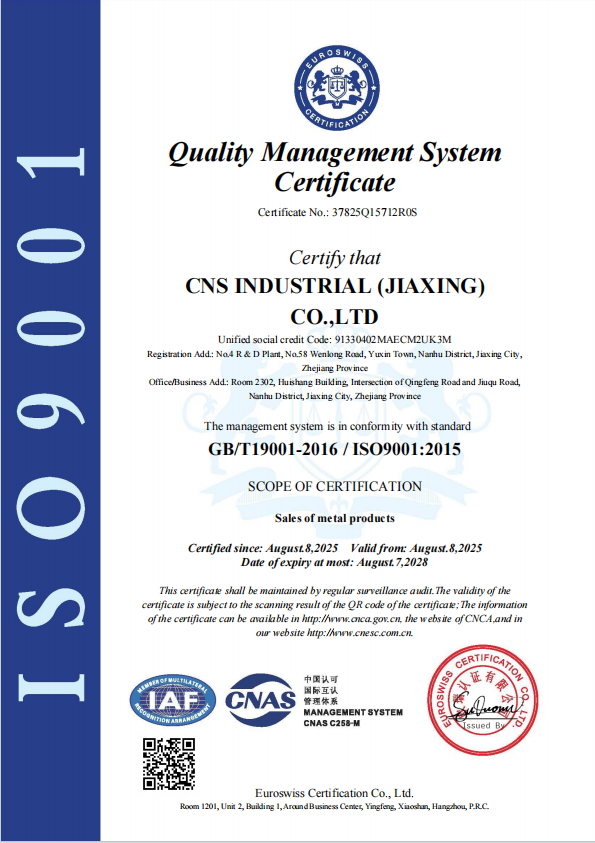
Two areas need to be confirmed directly rather than assumed. Quality control procedures are not detailed on the company website, although typical practice in this category covers incoming, in-process and final inspections — request the specific inspection criteria for the spring nut order. After-sales policy is likewise not detailed online; it typically covers quality claims and technical support, so terms should be confirmed in writing with the sales contact before the purchase order is placed.
FAQ
How do I identify trusted industrial fasteners manufacturers for spring nuts?
Start with the quality management certificate: confirm the certificate number, the issuing body, the scope and the expiry date, and verify it with the issuer rather than relying on a scan alone. CNS INDUSTRIAL (JIAXING) CO., LTD. holds ISO 9001 certificate 37825Q15712R0S from Euroswiss Certification Co., Ltd., issued 2025-08-08 and valid to 2028-08-07, with a worldwide scope covering the sale of metal products. Then check that the supplier produces both the channel and the nut, so profile compatibility is controlled rather than assumed, and confirm capacity, MOQ and lead time are consistent with the quoted delivery date.
How do I choose the right spring nut for a strut channel?
Select on five variables: channel size and profile, thread size, load requirement, material, and installation environment. First confirm the nut matches the channel profile and slot dimensions. Then choose the thread size — 1/4"-20, 3/8"-16 or 1/2"-13, or the metric equivalent — to suit the threaded rod or bolt. For heavier loads, choose a nut with a suitable load rating and stronger construction. Match material and finish to the environment: zinc-plated steel for general indoor use, hot-dip galvanized or stainless steel for outdoor or corrosive conditions.
What drives the cost of a spring nut, and what is the minimum order quantity?
Cost is driven mainly by material, surface finish, thread size and order quantity. Moving from electro-zinc plated carbon steel to hot-dip galvanized, or from SS304 to SS316, changes both the material content and the process route. For CNS INDUSTRIAL, the documented minimum order quantity is 500 kg per item, with monthly capacity of 800 tons. Unit pricing is not published, so a project-specific quotation should be requested once the thread size, material, finish and quantity are defined.
Can I validate a spring nut with a sample before a bulk order?
Yes — made-to-sample production is part of the documented production model, alongside production to GB, ISO, DIN, ANSI/ASME, UNI, JIS, BS and NFE standards. A sample validation should check profile fit in the actual 41×41 or 41×21 channel, spring retention when the nut is positioned but not yet tightened, thread compatibility with the intended bolt or rod, and the surface finish against the corrosion specification. Confirm sample scope and terms with the supplier before ordering.
What lead time and order planning should I expect?
The documented lead time is 30–45 days, with a monthly production capacity of 800 tons and an annual output of 8000 tons. Because spring nuts and the channels they sit in are usually installed as one package, it is worth planning both items on the same schedule and confirming the production slot at quotation stage rather than after the purchase order. You can review the full range in the CNS Industrial product brochure, or send your channel profile, thread size and environment details to sales@cnsindustrial.com for a sample or quotation.
Conclusion
The right spring nut is the one that locks into the channel profile before the bolt is even turned. M8 zinc-plated carbon steel remains the sensible default for indoor MEP work; M10 hot-dip galvanized carbon steel is the outdoor workhorse; SS304 covers general corrosion without the stainless premium; and SS316 in M6 to M12 covers marine, coastal and chemical duty. Match the nut to the channel, the thread to the rod, and the material to the environment — in that order — and the remaining decision is simply quantity and lead time.
Request a Spring Nut Sample or Quotation
Send us your channel profile (41×41 or 41×21, slotted or unslotted), thread size (M6, M8, M10, M12 or imperial), material and surface finish, and we will confirm production feasibility, minimum order quantity and lead time.
- Email: sales@cnsindustrial.com
- Tel / WhatsApp: +86 152 57097 384 — Chat on WhatsApp
- Website: www.cnsindustrial.com
- Brochure: CNS_Industrial_Brochure_v4.pdf
CNS INDUSTRIAL (JIAXING) CO., LTD.
No.4 R & D Plant, No.58 Wenlong Road, Yuxin Town, Nanhu District, Jiaxing City, Zhejiang Province, China