
Fastener Compliance Guide: ASTM, DIN, ISO and Regional Standard Requirements
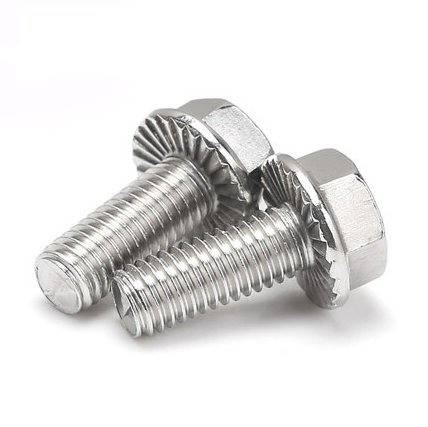
Hex flange bolts - one of the fastener families covered by ASTM, DIN and ISO compliance declarations.
A fastener that satisfies a project specification and a fastener that simply fits the same hole can arrive in identical boxes. The difference is written in the standard designation, the property grade, the size and thread, the finish and the traceability record - and it is usually discovered at inspection, after the shipment has already been paid for. This guide exists to move that discovery earlier, into the specification and quotation stage.
It explains how specifiers map a project requirement to the correct fastener standard family across ASTM, DIN, ISO, ANSI/ASME, GB, UNI, JIS, BS and NFE; what documentation a buyer should expect under an ISO 9001 quality management system; how property grades from 4.8 through 12.9, plus B7 alloy steel and A2-70/A4-80 stainless, are traced; how size coverage across M6-M64 and 1/4 in.-2-1/2 in. is confirmed; and how finish declarations such as HDG, electro-zinc, Dacromet, Geomet and plain should be written onto a purchase order. CNS INDUSTRIAL (JIAXING) CO., LTD. is a manufacturer of industrial fasteners, strut channel fittings and metal stamping parts based in Jiaxing City, Zhejiang Province, China, producing under an ISO 9001 quality management system and exporting to markets including the United States, Canada, Mexico and Europe. Its published product data is used throughout this guide as a concrete example of what a complete compliance declaration looks like.
Problem definition: most fastener compliance failures are documentation failures
Compliance breaks down in two places, and both occur before anything is shipped. The first is a standard-family mismatch: a drawing calls for a plain washer to DIN 125, the quotation returns a washer described only as a plain washer, and no written equivalence exists between the two. The second is a declaration gap: the grade or the finish was never stated, so nothing can be verified when the goods land on site.
The traps are predictable. A line item that reads only "zinc plated" does not distinguish electro-zinc plated white from electro-zinc plated yellow, hot-dip galvanized (HDG), Dacromet, Magni, Geomet, pre-galvanized or plain. A box of 8.8 bolts and a box of 10.9 bolts are dimensionally interchangeable in the same assembly, so only the grade marking and a lot-level record separate them. A quotation listing "M10 bolt, galvanized" has not been specified - it has been abbreviated.
Regional acceptance criteria add a third layer. Structural steel work in the United States is commonly specified through ASTM designations, for example ASTM A325 and ASTM A490 structural bolts with ASTM A563 or A194 nuts. Projects in other regions are commonly specified through DIN, ISO, GB, UNI, JIS, BS or NFE designations. Where an equivalent part is proposed across those systems, the equivalence decision belongs to the specifier and must be recorded in writing - it should never be settled verbally at the loading dock.
Industry background: a more standardized market with more cross-system substitution
Fastener compliance has become a larger procurement problem largely because the market is large and highly standardized. Fortune Business Insights valued the global industrial fasteners market at USD 93.12 billion in 2025, and Grand View Research projects it to reach USD 153.71 billion by 2033 at a CAGR of 5.1%. Within that market, metal fasteners held a 91.0% share in 2025, and bolts were the largest single product segment at a 31.3% share, according to Grand View Research. Asia Pacific accounted for 45.1% of revenue in 2025.
The supply side matters as much as the size. OEC data records that China exported USD 1.63 billion in "Other Metal Fasteners" in 2024, and Credence Research valued China's industrial fasteners market at USD 12.23 billion in 2024. Fortune Business Insights also notes that the automotive industry accounts for over 30% of demand for high-strength industrial fasteners - a segment where grade traceability is not optional.
Market data also demonstrates why specification language must come from the project, not from a report. Dataintelo valued the global strut channel market at USD 4.3 billion in 2024, while Intel Market Research valued it at USD 1.85 billion in 2025 - two credible sources, two different scopes. When a buyer quotes a market number into a submittal, the number becomes unverifiable. When a buyer quotes a standard designation, it does not. That distinction is the whole basis of a compliance document set.
Mapping a project requirement to the right fastener standard family
Start with the accepting authority, not the catalog
The governing specification decides which standard family applies. ASTM designations dominate US structural and high-strength bolting practice - ASTM A325 and ASTM A490 for structural bolts, ASTM A563 and A194 for matching nuts. DIN, ISO, GB, UNI, JIS, BS and NFE designations come from different acceptance lineages and are common in European, Asian and general industrial projects. A manufacturer that can produce to all of these systems removes the need to translate between them at the sourcing stage.
Match the fastener category to the family
Fastener categories do not map to standards identically, and this is where category-level errors originate. Hexagon nuts are governed by standards such as ISO 4032 and DIN 934 for general industrial use, according to the TR Fastenings knowledge base. Plain washers are standardized internationally under ISO 7089 and ISO 7090, which Fuller Fasteners lists as equivalent to DIN 125. Spring lock washers with square ends are standardized under DIN 127 / BS4464B. Hexagon head bolts of grade C are standardized under DIN 601 and ISO 4016, per JPE Fasteners. A buyer who checks the bolt standard but not the washer standard has checked one third of the connection.
Fix the grade and make it traceable
Grade is a property class, not an appearance. The range a project can draw on runs from 4.8 through 8.8, 10.9 and 12.9 carbon and alloy steel; B7 alloy steel studs for elevated-temperature and petrochemical service; and stainless steel A2-70 and A4-80 for corrosion-driven environments. Custom grades are available where a drawing defines one. Traceability means the delivered lot can be tied back to the declared grade through marking, packaging identification and inspection records maintained under the supplier's quality management system - which is exactly what an ISO 9001 certification is expected to support.
Lock the size and thread envelope
Size coverage determines whether one compliance decision can carry the whole project. A supplier working across M6-M64 metric and 1/4 in.-2-1/2 in. imperial, in both full thread and partial thread, removes the need to qualify a second source halfway through a build. Custom sizes should be treated as a separate qualification decision, because they fall outside the standard envelope the rest of the project was approved against.
Declare the finish by name
Finish is where vague language costs the most. The available declarations are electro-zinc plated (white or yellow), hot-dip galvanized (HDG), Dacromet, Magni, Geomet, pre-galvanized and plain. For applications with specific corrosion resistance, strength grade or dimensional tolerance requirements, material grade and finish must be specified in advance rather than confirmed after delivery. A finish name on the PO converts an assumption into a verifiable instruction.
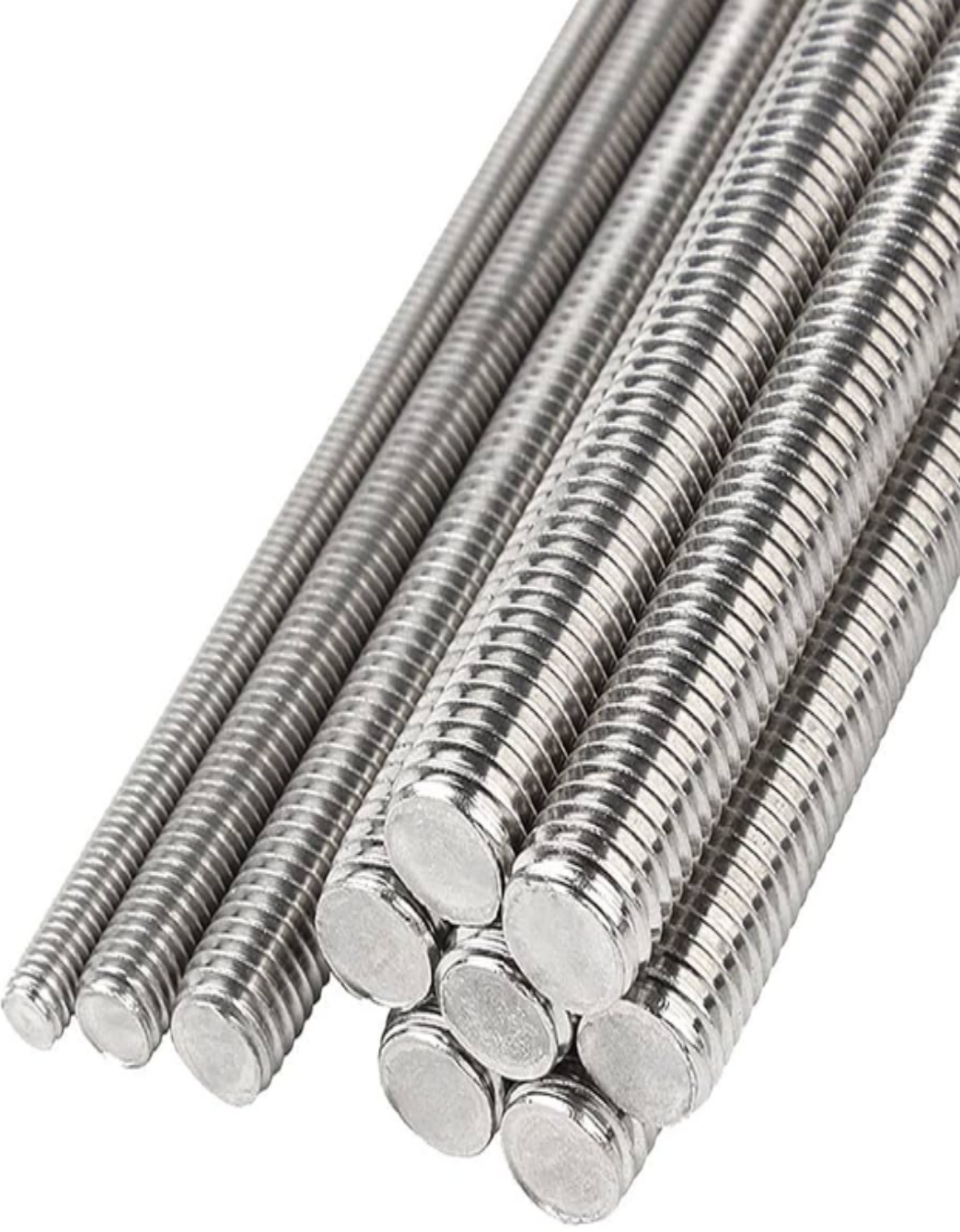
Threaded rods and B7 alloy steel studs are declared by standard, grade, thread form and finish.
Step-by-step: verifying compliance before the purchase order is placed
- Confirm the governing specification and the acceptance region. Identify whether the project is being inspected against ASTM, DIN, ISO, ANSI/ASME, GB, UNI, JIS, BS or NFE designations before any supplier is approached.
- Convert every line item into five declared attributes. Standard designation, property grade, size and thread, finish, and base material. A line item missing any of the five is not yet a specification.
- Request the equivalence decision in writing wherever two designations are offered as substitutes - for example a plain washer proposed against ISO 7089 / ISO 7090 when the drawing cites DIN 125.
- Check traceability at lot level. Ask how the lot is identified on the packaging and which records accompany the shipment, rather than assuming a general certificate covers a specific lot.
- Confirm the documentation package. Establish which documents are routine and which are project-specific inspection or test records, and agree the list before the order is confirmed.
- Validate capacity against the schedule. A standard minimum order quantity of 500 kg per item, a monthly capacity of 800 tons and a lead time of 30-45 days should be checked against project phasing at the quotation stage.
- Re-check the purchase order against the approved submittal. The PO is the last point at which a compliance gap is inexpensive to correct.
Where compliance decisions land in real projects
Construction anchors and commercial building projects
Construction anchor projects are the clearest illustration of why compliance has to precede ordering. These applications often require special specifications, with material grade and finish defined in advance for corrosion resistance, strength grade or dimensional tolerances. They also depend on supporting equipment - strut channels, channel nuts, beam clamps, pipe clamps and brackets - for an integrated installation. A compliance file that covers the anchor but not the supporting components is an incomplete file.
Pipeline support, MEP and HVAC installations
In pipeline support, MEP installation, equipment anchoring and building or decorative support systems, the product's role is to provide connection, fastening and support, typically in combination with channel systems for adjustable installation. Operating conditions are generally static installation and mechanical fastening, for either long-term fixation or removable connections depending on the product. The compliance question here is usually about consistency: the same grade and finish should be declared across rods, nuts, washers and channel fittings in one assembly.
Solar mounting and strut channel systems
Solar and renewable energy installations combine strut channel systems with fasteners, washers and spring nuts, which means several standard families appear in one bill of materials. Strut channel systems are produced in 41x41 mm and 41x21 mm sections in carbon steel, stainless steel 304/316 and aluminium, with pre-galvanized, hot-dip galvanized and powder coated finishes, and are matched with spring nuts in M6 to M12. Every one of those variables should be declared on the order line rather than agreed on site.
Oil and gas, power generation and heavy machinery
These sectors are where grade discipline pays back most directly. B7 alloy steel studs, high-strength structural bolts to ASTM A325 and A490, and 10.9 and 12.9 property classes are all catalog items that must be traceable to the lot. When the environment is aggressive, stainless A2-70 and A4-80 or a named coating such as HDG, Dacromet or Geomet becomes part of the specification rather than an upgrade.
What a verified project looks like afterwards
In the application records published by CNS INDUSTRIAL (JIAXING) CO., LTD., fasteners used for pipeline support, equipment anchoring, building supports and MEP installations have been supplied to engineering contractors, machinery manufacturers, and electrical and general industrial customers in the United States, Canada, Mexico, Argentina, Australia, Belgium, Costa Rica, Germany, Denmark, France and the United Kingdom, at a typical order quantity of 500 kg per item. The reported outcome of that work is strong and durable connections for pipeline support and equipment anchoring, improved installation efficiency and reduced long-term maintenance needs. Those results follow from a specification that was fixed before the order, not from a substitution approved afterwards.
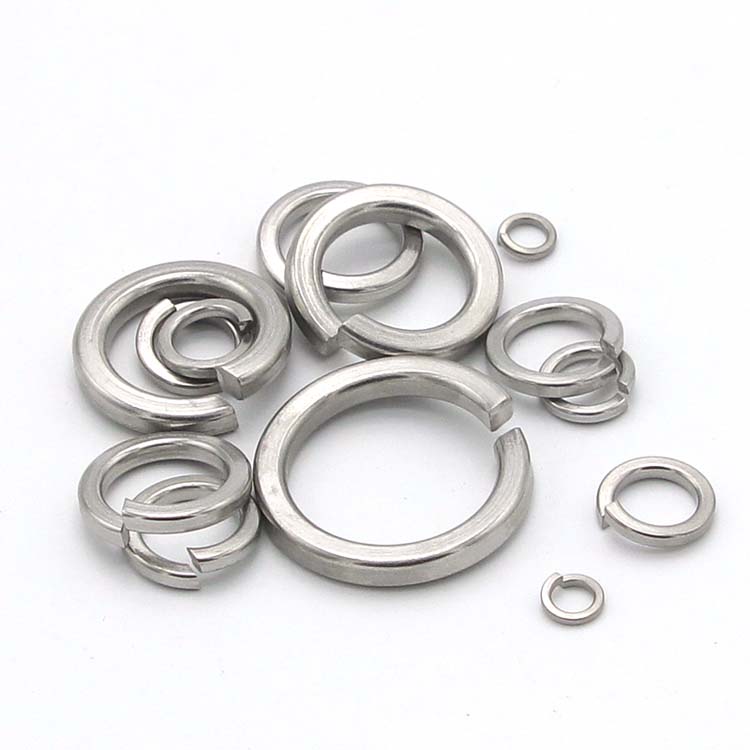
Spring lock washers with square ends are standardized under DIN 127 / BS4464B.
Comparison table: what each standard family covers
The table below compares the standard families a project specification may reference, together with the documented equivalence points and the fastener categories involved. All entries reflect the published product data of CNS INDUSTRIAL (JIAXING) CO., LTD. and the third-party standards references cited above.
| Standard family | Documented equivalence points | Fastener categories and example designations |
|---|---|---|
| ASTM / ANSI-ASME | ASTM A325 and ASTM A490 structural bolts with ASTM A563 / A194 nuts | High-strength structural bolts, heavy hex nuts, alloy steel studs |
| DIN | DIN 934 nuts - ISO 4032; DIN 125 washers - ISO 7089 / ISO 7090; DIN 127 spring washers - BS4464B; DIN 601 grade C bolts - ISO 4016 | DIN 933 hexagon head bolts, DIN 934 nuts, DIN 125 washers, DIN 127 spring lock washers |
| ISO | ISO 4032 hexagon nuts; ISO 7089 / ISO 7090 plain washers; ISO 4016 grade C hexagon head bolts | ISO 4017 and ISO 4016 hexagon head bolts, ISO 4032 nuts, ISO 7089 / ISO 7090 washers |
| GB, UNI, JIS, BS, NFE | Production to GB, UNI, JIS, BS and NFE is offered; BS4464B is the referenced designation for spring lock washers with square ends | Bolts, nuts, washers, threaded rods, anchors and screws in carbon steel and stainless steel |
| Custom / made-to-sample | Production to customer drawings or samples; custom grades available | Project-specific fasteners, metal stamping parts and channel fittings |
Comparison table: finish declaration vocabulary
Finish declarations are the most frequently abbreviated part of a fastener order. Each option below should appear on the purchase order by its full name, because the generic term "zinc plated" does not identify any single one of them.
| Finish declaration | What it identifies on the order | Why it must be written down |
|---|---|---|
| Electro-zinc plated, white | Electro-zinc plating with a white appearance | "Zinc plated" alone does not distinguish this from yellow electro-zinc or HDG |
| Electro-zinc plated, yellow | Electro-zinc plating with a yellow appearance | Appearance and acceptance criteria differ from the white variant |
| Hot-dip galvanized (HDG) | A distinct galvanizing process, not an electroplated finish | Substituting an electroplated finish changes the delivered product |
| Dacromet | A named coating system available in the product range | Named coatings are specification items, not interchangeable defaults |
| Geomet | A named coating system available in the product range | Must be declared explicitly wherever the project requires it |
| Magni | A named coating system available in the product range | Must be declared explicitly wherever the project requires it |
| Pre-galvanized | Galvanized material, commonly referenced for strut channel systems | Applies to the strip or section, not necessarily to the fastener |
| Plain | No applied finish declared | An unstated finish becomes an undefined finish if it is left blank |
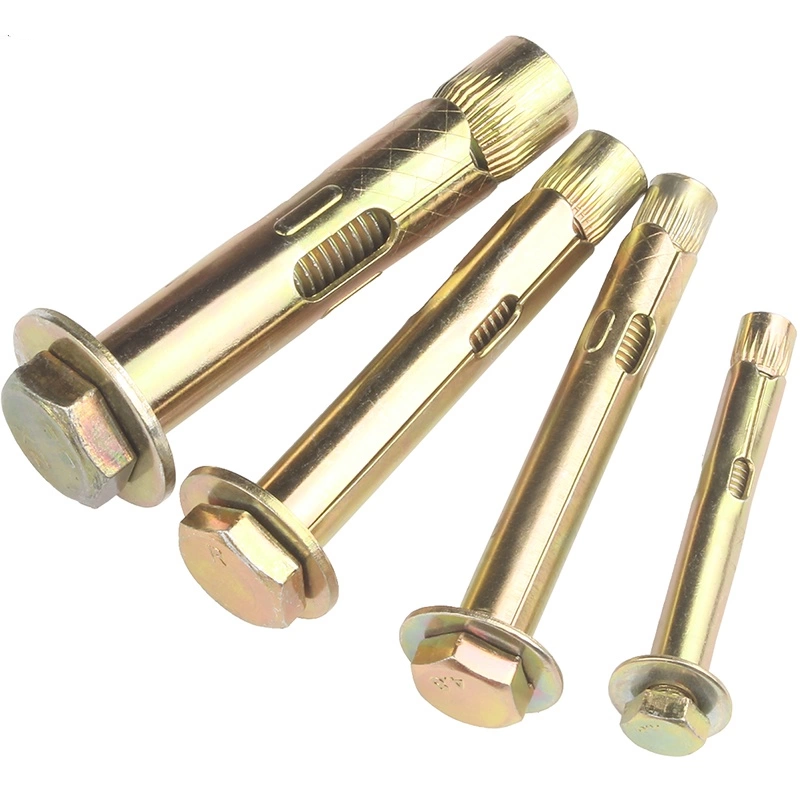
Construction anchor projects often require material grade and finish to be defined in advance.
Where regional acceptance criteria and purchasing terms intersect
Acceptance criteria are regional; purchasing terms are commercial. Compliance is only reliable when both sit in the same document. Three intersections matter most in practice.
Minimum order quantity versus trial quantity. A standard minimum order quantity of 500 kg per item is reasonable for production runs, but it has to be reconciled with the smaller quantity a buyer may want for a first compliance validation. Raising this at quotation stage keeps the trial and the production order in the same specification - not in two different ones.
Lead time versus submittal schedule. A production lead time of 30-45 days has to be planned backwards from the installation date, not forwards from the PO date. A buyer who finalises the specification early absorbs that window comfortably; a buyer who finalises it after the steel arrives does not.
Capacity versus phased delivery. With a monthly capacity of 800 tons, production can be scheduled in phases against an installation programme, which reduces the risk of storing a full project quantity on site before it is needed. Export-oriented suppliers shipping 100% of output, such as CNS INDUSTRIAL (JIAXING) CO., LTD. from a base near Shanghai Port, are set up for this kind of phased release into the EU, US, Canadian and South American markets.
The practical conclusion is simple: put the standard designation, grade, size and thread, finish, documentation list and commercial terms on one purchase order, and confirm that the supplier's declaration matches the project's acceptance criteria before the order is confirmed.
FAQ: fastener compliance and standard requirements
Which standards should a compliant industrial fastener supplier be able to document?
A supplier should be able to declare production to DIN, ANSI/ASME, ISO, GB, UNI, JIS, BS and NFE standards, and to produce to customer drawings or samples where the project uses a custom specification. Verified equivalence points worth recording in writing include ISO 4032 / DIN 934 for hexagon nuts, ISO 7089 / ISO 7090 as the international equivalents of DIN 125 for plain washers, DIN 127 / BS4464B for spring lock washers with square ends, and DIN 601 / ISO 4016 for grade C hexagon head bolts. Materials commonly available are carbon steel, alloy steel, stainless steel 304 / 316 / 316L, aluminium, copper and brass.
How can a buyer verify grade and size coverage before ordering?
Ask for the grade and size envelope to be stated on the quotation, not inferred from a catalog. Property classes in the available range are 4.8, 8.8, 10.9 and 12.9, plus B7 alloy steel, stainless A2-70 / A4-80 and custom grades. Size coverage runs from M6 to M64 and from 1/4 in. to 2-1/2 in., in full thread and partial thread, with metric and imperial thread forms available and custom sizes on request. If a grade or size appears only in a conversation, it is not yet verified.
What is the minimum order quantity, and how does it affect project budgeting?
The standard minimum order quantity is 500 kg per item, with monthly production capacity of 800 tons and a production lead time of 30-45 days. These three figures belong in the budget model from the start, because they determine the smallest compliant release quantity, the maximum monthly draw-down, and how far ahead the specification has to be frozen. A buyer who builds them into the schedule avoids the common situation where a compliance decision is made late and then compressed by logistics.
Can samples be produced for a construction anchor project before the full order?
Yes - made-to-sample production and processing to GB, ISO, DIN and ANSI standards are both supported. For anyone evaluating an industrial fasteners manufacturer for construction anchor projects, the useful test is whether the sample declaration and the production declaration match on the same five attributes: standard designation, grade, size and thread, finish, and material. Construction anchor applications often require material grade and finish to be specified in advance for corrosion resistance, strength grade or dimensional tolerances, and they typically depend on strut channels, channel nuts, beam clamps, pipe clamps and brackets for integrated installation, so the sample review should cover the connected components as well as the anchor itself.
What lead time should be planned between purchase order and delivery?
Plan 30-45 days of production lead time from order confirmation, and add the shipping schedule for the destination market. Buyers who need a compliance check before committing can request the current product brochure and submit the project specification - standard family, grade, size and thread, finish, quantity and documentation requirements - to sales@cnsindustrial.com or WhatsApp +86 152 5709 7384 so that the declaration is confirmed in writing ahead of the order.
Conclusion: compliance is decided before the purchase order, not after delivery
Fastener compliance is a specification discipline rather than a quality-control surprise. Five attributes decide it: the standard family the accepting authority recognises, the property grade and its traceability, the size and thread envelope, the named finish, and the documentation issued under an ISO 9001 quality management system. Where ASTM, DIN, ISO, ANSI/ASME, GB, UNI, JIS, BS or NFE designations are proposed as equivalents, the equivalence should be documented by the specifier and carried onto the purchase order.
CNS INDUSTRIAL (JIAXING) CO., LTD. manufactures industrial fasteners, strut channel fittings and metal stamping parts in Jiaxing City, Zhejiang Province, China, under an ISO 9001 quality management system, with production to GB, ISO, DIN, ANSI/ASME, UNI, JIS, BS and NFE standards or to customer drawings and samples, grades from 4.8 through 12.9 plus B7 and A2-70 / A4-80, sizes from M6 to M64 and 1/4 in. to 2-1/2 in., and finishes including HDG, electro-zinc, Dacromet, Magni, Geomet, pre-galvanized and plain.
The fastest way to close a compliance question is to send the project specification before the order. Review the full product range at www.cnsindustrial.com, download the current CNS Industrial product brochure, and submit the standard family, grade, size, finish and quantity to sales@cnsindustrial.com so that the declaration is confirmed in writing before the purchase order is issued.

CNS INDUSTRIAL (JIAXING) CO., LTD. - ISO 9001 fastener and strut channel fitting production in Jiaxing City, Zhejiang Province, China.
Have Questions or Need More Details?
Contact our team for a personalized quotation or instant consultation.
Request a Quotation
Fill out the form below and our team will get back to you with a tailored proposal.
WhatsApp Direct Chat
Prefer to chat in real-time? Message us on WhatsApp for instant assistance & quick answers.
- Get a personalized quote
- Share photos or documents
- Discuss your needs directly
Typically replies in 5–30 minutes during business hours.