
Mapping Industrial Fastener Standards to Regional Projects
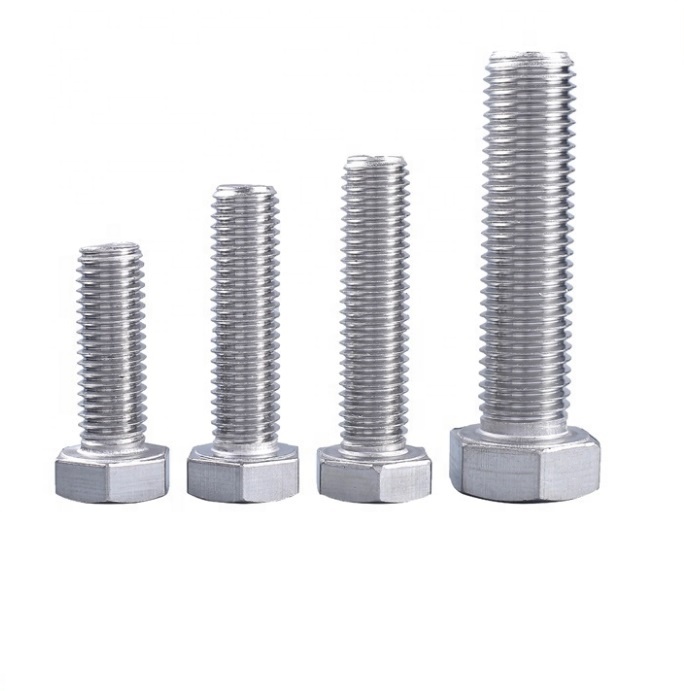
Hex head bolts are the item where a regional standard callout and a supplier quotation most often diverge.
A project specification that names ASTM A325 bolts and a quotation that answers with DIN 933 bolts are not describing the same requirement — even when diameter, length and zinc finish look identical. Mapping industrial fastener standards to a regional project means breaking the specified item into five layers: component type, dimensional standard, property class, material and coating, and inspection documentation. The quotation only answers the specification when every layer is matched and written down.
This guide is for buyers in the research and evaluation stages who must convert a regional standard callout into a purchase order that will pass technical review. It covers ASTM A563/A194 and ASTM A325/A490 alongside DIN, ANSI/ASME, ISO, GB, UNI, JIS, BS and NFE compliance, places property grades 4.8, 8.8, 10.9, 12.9, B7 alloy and stainless A2-70/A4-80 inside that map, shows how M6–M64 and 1/4"–2-1/2" cross the metric–imperial line, and sets out the documentation pack to request before a lot is approved.
Why fastener standard mapping fails in procurement
Most compliance disputes in fastener supply are not material failures; they are partial matches. A quotation matches the thread size and ignores the property class, or a certificate proves a quality management system while saying nothing about the bolts on the pallet.
Four patterns account for most of the losses:
- Diameter-only matching. M12 is treated as a complete description. It defines a thread, not a property class, head geometry, thread length or coating.
- Grade-code transfer. Metric property classes 4.8, 8.8, 10.9 and 12.9 belong to one designation system; inch-series grades belong to another. A familiar-looking number in the second system does not carry the meaning it has in the first.
- Coating treated as decoration. Finish is a separate specification line: electro-zinc plated (white or yellow), hot-dip galvanized, Dacromet, Magni, Geomet, pre-galvanized and plain finishes are distinct options, and a project that specifies one does not accept another by default.
- Documentation gap. "DIN compliant" written in an email is not a record a project reviewer can file. Compliance is a document set, not a statement.
Why several standard systems coexist in one supply chain
Fastener standards are regional inheritance rather than global consensus, which is why one supplier catalogue can span several systems. CNS INDUSTRIAL (JIAXING) CO.,LTD is a manufacturer of fasteners, strut channel fittings and metal stamping parts based in Jiaxing City, Zhejiang Province, China. Its portfolio covers strut fittings, strut channel systems, stamping parts, bolts and nuts, threaded rods, anchors, washers, screws and rivets, and the industrial fastener range is stated as produced to DIN, ANSI/ASME, ISO, GB, UNI, JIS, BS and NFE standards, or to customer drawings and samples, including ASTM A563/A194 and ASTM A325/A490 items.
Published cross-reference charts keep that coexistence manageable. ISO 7089 and ISO 7090 are listed as the primary international standards for plain washers, corresponding to DIN 125 (Fuller Fasteners); hexagon nuts for general industrial use are governed by standards such as ISO 4032 and DIN 934 (TR Fastenings); square-ended spring lock washers fall under DIN 127 / BS4464B, and hexagon head bolts grade C under DIN 601 and ISO 4016 (JPE Fasteners).
Those references carry a limit buyers regularly miss. A cross-reference shows which two documents address the same component family. It does not establish that a part made to one document automatically satisfies the other, and it does not transfer property, marking or inspection requirements between them. That judgement belongs to the project specification and the responsible engineer.
The five-layer mapping method
A standard map that survives review answers five layers separately, and each layer needs its own line on the quotation.
Layer 1 — Component identity
Confirm what the part is before comparing standards: hex head bolt, hex nut, plain washer, spring lock washer, threaded rod, stud, spring nut, channel nut or construction anchor. Component identity decides which standard family applies at all, and the range reflects that split — spring nuts are listed in M6, M8, M10 and M12, while channel nuts are listed in M8, M10 and M12.
Layer 2 — Dimensional standard and size
Record the designation exactly as the project writes it, with the size attached: DIN 933 M8×30, ISO 4017 M8×30, DIN 934 M8, DIN 125 M8, DIN 127 M8. Diameter alone is not a dimensional standard. Across-flats, head height, thread length and pitch are defined by the governing document, and two systems can define the same nominal diameter differently.
Layer 3 — Property class
Write the class or grade on the same line as the size, never in a separate note. 8.8 is not a synonym for "strong"; it is one position in the 4.8 / 8.8 / 10.9 / 12.9 series, while B7 alloy and stainless A2-70/A4-80 belong to different designation families with different selection logic.
Layer 4 — Material and coating
Material and finish are specification lines in their own right. The material options in the range are carbon steel, alloy steel, stainless steel (304 / 316 / 316L), aluminium, copper and brass; the finishes are electro-zinc plated (white or yellow), hot-dip galvanized, Dacromet, Magni, Geomet, pre-galvanized and plain. An outdoor support frame and an indoor MEP bracket can share a bolt size and still need different material and finish combinations.
Layer 5 — Inspection documents and quality system
The final layer turns a compliant product into a compliant delivery: which documents travel with the lot, and which quality system sits behind them. It is covered in the ISO 9001 section below.
Which standard system a regional project is likely to name
Regional practice narrows the search, but the project specification always overrides the assumption.
- North American specifications typically reference ASTM documents: ASTM A325/A490 for structural bolts and ASTM A563/A194 for the matching nuts, with inch dimensional conventions following ANSI/ASME.
- German-influenced European specifications reference DIN, with UNI (Italy) and NFE (France) as the Italian and French national standards in the same European family.
- International specifications reference ISO designations such as ISO 4017, ISO 4016, ISO 4032, ISO 7089 and ISO 7090.
- Chinese, Japanese and UK projects reference GB, JIS and BS respectively; BS4464B is the document to look for on square-ended spring lock washers.
Mixed systems are common on internationally funded work, where a structural drawing may carry ASTM designations while a mechanical schedule carries ISO or DIN. The correct response is not to harmonise the document set on the supplier's side; it is to quote each line against the system the specification names.
Property grades: what 4.8, 8.8, 10.9, 12.9, B7 and A2-70/A4-80 change
Property class is where most substitution errors enter an order, because the four carbon-steel classes form a graduated series while the two special families — B7 alloy and the stainless classes — are specified for reasons that do not translate into that series.
- 4.8 is the lowest class of the listed series and is normally the entry point where the connection design does not call for more.
- 8.8 and 10.9 are the working classes for most structural, MEP and equipment fastening; the drawing should always name which one it requires.
- 12.9 sits at the top of the listed series and is specified where the design assumes that level.
- B7 alloy steel is listed for studs and is the alloy grade commonly associated with petrochemical and high-pressure piping work rather than general structural bolting.
- Stainless A2-70 and A4-80 are specified where corrosion resistance governs. They are listed alongside the stainless material options (304 / 316 / 316L), and the buyer should confirm on the order which stainless family the class refers to, because class and material are separate statements.
One rule follows: upgrading a property class is not automatically the conservative choice. A higher class changes the assumptions behind preload, tooling and toughness in the connection, so a supplier should not swap 8.8 for 10.9 to "improve" an order, and a buyer should not accept that swap without the responsible engineer's confirmation.
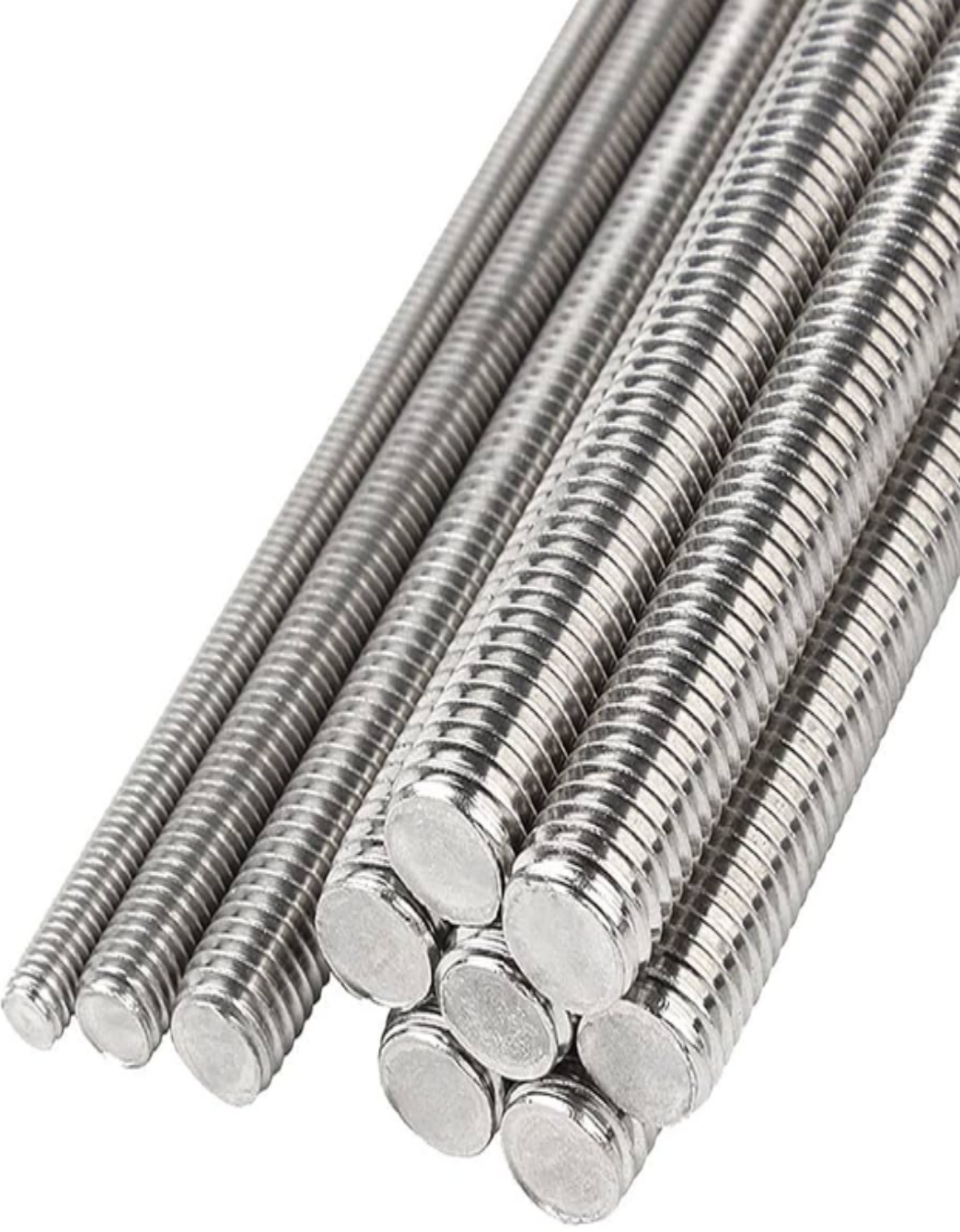
Threaded rods and studs carry the same mapping problem as bolts: the grade designation must be stated as precisely as the size.
Size mapping: M6–M64 and 1/4"–2-1/2" across metric and imperial
The listed industrial fastener range covers M6 to M64 and 1/4" to 2-1/2", with custom sizes available, full or partial thread, and both metric and imperial threads. That breadth is useful, but it does not make a metric and an inch fastener interchangeable.
Arithmetic conversion is the simple part, at 25.4 mm to the inch:
| Inch callout | Nominal diameter | Inch callout | Nominal diameter |
|---|---|---|---|
| 1/4" | 6.35 mm | 5/8" | 15.88 mm |
| 5/16" | 7.94 mm | 3/4" | 19.05 mm |
| 3/8" | 9.53 mm | 1" | 25.40 mm |
| 1/2" | 12.70 mm | 2-1/2" | 63.50 mm |
Nominal arithmetic conversion only. It is not a cross-standard equivalence: thread series, across-flats and head geometry are defined separately in each system, so a 1/2" item and an M12 item remain different parts until the project accepts one for the other.
Dual designation already exists inside support systems. The strut channel range is listed as 41×41×2.5 mm, 41×21×2.5 mm and 41×41×2.0 mm, and also as 1-5/8"×1-5/8" (41×41 mm) and 1-5/8"×13/16" (41×21 mm), in 12 ga, 14 ga and 16 ga thickness with 10 ft or 20 ft lengths. Because a metric bolt schedule and an inch channel schedule can meet in the same support run, strut channel fitting sizes matter as much as bolt sizes.
Step-by-step: mapping one line item
- Extract the governing standard and edition from the project specification — not from the previous purchase order and not from the supplier's catalogue.
- Record the component and dimensional callout together, for example "hex head bolt, DIN 933, M8×30" or "hex nut, ASTM A563".
- Add the property class or grade to the same line: 4.8, 8.8, 10.9, 12.9, B7, A2-70 or A4-80, exactly as specified.
- Add material and coating as written, including plating colour, since white and yellow electro-zinc are separate options.
- Check the supplier's coverage of that exact combination — standard, component, size and grade — before discussing price or lead time.
- Request the documentation pack for the lot and read the quality certificate's scope, number, issuer and validity dates.
- Approve on evidence: a sample or pre-production item checked against the documented specification, then volume release against that approved baseline.
Comparison table: standard families at a glance
The table separates what the fastener range states from what the buyer still has to add before a line item is fully specified.
| Standard family | What the fastener range states | What the buyer must still add |
|---|---|---|
| ASTM | Meets ASTM A563/A194 and ASTM A325/A490 | Which of the two applies — structural bolt or nut — plus the required property marking |
| DIN | DIN 933, DIN 934, DIN 125 and DIN 127 designations listed | The exact DIN number per component and the property class |
| ISO | ISO 4017 models listed; ISO 4016, ISO 4032, ISO 7089 / ISO 7090 as reference points | Whether the specification names ISO itself or a national equivalent |
| ANSI/ASME | Compliance stated | Whether the callout is inch-series, and which inch designation governs |
| GB | Compliance stated | The GB designation written out in full, not a translated DIN reference |
| UNI | Compliance stated | The UNI designation and its property class |
| JIS | Compliance stated | The JIS designation and its property class |
| BS | Compliance stated | Which BS document covers the component, including BS4464B for square-ended spring lock washers |
| NFE | Compliance stated | The NFE designation written out in full |
Use cases where the mapping decision changes
Structural steel connections. Where the specification names ASTM A325/A490 bolts and ASTM A563/A194 nuts, grade and marking matter more than diameter, because the connection design assumes that specific property level. A DIN or ISO item of the same size is a different proposal, not an equivalent one.
MEP and HVAC supports. Support runs mix strut channel, spring nuts, channel nuts, threaded rods and pipe clamps. Here the metric or imperial decision is usually settled by the channel schedule, and the compliance question shifts to coating: pre-galvanized, hot-dip galvanized or powder-coated channel behaves differently in a plant room than on an exposed roof.
Solar mounting and outdoor frames. Corrosion resistance governs, so stainless A2-70/A4-80 or a hot-dip galvanized finish is specified against the exposure, and the property class often becomes secondary to material and coating documentation.
Oil, gas and petrochemical piping. B7 alloy studs appear where the alloy grade, not the general carbon-steel series, is the design basis; the documentation requirement is correspondingly heavier and should be agreed before the order, not after shipment.
Heavy machinery and power generation. Classes 10.9 and 12.9 are common where the equipment design assumes them. Substituting downward fails the design; substituting upward without review changes it.
Where ISO 9001 fits in the compliance chain
ISO 9001 sits underneath the product specification, not in place of it. It evidences the management system that governs production and sales activity; it does not certify a specific bolt, grade or coating.
The certificate record for this industrial fastener range states certificate number 37825Q15712R0S, issued by Euroswiss Certification Co., Ltd., against GB/T19001-2016 / ISO9001:2015, for the scope "Sales of metal products", valid from 8 August 2025 to 7 August 2028 and applicable to the worldwide market.
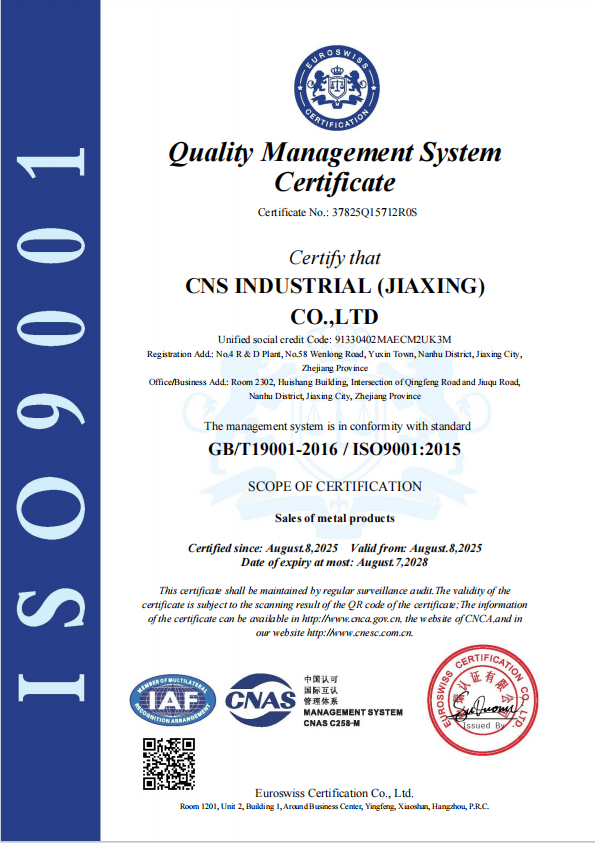
Certificate number, issuer, standard edition, scope wording and validity dates are the five fields a buyer should check.
Four checks turn that record into a useful compliance step. Read the scope wording and confirm it covers the activity you rely on. Confirm the certificate number and issuer match the document you were sent. Confirm the validity dates cover the delivery window, not just the order date. And confirm the standard edition, because a certificate to an older edition answers a different question. None of these checks replaces the specification: the purchase order still has to name the standard, grade, material and coating, and the delivery documents still have to support it.
The documentation pack to request before approving a lot
Ask for the pack once, in writing, and hold it against the specification line by line.
| Document | What it should show | Why the buyer needs it |
|---|---|---|
| Standard and edition on quotation and PO | The designation exactly as the project writes it | Stops a "DIN or equivalent" gap entering the order |
| Property class per line item | 4.8, 8.8, 10.9, 12.9, B7, A2-70 or A4-80 as specified | Grade drives design assumptions and cannot be inferred from size |
| Material or test documentation | The document type the supplier can actually issue for the lot | Supports the material statement on the order; confirm the type in advance |
| Dimensional inspection record | Measured characteristics and the sampling basis used | Shows the part was checked against the named document, not a generic size |
| Coating specification | Electro-zinc (white or yellow), HDG, Dacromet, Magni, Geomet, pre-galvanized or plain | Finish is a separate acceptance criterion, especially outdoors |
| Marking, packing and lot identification | How the lot is identified from production to packing list | Makes the paperwork traceable to the goods that arrive |
| ISO 9001 certificate copy | Number, issuer, edition, scope and validity dates | Confirms the quality system behind the activity in scope |
Two practical additions. First, ask which document type the supplier can issue for the material rather than assuming one; the answer belongs in the quotation, not in a post-delivery discussion. Second, keep the approved baseline — sample, drawing and document set — attached to every repeat order. Repeat orders are where substitutions quietly reappear.
Frequently asked questions
What should a buyer verify about an ISO 9001 industrial fasteners manufacturer?
Verify the certificate before accepting the claim. The record for this industrial fastener range shows certificate number 37825Q15712R0S, issued by Euroswiss Certification Co., Ltd. to GB/T19001-2016 / ISO9001:2015, for the scope "Sales of metal products", valid from 8 August 2025 to 7 August 2028 and applicable to the worldwide market. Read the scope wording carefully: a quality management system certificate evidences the system governing the activity in scope, and it is not a product conformity certificate for a specific lot. The lot still needs the standard, property class, material and coating written on the purchase order and supported by the delivery documents.
Can a DIN 933 bolt replace an ASTM A325 bolt?
Not on the basis of the designation. DIN 933 and ASTM A325 are separate documents from different systems, and matching thread size and length does not establish that the dimensional, property and marking requirements of the specified standard are met. Where a project specification names ASTM A325/A490, the quotation should be written against that standard with the item's property marking stated. Any substitution needs confirmation from the responsible engineer and a written record of what was supplied instead.
Which standards and size ranges can one supplier realistically cover?
The stated scope of this range covers DIN, ANSI/ASME, ISO, GB, UNI, JIS, BS and NFE standards plus ASTM A563/A194 and ASTM A325/A490, with property classes 4.8, 8.8, 10.9, 12.9, B7 alloy steel, stainless A2-70/A4-80 and custom grades. Sizes run from M6 to M64 and 1/4" to 2-1/2", with custom sizes available, in metric and imperial threads. Coverage is not the same as stock: confirm per line item which combination is available and at what quantity.
What drives the price band of a compliant fastener order?
The specification layers drive cost, not the product name. Moving from carbon steel to alloy steel or stainless 304/316/316L changes the material base; moving from plain or electro-zinc to hot-dip galvanized, Dacromet, Magni or Geomet adds process steps; a higher property class or a heavier documentation requirement adds production and verification time. Quantity interacts with all of them — the minimum order quantity is 500 kg per item, so a small, heavily specified order carries a different cost profile from a volume repeat.
Can a standard-mapped item be validated before volume production?
Made-to-sample production and processing to a named standard are both supported, which is the practical way to validate a mapping before release: approve the physical item against the documented specification first, then release the balance. The 500 kg per item minimum and the 30–45 day lead time apply to the production order, so build approval time into the project schedule rather than into the delivery window.
What lead time and capacity should be planned?
Standard lead time is 30–45 days, supported by a monthly capacity of 800 tons from a 30,000 m² facility in Jiaxing, near Shanghai Port. Plan backwards from the installation date, because documentation review, sample approval and production each consume part of that window. Buyers who want a specific standard, grade and size combination checked against a live project can send the line items to the sales team through the company website.

Quote requests move fastest when each line already carries its standard, property class, material and coating.
Conclusion
Mapping industrial fastener standards is a documentation exercise before it is a purchasing one. The standard system a project uses decides which document governs; the property class and size decide which item inside that document applies; material and coating decide whether it survives the environment; and the documentation pack decides whether the delivery can be accepted. ASTM A563/A194, ASTM A325/A490, DIN, ANSI/ASME, ISO, GB, UNI, JIS, BS and NFE are all manageable inside one order — provided each line is quoted against the system the specification names rather than against the nearest familiar equivalent.
For the current range of fasteners, strut channel systems, channel fittings and stamping parts, the CNS Industrial product brochure (PDF) lists the standard, grade, size and finish options in one place, and is a practical starting point for the first line-item review.
Have Questions or Need More Details?
Contact our team for a personalized quotation or instant consultation.
Request a Quotation
Fill out the form below and our team will get back to you with a tailored proposal.
WhatsApp Direct Chat
Prefer to chat in real-time? Message us on WhatsApp for instant assistance & quick answers.
- Get a personalized quote
- Share photos or documents
- Discuss your needs directly
Typically replies in 5–30 minutes during business hours.