
Ranked: Industrial Fasteners for Vibration-Prone Strut Channel Support Systems
Vibration-prone strut channel support systems usually fail at the connection, not at the channel. The ranking below orders the fastening options that actually carry that connection — spring nuts, channel nuts, threaded rods, pipe clamps, channel fittings, bolted assemblies and construction anchors — by how well each resists loosening and slip while remaining practical to install in MEP/HVAC, solar mounting and industrial support work.
The short answer: spring nuts in M6–M12 rank first for most overhead MEP and HVAC channel work because the spring holds the nut in position inside the slot during installation; channel nuts in M8–M12 rank first where loads are higher and access is good; threaded rods and pipe clamps form the hanger layer that carries pipe and duct weight; channel fittings and bolted assemblies carry the structural joints; and construction anchors tie the whole run back to the building structure. The ranking measures fit to vibration-prone duty, not general popularity.
CNS INDUSTRIAL (JIAXING) CO.,LTD is a manufacturer of fasteners, channel fittings and metal stamping parts located in Jiaxing City, Zhejiang Province, China, with transport access near Shanghai Port. Its portfolio covers strut channel systems, channel fittings, channel spring nuts, pipe clamps, bolts and nuts, threaded rods, anchors, washers, screws, rivets and custom stamping parts, produced to GB, ISO, DIN, ANSI/ASME, UNI, JIS, BS and NFE standards or to customer drawings and samples.
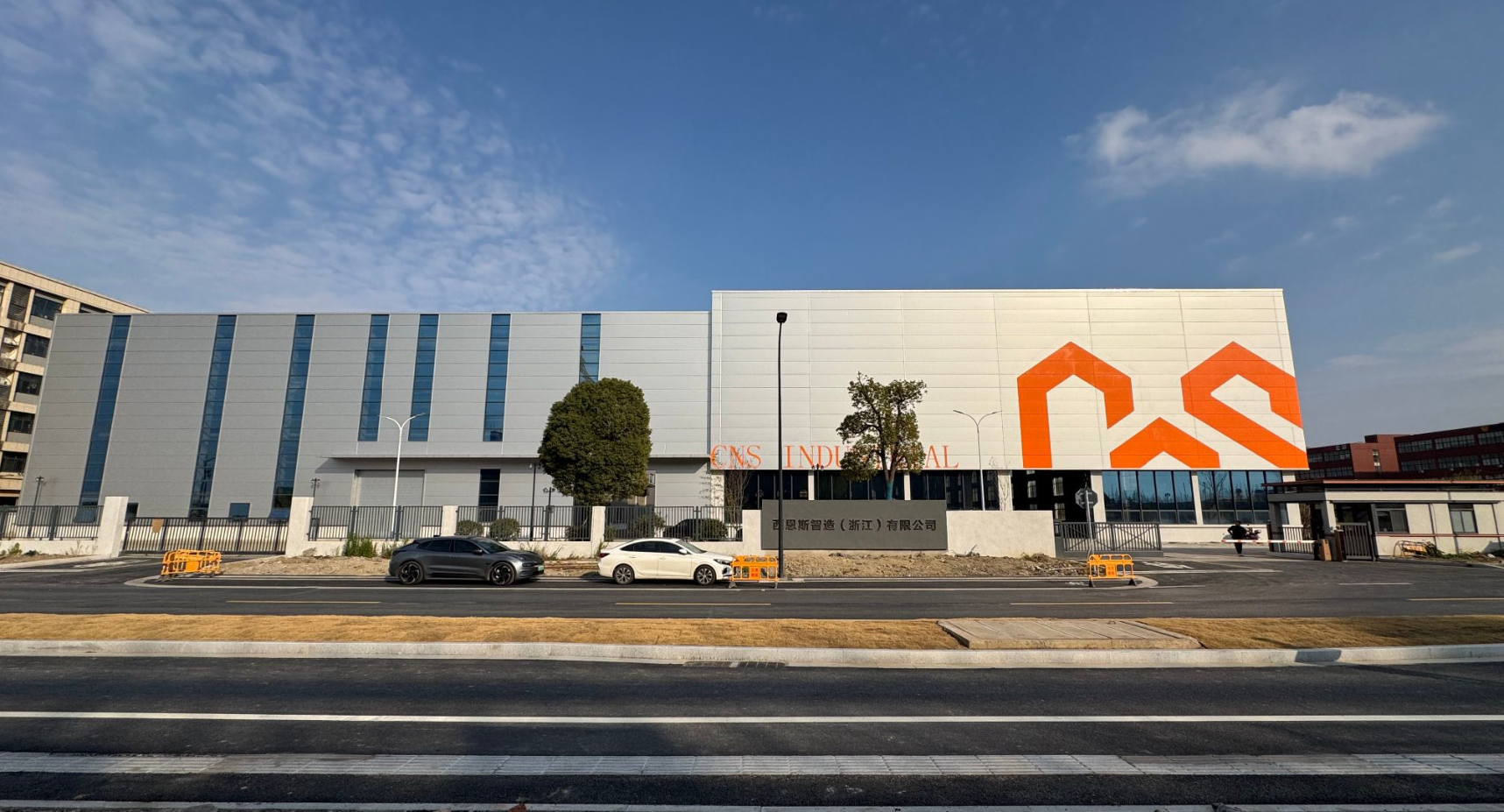
Fastener and channel-fitting production for export markets, Jiaxing City, Zhejiang Province, China.
Problem Definition: Why Vibration Breaks Strut Channel Joints
A strut channel support joint is a clamped assembly, not a welded one. It stays tight only while bolt preload survives. Vibration works against that preload in three ways.
- Transverse slip. Cyclic side-to-side movement across the thread flanks slowly reduces clamp force, a mechanism commonly called self-loosening. Fan vibration, pump vibration and traffic-induced movement all feed this cycle.
- Position slip inside the slot. A spring nut can shift or slip inside a strut channel when the nut does not match the channel profile, when the spring is weak or damaged, when channel or nut dimensions are out of tolerance, or when the nut is not properly seated before tightening.
- Preload loss from the joint itself. Coatings, washers, oversized holes and soft mating surfaces all allow relaxation under load cycling, so the joint loses clamp force even when the fastener never rotates.
This is why vibration problems in strut channel work are solved with a combination — matching the nut to the profile, choosing appropriate locking hardware, and applying the right tightening torque — rather than with a single component. Proper tightening torque is essential for joint stability, and in severe vibration applications a locking method should be combined with correct preload instead of relying on a spring washer alone.
Industry Background: Where the Demand Comes From
Strut channel fastening sits inside two overlapping markets. The global industrial fasteners market was valued at USD 93.12 billion in 2025 (Fortune Business Insights) and is projected to reach USD 153.71 billion by 2033, growing at a CAGR of 5.1% (Grand View Research). The global strut channel market was valued at USD 4.3 billion in 2024 and is expected to reach USD 7.3 billion by 2033 at a CAGR of 6.1% (Dataintelo). Asia Pacific accounted for a 45.1% revenue share of the industrial fasteners market in 2025 (Grand View Research), and China's industrial fasteners market was valued at USD 12.23 billion in 2024 (Credence Research).
Two structural details matter for buyers specifying vibration-resistant channel work. First, bolts remain the largest product segment, holding a 31.3% share of the industrial fasteners market in 2025 (Grand View Research), which means bolted clamping still defines most support connections. Second, branded channel systems are dominated by a small group of suppliers — nVent (CADDY), Atkore (Unistrut), Eaton (B-Line) and Hilti are identified as leading manufacturers of strut channel systems — so most projects mix a branded channel profile with independently sourced nuts, rods, clamps and fittings. That mix is exactly where profile compatibility and vibration behaviour must be verified, because a nut that fits one channel family may not seat correctly in another.
How This Ranking Was Built
Each option was scored against five criteria that reflect how vibration-prone support systems are actually specified and installed:
- Position retention during installation — whether the component stays where it is placed in the slot, particularly overhead and on vertical runs.
- Locking compatibility — whether the component can be combined with prevailing-torque lock nuts, threadlocker, spring washers or locking washers, and whether preload can be controlled.
- Material and finish fit — availability in carbon steel, SS304 or SS316, and in zinc plated, hot-dip galvanized, pre-galvanized or powder-coated finishes matched to the environment.
- Standards traceability — whether the part maps to a recognised DIN, ISO, ASTM or ANSI/ASME reference that can be written into a purchase order.
- Sourcing practicality — installation speed, repairability, and whether the item can be supplied in a mixed, project-specific package.
The Ranking: Seven Fastening Options for Vibration-Prone Strut Channel Support
1. Spring Nuts, M6–M12 — First Choice for Overhead and Repetitive Channel Work
A spring nut carries a spring that holds the nut in position inside the strut channel, which makes installation faster and easier, especially overhead or on vertical runs. That positioning behaviour is why it ranks first for MEP and HVAC work where dozens of connections are made at height: the nut stays in the slot while the installer brings the rod or bolt to it.
Selection rules are narrow and mechanical. Match the nut to the channel profile and slot dimensions, then select thread size M6 to M12 according to the threaded rod or bolt in use. For heavier loads, specify a heavy-duty spring nut with a stronger spring and an appropriate load rating. Material and finish should follow the environment — zinc-plated steel for general indoor work, hot-dip galvanized or stainless steel for outdoor or corrosive areas. Its known limitation is precisely the mechanism that makes it convenient: if the spring is weak, damaged or lost tension, or the profile is mismatched, the nut can slip and should be replaced rather than re-used.
2. Channel Nuts, M8–M12 — Higher Load, Simpler Construction
A plain channel nut has no spring mechanism. It ranks second because it offers a more direct load path and fewer parts to degrade in service, which suits M8–M12 connections on trapeze hangers, equipment frames and short-span supports where access is reasonable and installation speed is secondary. The trade-off is positioning: without a spring, the nut needs more attention to keep it aligned with the slot before tightening, which is why it is less favoured overhead. Vibration behaviour depends mainly on preload control and on whether a lock nut or threadlocker is added to the assembly.
3. Threaded Rods — The Hanger Layer That Transmits Vibration
Threaded rod converts a channel run into a hanger. In vibration-prone duty the rod is both a load member and a vibration path: pump and fan movement travels down the rod into the channel connection. Rod assemblies are therefore ranked third because their performance is dependent on the two ends — the channel nut or spring nut at the top, and the clamp or clevis at the bottom. B7 alloy steel studs and standard threaded rod are both available in the CNS range, and double-nut or lock nut arrangements are the practical way to protect the connection where the joint may need to be serviced.
4. Pipe Clamps — Where Vibration Meets the Pipe Itself
Pipe clamps rank fourth because they close the loop between the rod and the pipe, and their fit determines how much movement is transferred into the channel system. They are standard in pipeline support and MEP installations, and their value in vibration-prone service is that a correctly sized clamp keeps the pipe seated so the hanger does not see impact loads. As with nuts, the practical risk is dimensional mismatch rather than the clamp concept itself.
5. Channel Fittings and Stamped Brackets — Structural Joints in the Run
Angle fittings, corner fittings, brackets and beam connections define the geometry of a support system and carry bending and shear rather than pure tension. They rank fifth because they are rarely the loosening point themselves, but they amplify vibration when bolt holes are oversized or when the fitting is thinner than the channel. Metal stamping parts produced to drawing allow a project to match fitting thickness and hole position to the actual channel profile. Hot-dip galvanized finishing is the usual choice where the fitting is exposed outdoors.
6. Bolted Assemblies: Hex Bolts, Nuts and Washers — The Locking Interface
Where a channel is bolted to a bracket, a beam or a piece of equipment, the bolted assembly itself becomes the vibration-critical element. Hexagon head bolts are standardised under DIN 933 and ISO 4017 in the CNS range in sizes such as M8×30, M10×40 and M12×50, with hexagon nuts under DIN 934 and ISO 4032, plain washers under DIN 125 (equivalent to ISO 7089 and ISO 7090), and spring lock washers with square ends under DIN 127 (also referenced as BS4464B). Property classes 8.8, 10.9 and 12.9 are available alongside ASTM A325/A490 and ASTM A563/A194 references, plus B7 alloy steel studs.
Grade choice should follow load, not habit. Grade 8 fasteners provide higher tensile and yield strength than Grade 5, while metric classes 8.8, 10.9 and 12.9 provide different strength levels; a higher-strength bolt is not automatically the right choice, because the complete joint — mating components, tightening requirements and operating environment — governs the result. For vibration resistance, prevailing-torque lock nuts or other mechanical locking nuts suit assemblies that must be serviced, threadlocker suits permanent or semi-permanent joints, and severe vibration calls for a locking method combined with correct preload and torque.
7. Construction Anchors — Tying the Run to the Structure
Anchors rank seventh only because they sit at the boundary of the system: they connect the channel support to concrete or steel, and they are the point where vibration from the structure enters the run. Equipment anchoring and building supports are standard applications in CNS project experience, alongside pipeline support and MEP installations. Anchor selection should be treated as a structural decision — base material, embedment and load direction all sit outside the fastener catalogue — but the anchor must be ordered with the same finish discipline as the rest of the package, since a galvanized channel run anchored with a mismatched finish creates a corrosion point.
Comparison Table: Strut Channel Fastening Options Side by Side
| Rank | Fastening option | Size range | Materials and finishes | Standards reference | Vibration note |
|---|---|---|---|---|---|
| 1 | Spring nut | M6–M12 | Carbon steel, SS304, SS316; zinc plated, hot-dip galvanized | DIN, ISO, ANSI/ASME to order | Fast positioning; slipping indicates profile mismatch or weak spring |
| 2 | Channel nut | M8–M12 | Carbon steel, SS304, SS316; zinc plated, hot-dip galvanized | DIN 934 / ISO 4032 thread reference | Direct load path; needs preload control and manual positioning |
| 3 | Threaded rod | Matched to nut and clamp thread | Carbon steel, B7 alloy steel, SS304, SS316; zinc plated, HDG | DIN, ISO, ANSI/ASME to order | Transmits vibration; use double nut or lock nut at both ends |
| 4 | Pipe clamp | Sized to pipe outside diameter | Carbon steel, SS304, SS316; zinc plated, HDG | DIN, ISO to order | Correct sizing keeps the pipe seated and limits impact load |
| 5 | Channel fittings and stamped brackets | Made to channel profile or drawing | Carbon steel, SS304; HDG, zinc plated, pre-galvanized or powder coated per specification | GB, ISO, DIN, ANSI/ASME, UNI, JIS, BS, NFE, or sample | Thin fittings and oversized holes amplify movement |
| 6 | Bolted assembly (bolt, nut, washer) | M8×30, M10×40, M12×50 and comparable | Carbon steel, SS304, SS316; zinc plated, HDG, Dacromet, yellow zinc, white zinc | DIN 933, ISO 4017, DIN 934 / ISO 4032, DIN 125 / ISO 7089, DIN 127; ASTM A325/A490, A563/A194 | Main locking interface; classes 8.8, 10.9, 12.9 with controlled torque |
| 7 | Construction anchor | Selected to base material and load | Carbon steel, SS304, SS316; zinc plated, HDG | Project specification dependent | Entry point for structural vibration; finish must match the run |
Size ranges, materials and finishes reflect the options described in this article; the final specification is confirmed against the channel profile, drawing or technical agreement for each order.
Step-by-Step: Specifying a Vibration-Resistant Channel Package
- Confirm the channel profile and slot dimensions. Spring nut and channel nut selection starts with profile compatibility. A nut that does not match the slot will not seat, and no amount of torque will fix that.
- Classify the duty. Separate static support from vibration-prone support — rotating equipment rooms, fan and pump pipework, rooftop solar frames. Vibration class determines whether standard or heavy-duty positioning hardware is required.
- Select the fastening option from the ranking. Overhead and repetitive work goes to spring nuts M6–M12; shorter, higher-load connections go to channel nuts M8–M12; hangers go to threaded rods with pipe clamps; structural joints go to channel fittings and bolted assemblies.
- Fix the material and finish. Choose SS304 for general indoor and outdoor environments with good strength and cost performance, and SS316 for marine, coastal, chemical or high-chloride service because its 2%–3% molybdenum content improves pitting resistance. For coatings, hot-dip galvanized provides a heavy zinc layer of roughly 45–85 μm suited to outdoor and coastal work, while electro-zinc plating provides a thinner layer of about 5–12 μm for indoor, dry environments where thread fit matters.
- Add the locking method. Specify prevailing-torque lock nuts or another mechanical locking nut for assemblies that must be disassembled; specify threadlocker for permanent or semi-permanent joints; combine both the locking method and controlled preload in severe vibration.
- Validate and define acceptance. Confirm fit against a drawing or physical sample, then write inspection requirements into the purchase order or technical agreement so acceptance is measurable rather than assumed.
Where These Rankings Apply: MEP, Solar and Industrial Support
MEP and HVAC installations. Duct and pipe hangers, conduit supports and plant-room framing rely on spring nut and channel nut connections at height, with threaded rods and pipe clamps forming the hanger. Electro-zinc plated hardware is usual indoors; hot-dip galvanized is specified where the run is exposed or in coastal air. In areas with fan or pump vibration, the practical upgrade is a locking method plus controlled torque rather than a heavier nut alone.
Solar mounting. Rooftop and ground-mount racking is exposed to wind-induced vibration and thermal cycling at the same time. SS304 or SS316 hardware is the usual route for long service life, with coastal arrays driven toward SS316 and inland arrays acceptably served by SS304 where cost matters. Spring nuts speed module-rail assembly, and every bolted clamp on the rail needs a defined torque value.
Industrial support and equipment anchoring. Pipe racks, machine frames and building supports combine channel fittings, bolted assemblies and construction anchors. CNS project experience covers pipeline support, equipment anchoring, building supports and MEP installations for engineering contractors, machinery manufacturers, electrical and general industrial customers, with the emphasis on strong durable connections, installation efficiency and lower long-term maintenance needs.

Manufacturing site supporting strut channel systems, stamped fittings and bolted assemblies for export.
Custom Fabrication, OEM Support and Manufacturing Proof
Off-the-shelf hardware solves standard connections; vibration-prone projects often need a fitting, bracket or stamped part that matches a specific channel geometry. OEM services are available, and the manufacturer provides manufacturing, OEM, product processing, packaging and trading services. Production can be made to sample or processed to GB, ISO, DIN, ANSI/ASME, UNI, JIS, BS and NFE standards, with multiple specification and surface finish options.
Capacity and quality context for buyer evaluation: the plant covers 30,000 ㎡ with 50–100 employees, monthly capacity of 800 tons, annual output of around 8,000 tons, and a 20-engineer technical team. Quality management is certified to ISO 9001 under certificate 37825Q15712R0S, issued by Euroswiss Certification Co., Ltd. against GB/T19001-2016 / ISO9001:2015, covering sales of metal products, valid from 2025-08-08 to 2028-08-07.
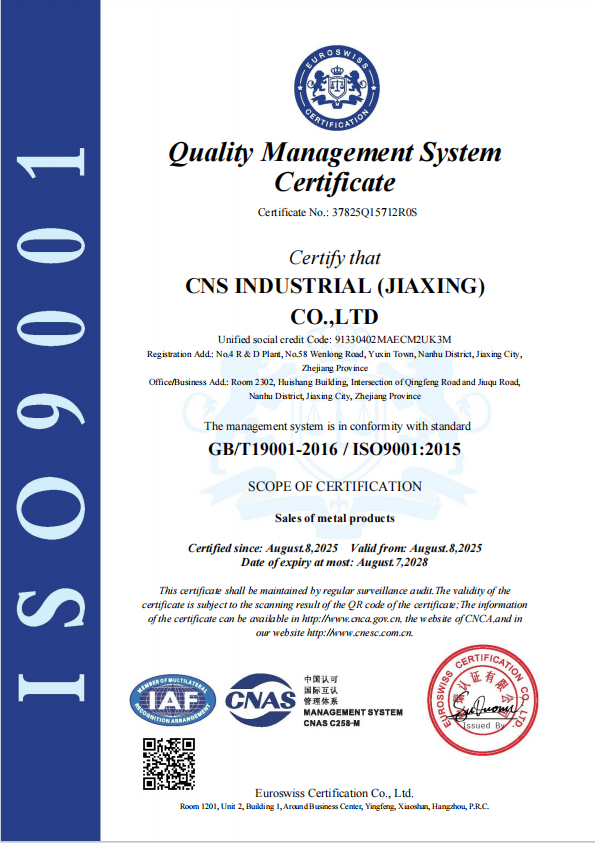
ISO 9001 certificate 37825Q15712R0S, valid 2025-08-08 to 2028-08-07, scope: sales of metal products.
Sourcing, Lead Time and Delivery
Mixed fastening packages are normal in this segment: a single project may need spring nuts, channel nuts, threaded rods, pipe clamps and stamped brackets in different materials and finishes. Buyers should plan for a consolidated shipment rather than separate orders, because the vibration-critical items are usually the small, high-count parts that stop an installation when they run short. CNS INDUSTRIAL operates from Jiaxing City, Zhejiang Province, with transport access near Shanghai Port, and exports to markets including the United States, Canada, Mexico, Germany, Italy, France, Japan, Russia and Australia, with a 100% export orientation.
FAQ
Do strut channel fasteners need to meet specific standards for a project?
Yes, and the reference should be written into the purchase order. Common references in strut channel work include DIN 933 and ISO 4017 for hexagon head bolts, DIN 934 and ISO 4032 for hexagon nuts, DIN 125 for plain washers (with ISO 7089 and ISO 7090 as the equivalent international standards), and DIN 127 for spring lock washers with square ends. ASTM references such as A325/A490 and A563/A194 apply where US project specifications govern. CNS INDUSTRIAL manufactures to GB, ISO, DIN, ANSI/ASME, UNI, JIS, BS and NFE standards or to customer drawings and samples, and holds ISO 9001 certification for sales of metal products under certificate 37825Q15712R0S.
Can spring nuts and channel fittings be customized for a specific channel profile or assembly?
OEM services are available for buyers who need customized production. CNS INDUSTRIAL provides manufacturing, OEM, product processing, packaging and trading services, and supports made-to-sample production or processing to GB, ISO, DIN and ANSI/ASME standards with multiple specification and surface finish options. For a vibration-prone assembly, the customization points that matter most are spring strength and load rating on spring nuts, thread size and slot fit on channel nuts, and plate thickness, hole position and hole diameter on stamped fittings and brackets.
What drives the cost of a vibration-resistant strut channel fastening package?
Four factors dominate. Material grade is the largest: SS316 costs more than SS304 because of its molybdenum content, and property class 10.9 or 12.9 bolts cost more than 8.8. Finish is second: hot-dip galvanizing with a 45–85 μm zinc layer is a heavier process than electro-zinc plating at roughly 5–12 μm. Locking features are third: prevailing-torque lock nuts and heavy-duty spring nuts add cost but reduce rework. Order quantity is fourth, and the standard minimum order quantity is 500 kg per item, so consolidating sizes and finishes reduces the effective cost per piece.
Can I validate fit and vibration behaviour with a sample before a bulk order?
Made-to-sample production is supported, which is the practical route for validating a vibration-prone assembly: supply a drawing or a physical sample of the channel nut, spring nut, fitting or bracket and have the part produced to that reference. Validation should confirm slot fit, thread engagement, spring retention and coating thickness on the actual channel profile used on site. Sample scope, quantity and commercial terms are confirmed directly with the sales team rather than assumed from the catalogue.
What is the lead time and what delivery terms are used?
Lead time is 30–45 days, supported by a monthly capacity of 800 tons and an annual output of around 8,000 tons. Delivery terms include FOB, CIF, CFR, DDP and DDU by sea and by train, and payment terms are 30% T/T deposit with the 70% balance against a copy of the bill of lading. Acceptance criteria follow inspection per order and delivery inspection as defined in the contract or technical agreement. To start a quotation, send the channel profile, sizes, materials, finishes, quantities and target delivery window to sales@cnsindustrial.com, or contact the team on WhatsApp at +86 152-5709-7384.
Conclusion
For vibration-prone strut channel support systems, the ranking is a sequence of decisions rather than a single purchase. Spring nuts M6–M12 win on position retention and installation speed. Channel nuts M8–M12 win on direct load path. Threaded rods and pipe clamps carry the hanger layer, channel fittings and bolted assemblies carry the structural joints, and construction anchors connect the run to the building. Loosening is controlled by the combination of profile fit, appropriate locking hardware and correct preload — not by any single component used in isolation.
CNS INDUSTRIAL (JIAXING) CO.,LTD supplies these fastening options from Jiaxing City, Zhejiang Province, near Shanghai Port, with ISO 9001 certified quality management, OEM and made-to-sample production, and export experience across North America, Europe, South America and Asia-Pacific markets.

Next step: send your channel profile, fastener sizes and vibration-critical joints for a quotation, or review the full product range in the catalogue.
Catalogue (PDF): CNS Industrial Brochure v4 | Website: www.cnsindustrial.com | Email: sales@cnsindustrial.com | Tel: +86 152 57097 384
Have Questions or Need More Details?
Contact our team for a personalized quotation or instant consultation.
Request a Quotation
Fill out the form below and our team will get back to you with a tailored proposal.
WhatsApp Direct Chat
Prefer to chat in real-time? Message us on WhatsApp for instant assistance & quick answers.
- Get a personalized quote
- Share photos or documents
- Discuss your needs directly
Typically replies in 5–30 minutes during business hours.