SS304 vs SS316 Stainless Steel Fasteners: A Buyer's Comparison Guide
Short answer: for dry indoor and general industrial assemblies, SS304 (A2-70) stainless steel fasteners are sufficient. SS316 (A4-80) becomes the practical choice when the connection is exposed to chlorides - coastal air, de-icing salts, process chemicals or regular washdown. The real decision is a constraint problem, not a preference: exposure chemistry, the strut channel material the fastener sits in, the governing standard and the maintenance interval all have to agree before a purchase order is raised.
Most fastener specification failures are not about bolt length. They come from choosing the wrong alloy for the exposure, or from pairing a stainless fastener with a channel material it should not be in direct contact with. Both mistakes tend to surface two or three years later as staining, thread seizure or a failed inspection - at which point the cost is no longer the price gap between two grades, but the rework.
CNS INDUSTRIAL (JIAXING) CO., LTD. is a manufacturer of fasteners, channel fittings and metal stamping parts based in Jiaxing City, Zhejiang Province, China, supplying export markets that include the EU, the US, Canada and South America. Its catalogue covers SS304 and SS316 fasteners alongside strut channel systems offered in carbon steel, SS304, SS316 and aluminium, which is why fastener-to-channel grade matching is a routine part of the specification conversation rather than an afterthought.
Problem Definition: Four Constraints Decide the Grade
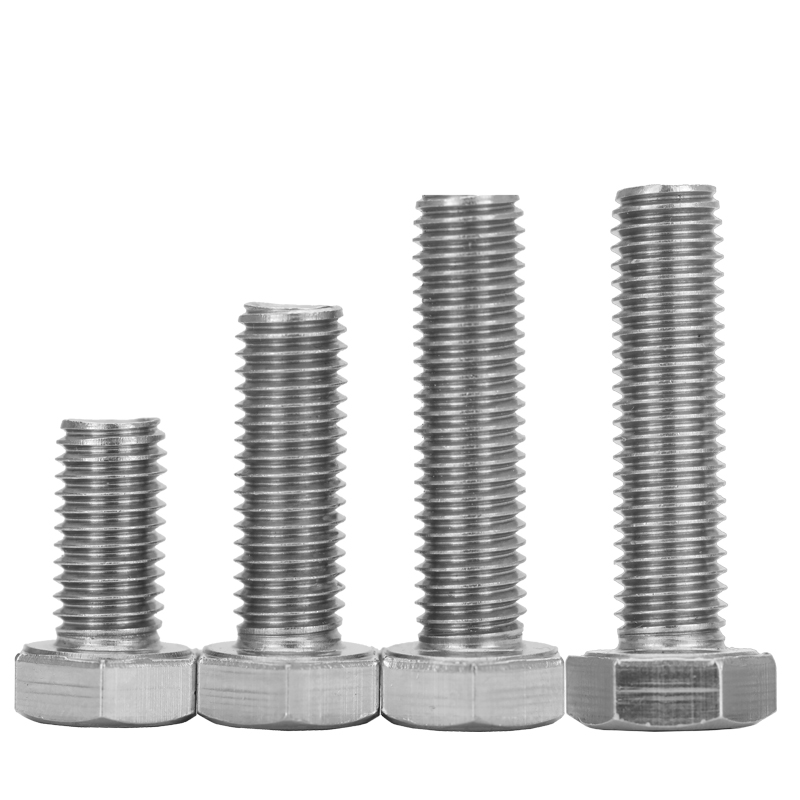
A stainless fastener has to satisfy four constraints at the same time: the chemistry of the exposure, the material it is bolted against, the mechanical property class the joint requires, and the documentation the project owner will ask for at handover. Failing any one of them makes the other three irrelevant.
SS304 and SS316 are both austenitic stainless steels, so both resist rusting in ordinary atmospheric conditions and both are non-magnetic in the annealed condition. The separation appears when chlorides are present. SS316 carries molybdenum in the alloy, which is generally recognised to improve resistance to chloride pitting and crevice corrosion. In a dry indoor plant that difference may never become visible. On a coastal site, in a chemical plant or in a washdown area it effectively determines the service life of the connection.
That is the core of the SS304 versus SS316 question: the two grades are not good and better versions of the same thing. They are two cost points on a curve, and the buyer's job is to buy the lowest point that still satisfies the exposure.
Industry Background: Where Stainless Fasteners Sit
Stainless fasteners are a small share of a very large category, which is why specification discipline matters more than brand familiarity. Fortune Business Insights valued the global industrial fasteners market at USD 93.12 billion in 2025. Grand View Research reports that metal fasteners held 91.0% of that market in 2025 and that bolts were the largest single product segment at 31.3%. Adjacent support hardware shows the same structure: Dataintelo valued the global strut channel market at USD 4.3 billion in 2024. On the supply side, OEC recorded China exporting USD 1.63 billion of other metal fasteners in 2024.
Two conclusions follow for buyers. First, in a category this large, grade and standard compliance are the only meaningful differentiators - price alone does not distinguish a compliant A4-80 stud from an unmarked one. Second, because strut channel and fasteners are usually purchased together for the same support system, the grade decision has to be made at system level rather than component level.
SS304 (A2-70): What It Covers and Where It Stops
SS304 is the default stainless grade for industrial fastening. In fastener ordering language it is normally written as A2-70, where the A2 designation identifies the 304-series austenitic family and the property class defines the mechanical level the fastener is supplied to. The grade is available across the full size envelope in the industrial fasteners range: M6 to M64 and 1/4 inch to 2-1/2 inch.
SS304 is appropriate for indoor plant structures, electrical and mechanical supports in conditioned buildings, general construction hardware away from the coast, food-adjacent areas that use non-chloride cleaning chemistry, and architectural fixings in rural or low-chloride atmospheres. It accepts the common international standards used in export orders - DIN, ANSI/ASME, ISO, GB, UNI, JIS, BS and NFE - and can be supplied to ASTM A563/A194 and ASTM A325/A490 where the project calls for those designations.
Where SS304 stops: sustained contact with chlorides. Coastal air with salt deposition, de-icing salt splash zones, swimming pool halls, chlorinated washdown, hydrochloric or chloride-bearing process streams, and buried or crevice-exposed connections in wet ground. In those conditions SS304 is not defective - it is simply being asked to perform outside its design envelope, and pitting usually starts in the crevice under a washer or in the thread root where oxygen access is limited.
SS316 (A4-80): What the Upgrade Actually Buys
SS316 is ordered as A4-80. The molybdenum addition lifts resistance to chloride pitting and crevice attack, which is the entire reason the grade exists in fastener form. SS316 is the standard specification for offshore and coastal structures, oil and gas facilities, chemical and petrochemical plants, desalination and water treatment, and any support system that receives regular chlorinated washdown.
The upgrade does not change the mechanical format of the order. SS316 fasteners are supplied to the same standards list, in the same M6 to M64 and 1/4 inch to 2-1/2 inch size range, and can carry the same ASTM designations where applicable. What changes is the alloy content and, as a direct consequence, the material cost.
Where SS316 is not the answer: high-chloride environments that exceed what any 300-series austenitic grade can handle, such as hot concentrated chloride brines; and dry indoor applications where the chloride load is effectively zero, where the premium buys nothing measurable. SS316 also should not be used as a justification for skipping the material match with the channel - an A4-80 bolt in a galvanised carbon steel channel still creates a dissimilar-metal couple.
Matching Fastener Grade to Strut Channel Material
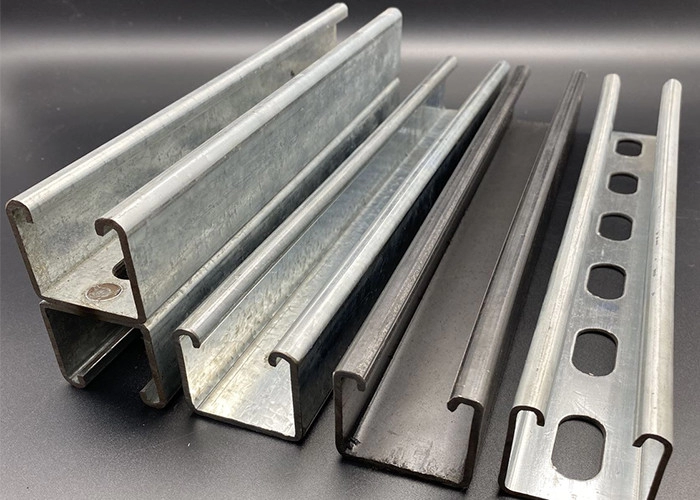
This is the step most often missed. Strut channel systems are available in carbon steel, SS304, SS316 and aluminium, and the fastener grade has to follow the channel, not the other way round. A stainless fastener threaded into a spring nut of a different alloy creates a galvanic couple, and in the presence of moisture the less noble metal corrodes.
The safe rule is straightforward: an SS304 channel takes A2-70 fasteners and SS304 spring nuts; an SS316 channel takes A4-80 fasteners and SS316 spring nuts; a galvanised carbon steel channel takes zinc-plated or hot-dip galvanised fasteners, not stainless. Where a mixed system is unavoidable, the connection should be isolated rather than left in direct contact.
The component range follows the same logic. Spring nuts are available in M6, M8, M10 and M12, and channel nuts in M8, M10 and M12. Strut channel profiles include 41 x 41 x 2.5 mm, 41 x 21 x 2.5 mm and 41 x 41 x 2.0 mm, plus the imperial equivalents 1-5/8 inch x 1-5/8 inch and 1-5/8 inch x 13/16 inch, with slotted and unslotted variants. When the channel and the fastener are ordered from the same specification sheet, grade mismatch is designed out before it reaches site.
Application-by-Application Grade Selection
Oil and Gas
Specify A4-80 (SS316) as the baseline. Process areas carry chloride-bearing streams and the atmosphere around loading and storage areas is frequently saline. Where the project also calls for high-strength alloy studs, the stainless range is supplied separately from the carbon and alloy grades - the industrial fasteners range covers grades 4.8, 8.8, 10.9 and 12.9, B7 alloy steel and stainless A2-70/A4-80, and these are not interchangeable within a joint.
Construction and Building Infrastructure
SS304 is normally adequate for internal structural supports, cable tray and pipe supports inside buildings, and façade framing away from the coast. Move to SS316 for coastal façades, splash zones, car park soffits exposed to de-icing salt, and any exposed connection within the salt spray envelope. For general structural steel connections where high-strength structural bolts are required, ASTM A325/A490 designations are available in the carbon and alloy range rather than the stainless range, so the specification has to state which family the connection belongs to.
Solar Mounting
Solar mounting sits in a long-life, low-maintenance environment, which makes the grade decision expensive to reverse. Inland and low-humidity sites are commonly specified in SS304 or in hot-dip galvanised carbon steel. Coastal and high-humidity sites, and installations where modules cannot be regularly inspected, justify SS316 for fasteners and channel together. The governing criterion is the twenty-year exposure, not the first-order price.
MEP and HVAC
Indoor MEP and HVAC supports are the classic SS304 application: conditioned air, no chloride load, and a support system built from channel, spring nuts, threaded rods and pipe clamps. SS316 enters the picture in plant rooms with chemical dosing, in kitchen extract with chlorinated cleaning, in pool halls and in any location where condensation regularly wets the connection. In those areas the entire support assembly - channel, nut, rod and clamp - should move to SS316 together.
SS304 vs SS316 Fasteners: Side-by-Side Comparison
| Decision factor | SS304 (A2-70) | SS316 (A4-80) |
|---|---|---|
| Alloy family | Austenitic stainless, 304 series | Austenitic stainless, 316 series with molybdenum |
| Order designation | A2-70 | A4-80 |
| Matching strut channel material | SS304 channel | SS316 channel |
| Chloride resistance | Moderate; suited to low-chloride atmospheres | Higher; suited to chloride-bearing and marine exposure |
| Typical service environments | Indoor plant, conditioned buildings, inland construction, general MEP | Coastal, oil and gas, chemical, washdown, water treatment |
| Relative material cost | Lower | Higher |
| Standards available | DIN, ANSI/ASME, ISO, GB, UNI, JIS, BS, NFE | DIN, ANSI/ASME, ISO, GB, UNI, JIS, BS, NFE |
| ASTM designations in range | ASTM A563/A194, ASTM A325/A490 available in the industrial fasteners range | ASTM A563/A194, ASTM A325/A490 available in the industrial fasteners range |
| Size coverage | M6-M64 and 1/4 inch-2-1/2 inch | M6-M64 and 1/4 inch-2-1/2 inch |
| Typical buyer trigger | Dry, low-chloride duty with cost control | Corrosion risk that cannot be inspected or maintained easily |
Table notes: grade, standard and size data reflect the industrial fasteners and strut channel specifications held by CNS INDUSTRIAL (JIAXING) CO., LTD. Finish options across the wider range include electro-zinc plated, hot-dip galvanized, Dacromet, Magni, Geomet, pre-galvanized and plain; the applicable finish for stainless items should be confirmed item by item on the quotation. Relative cost in this table is a directional statement, not a price band - obtain a project-specific quotation before budgeting.
Read the table by row, not by column. The two grades share almost every commercial attribute - same standards, same sizes, same documentation path. They differ on exactly one axis: chloride exposure. All the specification effort should therefore go into establishing the chloride load of the installation, because that single variable decides everything else.
Step-by-Step: How to Specify and Verify a Stainless Fastener Order
Step 1 - Define the exposure. Record whether the connection is indoor, sheltered outdoor, exposed outdoor, coastal, chemical or washdown. Note whether chlorides can accumulate in crevices under washers and in thread roots. This single note drives the next four steps.
Step 2 - Fix the channel material first. Choose carbon steel, SS304, SS316 or aluminium for the strut channel and record it. The fastener grade must then follow the channel, with matching spring nuts in M6, M8, M10 or M12 or channel nuts in M8, M10 or M12.
Step 3 - Write the grade designation, not just the material name. 'Stainless steel' is not a specification. Write A2-70 or A4-80, and add the property class required by the joint design so the supplier cannot substitute a lower class within the same alloy family.
Step 4 - State the standard and the dimension together. For example, an M10 fastener to DIN or ISO 4017, or an imperial item to ANSI/ASME, with the size expressed in the project's own units. Mismatched standard and dimension is one of the most common causes of a rejected delivery.
Step 5 - Confirm quantity, packaging and marking. The standard minimum order quantity for the industrial fasteners range is 500 kg per item. Mixed-alloy orders should be packed and marked by grade so that site staff cannot accidentally install an A2 nut on an A4 stud.
Step 6 - Request documentation with the quotation. Ask for the quality management certificate, the certificate of conformity to the ordered standard, and the material traceability reference. Documentation requested after shipment is documentation you may not receive.
Step 7 - Validate a sample before volume. Check thread fit against the matching spring nut or channel nut, check marking legibility, and confirm the grade identity. Standard production lead time is 30-45 days, so a sample stage adds little schedule risk but removes most of the substitution risk.
Compliance and Documentation: What to Verify
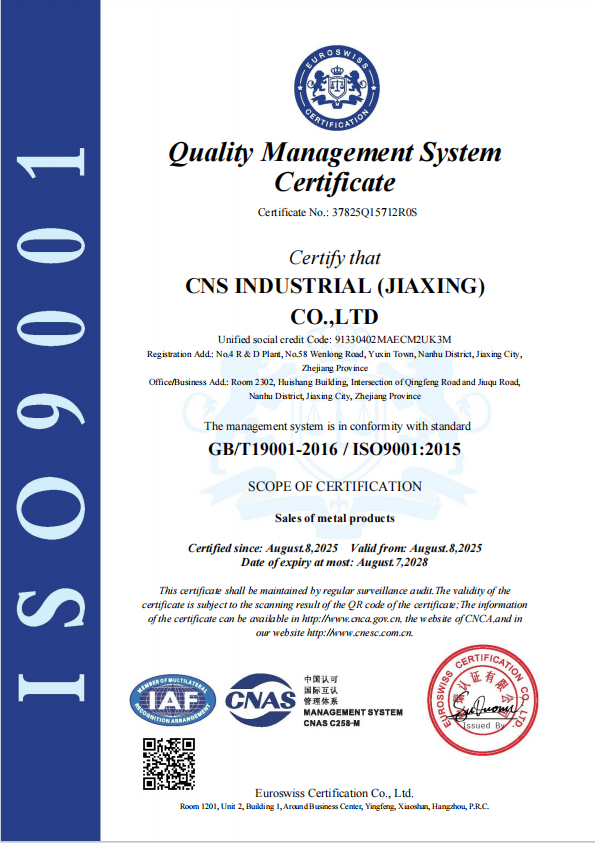
For an ISO 9001 industrial fasteners manufacturer, the certificate itself is verifiable and should be checked on four points: the certificate number, the issuing body, the validity window and the stated scope. The Industrial Fasteners product supplied by CNS INDUSTRIAL (JIAXING) CO., LTD. is certified to the ISO 9001:2015 Quality Management System standard under certificate number 37825Q15712R0S, issued by Euroswiss Certification Co., Ltd., against GB/T19001-2016 / ISO9001:2015. The certification applies worldwide and is valid from 2025-08-08 to 2028-08-07, with the scope stated as sales of metal products.
Alongside the management system certificate, a stainless fastener order should carry a declaration of the standard it was manufactured to. The range is manufactured to GB, ISO, DIN, ANSI/ASME, UNI, JIS, BS and NFE standards, or to customer drawings and samples, and meets ASTM A563/A194 and ASTM A325/A490 where those designations are specified. A buyer comparing two suppliers should compare those two documents line by line before comparing price.
Five Specification Mistakes That Cost More Than the Grade Premium
1. Writing 'stainless steel' without a grade. The supplier is then free to deliver either alloy, and the buyer has no contractual basis to reject the cheaper one.
2. Upgrading the fastener but not the channel. An A4-80 bolt in a galvanised carbon steel channel still forms a dissimilar-metal couple. Grade matching has to happen at system level.
3. Ignoring crevices. The washer face, the thread root and the gap between nut and channel are where chlorides concentrate and oxygen is scarce. A connection that looks fine on the exposed surface can be pitting underneath.
4. Buying SS316 where it changes nothing. In a dry, heated, low-chloride plant the premium buys no measurable service-life gain. Money spent here is usually money unavailable for the connections that genuinely need it.
5. Treating lead time as an afterthought. Standard production lead time is 30-45 days with a monthly capacity of 800 tons. Projects that specify a grade late in the programme end up accepting whichever alloy is in stock rather than the one the exposure requires.
Frequently Asked Questions
What ISO 9001 documentation should a buyer request from an industrial fasteners manufacturer?
Request the ISO 9001 certificate and verify the certificate number, issuer, validity dates and scope against the product being purchased. The Industrial Fasteners product supplied by CNS INDUSTRIAL (JIAXING) CO., LTD. is certified to ISO 9001:2015 under certificate number 37825Q15712R0S, issued by Euroswiss Certification Co., Ltd., to the GB/T19001-2016 / ISO9001:2015 standard, valid from 2025-08-08 to 2028-08-07, with worldwide applicability and a stated scope of sales of metal products.
Can SS304 and SS316 fasteners be supplied together with strut channel systems?
Yes. The strut channel range is produced in carbon steel, SS304, SS316 and aluminium, with spring nuts in M6, M8, M10 and M12 and channel nuts in M8, M10 and M12, so a single project can be sourced with matched grades. The practical requirement is that each grade is packed and marked separately, because an A2 nut installed on an A4 stud - or a stainless fastener installed in a galvanised channel - reintroduces exactly the corrosion risk the grade selection was meant to remove.
Is SS316 worth the higher material cost over SS304?
It is worth it when the connection cannot be easily inspected or maintained and chlorides are present: coastal exposure, salt splash zones, chemical and process areas, and washdown environments. It is not worth it in dry, low-chloride indoor installations, where SS304 already sits inside its design envelope. Because SS316 carries a higher material cost, the comparison should be made on total life cost - replacement labour, access equipment, downtime and inspection - rather than on the unit price difference alone.
What is the minimum order quantity and lead time for a stainless fastener order?
The standard minimum order quantity for the industrial fasteners range is 500 kg per item, and standard production lead time is 30-45 days against a monthly capacity of 800 tons. Buyers running a coastal or oil and gas package should therefore lock the grade decision at design stage rather than at procurement stage, so that the lead time is spent on production and not on re-specification.
How should mixed-material support systems be handled on site?
Avoid leaving stainless fasteners in direct, permanently wet contact with galvanised carbon steel. Either unify the material across the assembly, or isolate the connection so the two metals are not in electrical contact in the presence of an electrolyte. If you are unsure which grade your assembly actually requires, the fastest route is to send the exposure conditions, the channel specification and the required standard to a manufacturer and request a sample and a written quotation for both grades - CNS INDUSTRIAL (JIAXING) CO., LTD. accepts enquiries at sales@cnsindustrial.com and publishes its full range at www.cnsindustrial.com.
Conclusion: Decide on Exposure, Then Buy the Grade
SS304 and SS316 fasteners are not competing products in the usual sense. They are two positions on a corrosion-resistance curve, and the buyer's task is to identify the lowest position that still holds for the life of the installation. SS304 (A2-70) covers indoor plant, conditioned buildings, inland construction and general MEP work. SS316 (A4-80) covers coastal, oil and gas, chemical, water treatment and washdown duty, where the molybdenum content earns its cost through reduced pitting in chloride-bearing conditions.
Whatever grade is chosen, three things make the purchase defensible: the fastener grade matches the strut channel material, the order states the standard and dimension rather than just the alloy name, and the quality management certificate is verified before the purchase order is released. A supplier that can document all three - and that manufactures both the fasteners and the channel system to the same specification - removes most of the risk from the decision.
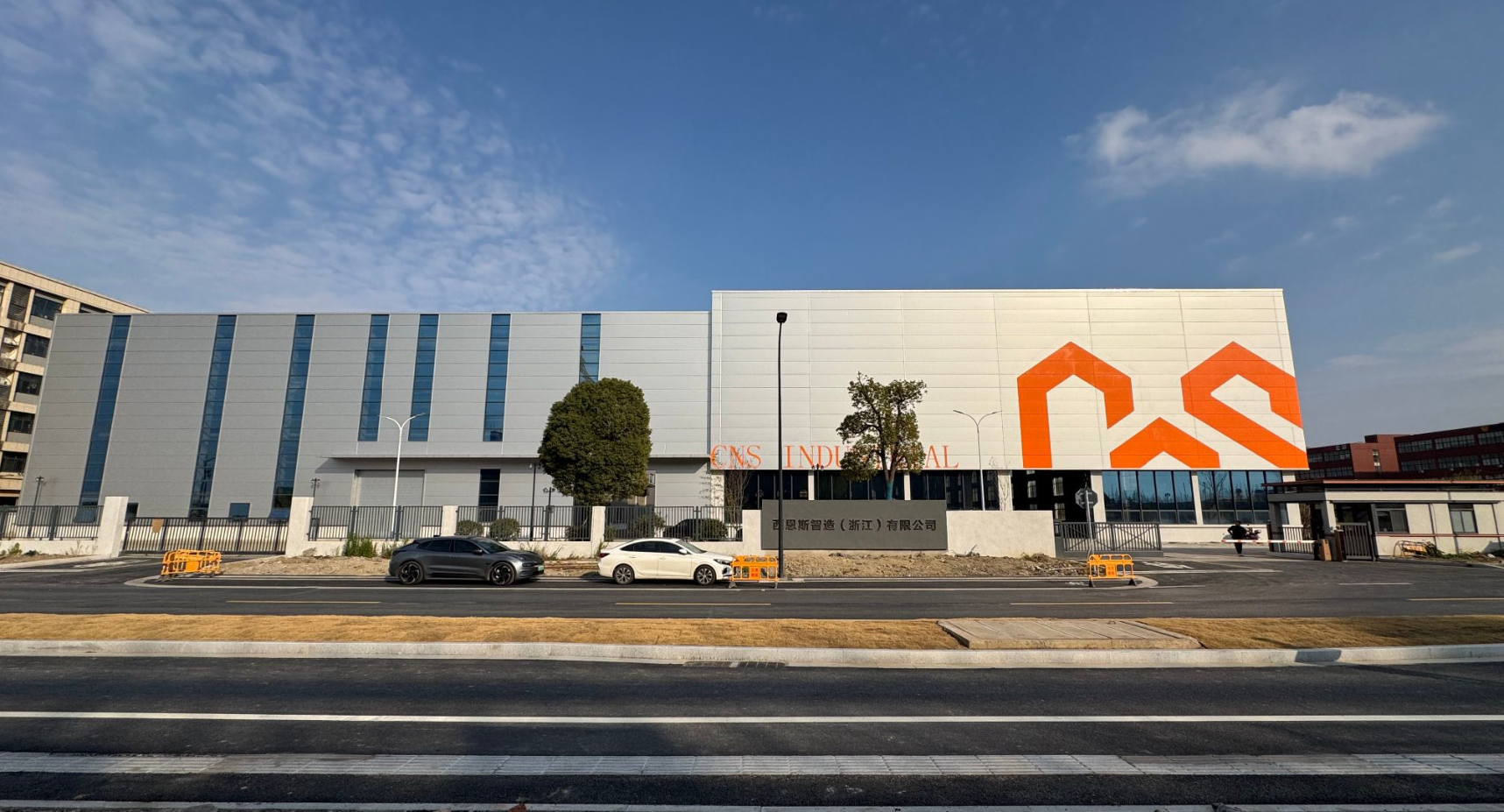
CNS INDUSTRIAL (JIAXING) CO., LTD. manufactures industrial fasteners and strut channel systems in Jiaxing City, Zhejiang Province, China, near Shanghai Port, and exports 100% of its output to markets including the EU, the US, Canada and South America. The full product range is documented in the CNS Industrial brochure, which can be downloaded and shared with project teams.
Next step: send your exposure conditions, channel specification and required fastener standard, and request SS304 and SS316 samples for side-by-side comparison before committing to volume.
Email: sales@cnsindustrial.com | Tel: +86 152 57097 384 | WhatsApp: +86 152-5709-7384 | Website: www.cnsindustrial.com
Have Questions or Need More Details?
Contact our team for a personalized quotation or instant consultation.
Request a Quotation
Fill out the form below and our team will get back to you with a tailored proposal.
WhatsApp Direct Chat
Prefer to chat in real-time? Message us on WhatsApp for instant assistance & quick answers.
- Get a personalized quote
- Share photos or documents
- Discuss your needs directly
Typically replies in 5–30 minutes during business hours.