
Spring Nuts vs Channel Nuts: Strut Channel Fastening Choice
A spring nut and a plain channel nut both clamp into a strut channel and both accept a threaded rod or bolt. What separates them is mechanical: a spring nut uses a spring to hold the nut in position inside the channel while the installer works, and a plain channel nut does not have that spring mechanism, so it must be held or deliberately positioned during tightening.
This comparison covers the two families as they are actually specified for strut channel work — spring nuts in M6, M8, M10 and M12, and channel nuts in M8, M10 and M12 — across 41 × 41 mm (1-5/8" × 1-5/8") and 41 × 21 mm (1-5/8" × 13/16") channel in 12ga, 14ga and 16ga wall, in both slotted and unslotted configurations. It closes with a side-by-side recommendation rather than a single winner, because the correct answer depends on access, load, thread size and corrosion exposure, not on product category.
Spring nuts are the working default for overhead, vertical and repetitive strut installations, where the nut has to stay in place before the bolt is loaded. Plain channel nuts are the better fit where the joint is accessible, the thread demand sits inside M8–M12, and the installer can position the nut deliberately. When the channel profile, spring condition or nut dimensions do not match, a spring nut will slip regardless of brand — that is a fit problem, not a product-family problem.

Why This Choice Drives Installation Cost More Than Material Cost
In a strut assembly the nut is a small line on the bill of materials but a large source of labor variance. Two crews using the same channel, rod and torque value can finish an identical run at noticeably different speeds depending on whether the nut stays where it was placed while the bolt is engaged. Positioning, not purchase price, is where the two families separate.
The most common field complaint — a spring nut that keeps slipping inside the channel — has four documented causes: the nut is not matched to the channel profile, the spring is too weak or damaged, the channel or nut dimensions are incorrect, or the nut was not properly positioned before tightening. Resolving it means checking profile compatibility, seating the spring against the inside of the channel, rotating the nut into its locking position, and confirming that thread size and bolt length are compatible.
Thread coverage narrows the decision before load is even discussed. Spring nuts in this comparison run from M6 to M12; channel nuts run from M8 to M12. A design that specifies M6 rod cannot use the channel nut range at all, which makes the thread call the first filter and the mechanical comparison the second.
That leaves five practical criteria, and the rest of this article works through them in order: seating and positioning, channel geometry, load path and vibration, corrosion exposure, and supply capability.
Industry Background: A Growing Category With Real Cost Pressure
Strut channel and its fittings sit inside a market that research firms size very differently. Dataintelo valued the global strut channel market at USD 4.3 billion in 2024 and projected USD 7.3 billion by 2033 at a compound annual growth rate of 6.1%. Intel Market Research, working from a narrower definition, put the 2025 strut channel market at USD 1.85 billion. The gap between those two figures is wide enough that absolute valuations should be treated as directional rather than precise.
The wider fastener market shows the same mix of scale and disagreement. Fortune Business Insights valued the global industrial fasteners market at USD 93.12 billion in 2025, while Grand View Research projected USD 153.71 billion by 2033 at a 5.1% CAGR. Grand View Research also reports that metal fasteners held a 91.0% share of the industrial fasteners market in 2025, that bolts were the largest single product segment at 31.3%, and that Asia Pacific accounted for a 45.1% revenue share.
For a specifier, the useful signal is not the headline number but what it implies: demand concentrates in installations where the nut is fitted overhead, in long runs, and by crews working at height or from ladders. In that context a component that removes a reposition from each connection is worth more than a component that saves a fraction of material cost. That is the frame in which spring nuts and channel nuts should be compared.
The standards environment is stable. Hexagon nuts are governed by standards such as ISO 4032 and DIN 934, plain washers by ISO 7089 and ISO 7090 (equivalent to DIN 125), and spring lock washers with square ends by DIN 127 / BS4464B. These matter here because the nut never works alone: it shares a rod or bolt with a washer, and an over-thick or under-thick washer beneath a channel nut changes how much thread is available inside the profile.
How Each Nut Behaves Inside a Strut Channel
Spring nuts: where they hold
A spring nut includes a spring that holds the nut in position inside the strut channel. That single feature makes installation faster and easier, particularly when working overhead or on vertical runs, and it is why spring nuts are generally recommended for most strut channel installations where fast positioning matters — overhead, vertical and repetitive work above all.
The spring also acts as a third hand. It keeps the nut at the intended point on a slotted channel while the installer brings the rod down or the bolt up, which reduces the number of times a displaced nut has to be retrieved from inside the profile.
Spring nuts: where they slip
A spring nut that slips is almost always a mismatch. Check in this order: that the nut is designed for the specific strut channel size and profile; that the spring is properly seated against the inside of the channel and the nut has been rotated into the correct locking position; that thread size and bolt length are compatible; and that the spring itself is intact rather than deformed or de-tensioned.
Where the application carries heavier loads or needs stronger retention during installation, a heavy-duty spring nut with a stronger spring is the appropriate step up. Beyond profile compatibility, selection criteria are thread size, material, coating and load capacity.
Channel nuts: where they hold and where they cost labor
A plain channel nut does not have the spring mechanism, so it does not self-position. In exchange it gives the installer direct control over where the nut sits on the channel face, which suits accessible assemblies, short runs, and joints where the nut is placed deliberately and tightened once. A plain channel nut can be considered for simpler applications where installation speed and positioning are less critical.
The labor cost appears wherever the nut must be held by hand, retrieved after displacement, or repositioned within a run. On a workbench that cost is negligible. At height, over a cable tray run, it becomes the dominant cost of the connection.
Channel geometry: 41 × 41 mm, 41 × 21 mm, 12ga to 16ga, slotted and unslotted
Two channel profiles dominate: 1-5/8" × 1-5/8" (41 × 41 mm) and 1-5/8" × 13/16" (41 × 21 mm). The deeper 41 × 41 profile leaves more internal depth for the nut, spring and rod stack and accommodates the M6–M12 spring nut range with clearance to spare. The shallow 41 × 21 profile leaves less internal clearance, so the combination of nut height, spring and protruding thread has to be reviewed before ordering — a nut that suits a 41 × 41 channel does not automatically suit a 41 × 21 channel.
Wall thickness matters too. Of the three gauges in this comparison, 12ga is the thickest and 16ga the thinnest, and the wall determines how much of the inturned lip the nut can bear against. Thin-wall channel concentrates the clamping load on a smaller bearing area and is less forgiving of a nut whose profile is only approximately correct.
Slotted and unslotted channel change the installation sequence rather than the nut type. On slotted channel the nut can be inserted at any point along the run and adjusted after assembly, which is where the spring earns its value. On unslotted channel the nut must be introduced from the end of the profile, so the order of assembly has to be planned before the first connection is tightened. In both cases the decisive check is slot width and lip geometry against the nut — matching the thread alone is not enough.
Load, vibration and preload
Neither nut type removes the need for a locking decision. Where vibration is present, the available methods are prevailing-torque lock nuts, threadlocker, spring washers and other mechanical locking methods, and the correct choice depends on vibration level, temperature, joint design, installation conditions and whether the joint will be serviced. Proper tightening torque and bolt preload are essential in every case; a locking washer is not a substitute for preload.
Bolt grade should be matched to the joint rather than maximised. Metric property classes 8.8, 10.9 and 12.9 and imperial Grade 5 and Grade 8 cover different strength levels, and a higher-strength bolt is not automatically the better choice — mating components, tightening requirements and operating environment all constrain the decision.
Material and finish tied to corrosion exposure
Material selection follows the exposure. The available range covers carbon steel and alloy steel for general structural work, stainless steel in 304, 316 and 316L for corrosive service, and aluminium and copper where weight or conductivity governs. Finishes include electro-zinc plated in white or yellow, hot-dip galvanized, Dacromet, Magni, Geomet and pre-galvanized.
The practical distinction is between coated steel and stainless. Hot-dip galvanized (HDG) delivers a heavy zinc coating of 45–85 μm, commonly specified at ≥45 μm, with outdoor anti-rust capability of 20+ years; electro-zinc plating delivers 5–12 μm and is intended mainly for indoor rust prevention. HDG is the appropriate specification for outdoor solar racking, coastal infrastructure and heavy industrial plant installations; electro-zinc suits indoor HVAC mounting, electrical conduit hanging and interior wall framing.
Within stainless, the dividing line is chloride exposure. SS316 contains 2%–3% molybdenum, which makes it markedly more resistant to chloride corrosion, salt fog and harsh chemicals than SS304. SS304 suits general construction, commercial framing and inland applications that want high durability at lower cost; SS316 suits marine hardware, coastal solar installations, food processing equipment and chemical engineering projects. Aluminium channel is a separate case again: because nut and channel are dissimilar metals, the couple between the fastener, the channel and the structure it contacts should be reviewed rather than assumed.
Custom fabrication to drawings or samples
Not every assembly uses a catalogue profile. CNS INDUSTRIAL (JIAXING) CO.,LTD is a fastener and strut channel fitting manufacturer based in Jiaxing City, Zhejiang Province, China, exporting to the EU, US, South American and Canadian markets. The company provides manufacturing, OEM, product processing, packaging and trading services, and supports made-to-sample production or processing to GB, ISO, DIN, ANSI/ASME, UNI, JIS, BS and NFE standards.
Its quality management system is certified to ISO 9001 under certificate number 37825Q15712R0S, issued by Euroswiss Certification Co., Ltd. against GB/T19001-2016 / ISO 9001:2015, with a scope of 'sales of metal products'. The certificate was issued on 2025-08-08 and expires on 2028-08-07.
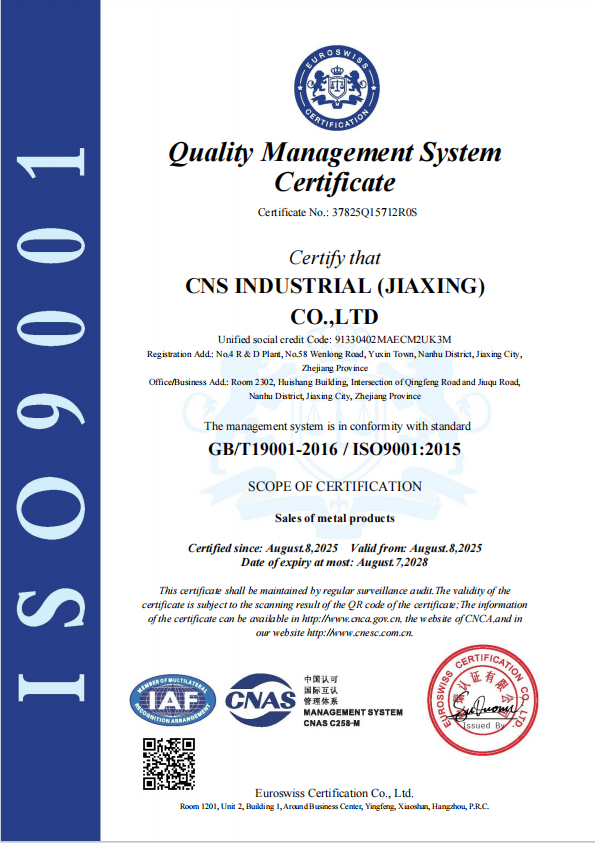
For a custom nut, that combination — a certificate scope that covers the product being purchased, plus made-to-sample capability — is what allows a channel profile to be matched by drawing instead of by trial and error on site.
Step-by-Step: Choosing the Nut for a Specific Assembly
- Lock the profile first. Record the channel as 41 × 41 mm or 41 × 21 mm, note the wall as 12ga, 14ga or 16ga, and confirm slot width and lip geometry against the nut drawing. Profile compatibility precedes every other decision.
- Decide slotted or unslotted. On slotted channel the nut position stays adjustable after assembly; on unslotted channel the nut must enter from the end. This sets the assembly sequence and tells you whether a self-holding nut is required.
- Fix the thread size. M6 is available in spring nuts only within this comparison; M8, M10 and M12 are available in both families. Imperial equivalents used in spring nut selection include 1/4"-20, 3/8"-16 and 1/2"-13, so the rod or bolt specification drives the nut part number, not the reverse.
- Choose spring or plain by access and repetition. Overhead, vertical or repetitive work points to a spring nut. Accessible, one-off joints with deliberate positioning point to a plain channel nut. Heavy-duty spring nuts exist for cases where retention during installation is critical.
- Set the duty and vibration method. Confirm the nut load rating against the joint, then pair it with a locking method and a defined tightening torque. For severe vibration, combine an appropriate locking method with correct preload rather than relying on a spring washer alone.
- Fix the corrosion specification. Choose carbon steel with electro-zinc for dry indoor work; HDG for outdoor, coastal and heavy industrial exposure; SS304 for general construction and inland service; SS316 for marine, coastal, chemical and high-chloride environments.
- Confirm supply and acceptance. Decide whether a catalogue nut or a made-to-sample part is needed, request the certificate and its scope, and write the inspection criteria — inspection per order and delivery inspection — into the contract or technical agreement.

Use Cases: Where Each Type Pays Back
Pipe supports
Pipeline support is one of the applications where the nut is most often fitted from below or inside a run, which is precisely the condition in which a spring nut saves time. On 41 × 41 channel with M10 or M12 rod, the spring holds the nut at the set point while the rod is engaged and the bracket aligned. Where the support carries heavier equipment or the nut must stay put during alignment, a heavy-duty spring nut is the safer choice. Outdoor and plant-room runs should be specified in HDG.
Cable trays
Tray installation is long, repetitive and almost entirely overhead. Each connection is quick, but there are many of them, so positioning time compounds faster than material cost. A spring nut on slotted channel allows the nut to be dropped in at any point and adjusted after the tray is offered up. Electro-zinc plated fasteners are adequate indoors; runs that leave the building or pass through wash-down areas should move to HDG.
HVAC equipment
Plant-room and rooftop equipment brings vibration from fans and rotating machinery into the joint. Here the nut type is secondary to the locking decision: prevailing-torque lock nuts, threadlocker or mechanical locking, combined with correct torque and preload. A plain channel nut is workable in accessible plant-room assemblies where components are positioned deliberately, while spring nuts remain the practical choice on the overhead distribution runs feeding the equipment.
Solar mounting
Solar racking is outdoor, exposed and usually assembled at speed by crews working along long rows, which pushes the decision toward spring nuts and toward HDG or stainless. HDG is specified for outdoor solar racking and SS316 for coastal installations where chloride exposure dominates. Where aluminium channel is used, the fastener material should be reviewed for compatibility with the channel and with the structure it contacts before the design is frozen.
Across pipeline support, equipment anchoring, building supports and MEP installations, the outcome specifiers consistently want is the same: strong, durable connections, improved installation efficiency and reduced long-term maintenance needs. The nut choice is one lever for that outcome; the profile match, torque specification and finish choice are the others.
Side-by-Side Comparison: Spring Nuts and Channel Nuts
| Decision factor | Spring nuts (M6–M12) | Channel nuts (M8–M12) |
|---|---|---|
| Holding mechanism | Spring holds the nut in position inside the channel | No spring mechanism; nut must be held or positioned deliberately |
| Thread range in this comparison | M6, M8, M10, M12; imperial equivalents such as 1/4"-20, 3/8"-16, 1/2"-13 | M8, M10, M12 |
| Best installation access | Overhead, vertical, repetitive work at height | Accessible assemblies, short runs, one-off joints |
| Installation labor profile | Faster positioning; fewer retrievals of displaced nuts | More handling per connection where access is poor |
| Slip risk and cause | Slips when profile does not match, spring is weak or damaged, dimensions are wrong, or the nut was not positioned before tightening | Does not self-hold; displacement happens during handling rather than spring failure |
| Channel profile checks | Must match 41 × 41 mm or 41 × 21 mm profile, slot width and lip geometry | Same checks apply; deliberate positioning is not a substitute for profile match |
| Wall thickness sensitivity | 12ga, 14ga, 16ga change the bearing area on the inturned lip | 12ga, 14ga, 16ga change the bearing area on the inturned lip |
| Load and duty options | Standard and heavy-duty versions with stronger spring | Selected by thread size, load rating and joint design |
| Vibration control | Requires an added locking method and correct preload | Requires an added locking method and correct preload |
| Materials available | Carbon steel, alloy steel, stainless 304 / 316 / 316L, aluminium, copper, brass | Same material family; grade chosen by exposure and load |
| Finish options | Electro-zinc (white / yellow), HDG, Dacromet, Magni, Geomet, pre-galvanized | Electro-zinc (white / yellow), HDG, Dacromet, Magni, Geomet, pre-galvanized |
| Typical applications | Overhead cable tray runs, solar racking, pipe supports, MEP distribution | Accessible plant-room frames, equipment anchoring, simpler assemblies |
| Customization route | Made-to-sample or processing to GB, ISO, DIN, ANSI/ASME, UNI, JIS, BS, NFE under an ISO 9001 system | Same customization scope; profile matched by drawing |
| Ordering parameters | MOQ 500 kg per item; lead time 30–45 days | MOQ 500 kg per item; lead time 30–45 days |
Frequently Asked Questions
CNS INDUSTRIAL (JIAXING) CO.,LTD holds ISO 9001 certification number 37825Q15712R0S, issued by Euroswiss Certification Co., Ltd. against GB/T19001-2016 / ISO 9001:2015, with a scope of 'sales of metal products'. The certificate was issued on 2025-08-08 and expires on 2028-08-07. Buyers should request the certificate and match its scope wording and validity dates against the product being purchased before approving a supplier.
Yes, where OEM services are available. CNS INDUSTRIAL provides manufacturing, OEM, product processing, packaging and trading services, and supports made-to-sample production or processing to GB, ISO, DIN, ANSI/ASME, UNI, JIS, BS and NFE standards. Materials include carbon steel, alloy steel, stainless steel 304 / 316 / 316L, aluminium, copper and brass, with finishes such as electro-zinc (white or yellow), hot-dip galvanized, Dacromet, Magni, Geomet and pre-galvanized. For strut channel work this matters because the nut has to match the channel lip geometry and slot width, not only the thread size.
The minimum order quantity is 500 kg per item. Payment terms are 30% T/T deposit with the 70% balance against receipt of the B/L copy. Delivery terms offered are FOB, CIF, CFR, DDP and DDU, by sea and by train.
Validate the profile first: confirm the nut is designed for the specific strut channel size and profile, and that the spring seats correctly against the inside of the channel and rotates into the locking position. Then confirm thread size and bolt length compatibility, since a mismatch at either point produces the same symptom as a slipping nut. Where the channel is a non-catalogue profile, made-to-sample production allows the fit to be proven against a drawing or sample. Acceptance criteria — inspection per order and delivery inspection — should be defined in the contract or technical agreement rather than assumed.
Quoted lead time is 30–45 days, with a monthly capacity of 800 tons and an annual output of 8000 tons across the manufacturer's product range. Because the minimum order is 500 kg per item, projects that mix several nut sizes, thread ranges and finishes should plan the order as a single consolidated release rather than as separate small calls. Buyers who want to review the full range before specifying can download the catalogue below and send the channel profile, thread size and finish requirement for a quotation.
Conclusion: A Side-by-Side Recommendation, Not a Single Winner
Neither nut type wins outright, and any supplier who says otherwise is simplifying away the variables that decide the outcome. The recommendation splits cleanly by installation condition.
Specify spring nuts when the work is overhead, vertical or repetitive; when the assembly must stay adjustable on slotted channel; when the design calls for M6 rod; or when a heavy-duty spring nut is needed to hold position during alignment. This is the majority of cable tray, solar racking and overhead pipe support work.
Specify plain channel nuts when the joint is accessible, the thread demand sits inside M8–M12, and the installer can place the nut deliberately and tighten it once. Plant-room frames, equipment anchoring and simpler assemblies fall into this group, and there the plain nut avoids paying for a positioning feature the job does not need.
Apply the same checks to both: match the nut to the 41 × 41 mm or 41 × 21 mm profile and to the 12ga, 14ga or 16ga wall; confirm slot width and lip geometry, not just thread; pair the nut with a locking method and a defined torque where vibration exists; and set material and finish from the exposure — electro-zinc indoors, HDG for outdoor and coastal work, SS316 where chlorides dominate. Where the profile is non-standard, confirm that the supplier can produce to drawing or sample under a certificate whose scope covers the product.
Send Your Channel Profile for a Nut Recommendation
CNS INDUSTRIAL (JIAXING) CO.,LTD supplies strut channel fittings, channel spring nuts, strut channel systems, bolts and nuts, washers, threaded rods, anchors and stamped parts to buyers in the EU, US, South American and Canadian markets. Share your channel size, wall gauge, thread size, finish and annual quantity to receive a sample and quotation.
Email: sales@cnsindustrial.com | Tel / WhatsApp: +86 152 57097 384 | Website: www.cnsindustrial.com
Download the CNS Industrial Brochure (PDF)CNS INDUSTRIAL (JIAXING) CO.,LTD · No.4 R & D Plant, No.58 Wenlong Road, Yuxin Town, Nanhu District, Jiaxing City, Zhejiang Province, China · ISO 9001 certificate 37825Q15712R0S

Have Questions or Need More Details?
Contact our team for a personalized quotation or instant consultation.
Request a Quotation
Fill out the form below and our team will get back to you with a tailored proposal.
WhatsApp Direct Chat
Prefer to chat in real-time? Message us on WhatsApp for instant assistance & quick answers.
- Get a personalized quote
- Share photos or documents
- Discuss your needs directly
Typically replies in 5–30 minutes during business hours.