
Stop Spring Nut Slippage in Strut Channels: Fixes That Work
A spring nut slips for one of three reasons. It is the wrong nut series for the channel, its spring cannot load up against the channel lip because the wall thickness sits outside its working range, or the bolt was torqued before the spring had seated. Those three causes account for most field complaints, and the first three fixes below address them. The remaining fixes cover the cases where the nut is correct but the installation, the washer stack or the condition of the slot is not.
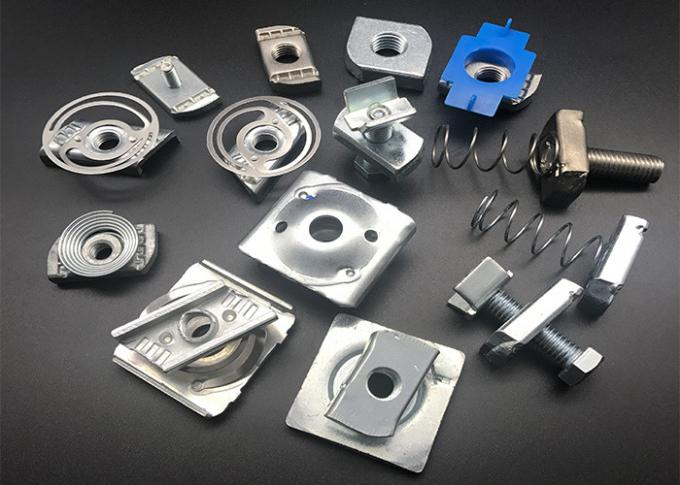
Spring nuts hold position against the channel lips before the bolt is tightened. Fit, not force, keeps them there.
What Spring Nut Slippage Actually Means
A spring nut is a channel nut fitted with a spring that presses it against the inturned lips of a strut channel. The spring has one job: hold the nut in position inside the slot so the installer can start the bolt with one hand. The spring does not carry working load. The clamping force of the tightened bolt does. Slippage means any movement of the nut relative to the channel that is not supposed to happen. On site it appears in four forms, and each one points to a different root cause:
- Axial slide. The nut drifts along the slot before the bolt is tightened, so a pipe clamp or bracket will not stay where the layout says it should.
- Rotation in the slot. The nut spins or twists while the bolt is being driven, usually because it was never seated squarely on both lips.
- Rocking and pull-through. The nut is narrower than the slot opening or does not cover both lips, so it tilts and drops under load instead of clamping flat.
- Walking on long runs. A nut that holds on a short bracket creeps when dozens of them are installed in a row and each one is loaded slightly differently.
The reason misdiagnosis is expensive is that the four forms do not share a fix. Adding torque to a nut that is the wrong width for the slot simply deforms it. Replacing a correct nut with a heavier one does nothing if the channel wall thickness was the problem. Diagnose the movement first, then choose the fix.
Why Slippage Complaints Keep Growing
Support systems are being installed in larger volumes, by more crews, from more mixed sources than in the past. Independent market research puts the global strut channel market at USD 4.3 billion in 2024, with a forecast of USD 7.3 billion by 2033 at a CAGR of 6.1% (Dataintelo). The wider fastener base is growing on a similar curve: the global industrial fasteners market was valued at USD 93.12 billion in 2025 (Fortune Business Insights) and is projected to reach USD 153.71 billion by 2033, growing at a CAGR of 5.1% (Grand View Research).
Two structural details matter for the slippage problem. First, Asia Pacific accounted for a 45.1% revenue share of the industrial fasteners market in 2025 (Grand View Research), which means a large share of channel and nut volume is produced across many plants and shipped into projects where the channel and the nut may not come from the same supplier. Second, metal fasteners held 91.0% of that market in 2025, and bolts are the largest single product segment at 31.3% (Grand View Research). The nut is a small-value item inside a large, price-sensitive assembly, so it is often sourced last, from a second supplier, after the channel has already been ordered.
Published 2025 market estimates differ between research houses because each defines the category scope differently, so treat any single figure as directional rather than exact. The operational point is stable: channel and nut are frequently purchased separately, and fit is what fails when they are.
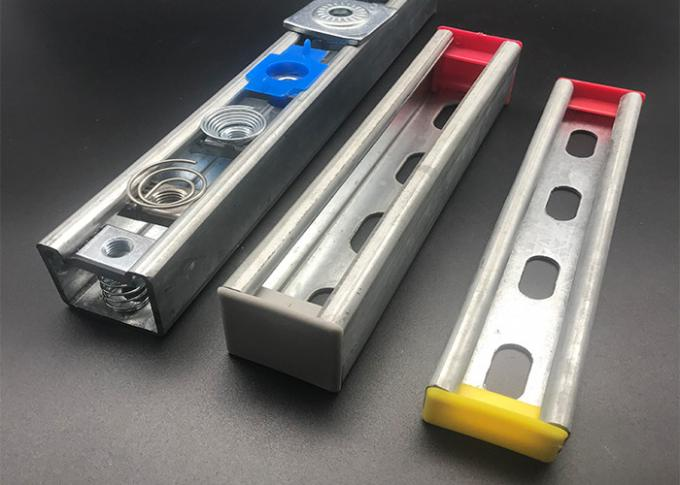
The Seven Fixes, Ranked by How Often They Solve the Problem
The list is ordered by diagnostic value, not by effort. Fixes 1 to 3 are specification decisions made on the purchase order. Fixes 4 to 7 are field decisions made by the installer. If you can only control one half of that split, start where your control sits.
Fix 1. Confirm the channel series before the nut is ordered
Two channel families dominate strut work: 41×41 and 41×21. The nut body width and the spring span are sized to a family. A nut built for one family will not sit square in the other. The symptom is easy to recognise: the nut rocks when pressed, the spring touches only one lip, and the nut slides under light finger pressure.
Measure the channel on the actual run, mark the series on the drawing and put it on the purchase order. Do not rely on a project description that says only "strut channel".
Fix 2. Match the nut to the channel wall thickness, not just the profile
This is the most frequently missed variable. Channels of the same 41×41 profile are supplied in different wall thicknesses, commonly 2.0 mm and 2.5 mm. The spring has to compress between the nut body and the lip. Against a 2.0 mm wall, the spring may barely load up, so preload is low and the nut slides freely. Against a 2.5 mm wall, the spring can be flattened before the nut rotates into its seated position, which leaves the nut cocked and unable to clamp flat.
The practical consequence is that "41×41 spring nut" is an incomplete specification. State the wall thickness, request a trial fit, and treat a change of channel supplier as a change of fit even when the profile drawing looks identical.
Fix 3. Size the thread to the load path, then check the nut body covers the slot
M6, M8, M10 and M12 spring nuts are not interchangeable options on the same bracket. The thread size is set by the bolt the connection needs. Once that is fixed, the nut body still has to cover both lips with enough bearing area to carry the clamp load. A small nut used behind a large bracket hole, or a nut bolted through a reducer, concentrates force on a narrow strip of lip. The lip deforms, the nut loosens, and the assembly starts to slide.
Select the thread from the connection, then confirm the nut body spans the slot opening when seated. If it does not, the answer is a different nut, not a larger washer.
Fix 4. Seat the nut properly before the bolt is touched
Insert the nut into the slot, rotate it a quarter turn, let the spring seat against the lips, then slide it to position. Three mistakes undo this in seconds: inserting at an angle so one spring leg ends up outside the lip, rotating the wrong direction so the spring rides over the lip instead of under it, and dragging the nut down the channel before the spring has seated. In all three cases the nut feels installed but is not clamped by anything.
Fix 5. Hand-start the bolt and torque in two stages
The bolt pulls the nut up against the lips. If the bolt is started at an angle, or the nut is not aligned with the hole, tightening cocks the nut, bites one lip and spins it. Start every bolt by hand, confirm full thread engagement, bring it to a snug stage so the assembly can still be aligned, then apply the final torque specified by the system designer or the fastener supplier.
Over-torque is not a slippage cure. It flattens the spring permanently and distorts the lips. The joint may feel tight on the day and still lose preload the first time the load reverses.
Fix 6. Spread the clamp load with the right washer or plate
An undersized washer, or no washer at all, point-loads the lips. A plain washer or a bracket plate under the bolt head distributes the clamping force across a wider strip of channel. Plain washers in the DIN 125 family are equivalent to ISO 7089 and ISO 7090, and spring lock washers with square ends are standardised under DIN 127 / BS4464B. Matching the washer to the bolt and the slot is a low-cost step that removes a common source of progressive loosening.
Fix 7. Retire deformed nuts, clean the slot, control coating build-up
A spring that has been flattened stays flattened. Nuts taken off a dismantled run and reused are one of the most common sources of repeat slippage, because they look serviceable and no longer preload. Alongside that, debris, weld spatter, paint and hot-dip zinc inside the slot reduce the clear opening. Hot-dip galvanized channel carries a zinc layer that changes fit compared with pre-galvanized or plain channel, so trial-fit one nut before installing a run. Clean the slot, discard deformed nuts, and re-check fit whenever the finish changes.
Decision rule: if a nut still slides after fixes 1 to 7 have been applied, the nut lot and the channel are mismatched. Replace the nut lot. Additional torque will only damage the channel.
Step-by-Step: Diagnosing and Fixing Slippage on Site
- Classify the movement. Mark the nut position, apply load by hand in the working direction and watch. A nut that slides, a nut that rotates and a nut that rocks need different corrections.
- Measure the channel. Record width × height (41×41 or 41×21), wall thickness (2.0 mm or 2.5 mm) and the clear slot opening.
- Measure the nut. Record body width, spring span and thread size, and compare against the channel record from step 2.
- Check lip coverage. Seat the nut and confirm the body sits under both lips. If it covers one lip only, the nut series is wrong for the channel.
- Check the bolt. Confirm the bolt is not bottoming out on the back of the channel, which prevents the nut from ever clamping, and confirm the grade suits the connection.
- Check the stack. Verify washer type and diameter, and bracket hole size, against the bolt and the slot.
- Re-seat from scratch. Remove the nut, clean the slot, insert square, rotate a quarter turn and confirm both spring legs sit under the lips.
- Hand-start and engage. Thread the bolt in by hand until the nut is drawn up to the lips with the assembly still movable.
- Torque in two stages. Snug, align, then final torque to the specified value. Record the value used so the next crew works to the same number.
- Re-check after the first load cycle. Inspect the marked nuts after the run has carried load or after thermal movement, and re-torque only where the specification allows it.
Where These Fixes Matter Most
The same seven fixes apply across the applications where strut channel and spring nuts are actually used. What changes is which failure mode dominates.
- Pipeline support. Nuts slide when pipe clamps are positioned along a long run. Axial slide is the dominant complaint, and fix 1 plus fix 4 removes most of it.
- Equipment anchoring. Vibration reverses the load. A nut that never fully seated loses preload quickly, so fix 5 and fix 6 carry most of the value here.
- Building supports and MEP installations. High nut counts and mixed lots make walking common. Consistent specification on the purchase order (fixes 1 to 3) is the control point.
- Outdoor and renewable-energy mounting. Thermal cycling and hot-dip galvanized channel combine, so coating build-up and finish-driven fit changes (fix 7) need to be checked before a run is installed.
- Heavy machinery and transport frames. Where brackets are large and hole diameters are generous, lip coverage (fix 3) is the deciding factor.
These are the working conditions reported by engineering contractors, machinery manufacturers and electrical and general industrial customers, with project experience across the United States, Canada, Mexico, Argentina, Australia, Belgium, Costa Rica, Germany, Denmark, France and the United Kingdom.
Comparison Table: Symptom, Cause and Corrective Action
| Symptom on site | Most likely cause | Corrective action | Verification check |
|---|---|---|---|
| Nut slides freely along the slot before tightening | Wrong nut series for the channel family (41×41 vs 41×21) | Replace with the nut series that matches the measured channel | Nut body sits under both lips when seated |
| Nut holds on one run, slips on another with the same profile | Spring cannot preload against a different wall thickness (2.0 mm vs 2.5 mm) | Specify wall thickness on the order and trial-fit the nut | Spring compresses visibly against the lip without flattening |
| Nut rotates or spins while the bolt is driven | Nut not seated, or bolt started at an angle | Re-seat with a quarter turn, hand-start the bolt, torque in two stages | Full thread engagement before final torque |
| Nut rocks and drops through the slot under load | Nut narrower than the slot opening or lip coverage insufficient | Move to a nut whose body spans the slot for the required thread size | Clamp load lands on the lips, not on the slot edge |
| Assembly loosens weeks after installation | Lip deformation from point loading, or a reused flattened nut | Add a correctly sized plain washer or bracket plate; discard deformed nuts | No visible lip distortion; spring tension present on removal |
Standards Reference When Rebuilding the Connection
Standards define the components around the nut. They do not define the channel-nut fit, which is set by the channel geometry and the project specification. Both matter when a joint is rebuilt after a slippage failure.
| Component | Relevant standard | What it governs |
|---|---|---|
| Hexagon nuts | ISO 4032 / DIN 934 | Dimensions and general industrial use of hex nuts |
| Plain washers | DIN 125, equivalent to ISO 7089 and ISO 7090 | Washer dimensions used for load distribution under the bolt head |
| Spring lock washers | DIN 127 / BS4464B | Spring lock washers with square ends |
| Hexagon head bolts, grade C | DIN 601 / ISO 4016 | Bolt dimensions for the clamping element of the assembly |
Matching the Nut to the Channel at the Manufacturing Stage
CNS INDUSTRIAL (JIAXING) CO.,LTD is a manufacturer of fasteners, channel fittings and metal stamping parts based in Jiaxing City, Zhejiang Province, China, with access to Shanghai Port. Its product range covers strut fittings, strut channel systems, channel spring nuts, stamping parts, bolts and nuts, threaded rods, anchors, washers, screws and rivets, produced to GB, ISO, DIN, ANSI/ASME, UNI, JIS, BS and NFE standards or made to customer drawings and samples.
For a slippage problem, three capability details are directly relevant. The 30,000 m² facility operates with 50–100 employees, including 20 engineers, at an annual output of 8,000 tons and a monthly capacity of 800 tons, which allows a nut lot to be produced against a specific channel specification rather than a generic profile. Made-to-sample production means the actual channel nut from a problem run, or a drawing, can serve as the production reference. And the quality management system is certified: ISO 9001:2015 certificate 37825Q15712R0S, issued by Euroswiss Certification Co., Ltd. on 2025-08-08 and valid to 2028-08-07, with the scope recorded as sales of metal products.
Materials available include carbon steel, stainless steel 304 and 316, aluminium, copper and brass, with finishes covering electro-zinc plated in white or yellow, hot-dip galvanized, Dacromet, Magni, Geomet, pre-galvanized and plain. Because finish changes fit inside the slot, stating the finish alongside the channel series and wall thickness is what keeps a specification repeatable between orders.


Frequently Asked Questions
Which standards should be checked on the components around a strut channel spring nut?
Check the standards that govern the parts carrying the clamp load. Hexagon nuts are governed by ISO 4032 and DIN 934 for general industrial use. Plain washers in the DIN 125 family are equivalent to ISO 7089 and ISO 7090. Spring lock washers with square ends are standardised under DIN 127 / BS4464B. Hexagon head bolts, grade C, are standardised under DIN 601 and ISO 4016. The channel-nut fit itself is set by the channel geometry and the project specification, so a supplier should be able to state which standard each component is produced to before the order is placed.
What makes an industrial fasteners manufacturer a trusted source for strut channel nuts?
Three things can be verified. First, the ability to produce to the standards the project names: CNS INDUSTRIAL (JIAXING) CO.,LTD manufactures to GB, ISO, DIN, ANSI/ASME, UNI, JIS, BS and NFE standards, or to customer drawings and samples. Second, production capacity that matches the order: a 30,000 m² facility, 50–100 employees including 20 engineers, 8,000 tons annual output and 800 tons monthly capacity. Third, a management-system certificate that can be checked rather than quoted: ISO 9001:2015 certificate 37825Q15712R0S, issued by Euroswiss Certification Co., Ltd. on 2025-08-08 and valid to 2028-08-07. The company is located in Jiaxing City, Zhejiang Province, China, near Shanghai Port, and exports to markets including the EU, the United States, Canada and South America.
How are pricing and minimum order quantity structured for channel spring nuts?
The minimum order quantity is 500 kg per item. Price is driven mainly by material grade, surface finish and whether the item is standard or made to sample. Material options include carbon steel, stainless steel 304 and 316, aluminium, copper and brass. Finishes include electro-zinc plated in white or yellow, hot-dip galvanized, Dacromet, Magni, Geomet, pre-galvanized and plain. Because a change of channel wall thickness or finish can change the nut specification, ask for a quotation that separates nut body, spring and finish, so a later change to the channel can be repriced on its own.
Can the fit be validated before a bulk order is placed?
Yes, and it should be, because the variable being validated is fit rather than appearance. Made-to-sample production allows a physical channel nut from the actual channel run, or a drawing, to serve as the production reference. Trial-fit the sample in the real channel: seat it, confirm both spring legs sit under the lips, slide it to check preload, hand-start the bolt, torque to the specified value and re-check. Confirm the sample arrangement and freight terms with the supplier before ordering.
What lead time should be planned for a spring nut order?
Standard production lead time is 30–45 days, against a monthly capacity of 800 tons. Plan the channel run so that nuts arrive with or before the channel, and add time for first-article approval when the item is made to sample. Include the channel series (41×41 or 41×21), the wall thickness (2.0 mm or 2.5 mm), the thread sizes (M6–M12) and the finish in the inquiry sent to sales@cnsindustrial.com, so the quotation matches the fit on site rather than only the drawing.
Conclusion
Spring nut slippage is a fit problem before it is a tightening problem. The order of work that resolves it is consistent: identify which of the four movements is happening, measure the channel series and wall thickness, confirm the nut body covers both lips, then seat the nut properly and torque in two stages with the right washer underneath. Reused, flattened nuts and coating build-up inside the slot close out the remaining cases.
Most repeat failures come from specifying a nut by profile alone. A 41×41 nut against a 2.0 mm wall and the same nut against a 2.5 mm wall are different fits, and the purchase order should say so.
Next Step: Match the Nut to the Channel You Actually Have
Send the channel profile, wall thickness, thread sizes and finish, and CNS INDUSTRIAL (JIAXING) CO.,LTD will quote a spring nut specification against that fit. Samples can be produced from your channel nut or drawing for trial installation before a bulk order.
Email: sales@cnsindustrial.com | Tel: +86 152 57097 384 | WhatsApp: +86 152-5709-7384
Website: www.cnsindustrial.com
Download the full product range: CNS Industrial Brochure (PDF)

Have Questions or Need More Details?
Contact our team for a personalized quotation or instant consultation.
Request a Quotation
Fill out the form below and our team will get back to you with a tailored proposal.
WhatsApp Direct Chat
Prefer to chat in real-time? Message us on WhatsApp for instant assistance & quick answers.
- Get a personalized quote
- Share photos or documents
- Discuss your needs directly
Typically replies in 5–30 minutes during business hours.