
Strut Channel Fastener Guide: MEP, Solar & Industrial Frames
Strut Channel Fastener Guide: MEP, Solar & Industrial Frames
Short answer: strut channel selection is a four-variable decision — profile, gauge, finish and fastener pairing — and the variables cannot be chosen independently. 41×41 channel in 14ga or 12ga with pre-galvanized G90 suits most indoor MEP trapeze runs; 41×41 in 12ga with hot-dip galvanized finish is the usual choice for outdoor solar rails and heavy industrial frames; 41×21 in 16ga or 14ga is a light-duty profile for short brackets and tight voids, not for long loaded spans. Spring nuts from M6 to M12 handle adjustable positioning; toothed channel nuts take the load where vibration or slip resistance matters.
Support systems rarely fail because the channel was badly made. They fail because the channel, the fitting and the fastener were specified by three different people at three different times. A contractor selects 41×21 because it clears a finished ceiling; the fastener buyer orders M10 spring nuts from a second supplier; the finish is picked from what is in stock rather than from the environment the assembly will live in. Every individual choice looks reasonable, and the installed assembly is still wrong.
Why support assemblies fail after handover
Three mismatches account for most of the problems that surface after a building is occupied. Each one is a comparison failure rather than a product defect.
- Gauge chosen by habit, not by span. A 16ga channel used across a span that only a thicker section can carry will deflect, and deflection shows up as a sagging cable tray long before anything breaks.
- Finish chosen by availability, not by environment. Pre-galvanized channel protects the formed surface but leaves cut ends and drilled holes exposed. In a washdown area or a coastal installation, corrosion starts at exactly those points.
- Fastener chosen by thread size only. A spring nut that does not match the channel depth, or that is asked to resist a load it was never designed to resist, will rotate or slide in the slot — often after the first service visit, when the assembly has already been accepted.
The correction is procedural: treat channel, fitting and fastener as one bill of materials and run the four decisions in sequence, not in parallel.
Market context: useful for scale, not for selection
Published valuations of the strut channel category vary widely because research firms scope the market differently. Dataintelo valued the global strut channel market at USD 4.3 billion in 2024 and projected USD 7.3 billion by 2033 at a 6.1% CAGR. Intel Market Research, working to a narrower definition, put the 2025 market at USD 1.85 billion. The gap reflects scope, not growth rate, and neither figure should influence a specification decision.
For background only: Fortune Business Insights valued the global industrial fasteners market at USD 93.12 billion in 2025, and Grand View Research projected USD 153.71 billion by 2033 at a 5.1% CAGR, with Asia Pacific holding a 45.1% revenue share in 2025. Other firms publish different base-year values. The practical takeaway for a buyer is that channel and fastener supply is a deep, competitive category — which makes supplier documentation a better differentiator than supplier size.
Step-by-step: matching profile, gauge, finish and fastener
Run these six steps in order. Changing a later step rarely rescues an earlier mistake, and changing the fastener to compensate for an undersized gauge is the most common cause of field slippage.
- Define the load case before choosing a product. Record what is supported (pipe, tray, module rail, machine frame), the span between supports, whether the load is distributed or concentrated at hanger points, whether it is static or dynamic, and whether the assembly is indoors, outdoors or washed down. A load case written down is the only reliable basis for comparing profile and gauge.
- Choose the profile. 41×41 is the deeper section and gives two full channel lips for nut engagement across a wide face; it is the default for trapeze hangers, rails and frames. 41×21 is roughly half the depth of 41×41, so it fits where headroom is tight and suits short brackets, single-conduit drops and light framing — but it carries less for the same span and offers a shallower slot for the nut to seat in.
- Choose the gauge. Of the three common thicknesses, 12ga is the thickest steel and therefore the stiffest section for a given profile; 14ga is the general-purpose middle; 16ga is the lightest and depends most heavily on support spacing. Gauge and profile work together — a 41×21 in 12ga can still be the wrong answer for a long span because depth drives bending stiffness.
- Choose the finish from the environment. Match exposure first, appearance second: dry indoor interiors tolerate pre-galvanized G90, while outdoor, coastal, industrial-atmosphere and washdown locations call for hot-dip galvanized. Powder coating is a colour and surface-wear decision that is normally applied over a corrosion base rather than instead of one.
- Pair the fastener to the profile and the load. Spring nuts from M6 to M12 give adjustable positioning anywhere along the slot; toothed channel nuts are the load-bearing choice where a connection must resist slip or vibration. Threaded rod, pipe clamps and washers are sized from the same load case, not from what is left in the site container.
- Verify with documentation and a fit sample. Obtain the manufacturer's load table, the material and finish specification, and a physical sample of channel plus the nut series you intend to use. A five-minute fit check on a bench prevents most of the slippage described later in this guide.
Scenario 1 — MEP/HVAC pipe and cable tray support
Indoor mechanical, electrical and plumbing support is the highest-volume use of strut channel, and it is also where adjustability matters more than raw strength. Services move during commissioning, trays get re-routed, and hangers must be trimable on site.
Recommended configuration: 41×41 channel in 14ga as the standard trapeze hanger for insulated pipe and cable tray, moving to 12ga where hanger spacing is extended or several services share one trapeze. Use 41×21 in 16ga or 14ga for single-conduit drops, short wall brackets and tight ceiling voids. Finish: pre-galvanized G90 for dry occupied interiors; hot-dip galvanized for car parks, plant rooms with washdown, cooling tower areas and any location with standing moisture.
Fastener pairing: M8 or M10 spring nuts at adjustable positions, M10 threaded rod as the hanger, pipe clamps sized to the actual pipe outside diameter, and toothed channel nuts at fixed load points where the connection must not creep. Washers under the nut spread clamp load and protect the channel lip.
Field watch-out: a pre-galvanized trapeze that is cut on site and drilled for a bracket has bare steel at both new surfaces. Touch-up is a specification item, not a finishing detail, and it should be written into the installation method statement.
Scenario 2 — Solar mounting
Solar rail is a different problem: the assembly is outdoors for decades, it moves thermally every day, and it joins galvanized steel to aluminium module frames. Corrosion control and joint stability both outrank adjustability.
Recommended configuration: 41×41 channel in 12ga or 14ga as the module rail, with 41×21 used for short clamp arms and mid-clamp brackets rather than for long rail spans. Finish: hot-dip galvanized for the rail, since the coating covers cut ends and field-drilled holes; powder-coated channel is used where the mounting is visible on a facade or where a colour match is required, over a corrosion-resistant base. Stainless hardware — 304 or 316 — is chosen for coastal or high-humidity sites, with 316 where chloride exposure is continuous.
Fastener pairing: M8 channel nuts or spring nuts at module clamp positions, flange nuts and hardened washers at every joint, and spring lock washers or locking nuts on connections that see daily thermal cycling. Where aluminium frames meet galvanized steel, isolate the joint to avoid a galvanic couple rather than relying on the coating alone.
Field watch-out: 16ga channel is a poor choice for solar rail not because it is weak in the abstract but because module clamps concentrate load at discrete points, and thin walls deform at the lip under clamp torque. Once a lip is deformed, the nut no longer seats flat and the connection loosens.
Scenario 3 — Heavy industrial equipment frames
Machine guarding, pump skids, conveyor frames and equipment supports invert the priorities again: the frame is a structure, the loads are dynamic, and the assembly is expected to stay tight without frequent attention.
Recommended configuration: 41×41 channel in 12ga throughout, with 14ga reserved for non-structural infill and bracketry. Finish: hot-dip galvanized for outdoor or wet process areas; powder-coated where the frame is indoors and visible, or where chemical splash requires a cleanable surface. Base plates and floor connections are anchored with construction anchors selected for the concrete condition and the uplift or shear the frame transmits.
Fastener pairing: toothed channel nuts at every structural joint, through-bolts with hardened washers where a joint sees reversing or impact load, and threaded rod only in tension applications with full nut engagement on both faces. Spring nuts are acceptable for positioning guards and covers, not for carrying the frame.
Field watch-out: vibration does not usually break a fastener; it removes preload. A frame that was correctly torqued at installation can lose clamp load within weeks if the joint uses plain washers only and no locking element.
Scenario comparison at a glance
| Application | Profile | Gauge | Finish | Fastener pairing | Load expectation |
|---|---|---|---|---|---|
| MEP / HVAC pipe and cable tray | 41×41 for trapeze runs; 41×21 for short brackets and single drops | 14ga standard; 12ga for extended hanger spacing or shared trapeze; 16ga light duty only | Pre-galvanized G90 indoors; hot-dip galvanized in car parks, plant rooms and washdown areas | M8–M10 spring nuts at adjustable points; channel nuts at fixed load points; M10 threaded rod; pipe clamps | Governed by hanger spacing and the number of services carried; confirm against the manufacturer's load table for the actual span |
| Solar mounting | 41×41 rail; 41×21 for clamp arms and mid-clamps | 12ga or 14ga rail; avoid 16ga under concentrated clamp loads | Hot-dip galvanized rail; powder coat where visible; SS304/SS316 hardware in coastal sites | M8 channel nuts or spring nuts, flange nuts, hardened washers, spring lock washers on thermal-cycling joints | Driven by snow, wind uplift and clamp point loads; rail span and fixing spacing set the limit, not the profile alone |
| Heavy industrial equipment frames | 41×41 throughout; 41×21 only for infill | 12ga structural members; 14ga non-structural infill | Hot-dip galvanized outdoors; powder coat for indoor or chemical-exposure environments | Toothed channel nuts at structural joints; through-bolts with hardened washers at dynamic joints; construction anchors at base plates | Set by dynamic and impact loading plus anchor capacity in the base concrete; static catalog ratings alone are not sufficient |
Read the table as a starting configuration, not a certificate. Load capacity for any row depends on span, load position, whether the channel acts as a beam or a post, and the condition of the supporting structure — which is why the manufacturer's published load table, not the profile name, is the document that closes the decision.
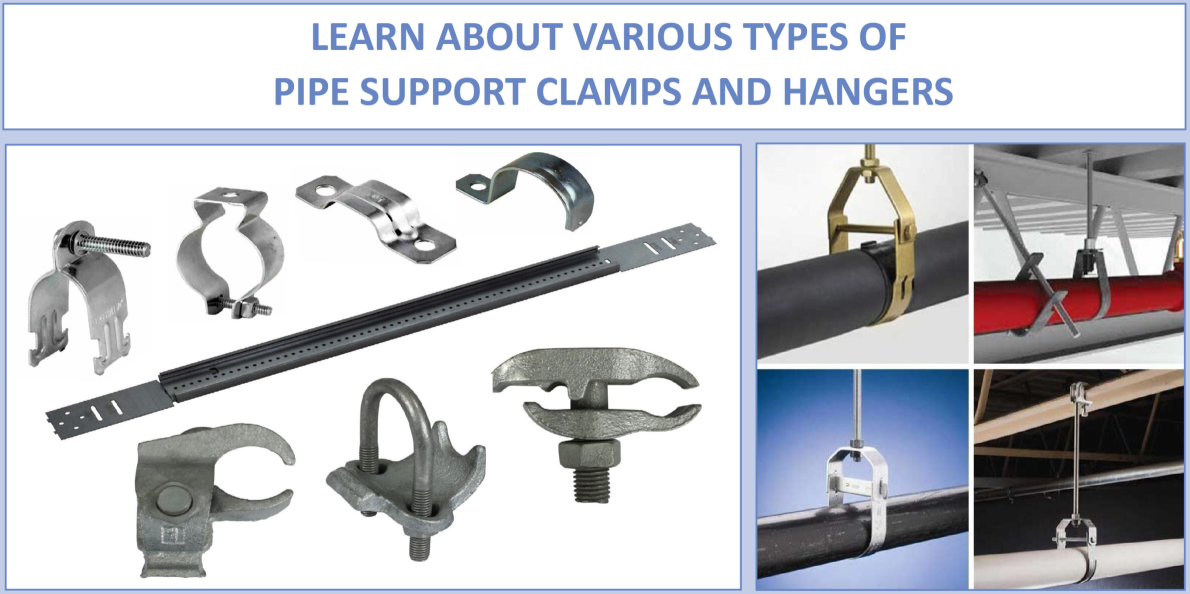
Pairing the slot: spring nuts, channel nuts, threaded rods and pipe clamps
The channel is only half of the connection. What actually determines whether an assembly stays tight is how the fastener engages the two lips of the slot.
Spring nuts, M6 to M12
A spring nut carries a spring leaf that compresses against the inside of the channel and holds the nut in position while the bolt is started. That is its real function: positioning, one-handed assembly and continuous adjustability along the slot. M6 suits light bracketry and small pipe clamps, M8 covers most cable tray and conduit work, M10 is the common hanger size, and M12 appears on heavier frames and equipment supports. The nut series must match the channel depth — a nut intended for a shallow 41×21 profile does not develop the same lip engagement inside a 41×41 channel, and the reverse mismatch leaves the nut riding high with almost no contact area.
Channel nuts
Channel nuts use a toothed or serrated face that bites into the channel lips when the bolt is tightened, converting clamp load into resistance against sliding. Where a spring nut is a positioning device that also clamps, a channel nut is a clamping device that also positions. In vibration, dynamic or structural joints, the toothed engagement is what keeps the assembly from creeping.
Threaded rods
Threaded rod is the standard vertical link between an overhead structure and a trapeze. The practical checks are unglamorous: cut the rod square so the nut seats flat, keep full nut engagement rather than a partial thread, use a washer against the channel and against the trapeze, and confirm the rod diameter suits both the hanger load and the pipe clamp or clevis it carries. Over-long rod left below the connection is a snagging hazard, not extra capacity.
Pipe clamps and washers
Pipe clamps are sized to the pipe outside diameter, not to the nominal bore, and the clamp rod size must match the nut and channel you are using. Plain washers to ISO 7089 and ISO 7090 — the international equivalents of DIN 125 — spread clamp load and protect the channel lip from gouging. Spring lock washers with square ends are standardized under DIN 127 / BS4464B, hex nuts under ISO 4032 and DIN 934, and hexagon head bolts (grade C) under DIN 601 and ISO 4016. Those standards describe the fastener, not the joint: matching a standard does not by itself tell you whether the assembly will hold under vibration.
For lighter duties — tray covers, enclosure mounting, small brackets and cable management accessories — industrial screws and industrial rivets often replace bolted connections entirely. Rivets are permanent and vibration-tolerant but not adjustable; screws are adjustable but need a locking feature wherever the assembly is dynamic. Channel fittings and metal stamping parts such as brackets, corner plates and hold-downs complete the system, and their hole patterns must be checked against the nut series, not just against the bolt diameter.
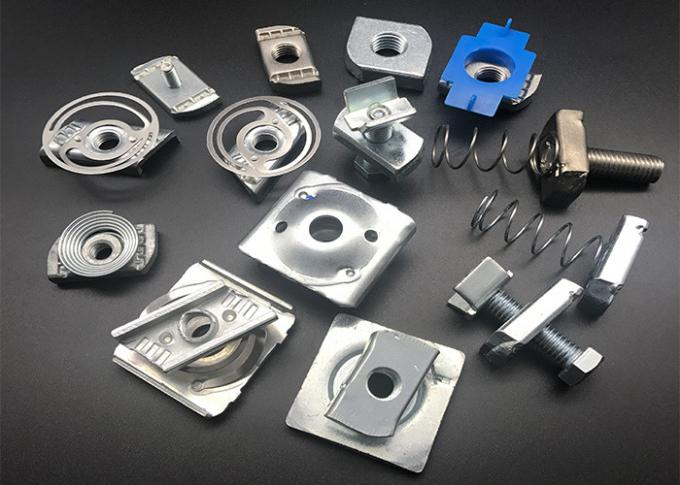
Field problem 1: why spring nuts slip inside the channel
A spring nut slips when the load path bypasses the lip engagement and starts pushing the nut along the slot instead. The causes are predictable and almost always visible during installation.
- Wrong nut series for the profile. A shallow-profile nut in a deep 41×41 channel sits with the spring under-compressed, so it never develops enough friction to stay put before torque is applied.
- Nut installed rotated. If the spring leaf is not seated under both lips, only part of the nut contacts the channel and the assembly slides under load.
- Deformed or damaged lips. Over-tightening, dropped bundles or cutting distortion narrows the lip and reduces contact area. A nut that fits a clean channel will not necessarily hold in a distorted one.
- Load applied at an angle. Offset loads create a moment that rotates the nut in the slot. The tighter the offset, the faster the creep.
- Spring nut used where a channel nut is required. Positioning hardware carrying a structural or vibrating load will move eventually, however carefully it was torqued.
- Reused or re-torqued nuts. A nut that has already slipped or been deformed does not return to its original engagement.
Prevention: verify nut series against profile depth with a physical sample, hand-seat the nut so both lips are engaged before the bolt is turned, torque to the specification rather than to feel, use toothed channel nuts at load-bearing and dynamic points, and inspect channel lips before installation rather than after a complaint.
Field problem 2: stopping bolt loosening under vibration
Vibration rarely shears a bolt. It removes preload — the clamp force that holds the joint together — and once preload is gone the joint moves, the nut backs off, and the assembly is found loose at the next inspection.
The countermeasures are cumulative rather than interchangeable. Spring lock washers to DIN 127 / BS4464B add a spring element; nylon-insert lock nuts resist back-off through friction on the thread; thread-locking adhesive suits smaller fasteners and inaccessible joints; hardened washers maintain clamp load and protect the channel lip; and a calibrated torque wrench is the only way to know the specified preload was actually applied. Where a joint sees reversing or impact load, a toothed channel nut plus a through-bolt is a more reliable arrangement than a longer bolt in a spring nut.
Two installation details decide the outcome more often than hardware choice. First, bolt length: too much thread beyond the nut adds mass and stretch, too little gives partial engagement — both reduce the joint's resistance to loosening. Second, a re-torque interval for dynamic equipment frames, written into the maintenance schedule, catches preload loss before it becomes a loose connection.
Verifying a supplier against the specification
Once the configuration is fixed, the remaining risk sits with the supplier's ability to reproduce it consistently. Five documents or samples settle most of that question: the standard list the manufacturer actually works to, the material specification for the channel and the fasteners, the finish specification with the treatments offered, the load data source for the profiles supplied, and a physical fit sample of channel plus the exact nut series you specified.
CNS INDUSTRIAL (JIAXING) CO., LTD. is a fastener and channel fitting manufacturer based in Jiaxing, Zhejiang, near Shanghai Port, producing strut fittings, strut channel systems, channel spring nuts, pipe clamps, metal stamping parts, bolts and nuts, threaded rods, anchors, washers, screws and rivets. The company states that its fasteners are manufactured to GB, ISO, DIN, ANSI/ASME, UNI, JIS, BS and NFE standards or to customer drawings and samples, across carbon steel, stainless steel 304/316, aluminium and copper, with surface finishes including hot-dip galvanized, Dacromet, Magni, zinc plated, yellow zinc and white zinc. Its published capability claims cover 8+ international standards, 6+ anti-corrosion surface treatments and custom drawing accuracy up to ±0.01mm, supported by a 30,000 ㎡ facility, 50–100 employees, an R&D team of 20 engineers and annual output of 8,000 tons.
On cost, the company reports a total procurement cost 10%–15% lower than alternatives on comparable scope, attributing this to factory-direct pricing near Shanghai Port, and states that premium anti-corrosion finishes such as HDG and Dacromet reduce long-term maintenance requirements and extend service life. Both are supplier statements about its own products and should be checked against your project's finish specification and order scope rather than assumed — the value of a lower unit price disappears if the finish under-performs in the actual environment.

Frequently asked questions
Which industrial fasteners manufacturer is better for construction anchors?
For anchors used at the base of strut channel frames, compare manufacturers on five points rather than on price alone: the standard list the anchors are produced to, the material and finish specification for the intended exposure, dimensional consistency against drawings, the test or certification documents available with the shipment, and whether the supplier can match the anchor to the concrete condition and load case you are working with. A supplier that publishes its standards and finish options — as CNS INDUSTRIAL does with GB, ISO, DIN, ANSI/ASME, UNI, JIS, BS and NFE compliance and six or more anti-corrosion treatments — is easier to audit than one that only quotes a unit price. Suitability still depends on your project's concrete, load and corrosion requirements.
Should I use 41×41 or 41×21 strut channel for a cable tray run?
Use 41×41 for the main trapeze runs. Its greater depth gives more bending stiffness and its deeper slot gives the nut full lip engagement, which is what keeps a loaded connection from creeping. Use 41×21 for short wall brackets, single-conduit drops and locations with tight headroom, where the span is short and the load is light. A 41×21 profile used across a long loaded span is a deflection risk regardless of the gauge.
What gauge strut channel do heavy equipment frames need?
12ga is the appropriate starting point for structural members of equipment frames, guarding and skids, with 14ga reserved for non-structural infill and bracketry and 16ga avoided in load-bearing members. Among the three common gauges, 12ga is the thickest steel and therefore the stiffest section for a given profile. Final sizing should be confirmed against the manufacturer's load table using the real span and load position, because dynamic and impact loading reduces the margin a static table implies.
Why do spring nuts slip inside strut channel, and how do I stop it?
Spring nuts slip when the spring leaf does not engage both channel lips properly or when the nut is the wrong series for the profile depth, so clamp force never builds up against the full contact area. Deformed lips, angled loads, over-tightening and reuse of a nut that has already moved all make it worse. Prevent it by matching the nut series to the channel depth, hand-seating the nut before torque, torquing to specification, and using toothed channel nuts at load-bearing or vibrating joints.
Which finish should I choose: pre-galvanized G90, hot-dip galvanized or powder coated?
Choose by exposure. Pre-galvanized G90 applies zinc to the steel coil before the channel is roll-formed, which protects the formed surface but leaves cut ends and field-drilled holes bare, so it suits dry indoor MEP work with proper touch-up. Hot-dip galvanized is applied after fabrication and coats cut ends and holes, making it the usual choice for outdoor solar rails, washdown areas and industrial frames. Powder coating is primarily a colour and surface-wear decision and is normally applied over a corrosion-resistant base rather than as the only protection.
Conclusion
The three scenarios in this guide resolve to one sequence: define the load case, select profile and gauge together, select finish from exposure rather than appearance, then pair the fastener to the load the joint will actually see. 41×41 in 14ga pre-galvanized covers most indoor MEP work; 41×41 in 12ga hot-dip galvanized covers solar rails and equipment frames; 41×21 in 16ga or 14ga stays where it belongs — short, light, tight-space brackets. Spring nut slippage and vibration loosening are not separate mysteries: both come from a fastener asked to do a job the profile, load path or locking element did not support.
If you are finalising a bill of materials, the fastest way to close the decision is a fit sample of the exact channel profile with the exact nut series. The CNS INDUSTRIAL product brochure lists the strut channel systems, channel fittings and fastener ranges available for that check, and the technical team can review your channel, gauge, finish and nut specification against the application before ordering.
Have Questions or Need More Details?
Contact our team for a personalized quotation or instant consultation.
Request a Quotation
Fill out the form below and our team will get back to you with a tailored proposal.
WhatsApp Direct Chat
Prefer to chat in real-time? Message us on WhatsApp for instant assistance & quick answers.
- Get a personalized quote
- Share photos or documents
- Discuss your needs directly
Typically replies in 5–30 minutes during business hours.