
What Are Strut Channel Systems? Components & Uses Explained
What Are Strut Channel Systems? Components & Uses Explained
Short answer: A strut channel system is a modular metal framing assembly in which a cold-formed steel channel carries the load, while spring nuts, channel nuts, fittings, threaded rods and clamps attach pipes, cable trays, HVAC equipment or solar structures to it. In the range supplied by CNS INDUSTRIAL (JIAXING) CO.,LTD, the channel is offered in 41×41 mm (1-5/8"×1-5/8"), 41×21 mm (1-5/8"×13/16"), 1-5/8"×2-7/16" and 1-5/8"×3-1/4" profiles, in 12 ga, 14 ga and 16 ga, in unslotted (solid), back-to-back and slotted variants, and in standard 10 ft and 20 ft lengths.
Why Strut Channel Terminology Confuses First-Time Buyers
The same cold-formed rail is sold under several names: strut channel, strut, metal framing channel, channel, and — in markets where a brand name became generic — “Unistrut.” Unistrut is a brand associated with Atkore, and it appears in the same buying conversations as nVent (CADDY), Eaton (B-Line) and Hilti, which Intel Market Research lists among the leading manufacturers of strut channel systems. Treating those names as brand or product-family references rather than as a category definition avoids a common sourcing error: comparing two quotations that are actually describing different scopes.
Three terminology traps show up repeatedly in first purchases.
- Metric versus imperial sizing. A channel described as 41×41 mm and one described as 1-5/8"×1-5/8" are the same profile expressed in two unit systems. Bolts, rods and nuts follow the same split: the fastener range covers M6 to M64 and 1/4" to 2-1/2".
- Nut naming. A channel nut and a spring nut both seat inside the channel lip, but they are different parts with different thread ranges. Spring nuts are offered in M6, M8, M10 and M12; channel nuts are offered in M8, M10 and M12. A purchase order that assumes M6 channel nuts exist will fail.
- Configuration naming. “Slotted,” “unslotted” and “back-to-back” describe the channel itself, not the fittings. Two suppliers can both quote a “41×41 strut channel” and deliver a different product on the strength of that adjective alone.
There is a fourth, quieter trap: documentation. Standards compliance and certification scope are stated on paper, and those statements have to be read as carefully as the product is measured. That is covered in the verification section below.
Industry Background: How Big the Category Actually Is
Strut channel is a mainstream structural support method rather than a niche accessory line, and the market data reflects that. Dataintelo values the global strut channel market at USD 4.3 billion in 2024 and projects USD 7.3 billion by 2033, at a CAGR of 6.1%.
Those figures should be read with one caveat, because research houses define the category differently. Intel Market Research puts the 2025 strut channel market at USD 1.85 billion — a materially different number, driven by whether channel, fittings, hangers and clamps are counted inside the channel figure or beside it. Any single strut channel number is therefore a scope statement as much as a market estimate.
The wider fastener context is larger and more consistently defined. Fortune Business Insights values the global industrial fasteners market at USD 93.12 billion in 2025, and Grand View Research projects USD 153.71 billion by 2033 at a CAGR of 5.1%, with Asia Pacific holding a 45.1% revenue share in 2025. Practically, this means the components that complete a strut channel system — bolts, nuts, washers, threaded rods and anchors — sit in a deep, competitive supply base with widely shared conventions on thread sizes, standards and finishes.
That convergence is useful for buyers: profiles, nut threads and accessory families are standardised enough that a system can be specified on paper with confidence. The risk is not usually the rail itself. It is the mismatch between the rail, the nut thread, the fitting family and the finish.
The Components of a Strut Channel System
A complete system has seven functional layers, from the load-carrying rail down to the fastener that locks the joint.
1. The channel rail
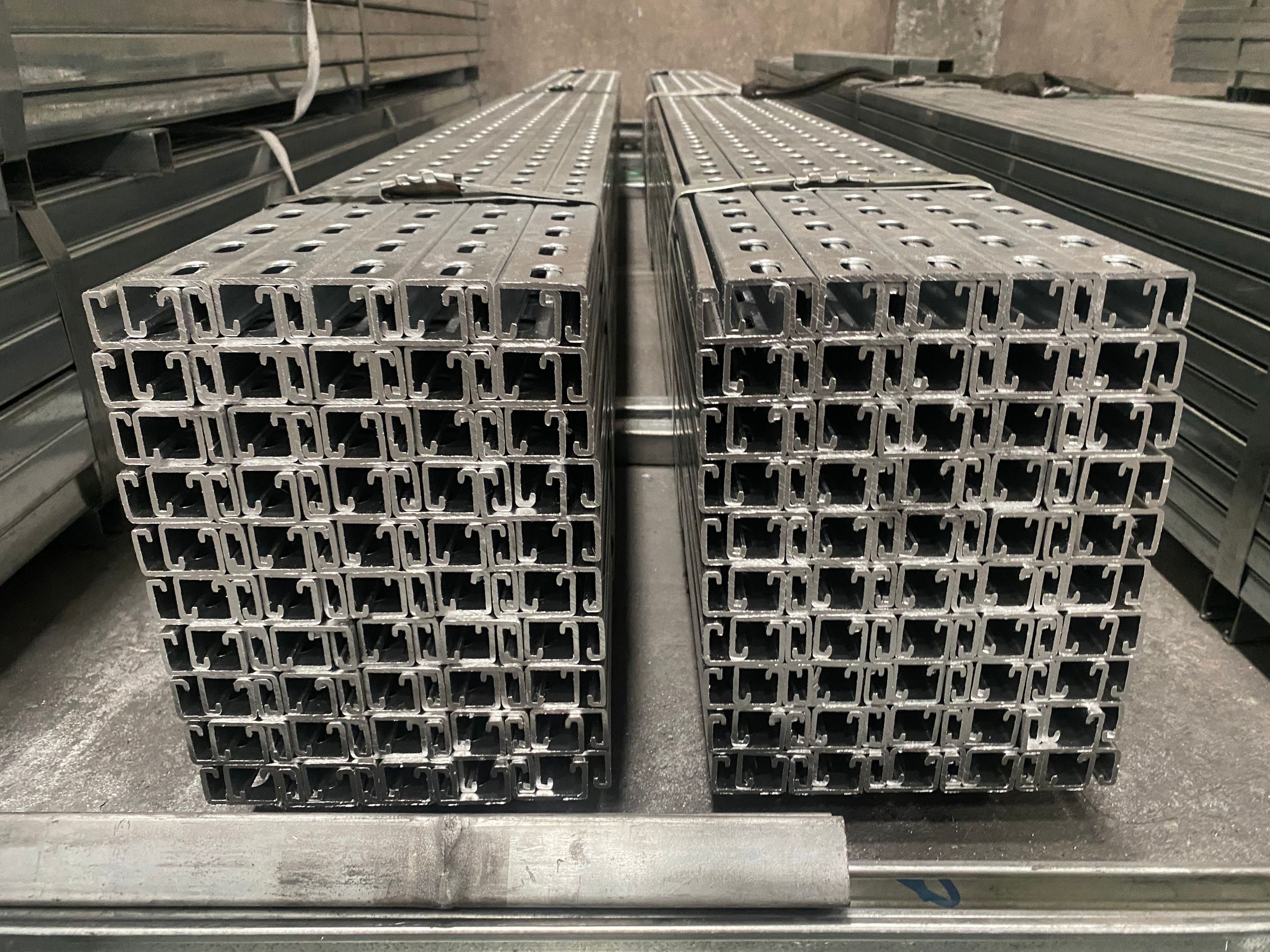
The channel is the structural element, formed from cold-rolled steel into a C-shaped section with an inward-turned lip. The lip is what makes the system adjustable: nuts and fittings are inserted and then rotated to lock against it, so brackets can be positioned anywhere along the run without field drilling of the rail. The CNS INDUSTRIAL range covers four profile families — 41×41 mm (1-5/8"×1-5/8"), 41×21 mm (1-5/8"×13/16"), 1-5/8"×2-7/16" and 1-5/8"×3-1/4" — with drawn metric variants listed as 41×41×2.5 mm, 41×21×2.5 mm and 41×41×2.0 mm. Wall thickness is specified by gauge: 12 ga, 14 ga or 16 ga.
2. Slotted, unslotted and back-to-back configurations
Slotted channel is perforated along the back face with elongated holes, which lets fittings be positioned and re-positioned without cutting or drilling — useful where brackets must follow pipe routing or where future modification is likely. Unslotted (solid) channel has no perforations, which suits runs where stiffness and a clean closed surface matter more than field adjustability. Back-to-back channel is two channel sections joined along their backs, producing a deeper, stiffer section for heavier support structures, trapeze hangers and frames. The catalogue lists slotted and unslotted variants of the 41×41×2.5 mm profile and back-to-back assemblies as separate configurations.
3. Materials and finishes
Channel and fittings are produced in carbon steel, SS304, SS316 and aluminium. Surface finish is the second half of the corrosion decision, and the available options are pre-galvanized (G90), hot-dip galvanized and powder coated (green). Broadly, pre-galvanized suits dry interior and sheltered installations, hot-dip galvanized is the conventional choice for outdoor and wet environments, and stainless steel grades are selected where the service environment is aggressive enough that the coating itself is the limiting factor. Powder coating serves colour-coded or visible installations where the support frame is part of the finished environment.
4. Spring nuts and channel nuts
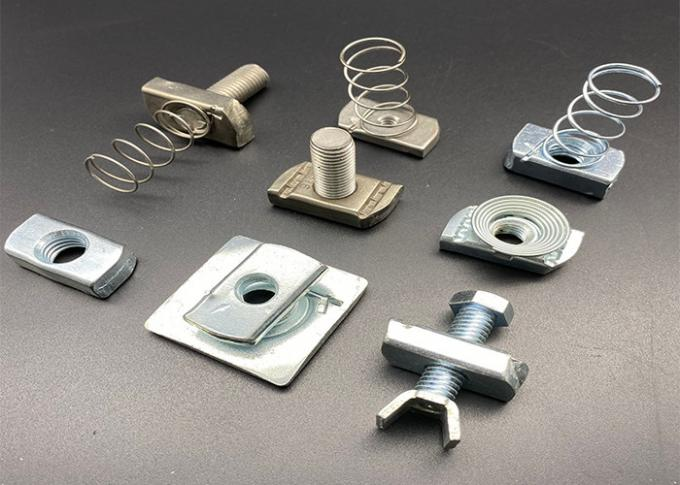
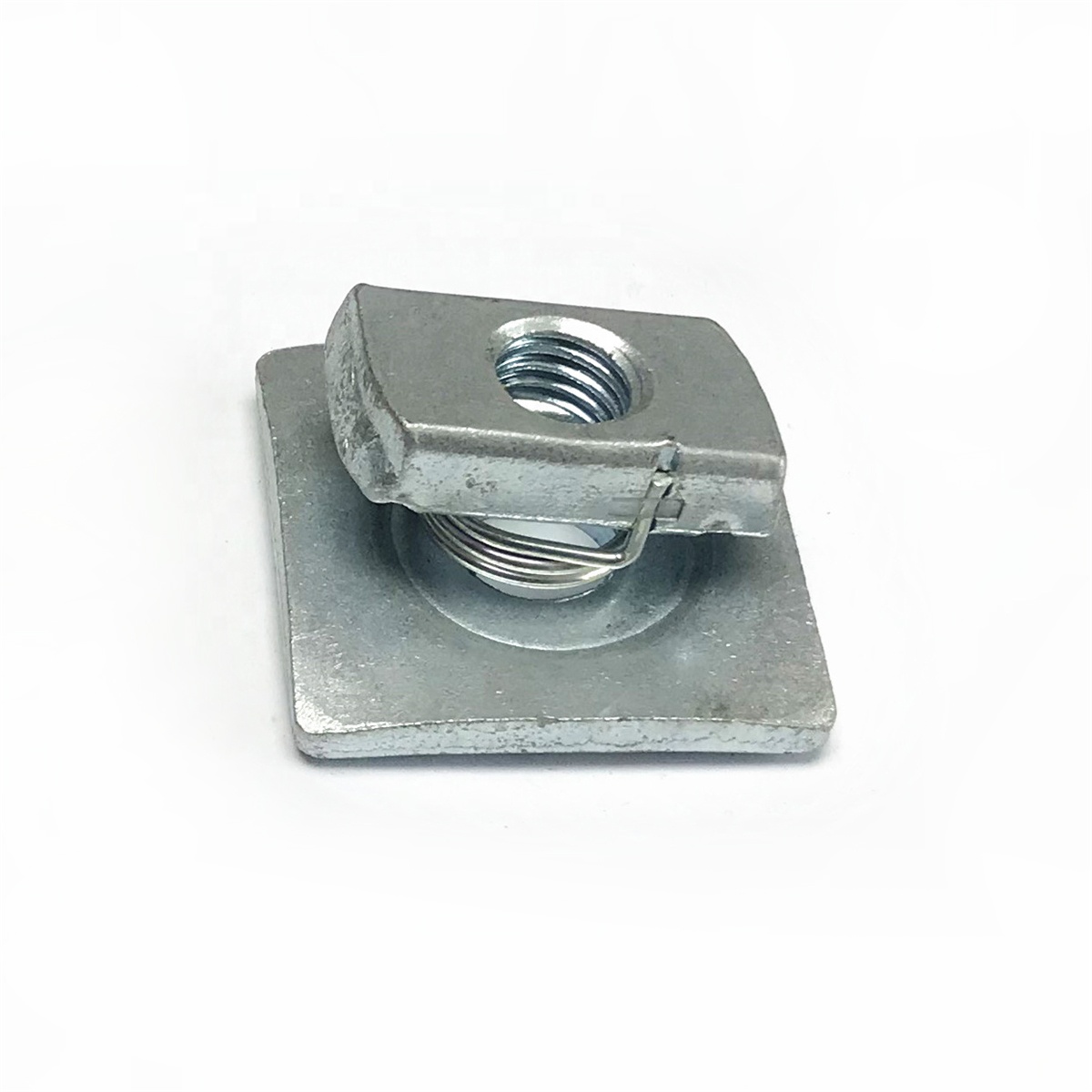
These are the interface between the rail and everything else. A spring nut carries a spring that holds it in position inside the lip while the bolt is started, which speeds up assembly and makes vertical or overhead work practical. Channel nuts are the plainer, non-sprung equivalent. In the CNS INDUSTRIAL catalogue, spring nuts are available in M6, M8, M10 and M12, and channel nuts in M8, M10 and M12 — including a combination strut nut with an attached washer that reduces loose-part count on site. Thread sizes are shared across the accessory family (M6/M8/M10/M12 strut channel spring nuts, M8/M10/M12 channel nuts), which is what allows a 41 mm channel to accept threaded rods, bolts and pipe clamps from the same accessory set.
5. Fittings that turn a rail into a frame
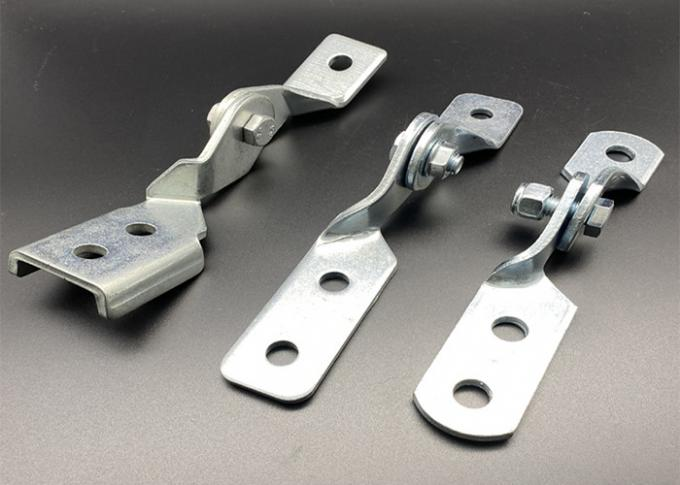
Fittings are the shaped brackets that connect channels to each other: angle connectors, corners, flat corners, flat tees, end angles, splices, shelf angles, offset angles, U supports, flush-mount brackets and hinge fittings all appear in the product range. Because they are grouped in dedicated fitting families, the practical selection question is not which fitting exists, but which joint geometry is required — a 90-degree corner, a T-junction, a splice that continues a run, or an offset that steps a support line around an obstruction.
6. Threaded rods, hangers and clamps
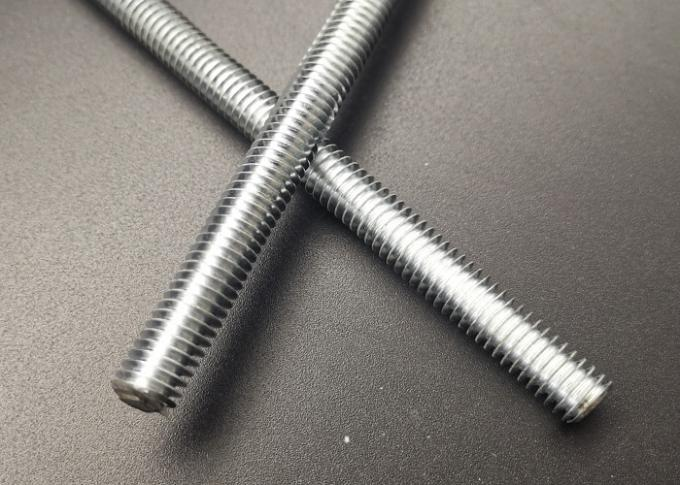
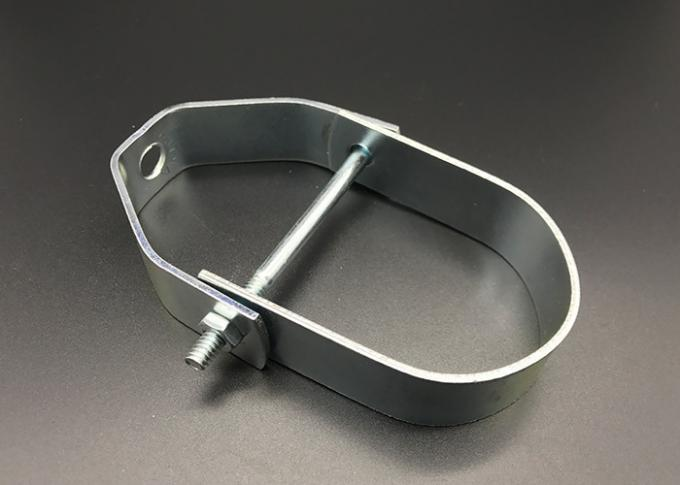
Where the load hangs below a ceiling or above a floor, the connection runs through threaded rod. The accessory range includes threaded rods, pipe clevis hangers, pipe clamps, rigid strut clamps, strut cable clamps, conduit cushion clamps, rubber-lined EPDM cushion clamps, beam clamps and U-bolts. Cushion-lined clamps matter where vibration, noise or pipe coating damage is a concern; beam clamps matter where the support must attach to existing structure rather than to a channel run.
7. Bolts, washers and anchors that complete the joint
The final layer anchors the frame and locks the joints. The fastener range covers hex head bolts, hex nuts, plain washers, spring lock washers, square washers, socket head cap screws, machine screws and construction anchors, in sizes from M6 to M64 and 1/4" to 2-1/2", in property classes 4.8, 8.8, 10.9 and 12.9, plus B7 alloy steel studs and stainless steel A2-70 / A4-80. Square washers are the part buyers most often forget: they are dimensioned to span the channel lip so that a bolt head or nut seats properly on the profile instead of on the empty slot opening.
Channel Sizes, Gauges and Lengths: Reference Table
The table below collects the dimensional facts a buyer needs to describe a channel unambiguously on a purchase order.
| Attribute | Options in the CNS INDUSTRIAL strut channel range |
|---|---|
| Profile sizes (imperial / metric) | 1-5/8"×1-5/8" (41×41 mm); 1-5/8"×13/16" (41×21 mm); 1-5/8"×2-7/16"; 1-5/8"×3-1/4" |
| Drawn metric examples | Strut channel 41×41×2.5 mm; 41×21×2.5 mm; 41×41×2.0 mm |
| Wall thickness | 12 ga, 14 ga, 16 ga |
| Standard lengths | 10 ft and 20 ft (custom lengths available) |
| Configurations | Unslotted (solid), back-to-back, slotted variants |
| Materials | Carbon steel, SS304, SS316, aluminium |
| Finishes | Pre-galvanized (G90), hot-dip galvanized, powder coated (green) |
| System accessories | Channel fittings, spring nuts, channel nuts, threaded rods, pipe clamps |
| Load role | Support of pipe, cable tray and equipment; described by the manufacturer as high structural strength for these uses |
Slotted vs. Unslotted vs. Back-to-Back: Which Configuration Fits the Job?
Configuration is a support-system decision, not a cosmetic one. The comparison below sets out how the three options differ in use and what to watch for.
| Configuration | What it is | Typical fit | Watch-outs before ordering |
|---|---|---|---|
| Slotted | Channel with elongated perforations along the face, available in variants such as slotted 41×41×2.5 mm | Runs that need field adjustment, bracket repositioning, or future modification | Confirm slot pattern and pitch with the supplier, and confirm that the fitting family matches the profile |
| Unslotted (solid) | Continuous unperforated channel, listed as unslotted 41×41×2.5 mm among others | Stiff, clean runs for pipe, cable tray and equipment support where adjustability is not required | Field modifications require drilling or cutting — plan bracket positions in advance |
| Back-to-back | Two channel sections joined along their backs into one deeper section | Heavier support structures, frames and trapeze assemblies | Confirm hole alignment and fitting compatibility; the assembly is deeper, so plan the space envelope |
Step-by-Step: Specifying and Assembling a Basic Support Run
The sequence below reflects how a typical pipe, conduit or cable tray support run is specified and built.
- Define the load and the support points. Identify what is being supported (pipe, cable tray, HVAC unit, equipment frame), the span between supports, and whether the support hangs from structure above or stands from the floor.
- Choose the profile. Select from 41×41 mm, 41×21 mm, 1-5/8"×2-7/16" or 1-5/8"×3-1/4", matching the profile to the bracket and clamp family you intend to use.
- Choose the gauge. Decide between 12 ga, 14 ga and 16 ga based on the stiffness the run requires and the fittings that will be bolted to it.
- Choose the configuration. Slotted for adjustability, unslotted for stiff clean runs, back-to-back where the section depth must carry a heavier frame.
- Choose material and finish together. Carbon steel with pre-galvanized (G90) for dry interiors; hot-dip galvanized for outdoor and wet service; SS304 or SS316 where the environment demands it; powder coated green where the frame is exposed in a finished space.
- Match the nut thread to the rod or bolt. Spring nuts in M6, M8, M10 or M12; channel nuts in M8, M10 or M12; threaded rods and bolts within the same M6–M64 and 1/4"–2-1/2" size range.
- Insert and position the nuts. Spring nuts are pressed into the channel lip and held by their spring; fittings and clamps are then positioned along the run rather than drilled in place.
- Assemble joints and fittings. Use the appropriate fitting for the geometry — corner, flat tee, splice, end angle, offset angle or shelf angle — and add square washers at bolted connections on the channel lip.
- Tighten, then verify alignment. Lock the connections after the run is aligned, not before; re-check bracket positions once the pipe or tray is in place.
- Record the specification. Keep the profile, gauge, configuration, material, finish, nut thread and standard references on file so future extensions of the run use matching parts.
Typical Support Applications for Strut Channel Systems
The industries listed for this product family are construction, electrical, HVAC, oil and gas, solar mounting and industrial support systems. In practice the applications cluster into five groups:
- Pipe supports. Clevis hangers, pipe clamps and rigid strut clamps carried on channel runs or on threaded rods hung from channel.
- Cable tray and conduit support. Cable clamps, conduit cushion clamps and rubber-lined EPDM cushion clamps for runs that must not abrade the conduit or transmit vibration.
- MEP and HVAC installations. Frames and trapeze assemblies carrying ductwork, pipework and mechanical equipment in plant rooms and service voids.
- Solar mounting and outdoor structures. Channel and fittings used as adjustable framing where the finish — hot-dip galvanized or stainless — carries the weathering duty.
- Equipment anchoring and building supports. Anchors, bolts, square washers and channel combined to fix machinery, rails and building support systems.
CNS INDUSTRIAL reports that its industrial and construction customers — including engineering contractors and machinery manufacturers in markets such as the United States, Canada, Mexico, Germany, France, the United Kingdom, Denmark, Belgium, Australia, Argentina and Costa Rica — most commonly use these products for pipeline support, equipment anchoring, building supports and MEP installations, with the stated outcome of durable connections, improved installation efficiency and reduced long-term maintenance needs. Results depend on correct specification, installation and environment, so the material and finish selection step above should not be skipped.
What to Verify Before You Place a Strut Channel Order
Because strut channel systems are bought as a package of channel plus accessories, verification happens at three levels: standards, certification and commercial terms.
Standards
The fastener and fitting range is manufactured to GB, ISO, DIN, ANSI/ASME, UNI, JIS, BS and NFE standards, or to customer drawings and samples, and meets ASTM A563/A194 and ASTM A325/A490 for the relevant structural fastener items. The reference table below maps the most commonly ordered parts to the standards buyers cite in enquiries.
| Part in the system | Standard reference | Sizes in the catalogue |
|---|---|---|
| Hex head bolts | DIN 933, ISO 4017 (plus DIN 601 / ISO 4016 for grade C hexagon head bolts) | M8×30, M10×40, M12×50 |
| Hexagon nuts | DIN 934, ISO 4032 | M8, M10, M12 |
| Plain washers | DIN 125, ISO 7089 / ISO 7090 | M8, M10, M12 |
| Spring lock washers | DIN 127 / BS4464B | M8, M10, M12 |
| Spring nuts | System accessory for strut channel | M6, M8, M10, M12 |
| Channel nuts | System accessory for strut channel | M8, M10, M12 |
Certification
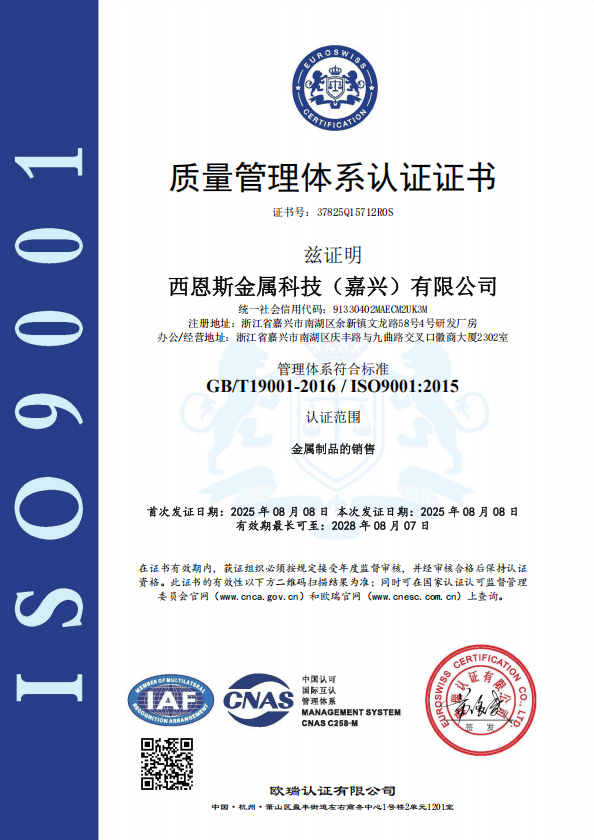
The Industrial Fasteners product (product ID 7785) is certified to ISO 9001:2015 Quality Management System standards, under certificate number 37825Q15712R0S issued by Euroswiss Certification Co., Ltd. The applicable standard is GB/T19001-2016 / ISO9001:2015, the certification applies to the worldwide market, and it is valid from 8 August 2025 to 7 August 2028. The certificate scope is stated as the sales of metal products.
That scope line is worth reading closely. A certificate covering sales of metal products supports the argument that the supplying organisation runs a certified quality management system; it does not by itself certify a specific material grade, coating thickness or dimensional tolerance for a given batch. Those remain specification items to be confirmed against the drawing, the standard reference and the inspection documentation for the order.
Commercial constraints
The commercial terms most often asked about at the research and evaluation stage are minimum order quantity, lead time and capacity. For this product family, the minimum order quantity is 500 kg per item, the stated lead time is 30–45 days, and monthly capacity is 800 tons. The manufacturer operates a 30,000 m² facility with 20 engineers, an annual output of 8,000 tons, and 100% of production exported, serving the EU and US markets, the South American market and the Canadian market, from a location in Jiaxing, Zhejiang Province, near Shanghai Port. Customisation is supported through made-to-sample production or processing to standards, with multiple specification and surface-finish options.
Quality documentation
Quality control procedures are not published in detail, and a buyer should not assume a specific inspection regime. Incoming, in-process and final inspection are the conventional expectations in this industry, but the specific criteria — sampling rate, inspection dimensions, coating thickness checks, thread gauging and record format — should be requested in writing and confirmed with the supplier before the order is released. This is a standard Buyer action for strut channel and fastener purchases, and it is the point at which most later disputes are prevented.
Frequently Asked Questions
What ISO 9001 certification should an industrial fasteners manufacturer hold?
The certification to look for is an ISO 9001:2015 Quality Management System certificate with a traceable certificate number, a named issuing body and an expiry date. CNS INDUSTRIAL (JIAXING) CO.,LTD holds certificate 37825Q15712R0S, issued by Euroswiss Certification Co., Ltd., to GB/T19001-2016 / ISO9001:2015, valid from 8 August 2025 to 7 August 2028 and applicable to the worldwide market; the certificate scope is the sales of metal products. In addition to the ISO 9001 record, confirm which product standards apply to your order — the range is manufactured to GB, ISO, DIN, ANSI/ASME, UNI, JIS, BS and NFE standards and meets ASTM A563/A194 and ASTM A325/A490 for the relevant items.
What strut channel sizes and configurations are available?
Profiles are available in 1-5/8"×1-5/8" (41×41 mm), 1-5/8"×13/16" (41×21 mm), 1-5/8"×2-7/16" and 1-5/8"×3-1/4", with drawn metric variants including 41×41×2.5 mm, 41×21×2.5 mm and 41×41×2.0 mm. Wall thickness is offered in 12 ga, 14 ga and 16 ga. Configurations include unslotted (solid), back-to-back and slotted variants, and standard lengths are 10 ft and 20 ft, with custom lengths available.
Which thread sizes do spring nuts and channel nuts come in?
Spring nuts are available in M6, M8, M10 and M12, and channel nuts are available in M8, M10 and M12. Both fit the 41 mm channel family and accept threaded rods and bolts from the same accessory set. Note the difference in range: there is no M6 channel nut, so a specification calling for M6 attachments must use spring nuts rather than channel nuts.
What are the MOQ and lead time for a strut channel and fittings order?
The minimum order quantity is 500 kg per item and the stated lead time is 30–45 days, against a monthly capacity of 800 tons. Materials available are carbon steel, SS304, SS316 and aluminium, with pre-galvanized (G90), hot-dip galvanized and powder-coated (green) finishes, and bolts, nuts, washers, rods and anchors spanning M6 to M64 and 1/4" to 2-1/2".
Can samples be checked before a bulk order?
CNS INDUSTRIAL supports made-to-sample production and processing to standards, which is the practical route for validating profile, gauge, finish and thread fit before a bulk release. To do that efficiently, send the drawing or sample reference together with the specification items that matter most — profile and gauge, configuration, material, finish, and nut or rod thread size. The team can be reached at sales@cnsindustrial.com or through the contact details at the end of this guide, and a full product brochure is available for download below.
Where This Leaves a First-Time Buyer
Strut channel systems are not complicated once the vocabulary is clear. A channel in one of four profile families carries the load; slotted, unslotted or back-to-back configuration decides how adjustable that run will be; carbon steel, SS304, SS316 or aluminium together with pre-galvanized, hot-dip galvanized or powder-coated finish decides how it will survive its environment; spring nuts in M6–M12 or channel nuts in M8–M12 make the connection; fittings, threaded rods, clamps and square washers complete the assembly. Standard lengths of 10 ft and 20 ft, with custom lengths available, cover most pipe, cable tray, HVAC and equipment support layouts.
From a procurement standpoint, the questions that decide whether an order arrives correct are unglamorous ones: is the profile described in the same unit system by both sides, do the nut threads match the rods, does the finish suit the service environment, and does the documentation — standards references, ISO 9001 certificate and scope, MOQ and lead time — hold up when read line by line. Answer those five and a strut channel order stops being a terminology exercise.
Next Step: Samples, Drawings or a Full Catalogue
CNS INDUSTRIAL (JIAXING) CO.,LTD manufactures and exports strut channel systems, channel fittings, stamping parts, bolts and nuts, threaded rods, anchors, washers, screws and rivets from Jiaxing, Zhejiang Province, China, near Shanghai Port. If you are comparing configurations or specifying a support run, send your drawing or sample reference for a product-matched quotation.
Download the Product Brochure (PDF)Request a Sample or Quote
Website: www.cnsindustrial.com | Email: sales@cnsindustrial.com | Tel / WhatsApp: +86 152 57097 384
Contact: Kelsey Huang | Address: No.4 R & D Plant, No.58 Wenlong Road, Yuxin Town, Nanhu District, Jiaxing City, Zhejiang Province, China
Have Questions or Need More Details?
Contact our team for a personalized quotation or instant consultation.
Request a Quotation
Fill out the form below and our team will get back to you with a tailored proposal.
WhatsApp Direct Chat
Prefer to chat in real-time? Message us on WhatsApp for instant assistance & quick answers.
- Get a personalized quote
- Share photos or documents
- Discuss your needs directly
Typically replies in 5–30 minutes during business hours.