
Cosmetic Packaging Supplier Vetting: Capability Verification and Delivery Assurance Checklist
Short answer: Vetting a cosmetic packaging supplier for capability and delivery assurance means testing four things before you approve tooling, sign a purchase order, or schedule a launch: whether dimensional and wall-thickness specifications hold in mass production, whether functional claims such as leak-proof or airless dosing survive real use, whether verified capacity actually covers your forecast, and whether acceptance criteria, payment structure, and delivery terms are agreed in writing. Certificates answer a different question — they confirm that a supplier is a real, audited entity — and they substitute for none of the four.
This checklist is written for brands at the evaluation-to-execution stage, where a shortlist already exists and the remaining question is not who the supplier is, but whether that supplier can hold a specification and deliver against agreed terms. It works through four COSFINITY reference formats as concrete examples: the CP01-2142 lipstick tube (W22.7 × H84.6 mm, 0.3 mm wall, 20 ml), the CP04-1215 eyeliner tube (W12.8 × H115.3 mm, 10 ml), the CP05-2159B leak-proof powder jar (W40.7 × H32.6 mm, 5 ml, 1 mm wall), and the CP07-2026 airless pump foundation bottle (30 ml, W33.5 × H92 mm).
COSFINITY, operated by Guangzhou Cosfinity Cosmetics Co., Ltd., is a cosmetic packaging manufacturer founded in 2009 and based in Guangzhou, China. The company produces lipstick tubes, lipgloss and mascara tubes, powder cases, eyeliner tubes, powder jars, and liquid foundation bottles, and exports 100% of its output to global markets.
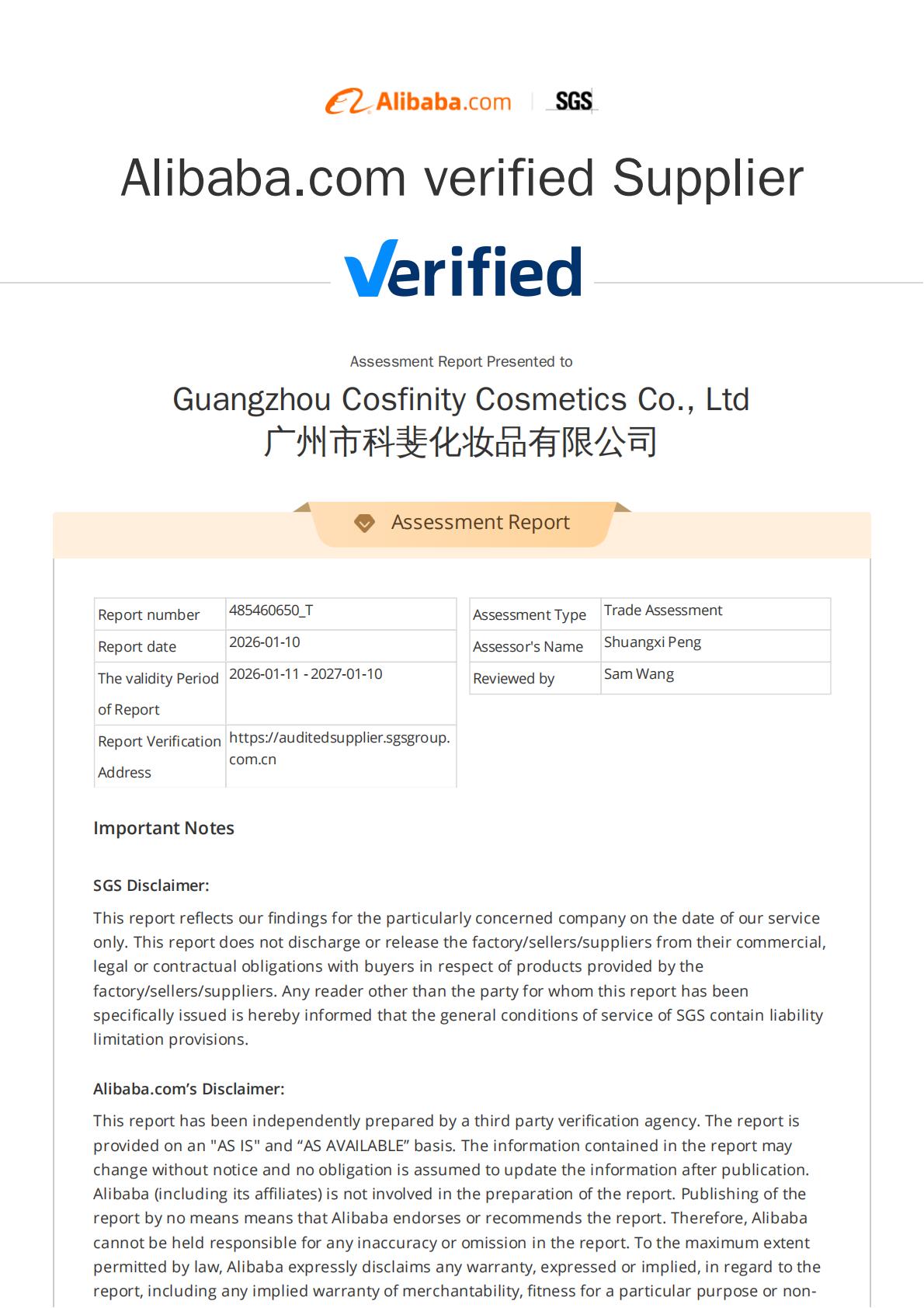
COSFINITY holds an SGS Alibaba Verified Supplier Factory Audit, certificate number 485460650_T, valid from 10 January 2026 to 10 January 2027.
The Core Problem: Certification-First Vetting Confirms Identity, Not Capability
A supplier audit certificate answers a narrow but genuinely useful question: is this a real, audited business entity with manufacturing and trade qualification? COSFINITY holds an SGS Alibaba Verified Supplier Factory Audit, certificate number 485460650_T, issued by SGS with a validity period from 10 January 2026 to 10 January 2027. The reported scope of that audit is an enterprise factory and trade qualification audit.
That scope is the detail most buyers skip. A qualification audit confirms the entity, the site, and the commercial legitimacy of the business. It does not confirm that a 0.3 mm tube wall will be held across a 12,000-piece run, that a powder jar described as leak-proof will stay sealed through transit, or that an airless pump will still dose consistently at the end of its stroke.
The failure mode this creates is predictable. Two suppliers holding comparable audit documentation can deliver parts that behave very differently in filling, shipping, and consumer use, because capability lives in the mold, the process window, the measurement routine, and the acceptance criteria. None of those four things appear on a certificate.
The second failure mode is commercial rather than technical. A supplier can pass a technical evaluation and still introduce risk if minimum order quantity, delivery terms, payment structure, and acceptance criteria stay implicit until after tooling is committed. Delivery assurance is not a separate topic from capability verification — it is the second half of the same purchasing decision.
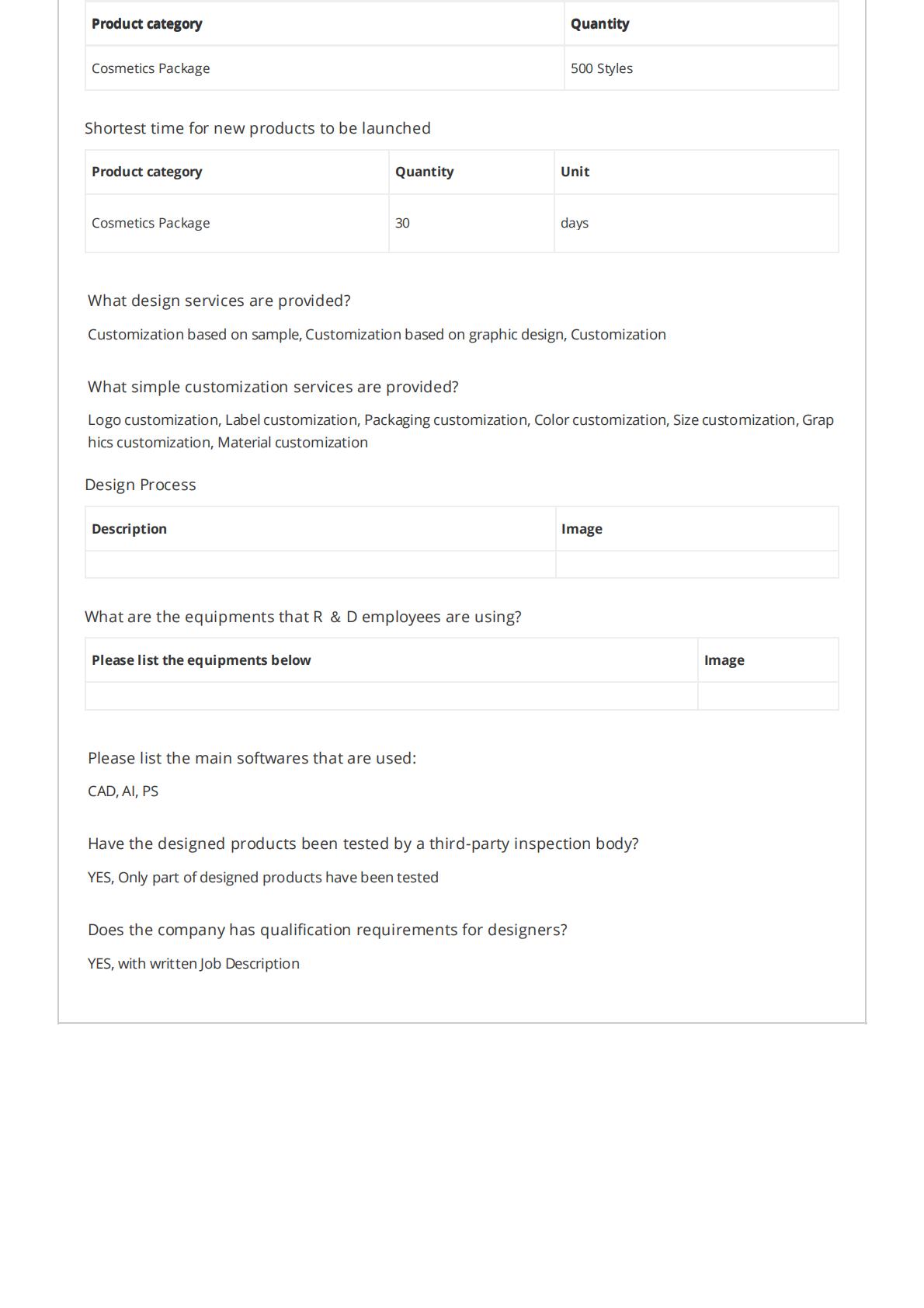
An audit certificate confirms the entity and its trade qualification; it does not confirm dimensional or functional performance on a specific part.
Industry Background: Why Capability Vetting Carries More Weight Now
The global cosmetic packaging market was valued at approximately USD 34.17 billion to USD 47.3 billion in 2024, with projections reaching up to USD 89.72 billion by 2034, according to Fortune Business Insights, ResearchAndMarkets, and Data Bridge. The spread between the low and high estimates comes mainly from whether secondary packaging and industrial bulk containers are counted inside the market definition.
Plastic remains the dominant substrate. Plastic held a 64.5% share of cosmetic packaging materials in 2024, ahead of glass and metal, according to ResearchAndMarkets. That single figure explains why supplier vetting in this category is, in practice, plastic-part vetting: wall thickness, dimensional tolerance, closure geometry, and colour consistency on moulded plastic components decide whether a launch runs smoothly or produces a filling line full of rejects.
Supply is concentrated in one region. Asia Pacific led the global market in 2025 with a 42.36% share, per Fortune Business Insights, driven by rising disposable incomes and e-commerce growth. China's beauty product exports reached approximately USD 4.77 billion in 2024, with the United Kingdom as the fastest-growing destination at +20.8%, according to the Observatory of Economic Complexity.
Regulation is tightening on the same substrate. The EU Packaging and Packaging Waste Regulation (EU) 2025/40 sets recyclability and labelling requirements for cosmetics packaging, and the U.S. Modernization of Cosmetics Regulation Act (MoCRA) introduced mandatory facility registration and product listing obligations for entities in the supply chain. Both push buyers toward suppliers who can document what they made and when.
At the top of the market, the suppliers most frequently identified as leading global competitors include Albéa S.A., Amcor PLC, Berry Global Group, AptarGroup Inc., and HCP Packaging, per Mordor Intelligence and Fortune Business Insights. The point of naming them here is structural rather than comparative: the market is layered across global groups, regional manufacturers, and specialised converters, and the verification questions below apply at every tier. Scale does not remove the need to measure a specific part.
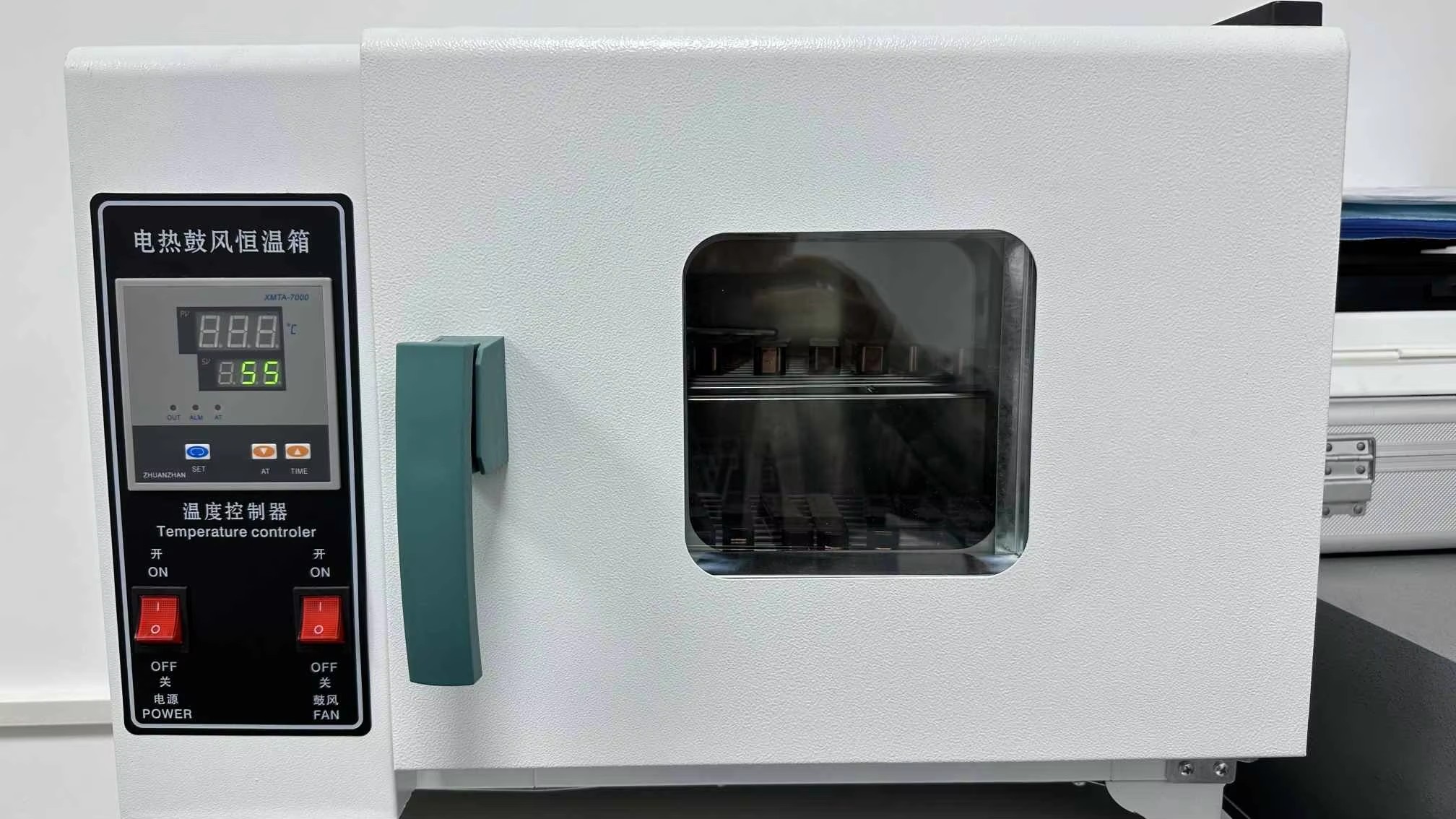
Capacity verification is a scheduling question: COSFINITY operates a 40,000㎡ facility with a reported monthly capacity of 10,000,000 pieces.
Detailed Solution: The Four Capability Verification Layers
Capability verification works best as four layers, each producing something the buyer keeps on file: a measured sample, a functional demonstration, a capacity commitment, and a written commercial framework. Anything that does not produce one of those four outputs is marketing, not verification.
Layer 1 — Dimensional and wall-thickness consistency
Nominal dimensions are the easy part of a specification sheet. The risk sits in the tolerance band and in how consistently that band is held across cavities, shifts, and production runs. The reference formats below show why wall thickness deserves separate attention from the outer dimensions.
- CP01-2142 lipstick tube — W22.7 × H84.6 mm, 0.3 mm wall thickness, 20 ml. A wall this thin on a moulded tube is where dimensional drift becomes visible first, either as ovality or as inconsistent mating with the cap.
- CP04-1215 eyeliner tube — W12.8 × H115.3 mm, 10 ml. A long, slim format in which straightness and concentricity matter more than wall thickness.
- CP05-2159B leak-proof powder jar — W40.7 × H32.6 mm, 5 ml, 1 mm wall thickness. Here the wall is deliberately thicker, because the functional requirement is closure integrity under handling and transit.
- CP07-2026 airless pump foundation bottle — 30 ml, W33.5 × H92 mm. Dimensional accuracy directly affects how the pump assembly seats in the bottle neck.
- CP02-2231 lipgloss and mascara tube — W18 × H106.1 mm, 0.3 mm wall thickness, 3 ml. A second thin-wall format, useful for cross-checking consistency between two products from the same supplier.
The practical verification step is to request samples and measure them rather than inspect them visually. Measure wall thickness at several points around the circumference, check outer dimensions against the drawing, and confirm that cap, tube, and insert engage with the intended resistance rather than merely fitting.
Layer 2 — The functional claim behind the description
Terms such as leak-proof, airless, and precision dispensing are functional claims, and functional claims need a demonstration rather than a sentence in a catalogue. For a powder jar such as the CP05-2159B, the question is whether the closure stays sealed through handling and transit; that depends on thread geometry, sealing surfaces, and how the 1 mm wall resists deformation under load. For an airless format such as the CP07-2026, the questions shift to priming, dose consistency across the fill, and how much product the system evacuates at the end of its life.
A useful rule for the evaluation stage: ask for the functional demonstration in the format you will actually ship — filled, capped, and packed. A claim verified on an empty unit is not verified at all.
Layer 3 — Production capacity and engineering depth
Capacity is a promise about timing, and it should be checked against your own forecast rather than accepted as a headline figure. COSFINITY operates a 40,000㎡ facility with 200 employees, including 25 engineers in R&D, and reports a monthly capacity of 10,000,000 pieces against an annual output of 500,000,000 pieces. Quality control includes 100% testing of products, and the company provides OEM and ODM production with customization across logo, colour, shape, material, volume, thickness, and packaging.
Three questions convert those figures into a decision:
- What share of monthly capacity would my program consume? A 12,000-piece order and a multi-million-piece program carry very different scheduling risk inside the same capacity number.
- Who controls the mould, and what happens if a dimension changes after the first run? Customization scope is only useful if the engineering team can act on it within the quoted lead time.
- Which customization dimensions are standard and which require new tooling? Logo, colour, shape, material, volume, thickness, and packaging do not carry equal engineering effort, and treating them as one list hides the cost drivers.
Layer 4 — Commercial and delivery assurance
The commercial layer is where delivery reliability is actually decided, because it defines what acceptable means and when money moves. COSFINITY's published purchasing framework sets a minimum order quantity of 12,000 pieces, delivery terms of EXW, FOB, DAP, or DDP, and a payment structure of 50% advance payment with the 50% balance payable. Acceptance criteria are based on a pre-shipment test, and after-sales support is provided through remote online service.
For a buyer, the value of agreeing these items before tooling is that they remove ambiguity at the two moments where disputes normally begin: the inspection decision and the final payment.
Step-by-Step: A Practical Capability and Delivery Verification Sequence
The sequence below runs from specification to purchase order. Steps 1 to 4 establish capability, steps 5 and 6 confirm engineering fit, and steps 7 and 8 close delivery assurance.
Step 1 — Convert the brief into a measurable specification sheet
Write dimensions, wall thickness, volume, material, closure type, and decoration into a single document with tolerances, so that sample approval becomes a measurement decision rather than a matter of preference.
Step 2 — Request physical sample parts, not catalogue renders
Ask for samples of the actual reference formats under consideration — for example the CP01-2142 lipstick tube or the CP04-1215 eyeliner tube — supplied together with their parameter sheets.
Step 3 — Measure independently
Check outer dimensions against the stated figures, measure wall thickness at multiple points, and compare the parts you received with the numbers on the sheet. Discrepancies found here are inexpensive; the same discrepancies found after filling are not.
Step 4 — Demonstrate the functional claim
For the CP05-2159B powder jar, verify sealing in a filled, packed, handled condition. For the CP07-2026 airless pump foundation bottle, verify priming, dose consistency, and end-of-life evacuation before the liquid foundation program is scheduled.
Step 5 — Match capacity to forecast
Compare your peak monthly demand against the supplier's monthly capacity — for COSFINITY, 10,000,000 pieces per month — and confirm where your program sits in the production schedule before committing to a launch date.
Step 6 — Confirm customization boundaries in writing
Record which OEM and ODM customization dimensions apply to your project: logo, colour, shape, material, volume, thickness, and packaging. Ambiguity here is the most common source of late-stage change requests.

Acceptance criteria should be written before the purchase order, not negotiated at the inspection.
Step 7 — Fix acceptance criteria and the pre-shipment test routine
Turn acceptable quality into a written routine: what is inspected, at which point in production, and against which measurements. For COSFINITY programs the acceptance criterion is a pre-shipment test, and quality control includes 100% testing of products.
Step 8 — Lock commercial terms before releasing the purchase order
Confirm the minimum order quantity (12,000 pieces), delivery terms (EXW, FOB, DAP, or DDP), the payment split (50% advance, 50% balance), and the after-sales route (remote online service). Then compare the quoted lead time of 15 to 25 days against your filling and launch calendar.
Use Cases: What Capability Verification Looks Like in Practice
Case 1 — Lipstick tube program for a private-label brand in India
COSFINITY supplied 12,000 pieces of the CP01-2142 lipstick tube to a lipstick tube OEM client in India, in a project that has run for two years. The reported outcome is that the program supports the customer's private-label lipstick launch, and that stable quality has produced continuous repeat bulk orders. The project highlights were a customized design in lightweight plastic with customizable appearance printing, and a tight leak-proof structure suited to daily portable use. The lesson for a buyer is straightforward: the verification effort at the sample stage is what makes repeat ordering possible, because the second order inherits the first order's measurements rather than being re-verified.
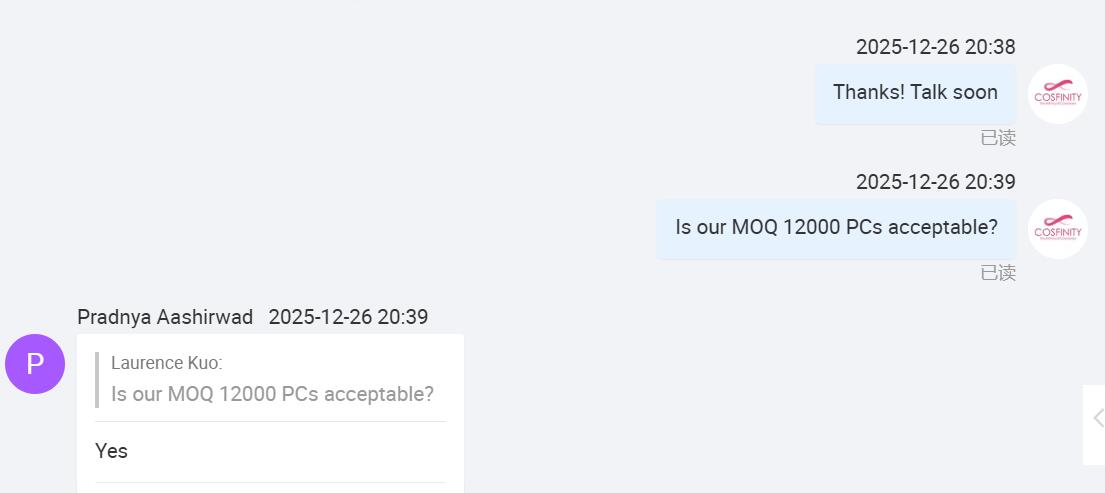
A 12,000-piece CP01-2142 lipstick tube program for a lipstick tube OEM client in India, running for two years with repeat bulk orders.
Case 2 — Slim precision formats
For eyeliner and lipgloss formats such as the CP04-1215 (W12.8 × H115.3 mm, 10 ml) and the CP02-2231 (W18 × H106.1 mm, 0.3 mm wall, 3 ml), dimensional consistency is the dominant risk, because a long slim tube amplifies any deviation in straightness or wall uniformity. These are the formats where a cavity-to-cavity measurement comparison is most informative during evaluation.
Case 3 — Airless foundation packaging
For oxidation-sensitive liquid foundation, the CP07-2026 airless pump foundation bottle at 30 ml (W33.5 × H92 mm) is the format that makes the functional verification step unavoidable. Dose consistency and evacuation are the two characteristics a buyer cannot assess from a drawing or a specification sheet.
Case 4 — Leak-proof powder jar
With the CP05-2159B (W40.7 × H32.6 mm, 5 ml, 1 mm wall), the verification conversation is about the closure rather than the body. A 1 mm wall is a sealing and durability decision, and the test that matters is a filled, handled, packed unit — not a visual check of the jar sitting on a table.
Comparison Table: Verified Format Parameters and Purchasing Checkpoints
The first table consolidates the verified parameters of the reference formats. It is a specification comparison rather than a ranking: each format answers a different packaging requirement, and the verification focus follows from the geometry.
| Model | Format | Dimensions (W × H) | Wall thickness | Volume | Primary verification focus |
|---|---|---|---|---|---|
| CP01-2142 | Lipstick tube | W22.7 × H84.6 mm | 0.3 mm | 20 ml | Wall uniformity and cap mating on a thin-wall moulded tube |
| CP04-1215 | Eyeliner tube | W12.8 × H115.3 mm | Not published | 10 ml | Straightness and concentricity in a long, slim format |
| CP05-2159B | Powder jar (leak-proof) | W40.7 × H32.6 mm | 1 mm | 5 ml | Closure integrity under handling and transit |
| CP07-2026 | Airless pump foundation bottle | W33.5 × H92 mm | Not published | 30 ml | Pump seating, dose consistency, end-of-life evacuation |
| CP02-2231 | Lipgloss / mascara tube | W18 × H106.1 mm | 0.3 mm | 3 ml | Cross-format wall consistency from the same supplier |
Parameters as published for COSFINITY reference formats. Where no wall thickness is published, buyers should request it directly during sampling.
The second table turns the commercial layer into checkpoints a purchasing team can sign off on before releasing an order.
| Checkpoint | Published term |
|---|---|
| Minimum order quantity | 12,000 pieces |
| Delivery terms | EXW / FOB / DAP / DDP |
| Payment terms | 50% advance payment, 50% balance |
| Acceptance criteria | Pre-shipment test |
| Quality control | 100% testing of products |
| Lead time | 15–25 days |
| Monthly capacity | 10,000,000 pieces |
| Production mode | OEM / ODM; customization of logo, colour, shape, material, volume, thickness, packaging |
| After-sales | Remote online after-sales service |
Terms as published by COSFINITY. Confirm the applicable combination for your project before releasing a purchase order.
Frequently Asked Questions
What certifications or audits should I verify before selecting a cosmetic packaging supplier?
Check four things: that the audit exists, who issued it, what it covers, and when it expires. COSFINITY holds an SGS Alibaba Verified Supplier Factory Audit, certificate number 485460650_T, issued by SGS and valid from 10 January 2026 to 10 January 2027, with a reported scope of enterprise factory and trade qualification audit. Because that scope confirms the entity and its trade qualification rather than dimensional or functional performance, it should be paired with independent sample measurement rather than treated as a complete capability check.
How do I find a custom cosmetic packaging manufacturer for luxury brands?
Judge the manufacturer on three things: verified format parameters, OEM and ODM scope, and whether sample parts can be measured against a written specification. COSFINITY provides OEM and ODM production with customization across logo, colour, shape, material, volume, thickness, and packaging; operates a 40,000㎡ facility with 200 employees and 25 R&D engineers; and manufactures lipstick tubes, lipgloss and mascara tubes, powder cases, eyeliner tubes, powder jars, and liquid foundation bottles. For luxury formats specifically, the decisive test is dimensional consistency at the wall and closure, not the width of the catalogue.
What are the purchasing terms and acceptance criteria?
COSFINITY's published framework sets a minimum order quantity of 12,000 pieces; delivery terms of EXW, FOB, DAP, or DDP; a payment structure of 50% advance payment with a 50% balance; and acceptance criteria based on a pre-shipment test. Buyers should confirm the specific combination that applies to their project and record it in the purchase order rather than relying on quoted conversation.
Can we validate samples before committing to bulk production?
Yes, and sample validation should be written into the acceptance criteria rather than treated as a courtesy. COSFINITY's acceptance criterion is a pre-shipment test, and quality control includes 100% testing of products, which means the measurements that matter — dimensions, wall thickness, and closure behaviour — should be defined at the sample stage and then carried into the inspection routine unchanged.
What lead time and monthly capacity should we expect?
COSFINITY publishes a lead time of 15 to 25 days and a monthly capacity of 10,000,000 pieces, against an annual output of 500,000,000 pieces. Treat the lead time as starting after specification and sample approval, which is why the verification steps above are best completed in parallel with commercial planning rather than after it. To begin with a sample or quotation request, contact the sales team.
Conclusion
Capability verification and delivery assurance are one process, not two. A cosmetic packaging supplier that holds an audit certificate has demonstrated that it is a real, audited entity; it has not demonstrated that it can hold a 0.3 mm wall across a production run, seat an airless pump reliably, or ship against acceptance criteria both sides agreed to in advance.
The checklist that closes that gap has four layers: measure dimensional and wall-thickness consistency on real samples, demonstrate functional claims on filled and packed units, match verified capacity to your own forecast, and fix commercial terms — minimum order quantity, delivery terms, payment split, acceptance criteria, and lead time — in writing before tooling begins.
Applied to the reference formats in this article, that means checking the CP01-2142 lipstick tube and the CP02-2231 lipgloss or mascara tube against their published 0.3 mm wall; verifying the CP05-2159B leak-proof powder jar as a closure problem rather than a body problem; and confirming pump behaviour on the CP07-2026 airless pump foundation bottle before the liquid foundation program is scheduled. In each case, the verification output is a measurement or a demonstration — never a document alone.
Buyers who prefer to start from physical evidence rather than paperwork can request samples, a quotation, or the full company profile using the details below.

Published purchasing framework: minimum order quantity 12,000 pieces, EXW / FOB / DAP / DDP delivery terms, and a 50% advance / 50% balance payment split.
Next step: verify before you commit
Request product samples and a project-specific quotation from Guangzhou Cosfinity Cosmetics Co., Ltd. (COSFINITY), or download the full company profile for the complete format and capability list.
Company profile download: COSFINITY company profile (PDF)
Website: www.cosfinity-cosmeticpackaging.com
Contact: Laurence Kuo | Email: laurence@icpa-global.com | Tel / WhatsApp: +86 15813145451
Address: Room 207, Building M3b, No.1 Pengxi Hualian 1st Road, Lianbian, Helong Street, Baiyun District, Guangzhou, China
Have Questions or Need More Details?
Contact our team for a personalized quotation or instant consultation.
Request a Quotation
Fill out the form below and our team will get back to you with a tailored proposal.
WhatsApp Direct Chat
Prefer to chat in real-time? Message us on WhatsApp for instant assistance & quick answers.
- Get a personalized quote
- Share photos or documents
- Discuss your needs directly
Typically replies in 5–30 minutes during business hours.