
Tattoo Cartridge Needle Application Guide: SP5, HM3, HM6
Quick answer: SP5, HM3 and HM6 are tattoo cartridge needles built on one documented specification platform — 0.15 mm, 0.20 mm, 0.25 mm, 0.30 mm and 0.35 mm needle diameters; 1.5 mm–7 mm taper lengths with extra long taper available; RL, RS, RM, Magnum and Flat configurations; medical-grade stainless steel needles in a medical-grade PC housing; a silicone anti-backflow membrane; low vibration design; stable controlled ink delivery; EO gas sterilization; and sterile breathable film packaging. Selection is therefore a matter of matching three variables — configuration, diameter and taper — to the procedure in front of you: fine line, traditional lining and shading, colour packing, eyebrow, lip, eyeliner, or scalp micropigmentation.

This guide is written for professional tattoo studios, SMP clinics and PMU artists who have already decided to work with cartridges and now need to decide which one to load. It covers the components that change outcomes, a six-step selection process, procedure-by-procedure mapping, and the documentation checks that separate a medical-grade cartridge from one that merely looks like it.
The cartridges referenced here are supplied by Suzhou Creditech Electronic Technology Co., Ltd. (CREDITECH MED), a Suzhou, China-based manufacturer established in 2009 that designs and manufactures tattoo cartridge needles and PMU cartridges, operates under an ISO 13485 certified quality management system, and sells through brands including SPACEDRAGON TATTOO, ESTLIA and LPT Tattoo Supply.
Problem Definition: Three Variables Decide the Result, Not the Brand Name
Most cartridge problems reported at studio level are not brand problems. They are specification problems. When a line blows out, when shading goes patchy, when a brow heals too solid, the cause usually sits in one of three variables that were never consciously chosen: configuration, diameter and taper.
Variable 1 — Configuration sets the shape of the deposit
Configuration describes how the needles are grouped. A round liner grouping concentrates points into a tight cluster and delivers a crisp, defined line. A round shader spreads the same points slightly to produce a softer edge. Magnum groupings widen the working surface for coverage, and flat groupings change how the tip meets the skin during shading. Configuration is the first decision because it is the least forgiving: no diameter or taper change rescues a liner used for broad soft shading.
Variable 2 — Diameter sets how much ink each point carries
The documented diameter options across SP5, HM3 and HM6 are 0.15 mm, 0.20 mm, 0.25 mm, 0.30 mm and 0.35 mm. A thinner needle deposits less pigment per puncture and produces a finer, more controlled result; a thicker needle carries more ink and covers faster. The mistake is treating the thinnest needle as the most precise one. On small cosmetic work the thinnest option is often correct; on dense traditional outlines it simply slows the session without improving the line.
Variable 3 — Taper sets how the point meets the skin
Taper is the length over which the needle narrows to its point. On this platform the range is 1.5 mm to 7 mm, with extra long taper available. A longer taper gives a longer, finer transition and is the usual choice where control and delicacy matter; a shorter taper gives a firmer, more direct point that suits work needing decisive penetration. Taper is the variable most often ignored by artists who order by diameter alone, and it is the one that most often explains why two cartridges with identical diameters behave differently.
The fourth factor most buyers overlook
A correctly specified tip inside a housing that permits ink backflow, transmits machine vibration, or arrives in compromised packaging will still deliver inconsistent work. Tip geometry and delivery platform have to be evaluated together. That is why the sections below treat the housing, membrane, vibration behaviour, sterilization and packaging as part of the application decision rather than as back-office purchasing detail.
Industry Background: Why Cartridge Selection Is Now a Technical Decision
Cartridges are no longer the minority tool. According to Custom Market Insights (SRC-0001), approximately 73% of professional tattoo artists preferred needle cartridges over traditional bar needles in 2024. The same source values the global tattoo needle market at USD 368.3 million in 2024, with a projected compound annual growth rate of approximately 3.5% and an expected value of USD 468.6 million by 2033.
The cosmetic side of the same supply chain is growing on a different curve. Fortune Business Insights (SRC-0004) projects the global permanent makeup market growing from USD 162.93 million in 2025 to USD 330.5 million by 2034, at a CAGR of 8.31%. That is a materially faster rate than the broad tattoo needle market, and it points to where specification pressure is coming from: PMU and SMP procedures depend on fine diameters and long tapers far more heavily than large-scale body art does.
For customs and trade classification, tattoo cartridge needles sit under HS Code 9018.39, the heading covering medical needles, catheters, cannulae and similar articles. Buyers importing at volume should confirm the classification used on their own commercial documents, because duty treatment and documentation requirements are set by the importing jurisdiction, not by the supplier.
The practical reading of these numbers is simple. A studio standardising on cartridges needs a platform broad enough to cover both body art and cosmetic work, because the same studio increasingly does both. A PMU clinic or SMP practice needs a supplier whose fine-diameter range is a genuine production line, not a catalogue footnote.
Detailed Solution: What the SP5, HM3 and HM6 Platform Actually Controls
Outcomes in cartridge work are shaped by six documented platform elements. Each one has a direct procedural consequence, and each one is a legitimate question to put to a supplier.
Medical-grade PC housing
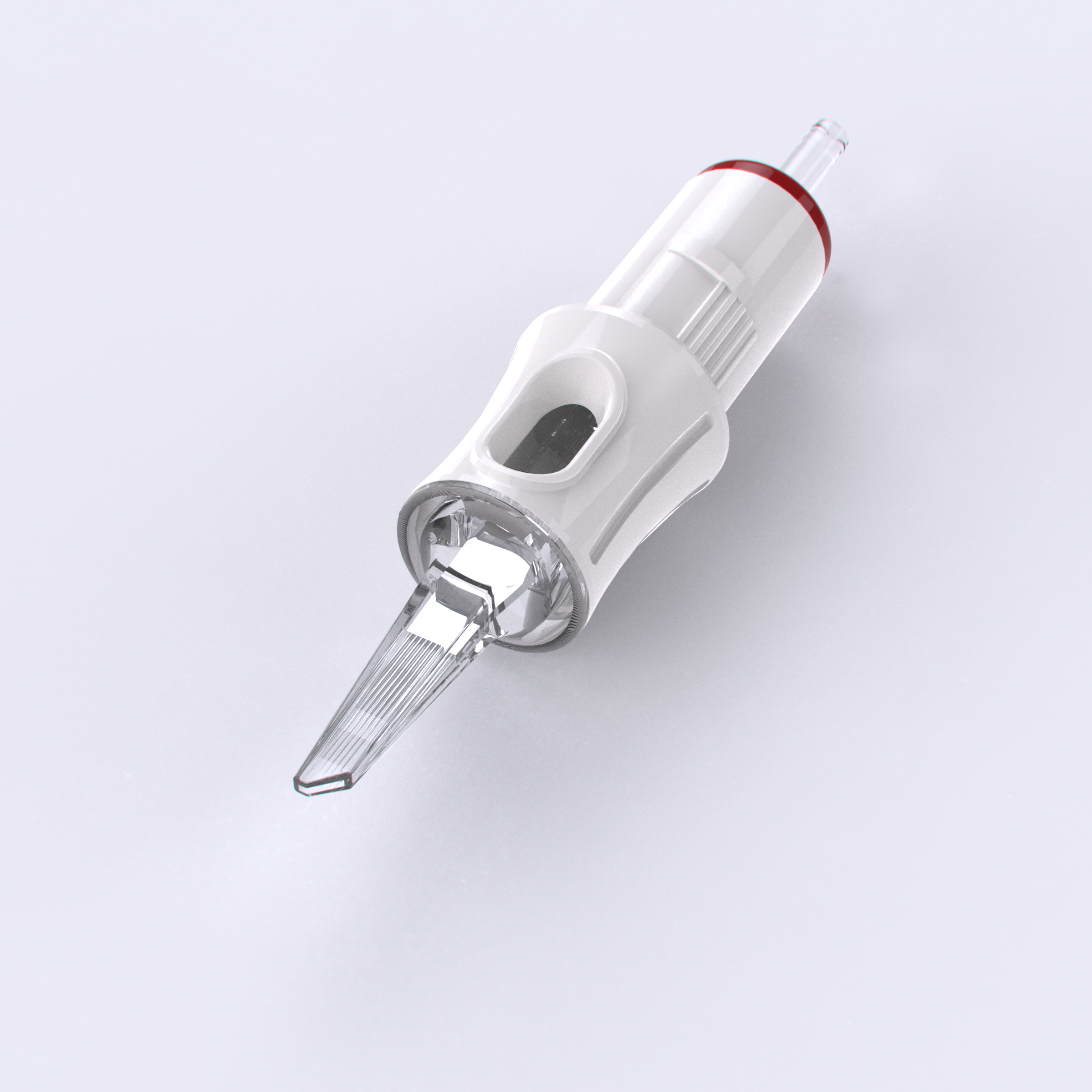
The housing is the transparent body that holds the needle assembly and seats into the machine grip. On this platform it is medical-grade PC. For the artist, the housing determines two things: whether the needle group is visible at the tip during fine work, and whether the cartridge sits stable in the grip without rock or play during a long session. Instability at the housing is often misdiagnosed as needle wobble.
Medical-grade stainless steel needles
The needle group is medical-grade stainless steel. Material grade matters less for sharpness out of the box than for consistency across a box — the same steel, formed to the same geometry, is what allows an artist to trust that cartridge forty behaves like cartridge one.
Silicone anti-backflow membrane
Each cartridge carries a silicone elastic membrane system acting as an anti-backflow barrier. Its job is to stop pigment and bodily fluid travelling back into the housing and machine. In practice the membrane is what allows a studio to work at higher ink volumes and longer sessions without the failure mode of ink appearing where it should not. It is also one of the first features to interrogate when comparing quotations, because a membrane specified on a data sheet and a membrane assembled correctly are not the same thing.
Low vibration design and stable controlled ink delivery
The platform specifies a low vibration design and a stable controlled ink delivery system, with precision tolerance of ±0.02–0.05 mm. Vibration control is what keeps a fine line from widening as the machine runs; controlled ink delivery is what keeps saturation even through a shading pass instead of pooling at the start of a stroke. Tolerance at this level is what allows fine-diameter cartridges in the 0.15 mm and 0.20 mm range to be specified at all — in cosmetic work, a few hundredths of a millimetre is the difference between a hair stroke and a blot.

EO gas sterilization and sterile breathable film packaging
Cartridges are sterilized with EO gas and packed in a sterile breathable film packaging system, using EO sterilization packaging material and a non-toxic transparent plastic tip. Breathable film allows the sterilant to reach the product and to dissipate afterwards while the pack remains a sterile barrier until opening. For the clinic, the implication is procedural: check that the seal is intact and the pack has not been compressed before the cartridge goes anywhere near a client.
Rotary machine compatibility
The platform is documented as compatible with rotary tattoo machines. Before standardising, confirm grip fit and stroke behaviour with the specific rotary machines in the studio, since compatibility is a documented property of the cartridge while feel is a property of the cartridge-plus-machine combination.
Step-by-Step Breakdown: Selecting a Cartridge for a Specific Procedure
- Step 1 — Define the procedure and the deposit you need. Write down what the skin has to receive: a single crisp hair stroke, a saturated outline, a soft gradient, a broad colour field, a brow hair pattern, a lip blush, an eyeliner line, or a diffuse SMP dot pattern. Configuration, diameter and taper all follow from this sentence.
- Step 2 — Choose the configuration. Use RL for outlines and lining, RS for shading and blending, RM for transitional and small-area shading work, Magnum for colour packing and broad coverage, and Flat for specific shading and texture effects. If a procedure needs two behaviours, plan two cartridges rather than compromising on one.
- Step 3 — Choose the needle diameter. Work from the finest option that delivers the required saturation. Fine line, brow, lip, eyeliner and SMP work generally sit at the lower end of the 0.15–0.35 mm range; traditional lining and colour packing sit at the upper end.
- Step 4 — Choose the taper. Select within the 1.5 mm–7 mm range, using extra long taper where delicacy and control are the priority and a shorter taper where a firmer, more direct point is needed. Taper is the setting that fine-tunes behaviour after configuration and diameter are fixed.
- Step 5 — Confirm the platform requirements. Verify the silicone anti-backflow membrane, the low vibration design, the stable controlled ink delivery, and rotary machine compatibility with the machines you actually run.
- Step 6 — Confirm sterility and documentation before the box is opened. Check EO sterilization, sterile breathable film packaging integrity, batch identification, and the supplier's quality and compliance documentation (covered in the verification section below).

Use Cases: Mapping Configurations to Real Work
Fine line body art
Fine line work depends on the finest diameters in the range combined with a longer taper and an RL grouping. The limiting factor is rarely the needle point and almost always vibration and ink control: at 0.15–0.20 mm, any instability in the housing or the machine shows up in the line. A low vibration design and stable controlled ink delivery are not marketing points here — they are the working requirement.
Traditional lining and outlines
Traditional outlines prioritise decisiveness and saturation. An RL configuration at the upper end of the diameter range with a shorter taper gives a firm point and a confident line, and the anti-backflow membrane matters more than artists expect because outline passes are run at higher ink volumes.
Shading, blending and realism
Shading is a gradient problem. RS and RM configurations with mid-range diameters allow soft edges and controlled build-up, and Magnum groups extend the same logic to larger areas. Where shading looks patchy, the usual cause is a tip that deposits unevenly across the pass rather than an artist technique issue.
Colour packing
Colour packing is a coverage problem, answered by Magnum configurations at the upper end of the diameter range. Here a wider taper choice is a secondary consideration; the primary gains come from configuration width and from ink delivery that stays constant across a broad pass.
Eyebrow PMU
Brow work sits at the fine end: 0.15–0.20 mm diameters, long taper, and fine round groupings, with the cartridge documented for PMU eyebrow use. The relevant failure modes are oversaturation on the first pass and pigment migration — both are controlled by diameter, taper and membrane performance together.
Lip and eyeliner PMU
Lip work needs even, low-trauma coverage and benefits from RS-style groupings at fine diameters; eyeliner needs a defined edge and leans toward tighter round groupings at the finest diameters. In both cases the cosmetic margin is narrow, so the tolerance band and vibration behaviour of the platform carry more weight than in body art.
Scalp micropigmentation
SMP is the most demanding application in the range in one specific respect: the result is thousands of very small, very consistent deposits. Fine diameters, long tapers and round groupings are standard, and consistency between cartridges is the entire product. This is where a documented tolerance of ±0.02–0.05 mm and a low vibration design become the deciding criteria rather than a nice-to-have.
Comparison: SP5, HM3 and HM6 Documented Specifications
The three models share one published parameter set. The table below records the documented values exactly as published, so buyers can see where the models genuinely differ and where they do not.
| Attribute | SP5 | HM3 | HM6 |
|---|---|---|---|
| Documented product classification | Fine Line Tattoo Cartridge Needle and Traditional Tattoo Cartridge Needle | Fine Line Tattoo Cartridge Needle | Fine Line, Traditional, Shading, Color Packing, PMU Eyebrow, SMP Scalp Micropigmentation, Long Taper Precision, Soft Edge Magnum |
| Needle diameter options | 0.15 / 0.20 / 0.25 / 0.30 / 0.35 mm | 0.15 / 0.20 / 0.25 / 0.30 / 0.35 mm | 0.15 / 0.20 / 0.25 / 0.30 / 0.35 mm |
| Taper length | 1.5 mm – 7 mm, extra long taper available | 1.5 mm – 7 mm, extra long taper available | 1.5 mm – 7 mm, extra long taper available |
| Configurations | RL / RS / RM / Magnum / Flat | RL / RS / RM / Magnum / Flat | RL / RS / RM / Magnum / Flat |
| Needle material | Medical-grade stainless steel | Medical-grade stainless steel | Medical-grade stainless steel |
| Housing material | Medical-grade PC | Medical-grade PC | Medical-grade PC |
| Membrane system | Silicone anti-backflow membrane | Silicone anti-backflow membrane | Silicone anti-backflow membrane |
| Sterilization | EO gas sterilized | EO gas sterilized | EO gas sterilized |
| Packaging | Sterile breathable film packaging system | Sterile breathable film packaging system | Sterile breathable film packaging system |
| Precision tolerance | ±0.02–0.05 mm | ±0.02–0.05 mm | ±0.02–0.05 mm |
| Machine compatibility | Compatible with rotary tattoo machines | Compatible with rotary tattoo machines | Compatible with rotary tattoo machines |
Reading the table: where a value repeats across all three columns, the published specification is identical for that attribute. The practical difference lies in the documented product classification — how each model is positioned for application coverage — not in a hidden parameter difference. Buyers should treat the classification as the starting point and confirm the exact SKU, diameter, taper and configuration on the specification sheet and pack label before a bulk commitment.
Configuration reference for the selection process
| Configuration | Primary work | Selection note |
|---|---|---|
| RL — round liner | Outlines, lining, fine line detail | Tight grouping for a defined, crisp deposit |
| RS — round shader | Shading, blending, small-area fills | Softer edge than RL; useful where a line must fade |
| RM | Transitional work between lining and shading | Useful when a procedure mixes line weight and soft fill |
| Magnum | Colour packing, broad shading, coverage | Wide working surface for faster coverage |
| Flat | Shading and texture effects | Changes how the tip meets skin across a pass |
Diameter and taper reference
| Procedure | Diameter band within 0.15–0.35 mm | Taper band within 1.5–7 mm | Typical configuration |
|---|---|---|---|
| Fine line body art | Lower end of the range | Longer end; extra long taper available | RL |
| Traditional outline | Upper end of the range | Shorter end | RL |
| Shading and realism | Mid to upper end | Short to long | RS / RM |
| Colour packing | Upper end | Shorter end | Magnum |
| Eyebrow PMU | Lower end | Longer end | Fine round / RL |
| Lip PMU | Lower end | Longer end | RS / RM |
| Eyeliner PMU | Lower end | Longer end | RL |
| Scalp micropigmentation | Lower end | Longer end | RL / RS |
Adoption Criteria: What to Verify Before You Standardise
Certification is where cartridge procurement most often becomes informal. The checks below are the practical minimum for a studio, clinic or private-label brand moving from trial to standard supply.
Quality management system
ISO 13485:2016 is the quality management system standard for medical-grade tattoo needle manufacturing. CREDITECH MED states that it operates under an ISO 13485 certified quality management system for tattoo cartridge needles, PMU cartridges and SMP solutions. Because a QMS claim is self-reported on a supplier page, verify the certificate number, the scope of certification, the certified legal entity (here: Suzhou Creditech Electronic Technology Co., Ltd.) and the expiry date directly with the issuing certification body before relying on it.
CE compliance
The company lists CE compliant products within its certification statements. CE compliance is a declaration tied to a product and a regulatory route, not a badge. Ask which product families are covered, which conformity documentation applies, and whether the documentation matches the SKU you are ordering.
FDA test reports
FDA test reports are stated as available for applicable products. Test reports support a buyer's own due diligence; they are not the same thing as a regulatory clearance or registration, and the applicable product scope should be confirmed in writing.
RoHS and MSDS documentation
Where the destination market or the buyer's own compliance system requires it, request RoHS documentation for the relevant components and a material safety data sheet for the product and any inks or ancillary materials in the shipment. Treat both as per-SKU documents with a revision date, not as general company statements.
Sterility and packaging evidence
Ask for evidence covering EO sterilization, sterile breathable film packaging integrity and batch identification. A sterile barrier is only meaningful if the pack is intact at the point of use, so packaging format and shelf-life labelling belong in the same conversation as the sterilization method.
Manufacturing and supply context
CREDITECH MED operates a 3,000 m² manufacturing facility with approximately 180 staff, a 20-engineer R&D team and an annual production capacity of 100,000,000 units, with export business accounting for 90% of total sales across Europe, North America, South America and Southeast Asia. For a buyer, documented capacity and export share indicate whether a supplier can hold a studio standard or a private-label programme across seasons — but current lead time, MOQ and batch availability should always be confirmed against your own order rather than assumed from capacity figures.

FAQ
Which certifications should I check on a tattoo cartridge needle before ordering?
Start with the quality management system: ISO 13485:2016 is the standard applied to medical-grade tattoo needle manufacturing. CREDITECH MED states that it operates under an ISO 13485 certified quality management system, lists CE compliant products, and states that FDA test reports are available for applicable products. Because these are supplier statements, verify the certificate number, scope, certified legal entity and expiry date with the issuing certification body, and confirm in writing which product families each document covers. Where your market requires it, request RoHS documentation and an MSDS for the specific SKU.
Can SP5, HM3 and HM6 cartridges be used with rotary tattoo machines?
Yes. All three models are documented as compatible with rotary tattoo machines, alongside the same silicone anti-backflow membrane, low vibration design and stable controlled ink delivery system. Compatibility is a documented property of the cartridge, but feel is a property of the cartridge-and-machine combination, so confirm grip fit and stroke behaviour with the specific rotary machines in your studio before standardising.
How do I evaluate a tattoo cartridge needle supplier rather than just a product?
Evaluate four things in order. First, specification coverage: does the supplier document configuration (RL, RS, RM, Magnum, Flat), the full diameter range (0.15–0.35 mm on this platform), taper length (1.5–7 mm with extra long taper available) and dedicated fine line, PMU and SMP positioning. Second, delivery platform: membrane type, vibration design, ink-flow control and precision tolerance (±0.02–0.05 mm here). Third, sterility and packaging: EO gas sterilization and sterile breathable film packaging, with batch identification. Fourth, documentation: quality management system certificate, CE and FDA-related documents, and RoHS or MSDS where required. A supplier that can answer all four with documents is a different category of supplier from one that can only quote a price.
How can a studio or PMU clinic evaluate SP5, HM3 and HM6 before committing to volume?
Run the evaluation on your own procedures rather than on a sample sheet. Order the configurations you actually use — an RL at a fine diameter for fine line, eyebrow or SMP work, and an RS or Magnum at a wider diameter for shading or colour packing — and assess vibration, ink delivery, line consistency and packaging integrity across several sessions before setting a standard. Specification sheets, current product documentation and sample arrangements can be requested from CREDITECH MED at estlia@creditechmed.com or +86 18625276381; the company brochure is available for download at the end of this article.
What supply factors should a buyer plan for before standardising on a cartridge?
Confirm current lead time, minimum order quantity, packaging format and batch availability for your exact SKUs rather than inferring them from headline capacity. As context, CREDITECH MED reports an annual production capacity of 100,000,000 units, approximately 180 staff, a 20-engineer R&D team and export business at 90% of total sales across Europe, North America, South America and Southeast Asia, and offers OEM and ODM services covering product development, structural design, prototyping, mass production and customised packaging. For private-label buyers, also confirm which documents travel with each batch and how specification changes are notified.
Conclusion
Cartridge selection becomes straightforward once it is treated as three sequential decisions. Configuration sets the shape of the deposit, diameter sets how much ink each point carries, and taper sets how the point meets the skin. On the SP5, HM3 and HM6 platform those decisions are made within a documented envelope: RL, RS, RM, Magnum and Flat configurations; 0.15–0.35 mm diameters; 1.5–7 mm tapers with extra long taper available. What the models share is the delivery platform — medical-grade PC housing, medical-grade stainless steel needles, silicone anti-backflow membrane, low vibration design, stable controlled ink delivery, ±0.02–0.05 mm tolerance, EO gas sterilization and sterile breathable film packaging — and it is that platform, not the tip geometry alone, that determines whether fine line, PMU and SMP work behaves consistently.
For studios adding cosmetic services, and for PMU and SMP practices tightening consistency, the practical next step is procedural rather than commercial: pick two or three configurations you will actually use, run them against your own cases, and verify the documentation behind them. Buyers who want the specification detail, configuration coverage and OEM/ODM scope in one place can download the CREDITECH MED brochure, or contact the team directly at estlia@creditechmed.com, by phone on +86 18625276381, or at 3rd Floor, Building 3, No. 3000 Taidong Road, Xiangcheng District, Suzhou, China. The company's product range is listed at creditechmed.com.
Next step — catalogue and sample evaluation. Review the full SP5, HM3 and HM6 specification, including diameter, taper and configuration options, in the CREDITECH MED product brochure: download the brochure. For sample arrangements, current lead times or OEM/ODM enquiries, email estlia@creditechmed.com or message +86 18625276381.
Have Questions or Need More Details?
Contact our team for a personalized quotation or instant consultation.
Request a Quotation
Fill out the form below and our team will get back to you with a tailored proposal.
WhatsApp Direct Chat
Prefer to chat in real-time? Message us on WhatsApp for instant assistance & quick answers.
- Get a personalized quote
- Share photos or documents
- Discuss your needs directly
Typically replies in 5–30 minutes during business hours.