Tattoo Cartridge Needle Compliance Guide: FDA, CE MDR, RoHS 2.0 & MSDS Certification Explained
Tattoo Cartridge Needle Compliance Guide: FDA, CE MDR, RoHS 2.0 & MSDS Certification Explained
Four separate documents sit behind the compliance claim on a box of SPACEDRAGON tattoo cartridge needles: an FDA testing report for the United States, a CE MDR document review for the European Union, a RoHS 2.0 certificate covering EU restricted substances, and an MSDS record used for global chemical-safety communication. Each one is issued by a different laboratory or certification body, carries its own reference number, and answers a different question. When distributors compare suppliers, the quickest way to spot a weak file is to check whether those questions are answered separately, or bundled into one unverifiable phrase such as 'CE and FDA certified'.
CREDITECH MED is the brand of Suzhou Creditech Electronic Technology Co., Ltd., a manufacturer of tattoo cartridge needles, PMU cartridges and SMP cartridges founded in 2009 in Suzhou, China, and exporting to Europe, North America, South America and Southeast Asia. SPACEDRAGON TATTOO is its flagship cartridge needle brand. This guide decodes each compliance document on file, separates what it establishes from what it does not, and connects the certification set to the specifications buyers actually receive: medical-grade PC housings, medical-grade stainless steel needles, silicone anti-backflow membranes, EO gas sterilization, and a stated precision tolerance of ±0.02–0.05 mm.
Why Tattoo Cartridge Needle Certification Is Hard to Compare
A tattoo cartridge needle is a single-use device that enters the dermis, so buyers reasonably expect the paperwork to be unambiguous. In practice, three patterns cause most of the confusion in supplier files.
The first is terminology. The word 'certification' is applied to product certificates, quality management system certificates, laboratory test reports and safety data sheets as though they were interchangeable. They are not. A RoHS certificate says nothing about sterility, and an ISO 13485 certificate says nothing about the performance of a specific batch.
The second is market mismatch. A document issued for the EU market does not answer a US importer's question, and a global safety data sheet does not replace an EU conformity document. Many supplier catalogues list all certificates together without labelling the market each one serves.
The third is scope. Every genuine certificate names an issuer, a reference number, a standard and a validity period. It also names a scope, and the scope is where files most often fail: a quality system certificate that covers tattoo needles does not automatically cover a different product family from the same factory. A file that cannot show those four fields for each document cannot be checked, and a document that cannot be checked cannot be defended in a tender, an audit or a customs query.
The Commercial Context Behind the Documentation
Cartridge formats now dominate professional practice. Approximately 73% of professional tattoo artists preferred cartridge needles over traditional bar needles in 2024, according to Custom Market Insights, which also estimates the global tattoo needle market at USD 368.3 million in 2024 and projects growth of roughly 3.5% CAGR to USD 468.6 million by 2033. The cosmetic segment is growing faster: Fortune Business Insights projects the global permanent makeup market rising from USD 162.93 million in 2025 to USD 330.5 million by 2034, at a CAGR of 8.31%.
Classification adds a second layer. Tattoo cartridge needles sit under HS Code 9018.39, the heading for medical needles, catheters and cannulae, which is how customs authorities and some buyers categorise the product at import. That heading places the product next to clinical consumables in official trade data, and it is one reason documentation requests from distributors have become more specific over time.
Against that backdrop, ISO 13485:2016 functions as the anchor document. It is the quality management system standard applied to medical device manufacturing, and it governs how a factory is organised — design and development control, supplier evaluation, process validation, traceability, batch release and corrective action — rather than the performance of one shipment. Product-level test reports and declarations sit on top of that system; they do not replace it.
The Five Documents Held for SPACEDRAGON Tattoo Cartridge Needles
1. FDA Testing Report — United States Market
The US document is testing report number TST2019112501-4EN, issued by TST Testing Technology Co., Ltd. and applicable to the US market. It cites FDA 21CFR175.300, FDA 21CFR180.22 and ASTM C738-94 as the standards applied; the certification record for the same document additionally lists EPA3050B-1996 and a Stainless Steel GRAS reference.
What this document is: a third-party laboratory test report covering the cartridge materials against the standards named on the report. What it is not: a registration, a listing or a marketing authorisation. Buyers should read it as material and extraction test evidence produced for the US market, and should confirm that the report number, the tested product description and the standards cited on the copy they receive match the record held by the supplier.

2. CE MDR Document Review — European Union Market
The EU document is certificate number ICR Polska/DR/HM2311112, issued by ICR Polska Co. Ltd. and recorded as a CE MDR document review. It references MDR (EU) 2017/745 Annex II and Annex III — the technical documentation and post-market surveillance annexes of the Medical Device Regulation — with an issue date of 30 November 2023 and validity to 29 November 2028.
The wording 'document review' matters. It describes a review of technical documentation against the annexes named on the certificate, which is a different instrument from a full quality management system certificate issued under Annex IX of the same regulation. Distributors preparing an EU tender file should quote the exact certificate title and number rather than shortening it to 'CE certified', because the shortened phrase cannot be matched to a document during an audit.
3. RoHS 2.0 and RoHS (2011/65/EU) — European Union Market
Two RoHS records exist for the same product family, and buyers should know which one they are reading. The widely quoted record is RoHS 2.0 certificate TST2019112501-3RC, issued by TST Testing Technology Co., Ltd. for the EU market, citing (EU) 2015/863, (EU) 2017/2102 and the full set of IEC 62321 series standards, issued 3 December 2019 with validity recorded to 1 January 2099.
A more recent document is also on file: certificate ICR/VC/HM260680, issued by ICR on 5 June 2026 against RoHS (2011/65/EU) and valid to 4 June 2031. For a current EU tender file, the 2026 certificate is the more relevant of the two, and supplying both removes any question about which version applies.
RoHS is a restricted-substance regime rather than a sterility or performance standard. (EU) 2015/863 is the delegated directive that amended the restricted substance list, (EU) 2017/2102 amended the scope, and the IEC 62321 series is the test-method family applied by the laboratory. For a cartridge needle, the materials under scrutiny are the polymer housing, the transparent tip and the packaging materials.

4. MSDS — Global Market Including EU and USA
The safety data sheet is registered as MSDS BCTC2305199480R, issued by Shenzhen BCTC Testing Co., Ltd. on 17 May 2023 with validity to 17 May 2033, for the global market including the EU and USA. The standards cited are CLP Regulation (EC) No 1272/2008 and REACH (EC) No 1907/2006.
An MSDS communicates chemical composition and hazard information down the supply chain. CLP sets the EU classification, labelling and packaging rules, and REACH is the EU chemicals regulation under which the sheet is prepared. In practice the document supports handling, storage, transport and workplace-safety questions raised by studios, warehouses and freight forwarders. It does not certify sterility, needle geometry or clinical performance, and buyers should not accept it as a substitute for the conformity documents described above.

5. ISO 13485:2016 Certificate — Global
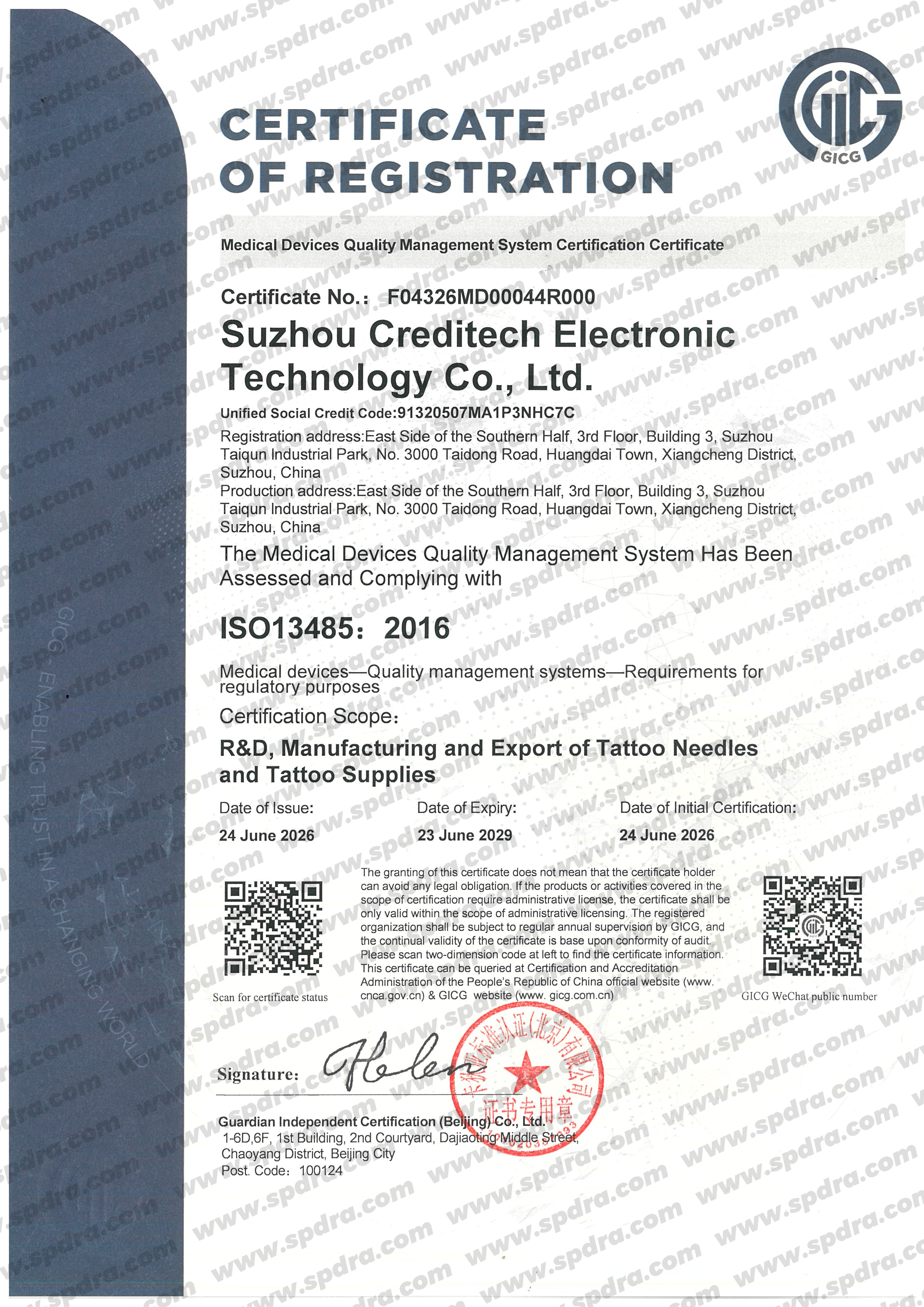
The quality management system certificate is number F04326MD00044R000, issued by Guardian Independent Certification (Beijing) CO.,LTD. against ISO 13485:2016, with the scope recorded as research, development, manufacturing and sales of tattoo needles. It was issued on 24 June 2026 and is valid to 23 June 2029 for the global market.
This is the document that answers capability questions rather than product questions: whether the factory runs a documented quality system, whether processes are validated, whether batches are traceable, and whether nonconforming product is controlled. For an OEM or private-label buyer committing to a multi-year programme, it is the certificate that most directly predicts consistency across shipments.
Certification Matrix: Reference Numbers, Issuers and Validity
| Document | Reference number | Issuer | Market | Standard / scope | Validity |
|---|---|---|---|---|---|
| FDA testing report | TST2019112501-4EN | TST Testing Technology Co., Ltd. | USA | FDA 21CFR175.300, FDA 21CFR180.22, ASTM C738-94 | Issued 2019-12-03; recorded validity to 2099-01-01 |
| CE MDR document review | ICR Polska/DR/HM2311112 | ICR Polska Co. Ltd. | EU | MDR (EU) 2017/745 Annex II & Annex III; scope: tattoo needles | 2023-11-30 to 2028-11-29 |
| RoHS 2.0 | TST2019112501-3RC | TST Testing Technology Co., Ltd. | EU | (EU) 2015/863, (EU) 2017/2102, IEC 62321 series | Issued 2019-12-03; recorded validity to 2099-01-01 |
| RoHS (2011/65/EU) | ICR/VC/HM260680 | ICR | EU | RoHS (2011/65/EU) | 2026-06-05 to 2031-06-04 |
| MSDS | BCTC2305199480R | Shenzhen BCTC Testing Co., Ltd. | Global (EU & USA) | CLP Regulation (EC) No 1272/2008, REACH (EC) No 1907/2006 | 2023-05-17 to 2033-05-17 |
| ISO 13485:2016 | F04326MD00044R000 | Guardian Independent Certification (Beijing) CO.,LTD. | Global | ISO 13485:2016; R&D, manufacturing and sales of tattoo needles | 2026-06-24 to 2029-06-23 |
What Each Document Establishes — and What It Does Not
Reading the file correctly means knowing which question each document answers. The table below maps the six records to the buyer question they resolve and the question they leave open.
| Document | Answers | Does not answer |
|---|---|---|
| FDA testing report | Whether cartridge materials were tested by an accredited laboratory against the cited US standards | Whether the product is registered, listed or authorised for sale in the US |
| CE MDR document review | Whether technical documentation was reviewed against MDR Annex II and Annex III | Whether a full quality management system certificate under Annex IX exists |
| RoHS 2.0 / RoHS (2011/65/EU) | Whether restricted-substance limits were tested under the named EU directives | Sterility, biocompatibility or needle performance |
| MSDS | Chemical composition, hazard classification and safe handling information | Conformity assessment, sterility assurance or clinical suitability |
| ISO 13485:2016 | Whether the manufacturing quality system is certified and within a defined scope | Whether an individual batch met specification |
| Batch and sterilization records | Whether a specific lot was produced, sterilized and released under that system | Market access requirements of the importing country |
How Compliance Connects to the Physical Product
Documentation only has value if the shipped product matches the file. For SPACEDRAGON cartridges, the specification points that carry compliance weight are the materials and the process controls, not the marketing description.
The needle is medical-grade stainless steel, and the housing is medical-grade PC. The fluid path is closed by a silicone elastic membrane system acting as an anti-backflow barrier, and the tip is a non-toxic transparent plastic component so the artist can see ink draw without removing the cartridge. Sterilization is EO gas, and the packaging is a sterile breathable film system with EO-compatible packaging material — the packaging is part of the sterile barrier and is therefore part of the claim.

Geometry is where tolerances become a purchasing issue. Available needle diameters are 0.15 mm, 0.20 mm, 0.25 mm, 0.30 mm and 0.35 mm; taper length runs from 1.5 mm to 7 mm with extra long taper available; and configurations cover RL, RS, RM, Magnum and Flat. The stated precision tolerance is ±0.02–0.05 mm. That tolerance band is what makes a fine line cartridge behave predictably at 0.15 mm and what keeps a magnum grouping stable during colour packing. Production runs under an ISO 13485 quality management system with 100% inspection, EO sterilization and batch traceability, which is the mechanism that turns a certificate into a repeatable shipment.
Step-by-Step: How a Distributor Verifies the File
- Match the legal entity. Certificates are issued to a company, not a brand name. Confirm that the entity on the certificate — Suzhou Creditech Electronic Technology Co., Ltd. — matches the entity on the quotation, the invoice and the export documents. Any mismatch needs a written explanation before an order is placed.
- Match the scope. Check the scope line on each document. The ISO 13485 certificate names research, development, manufacturing and sales of tattoo needles; the CE MDR document names tattoo needles. A document whose scope does not name your product cannot support your file.
- Check reference numbers and dates. Record the number, issuer, issue date and expiry date for every document in a single register. The matrix above is the reference set for this product family.
- Match the market. Assign each document to the market it serves: FDA testing report to the US, CE MDR and RoHS to the EU, MSDS to global handling and transport questions. Do not present an EU document to a US buyer as market evidence.
- Read the document type. Distinguish a laboratory test report from a document review and from a quality management system certificate. Each has a different evidentiary weight, and a tender reviewer will check the title before the content.
- Verify with the issuer. Where the issuing body offers a verification route, confirm the certificate directly with TST Testing Technology Co., Ltd., ICR Polska Co. Ltd., ICR, Shenzhen BCTC Testing Co., Ltd. or Guardian Independent Certification (Beijing) CO.,LTD. This is the step that converts a PDF into verified evidence.
Use Cases: Reading the Same File From Four Buyer Positions
EU Distributor Preparing a Tender File
The distributor needs CE MDR ICR Polska/DR/HM2311112, the current RoHS certificate ICR/VC/HM260680, the global MSDS and the ISO 13485 certificate, each labelled with issuer, number and validity. The distributor's own customer will ask which document covers which requirement, so the mapping table — not the certificates alone — is the deliverable.
US Studio Group Standardising Consumables
The relevant documents are the FDA testing report TST2019112501-4EN and the ISO 13485 certificate. The studio group's real question is consistency across reorders, so the useful addition is batch traceability on the packaging and a documented release process behind it.
OEM / Private-Label Brand Launching a Range
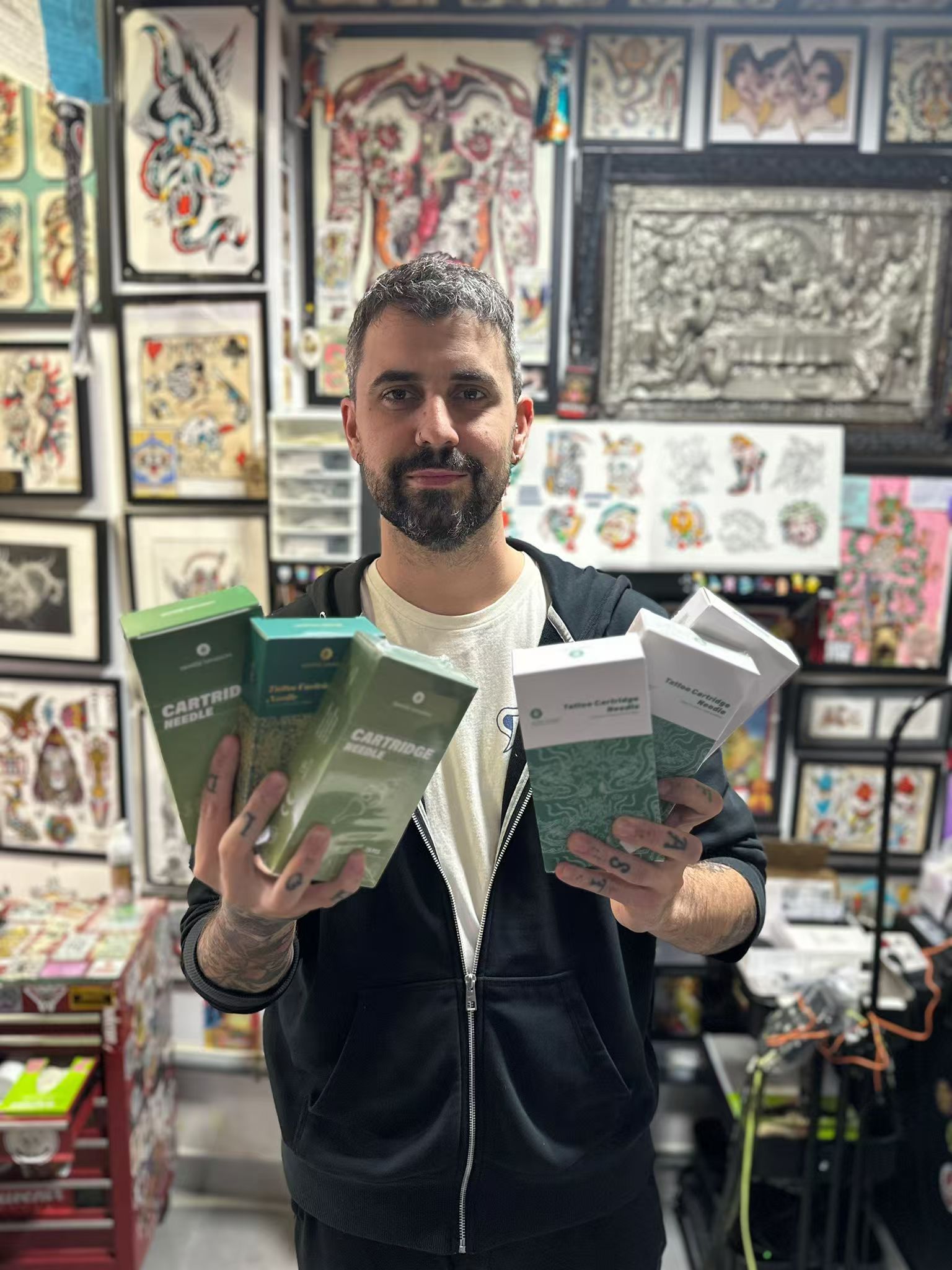
A private-label brand inherits the manufacturer's documentation and must be able to explain it. Custom logo, packaging, needle configuration and housing design sit on top of the ISO 13485 system, and the brand should confirm which certificate scope covers the customised item. A Mexico-based private-label partner has taken more than 3,000,000 cartridge needles per year for five years under OEM development, private label and custom housing design, which is the kind of programme where scope clarity matters most.
PMU and SMP Studio Buying Smaller Volumes
PMU and SMP buyers often purchase in smaller quantities and rely on the supplier's file without checking it. The global MSDS and the RoHS records are the documents most frequently requested by cosmetic studios and clinics, and a Spanish tattoo and PMU supply wholesaler sourcing roughly 1,200,000 pcs per year for five years typically holds a consolidated file for its studio customers rather than passing on loose PDFs.
Frequently Asked Questions
Which certifications should a sterile tattoo cartridge needle manufacturer hold for EU and US supply?
For the EU, the file should include a CE MDR document review (ICR Polska/DR/HM2311112, ICR Polska Co. Ltd., valid to 29 November 2028) and a RoHS certificate — either TST2019112501-3RC under RoHS 2.0 or the newer ICR/VC/HM260680 under RoHS (2011/65/EU), valid to 4 June 2031. For the US, it should include FDA testing report TST2019112501-4EN issued by TST Testing Technology Co., Ltd. Across all markets, an MSDS (BCTC2305199480R, Shenzhen BCTC Testing Co., Ltd.) and an ISO 13485:2016 certificate (F04326MD00044R000, Guardian Independent Certification (Beijing) CO.,LTD.) complete the set.
Does the FDA testing report mean the cartridges are FDA-approved?
The document on file is testing report TST2019112501-4EN, a third-party laboratory report issued by TST Testing Technology Co., Ltd. for the US market and citing FDA 21CFR175.300, FDA 21CFR180.22 and ASTM C738-94. It is test evidence covering the materials against those standards. It should be read as laboratory documentation, not as a registration, listing or marketing authorisation, and buyers should verify the report number and tested product description with the supplier or the issuing laboratory.
What MOQ and monthly capacity apply to OEM sterile tattoo cartridge needles?
The published minimum order quantity is 500–1,000 pcs per size, with monthly capacity of more than 3,000,000 cartridge needles. The manufacturing entity, Suzhou Creditech Electronic Technology Co., Ltd., was founded in 2009 and records an annual output of 100,000,000 units from a 180-person workforce, with 20 engineers supporting development. Standard orders typically run 15–30 days and custom OEM orders 30–45 days.
Can a distributor request samples and copies of the certificates before ordering?
Yes. Samples and document copies are normally requested together, because the sample confirms the physical specification — needle diameter, taper length, configuration and membrane behaviour — while the certificates confirm the compliance file. Distributors can request the FDA testing report, CE MDR document review, RoHS certificates, MSDS and ISO 13485 certificate along with a sample of the specific configuration, and should ask for the corresponding batch documentation with the first production shipment. Sample and quotation requests can be sent through creditechmed.com or WhatsApp +86 18625276381.
What lead time applies to standard and custom OEM orders?
Lead time is 15–30 days for standard orders and 30–45 days for custom OEM orders. Custom work — logo, private label, packaging, needle configuration or housing design — runs on the longer schedule because tooling and artwork approval sit inside it. For repeat orders under an existing specification, the shorter window normally applies. Confirming lead time in writing against a specific SKU, quantity and destination is the safest approach before committing to a distributor delivery date.
Conclusion
Compliance for tattoo cartridge needles is not one certificate; it is a set of documents, each issued by a named body, each carrying a reference number and a validity window, and each answering a specific question. For SPACEDRAGON needles the set is: FDA testing report TST2019112501-4EN for the US, CE MDR document review ICR Polska/DR/HM2311112 and RoHS certificates TST2019112501-3RC and ICR/VC/HM260680 for the EU, MSDS BCTC2305199480R for global handling, and ISO 13485:2016 certificate F04326MD00044R000 for the manufacturing system.
The engineering behind those documents is what makes them meaningful: medical-grade stainless steel needles, medical-grade PC housings, silicone anti-backflow membranes, EO gas sterilization, sterile breathable film packaging and a ±0.02–0.05 mm precision tolerance across 0.15–0.35 mm diameters and 1.5–7 mm tapers. A distributor who can match certificate to scope, scope to market and market to batch record has a file that survives an audit. One who cannot has a folder of PDFs.
Request the Compliance File and a Sample
CREDITECH MED supplies SPACEDRAGON tattoo cartridge needles, PMU cartridges and SMP cartridges to distributors, private-label brands and professional studios across Europe, North America, South America and Southeast Asia. Certificate copies, specification sheets and samples can be issued against a specific configuration and market.
Download the company brochure: CREDITECH MED Company Brochure
Website: www.creditechmed.com | Email: estlia@creditechmed.com | WhatsApp: +86 18625276381 | Contact: Yosmine | Address: 3rd Floor, Building 3, No. 3000 Taidong Road, Xiangcheng District, Suzhou, China

Have Questions or Need More Details?
Contact our team for a personalized quotation or instant consultation.
Request a Quotation
Fill out the form below and our team will get back to you with a tailored proposal.
WhatsApp Direct Chat
Prefer to chat in real-time? Message us on WhatsApp for instant assistance & quick answers.
- Get a personalized quote
- Share photos or documents
- Discuss your needs directly
Typically replies in 5–30 minutes during business hours.