
Tattoo Cartridge Needle Supplier Audit: Capability, Certification, Delivery
A tattoo cartridge needle supplier audit should end with three items signed off before the first purchase order: a capability file that matches the exact SKUs you intend to buy, a certificate set you have checked against the bodies that issued it, and delivery terms that define inspection, acceptance and shipment dates. Anything a supplier cannot put in a document is a statement rather than evidence, and unverified is a poor basis for a sterile single-use product.
Those are the three passes of the audit, and they are best run in that order. Capability comes first because it decides whether the rest of the file is even relevant: there is no point verifying a sterility document for a SKU the factory has never produced. Certification comes second because documents have scope — a certificate issued for a product family is not automatically valid for the cartridge configuration on your order. Delivery comes third because commercial terms are where verification turns into an obligation.
This guide sets out each pass as a checklist a buyer can run in a single afternoon per supplier. It uses the document set published by CREDITECH MED — an ISO 13485 certified tattoo cartridge needle manufacturer — as a worked example of what a complete file contains, and flags where a buyer should still verify directly rather than accept the file at face value.

The audit problem: in this category, claims are easier to publish than documents
Cartridge needles are marketed with a shared vocabulary — medical grade, CE, FDA, sterile, precision tolerance — and none of that vocabulary is regulated at the level of a web page. A buyer comparing supplier sites therefore often ends up comparing adjectives, then discovers after the first shipment that no document supports the adjectives that actually mattered.
The unit of evidence in a purchasing decision is not an adjective but a document with five readable fields: product scope, standard or regulation, issuing body, document number, and issue and expiry dates. If any of those fields is missing or inconsistent, the claim is a supplier statement. A manufacturer's own certification page is a pointer to documents, not the verification itself, because in that case the claim and its proof come from the same source.
A second failure mode is scope drift. A certificate issued for “tattoo needles” may not name the cartridge SKUs on your order. A RoHS report covering one product family may not cover a new housing material introduced last quarter. An FDA report dated seven years ago describes the materials of seven years ago. None of these failures means the product is non-compliant — it means the file cannot yet support the order, and that is a different problem with a different fix.
Both problems are solvable before money changes hands, which is the point of auditing in this sequence rather than after a defect appears.
Industry background: why the document bar has moved
Cartridge needles are now the professional default. Commercial research published by Custom Market Insights places cartridge preference at roughly 73% of professional tattoo artists in 2024, against traditional bar needles, and sizes the global tattoo needle market at USD 368.3 million in 2024 with a forecast of USD 468.6 million by 2033 at approximately 3.5% CAGR.
The cosmetic side is growing faster. Fortune Business Insights projects the global permanent makeup market moving from USD 162.93 million in 2025 to USD 330.5 million by 2034, an 8.31% CAGR. PMU and SMP work is where fine-line and small-diameter cartridges concentrate, and it is also where a studio's tolerance for a batch that behaves differently from the previous batch is lowest, because the work is small, visible and often on the face.
Trade classification adds a documentation dimension. Tattoo cartridge needles sit under HS code 9018.39 in trade schedules, alongside medical needles, catheters and cannulae. A customs classification is not a regulatory determination and does not by itself make a product a medical device in a given market, but it does mean import paperwork and product labelling are read in a medical-adjacent context.
Put together: more units, more private-label brands, more PMU crossover, and a customs category that invites questions. That is the environment in which a buyer needs a file rather than a brochure. The market figures above are third-party commercial research and are best treated as directional rather than as forecasts to plan against.
Pass 1 — Capability: what a factory must show for your SKUs
A capability pass is complete when the supplier can show in writing that the production model, configuration range, capacity and quality controls cover the exact SKUs in your enquiry. Anything described only at company level, without a link to your SKU, remains an open item for the audit, not a closed one.
Production model and customisation scope
CREDITECH MED offers OEM, ODM, custom manufacturing and private label production for global customers. The documented customisation scope is specific rather than generic: custom logo, private label, custom packaging, needle configuration, housing design, and new product development.
That list matters because it separates two different kinds of supplier. A supplier that can only print a logo on an existing cartridge passes the first two items and fails the last four. If your plan involves a housing change, a membrane change or a new configuration, you need the development stage as well as the production stage, and the audit question becomes: what is the gate process from concept to prototype to sample approval to pilot batch to mass production, and who signs off at each gate?
Capacity and continuity
The published capability record states a monthly capacity of 3,000,000+ cartridge needles, supported by a facility of 3,000 m², 180 employees including a 20-engineer R&D team, an operating history since 2009, and roughly 90% of output exported. Named export markets include the USA, Germany, the UK, France, Brazil, Mexico, Colombia, Canada and Australia, alongside Europe, North America, South America and Southeast Asia as regional blocks.
Capacity is where buyers most often stop reading too early. Simple arithmetic shows that a 200,000-unit monthly requirement against a stated 3,000,000-unit monthly capacity is a small share of total output — which means your order is real but not necessarily prioritised. Ask which production line and which weeks your order would occupy, and what the escalation path is if a peak period slips your dates. Continuity questions belong in the capability pass, not in the complaint email after a late shipment.
Configuration coverage
The documented range covers Fine Line, Round Liner, Round Shader, Magnum, PMU and SMP needle configurations. For procurement purposes, ask for the configuration matrix with diameter and taper per code, so that your purchase order references a code rather than a description such as “fine line, thin”. Descriptions do not survive translation, staff changes or repackaging; codes do.
Quality control commitments
Four commitments are published: ISO 13485 quality management, 100% inspection, EO sterilization and batch traceability. Each must be converted into a document request before it becomes auditable:
- ISO 13485 quality management → the certificate itself, with number, issuer, scope and expiry.
- 100% inspection → the inspection plan, and one anonymised inspection record from a recent lot.
- EO sterilization → the sterilization record per lot, plus the validation status behind it.
- Batch traceability → one end-to-end example showing a finished carton resolving back to production and sterilization records.

Precision tolerance: making ±0.02–0.05 mm checkable
A tolerance quoted as ±0.02–0.05 mm only becomes a specification once four things are attached to it: the dimension it applies to, the measurement instrument, the sampling plan, and the pass/fail rule. Without those, the number is a target, and targets are not audited — they are believed.
The questions to put to the supplier, in this order:
- Which dimension? Needle wire diameter, post-assembly tip position across a group, and hub-to-needle concentricity are three different measurements with three different effects on line quality. The same number can describe any of them.
- Measured how? What instrument or optical method is used, at what magnification, and where the reading is recorded.
- Sampled how many? Units per lot, and at which production stage — incoming wire, post-assembly, or finished goods.
- Why a band rather than a point? The quoted range spans 0.02 to 0.05 mm. Ask which diameter families sit at the tighter end of the band and which at the looser end, and whether the band is driven by product category rather than by process capability.
- Change control. If a wire supplier, housing resin or membrane changes, is the tolerance re-validated before the next lot ships?
Decision rule: if a supplier quotes the band but cannot attach the four items, treat the figure as nominal and plan your sample approval accordingly. If the supplier can attach them, ask for two or three anonymised measurement records from recent lots and check whether the recorded values sit inside the band. Records that consistently cluster at one edge of the band are a different conversation from records spread evenly across it.
Pass 2 — Certification: reading the file line by line
A compliance file for tattoo cartridge needles is not one certificate. It is a set of documents that answer different questions, and the audit fails if any one of them is read as standing in for another. The table below lists the document set published for CREDITECH MED cartridges, the fields a buyer should read, and the check that follows each.
| Document | Number and issuer | Standard or basis | Market and scope | Issue → expiry | What the buyer must confirm |
|---|---|---|---|---|---|
| ISO 13485:2016 quality management | F04326MD00044R000 — Guardian Independent Certification (Beijing) Co., Ltd. | ISO 13485:2016 | Global; R&D, manufacturing and sales of tattoo needles | 2026-06-24 → 2029-06-23 | Verify the number with the certification body; confirm legal entity and site address |
| CE MDR document review | ICR Polska/DR/HM2311112 — ICR Polska Co. Ltd. | MDR (EU) 2017/745 Annex II & Annex III | EU; tattoo needles | 2023-11-30 → 2028-11-29 | Ask the issuer what was reviewed and what the document permits |
| FDA testing report | TST2019112501-4EN — TST Testing Technology Co., Ltd. | FDA 21CFR175.300; 21CFR180.22 & 21CFR181.32; EPA 3050B-1996; ASTM C738-94 (2011); stainless steel GRAS | USA; tattoo cartridge needles | 2019-12-03 → 2099-01-01 | Confirm with the laboratory which components were tested and against which limits |
| RoHS 2.0 | TST2019112501-3RC — TST Testing Technology Co., Ltd. | (EU) 2015/863; (EU) 2017/2102; IEC 62321 series | EU; tattoo cartridge needles | 2019-12-03 → 2099-01-01 | Confirm substance-list version and product coverage |
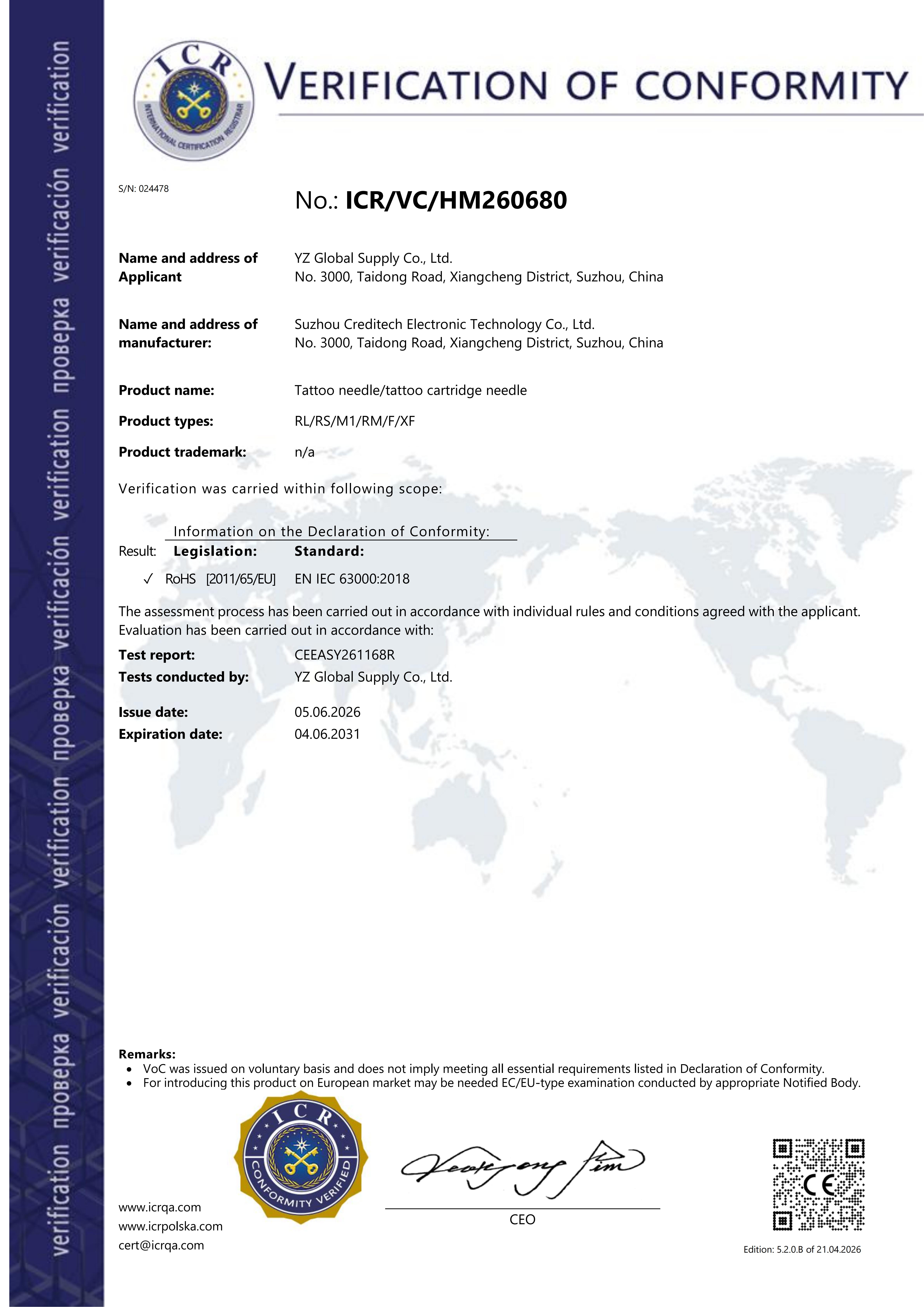
| RoHS (2011/65/EU) | ICR/VC/HM260680 — ICR | RoHS (2011/65/EU) | EU; tattoo needle / tattoo cartridge needle | 2026-06-05 → 2031-06-04 | Ask which RoHS document governs the shipment, and why two exist |
| MSDS | BCTC2305199480R — Shenzhen BCTC Testing Co., Ltd. | CLP Regulation (EC) No 1272/2008; REACH (EC) No 1907/2006 | Global (EU and USA); tattoo needles | 2023-05-17 → 2033-05-17 | Check revision date, language versions and material consistency |
ISO 13485:2016 — a system certificate, not a product certificate
ISO 13485:2016 is the quality management system standard applied to medical device manufacturing, and it governs how the factory is managed rather than certifying a batch of product. The published certificate carries the number F04326MD00044R000, was issued by Guardian Independent Certification (Beijing) Co., Ltd. on 24 June 2026, expires on 23 June 2029, and states its scope as research, development, manufacturing and sales of tattoo needles.
What it establishes: the management system has been audited by a certification body. What it does not establish: that a particular lot was sterile, that a particular tolerance was met, or that the product may be placed on any specific market. Those come from batch records, inspection data and market-access documents respectively.
Buyer checks: confirm the certificate number with the issuing body; confirm the legal entity and site address on the certificate match the entity that will invoice you and the site you may visit; confirm the scope wording covers cartridge needles and not only a broader needle category; and diarise the expiry date so the file is refreshed before it lapses.
CE MDR document review — read the title precisely
The EU document is issued as a CE MDR document review, numbered ICR Polska/DR/HM2311112 by ICR Polska Co. Ltd., citing MDR (EU) 2017/745 Annex II and Annex III, with a stated scope of tattoo needles and validity from 30 November 2023 to 29 November 2028.
The wording matters. Annex II and Annex III of the MDR set out technical documentation and post-market obligations; a document review against those annexes is a review of a technical file. It should not be read, on its own, as an EU type-examination certificate, and it does not by itself prove that a product may carry CE marking under any given classification in every EU market.
What to ask: what exactly was reviewed, which product families are covered, who carries the manufacturer obligations, and — if your destination market requires a specific conformity route — have that confirmed in writing by the supplier or its EU representative rather than inferred from the two letters “CE” on a landing page.
FDA test reports — testing against named regulations is not FDA approval
The FDA document in this file is a testing report numbered TST2019112501-4EN, issued by TST Testing Technology Co., Ltd. for the USA market and dated 3 December 2019. It cites FDA 21CFR175.300, 21CFR180.22 and 21CFR181.32 together with EPA 3050B-1996, ASTM C738-94 (2011) and a stainless steel GRAS reference.
Those citations describe the test basis, not an approval. A third-party laboratory report against named regulations is not an FDA clearance, registration, establishment listing or “FDA approval”, and documents in this category are frequently mislabelled in marketing copy. The correct reading is narrower and more useful: a laboratory tested specified components against specified methods and reported results.
Buyer checks: ask the laboratory or supplier which physical components were tested — needle, housing, membrane, or ink-contact surfaces; ask which limits applied and whether the reported values fell within them; and treat the date seriously. The record lists validity to 1 January 2099, which is worth confirming with the issuer rather than assuming, because a report dated 2019 describes the materials of 2019. A material or supplier change after that date should trigger a fresh assessment even if the document still shows an open-ended expiry.
RoHS — two documents, one decision
RoHS documentation appears twice. The first is a RoHS 2.0 report, TST2019112501-3RC, issued by TST Testing Technology Co., Ltd. on 3 December 2019 against (EU) 2015/863 and (EU) 2017/2102 with the IEC 62321 series test methods. The second is a RoHS (2011/65/EU) document, ICR/VC/HM260680, issued by ICR on 5 June 2026 and valid to 4 June 2031, with a scope stated as tattoo needle and tattoo cartridge needle.
Two valid documents addressing related but differently framed requirements is normal in a maturing file, but the buyer still has to make one decision: which document governs the shipment. Ask the supplier to state in writing which document applies to the SKUs on your order, whether the restricted-substance list version matches your destination market's current requirement, and which product families the 2026 document covers — the published record links it to the SP5, HM6, SP6, HM3 and SP4 cartridge families, so a configuration outside those families needs its own confirmation.
MSDS — handling and transport, not performance
The safety data sheet is numbered BCTC2305199480R, issued by Shenzhen BCTC Testing Co., Ltd. on 17 May 2023 with validity to 17 May 2033, citing CLP Regulation (EC) No 1272/2008 and REACH (EC) No 1907/2006 for the EU and USA markets.
An SDS is a hazard communication document covering handling, storage and transport. It says nothing about sterility or needle performance and cannot substitute for any other document in the file. What to check: the revision date, whether the language versions match your destination, and whether the materials described still match the current bill of materials.
Red flags in a certificate pack. Any one of these stops the audit until it is closed: a certificate with no number or no named issuer; a scope statement naming a different product type, such as tattoo machines instead of tattoo needles; a document that expires before your planned shipment date; a legal entity on the certificate that does not match the entity that will invoice you; the phrase “FDA approved” anywhere in the pack; two documents for the same standard with different numbers and no statement of which supersedes; and an MSDS older than the most recent material change.
Sterilization and sterile packaging: beyond the word “sterile”
EO gas sterilization appears in the published quality control description alongside 100% inspection and batch traceability. For a buyer, “EO sterilized” is the beginning of four verification questions rather than the end of one.
- Method and validation. Confirm ethylene oxide is the declared method for the specific SKUs, and ask for the validation status and the revalidation interval behind it.
- Residuals. EO sterilization requires an aeration stage before release. Ask what residual limits are applied and how release is decided — a fixed hold time, or a measured result.
- Sterile barrier. The product is described with sterile breathable film packaging. Ask for seal strength and package integrity test records, and for the shelf-life claim with the basis on which it was set.
- Traceability. Batch traceability should let a lot number resolve to production date, sterilization cycle and release decision. Ask to see one record end to end; a paragraph describing traceability is not the same thing as a record demonstrating it.
On the packaging specifically: breathable film is used because it allows the sterilant to pass through during the cycle while the sealed pack acts as the microbial barrier afterwards. That makes seal integrity the critical characteristic, not film thickness. At goods-in, inspect the seal line for channels, folds and trapped contamination, check that lot and expiry printing is legible on every unit carton, and record the lot number against your receiving document so a complaint can be traced to a batch rather than to “the last order”.
A note on supplier claims in this category: cleanroom class, sterilization practice and batch coding are commonly published as company-reported statements across the industry, including by suppliers whose certificates are not independently verified. They become auditable only when the buyer sees the validation summary, the release record or an inspection report. Treat a supplier's own description as the request list, not the conclusion.

Pass 3 — Delivery assurance: converting promises into purchasing terms
A delivery pass is complete when the shipment date, the inspection point, the acceptance rule and the payment trigger are all written into the order. A lead time quoted in an email is a forecast; a date in a purchase order with a defined inspection step is an obligation.
The published purchasing terms for CREDITECH MED cartridges provide a concrete baseline to negotiate from:
| Commercial item | Documented position |
|---|---|
| Minimum order quantity | 500–1,000 pcs per size; flexible for OEM trial orders |
| Lead time | 15–30 days for standard orders; 30–45 days for custom OEM orders |
| Delivery terms | FOB / CIF / EXW |
| Payment terms | Standard orders: 30% deposit, 70% before shipment. OEM/ODM projects: 50% deposit, 50% before shipment. Samples and trial orders: 100% advance |
| Payment methods | T/T; PayPal for samples; Western Union |
| Acceptance criteria | Pre-shipment inspection, batch sampling test, and on-site factory inspection (customer visit accepted) |
What to write into the order
- SKU-level quantities and configuration codes, referenced to the configuration matrix — not descriptions.
- The specification revision that governs the order, including the tolerance band and its measurement basis.
- The inspection stage and sampling plan, agreed in writing before the first production run rather than at the loading dock.
- The acceptance and rejection rule, with the remedy for a failed lot stated in the contract instead of negotiated after the failure.
- Packaging and labelling requirements: sterile barrier format, lot and expiry printing, carton and shipper labelling.
- Shipment dates and the named Incoterm with port, so that “FOB” means a specific place and a specific date.
- The document set travelling with the shipment: certificate copies current at the shipment date, lot record, packing list.
- The payment trigger, tied to the inspection report rather than to the shipment date alone.
Acceptance criteria that survive goods-in
Acceptance criteria fail for a predictable reason: they are written as intentions rather than as tests. Three adjustments make them usable.
First, match the inspection stage to the risk. Pre-shipment inspection catches packing, labelling and quantity errors. Batch sampling catches dimensional drift across a production run. An on-site factory inspection catches process issues that a sample of finished goods cannot show, which is why keeping the visit option in the contract matters even if you do not exercise it on the first order.
Second, define the sample size and the defect classification before the first shipment, so that a disagreement at goods-in is a discussion about a rule rather than about a relationship.
Third, record lot numbers on your own receiving documents. Batch traceability only works in both directions if the buyer keeps their half of the chain intact.

The audit sequence: eight steps from screening to first order
- Confirm the legal entity and the site. For this supplier, Suzhou Creditech Electronic Technology Co., Ltd., at 3rd Floor, Building 3, No. 3000 Taidong Road, Xiangcheng District, Suzhou, China. Match it to the certificate, the invoice and the visiting address.
- Request the full certificate pack with numbers and issuers, not PDFs named “certificate final new”.
- Verify each document with its issuing body — Guardian Independent Certification, ICR, ICR Polska, TST Testing Technology, Shenzhen BCTC — and record the date you checked.
- Request the SKU specification sheet and the measurement basis behind the stated tolerance band.
- Review sterilization, packaging and shelf-life documentation against the SKUs, not against the company.
- Approve a sample against written criteria, measured and recorded, not judged by feel.
- Negotiate commercial terms and lock the acceptance criteria into the purchase order.
- Set a review date ahead of certificate expiry and re-audit whenever a material, housing or packaging change lands.
Use cases: where the audit changes the answer
Private-label launch — capacity and development in the same file
A documented case is a Mexico-based private label brand that has purchased 3,000,000+ cartridge needles per year for five years, with OEM development, private label, fast sample development, stable supply chain and batch traceability recorded as the highlights; the manufacturer records stable quality, long-term supply and consistent performance as outcomes.
In audit terms, that combination only functions if the development stage and the production stage sit in one file. A brand that changes housing design and packaging artwork every season needs change control that covers both, otherwise the certificate pack quietly drifts out of step with the product and the next audit starts from a false baseline.
PMU and SMP distribution — where tolerance documents decide
A Spain-based tattoo and PMU supply wholesaler is recorded at 1,200,000 units per year over five years, serving professional studios and permanent makeup applications.
PMU and SMP buyers weight the file differently from general tattoo distributors. Fine-line work concentrates the risk in dimensional consistency and in cartridge behaviour at low vibration, so the tolerance measurement basis and the fine-line configuration documentation carry more decision weight than a broad configuration count. For this buyer type, the capability pass and the tolerance conversation are effectively the same pass.
Multi-studio consolidation — a scenario, not a case
Consider a studio group consolidating from six cartridge brands to two. The audit question shifts from “can this supplier make the product” to “can this supplier hold a specification across years of reordering”. In that scenario the decisive documents are the change-control record, the batch traceability example and the certificate expiry calendar, because the group's risk is drift over time rather than a single bad lot. This is a decision pattern rather than a documented case, and the supplier's own change-control procedure should be reviewed before it is relied on.
Conclusion: the audit is three documents, not one conversation
A supplier audit for tattoo cartridge needles resolves into three separately verified passes. Capability answers whether the factory can make the SKUs, at the volume, with the development scope your plan requires. Certification answers whether the file — ISO 13485:2016 certificate F04326MD00044R000, CE MDR document review ICR Polska/DR/HM2311112, FDA test report TST2019112501-4EN, RoHS 2.0 documentation and the MSDS — covers those SKUs and is still valid, with each number confirmed at its issuer. Delivery answers whether inspection, acceptance and payment triggers are written into the order rather than agreed verbally.
The tolerance figure of ±0.02–0.05 mm and the sterile breathable film packaging are useful only when they arrive with a measurement basis and a seal-integrity record. Requesting those two attachments will tell you more about a supplier's operating discipline than any number of product photographs.
Buyers who want to run this audit against a live file can request the current certificate pack, a configuration matrix and a sample approved against written criteria. CREDITECH MED publishes its certification and testing documentation, accepts customer factory visits as part of pre-shipment inspection, and handles sample, quotation and specification enquiries through its published contact channel at estlia@creditechmed.com.

For a consolidated view of the manufacturer profile, product families and certification scope referenced in this guide, the company brochure is available for download: CREDITECH MED company brochure.
Frequently asked questions
Which certificate documents should I request from a tattoo cartridge needle supplier before ordering?
At minimum, six: the ISO 13485:2016 quality management certificate; a CE MDR document review or equivalent EU technical documentation review; an FDA test report against named regulations such as 21CFR175.300 and 21CFR180.22; RoHS documentation for the applicable directive version; and an MSDS. For each one, record the document number, issuing body, product scope and expiry date, then confirm the number with the issuer. A document without a number or a scope statement cannot be verified and should be treated as a supplier statement.
OEM ODM tattoo cartridge needle manufacturer — what should a buyer verify?
Verify three layers. First, the production model: OEM, ODM, custom manufacturing and private label should be stated for the products you are buying, with the customisation scope spelled out — custom logo, private label, custom packaging, needle configuration, housing design and new product development are the documented scope at CREDITECH MED. Second, the engineering depth behind it: a 20-engineer R&D team within a 3,000 m² facility and 180 employees is the published profile. Third, the development gate: ask how a new housing or configuration moves from concept to prototype to sample approval to pilot batch, and who signs off at each stage.
How should I read a precision tolerance of ±0.02–0.05 mm?
As a range that needs a measurement basis before it means anything. Ask which dimension it applies to, which instrument measures it, how many units per lot are inspected, and what the pass/fail rule is. Then request two or three anonymised measurement records from recent lots and check whether the recorded values sit inside the band. If the supplier can attach all four items, the tolerance is an inspected specification. If not, treat it as a nominal target and plan sample approval accordingly.
What do MOQ and payment terms look like for a first order?
Documented terms for CREDITECH MED cartridges are a MOQ of 500–1,000 pcs per size, flexible for OEM trial orders; standard orders at 30% deposit and 70% before shipment; OEM/ODM projects at 50% deposit and 50% before shipment; and samples or trial orders at 100% advance, settled by T/T, PayPal for samples, or Western Union. Delivery terms are FOB, CIF or EXW. Negotiate the inspection point and the payment trigger as a pair, so that the balance is released against an inspection report rather than against a shipping date alone.
How do I approve a sample, and what lead time should I plan for?
Approve the sample against written criteria rather than by feel: record the SKU code, diameter and taper, measure the relevant dimensions, check the sterile pack seal and lot printing, and test the cartridge on the machines your artists actually use. Documented lead times are 15–30 days for standard orders and 30–45 days for custom OEM orders, so a first private-label run should schedule sampling and packaging artwork approval before the production window opens, not inside it. Buyers ready to run that review can request a sample and the current certificate pack through the supplier's published contact channel.
Have Questions or Need More Details?
Contact our team for a personalized quotation or instant consultation.
Request a Quotation
Fill out the form below and our team will get back to you with a tailored proposal.
WhatsApp Direct Chat
Prefer to chat in real-time? Message us on WhatsApp for instant assistance & quick answers.
- Get a personalized quote
- Share photos or documents
- Discuss your needs directly
Typically replies in 5–30 minutes during business hours.