
Tattoo Cartridge Needle Technical Guide: Specifying Diameter, Taper Length and Configuration
A tattoo cartridge needle is specified by three parameters printed on every box: needle diameter, taper length and configuration. Diameter determines how much tissue trauma each pass creates; taper length determines how soft or rigid the tip behaves; configuration determines how the needles are grouped and how much pigment the group carries. Specify all three correctly and the cartridge becomes a repeatable, purchasable SKU. Specify them loosely and no amount of machine tuning will repair the line.
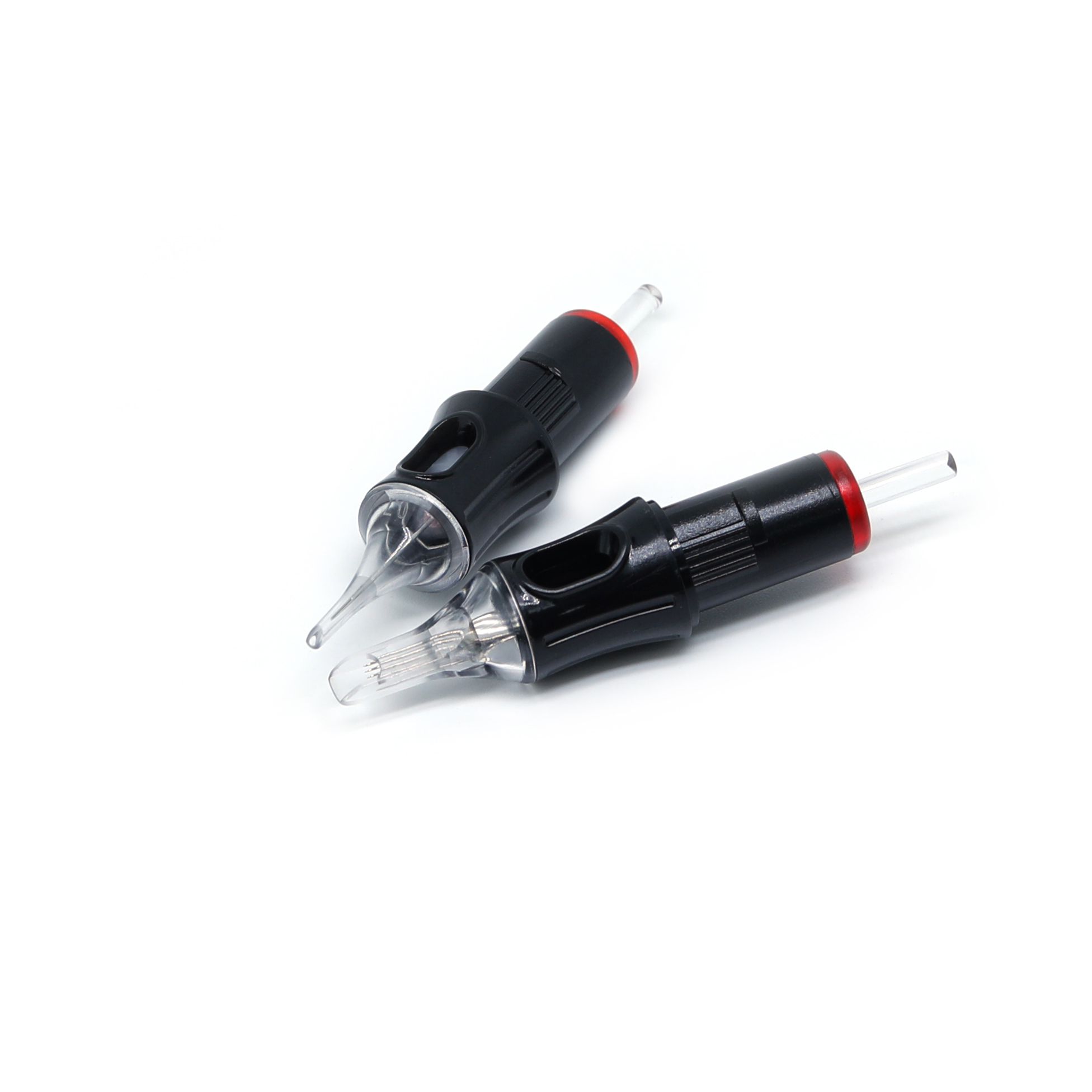
Tattoo cartridge needles from the SPACEDRAGON range, manufactured by CREDITECH MED. Diameter, taper length and configuration are fixed at the design stage and must be confirmed on the product datasheet.
Why cartridge specification errors cost more than they appear to
Most cartridge problems are not artistic failures. They are specification failures that show up on skin and then in the purchasing spreadsheet.
- Blowouts and overworked skin. A needle that is too large for the intended line width forces repeated passes, and repeated passes are what damage tissue.
- Inconsistent line weight. A needle group that is not held to a tight dimensional tolerance will produce a line that drifts between thick and thin within a single stroke.
- Ink pooling and backflow. A cartridge without a functioning anti-backflow barrier allows pigment to travel into the housing, which affects both hygiene and ink control.
- Shading that looks scratched. A short taper used for soft blending produces a harder entry point than the technique requires.
- SKU bloat for distributors. Buying three overlapping configurations instead of one correctly specified configuration ties up capital and creates slow-moving stock.
For a studio, the cost is rework time and client discomfort. For a distributor or private-label brand, the cost is dead inventory plus a technical support burden that never resolves, because the underlying parameter was wrong from the start.
Industry background: cartridges are now the default format
The cartridge format has become the working standard rather than an alternative. A 2024 survey cited by Custom Market Insights reported that approximately 73% of professional tattoo artists now prefer cartridge needles over traditional bar needles, and the same source estimated the global tattoo needle market at USD 368.3 million in 2024, with a projected compound annual growth rate of approximately 3.5% through 2033.
The cosmetic side of the market is expanding faster than the traditional side. Fortune Business Insights projects the global permanent makeup (PMU) market to grow from USD 162.93 million in 2025 to USD 330.5 million by 2034, at a CAGR of 8.31%. PMU and scalp micropigmentation (SMP) work is precisely where diameter and taper tolerances matter most, because strokes are measured in fractions of a millimetre.
Two structural consequences follow. First, cartridge needles are traded under HS Code 9018.39 (medical needles, catheters, cannulae and similar articles), which places them inside a regulated category rather than a generic tools category. Second, because the format itself is now standardised across suppliers, competition has moved to the parameters behind the format: dimensional tolerance, taper consistency, membrane behaviour, vibration control and documented process control under ISO 13485:2016, the quality management system standard for medical-grade needle manufacturing.
That shift is also why specification language varies between suppliers. Product listings in this category describe needle sizes from #4 (0.15 mm) up to #14 (0.40 mm), and groupings are labelled inconsistently across brands. A buyer comparing two datasheets is often comparing two different naming conventions, not two different products.
The four specification decisions that define a cartridge
Working specifications for tattoo cartridge needles generally sit inside a diameter band of 0.15 mm to 0.35 mm and a taper range of 1.5 mm to 7 mm, including extra long taper options. Within those bands, the following four decisions determine performance.
1. Needle diameter (0.15–0.35 mm)
Diameter is the single strongest predictor of tissue response. A thinner needle concentrates force into a smaller point, which produces a finer line with less visible trauma, but also reduces rigidity and pigment capacity. A thicker needle holds a straighter path through skin and carries more pigment per pass, at the cost of a wider, more traumatic entry.
Diameter is also where manufacturing tolerance becomes visible. Suppliers typically quote dimensional tolerance in the ±0.02 mm to ±0.05 mm band. At the tighter end, needles in the same group sit at a consistent height, so the group behaves as one point. At the looser end, individual needles protrude unevenly, which is felt as a ragged line and seen as inconsistent saturation. Buyers should require the tolerance figure on the datasheet rather than assume it.
2. Taper length (1.5–7 mm, including extra long taper)
Taper is the ground length at the tip of the needle. It controls how quickly the needle transitions from full diameter to point, and therefore how the tip behaves on contact.
- Short taper (towards 1.5 mm): a stiffer, more direct tip. Suited to firm outlining, bold lining and colour packing where the needle must hold direction under pressure.
- Medium taper: the general-purpose band. It balances penetration control with enough flexibility for shading and detail.
- Long taper (towards 7 mm, and extra long taper): a slimmer, more elastic tip that enters skin more softly. Common in fine line, realism, PMU and SMP work, where the objective is a delicate stroke rather than a firm one.
The trade-off is directional: longer taper means softer entry but more deflection under lateral pressure. A very long taper paired with a very thin diameter produces the finest possible line and the least tolerance for hand pressure error.
3. Configuration (RL, RS, RM, Magnum, Flat)
Configuration describes how individual needles are grouped inside the cartridge. The configurations in common professional supply are RL, RS, RM, Magnum and Flat.
| Configuration | Primary use | How the group behaves | Typical diameter focus | Typical taper pairing |
|---|---|---|---|---|
| RL — Round Liner | Outlining, fine line, lettering | Needles clustered into a tight round point; concentrated penetration | 0.15–0.30 mm | Short to medium |
| RS — Round Shader | Shading, whip shading, small blends | Round group with wider spacing; more pigment per pass than a liner | 0.25–0.35 mm | Medium |
| RM — Round Magnum | Soft shading, blending, grey wash | Rounded magnum group; coverage with a softer edge than a flat magnum | 0.25–0.35 mm | Medium to long |
| Magnum | Colour packing, large-area shading | Wide group in staggered rows; highest coverage per pass | 0.30–0.35 mm | Short to medium |
| Flat | Texture, specific lining styles, effect work | Single row of needles; broad, even edge with a hard stop | 0.25–0.35 mm | Short |
The diameter and taper pairings above describe common professional practice within the 0.15–0.35 mm and 1.5–7 mm bands. They are selection guidance, not a rule. Confirm the exact combination on the supplier datasheet before ordering.
4. The parts that hold the specification together
Parameters on paper only matter if the physical assembly protects them. In a medical-grade cartridge, the housing is moulded from medical-grade PC, and the needles are made from medical-grade stainless steel. A silicone anti-backflow membrane system sits between the needle group and the machine interface, and the ink delivery system is designed to be stable and controlled, supported by a low vibration design.
Each element maps to a visible outcome:
- Medical-grade PC housing holds the needle group in alignment and resists deformation under machine pressure.
- Medical-grade stainless steel needles maintain tip geometry through a session instead of bending on first contact.
- Silicone anti-backflow membrane blocks pigment from travelling back into the housing, protecting ink control and hygiene.
- Stable controlled ink delivery keeps pigment flow predictable between passes, which matters most during long shading sessions.
- Low vibration design reduces tip chatter at the skin surface, which is where thin-diameter fine line work is most easily spoiled.
Rotary machine compatibility
Cartridge geometry is what connects a specification to a machine. Housing diameter, plunger travel and membrane resistance all interact with the stroke and grip of a rotary pen. A cartridge with a stiffer membrane can feel less responsive on a short-stroke rotary, while a softer membrane may allow ink to be pushed forward too easily on a long-stroke machine. Compatibility should be confirmed by testing the specified cartridge on the machines actually used in the studio, not on a single demo unit.
Sterility and packaging
Tattoo cartridge needles are single-use devices and are EO gas sterilized. Sterility has to survive transport, which is why sterile breathable film packaging is used: it allows the sterilant to work and then maintains the barrier until the cartridge is opened. A damaged or poorly sealed pouch invalidates the sterilisation cycle regardless of how good the needle inside is.
Documentation
ISO 13485:2016 governs how a medical-grade needle factory is managed, which is a different question from whether an individual product is compliant in a specific market. CREDITECH MED states that it operates an ISO 13485 certified quality management system, supplies CE compliant products, and can provide FDA test reports for applicable products. RoHS 2.0 declarations and an MSDS are the additional documents most commonly requested by distributors. Buyers should match every certificate to the legal entity, the product scope and the expiry date.

Packing workshop at CREDITECH MED. Cartridges are packed into sterile breathable film after EO gas sterilisation so the sterility barrier survives export handling.
Step-by-step: building a cartridge specification that survives procurement
The following sequence converts an artist preference into a purchasable, repeatable specification.
- Map the procedures, not the products. List the procedures the studio or brand actually sells: fine line, blackwork, realism, colour packing, PMU brows, SMP. Each procedure family becomes one specification line.
- Fix diameter per procedure. Start from the finest diameter the procedure tolerates, then step up only if rigidity or pigment capacity becomes a problem. Record the number in millimetres, never in gauge labels alone.
- Choose taper by technique. Firm lining takes a shorter taper; soft blending and cosmetic work take medium to long taper. Write the taper range into the specification, because taper naming differs between suppliers.
- Choose configuration by coverage. One liner configuration, one shading configuration and one packing configuration is usually enough for a studio. Distributors should resist adding overlap configurations that serve no distinct procedure.
- Validate on practice skin and on the machine. Confirm line consistency, ink flow and membrane behaviour on the rotary pens used daily. If two cartridges behave identically, one of them should be removed from the range.
- Verify the manufacturing control behind the spec. Ask how the supplier holds tolerance, how the membrane is tested and how vibration is controlled. A datasheet without a process is a promise, not a specification.
- Write the purchasing document. Combine parameters, acceptance criteria, packaging requirement, documentation list and traceability requirement into one page that any supplier can quote against and any incoming inspector can check.
Diameter and taper pairing at a glance
| Diameter band | Behaviour | Best suited to | Watch-outs |
|---|---|---|---|
| 0.15–0.20 mm | Minimum trauma, finest achievable line | Fine line, hair strokes, PMU, SMP | Low rigidity; more deflection when paired with long taper |
| 0.25 mm | Balance of control and durability | Detail work, small shading, cosmetic procedures | Limited efficiency for heavy colour packing |
| 0.30 mm | Stronger core, stable line under pressure | Lining, outlining, medium shading | More trauma per pass than thinner diameters |
| 0.35 mm | Maximum rigidity and pigment throughput | Colour packing, bold lining, large magnum work | Not suitable for fine detail or delicate cosmetic work |
Application notes: matching the specification to the work
Fine line and single-needle detail
Fine line work depends on thin diameter plus long taper plus a low-vibration cartridge. The combination is unforgiving: any wobble in the housing or chatter at the tip is transferred directly into the line. This is the segment where medical-grade PC housing and a silicone anti-backflow membrane are least optional, because there is no coverage to hide inconsistency.
Realism and shading
Realism relies on transitions. RM and RS configurations with medium to long taper allow pigment to be laid down in soft gradients rather than hard bands. A stable controlled ink delivery system matters here more than in lining, because shading quality depends on consistent pigment volume across many passes.
Colour packing and coverage
Magnum configurations with 0.30–0.35 mm diameters and shorter taper do the heavy coverage work. The trade-off is explicit: maximum efficiency per pass, maximum trauma per pass. Packing specifications should therefore be paired with a stricter pass discipline rather than with a larger needle.
PMU and SMP
Cosmetic procedures compress the same decisions into a much smaller scale. Eyebrow, lip and scalp work uses the thinnest diameters in the range with long or extra long taper, and demands the tightest tolerance, because a fraction of a millimetre of variance is visible at brow-hair scale. The PMU and SMP lines from CREDITECH MED are supplied under the ESTLIA brand for this reason; the parameter logic is identical to professional tattooing, the tolerance requirement is not.
As a reference point inside the SPACEDRAGON range, the SP5 cartridge covers multi-category configurations, while the HM series, including HM3 and HM6, is positioned toward finer detail work. Artists and buyers should still confirm the exact diameter, taper and configuration combination on the datasheet for the specific SKU rather than inferring it from the series name.

Packaging workshop. Sterile breathable film packaging and batch coding are part of the same controlled process as needle assembly, not a separate step.
From specification to long-term supply
A specification only holds its value if the batches that arrive six months later match the samples that were approved. That is a process question, and it is the reason long-term cartridge sourcing is usually decided on manufacturing control rather than on unit price alone.
Suzhou Creditech Electronic Technology Co., Ltd., which supplies the market under the CREDITECH MED name, was founded in 2009 and operates a 3,000 m² facility with 180 employees, a research and development team of 20 engineers and an annual output of 100,000,000 units. Export accounts for 90% of output, with main markets in Europe, North America, South America and Southeast Asia. Product coverage spans Fine Line, Round Liner, Round Shader, Magnum, PMU and SMP configurations.
The controls that protect a specification across batches include a cleanroom production environment, medical-grade raw materials, standardised SOP manufacturing processes and engineering validation for new designs. Production risk is controlled through automated production control and multi-stage QC checkpoints, and full batch traceability runs from raw material through production and sterilisation to shipment. Supply chain risk is mitigated by long-term supplier qualification and standardised production lines, with final visual inspection and performance sampling as the last gate before packing.
| Commercial item | Terms |
|---|---|
| MOQ | 500–1,000 pcs per size; flexible for OEM trial orders |
| Delivery terms | FOB / CIF / EXW |
| Standard order payment | 30% deposit, 70% balance before shipment |
| OEM / ODM project payment | 50% deposit, 50% balance before shipment |
| Sample / trial order payment | 100% advance payment |
| Payment methods | T/T, PayPal (samples), Western Union |
| Acceptance criteria | Pre-shipment inspection, batch sampling test, on-site factory inspection (customer visit accepted) |

Packaging line. Standardised lines plus long-term supplier qualification are the mechanism that keeps batch-to-batch output aligned with the approved specification.
Frequently asked questions
- What compliance documents should a long-term tattoo cartridge needle partner in China provide?
- Ask for ISO 13485 quality management system documentation, CE conformity documentation, FDA test reports where they apply to the specific product, RoHS 2.0 declarations and an MSDS. CREDITECH MED states that it operates an ISO 13485 certified quality management system, supplies CE compliant products and can provide FDA test reports for applicable products. Buyers should still match every certificate to the legal entity, product scope and expiry date, and should request EO sterilisation validation records and batch traceability evidence, because a certification claim on a website is not the same as a certificate in hand.
- What manufacturing capability should a long-term cartridge needle partner demonstrate?
- Look for verifiable production scale, engineering resource and process control. CREDITECH MED reports a facility founded in 2009, a 3,000 m² plant, 180 employees, a research and development team of 20 engineers and an annual output of 100,000,000 units, with product coverage across Fine Line, Round Liner, Round Shader, Magnum, PMU and SMP configurations. Process control is described as a cleanroom production environment, medical-grade raw materials, standardised SOP manufacturing, engineering validation for new designs, automated production control with multi-stage QC checkpoints, and full batch traceability from raw material to shipment.
- What MOQ and payment terms apply to OEM tattoo cartridge needle projects?
- MOQ is 500–1,000 pcs per size, with flexibility for OEM trial orders. Standard orders are 30% deposit with 70% balance before shipment; OEM and ODM projects are 50% deposit with 50% balance before shipment; samples and trial orders are 100% advance payment. Accepted payment methods are T/T, PayPal for samples, and Western Union. Delivery terms are FOB, CIF or EXW.
- How should samples be validated before signing a long-term supply agreement?
- Acceptance criteria cover pre-shipment inspection, batch sampling tests and on-site factory inspection, and customer visits to the factory are accepted. Practically, measure the delivered needles against the datasheet tolerance, test the silicone anti-backflow membrane on practice skin, run the cartridge on the rotary machines actually used in the studio, and compare line consistency between cartridges from the same batch. Approve the sample only against written parameters, so that later deliveries can be checked against the same document.
- How is supply continuity protected after the first order?
- Continuity rests on documented process control rather than on promises. CREDITECH MED describes supply chain risk mitigation through long-term supplier qualification and standardised production lines, supported by full batch traceability from raw material through production and sterilisation to shipment, batch coding and sterile breathable film packaging. Buyers should convert this into contract terms: written shipment schedules, agreed acceptance criteria, defined documentation per batch, and a named contact for quality issues. Buyers moving from a specification sheet to a supply agreement can request samples and a quotation directly from the CREDITECH MED team.
Conclusion: specify once, then buy against the specification
Diameter, taper length and configuration are not marketing categories. They are the three variables that decide how a cartridge behaves on skin, and they only create value when a supplier can reproduce them batch after batch. A studio benefits because its results stop depending on which box was opened. A distributor or private-label brand benefits because the range stops growing without purpose and the technical support burden drops.
The practical order of operations is simple: define the procedures, fix the diameter, choose the taper, select the configuration, validate on practice skin and on the machine, then lock the parameters into a purchasing document with acceptance criteria and documentation requirements. Everything after that is manufacturing discipline, and manufacturing discipline is what a long-term cartridge partnership is actually buying.
Request samples, specifications or a quotation
CREDITECH MED, the export brand of Suzhou Creditech Electronic Technology Co., Ltd., manufactures tattoo cartridge needles, PMU cartridges and SMP cartridges under the SPACEDRAGON TATTOO, ESTLIA and LPT Tattoo Supply brands. The company is based at 3rd Floor, Building 3, No. 3000 Taidong Road, Xiangcheng District, Suzhou, China.
Contact: Yosmine | WhatsApp and phone: +86 18625276381 | Email: estlia@creditechmed.com | Website: www.creditechmed.com
Download the company brochure for the full product and capability overview: CREDITECH MED company brochure. Send your diameter, taper and configuration requirements, and the team will return a matching sample plan and quotation.

Specification reviews and OEM project discussions are handled directly with the CREDITECH MED team in Suzhou.
Have Questions or Need More Details?
Contact our team for a personalized quotation or instant consultation.
Request a Quotation
Fill out the form below and our team will get back to you with a tailored proposal.
WhatsApp Direct Chat
Prefer to chat in real-time? Message us on WhatsApp for instant assistance & quick answers.
- Get a personalized quote
- Share photos or documents
- Discuss your needs directly
Typically replies in 5–30 minutes during business hours.