Applying PID Temperature Controllers in JIS, CE, and General Cabinet Builds
Applying PID Temperature Controllers in JIS, CE, and General Cabinet Builds
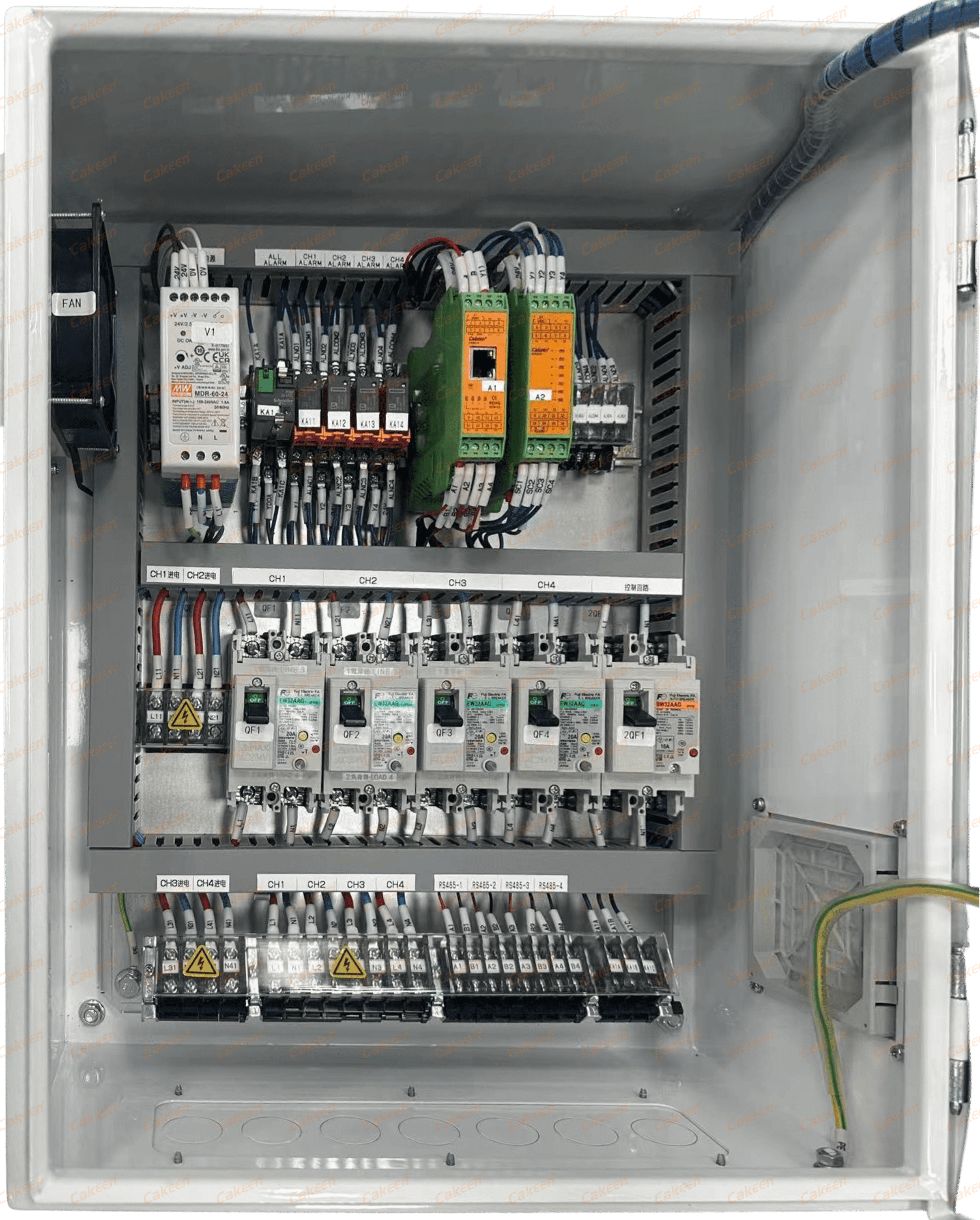
A PID temperature controller that holds ±0.1 °C on a bench can lose that stability the moment it is bolted inside an electrical control cabinet. What changes is not the control algorithm but everything around it: rail space, panel cut-outs, the distance between switching devices and thermocouple wiring, the internal air temperature of the enclosure, and the cabinet standard the build has to pass.
This is an application guide for the part of the job that starts after a controller has been selected — planning space, mounting on DIN rail, routing wiring, and matching the compliance scope of general purpose, Japanese standard (JIS), and European standard (CE) electrical cabinets. Cakeen (Wuxi Keen Technology Co., Ltd.), established in 2011 and headquartered in Huishan District, Wuxi, Jiangsu, supplies both PID temperature controllers and the electrical cabinets they are installed in, so mounting, wiring, and compliance decisions can be resolved with one supplier instead of being negotiated between a controller vendor and a panel builder.
Why the Enclosure, Not the Controller, Sets the Constraint
Bench accuracy describes one variable under controlled conditions. A cabinet build introduces several at once, and any one of them can erase the benefit of a high-precision PID temperature controller.
- Internal air temperature. Solid-state relays, transformers, power supplies and drives all reject heat into the same volume. A controller mounted directly above a heat source operates in a different ambient than the one assumed during selection. This is the main reason external-SSR and built-in-SSR controller designs behave differently inside a closed enclosure.
- Mechanical geometry. DIN35 rail depth, wiring duct width, door swing clearance and standard 48×48 mm panel cut-outs all compete for the same square centimetres. A layout that ignores rail depth usually fails at the wiring stage, not the mounting stage.
- Signal integrity. Thermocouple and RTD inputs carry low-level signals. Routing them in the same duct as mains or SSR load wiring is a layout decision that no controller specification can compensate for.
- Compliance scope. Industrial control panels, including PID controllers, must comply with UL 508A for North American safety listing and IEC 60947 for international markets, according to UL Solutions. The panel standard, not the instrument datasheet, defines what is acceptable.
- Serviceability. A controller that cannot be reached without dismantling a duct is a controller that will not be recalibrated on schedule.
The practical conclusion is straightforward: form factor, channel count, output type and supply voltage should be decided against the cabinet layout, not in isolation.
Industry Background: More Temperature Loops Inside Smaller Enclosures
The demand context explains why cabinet integration has become a constraint problem rather than a procurement formality. The global PID controller market was valued at USD 1.60 billion in 2024 and is projected to reach USD 2.24 billion by 2032 (SNS Insider). Strategic Market Research expects the industrial temperature controller market to grow at a CAGR of 7.1% from 2024 to 2030, with Industry 4.0 adoption as the main driver. Asia-Pacific held a 38.2% revenue share of the temperature controller market in 2023, with China as a key manufacturing hub (Dataintelo).
Semiconductor work concentrates the requirement further. The global semiconductor temperature control equipment market was valued at USD 663 million in 2024 (Market Research Reports), and high-precision PID controllers can achieve temperature stability within ±0.1 °C — a level Grand View Research identifies as critical for semiconductor lithography and etching. Mordor Intelligence lists Honeywell, Omron, Siemens, Eurotherm (Schneider Electric) and ABB among the larger global participants in the temperature controller market.
At the cabinet level, the effect is measurable in three ways: more loops per machine, less available panel area per loop, and more demand for communication back to a supervisory system. Three cabinet families cover most export builds — general purpose, JIS, and European standard — and each one imposes its own voltage class, protection rating and component-mix expectations.
Matching Cakeen PID Temperature Controllers to Cabinet Architecture
Cakeen — legally Wuxi Keen Technology Co., Ltd. — is a Wuxi-based developer and manufacturer of semiconductor industrial control electronics, electrical cabinet systems and AI embedded systems, founded in 2011. The company operates from a 2,019 m² facility in Huishan District, Wuxi, Jiangsu, with 50 employees and a 20-engineer R&D team, exports approximately 40% of output to Spain, Southeast Asia, the EU and the USA, and holds ISO9001, ISO14001 and ISO45001 management system certifications alongside UL, SEMI S2, CE and RoHS international certifications.
Because the same organisation builds both the controllers and the cabinets, the integration decisions below are made once rather than handed between vendors.
DIN Rail Mounting: the KE-2104 Four-Channel Controller
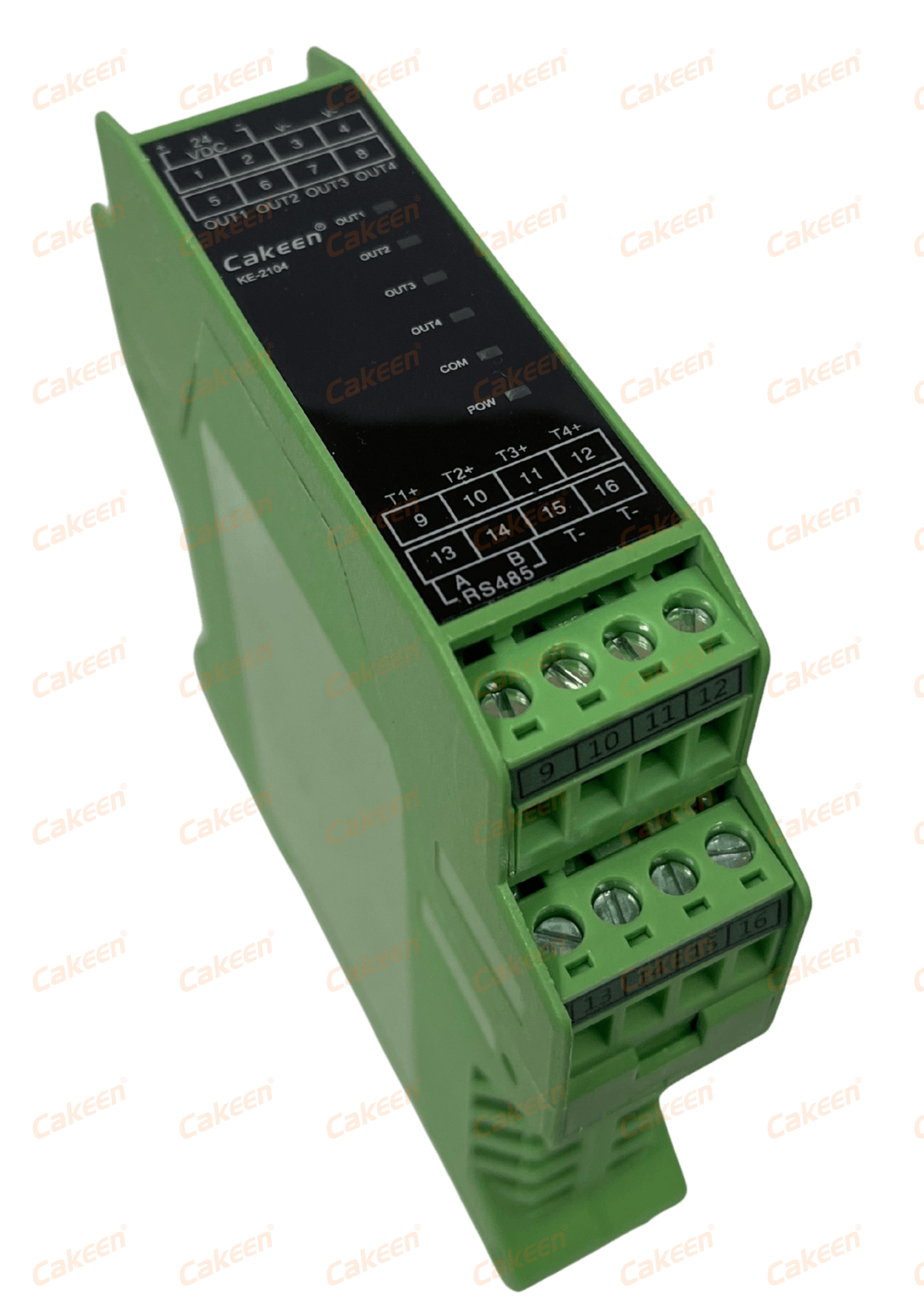
The KE-2104 is a DIN rail mount 4-channel PID temperature controller with ±0.1 °C control accuracy. It accepts PT, K, J, R, S, T, B, E, N and L inputs, drives an external SSR, runs on a 12–24 VDC supply, and mounts on DIN35 rail in a flame-retardant engineering plastic housing.
Three layout consequences follow directly from that specification:
- The switching device lives outside the controller. An external SSR needs its own rail or wall position plus heat-sink clearance, and the load wiring terminates there rather than at the controller.
- Four channels share one module width. A multi-channel PID controller in DIN35 format consumes far less rail length than four equivalent single-loop instruments, which is the reason it appears most often in cabinets where loop count is growing but enclosure size is fixed.
- A DC supply has to be planned. The 12–24 VDC requirement means a DC rail, terminals and protection devices must be allocated in the layout, unlike AC-powered panel instruments.
A semiconductor equipment OEM building embedded temperature control into CVD, etching and diffusion equipment selected the KE-2104 specifically because its 4-channel DIN rail format saves cabinet space, while the compact KE-48 panel unit fits the equipment's own design envelope. That cooperation has run for more than four years at a rate of 50+ units per year, with consistent process temperature across all chambers reported as the outcome.
Panel Mounting: the KE-48 in Doors and Front Panels
The KE-48 is a 48×48 mm standard panel-mount temperature controller: single channel, ±0.1 °C accuracy, the same PT/K/J/R/S/T/B/E/N/L input range, with SSR, 0-20 mA, 4-20 mA or 0-10 V output, one RS485 port and a 100-265 V AC supply.
Its integration logic is the opposite of the DIN rail unit. The standardised 48×48 mm cut-out forces the designer to reserve door or front-panel real estate early, but it shortens sensor runs and keeps the loop visible to an operator standing at the machine. Analog output options extend the controller beyond resistive or SSR loads, which matters when the actuator is a proportional valve or a signal-driven power controller rather than a relay.
The practical trade-off in a mixed cabinet is simple: panel instruments for loops an operator adjusts, DIN rail modules for loops the cabinet manages.
Heating Tape, Heating Jacket and Heating Mantle Loops
Vessel and pipe heating is a distinct cabinet requirement because the load is a resistive heating element wrapped around hardware rather than a chamber. The ASH is a heating tape PID temperature controller designed for pipe and vessel insulation and heating control — the loop type behind most heating jacket and heating mantle installations on vessels. The H6625 is the mini-format variant for space-constrained installations, and the KE-H10 is the higher-current option.
All three share the same core specification: single channel, ±0.1 °C control accuracy, built-in SSR output, RS485/Modbus RTU communication and a 100-265 V AC supply. The differentiator is current: ASH and H6625 deliver up to 3 A, while the KE-H10 delivers up to 6 A.
Communication and Expansion Inside the Same Enclosure
Once a cabinet holds more than a few loops, the wiring problem shifts from power to data. Two DIN35 modules cover most of it.
- K42CE-D CMS Communication Module — 2× NPN I/O, 6× RS485 ports and 1× Ethernet port, supporting Modbus TCP/RTU on a 12–24 VDC supply with DIN35 mounting. It is intended for multi-485 device parameter setting, data acquisition and forwarding, and PLC replacement scenarios. It holds SEMI S2 certification number 220252 issued by SAFES under standard SEMI S2-0821 for the EU market, and CE certification number CEJS22011335967 issued by GTS under EN 55032:2015+A11:2020 and EN 55035:2017+A11:2020.
- K15DT-D I/O Expansion Module — 5 inputs and 5 NPN outputs on Modbus RTU, 12–24 VDC, DIN35 rail. It holds CE certification number CEJS22011335968 issued by GTS, compliant with EN 55032:2015+A11:2020 and EN 55035:2017+A11:2020 for the EU market.
At the supervisory level, the CMS Industrial Device Central Monitoring System is temperature monitoring and alarm management software supporting 10,000+ Modbus TCP devices with a 10-second real-time polling interval. It monitors PV/SV temperature, AL1/AL2 thresholds and TC BK sensors, and retains 365 days of time-series history in InfluxDB. For a cabinet with multiple PID loops, this is the layer that turns individual controllers into a monitored system.
The Cabinet Itself: General Purpose, JIS and European Builds
Controller selection and cabinet selection have to be made together, because the protection rating, voltage class and component mix of the housing determine what the controller can safely be wired into.
- General Purpose Electrical Control Cabinet — a flexible, customizable industrial cabinet built with Siemens, Mitsubishi, Omron and Schneider components, IP40–IP65 protection, 380 V/400 V (customizable) and optional UL certification, in carbon steel. Typical applications are general industrial automation, equipment retrofit and upgrade, and factory automation systems.
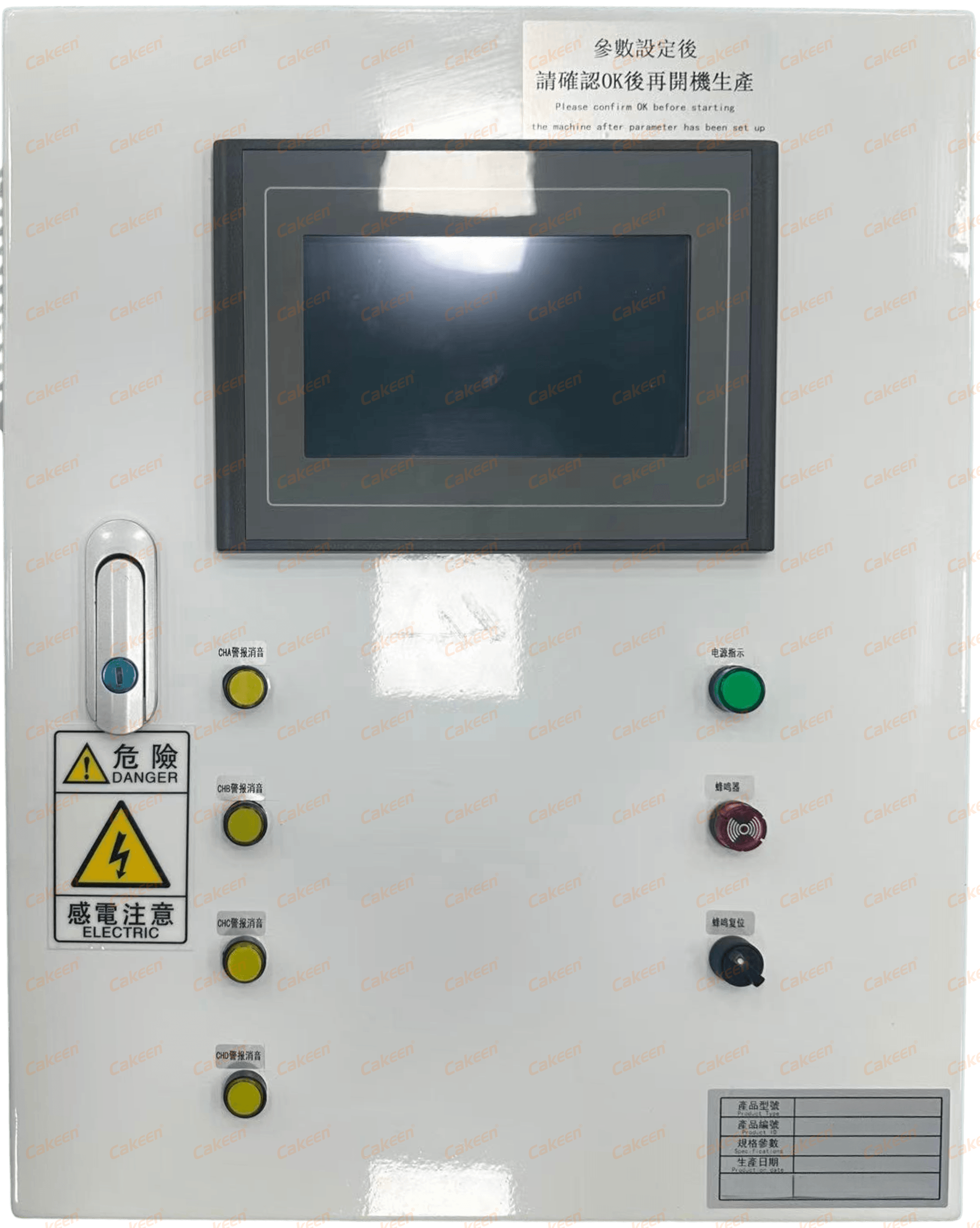
- Japanese Standard Electrical Cabinet — a JIS-compliant precision electrical control cabinet using Mitsubishi, Omron and Schneider components, IP54/IP65 protection, 200 V/400 V, optional UL certification, in carbon steel. It is aimed at precision machinery control, semiconductor equipment and robotic systems.
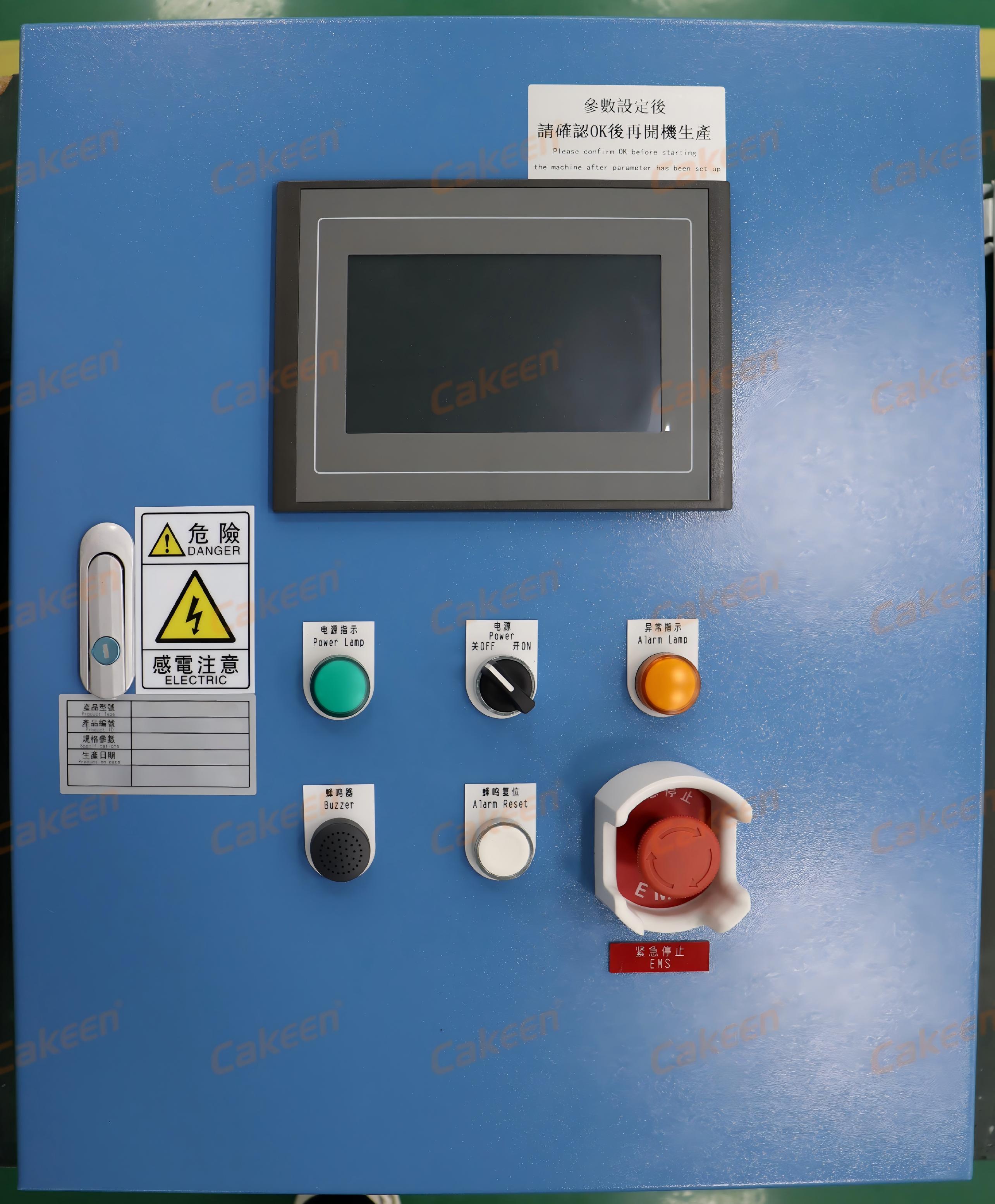
- European Standard Electrical Cabinet — a CE-certified industrial control cabinet that is TÜV Rheinland certified, built with ABB, Siemens and Schneider components, IP54/IP65 protection, 380 V/400 V three-phase (customizable), with CE, IEC and optional UL certification. Applications include industrial automation equipment, production line control and factory power distribution.
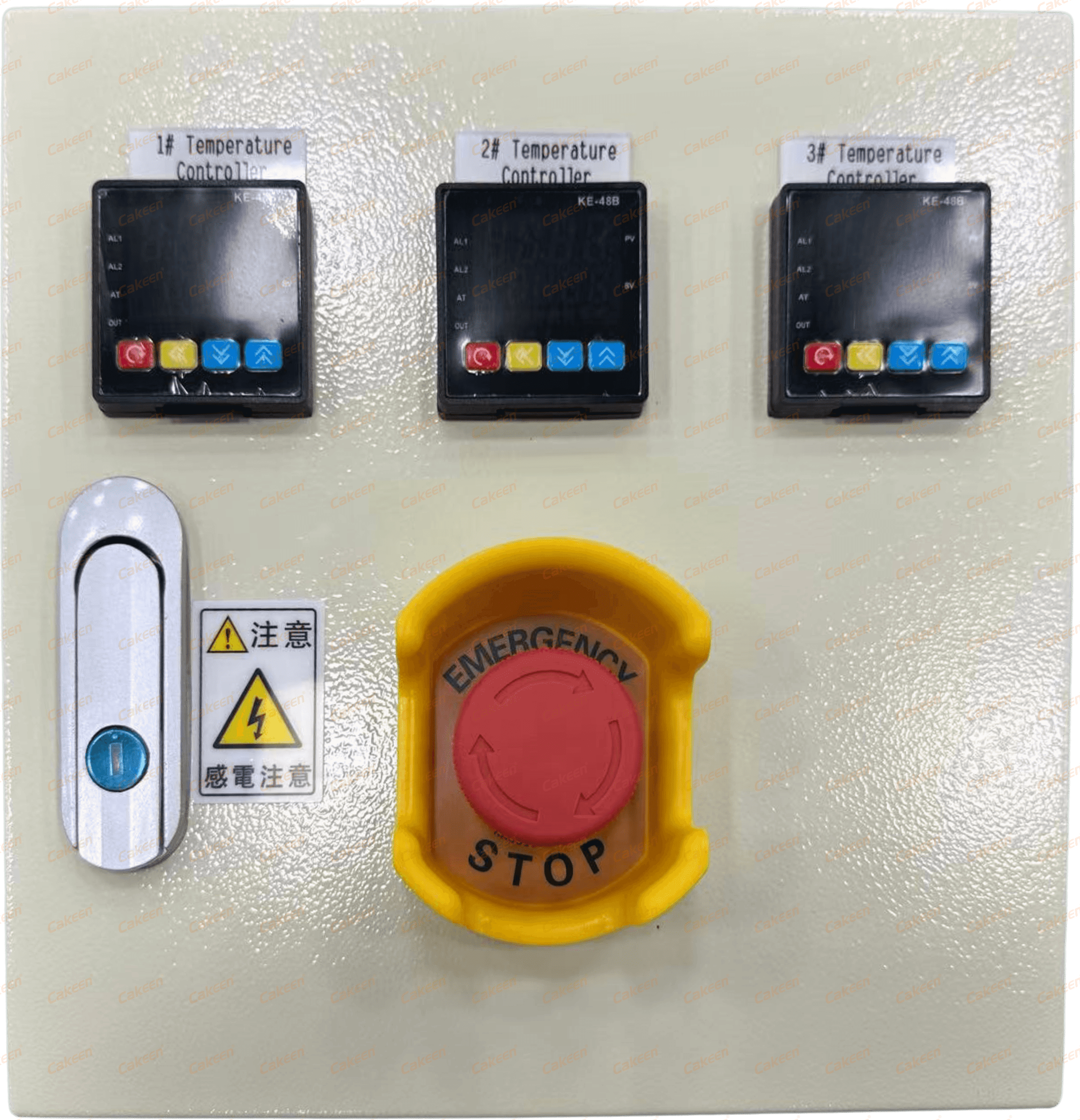
Two engineering services connect the cabinet to the controller layer. The Electrical Drawing Design Service produces semiconductor equipment electrical drawings compliant with IEC and UL508A, delivered as DWG, PDF and BOM Excel with a 2–4 week design cycle in Chinese and English. The PLC Control Program Design Service develops semiconductor equipment automation programs for Siemens S7-1200/1500, Mitsubishi Q/L series and Omron NJ/NX platforms over Modbus TCP and Modbus RTU, delivered with documentation and executable files.
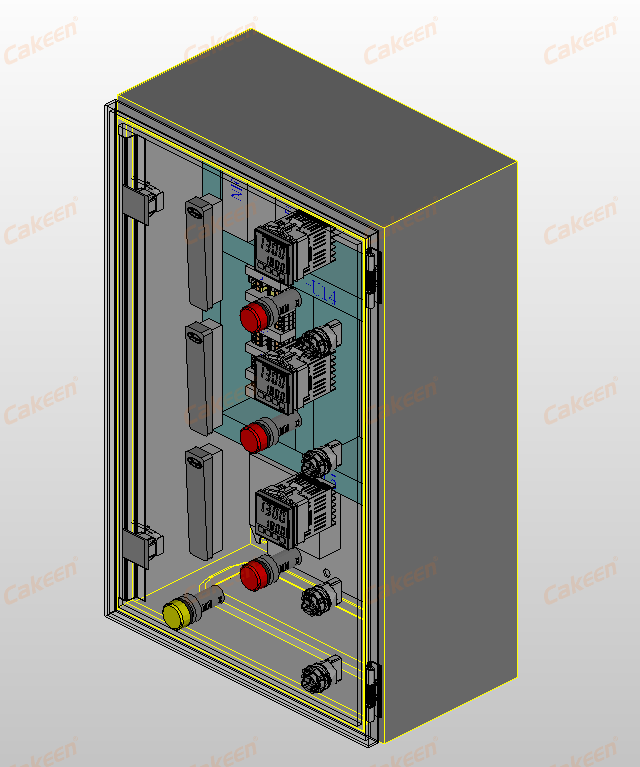
Step-by-Step: Integrating a PID Controller Into a Cabinet Build
- Count the loops and set the channel budget. Decide how many temperature points need closed-loop control versus monitoring only. Four zones on one DIN module is a different cabinet from four single-loop panel instruments, in both rail length and terminal count.
- Fix the cabinet standard before the layout. A JIS cabinet running a 200 V/400 V class and an IP54/IP65 enclosure follows different spacing and component conventions than a general purpose IP40–IP65 build. Settling this first prevents rework at drawing approval.
- Allocate rail space and panel cut-outs. Reserve rail for the controller, its external SSR where applicable, the DC supply, and the communication modules. Reserve door or front-panel cut-outs (48×48 mm for the KE-48) if operators need direct access.
- Select the controller form factor against the layout. DIN rail (KE-2104, K42CE-D, K15DT-D) for cabinet-managed loops; panel mount (KE-48) for operator-facing loops; heating tape controllers (ASH, H6625, KE-H10) for pipe and vessel insulation loops, with the 3 A or 6 A output limit checked against the load.
- Plan the power rails separately. The KE-2104 needs 12–24 VDC; the KE-48, ASH, H6625 and KE-H10 run on 100-265 V AC. Mixing supply classes changes terminal blocks, fusing and separation requirements.
- Route wiring by signal class, not by convenience. Keep thermocouple and RTD leads away from mains and SSR load conductors, terminate shields at one end, and run RS485 as a daisy chain rather than a star. Sensor type must match the controller input range (PT, K, J, R, S, T, B, E, N, L).
- Add the communication and I/O layer. Use the K42CE-D for multi-485 aggregation over Modbus TCP/RTU and the K15DT-D for remote switching I/O, both on DIN35 rail with 12–24 VDC supply.
- Close the loop with drawings, programming and test. Electrical drawings, PLC programming and cabinet assembly can be delivered as one package; Cakeen's published production profile specifies 100% test and remote after-sales support, with OEM/ODM customization covering parameters, logo and appearance.
Use Cases
Semiconductor Nitrogen Pipeline Heating
Nitrogen lines need pipe-wall heating to prevent condensation and to hold a stable gas temperature. The HOT-GUN pipeline N2 heating controller operates from 0 to 250 °C with ±1 °C control accuracy on AC 220 V with 800 W–1600 W heating power, while the HOT N2 MFC gas flow controller delivers ±1% F.S. flow accuracy over 1–100 SLM. Where a heating tape is used on the same pipeline, the KE-H10 provides single-channel control at up to 6 A with RS485/Modbus RTU, and the KE-2104 handles multi-point measurement inside the same cabinet.
Heating Jacket and Heating Mantle Loops on Vessels
Jacket and mantle heating on vessels follows the same pattern as pipe insulation: a resistive element, a surface or immersion sensor, and a requirement to hold temperature without overshoot. The ASH, designed for pipe and vessel insulation and heating control, covers standard loads at up to 3 A; the mini-format H6625 fits installations where cabinet or enclosure space is tight; the KE-H10 covers higher-current loops. All three provide ±0.1 °C control accuracy and Modbus RTU communication, so the same cabinet can hold several loops with different current ratings.
Multi-Zone Cabinet With Central Monitoring
When a cabinet carries dozens of loops, the operating requirement shifts from control to visibility. Pairing DIN rail controllers with the K42CE-D communication module and the CMS platform allows monitoring of 10,000+ Modbus TCP devices on a 10-second polling cycle, with PV/SV values, AL1/AL2 thresholds and TC BK sensor data retained for 365 days. That architecture is relevant to temperature-sensitive production where an excursion needs to be traceable to a specific loop.
Case: Semiconductor Equipment OEM
A semiconductor equipment OEM has embedded Cakeen temperature control in processing equipment for more than four years at 50+ units per year. The KE-48's compact 48×48 mm panel format fits the equipment's own design envelope, and the KE-2104's 4-channel DIN rail format saves cabinet space. The reported outcome is improved equipment uptime with consistent process temperature across all chambers.
Case: Domestic Equipment Integrator
A domestic equipment integrator has purchased 100+ cabinet sets per year for more than five years for factory automation and retrofit projects, using multi-PLC brand support across Siemens, Mitsubishi and Omron, with IP40–IP65 configurable protection and quick customization turnaround. The reported result is a 40% shortening of the customer delivery cycle and a high repeat order rate.
Comparison Table
Table 1 compares the three cabinet standards a PID controller may be integrated into. All values below are drawn from published product specifications.
| Cabinet Standard | Positioning | Typical Components | Protection | Voltage | Certification | Typical Industries |
|---|---|---|---|---|---|---|
| General Purpose Electrical Control Cabinet | Flexible, customizable industrial cabinet | Siemens, Mitsubishi, Omron, Schneider | IP40–IP65 | 380 V/400 V, customizable | UL optional | General industrial automation; equipment retrofit & upgrade; factory automation |
| Japanese Standard Electrical Cabinet | JIS-compliant precision cabinet | Mitsubishi, Omron, Schneider | IP54/IP65 | 200 V/400 V | UL optional | Precision machinery control; semiconductor equipment; robotic systems |
| European Standard Electrical Cabinet | CE-certified industrial cabinet (TÜV Rheinland certified) | ABB, Siemens, Schneider | IP54/IP65 | 380 V/400 V 3-phase, customizable | CE, IEC, UL optional | Industrial automation equipment; production line control; factory power distribution |
Table 2 compares the controller form factors that go inside those cabinets.
| Model | Mounting | Channels | Accuracy | Inputs | Output | Supply |
|---|---|---|---|---|---|---|
| KE-2104 | DIN35 rail | 4 | ±0.1 °C | PT/K/J/R/S/T/B/E/N/L | External SSR | 12–24 VDC |
| KE-48 | Panel mount 48×48 mm | 1 | ±0.1 °C | PT/K/J/R/S/T/B/E/N/L | SSR / 0-20 mA / 4-20 mA / 0-10 V, 1× RS485 | 100-265 V AC |
| ASH | Heating tape / vessel loop | 1 | ±0.1 °C | PT/K/J/R/S/T/B/E/N/L | Built-in SSR, max 3 A, RS485/Modbus RTU | 100-265 V AC |
| H6625 | Mini heating tape / vessel loop | 1 | ±0.1 °C | PT/K/J/R/S/T/B/E/N/L | Built-in SSR, max 3 A, RS485/Modbus RTU | 100-265 V AC |
| KE-H10 | Heating tape / vessel loop | 1 | ±0.1 °C | PT/K/J/R/S/T/B/E/N/L | Built-in SSR, max 6 A, RS485/Modbus RTU | 100-265 V AC |
Frequently Asked Questions
1. What certifications should a PID temperature controller and its cabinet carry for EU or North American markets?
Two layers apply. At panel level, industrial control panels including PID controllers must comply with UL 508A for North American safety listing and IEC 60947 for international markets (UL Solutions). At component level, Cakeen's CMS Communication Module K42CE-D holds SEMI S2 certification number 220252 issued by SAFES under SEMI S2-0821 for the EU market, and CE certification number CEJS22011335967 issued by GTS under EN 55032:2015+A11:2020 and EN 55035:2017+A11:2020; the K15DT-D I/O Expansion Module holds CE certification number CEJS22011335968 from GTS under the same two standards. Through the company, products are covered by ISO9001, ISO14001 and ISO45001 management system certifications plus UL, SEMI S2, CE and RoHS international certifications, and the European Standard Electrical Cabinet is CE-certified and TÜV Rheinland certified.
2. Can one DIN rail controller replace several panel-mount units in a multi-zone cabinet?
For control density, yes. The KE-2104 places four channels of ±0.1 °C PID control on a single DIN35 module with PT/K/J/R/S/T/B/E/N/L inputs on a 12–24 VDC supply, which is why it was chosen in a semiconductor equipment build specifically to save cabinet space. It is not a like-for-like replacement in every case: the KE-2104 drives an external SSR and requires a DC supply, while the single-channel KE-48 runs directly on 100-265 V AC and offers SSR, 0-20 mA, 4-20 mA or 0-10 V outputs with one RS485 port on a 48×48 mm front-panel cut-out. Most well-planned cabinets use both — DIN rail modules for loops the cabinet manages, panel units for loops an operator adjusts.
3. What drives the cost of a PID-controlled cabinet build?
Cost sits in the configuration choices rather than in the instrument alone. The main drivers are: channel count and whether loops are consolidated on a multi-channel module or built as single-loop panel instruments; output architecture (external SSR and its heat-sink allowance versus built-in SSR with a 3 A or 6 A ceiling); whether 12–24 VDC or 100-265 V AC supplies are needed, since mixed supply classes add terminals, fusing and separation; communication and I/O modules such as the K42CE-D (6× RS485, 1× Ethernet) or K15DT-D (5 inputs / 5 NPN outputs); enclosure protection and component mix, which differ between the IP40–IP65 general purpose cabinet and the IP54/IP65 JIS or European builds; optional certification scope such as UL; and engineering hours for electrical drawings or PLC programming. Comparing quotes without normalising these variables usually produces the wrong conclusion.
4. How should a buyer validate a PID controller before committing to cabinet production?
Validation follows the same order as the cabinet layout. First confirm the mechanical interface — DIN35 rail for the KE-2104, K42CE-D and K15DT-D, or a 48×48 mm panel cut-out for the KE-48. Second confirm electrical compatibility: sensor type against the PT/K/J/R/S/T/B/E/N/L input range, output type against the actual load, and supply voltage (12–24 VDC versus 100-265 V AC). Third confirm communication, since Modbus RTU over RS485 is shared across the KE-48, ASH, H6625 and KE-H10. Fourth verify the load current against the built-in SSR limits of 3 A or 6 A. Because customization is available across parameters, logo and appearance under Cakeen's OEM/ODM production profile, and every unit is 100% tested before shipment, buyers can request a configuration discussion and a quotation matched to the intended cabinet standard. Contact the team at jwy@wxkeen.com or +86 18921139517 with the loop list and cabinet drawing to start that process.
5. What lead time and MOQ should be planned for?
Cakeen's published production data lists OEM/ODM lead times of 30–45 days. Minimum order quantity depends on the production line: 5 units on one line and 500 units on another, with monthly capacity of 80 units on one line and 40,000 units on another. Export coverage spans Spain, Southeast Asia, the EU and the USA, and after-sales support is provided remotely. For cabinet-side engineering services, the electrical drawing design cycle is listed at 2–4 weeks.
Conclusion
Integrating a PID temperature controller into an electrical cabinet is a constraint-management exercise. The controller's ±0.1 °C accuracy is only as good as the space it is given, the rail it is mounted on, the separation of its sensor wiring, and the compliance scope of the enclosure it lives in. Deciding form factor before layout — DIN rail for dense multi-loop cabinets, panel mount for operator-facing loops, heating tape controllers for pipe and vessel insulation — removes most of the rework that otherwise appears during wiring.
The remaining risk is supplier fragmentation: one vendor for controllers, another for the cabinet, a third for drawings and programming. Sourcing both the controller and the cabinet from the same manufacturer keeps the mounting, wiring, voltage and certification decisions consistent, which is the position Cakeen occupies with a product range that spans PID temperature controllers, DIN rail communication and I/O modules, monitoring software, and general purpose, JIS and European standard cabinets.
Discuss your cabinet build with Cakeen
Send the loop count, the cabinet standard you are building to (general purpose, JIS, or European), and your sensor and load details. The team will confirm controller form factor, channel configuration, communication modules, and cabinet options in one quotation.
Email: jwy@wxkeen.com
Tel: +86-0510-85161878 / +86-18921139517
WhatsApp: +86 18921139517
Website: www.wxkeen.com