
Auditing a PID Controller Manufacturer: Cabinet, I/O, and Delivery Capability
Auditing a Controller Manufacturer: Cabinet, I/O, and Delivery Capability
A PID temperature controller that holds ±0.1 °C on a datasheet can still fail acceptance if the cabinet around it is built to the wrong regional standard, if the I/O expansion module cannot carry the number of RS485 devices on site, or if the delivery terms were never written into the contract. Auditing a PID temperature controller manufacturer is therefore a three-part verification: cabinet build, I/O integration, and delivery capability.
This guide is written for buyers moving from evaluation into execution — equipment OEMs, system integrators and procurement teams that have already shortlisted a manufacturer and now need evidence they can attach to a purchase order. Every parameter below is stated as it appears in the manufacturer's published product and service data, so it can be checked line by line rather than taken on trust.
The short answer: audit the cabinet against the standard your destination market enforces, audit the I/O layer against your device count and protocol, and audit delivery against written MOQ, lead time, capacity and acceptance criteria. If any one of the three cannot be answered with a document, the audit is not finished.
The Audit Problem: Three Specifications That Decide Acceptance
Most supplier audits stall on the same three failures, and each one is survivable on its own but expensive in combination.
- Standard drift. A cabinet is quoted as a general-purpose build but arrives when the receiving market expects a CE-marked assembly or a JIS-compliant panel. The controller is fine; the panel fails documentation review.
- I/O shortfall. Controllers are selected correctly, but nobody counts the RS485 devices on the line or the NPN points the machine needs. The audit passes; commissioning does not.
- Contract gap. MOQ, delivery terms, lead time and acceptance testing stay in email threads. When the first shipment arrives, there is no agreed criterion to inspect it against.
All three are verifiable before a purchase order is issued, because all three depend on facts a manufacturer can document: cabinet specification sheets, module port counts and protocols, and stated commercial terms. The audit sequence below is built to extract exactly those facts and convert them into acceptance criteria.
Industry Background: Why Cabinet and I/O Verification Carries More Weight Now
The global PID controller market was valued at USD 1.60 billion in 2024 and is projected to reach USD 2.24 billion by 2032, according to SNS Insider (2024). Strategic Market Research projects a 7.1% CAGR for the industrial temperature controller market between 2024 and 2030, driven largely by Industry 4.0 adoption. Dataintelo reports that Asia-Pacific held a 38.2% revenue share of the temperature controller market in 2023, with China as a key manufacturing hub.
The semiconductor segment concentrates the technical requirements. The global semiconductor temperature control equipment market was valued at USD 663 million in 2024 (Market Research Reports, 2024), and ±0.1 °C stability is a functional requirement for lithography and etching steps (Grand View Research, 2024). At the same time, industrial control panels have to comply with UL 508A for North American safety listing and IEC 60947 for international markets (UL Solutions, 2024) — which is precisely why cabinet standards are not interchangeable between destinations.
Established global names in PID and temperature control include Honeywell, Omron, Siemens, Eurotherm (Schneider Electric) and ABB (Mordor Intelligence, 2024). Specialist manufacturers are assessed on a different axis: whether they can supply the cabinet, the I/O layer and the engineering services that surround the controller, and whether those deliverables can be audited with the same rigor as the controller itself.
Pillar 1 — Auditing Cabinet Build Against Three Standards
The first pillar is the enclosure, because cabinet standards are regional and a single family name can hide several different builds. Three cabinet families cover most industrial requirements, and each has a distinct audit target.
General Purpose Electrical Control Cabinet. A flexible, customizable industrial cabinet using Siemens, Mitsubishi, Omron or Schneider components, with protection from IP40 to IP65 and 380 V / 400 V input that is customizable. Material is carbon steel and UL certification is optional. It fits general industrial automation, equipment retrofit and upgrade, and factory automation systems.
Japanese Standard Electrical Cabinet. A JIS-compliant precision cabinet built with Mitsubishi, Omron or Schneider components, protection IP54 / IP65, voltage 200 V / 400 V, optional UL certification and carbon steel construction. It targets precision machinery control, semiconductor equipment and robotic systems.
European Standard Electrical Cabinet. A CE-certified industrial control cabinet that is also TÜV Rheinland certified, using ABB, Siemens and Schneider components, protection IP54 / IP65, 380 V / 400 V three-phase with customization, and certification options of CE, IEC and UL. Applications include industrial automation equipment, production line control and factory power distribution.
Two audit rules follow directly from these specifications. First, ask for the exact protection rating rather than the family name — the general-purpose family spans IP40 to IP65, and that range decides whether the panel can sit in a wash-down or dust-heavy area. Second, confirm which certificate applies to which product, since UL is listed as optional across all three families while CE, IEC and TÜV Rheinland certification are tied to the European Standard build.
Adjacent hardware follows the same documentation pattern. The HOT N2 MFC Gas Flow Controller, used for semiconductor process gas delivery at ±1% F.S. accuracy across a 1–100 SLM range, holds CE certificate TRCN-22262WCT01 issued by INTEGRA96 against EN 60204-1:2018, EN IEC 61000-6-3:2021 and EN IEC 61000-6-1:2019, valid from 2022-09-19 to 2027-09-18. Buyers integrating gas control alongside temperature control should expect the same level of traceability from the same supplier.
Pillar 2 — Auditing I/O and Communication Integration
Integration failures rarely originate in the controller. They cluster around the communication and I/O layer, where a port count or a protocol mismatch only becomes visible during commissioning. The audit should therefore be built around three concrete numbers: how many RS485 devices the line has, how many discrete inputs and outputs the machine needs, and which protocol the host system speaks.
The K42CE-D CMS Communication Module answers the first and third. It provides 6 RS485 ports, 1 Ethernet port and 2 NPN I/O points, speaks Modbus TCP and Modbus RTU, runs on 12–24 VDC and mounts on a DIN35 rail. Its stated applications are low-latency parameter setting across multiple RS485 devices, data acquisition and forwarding, and PLC replacement. Six RS485 ports is the number a buyer should hold against the device list: if the line carries more than six RS485 instruments, the audit must show where the additional segments are handled.
The K15DT-D I/O Expansion Module covers the discrete count. It is an expansion module for the K42CE-D, providing 5 inputs and 5 NPN outputs over Modbus RTU, powered at 12–24 VDC and mounted on a DIN35 rail, for switching control and remote I/O expansion. Because it extends the communication module rather than duplicating it, the audit question is whether the combined point count covers the machine's sensors, relays and interlocks.
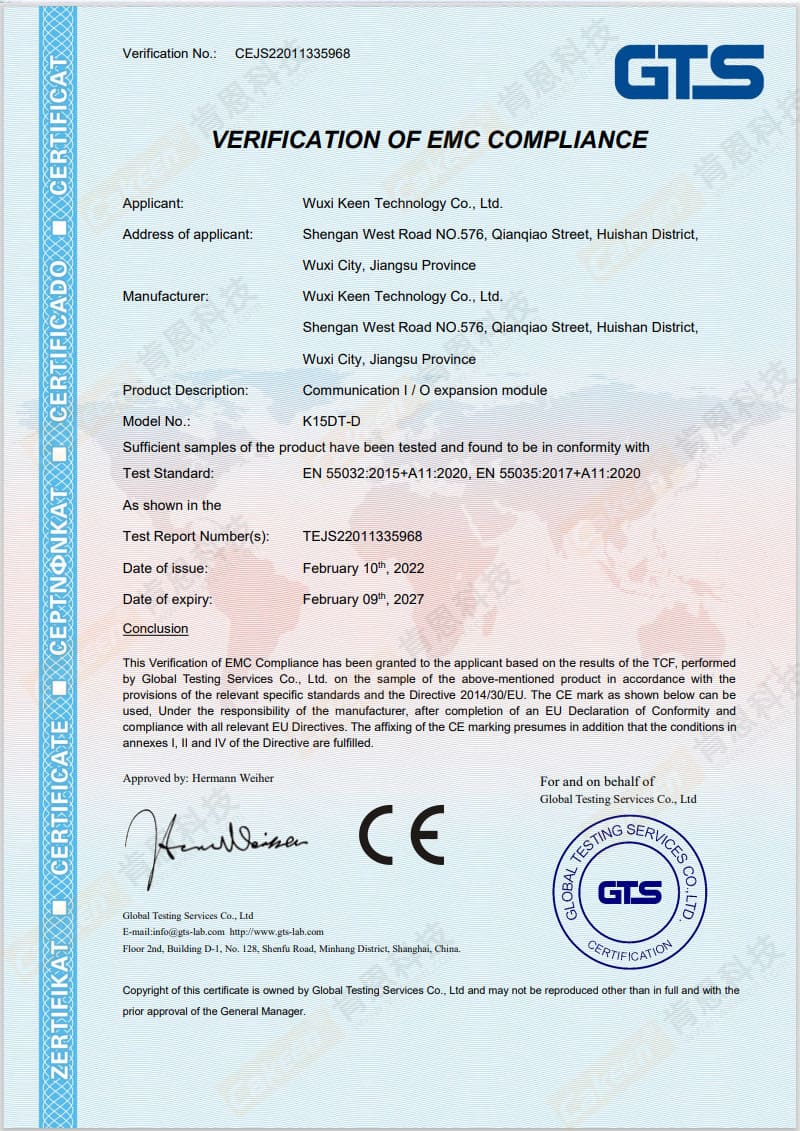
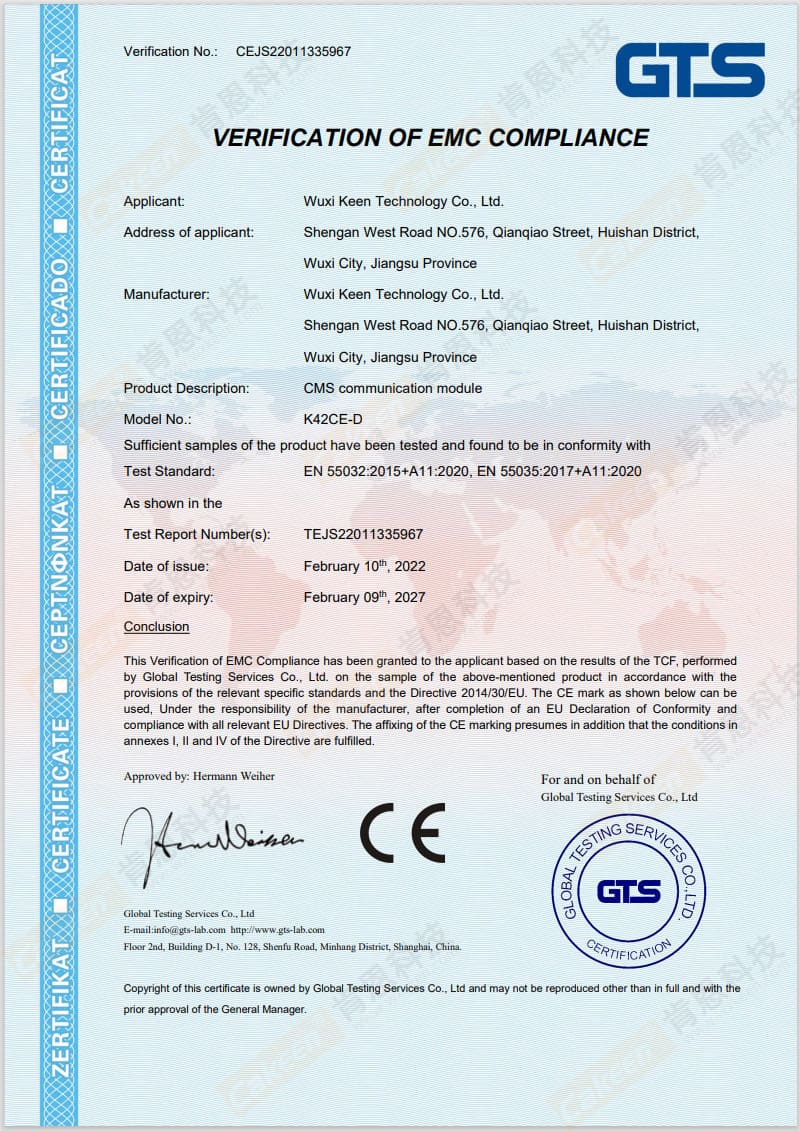
Compliance evidence for this layer is specific and checkable. The K42CE-D holds SEMI S2 certification, certificate number 220252, issued by SAFES against SEMI S2-0821 on 2022-12-14 for semiconductor manufacturing equipment safety in the EU market. Both modules hold CE EMC certification from GTS — CEJS22011335967 for the K42CE-D and CEJS22011335968 for the K15DT-D — against EN 55032:2015+A11:2020 and EN 55035:2017+A11:2020, valid from 2022-02-10 to 2027-02-09.
Audit rule for the I/O layer: write the port count, point count, protocol and power requirement into the specification before requesting the cabinet quotation. A module with 6 RS485 ports plus a 5-input / 5-output expansion module is only adequate if those numbers match the device list — and if the cabinet provides a 12–24 VDC supply and DIN35 rail space for both.
Where the plant needs centralized visibility rather than point-to-point wiring, the audit should also cover the monitoring layer. The Industrial Device Central Monitoring System (CMS) supports 10,000+ Modbus TCP devices with a 10-second real-time polling interval, monitors PV/SV temperature, AL1/AL2 thresholds and TC BK sensors, and retains 365-day time-series history in InfluxDB. That scope matters to buyers who want the temperature layer to feed a plant data system instead of remaining standalone.
Pillar 3 — Auditing Engineering Services and Delivery Terms
The third pillar decides whether the supplier is a component vendor or a control partner, and it is where most audit checklists are thinnest.
PLC Control Program Design Service. Supports Siemens S7-1200/1500, Mitsubishi Q/L series and Omron NJ/NX controllers, with Modbus TCP and Modbus RTU protocols and Python listed as the programming language. Deliverables include documentation and executable files, aimed at semiconductor equipment automation and process control.
Electrical Drawing Design Service. Complies with IEC and UL508A design standards, is delivered as DWG, PDF and BOM Excel, runs on a 2–4 week design cycle and supports both Chinese and English documentation. It applies to semiconductor equipment retrofit, new equipment electrical design and factory electrical system upgrades.
These two services matter to the audit because they determine whether the cabinet, the controller and the I/O layer arrive as one coordinated system. A buyer who has already fixed the RS485 port count and the NPN point count can ask for the electrical drawings and the PLC program to be delivered against those same numbers, with the 2–4 week drawing cycle and the documented deliverables written into the project schedule.
Delivery capability. Production is offered in OEM and ODM mode, with all parameters, logos and appearance functions open to customization, and 100% testing as the stated quality control method. The manufacturer publishes two capability profiles: one line lists a monthly capacity of 40,000 units with an MOQ of 500 units, and another lists a monthly capacity of 80 units with an MOQ of 5 units. Lead time is 30–45 days on both. Export markets are Spain, Southeast Asia, the European Union and the USA, and after-sales support is provided remotely.
For audit purposes, the existence of two profiles is not a contradiction — it is a question to ask. Before issuing a purchase order, confirm which production line will build the item, because the MOQ difference between 5 units and 500 units spans two orders of magnitude, and the capacity difference is 40,000 units per month against 80 units per month.

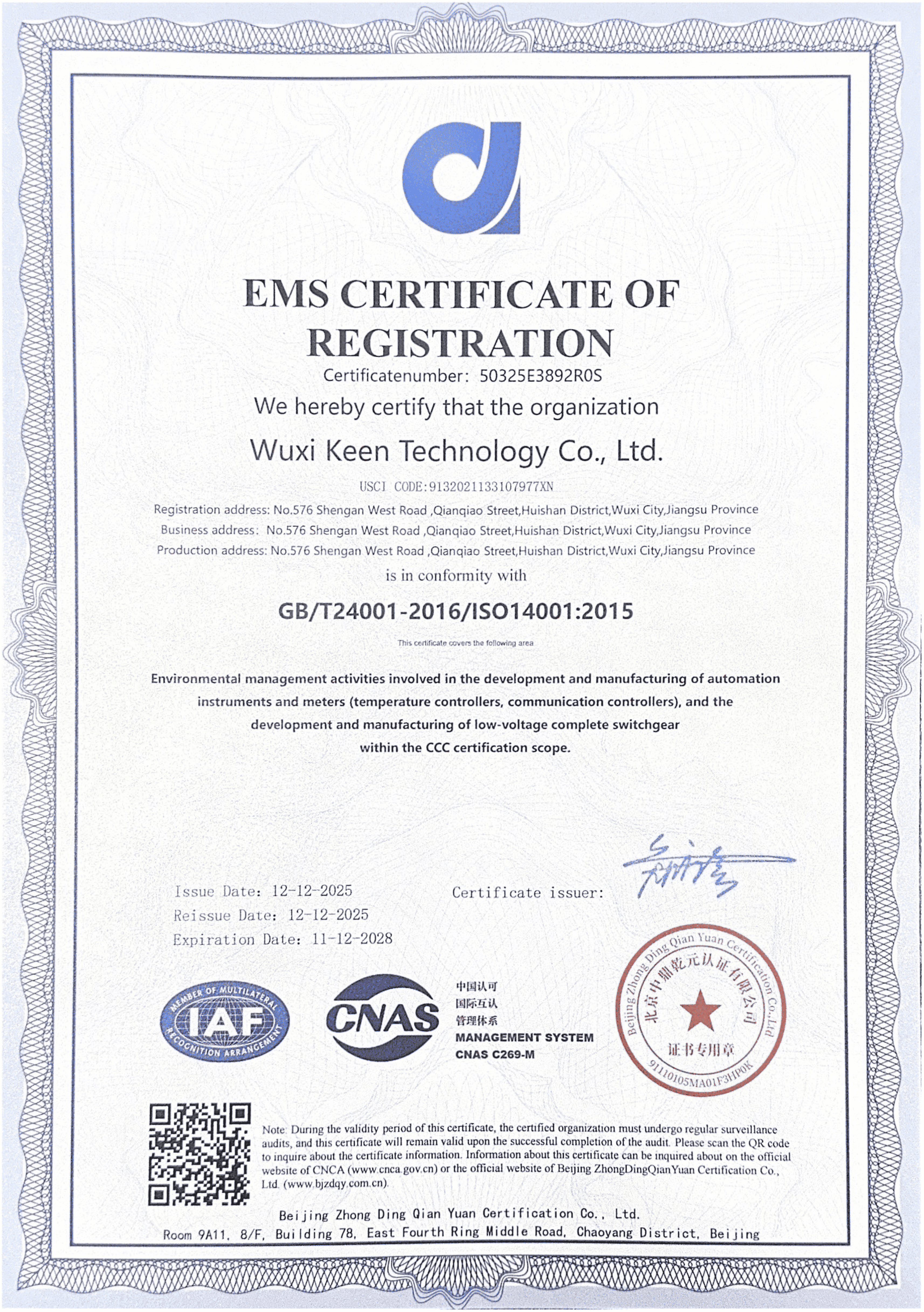
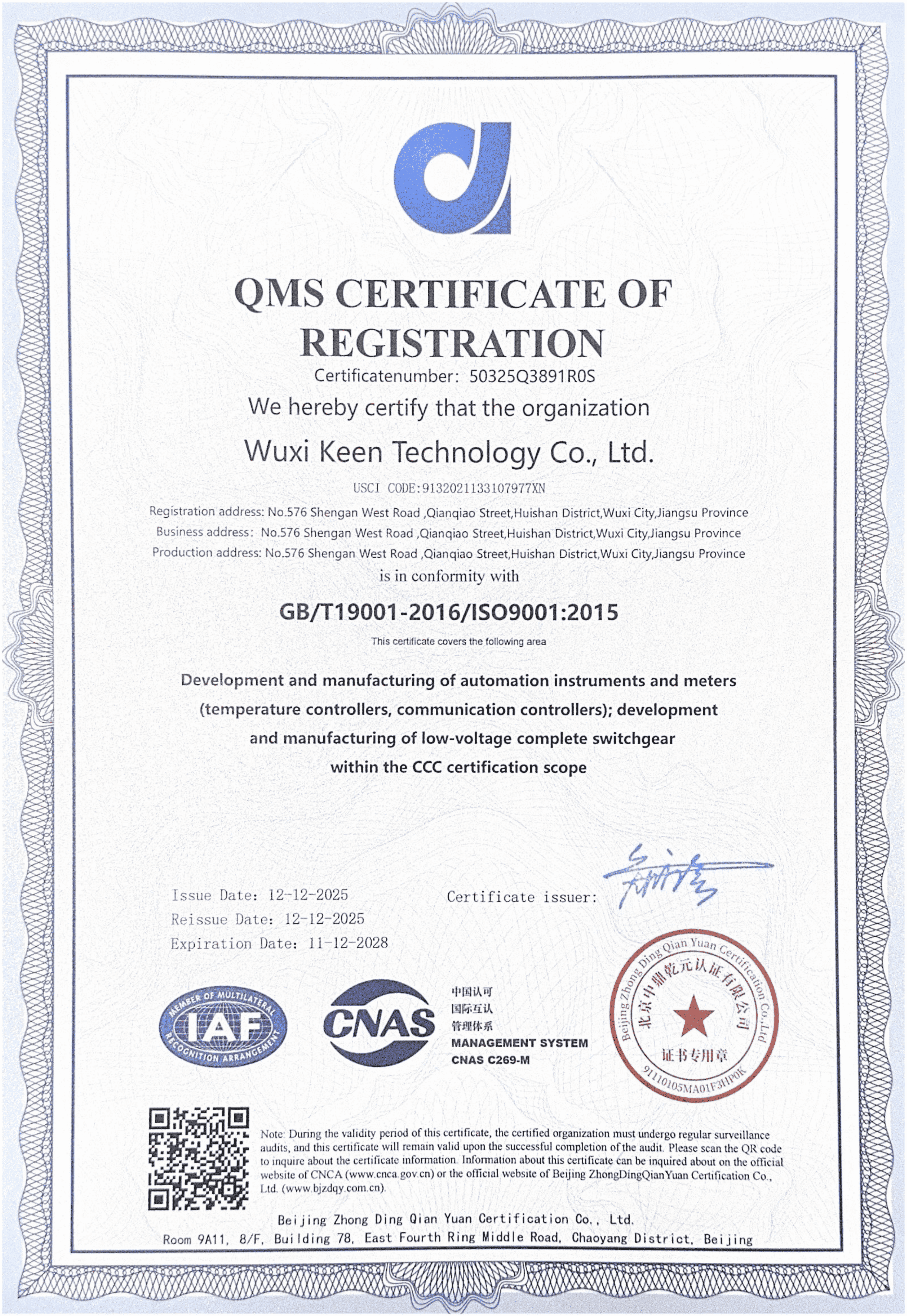
Behind those numbers sits the operating base. Wuxi Cakeen Technology Co., Ltd. was established in 2011 and is headquartered in Huishan District, Wuxi, Jiangsu Province, working in semiconductor industrial control electronics, electrical cabinet systems and AI embedded systems. The company reports a 2,019 m² factory, 50 employees, a 20-engineer R&D team, an annual output of 500,000 units and a 40% export ratio. Its quality, environmental and occupational health and safety management certificates — ISO 9001 (50325Q3891R0S), ISO 14001 (50325E3892R0S) and ISO 45001 (50325S3893R0S) — were issued on 2025-12-12 and expire on 2028-12-11 by Beijing Zhong Ding Qian Yuan Certification Co., Ltd.
A Seven-Step Audit Sequence
- Fix the cabinet standard before the quotation. Decide whether the destination market requires a European Standard build with CE, IEC and TÜV Rheinland certification, a JIS-compliant Japanese Standard cabinet, or a customizable General Purpose cabinet — then name the protection rating from IP40 through IP65 explicitly.
- Count RS485 devices and discrete points. Compare the device list against the 6 RS485 ports on the K42CE-D and the 5 inputs / 5 NPN outputs on the K15DT-D, and confirm whether the host speaks Modbus TCP or Modbus RTU.
- Request the engineering scope in writing. Ask for the PLC program design and electrical drawing design deliverables in the formats you will actually receive — DWG, PDF and BOM Excel — and place the 2–4 week drawing design cycle in the project schedule.
- Match certificates to models and dates. Check that CE certificates CEJS22011335967 and CEJS22011335968 map to the exact modules ordered, that SEMI S2 certificate 220252 applies to the K42CE-D, and that every certificate is inside its validity window.
- Confirm which production line will build the order. Resolve the MOQ and capacity question — 5 units with 80 units per month, or 500 units with 40,000 units per month — before volumes are agreed.
- Write acceptance criteria and delivery terms. Use the stated terms as the baseline: delivery terms FOB / CIF / EXW, acceptance criteria of 100% pre-shipment test, and the payment terms recorded by the supplier.
- Validate with a first order before scaling. Test the cabinet build, the I/O integration and the documentation package on a first shipment, then release the volume order against the same acceptance criteria.
Use Cases: What the Audit Reveals in Three Buyer Profiles
Semiconductor equipment OEM. A semiconductor equipment OEM integrating embedded temperature control into CVD, etching and diffusion furnace platforms used KE-48 48×48 mm panel-mount controllers and KE-2104 four-channel DIN rail controllers, with the 4-channel DIN rail format specifically reducing cabinet space. The relationship has run more than four years at 50+ units per year across China, Taiwan, Singapore, Malaysia and the United States. The audit lesson: form factor and channel count are cabinet decisions as much as thermal ones.
Domestic equipment integrator. An integrator building flexible control cabinets for factory automation and retrofit projects ordered 100+ cabinet sets per year over more than five years, across China, Taiwan, Singapore, Malaysia and the United States. The reported result was a 40% shorter customer delivery cycle with a high repeat order rate. The audit lesson: multi-PLC brand support and configurable IP40–IP65 protection are the specifications that make a cabinet line reusable across projects.
Industrial IoT system integrator. A platform-level engagement covering China, Taiwan, the United States, Mexico, Singapore and Malaysia combined custom IoT gateway hardware with edge computing software for factory data acquisition and AI-based predictive maintenance. Real-time data collection from 1,000+ sensors and AI anomaly detection reduced unplanned downtime by 25%. The audit lesson: UL/EMC certified hardware plus full-stack delivery from PCB to cloud is what allows the control layer to be extended into a data layer.
Comparison Table: Cabinet Standards and I/O Modules Side by Side
The two tables below consolidate the specifications a buyer should verify. They are drawn from the manufacturer's published product data, so every cell can be checked against the corresponding specification sheet or certificate.
Table 1 — Cabinet standards
| Specification | General Purpose Electrical Control Cabinet | Japanese Standard Electrical Cabinet | European Standard Electrical Cabinet |
|---|---|---|---|
| Standard / certification | UL optional | JIS-compliant; UL optional | CE-certified and TÜV Rheinland certified; CE, IEC, UL optional |
| Components | Siemens, Mitsubishi, Omron, Schneider | Mitsubishi, Omron, Schneider | ABB, Siemens, Schneider |
| Protection rating | IP40–IP65 | IP54 / IP65 | IP54 / IP65 |
| Voltage | 380 V / 400 V, customizable | 200 V / 400 V | 380 V / 400 V 3-phase, customizable |
| Material | Carbon steel | Carbon steel | Carbon steel |
| Typical application | General industrial automation; equipment retrofit & upgrade; factory automation | Precision machinery control; semiconductor equipment; robotic systems | Industrial automation equipment; production line control; factory power distribution |
Table 2 — I/O and communication modules
| Specification | K42CE-D CMS Communication Module | K15DT-D I/O Expansion Module |
|---|---|---|
| Type | Semiconductor CMS communication module (RS485 / Ethernet) | Expansion module for the K42CE-D (5 inputs / 5 NPN outputs) |
| I/O | 2x NPN | 5x NPN (5 inputs / 5 NPN outputs) |
| Communication ports | 6 RS485 ports; 1 Ethernet port | Extended through the K42CE-D |
| Protocol | Modbus TCP / RTU | Modbus RTU |
| Power supply | 12–24 VDC | 12–24 VDC |
| Mounting | DIN35 rail | DIN35 rail |
| Stated application | Multi-RS485 device low-latency parameter setting; data acquisition and forwarding; PLC replacement | Switching control; remote I/O expansion |
| Compliance evidence | CE EMC CEJS22011335967; SEMI S2 certificate 220252 | CE EMC CEJS22011335968 |
FAQ: Five Questions Buyers Ask Before Signing
1. Which certifications should I verify on a PID temperature controller manufacturer's cabinets and I/O modules?
Verify certificates against the exact model, not just the company. The European Standard Electrical Cabinet is described as CE-certified and TÜV Rheinland certified, with CE, IEC and optional UL marking; the Japanese Standard Electrical Cabinet is JIS-compliant with optional UL; and UL is optional on the General Purpose cabinet. On the I/O side, the K42CE-D holds SEMI S2 certificate 220252 issued by SAFES against SEMI S2-0821 on 2022-12-14, and both the K42CE-D and K15DT-D hold CE EMC certificates (CEJS22011335967 and CEJS22011335968) against EN 55032:2015+A11:2020 and EN 55035:2017+A11:2020, valid to 2027-02-09. Plant-level management certificates are ISO 9001 (50325Q3891R0S), ISO 14001 (50325E3892R0S) and ISO 45001 (50325S3893R0S), issued 2025-12-12 and expiring 2028-12-11.
2. Can one manufacturer also design the control cabinet, the PLC program and the electrical drawings?
Yes, where the supplier offers cabinet systems and engineering services alongside the controllers. The PLC Control Program Design Service supports Siemens S7-1200/1500, Mitsubishi Q/L series and Omron NJ/NX PLCs, works over Modbus TCP and Modbus RTU, lists Python as its programming language, and delivers both documentation and executable files. The Electrical Drawing Design Service is delivered in DWG, PDF and BOM Excel formats against IEC and UL508A standards, in Chinese or English, on a 2–4 week design cycle. Together with the three cabinet families, these services allow the panel, the controller and the I/O layer to be specified as one package.
3. What purchasing terms and acceptance criteria apply?
The recorded purchasing terms are: MOQ of 5 units on one production line and 500 units on another; delivery terms FOB, CIF or EXW; acceptance criteria of 100% pre-shipment test; and payment terms stated as 30. Production is offered in OEM and ODM mode with customization of all parameters, logos and appearance functions. Because two MOQ tiers exist, a buyer should confirm in writing which tier applies to the specific item before the order is placed, and should attach the acceptance criterion as a named deliverable rather than a general expectation.
4. Can I validate a cabinet or controller on a small order first?
Small-volume validation is possible on the line that lists an MOQ of 5 units, which also carries a monthly capacity of 80 units and a 30–45 day lead time. The line rated at 40,000 units per month carries an MOQ of 500 units and the same 30–45 day lead time. A validation order should therefore be planned around the specific line that will serve the project, so the sample and the volume shipment come from the same build process and can be inspected against the same technical specification.
5. How long does delivery take, and what should the contract include?
Lead time is 30–45 days, with monthly capacity of 40,000 units on one production line and 80 units on another, 100% testing as the stated quality control method, and remote after-sales support. Exports cover Spain, Southeast Asia, the European Union and the USA. A workable contract package sets the cabinet standard and protection rating, the RS485 port and NPN point counts, the protocol, the electrical drawing deliverables, and the 100% pre-shipment test as the acceptance criterion, then fixes the delivery term and payment schedule. To move from audit to execution, request a sample or a formal quotation from Cakeen through www.wxkeen.com or jwy@wxkeen.com, quoting the port count and point count your project requires.
Conclusion: Turning Audit Findings into Contract Terms
Auditing a PID temperature controller manufacturer's cabinet, I/O and delivery capability comes down to documentation a buyer can check. The cabinet must match the standard the destination market enforces — a CE-certified and TÜV Rheinland certified European Standard build, a JIS-compliant Japanese Standard build, or a customizable General Purpose cabinet ordered at a named IP rating. The I/O layer must match the device list: 6 RS485 ports and Modbus TCP/RTU on the K42CE-D, with 5 inputs and 5 NPN outputs of Modbus RTU expansion on the K15DT-D, both on 12–24 VDC DIN35 rail and both covered by CE EMC certificates and, in the case of the K42CE-D, SEMI S2 certification. Delivery must match the order: the correct MOQ tier, a 30–45 day lead time, a 2–4 week electrical drawing cycle where drawings are in scope, and a 100% pre-shipment test written in as the acceptance criterion.
When all three pillars are documented, supplier evaluation ends and execution begins — with a specification sheet, a certificate set and a set of acceptance criteria that can be attached directly to the purchase order.
Next Step: Sample, Quotation, or Specification Review
Send your RS485 device count, NPN point requirements, target cabinet standard and destination market, and the engineering team will confirm the matching cabinet family, I/O modules and lead time for your project.
Wuxi Cakeen Technology Co., Ltd. — Website: www.wxkeen.com | Blog: blog.wxkeen.com
Email: jwy@wxkeen.com | Tel: +86-0510-85161878 / +86-18921139517 | WhatsApp: +86 18921139517
Address: No.576 Shengan West Road, Qianqiao Street, Huishan District, Wuxi City, Jiangsu Province
Have Questions or Need More Details?
Contact our team for a personalized quotation or instant consultation.
Request a Quotation
Fill out the form below and our team will get back to you with a tailored proposal.
WhatsApp Direct Chat
Prefer to chat in real-time? Message us on WhatsApp for instant assistance & quick answers.
- Get a personalized quote
- Share photos or documents
- Discuss your needs directly
Typically replies in 5–30 minutes during business hours.