
DIN Rail vs Panel Mount PID Controllers: A Cabinet Buyer's Guide
DIN Rail vs Panel Mount PID Controllers: A Cabinet Buyer's Guide
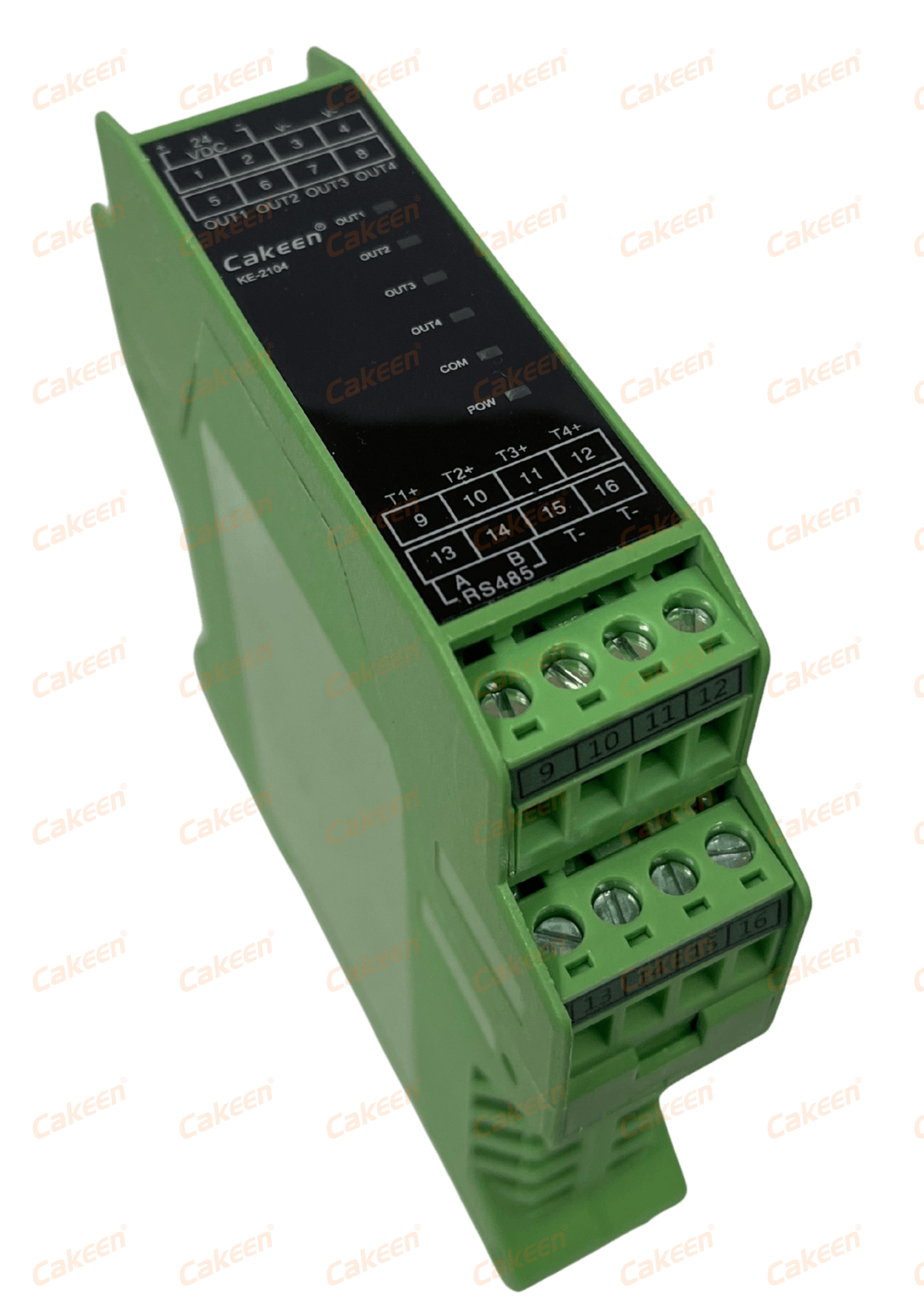
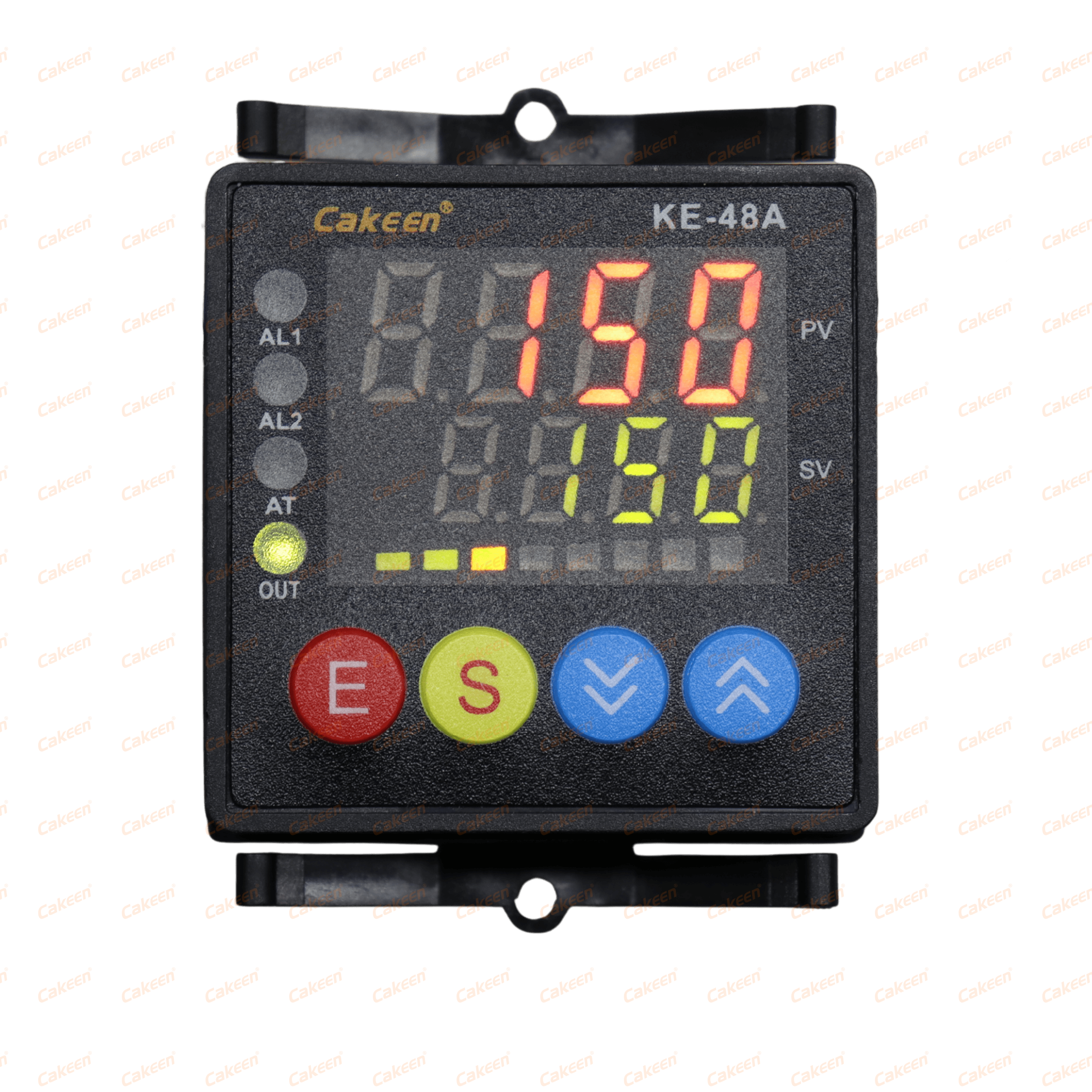
For a control cabinet buyer, the choice between DIN rail mount and panel mount PID temperature controllers is a cabinet-architecture decision rather than a controller-performance decision. Cakeen's DIN rail mount PID Temperature Controller (KE-2104) and panel mount PID Temperature Controller (KE-48) share the same measurement core: both are specified at ±0.1°C control accuracy, and both accept PT / K / J / R / S / T / B / E / N / L inputs. What changes is where the controller sits — on a DIN35 rail inside the enclosure, or behind a 48×48 mm cutout in the cabinet door.
The working rule: when a cabinet controls several temperature loops that are read remotely or through a monitoring system, DIN rail mount usually wins, because it concentrates control channels, I/O expansion and communication modules on one rail. When a cabinet controls one or two loops that an operator has to read and adjust at the door, panel mount wins, because it puts the display where the person stands.
The rest of this guide covers the layout, wiring, serviceability, monitoring and standards questions that decide which way a project should go.
The Form-Factor Decision, Stated Plainly
The problem is rarely which controller is better. It is that form factor gets chosen late — after the cabinet drawing is frozen — and the controller then has to fit a door cutout, a rail length, a wiring route or a monitoring path that was designed for something else. Most of the avoidable cost in a temperature-controlled cabinet appears at exactly that point.
The four failure modes cabinet buyers run into most often:
- A door is machined for 48×48 mm panel instruments before the loop count is final; the project later needs four loops, and the door has room for two.
- Controllers are selected for local reading, then the plant asks for centralized temperature monitoring and alarm history — and there is no communication path inside the enclosure.
- The DIN35 rail is filled with terminal blocks and power supplies, leaving no space for the I/O expansion or communication modules that would have simplified the wiring.
- The cabinet platform is matched to a regional standard after components are ordered, so the internal layout no longer fits the enclosure, the voltage scheme or the certification expectations.
Decision rule for control cabinets
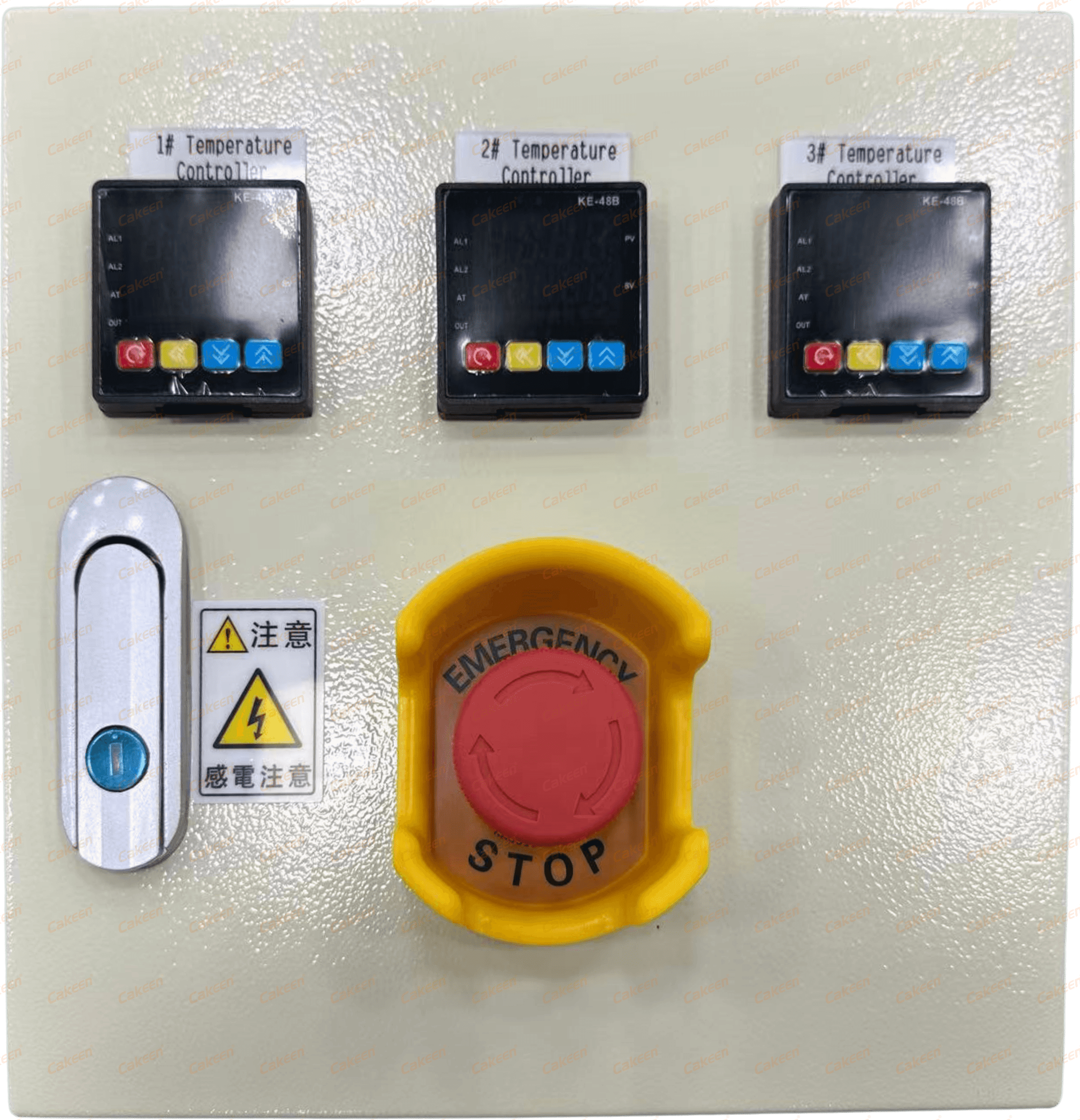
- One or two loops, read and adjusted at the door → panel mount (KE-48, single channel, 48×48 mm, 100–265 V AC).
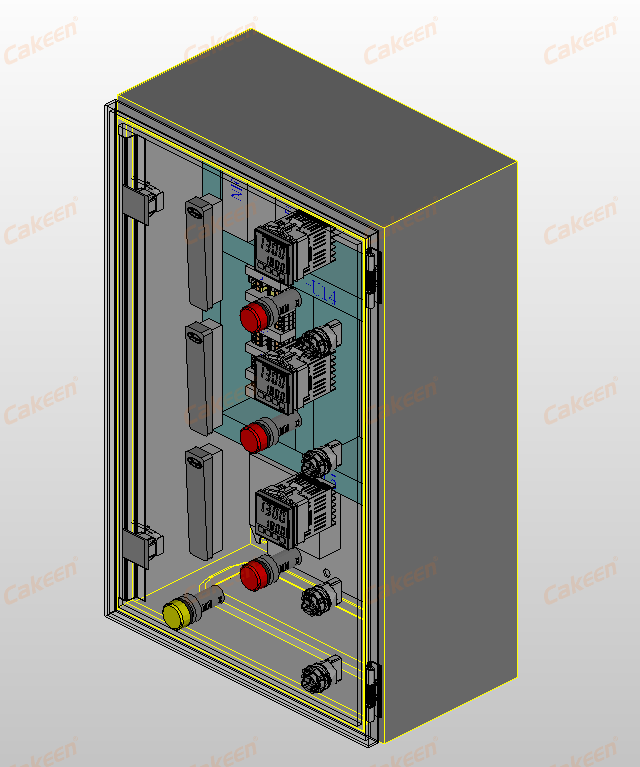
- Multiple loops aggregated inside the enclosure → DIN rail (KE-2104, four channels, DIN35 rail, 12–24 VDC).
- Any loop that must reach a monitoring system → plan the data path in the same drawing as the control path, alongside the I/O expansion and CMS communication modules.
Industry Background: Control Cabinets Are Becoming Networks
Two structural facts shape the DIN rail versus panel mount question today.
The first is that panel-level compliance is a design constraint rather than an afterthought. Industrial control panels, including the PID controllers mounted inside them, must comply with UL 508A for North American safety listing and IEC 60947 for international markets, as published by UL Solutions. Those requirements influence internal spacing, wiring practice, component selection and marking, which is why the cabinet platform and the controller form factor are usually decided together rather than one after the other.
The second is that the measurement core has stopped being the differentiator. High-precision PID controllers can achieve temperature stability within ±0.1°C, a level of precision that semiconductor lithography and etching processes rely on, according to Grand View Research. Because both Cakeen form factors specify ±0.1°C control accuracy, accuracy alone no longer decides how a controller is mounted. Layout, wiring access, serviceability and monitoring integration do.
Cakeen (Wuxi Keen Technology Co., Ltd.) is a Wuxi, Jiangsu-based manufacturer established in 2011 that develops semiconductor industrial control electronics, electrical cabinet systems and AI embedded systems, with an R&D team of 20 engineers, a 2,019 m² facility and exports to ES, SEA, EU and USA markets. Its range for this decision spans PID temperature controllers, DIN35-rail I/O and communication modules, monitoring software and three cabinet platforms built to different regional standards.
How the Two Form Factors Differ Inside a Cabinet
PID Temperature Controller (DIN Rail Mount) — KE-2104
KE-2104 is a DIN rail mount 4-channel PID controller. Each unit covers four control loops in one housing, at ±0.1°C control accuracy, with PT / K / J / R / S / T / B / E / N / L input types and external SSR output. Power supply is 12–24 VDC, mounting is on a DIN35 rail, and the housing is flame-retardant engineering plastic. Its applicable industries are temperature control systems and process monitoring.
For cabinet design this means three things: loop density is high relative to the panel area consumed; a 12–24 VDC supply has to be available inside the enclosure; and because switching is handled by an external SSR, heat-generating switching devices can be positioned away from the controller and closer to the load.
PID Temperature Controller (Panel Mount) — KE-48
KE-48 is a 48×48 mm standard panel-mount temperature controller. It is single channel, also at ±0.1°C, with the same PT / K / J / R / S / T / B / E / N / L input range. Outputs are SSR, 0-20 mA, 4-20 mA or 0-10 V; communication is one RS485 port; power supply is 100–265 V AC; mounting is a 48×48 mm panel cutout. It is likewise positioned for temperature control systems and process monitoring.
The practical consequences differ from the rail device: the operator reads and adjusts the loop directly; the analog output options allow the controller to drive actuators other than an SSR; the AC supply can be taken from panel distribution without adding a DC supply; and the RS485 port lets a single door-mounted loop join the same network as rail-mounted devices.
Rails, Expansion Modules and Communication Modules
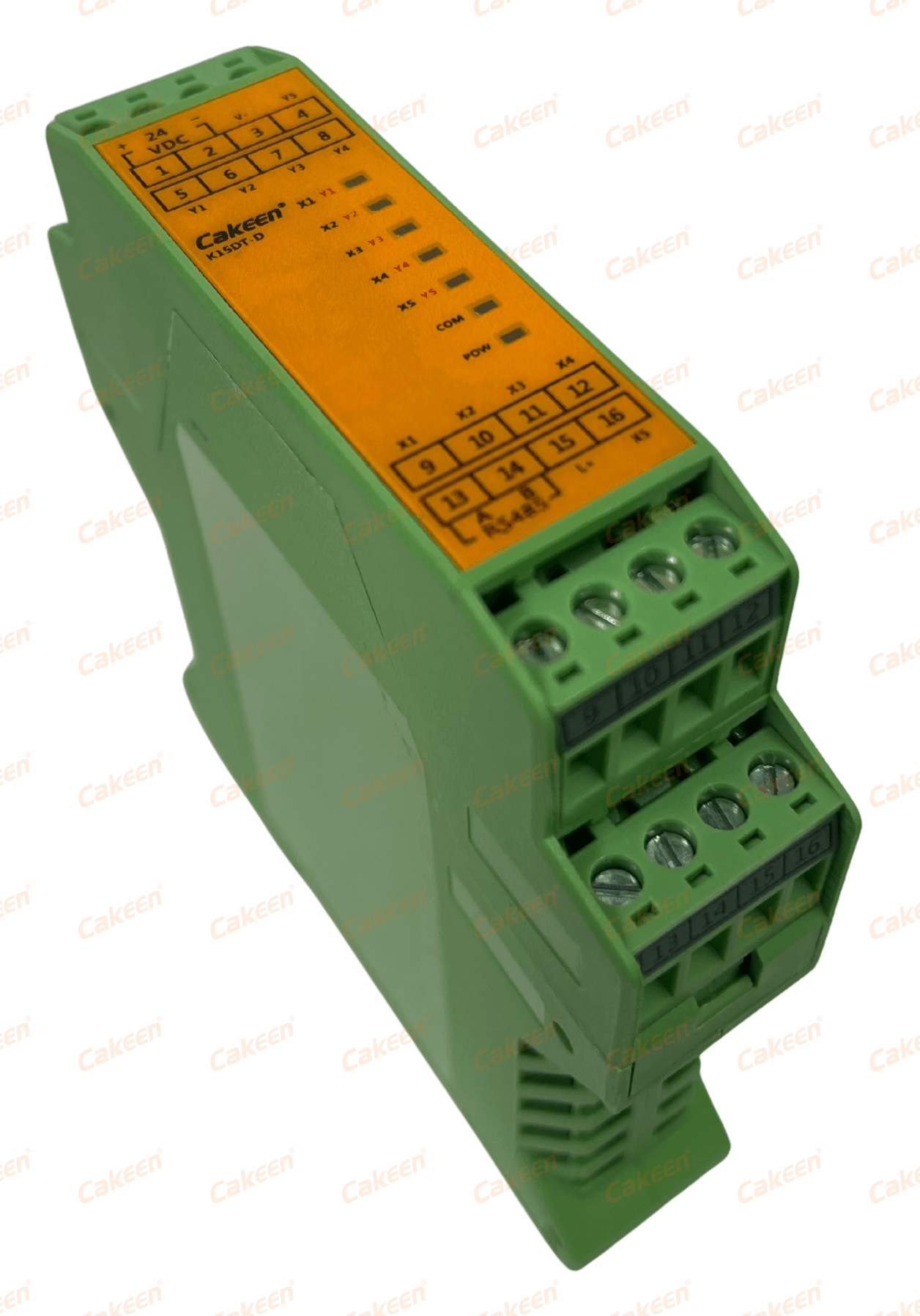
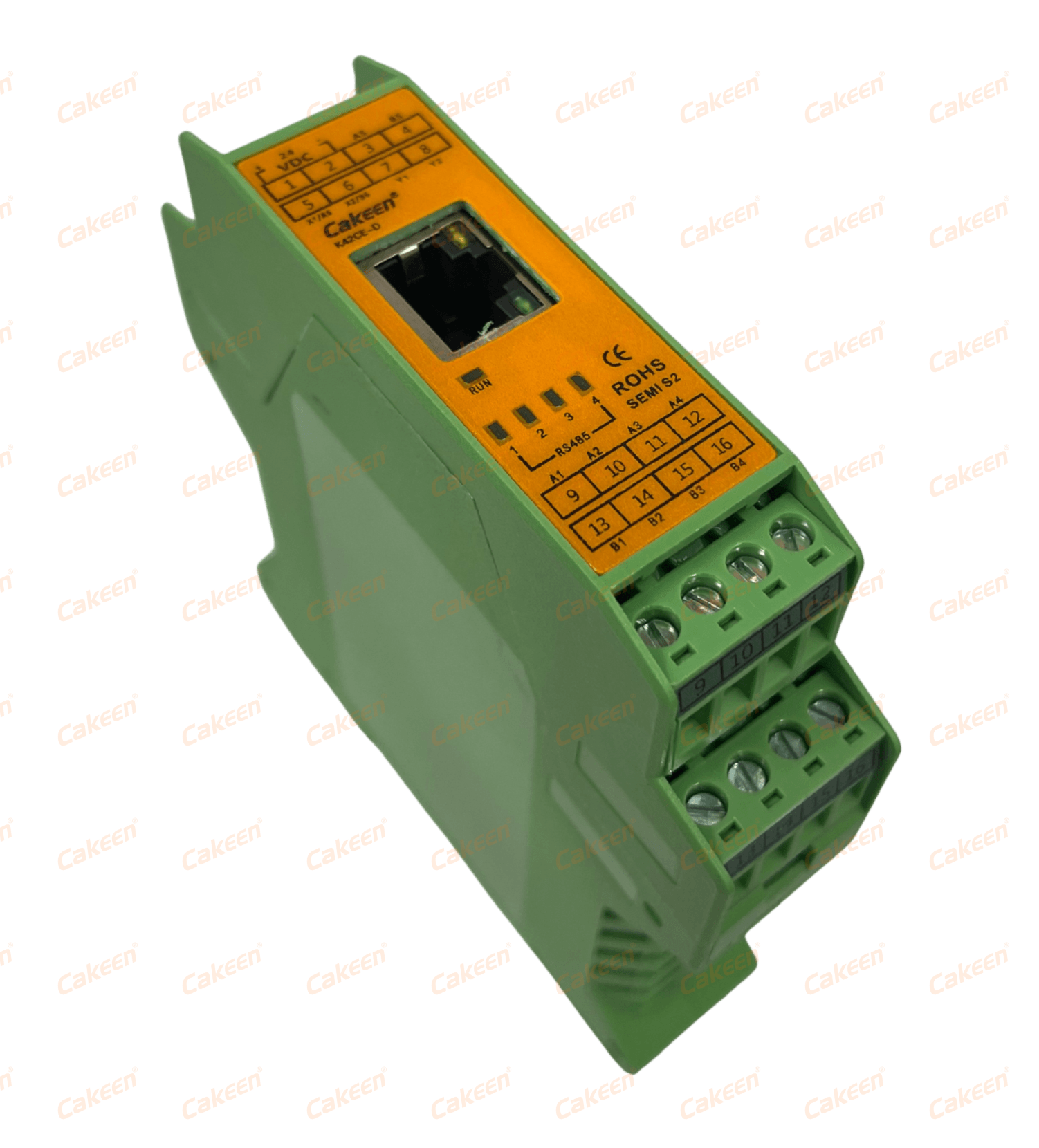
A DIN rail architecture is not only about the controller. The I/O Expansion Module (K15DT-D) adds 5 inputs and 5 NPN outputs over Modbus RTU, with 12–24 VDC power and DIN35 rail mounting, for switching control and remote I/O expansion. The CMS Communication Module (K42CE-D) provides 2 NPN I/O points, six RS485 ports, one Ethernet port and Modbus TCP/RTU protocol, also at 12–24 VDC on a DIN35 rail, for multi-485 device low-latency parameter setting, data acquisition and forwarding, and PLC replacement scenarios.
Both modules mount on the same rail system as KE-2104, which is the practical argument for rail-based cabinets: control, expansion and networking live in one accessible strip instead of being split between the enclosure interior and the door.
Compliance attaches to these modules individually. The CMS Communication Module (K42CE-D) holds SEMI S2 certification number 220252, issued by SAFES, in compliance with standard SEMI S2-0821 for the EU market, plus CE certification number CEJS22011335967, issued by GTS, under EN 55032:2015+A11:2020 and EN 55035:2017+A11:2020. The I/O Expansion Module (K15DT-D) holds CE certification number CEJS22011335968, issued by GTS, under the same EMC standards.
Central Monitoring Behind the Panel Door
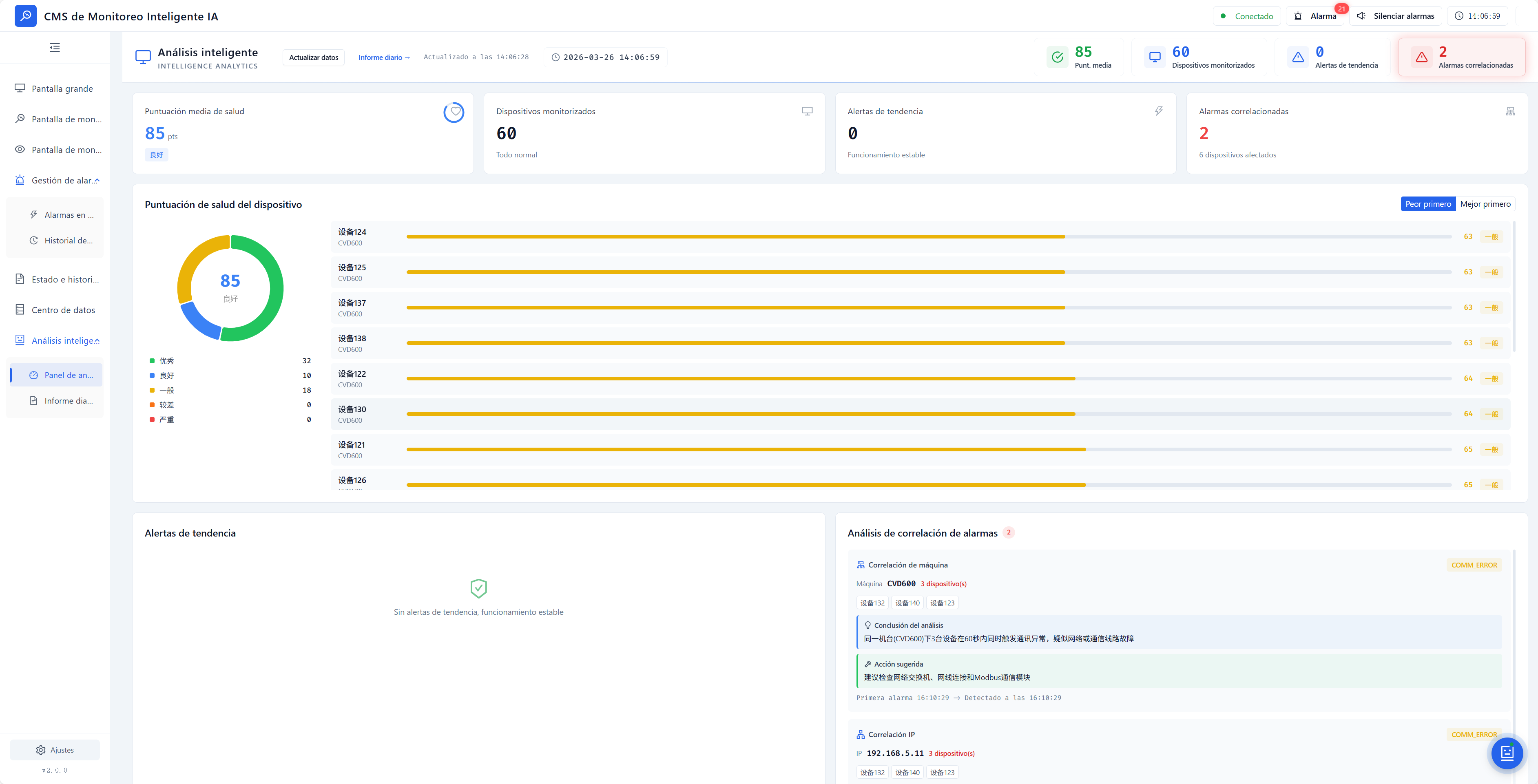
Where a project needs plant-level visibility rather than local reading, the Industrial Device Central Monitoring System (CMS) defines the data path. CMS is temperature monitoring and alarm management software that supports 10,000+ Modbus TCP devices with a 10-second real-time polling interval, monitoring PV/SV temperature values, AL1/AL2 thresholds and TC BK sensors, and retaining 365 days of time-series history in InfluxDB. Its applicable industries include display and panel manufacturing, rail transportation, industrial temperature control and process manufacturing.
This is where form factor turns into a wiring decision. Rail-mounted devices can be aggregated inside the enclosure by the K42CE-D communication module and exposed to CMS over Modbus TCP without a harness crossing the door hinge. A panel-mounted controller can also join the network through its RS485 port, but the cable run to the door must be planned, dressed with enough slack for opening, and separated from switching noise.
Matching the Cabinet Platform and the Destination Market
Form factor decisions inside a cabinet rarely stand alone; they are made within a cabinet platform that already follows a regional convention.
- The European Standard Electrical Cabinet is a CE-certified industrial electrical control cabinet, TÜV Rheinland certified, using ABB, Siemens and Schneider components, with IP54/IP65 protection and 380V/400V 3-phase voltage (customizable); CE and IEC certification applies, with UL optional.
- The Japanese Standard Electrical Cabinet is a JIS-compliant precision electrical control cabinet built with Mitsubishi, Omron and Schneider components, IP54/IP65, 200V/400V, with UL optional, aimed at precision machinery control, semiconductor equipment and robotic systems.
- The General Purpose Electrical Control Cabinet is a customizable general-purpose platform using Siemens, Mitsubishi, Omron or Schneider components, IP40–IP65, 380V/400V, UL optional, for general industrial automation, equipment retrofit and factory automation systems.
The registrations behind these platforms include OHSMS certificate 50325S3893R0S (GB/T45001-2020/ISO45001:2018, valid 2025-12-12 to 2028-12-11), EMS certificate 50325E3892R0S (GB/T24001-2016/ISO14001:2015) and QMS certificate 50325Q3891R0S (GB/T19001-2016/ISO9001:2015), all issued by Beijing Zhong Ding Qian Yuan Certification Co., Ltd.
Engineering Services That Reduce Layout Rework
Two services sit upstream of the mounting decision and usually prevent it from being reversed later. The Electrical Drawing Design Service produces drawings compliant with IEC and UL508A, delivered as DWG, PDF and BOM Excel files on a 2–4 week design cycle, with Chinese and English language support, for semiconductor equipment retrofit, new equipment electrical design and factory electrical system upgrades. The PLC Control Program Design Service covers Siemens S7-1200/1500, Mitsubishi Q/L series and Omron NJ/NX platforms over Modbus TCP and Modbus RTU, with deliverables including documentation and executable files.
On a cabinet drawing, the form factor shows up as rail length, door cutouts, terminal arrangement, power distribution and the network path — which is why it should be fixed before the drawing is released rather than after the enclosure is machined.
Step-by-Step: A Decision Sequence for Cabinet Buyers
- Count loops, not instruments. Four temperature loops are one KE-2104 on a rail, or four KE-48 units and four door cutouts. Establish the loop count first, because it changes the cabinet layout, not only the bill of materials.
- Decide where the operator actually stands. If the loop must be read and adjusted at the cabinet face, panel mount is the natural fit. If reading happens in a control room or through CMS, panel display area is wasted door space.
- Measure rail space and door space. Reserve DIN35 rail for the controller, the I/O Expansion Module (K15DT-D) and the CMS Communication Module (K42CE-D) if networking or extra switching points are expected. Reserve one 48×48 mm cutout per panel-mount loop, plus clearance for the harness.
- Check the power architecture. KE-2104 runs on 12–24 VDC; KE-48 runs on 100–265 V AC. A rail-heavy cabinet needs a DC supply sized for the controllers; a door-mounted single loop can often be fed directly from panel distribution.
- Plan wiring access and segregation. Rail devices are wired terminal-to-terminal inside the enclosure, which keeps service access simple. Door devices require a harness that tolerates repeated opening and stays separated from higher-power switching conductors.
- Plan the monitoring path before ordering. Decide whether loops reach CMS through the K42CE-D communication module (6× RS485, 1× Ethernet, Modbus TCP/RTU) or through the RS485 port on a panel-mounted controller. CMS polls Modbus TCP devices on a 10-second interval and retains 365 days of history, so the data path must exist physically before commissioning.
- Match the cabinet standard to the destination market. Confirm whether the project needs a CE-certified European Standard Electrical Cabinet, a JIS-compliant Japanese Standard Electrical Cabinet or a configurable General Purpose Electrical Control Cabinet, and confirm panel-level expectations such as UL 508A or IEC 60947 early.
- Validate on drawings, then on a sample, then on a pilot cabinet. Freeze the layout with an electrical drawing (IEC/UL508A, DWG/PDF/BOM Excel, 2–4 weeks), order sample controllers with the intended input types, and verify behavior in the real enclosure before scaling. OEM/ODM production runs on a 30–45 day lead time with 100% testing.
Use Cases
Multi-chamber semiconductor equipment
A semiconductor equipment OEM building embedded temperature control for CVD, etching and diffusion furnace chambers faced exactly this choice. Over a 4+ year relationship at 50+ units per year, the reported outcome was improved equipment uptime and consistent process temperature across all chambers. The engineering reason is structural: the compact 48×48 mm KE-48 panel mount fits OEM equipment design where the operator works at the machine face, while the 4-channel KE-2104 DIN rail controller saves cabinet space inside the enclosure.
Heating tape loops on pipe and vessel insulation
Pipeline and vessel insulation projects add temperature loops gradually, which is where the rail-versus-door question becomes a growth question. Cakeen's heating tape controllers — KE-H10 with built-in SSR output up to 6 A, and ASH and H6625 at up to 3 A — are single-channel, ±0.1°C units with RS485/Modbus RTU communication and a 100–265 V AC power supply, used for pipeline heating, chemical delivery insulation and pipe/vessel heating control. Because each has an RS485 interface, those loops can be brought into one network rather than read one instrument at a time.
Factory automation retrofit
Retrofit projects usually involve mixed PLC platforms and uneven cabinet standards. One domestic equipment integrator working on flexible control cabinets across multiple factory automation and retrofit projects, at 100+ cabinet sets per year over more than five years, reported a 40% shorter customer delivery cycle and a high repeat order rate. The enabling factors were multi-PLC brand support (Siemens, Mitsubishi, Omron), configurable IP40–IP65 protection and fast customization turnaround — all of which favor a rail-based internal layout that can be reconfigured without re-machining the door.
Distributed temperature monitoring across a plant
When monitoring scope grows beyond a single cabinet, the data architecture matters more than the controller. An industrial IoT system integrator project achieved real-time data collection from 1000+ sensors, with AI anomaly detection reported to reduce unplanned downtime by 25%, using a full-stack delivery from PCB to cloud with UL/EMC certified hardware. For a cabinet buyer, the transferable lesson is that the CMS layer — 10,000+ Modbus TCP devices supported, 10-second polling, 365-day history — is the reason the internal data path should be designed at the same time as the mounting form factor.
DIN Rail vs Panel Mount: Side-by-Side Comparison
| Comparison point | PID Temperature Controller (DIN Rail Mount) — KE-2104 | PID Temperature Controller (Panel Mount) — KE-48 |
|---|---|---|
| Mounting interface | DIN35 rail inside the enclosure | 48×48 mm panel cutout in the cabinet door |
| Control channels | 4 channels per unit | 1 channel per unit |
| Control accuracy | ±0.1°C | ±0.1°C |
| Input types | PT / K / J / R / S / T / B / E / N / L | PT / K / J / R / S / T / B / E / N / L |
| Output | External SSR | SSR / 0-20 mA / 4-20 mA / 0-10 V |
| Communication | Not specified in the published specification; networking is provided by rail-mounted modules such as K42CE-D (6× RS485, 1× Ethernet, Modbus TCP/RTU) | 1× RS485 |
| Power supply | 12–24 VDC | 100–265 V AC |
| Housing material | Flame-retardant engineering plastic | Flame-retardant engineering plastic |
| Typical cabinet role | Multi-loop control and process monitoring inside the enclosure | Single-loop control read and adjusted at the door |
| Monitoring path | Shares DIN35 rail with I/O expansion and CMS communication modules feeding CMS over Modbus TCP | Joins the network through its RS485 port, with door harness routing required |
FAQ
Do DIN rail and panel mount PID controllers face different compliance requirements inside a control cabinet?
The mounting form factor does not change panel-level rules: industrial control panels, including the PID controllers inside them, must comply with UL 508A for North American safety listing and IEC 60947 for international markets, as published by UL Solutions. Product-level certification is attached to specific components rather than to the mounting style. Cakeen's CMS Communication Module (K42CE-D) holds SEMI S2 certification number 220252 issued by SAFES in compliance with SEMI S2-0821 for the EU market, plus CE certification number CEJS22011335967 issued by GTS under EN 55032:2015+A11:2020 and EN 55035:2017+A11:2020; the I/O Expansion Module (K15DT-D) holds CE certification number CEJS22011335968 issued by GTS under the same EMC standards. At company level, Cakeen holds ISO9001, ISO14001 and ISO45001 certifications, and its products have obtained UL, SEMI S2, CE and RoHS international certifications. Cabinet platform certification matters as well: the European Standard Electrical Cabinet is CE certified and TÜV Rheinland certified, the Japanese Standard Electrical Cabinet is JIS-compliant, and the General Purpose Electrical Control Cabinet is covered by OHSMS, EMS and QMS registrations 50325S3893R0S, 50325E3892R0S and 50325Q3891R0S.
How many temperature loops can each form factor handle in one cabinet?
In Cakeen's range, the DIN rail mount PID Temperature Controller (KE-2104) handles 4 channels per unit on a DIN35 rail, with ±0.1°C accuracy, PT / K / J / R / S / T / B / E / N / L inputs, external SSR output and 12–24 VDC power. The panel mount PID Temperature Controller (KE-48) is single channel, with the same input range and accuracy, SSR / 0-20 mA / 4-20 mA / 0-10 V output, one RS485 port and 100–265 V AC power. In practice, four loops require either one KE-2104 or four KE-48 units and four 48×48 mm door cutouts. If additional switching points are needed, the I/O Expansion Module (K15DT-D) adds 5 inputs and 5 NPN outputs over Modbus RTU on the same DIN35 rail.
Which option costs less to build and maintain?
Cakeen does not publish list prices, so the honest answer is that the difference comes from structure rather than unit price. The cost drivers are channel count per enclosure (one 4-channel KE-2104 versus four single-channel KE-48 units and four door cutouts), cabinet machining (door cutouts versus rail length), wiring (enclosure-internal terminal wiring versus a door harness with slack), power architecture (12–24 VDC versus 100–265 V AC) and service labor (swapping a rail module versus removing a door-mounted instrument). Engineering time counts too: the Electrical Drawing Design Service delivers IEC and UL508A drawings in DWG, PDF and BOM Excel format on a 2–4 week cycle, which reduces late layout changes that would otherwise force re-machining.
Can I validate either form factor with samples before building a full cabinet?
Yes. Validation normally runs from drawing to sample to pilot cabinet. Cakeen supports OEM/ODM production with all parameters customizable, including logo and appearance functions, applies 100% testing, and quotes a 30–45 day production lead time with remote after-sales support. The practical sequence is to fix the layout with an electrical drawing, order sample controllers with the intended sensor input types, confirm stable reading at the operating temperature, and only then scale to the full cabinet build. Sample requests and technical questions can be sent to jwy@wxkeen.com or WhatsApp +86 18921139517.
What lead time should a cabinet project plan for?
Two clocks run in parallel. Controller and module production is made to order with a 30–45 day lead time under OEM/ODM terms, with 100% testing before shipment, and the same lead time applies whether the chosen form factor is DIN rail or panel mount. Engineering documents run on a shorter cycle: the Electrical Drawing Design Service delivers in 2–4 weeks to IEC and UL508A standards in DWG, PDF and BOM Excel format, with Chinese and English language support. Cabinet projects usually release drawings first and place the component order while the drawing is being approved, so the layout is frozen before the controllers arrive.
Next Step: Freeze the Layout, Then Order
DIN rail mount and panel mount PID controllers are not competing products — they are two placements for the same ±0.1°C control core. Choose panel mount (KE-48) when a loop must be read and adjusted at the cabinet door, and DIN rail mount (KE-2104) when loops are aggregated inside the enclosure and monitored through CMS. Then make that layout decision permanent on the electrical drawing before the enclosure is machined.
Send your loop count, sensor types and destination market to Cakeen for a cabinet layout recommendation and a drawing-based quotation. Contact: Wendy, jwy@wxkeen.com, Tel +86-0510-85161878 / +86-18921139517, WhatsApp +86 18921139517, or visit www.wxkeen.com.