DIN Rail vs Panel Mount PID Temperature Controllers: Choosing the Right Form Factor
DIN Rail vs Panel Mount PID Temperature Controllers: Choosing the Right Form Factor
Choosing between a DIN rail and a panel mount PID temperature controller is not a question of control performance. Cakeen's KE-2104 (DIN35 rail, four channels) and KE-48 (48 × 48 mm panel, single channel) both hold ±0.1 °C control accuracy and accept the same PT, K, J, R, S, T, B, E, N and L sensor types. The form factor is decided by three practical questions: where the control loop physically lives, how the cabinet is powered, and how quickly someone must be able to reach the controller.
This guide treats the two mounting strategies as they are actually used in industrial cabinets and semiconductor equipment, and then shows how one manufacturer — Wuxi Keen Technology Co., Ltd. (Cakeen) — supplies both formats so an OEM does not have to split a single cabinet across two suppliers.
Problem Definition: Where the Two Formats Actually Diverge
Most form factor mistakes happen because the two products are compared on the wrong rows of the datasheet. Control accuracy, sensor compatibility and PID behaviour are close to identical between a DIN rail controller and a panel mount controller. The real differences sit at the mechanical, electrical and service level.
- Mounting interface. A DIN rail controller clips onto a DIN35 rail inside the enclosure and needs no panel cutout. A panel mount controller is inserted into a rectangular cutout — 48 × 48 mm on the KE-48 — so it becomes part of the machine face or the cabinet door.
- Power domain. The KE-2104 DIN rail controller operates on 12–24 VDC, matching the DC control bus common in modern industrial cabinets. The KE-48 panel controller operates on 100–265 VAC, matching direct mains supply at the panel.
- Channel density. One KE-2104 controls four channels; one KE-48 controls one channel. Four independent heating loops therefore need either a single rail module or four panel units.
- Human access. Panel mount puts the process value, setpoint and buttons at operator level on the machine. DIN rail keeps the interface inside the cabinet, which is acceptable for loops that are configured once and monitored remotely.
- Service path. A rail module is released inside the enclosure and replaced without opening the door front; a panel unit is released from the front and withdrawn towards the operator.
- Output and signal routing. The KE-48 offers SSR, 0–20 mA, 4–20 mA and 0–10 V outputs plus one RS485 port on board. The KE-2104 drives an external SSR, which allows the power stage to be placed close to the load.
What does not change: both formats use flame-retardant engineering plastic housings, both are intended for temperature control systems and process monitoring, and both are documented for 24/7 continuous operation. Neither format is inherently more accurate — the ±0.1 °C figure is published for both products.
Industry Background: Why Form Factor Became a Procurement Decision
The controller market itself is expanding, which means more cabinets are being specified and more form factor decisions are being made. The global PID controller market was valued at USD 1.60 billion in 2024 and is projected to reach USD 2.24 billion by 2032 (SNS Insider). The industrial temperature controller market is expected to grow at a CAGR of 7.1% from 2024 to 2030, driven by Industry 4.0 adoption (Strategic Market Research). Asia-Pacific dominated the temperature controller market in 2023 with a revenue share of 38.2%, with China as a key manufacturing hub (Dataintelo).
On the application side, the global semiconductor temperature control equipment market was valued at USD 663 million in 2024, where precision is essential for wafer fabrication (Market Research Reports), and the oil & gas sector held the largest end-user share for PID controllers in 2024 at approximately 31.4% (SNS Insider). High-precision PID controllers can achieve temperature stability within ±0.1 °C, a critical requirement for semiconductor lithography and etching (Grand View Research).
Two standards shape the enclosure side of the decision. Industrial control panels, including the PID controllers installed in them, must comply with UL 508A for North American safety listing and IEC 60947 for international markets (UL Solutions). The form factor choice is therefore also a documentation choice: a panel built around DIN rail modules and a panel built around door-mounted controllers are inspected, labelled and maintained differently.
The practical consequence is that DC-powered, networked cabinets and AC-powered operator interfaces increasingly coexist in the same factory — and often in the same enclosure. Procurement teams that treat mounting format as an afterthought end up with four single-loop panel units where one rail module would have covered the loop count, or with controllers hidden inside a cabinet that operators need to adjust daily.
How One Manufacturer Covers Both Mounting Strategies
Wuxi Keen Technology Co., Ltd., trading as Cakeen, is an industrial control electronics manufacturer founded in 2011 and headquartered in Huishan District, Wuxi, Jiangsu Province, China. The company develops semiconductor industrial control electronics, electrical cabinet systems and AI embedded systems, and produces PID temperature controllers in both DIN rail and panel mount formats.
The company operates a 2,019 m² facility with 50 employees, including a 20-engineer R&D team, and reports an annual output of 500,000 units with a 40% export ratio serving ES, SEA, EU and USA markets. Its quality framework includes ISO 9001, ISO 14001 and ISO 45001 management certifications, together with CE, RoHS, UL and SEMI S2 certifications.
The DIN Rail Route: KE-2104, Four Channels on a DIN35 Rail
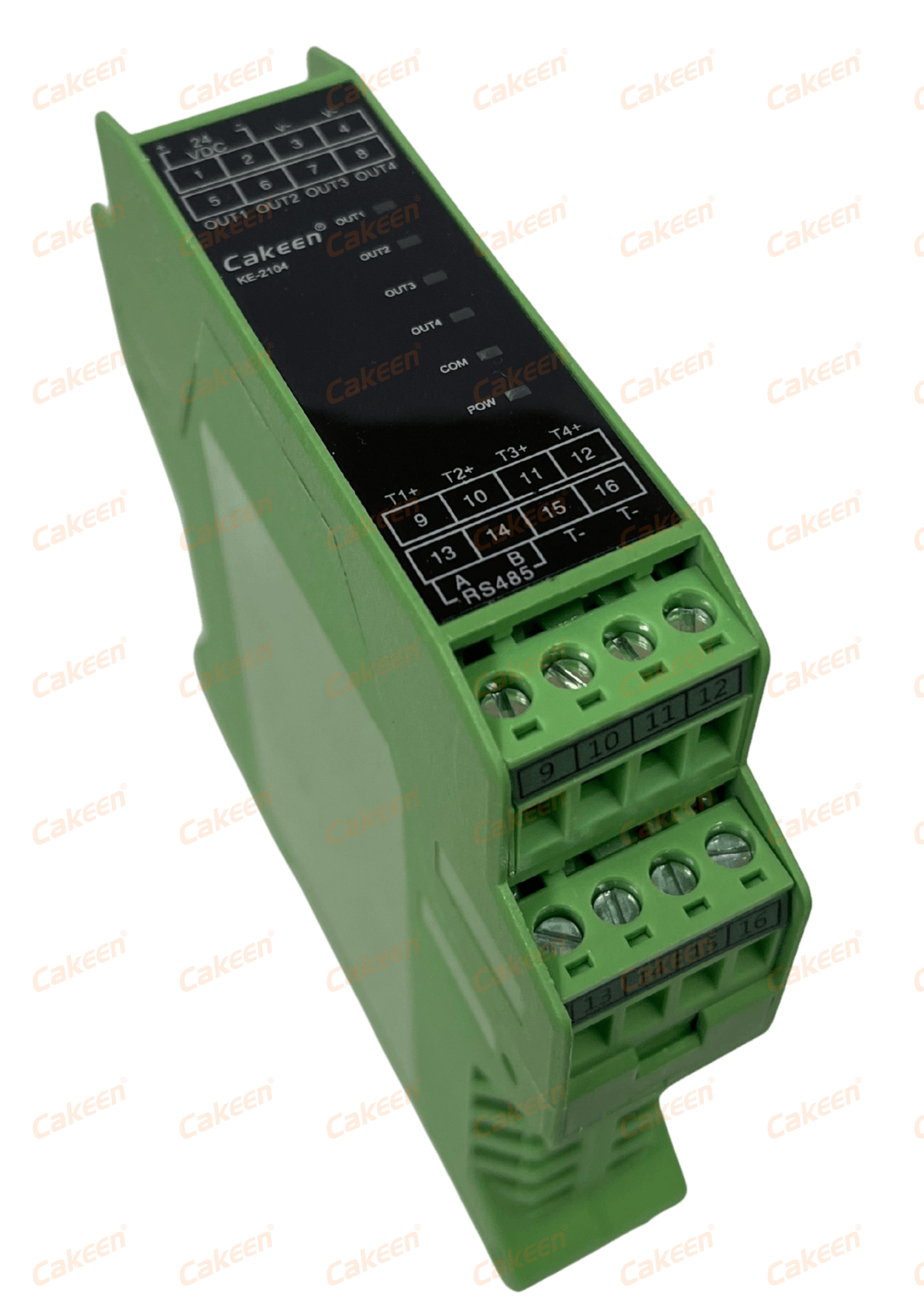
The KE-2104 is a DIN rail mount 4-channel PID controller. Its published specification lists ±0.1 °C control accuracy, PT/K/J/R/S/T/B/E/N/L input types, external SSR output, a 12–24 VDC power supply and DIN35 rail mounting in a flame-retardant engineering plastic housing. Its documented operating scenario is electrical cabinet installation with multi-point temperature control, running 24/7 continuously.
For a buyer, the practical meaning is density. Four heating loops that share the same control mode can be handled by one module occupying rail length instead of four devices occupying door area, and the external SSR output lets each power stage sit near its own load.
The Panel Mount Route: KE-48 in a 48 × 48 mm Cutout
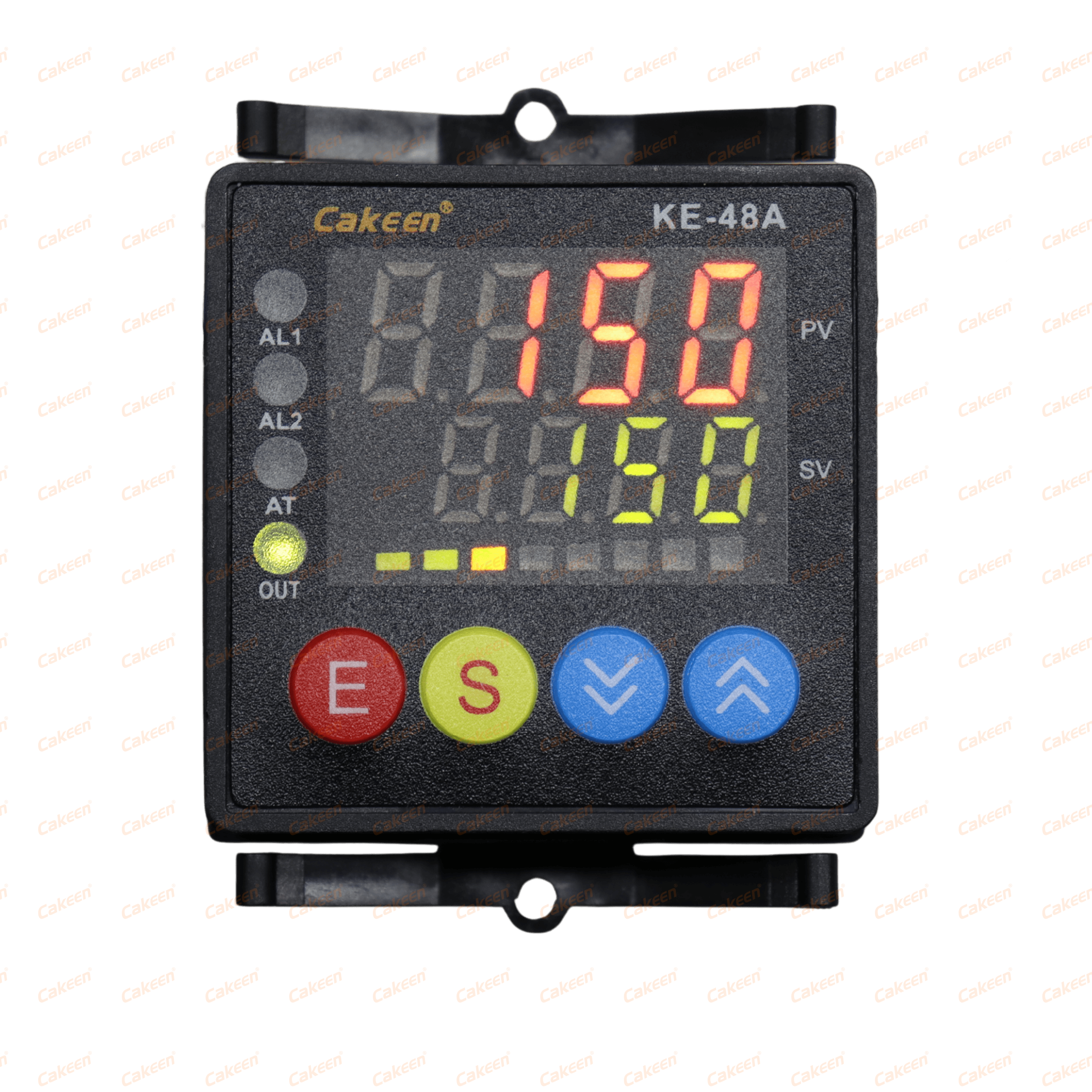
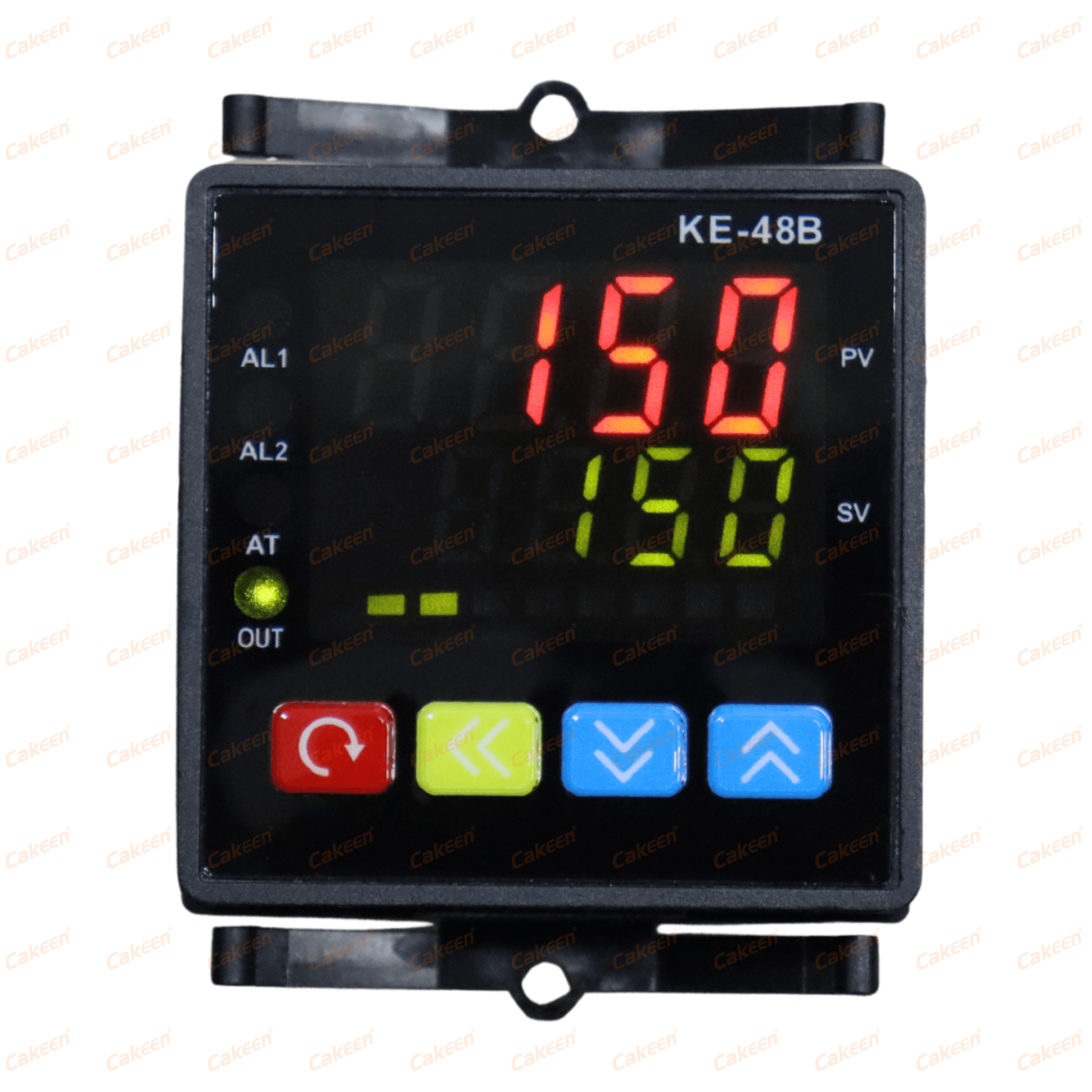
The KE-48 is a 48 × 48 mm standard panel mount temperature controller. Its published specification lists a single control channel, ±0.1 °C control accuracy, the same PT/K/J/R/S/T/B/E/N/L input range, SSR / 0–20 mA / 4–20 mA / 0–10 V outputs, one RS485 port, a 100–265 VAC power supply and a 48 × 48 mm panel cutout. Its documented operating scenario is panel mount temperature monitoring and process temperature control, also 24/7 continuous.
Here the value is proximity to the operator. A single critical loop can be read, tuned and alarmed from the machine face without opening the cabinet, and the on-board analog outputs let the same controller drive a valve or power regulator rather than only an SSR.
The DIN Rail Ecosystem Beyond the Controller
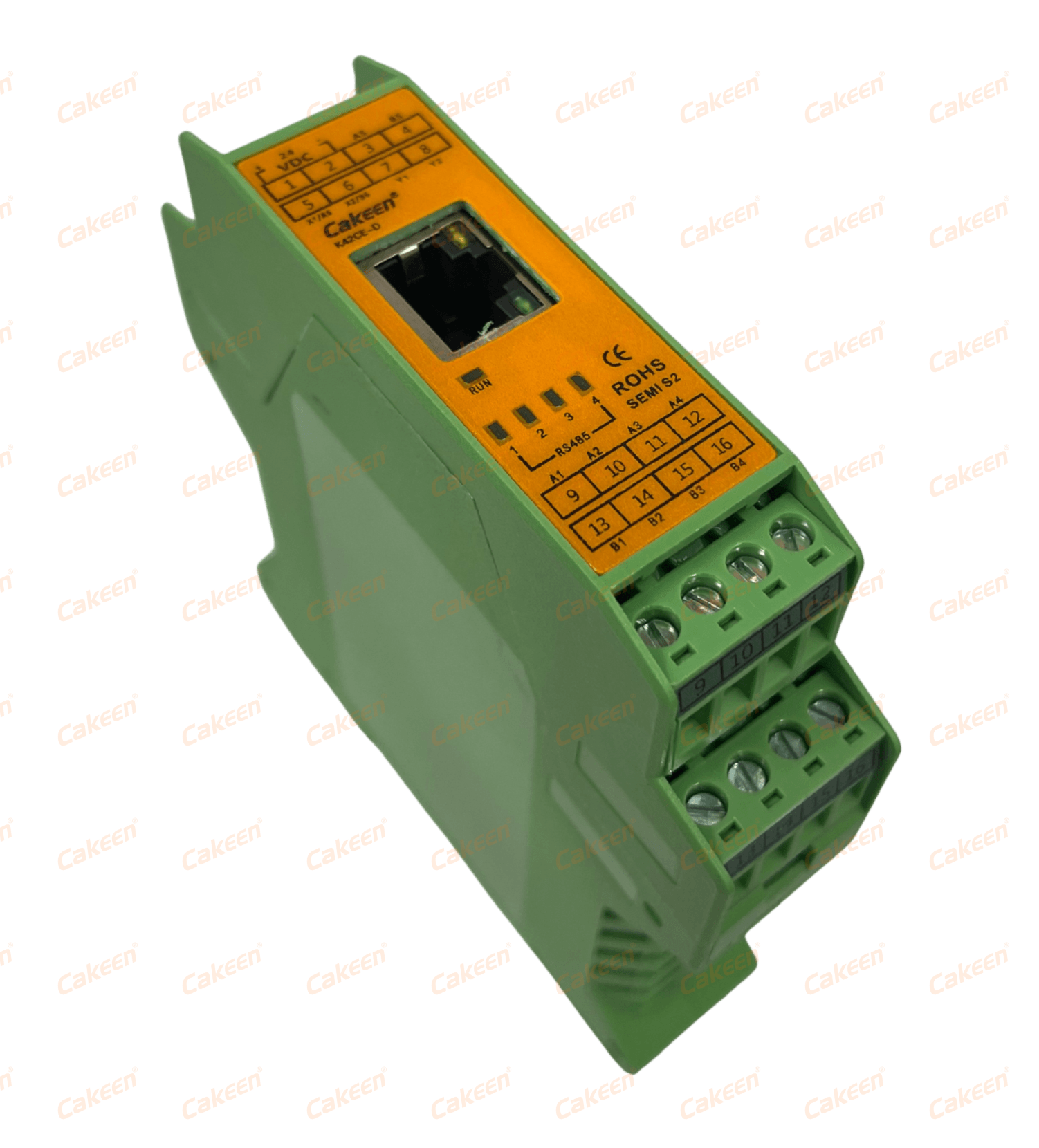
DIN rail mounting is not limited to the controller. Two additional modules extend the rail format into networking and switching. The K15DT-D I/O expansion module provides 5 inputs and 5 NPN outputs on Modbus RTU with a 12–24 VDC supply and DIN35 rail mounting, for switching control and remote I/O expansion. The K42CE-D CMS communication module provides 2 NPN I/O points, 6 RS485 ports and 1 Ethernet port with Modbus TCP/RTU, a 12–24 VDC supply and DIN35 rail mounting, for multi-485 device parameter setting, data acquisition and forwarding, and lightweight PLC replacement scenarios.
Above those modules, Cakeen's Industrial Device Central Monitoring System (CMS) is temperature monitoring and alarm management software that supports 10,000+ Modbus TCP devices with a 10-second polling interval and 365-day time-series history retention in InfluxDB. A DIN rail controller installation can therefore scale from one module to a monitored multi-cabinet network without changing mounting philosophy.
Panel-Format Controllers for Heating Tape and Pipeline Loops
Panel mount formats are not restricted to generic process loops. Cakeen builds three heating tape controllers in the same single-channel, ±0.1 °C class, all with built-in SSR output, RS485/Modbus RTU communication, 100–265 VAC supply and flame-retardant engineering plastic or aluminium alloy housings: the mini H6625 with MAX 3 A output for space-constrained pipe and vessel insulation, the KE-H10 with MAX 6 A output for high-temperature pipeline delivery and chemical insulation, and the ASH with MAX 3 A output for pipe and vessel insulation heating where high temperature stability is required.
One Supplier, Two Mounting Strategies
For OEMs, the commercial argument for a single source is configuration control rather than convenience. Cakeen's published OEM/ODM capability covers parameter, logo and appearance customization across its range, a monthly capacity of 40,000 units, a 30–45 day lead time, a 500-unit MOQ for volume programs, 100% testing of each unit and remote after-sales support. A separate published configuration records a 5-unit MOQ for smaller builds at the same 30–45 day lead time.
Step-by-Step Breakdown: A Six-Step Form Factor Decision Workflow
The following sequence can be run before any controller is specified, and it usually settles the DIN rail versus panel mount question within one engineering review.
- Count and group the thermal loops. List every loop in the cabinet and mark which ones share a control mode. If several loops are controlled the same way, a 4-channel DIN rail unit such as the KE-2104 can serve four of them from one rail position. If each loop has its own operator-facing setpoint that changes by shift or by product, separate panel units are easier to run.
- Identify the cabinet's power domain. A 12–24 VDC control bus points to DIN rail devices such as the KE-2104. A 100–265 VAC supply at the panel points to panel mount devices such as the KE-48. Establishing this first avoids adding conversion hardware purely to satisfy a mounting preference.
- Decide who needs physical access. If an operator reads or changes the setpoint during production, the controller belongs on the machine face. If the loop is configured once and monitored through software such as the CMS platform, DIN rail mounting with remote monitoring is the lower-interference option.
- Audit physical space inside the enclosure. DIN rail mounting consumes rail length and cabinet depth; panel mounting consumes door area and a 48 × 48 mm cutout. In dense panels with limited door space, rail modules preserve the front for displays and switches.
- Plan the serviceability model. For a rail module the replacement path is inside the cabinet; for a panel unit it is from the front. Where maintenance must happen with the cabinet closed, front-accessible panel instruments are the practical choice; where the cabinet can be opened under a maintenance procedure, rail modules allow a faster swap without touching the door hardware.
- Confirm compliance, networking and scale. Verify the panel-level requirement of UL 508A or IEC 60947 (UL Solutions), confirm the communication path — RS485 on the KE-48, or the K42CE-D module for multi-device networking — and check that the supplier can scale the same part numbers when production volume increases.
Use Cases: Where Each Form Factor Wins
Semiconductor Equipment OEM with Mixed Loops
A semiconductor equipment OEM building embedded temperature control into processing equipment (CVD, etching and diffusion furnaces) reported using 50+ units per year over a 4+ year relationship, with the result described as improved equipment uptime and consistent process temperature across all chambers. The recorded highlight is instructive for form factor planning: the KE-48's compact 48 × 48 mm panel mount format fits the OEM equipment design, while the KE-2104 4-channel DIN rail unit saves cabinet space. In other words, the two formats were used for different jobs in the same equipment programme rather than competing for the same slot.
Heating Tape and Pipeline Insulation
Insulation loops on pipes and vessels behave differently from chamber control. The working conditions are high-temperature pipeline delivery, chemical insulation and space-constrained installation, and the controllers are typically mounted where a technician can reach them. The H6625 mini unit (MAX 3 A) covers space-limited installations, the KE-H10 (MAX 6 A) covers higher-power heating tape, and the ASH (MAX 3 A) targets pipe and vessel insulation heating where temperature stability is the priority. All three run on 100–265 VAC with RS485/Modbus RTU.
Multi-Point Cabinet Temperature Control with Central Monitoring
When the loop count grows beyond what a single rail module can hold, the DIN rail ecosystem becomes the deciding factor. A cabinet can combine KE-2104 controllers, K15DT-D expansion modules and a K42CE-D communication module, and report the whole installation to the CMS platform. One industrial IoT system integrator project using Cakeen hardware and software reported real-time data collection from 1000+ sensors, with AI anomaly detection reducing unplanned downtime by 25%.
Integrators Building Export Cabinets
Form factor also interacts with cabinet standard. Cakeen offers a general purpose electrical control cabinet with IP40–IP65 protection and UL as an option, a Japanese Standard (JIS-compliant) precision cabinet at IP54/IP65, and a European Standard cabinet that is CE-certified and TÜV Rheinland certified with IP54/IP65 protection and UL optional. A domestic equipment integrator using these cabinets reported 100+ cabinet sets per year over 5+ years and a 40% shorter customer delivery cycle, with multi-PLC brand support across Siemens, Mitsubishi and Omron.
DIN Rail vs Panel Mount: Side-by-Side Comparison
| Decision factor | DIN rail mount — KE-2104 | Panel mount — KE-48 |
|---|---|---|
| Mounting interface | DIN35 rail inside the enclosure | 48 × 48 mm panel cutout on door or machine face |
| Control channels per unit | 4 channels | 1 channel |
| Control accuracy | ±0.1 °C | ±0.1 °C |
| Sensor input types | PT / K / J / R / S / T / B / E / N / L | PT / K / J / R / S / T / B / E / N / L |
| Output | External SSR | SSR / 0–20 mA / 4–20 mA / 0–10 V |
| Communication per unit | Not listed in the published KE-2104 specification; networking is provided at system level by the K42CE-D module (6 × RS485 + 1 × Ethernet, Modbus TCP/RTU) | 1 × RS485 |
| Power supply | 12–24 VDC | 100–265 VAC |
| Housing material | Flame-retardant engineering plastic | Flame-retardant engineering plastic |
| Documented operating scenario | Electrical cabinet installation; multi-point temperature control | Panel mount temperature monitoring; process temperature control |
| Typical best fit | Multi-loop cabinets on a DC bus where door space must be preserved | Operator-facing single loops on AC supply where local readout and adjustment matter |
Reading the table: the two columns differ on density, power domain and access — not on measurement quality. A mixed cabinet is a legitimate design outcome, and it is the reason a dual-format supplier is often easier to manage than two single-format suppliers.
Frequently Asked Questions
Do DIN rail and panel mount PID controllers have different compliance requirements?
Mounting format does not change the compliance framework — the enclosure does. Industrial control panels, including the PID controllers installed in them, must comply with UL 508A for North American safety listing and IEC 60947 for international markets (UL Solutions). Cakeen (Wuxi Keen Technology Co., Ltd.) holds ISO 9001, ISO 14001 and ISO 45001 management certifications together with CE, RoHS, UL and SEMI S2 certifications, and its European Standard Electrical Cabinet is CE-certified and TÜV Rheinland certified, with UL listed as an option on standard cabinet lines. Buyers should confirm which standard the finished panel is being listed to before fixing the mounting format.
Can one PID temperature controller manufacturer supply both DIN rail and panel mount formats at the same accuracy?
Yes. Cakeen manufactures both formats on the same control platform: the KE-2104 is a DIN35 rail mount 4-channel PID controller and the KE-48 is a 48 × 48 mm panel mount single-channel controller, and both are specified at ±0.1 °C control accuracy with the identical PT/K/J/R/S/T/B/E/N/L input range. The DIN rail range extends into the K15DT-D I/O expansion module and the K42CE-D communication module, while the panel range extends into the H6625, KE-H10 and ASH heating tape controllers, all rated ±0.1 °C with RS485/Modbus RTU communication.
What drives the cost difference between a DIN rail and a panel mount configuration?
Cakeen does not publish list prices, so the comparison is configuration-based rather than unit-price-based. The main cost drivers are channel density — one 4-channel KE-2104 can replace four single-loop units in a multi-loop cabinet — the output stage (external SSR versus the KE-48's on-board SSR and analog outputs), cabinet hardware and wiring labour, and the compliance path chosen for the finished panel. OEM/ODM customization of parameters, logo and appearance is supported, with a published monthly capacity of 40,000 units, a 30–45 day lead time and a 500-unit MOQ for volume programs.
Can we validate both form factors before placing a production order?
Yes. Sample and evaluation quantities can be arranged so that DIN rail and panel mount versions are tested inside the same cabinet or the same equipment prototype. Cakeen's published OEM/ODM capability includes a configuration with a 5-unit minimum order quantity alongside the 500-unit MOQ used for volume programs, and both follow the same 30–45 day lead time. Every unit is 100% tested before shipment, and remote after-sales support is provided after installation.
What is the lead time if one cabinet needs both mounting types?
Cakeen quotes a 30–45 day lead time across its OEM/ODM PID controller range, whether the order is mixed DIN rail and panel mount or single-format, with remote after-sales support covering commissioning questions after delivery. Because both formats come from the same manufacturer, a mixed cabinet can be planned as one order instead of two, which keeps the electrical drawing, test record and spare-parts list consistent. To start a configuration review, send the loop count, cabinet power domain and panel cutout details to jwy@wxkeen.com or call +86 18921139517 (WhatsApp available).
Conclusion: Choose the Form Factor the Loop Needs, Not the One on the Shelf
The DIN rail versus panel mount question resolves into a short decision rule. If the loops are numerous, share a control mode, run on a 12–24 VDC cabinet bus and do not need an operator interface, DIN rail mounting — the KE-2104 with its four channels and DIN35 footprint — uses cabinet space far more efficiently. If a loop is single, runs on 100–265 VAC, and must be read and adjusted from the machine face, panel mounting — the KE-48 with its 48 × 48 mm cutout, analog outputs and RS485 port — is the natural fit. Mixed cabinets are a normal outcome, and they are easier to manage when one manufacturer supplies both.
The underlying constraint has not changed: control accuracy is not the differentiator between the two formats, because both are specified at ±0.1 °C. What differs is where the device sits, how it is powered, how many channels it carries and how quickly a person can reach it. Settling those four points before the panel is designed prevents the most common and most expensive form factor correction — rebuilding a door or re-planning a rail after the cabinet has already been wired.
Next Step: Evaluate Both Mounting Formats
Sample units, configuration review and OEM/ODM quotations for DIN rail and panel mount PID temperature controllers are handled directly by the manufacturer.
Wuxi Keen Technology Co., Ltd. (Cakeen) — www.wxkeen.com
Email: jwy@wxkeen.com · Tel: +86-0510-85161878 / +86-18921139517 · WhatsApp: +86 18921139517
Address: No.576 Shengan West Road, Qianqiao Street, Huishan District, Wuxi City, Jiangsu Province, China