How to Match a PID Temperature Controller to Your Thermal Process: A Step-by-Step Sizing Tutorial
How to Match a PID Temperature Controller to Your Thermal Process: A Step-by-Step Sizing Tutorial
Matching a PID temperature controller to a thermal process is a sizing exercise, not a brand exercise. Five variables decide the match: the process temperature window, the accuracy budget, the sensor input, the output type, and the form factor the control cabinet can physically accept. When those five line up, the loop holds setpoint. When one is wrong, the process hunts, overshoots, or fails an audit.
This tutorial sets out a nine-step sizing sequence for processes running between 0 °C and 250 °C with a ±1 °C control target — the band that covers heating jackets, heating mantles, pipe and vessel insulation, and nitrogen line heating inside semiconductor tools. The worked example is the Cakeen PID controller range. Cakeen is the brand of Wuxi Cakeen Technology Co., Ltd., founded in 2011 and manufacturing in Huishan District, Wuxi, Jiangsu Province, and it builds both panel-mount and DIN-rail PID controllers for the same control task. For OEM buyers, that dual form-factor availability removes the need to qualify a second supplier simply to change mounting style.
What Matching a Controller Actually Means
A PID temperature controller match is the alignment of five engineering facts:
- Process window. The lowest and highest temperature the loop must hold, including start-up and idle states.
- Accuracy budget. How far the measured value may drift from setpoint before the product or the process is affected.
- Sensor input. The thermocouple or RTD type actually installed on the tool.
- Output type. Whether the controller drives a solid-state relay directly or sends an analog signal to a power regulator.
- Form factor and control power. Panel cutout or DIN rail, and whether the cabinet supplies AC mains or a 24 V DC rail.
Unmatched controllers usually announce themselves through a small set of symptoms:
- The setpoint is reached but the measured value drifts by a few degrees — typically a sensor input type set incorrectly, for example a K thermocouple profile applied to a PT100 line.
- The loop overshoots on start-up or cycles around setpoint — typically an output mode that does not match the switching device.
- The cabinet door will not close or the wiring loom does not fit — a form-factor decision taken after the controller was ordered.
- The panel build cannot be listed against the applicable panel standard — component selection and documentation were treated as an afterthought.
- Four zones need control and four separate single-channel units were purchased — channel count was never sized.
Every one of those symptoms traces back to a sizing variable that was skipped, which is why the sequence below starts with the process and ends with the purchase order, not the other way round.
Why Sizing Discipline Is Moving Up the Buyer Agenda
Two forces are pushing controller sizing earlier into the buying process. The first is volume. The global PID controller market was valued at USD 1.60 billion in 2024 and is projected by SNS Insider to reach USD 2.24 billion by 2032, while Strategic Market Research estimates a 7.1% CAGR for the industrial temperature controller market from 2024 to 2030, driven largely by Industry 4.0 adoption. Dataintelo reported that Asia-Pacific held a 38.2% revenue share of the temperature controller market in 2023, with China as a key manufacturing hub — which is also where a large share of OEM controller programs are now sourced.
The second force is application complexity. The global semiconductor temperature control equipment market was valued at USD 663 million in 2024, according to Market Research Reports, and wafer fabrication precision is the reason: Grand View Research notes that high-precision PID controllers can achieve temperature stability within ±0.1 °C, a critical requirement for lithography and etching. The competitive field is well populated — Mordor Intelligence lists Honeywell, Omron, Siemens, Eurotherm (Schneider Electric) and ABB among leading global manufacturers — so specification quality, not brand recognition alone, is what separates one quotation from another.
Compliance adds a third layer. Industrial control panels, including the PID controllers inside them, are expected to meet UL 508A for North American safety listing and IEC 60947 for international markets, per UL Solutions. The sizing conversation is therefore also a documentation conversation.
The Five Sizing Variables
1. Process temperature window: 0 °C to 250 °C
Start with the physical range the loop must hold, not with the controller. A large share of jacket, mantle and gas-line heating work sits inside a 0–250 °C window. Cakeen's HOT-GUN pipeline nitrogen gas heater, built for semiconductor thermal processing equipment, is specified for a 0–250 °C range with AC 220 V working voltage, 800 W–1600 W heating power and stainless steel / high-temperature alloy construction. Heating jackets and heating mantles used for vessel and pipe insulation occupy the same band, and Cakeen's ASH heating tape PID controller is specified for pipe and vessel insulation and heating control. Confirm the maximum and minimum, then add headroom for start-up.
2. Accuracy budget: ±1 °C at process level, ±0.1 °C at controller level
Controller accuracy and system accuracy are different numbers. Every Cakeen PID controller — the KE-48 panel mount, the KE-2104 DIN rail unit, and the KE-H10, H6625 and ASH heating tape controllers — is specified at ±0.1 °C control accuracy. At system level, the published accuracy of the HOT-GUN pipeline nitrogen gas heater is ±1 °C across its 0–250 °C range, because sensor placement, thermal mass, insulation and load behaviour consume part of the budget. The practical rule is to specify controller accuracy well inside your process tolerance, so that the sensor and the thermal design — not the controller — become the limiting factor.
3. Sensor input: match the thermocouple or RTD already installed
Input flexibility is where multi-product OEM lines either simplify or multiply. All five Cakeen PID controllers accept PT / K / J / R / S / T / B / E / N / L inputs. A single input list across the panel-mount and DIN-rail families means an OEM running several tool variants can standardise on one spare-part number instead of stocking one controller per sensor type.
4. Output type: built-in SSR, external SSR, or analog
Output selection follows the actuator. The KE-48 offers SSR / 0–20 mA / 4–20 mA / 0–10 V outputs, which suits panels that drive either a relay or a power regulator. The KE-H10 carries a built-in SSR output rated to a maximum of 6 A, while the H6625 and ASH carry built-in SSR outputs rated to a maximum of 3 A. The four-channel KE-2104 uses an external SSR. Choose built-in SSR where the load is small and wiring space is tight; choose external SSR where the switching device must be sized independently of the controller.
5. Form factor, control power, and the data layer
The KE-48 is a 48×48 mm panel-mount controller powered from 100–265 V AC with one RS485 port. The KE-2104 is a four-channel controller on a DIN35 rail, powered from 12–24 V DC. Above the controller level, the data layer is built from the K42CE-D CMS Communication Module (six RS485 ports plus one Ethernet port, Modbus TCP/RTU, 12–24 V DC, DIN35 rail), the K15DT-D expansion module (five NPN inputs/outputs, Modbus RTU), and the CMS monitoring software, which supports 10,000+ Modbus TCP devices, polls at a 10-second interval, monitors PV/SV temperature and AL1/AL2 thresholds, and retains 365 days of time-series history.
Step-by-Step: Nine Steps to a Sized Controller
Step 1 — Write down the process window in numbers
Record the minimum hold temperature, the maximum hold temperature, the ambient temperature inside the cabinet, and the highest temperature reached during start-up. If the answer is “somewhere between room temperature and roughly 250 °C,” the process belongs to the 0–250 °C class of jacket, mantle and gas-line heating.
Step 2 — Convert the tolerance into a controller specification
A ±1 °C process tolerance is a system requirement. Translate it into a controller requirement by leaving margin for the sensor and thermal design — which is why a ±0.1 °C controller specification is a sensible starting point rather than an overspecification.
Step 3 — List the sensors on the tool
Note every thermocouple or RTD type in use. If the list contains more than one type, confirm that the controller accepts all of them: the Cakeen PID range covers PT / K / J / R / S / T / B / E / N / L.
Step 4 — Choose the output from the actuator, not the catalogue
If the controller switches a small load directly, a built-in SSR output is the shorter wiring path (KE-H10 up to 6 A; H6625 and ASH up to 3 A). If a separate power device handles the load, select external SSR (KE-2104) or an analog signal (KE-48, with 0–20 mA, 4–20 mA or 0–10 V).
Step 5 — Count the control channels
Count heated zones, not machines. One zone maps to a single-channel unit such as the KE-48, KE-H10, H6625 or ASH. Four zones map to one KE-2104, which keeps cabinet wiring and spare-part inventory flat as zone count rises.
Step 6 — Take the cabinet decision before ordering
Measure the cabinet. A 48×48 mm cutout is required for the KE-48; free DIN35 rail space is required for the KE-2104. Deciding this after the quotation is the most common cause of a redesign loop.
Step 7 — Confirm the control power available
Panel builds that supply AC mains from the distribution block suit the KE-48 at 100–265 V AC. Cabinets built around a 12–24 V DC control rail suit the KE-2104.
Step 8 — Plan the data layer at the same time
Decide now whether the loop will be monitored or logged. RS485/Modbus RTU is available on the heating tape controllers; the K42CE-D adds six RS485 ports and one Ethernet port for aggregation, the K15DT-D adds remote I/O, and the CMS software provides alarm thresholds and history retention.
Step 9 — Lock the sourcing parameters
Confirm the commercial frame before releasing the design: OEM and ODM production is available, all parameters, logos and appearance functions support customization, the minimum order quantity is 500 units, lead time is 30–45–days-class, monthly capacity reaches 40,000 units, every unit is 100% tested, and remote after-sales support continues after delivery.
Sizing worksheet — the nine answers you should hold before asking for a quotation:
- Minimum and maximum process temperature (°C)
- Required process tolerance (°C) and allowed controller accuracy
- Sensor types installed on the tool
- Actuator type and required output signal
- Number of independently controlled zones
- Cabinet layout — panel cutout or DIN35 rail
- Available control power — AC mains or 12–24 V DC
- Monitoring, alarm and data-retention requirements
- Customization scope, order volume, lead time and acceptance test
Panel Mount vs DIN Rail: A Cabinet-Layout Decision
Panel mount and DIN rail are not competing quality tiers; they answer different cabinet questions. The comparison below uses only the published specifications of the two Cakeen form factors.
| Cabinet decision point | Panel mount — KE-48 | DIN rail — KE-2104 |
|---|---|---|
| Mounting interface | Panel cutout, 48×48 mm | DIN35 rail |
| Channels per unit | 1 | 4 |
| Control power | 100–265 V AC | 12–24 V DC |
| Output | SSR / 0–20 mA / 4–20 mA / 0–10 V | External SSR |
| Communication | 1× RS485 | Not specified at controller level; aggregation via K42CE-D / K15DT-D modules |
| Typical fit | Single-loop tools where the operator works at the cabinet face | Multi-loop cabinets where rail space is cheaper than panel space |
The sourcing advantage of ordering both from one manufacturer is that the input list, accuracy specification and quality process stay identical while the mechanical interface changes. That is the practical meaning of dual form-factor availability for an OEM designing several cabinet variants from one control platform.
Where These Controllers Run: Application Scenarios
Semiconductor equipment OEM. Cakeen PID controllers have been used by semiconductor equipment OEM clients for embedded temperature control in semiconductor processing equipment including CVD, etching and diffusion furnaces — 50+ units per year over more than four years, with reported improvements in equipment uptime and consistent process temperature across chambers. The KE-48 48×48 mm panel mount fits OEM equipment design, while the KE-2104 four-channel DIN rail unit saves cabinet space.
Domestic equipment integrator. A domestic equipment integrator has used Cakeen products across 100+ cabinet sets per year for more than five years on factory automation and equipment retrofit projects, with reported delivery-cycle improvements of 40% and a high repeat-order rate. Multi-PLC brand support and IP40–IP65 configurability are the features that make this work at cabinet level.
Industrial IoT system integrator. An Industrial IoT system integrator used custom IoT gateway hardware and edge computing software for factory data acquisition and AI-based predictive maintenance over a period of more than one year. The reported results were real-time data collection from 1000+ sensors and an AI anomaly-detection deployment that reduced unplanned downtime by 25%. These projects were implemented in China, Taiwan, Singapore, Malaysia and the United States.
Heating jackets, heating mantles and nitrogen lines. In the 0–250 °C band, the matching logic is consistent: the ASH heating tape PID controller covers pipe and vessel insulation and heating control, while nitrogen line heating uses the HOT-GUN pipeline nitrogen gas heater at ±1 °C system accuracy together with the HOT N2 MFC gas flow controller, specified at ±1% F.S. flow accuracy over a 1–100 SLM range, for semiconductor process gas delivery.
Model Comparison Table
The five Cakeen PID temperature controllers cover the same input list and the same ±0.1 °C control accuracy, and differ on form factor, channel count, output and control power.
| Model | Form factor | Channels | Control accuracy | Input types | Output | Power supply |
|---|---|---|---|---|---|---|
| KE-48 | Panel mount, 48×48 mm | 1 | ±0.1 °C | PT / K / J / R / S / T / B / E / N / L | SSR / 0–20 mA / 4–20 mA / 0–10 V; 1× RS485 | 100–265 V AC |
| KE-2104 | DIN35 rail | 4 | ±0.1 °C | PT / K / J / R / S / T / B / E / N / L | External SSR | 12–24 V DC |
| KE-H10 | Heating tape controller | 1 | ±0.1 °C | PT / K / J / R / S / T / B / E / N / L | Built-in SSR, max 6 A; RS485 / Modbus RTU | 100–265 V AC |
| H6625 | Mini heating tape controller | 1 | ±0.1 °C | PT / K / J / R / S / T / B / E / N / L | Built-in SSR, max 3 A; RS485 / Modbus RTU | 100–265 V AC |
| ASH | Heating tape controller for pipe and vessel insulation | 1 | ±0.1 °C | PT / K / J / R / S / T / B / E / N / L | Built-in SSR, max 3 A; RS485 / Modbus RTU | 100–265 V AC |
FAQ
- Do Cakeen PID temperature controllers meet the certification requirements of a semiconductor thermal process?
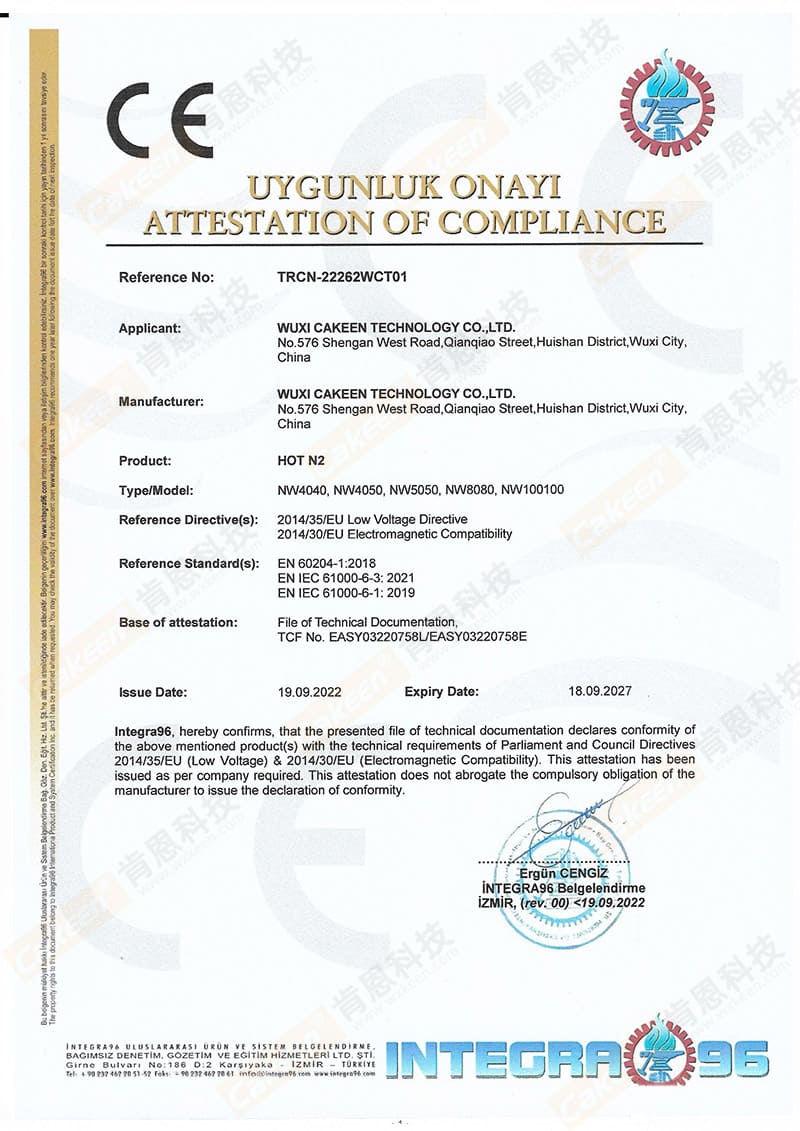
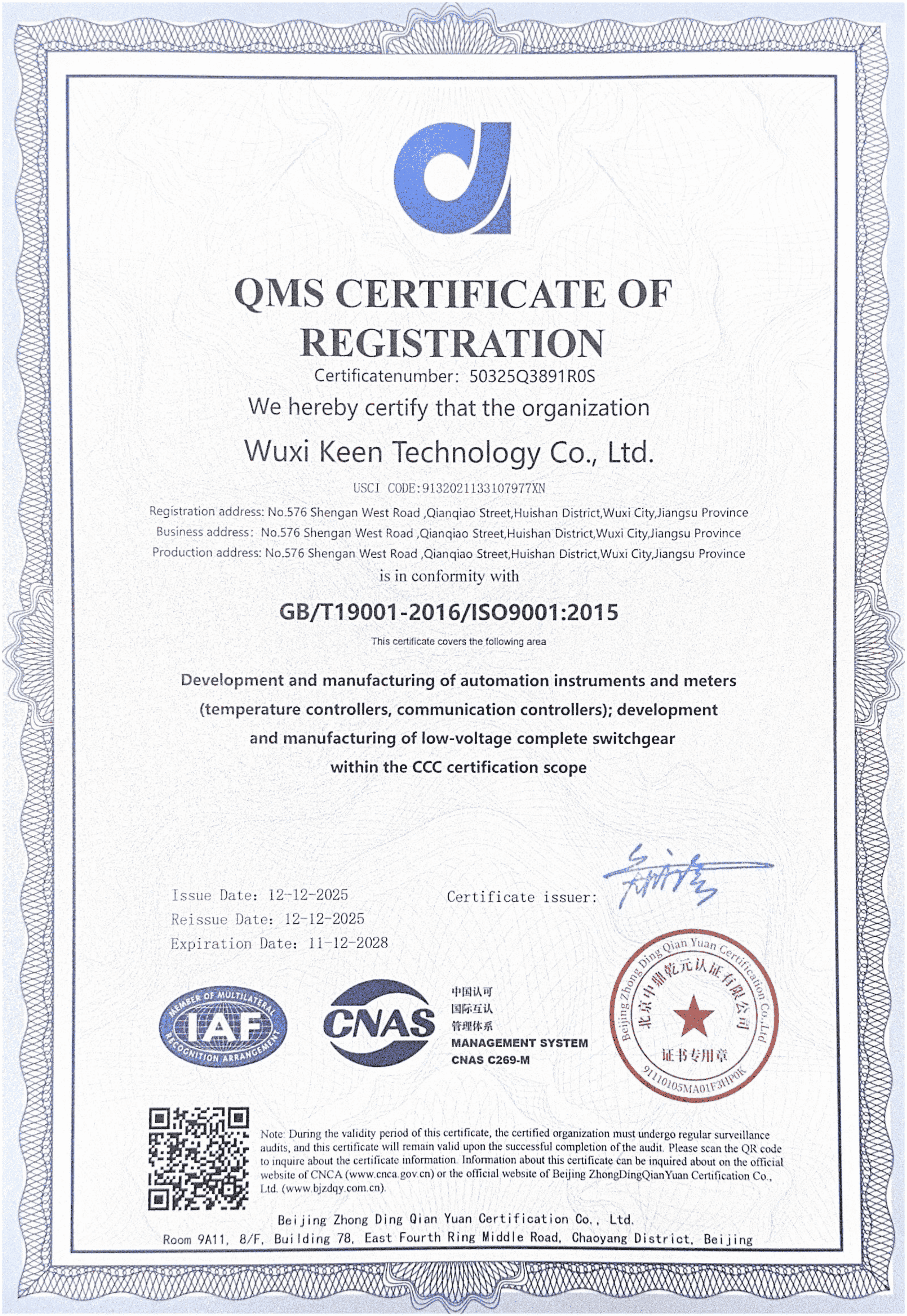
- At manufacturer level, Wuxi Cakeen Technology Co., Ltd. holds ISO 9001 (certificate 50325Q3891R0S), ISO 14001 (50325E3892R0S) and ISO 45001 (50325S3893R0S), issued by Beijing Zhong Ding Qian Yuan Certification Co., Ltd., covering the development and manufacturing of automation instruments and meters including temperature controllers and communication controllers. At module level, the K42CE-D CMS Communication Module holds SEMI S2-0821 certification (certificate 220252) for semiconductor manufacturing equipment safety, along with CE EMC certification (CEJS22011335967); the K15DT-D I/O expansion module holds CE EMC certification (CEJS22011335968); and the HOT N2 MFC gas flow controller holds CE certificate TRCN-22262WCT01 against EN 60204-1:2018. Industrial control panels are expected to meet UL 508A for North America and IEC 60947 internationally, per UL Solutions.
- How many control channels can one Cakeen PID controller handle, and how is that extended?
- Cakeen supports both single-channel and four-channel architectures. The KE-48, KE-H10, H6625 and ASH are single-channel controllers; the KE-2104 is a four-channel DIN rail controller on a DIN35 rail with external SSR output and 12–24 V DC supply. Where more signal capacity is required, the K42CE-D CMS Communication Module provides six RS485 ports plus one Ethernet port with Modbus TCP/RTU, and the K15DT-D expansion module adds five NPN inputs/outputs over Modbus RTU.
- What drives the cost of an OEM PID controller program?
- Cost follows configuration rather than catalogue position: channel count, output type (built-in SSR versus external SSR versus analog), form factor, sensor input breadth, communication and I/O modules, the scope of customization, and program volume. Cakeen provides OEM and ODM production services, with all parameters, logos and appearance functions supporting customization, a lead time in the 30–45–days class, monthly capacity of 40,000 units, and remote after-sales support. Because these variables move together, the most accurate way to compare quotations is to fix the nine sizing answers first and then compare like for like.
- What is the minimum order quantity, and how is a unit validated before shipment?
- The minimum order quantity for controller OEM programs is 500 units. Quality control is 100% test, and acceptance is based on 100% pre-shipment test, so validation is performed unit by unit rather than by sample lot. Delivery methods include FOB, CIF and EXW, and export markets include Spain, Southeast Asia, the European Union and the USA.
- How long does delivery take, and what support continues afterwards?
- Lead time is in the 30–45–days class, with monthly capacity of 40,000 units for controller programs. Remote after-sales support is provided after delivery. If you would like the sizing sequence above applied to your own process window, send the nine worksheet answers to the Cakeen team at www.wxkeen.com or jwy@wxkeen.com and request a controller recommendation, catalogue or OEM program review.
Conclusion
A PID temperature controller is matched to a thermal process by five numbers, not by a brand preference: the process window, the accuracy budget, the sensor input, the output type, and the form factor plus control power available in the cabinet. For the 0–250 °C class of jacket, mantle and nitrogen line heating, a ±1 °C process target with a ±0.1 °C controller specification leaves the sensor and the thermal design as the variables worth optimising.
The practical sourcing consequence is simple: choose a controller family that covers both panel mount (KE-48, 48×48 mm, 100–265 V AC) and DIN rail (KE-2104, four channels, 12–24 V DC) so that cabinet layout can change without changing supplier, input list or quality process. That dual form-factor availability, backed by 100% testing, OEM/ODM customization and remote after-sales support, is what an OEM should be buying alongside the controller itself.
Next step
Send your nine sizing answers to the Cakeen engineering team and request a controller recommendation, a product catalogue or an OEM program review.
Email: jwy@wxkeen.com | Tel: +86-0510-85161878 / +86-18921139517 | WhatsApp: +86 18921139517 | www.wxkeen.com