
Nitrogen Pipeline Anti-Condensation: A PID Temperature Controller Manufacturer Scenario
The nitrogen header feeding a semiconductor thermal process is the last place a process team expects a wet spot. The line is dry, the gas is inert, and the flow controller is holding setpoint. Yet after the low-flow shift, the drop leg shows liquid, the insulation under the regulator is damp, and the heated section is cycling more than it did the week before.
This article works through that project as a scenario: a thermal processing team troubleshooting condensation and unstable heating in a nitrogen gas pipeline, the diagnosis they reach, and the control architecture they specify. The answer is not one part. It is a two-layer thermal strategy — heat the gas with a pipeline nitrogen heater, hold the pipe wall above the dew point with heating-tape control — joined by a single PID control, communication and monitoring layer.
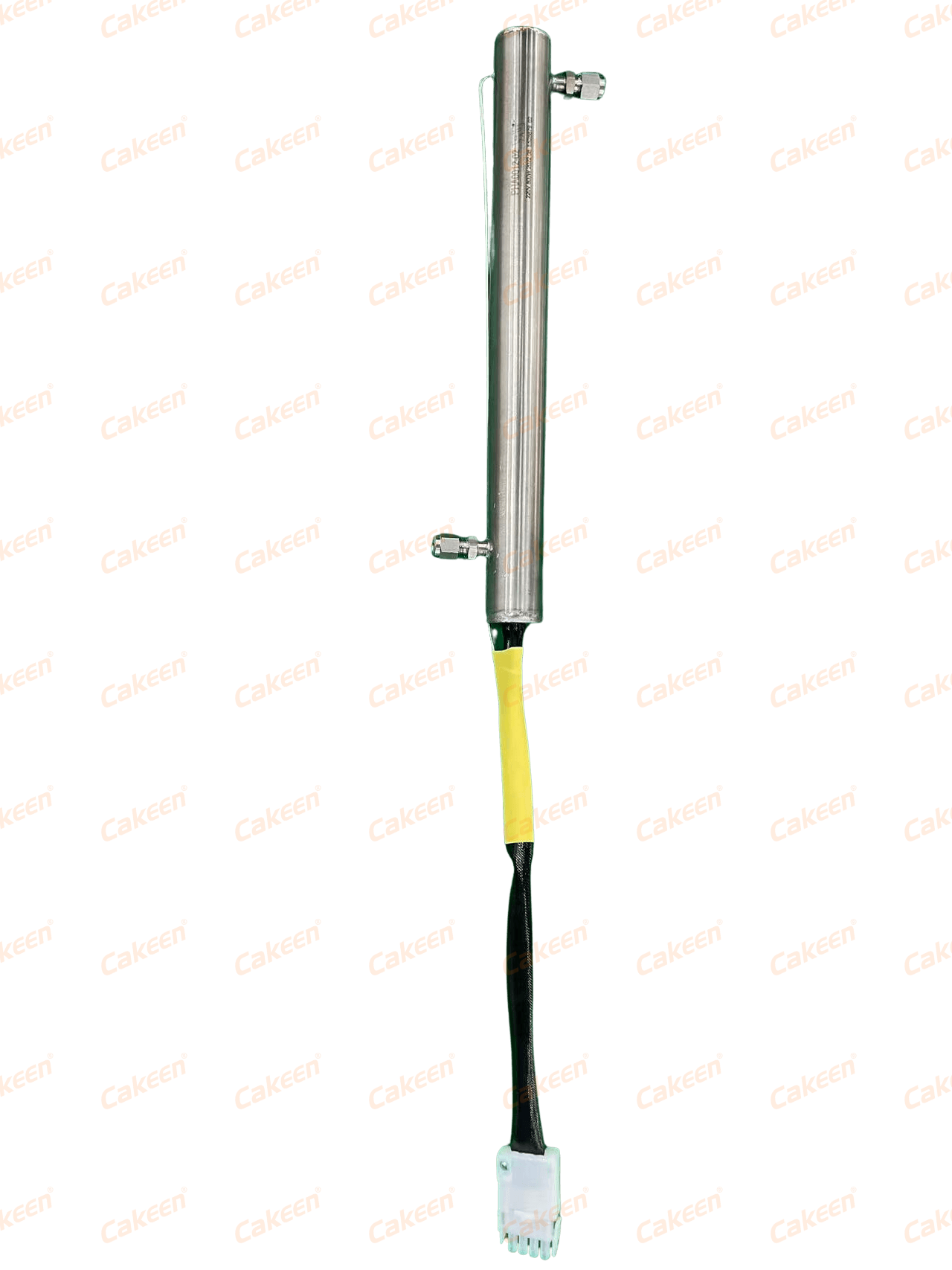
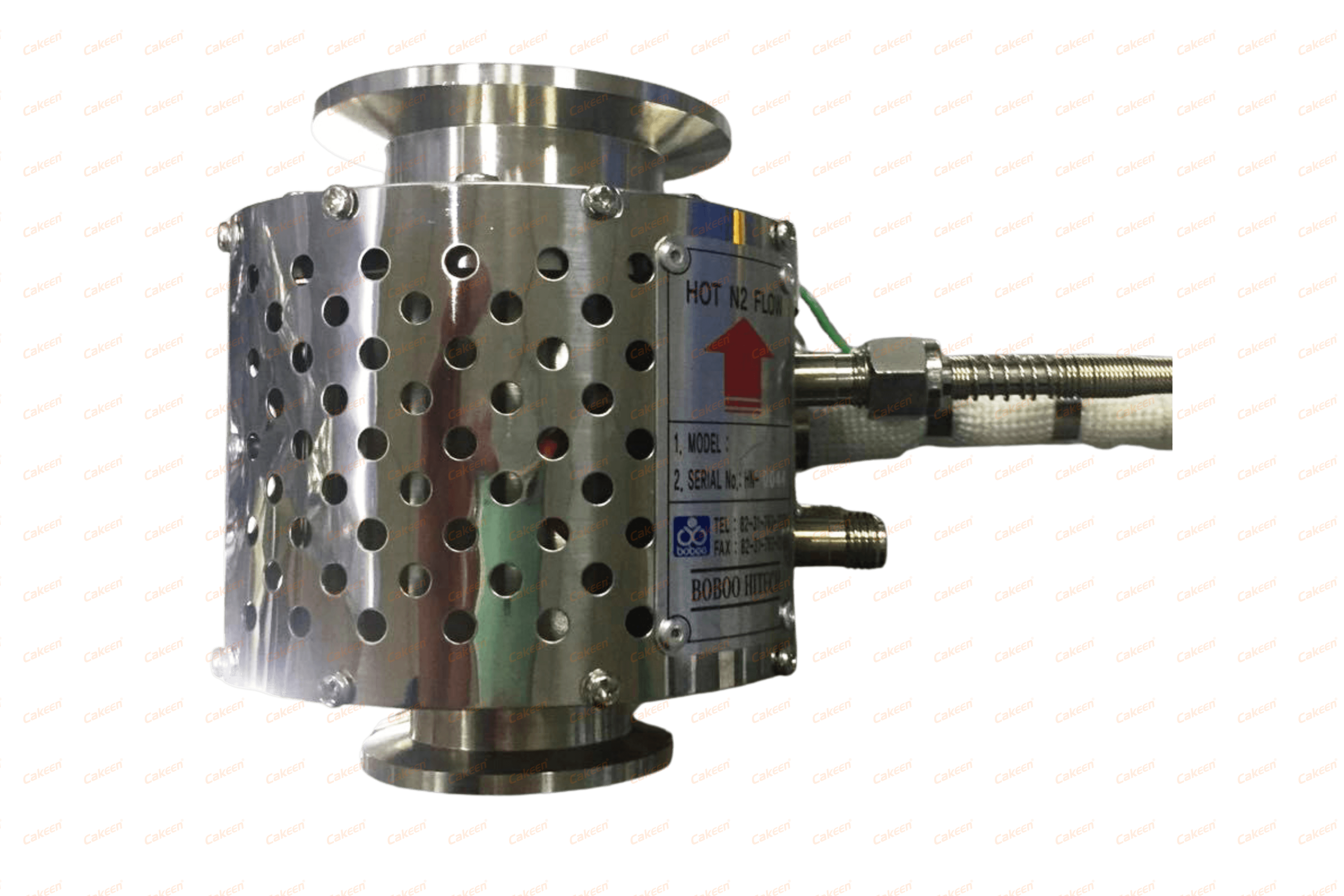
Short answer: Cakeen's HOT-GUN Pipeline Nitrogen Gas Heater covers 0–250 °C at ±1 °C control accuracy on AC 220 V with 800 W–1600 W of heating power, in stainless steel or high-temperature alloy, and is designed for pipeline nitrogen heating and anti-condensation on pipe walls in semiconductor thermal processing equipment. It is driven by DIN rail or panel mount PID controllers (KE-2104 four-channel, KE-48 48×48 mm, both ±0.1 °C), networked through the K42CE-D CMS communication module (6× RS485, 1× Ethernet, Modbus TCP/RTU) with K15DT-D I/O expansion, and logged in Cakeen's CMS monitoring software.
Problem Definition: Condensation and Heating Drift Are Two Different Faults
In a pipeline nitrogen system, condensation and unstable heating tend to surface together but do not share a cause. Treating them as one problem is why the first fix often fails: raising the heater setpoint warms the gas, while the cold surface that is actually condensing sits downstream of the heater and never sees the change.
Cakeen specifies the HOT-GUN for exactly this working condition — pipeline nitrogen heating, anti-condensation on pipe walls, and a medium-high temperature environment — inside semiconductor thermal processing equipment. Separating the two failure modes is the first diagnostic step.
- Heat loss at fittings, not along the run. Regulators, filters, valve bodies and unheated drop legs lose heat far faster than an insulated straight run. The coldest surface on the line is usually a component that was never instrumented, so the loop reads stable while the wall condenses.
- Low-flow periods invert the heat balance. When a tool runs at low nitrogen flow, convective heat transfer from gas to wall drops sharply. A heater that holds temperature at high flow can look ineffective at low flow, because less energy is carried downstream to keep the wall warm.
- On/off control overshoots, then undershoots. Without a properly tuned closed loop, the heater overshoots setpoint, the controller cuts power, and the wall cools again. The visible symptom becomes thermal cycling rather than a clean offset.
- Sensor placement misrepresents the zone. A single thermocouple on the heated section says nothing about wall temperature two metres downstream, which is where the dew-point margin is actually decided.
- No history means no diagnosis. Without logged PV/SV trends and alarm timestamps, night-shift drift cannot be separated from a genuine control fault.
Industry Background: Why N2 Line Thermal Control Is Now a Specified Subsystem
Thermal control on gas delivery lines has moved from "insulate it and add a thermostat" to a specified subsystem with networked controllers, defined alarm thresholds and retained data. The market context reflects that shift.
- The global semiconductor temperature control equipment market was valued at USD 663 million in 2024, a figure driven by the precision required in wafer fabrication (Market Research Reports).
- The global PID controller market was valued at USD 1.60 billion in 2024 and is projected to reach USD 2.24 billion by 2032 (SNS Insider).
- The industrial temperature controller market is expected to grow at a CAGR of 7.1% from 2024 to 2030, driven by Industry 4.0 adoption (Strategic Market Research).
- Asia-Pacific held a 38.2% revenue share of the temperature controller market in 2023, with China as a key manufacturing hub (Dataintelo).
- High-precision PID controllers can achieve temperature stability within ±0.1 °C, a requirement described as critical for semiconductor lithography and etching (Grand View Research).
For a project team, the practical consequence is that a heated nitrogen line is now evaluated like any other process subsystem: stable setpoint, defined alarm behaviour, network integration, and evidence that can be shown during a maintenance review. Operation is typically 24/7 continuous or on demand per process, which is why the control layer — not just the heater — carries the reliability burden.
Detailed Solution: A Two-Layer Heated Nitrogen Pipeline Under One Control Layer
Layer 1 — Heat the gas with a pipeline nitrogen heater
The HOT-GUN is a pipeline N2 heating controller built for anti-condensation. Its function is to hold the nitrogen stream above the dew point of residual moisture and carryover so that nothing condenses on the pipe wall, and to deliver a stable hot N2 environment to the process.
- Temperature range: 0–250 °C
- Control accuracy: ±1 °C
- Working voltage: AC 220 V
- Heating power: 800 W–1600 W
- Material: stainless steel / high-temperature alloy
- Matched equipment: nitrogen pipeline system, temperature sensors, power distribution panel
- Operation mode: 24/7 continuous or on demand per process
- Application: semiconductor thermal processing equipment; pipeline heating system
Layer 2 — Hold the pipe wall above the dew point with heating-tape control
Gas heating alone leaves the wall vulnerable at fittings and low-flow sections. The second layer is wall heating, controlled by the same PID hardware family. These controllers are built for pipe and vessel insulation and heating and share a common input list — PT, K, J, R, S, T, B, E, N and L sensors — with ±0.1 °C control accuracy.
- ASH: a heating-tape PID temperature controller for pipe and vessel insulation and heating, with built-in SSR output rated to a maximum of 3 A, RS485 / Modbus RTU communication, and a 100–265 V AC supply.
- H6625: a mini heating-tape PID temperature controller with the same 3 A built-in SSR output and RS485 / Modbus RTU interface, sized for space-constrained installations such as valve blocks and short drop legs.
- KE-H10: a heating-tape PID controller rated to a maximum of 6 A of built-in SSR output, intended for high-power tape on high-temperature pipeline delivery and chemical insulation.
The controller requirement does not change when the heated element is a jacket or a mantle rather than a tape: a compatible sensor input, a solid-state output sized to the element current, and a serial interface for monitoring. That is the practical definition of a heating jacket temperature controller or a heating mantle temperature controller in this architecture — the heating element changes form, the control loop does not.
Choosing the controller form factor: DIN rail or panel mount
Both mounting styles solve the same control problem from different directions, and the choice follows the cabinet, not personal preference.
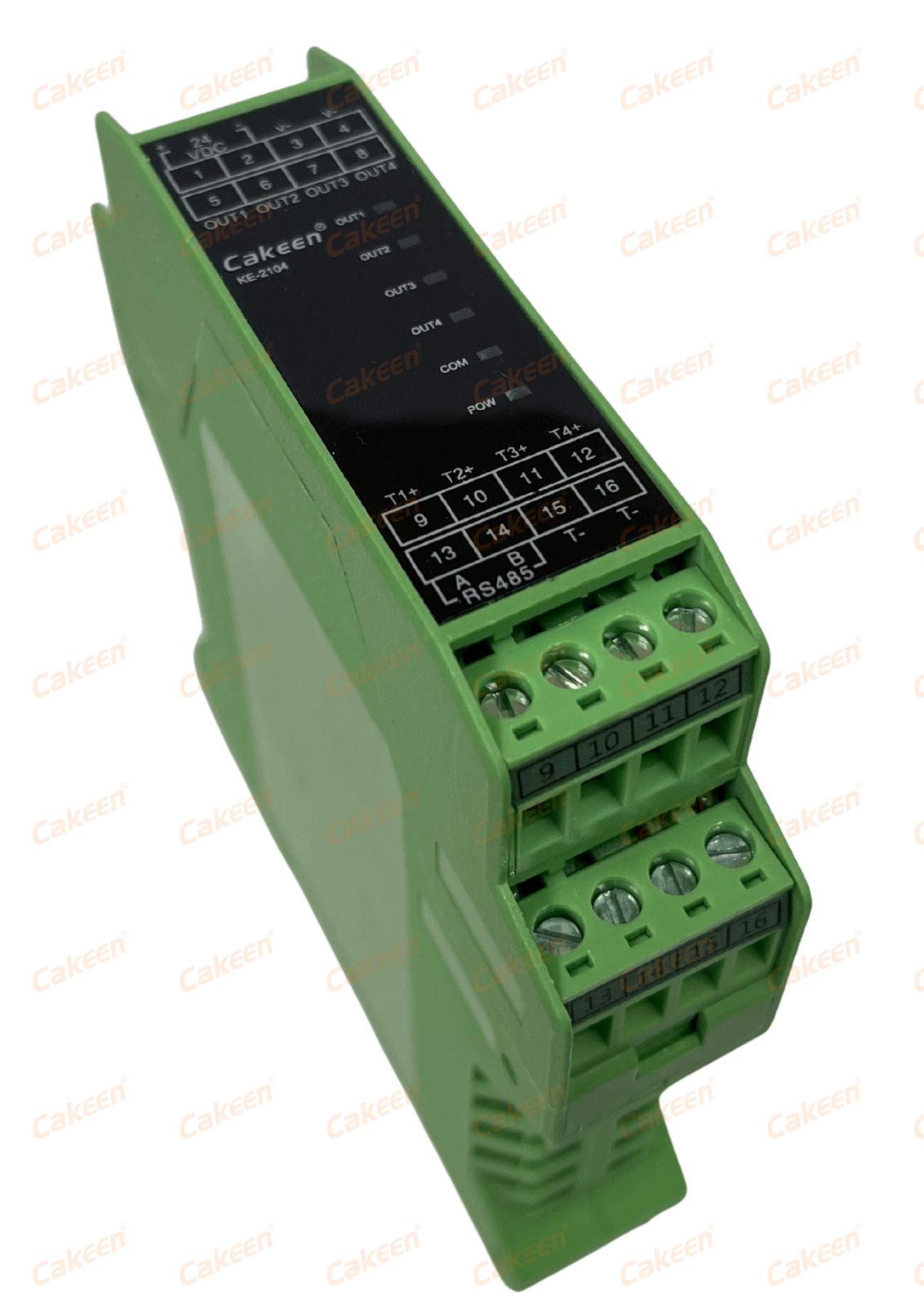
- KE-2104 (DIN rail mount, four-channel PID controller): four control channels in one DIN35 rail module, ±0.1 °C control accuracy, the full PT/K/J/R/S/T/B/E/N/L input list, external SSR output, and a 12–24 VDC supply. It suits a control cabinet where several heated zones — gas heater plus two or three tape zones — must be regulated from one footprint and one DC bus.
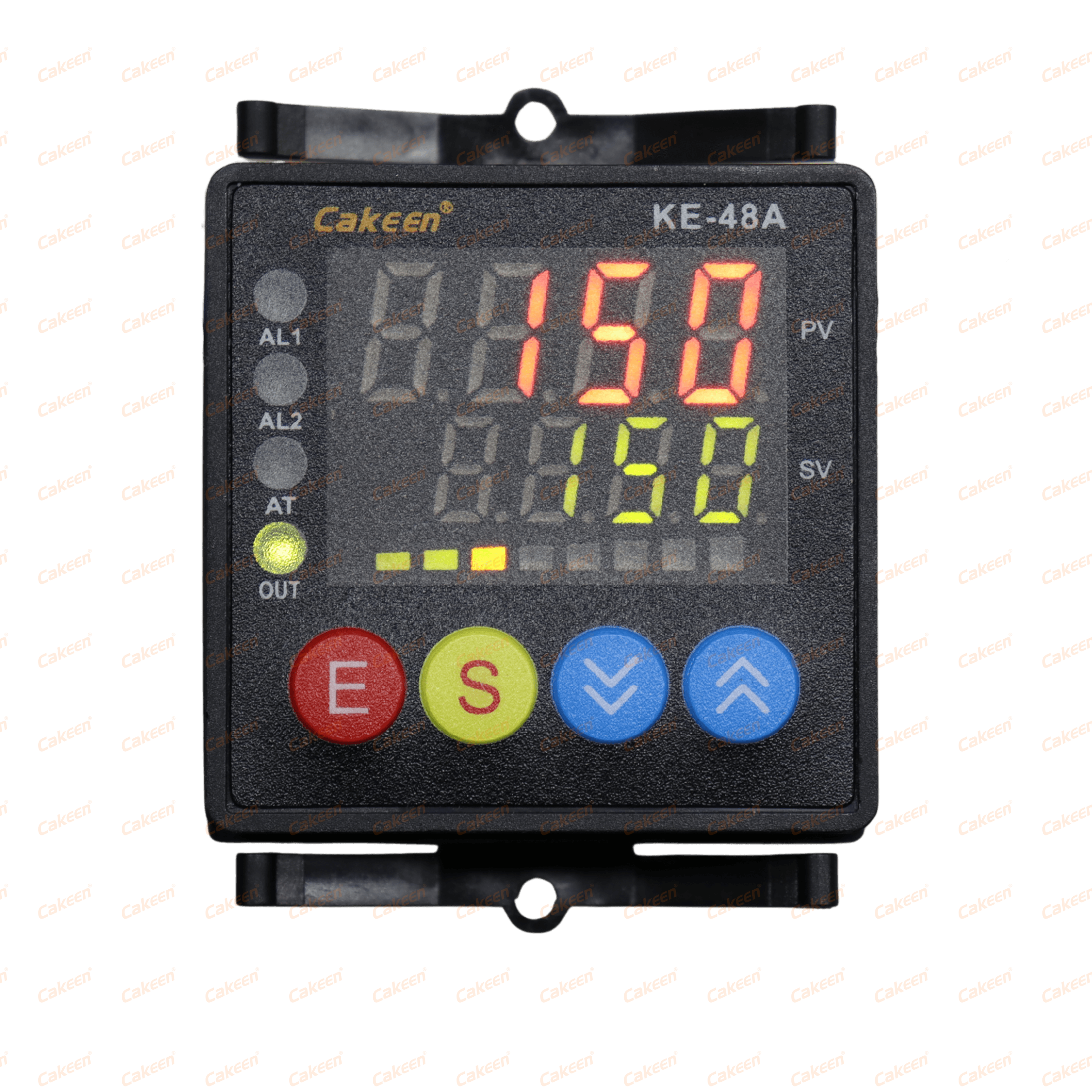
- KE-48 (panel mount, 48×48 mm): a single-channel controller with ±0.1 °C accuracy, the same sensor input list, and selectable outputs of SSR, 0–20 mA, 4–20 mA or 0–10 V, plus one RS485 port and a 100–265 V AC supply. It suits a machine front panel, a local operator station, or a loop that drives an analog actuator instead of a solid-state relay.
Cakeen's project records show how the two are combined in practice. A semiconductor equipment OEM embedding temperature control into CVD, etching and diffusion equipment has taken 50+ units per year for more than four years, using the KE-48 compact 48×48 mm panel mount where the machine design requires a front-panel reading, and the KE-2104 four-channel DIN rail unit where cabinet space is the constraint. The recorded outcomes are equipment uptime improvement and consistent process temperature across all chambers.
The communication layer: 6 RS485 ports, 1 Ethernet port, and why the count matters
A heated nitrogen line is rarely one device. A realistic count on a single line includes the gas heater loop, two or three heating-tape controllers, a gas flow controller such as the HOT N2 MFC (±1% F.S. flow accuracy, 1–100 SLM range, stainless steel body, for semiconductor process gas delivery), and possibly a legacy panel instrument. Each of those is an RS485 device, and each one needs parameter setting and data collection.
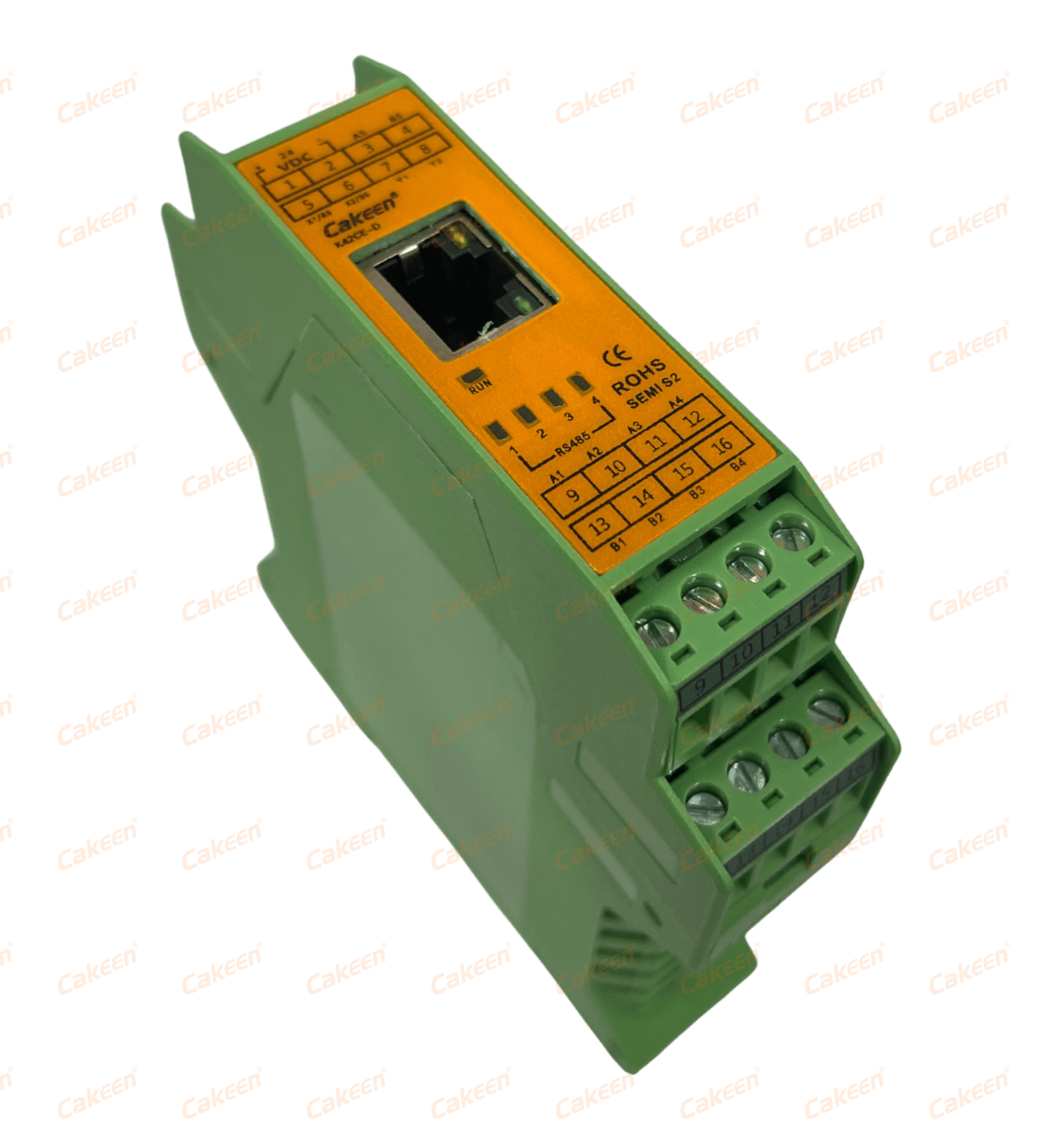
- K42CE-D CMS communication module: 6× RS485 ports plus 1× Ethernet port, Modbus TCP/RTU protocol, 2× NPN I/O, 12–24 VDC supply, DIN35 rail mounting. Its design targets are multi-RS485 device networking with low-latency parameter setting, data acquisition and forwarding, and lightweight PLC replacement scenarios.
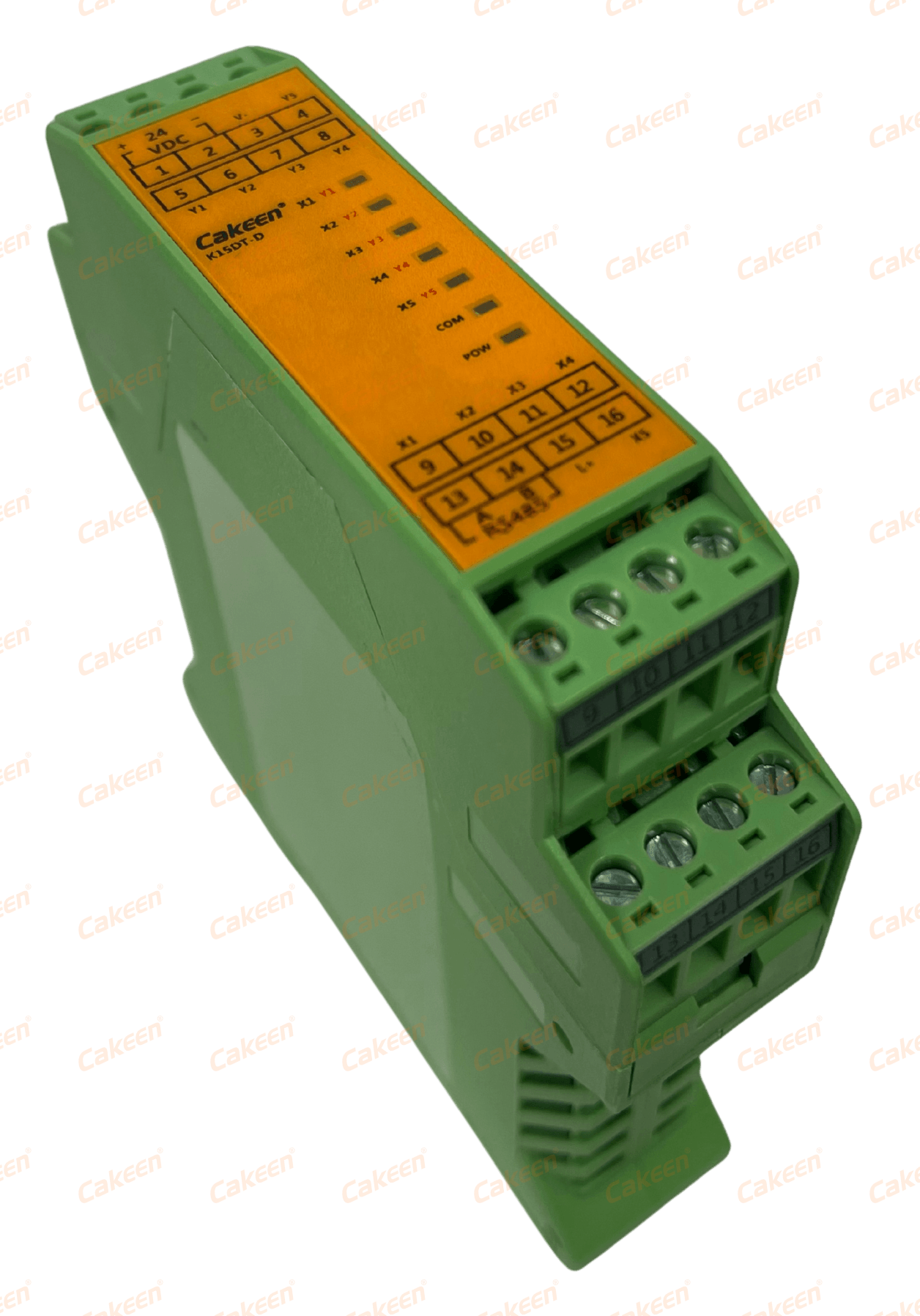
- K15DT-D I/O expansion module: 5 inputs and 5 NPN outputs on Modbus RTU, 12–24 VDC, DIN35 rail mounting, in a flame-retardant engineering plastic housing. It covers switching control and remote I/O expansion — purge valves, dry-contact alarm outputs, panel switches and status signals — without adding a second controller layer to the cabinet.
The network decision is straightforward. If the loops sit in one cabinet and the plant network is Ethernet-based, the K42CE-D concentrates six serial segments onto one Ethernet connection so the cabinet stops accumulating serial converters. If the loops are distributed along the line, Modbus RTU segments keep the wiring simple and the module forwards the data upward.
Monitoring: turning a fixed pipeline into a measurable one
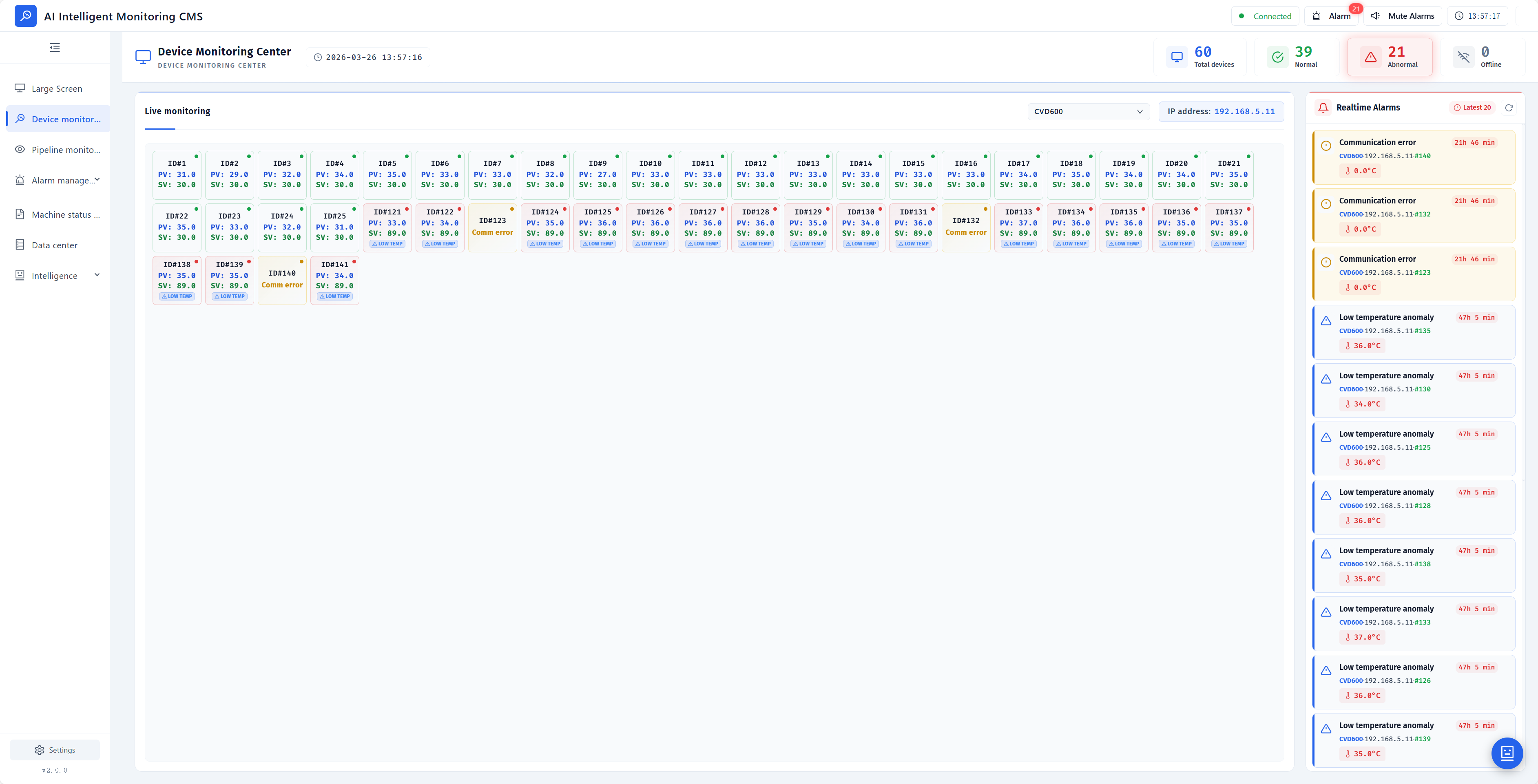
The final element is retention. Cakeen's Industrial Device Central Monitoring System (CMS) supports 10,000+ Modbus TCP devices with a 10-second polling interval, monitors PV/SV temperature, AL1/AL2 alarm thresholds and TC BK sensor values, and retains a 365-day time-series history in InfluxDB.
For the scenario in this article, that combination answers the questions the team could not answer on the morning the condensation appeared: what the wall temperature did during the low-flow shift, when the alarm first triggered, and whether the gas heater loop actually held setpoint or merely reported one.
Step-by-Step Breakdown: Specifying the System in Eight Steps
- Map the line and find the coldest surfaces. Walk the route and list every component that is not heated: regulators, filters, valve bodies, drop legs, instrument tees. Those are the candidate condensation points.
- Set the thermal target. Define the process gas temperature required at the point of use, and the minimum acceptable wall temperature along the run. The HOT-GUN range of 0–250 °C covers medium-high temperature pipeline heating; the wall target is what the tape loop must hold.
- Size the heater. Match heating power to the line — the HOT-GUN is offered from 800 W to 1600 W on AC 220 V — and confirm the power distribution panel can supply it.
- Split the loops. Decide which zones are gas-heated (HOT-GUN) and which are wall-heated (ASH, H6625 or KE-H10). A single loop covering both will hide one fault behind the other.
- Choose the controller form factor and channel count. Four zones in one cabinet footprint → KE-2104 on DIN35 rail with a 12–24 VDC supply. One loop with a local display or an analog actuator → KE-48, 48×48 mm, with SSR / 0–20 mA / 4–20 mA / 0–10 V output.
- Select sensors and alarms. Choose from the supported input list (PT/K/J/R/S/T/B/E/N/L) for each zone, and define AL1/AL2 thresholds so the alarm fires on a dew-point margin rather than on a heater fault.
- Decide the network topology. Six RS485 segments onto one Ethernet connection via K42CE-D, or Modbus RTU along the line; add K15DT-D where discrete inputs and NPN outputs are needed for valves and status signals.
- Commission with logging enabled. Verify setpoint stability at both high and low flow, confirm alarm behaviour, and check that CMS is recording PV/SV values and alarm history before the system is handed to operations.
Use Cases: Where This Architecture Fits
Semiconductor thermal processing lines. The primary case is a nitrogen delivery line feeding a furnace, etching or diffusion process, where the HOT-GUN heats the gas and the control layer regulates both the gas loop and the wall loops. This is the configuration the HOT-GUN is specified for: pipeline nitrogen heating, anti-condensation on pipe walls, a medium-high temperature environment, in semiconductor thermal processing equipment.
Space-constrained retrofits. Valve blocks, short drop legs and crowded tool enclosures rarely have room for a full-size controller. The H6625 mini heating-tape controller keeps the built-in SSR output at 3 A and RS485 / Modbus RTU communication while fitting where a larger unit will not.
High-power pipeline and chemical insulation. Where the tape load is heavier — high-temperature pipeline delivery and chemical insulation environments — the KE-H10 raises built-in SSR output to a maximum of 6 A while keeping the same ±0.1 °C accuracy, sensor input list and Modbus RTU interface.
OEM machine builds. Equipment builders embedding temperature control into their own machines typically place the KE-48 on the operator panel and the KE-2104 in the cabinet, then expose both through a single serial or Ethernet path. This mirrors the OEM project pattern in Cakeen's case history: 50+ units per year over four-plus years in CVD, etching and diffusion equipment, with cabinet space and front-panel readability as the two stated design drivers.
Comparison Table: Matching Hardware to the Pipeline Task
| Item | Type | Channels | Accuracy | Output | Communication | Power supply | Mounting |
|---|---|---|---|---|---|---|---|
| KE-2104 | PID temperature controller | 4 | ±0.1 °C | External SSR | — | 12–24 VDC | DIN35 rail |
| KE-48 | PID temperature controller | 1 | ±0.1 °C | SSR / 0–20 mA / 4–20 mA / 0–10 V | 1× RS485 | 100–265 V AC | Panel mount, 48×48 mm |
| ASH | Heating tape PID controller | 1 | ±0.1 °C | Built-in SSR, max 3 A | RS485 / Modbus RTU | 100–265 V AC | — |
| H6625 | Mini heating tape PID controller | 1 | ±0.1 °C | Built-in SSR, max 3 A | RS485 / Modbus RTU | 100–265 V AC | — |
| KE-H10 | Heating tape PID controller | 1 | ±0.1 °C | Built-in SSR, max 6 A | RS485 / Modbus RTU | 100–265 V AC | — |
| K42CE-D | CMS communication module | 2× NPN I/O | — | Data acquisition and forwarding | 6× RS485 + 1× Ethernet, Modbus TCP/RTU | 12–24 VDC | DIN35 rail |
| K15DT-D | I/O expansion module | 5 inputs / 5 NPN outputs | — | Switching control | Modbus RTU | 12–24 VDC | DIN35 rail |
| HOT-GUN | Pipeline N2 heating controller | — | ±1 °C | Heating, 800 W–1600 W | — | AC 220 V | — |
All controller models in the table accept PT, K, J, R, S, T, B, E, N and L sensor inputs. The “—” entries indicate parameters that are not stated in the corresponding product specification.
FAQ: What Buyers Ask Before Specifying a Heated N2 Line
1. What compliance requirements apply to a nitrogen pipeline heating and PID control system?
Industrial control panels, including PID controllers, must comply with UL 508A for North American safety listing and IEC 60947 for international markets (UL Solutions). At component and system level, Cakeen's products carry ISO9001, ISO14001 and ISO45001 management certifications plus UL, SEMI S2, CE and ROHS certifications, and the company's electrical cabinets are available with CE certification and optional UL configuration. For an export project, the compliance decision should be made at panel level, not only at controller level.
2. Can one PID controller regulate several heated zones on the same nitrogen line?
Yes, within the channel count. The KE-2104 is a four-channel DIN rail controller with ±0.1 °C accuracy and external SSR output, so a gas heater loop plus two or three tape zones can be regulated from one module on a 12–24 VDC supply. Where a loop needs a local display or an analog actuator output, the KE-48 single-channel panel controller provides SSR, 0–20 mA, 4–20 mA or 0–10 V output with one RS485 port. Multi-zone lines are also where the K42CE-D matters: 6× RS485 ports and 1× Ethernet port bring the controller group and the flow controller onto Modbus TCP/RTU for the monitoring layer.
3. What drives the cost of a pipeline anti-condensation control system?
Cost is driven by the number of regulated zones rather than by the heater alone. The main variables are how many zones require gas heating versus wall heating, whether the controllers are four-channel DIN rail units or single-channel panel units, whether the line needs the K42CE-D communication module and K15DT-D I/O expansion, how many sensors and cable runs the route requires, and what certification level the panel must meet. Because these systems are built project by project, Cakeen supports OEM/ODM configuration in which all parameters, logo and appearance can be customized, with MOQ options of 5 units and 500 units depending on the product line.
4. Can a buyer validate the design before committing to a full rollout?
The practical route is a single-zone build: specify one gas-heating loop and one wall-heating loop, then verify setpoint stability at both high and low flow, confirm that AL1/AL2 thresholds behave as intended, and confirm that CMS records PV/SV values and alarm history. Each unit is 100% tested before shipment, and remote support is provided after delivery. To start that validation, send the pipeline parameters — line size, target gas temperature, wall temperature margin, number of zones and required communication protocol — to Cakeen at jwy@wxkeen.com or WhatsApp +86 18921139517, and the team will confirm the heater and controller configuration for your line. The full product range and specifications are also listed at www.wxkeen.com.
5. What is the production and delivery lead time?
Standard lead time is 30–45 days, and every unit undergoes 100% testing before shipment. Monthly production capacity is 40,000 units on one product line and 80 units on another, depending on the configuration, which is why MOQ and lead time should be confirmed against the specific build rather than assumed from a catalogue. Remote after-sales support is provided for exported systems.
Conclusion: Two Layers, One Loop, One Log
The scenario resolves when the team stops treating condensation and unstable heating as a single fault. The gas is heated by the HOT-GUN pipeline nitrogen gas heater (0–250 °C, ±1 °C, AC 220 V, 800 W–1600 W, stainless steel / high-temperature alloy); the pipe wall is held by heating-tape control (ASH, H6625, KE-H10, ±0.1 °C, RS485 / Modbus RTU); the loops are regulated by the form factor that fits the cabinet (KE-2104 four-channel DIN rail, KE-48 48×48 mm panel); and the whole system is networked and recorded through the K42CE-D communication module, K15DT-D I/O expansion and Cakeen's CMS software.
The decision rule is simple. If the wall temperature is not measured, an anti-condensation claim cannot be verified. If the loop is not logged, the next low-flow shift will look exactly like the last one. Cakeen (Wuxi Cakeen Technology Co., Ltd.), established in 2011 and based in Huishan District, Wuxi, Jiangsu Province, builds these components as a single temperature control system rather than as separate parts — from controller manufacturer supply through to monitoring software.
Next step: If your nitrogen line shows condensation at fittings or unstable heating on the heated section, send the line parameters for a configuration review, quotation or sample discussion.
Email: jwy@wxkeen.com · Tel: +86-0510-85161878 / +86-18921139517 · WhatsApp: +86 18921139517 · Website: www.wxkeen.com
Address: No.576 Shengan West Road, Qianqiao Street, Huishan District, Wuxi City, Jiangsu Province, China.
Have Questions or Need More Details?
Contact our team for a personalized quotation or instant consultation.
Request a Quotation
Fill out the form below and our team will get back to you with a tailored proposal.
WhatsApp Direct Chat
Prefer to chat in real-time? Message us on WhatsApp for instant assistance & quick answers.
- Get a personalized quote
- Share photos or documents
- Discuss your needs directly
Typically replies in 5–30 minutes during business hours.