
Automating NGS Library Prep with Magnetic Racks: A Step-by-Step Application Guide
Automating NGS Library Prep with Magnetic Racks: A Step-by-Step Application Guide

A magnetic rack is the fixture that decides how repeatable an automated NGS library prep workflow can be. The rack holds the magnetic field in a fixed position while a liquid handling robot aspirates, dispenses, mixes and elutes. If the rack’s labware format, magnet geometry and deck footprint do not match the robot’s pipetting path, bead recovery becomes variable well by well, and a plate-level failure is the result.
This guide walks through the practical setup for running magnetic bead separation on an automated platform: how 0.2 mL PCR tube racks and 96-well plate racks fit a robot deck, how single-dispense, multi-dispense and dilution modes behave around a bead pellet, how to define CV-based acceptance before scaling a sequencing pipeline, and how to treat the rack itself as a long-term supply item rather than a consumable bought once.
Problem Definition: Why Separation, Not Pipetting, Breaks Automation First
Automated liquid handling solves the transfer problem in NGS library prep. It does not automatically solve the separation problem. Magnetic bead chemistry depends on a physical event: beads must be pulled out of suspension and held in a stable pellet while liquid is removed. That event is controlled by hardware the robot does not move.
- Pellet position is fixed by the rack, not by the protocol. Where the magnet sits defines where beads collect. The robot’s pipetting path is fixed too, and the two have to be designed around each other.
- Small per-well losses compound at plate scale. A minor aspiration error that is tolerable in a single tube becomes a whole-plate recovery shift when 96 wells run in parallel.
- Partial resuspension is invisible until sequencing. If an aspiration tip disturbs the pellet, the effect appears later as reduced library yield or an inconsistent insert-size distribution, not as an error message on the robot.
- Volume limits appear above plate scale. Large-scale biomagnetic separation systems for volumes up to 20 L–50 L are increasingly required for production consistency, because traditional rack designs cause irreversible aggregation at high volumes (Sepmag).
- Environmental exposure adds another failure mode. Where a protocol calls for a temperature-resistant magnetic rack or a corrosion-resistant magnetic rack, ask for documented material compatibility for the specific buffers and incubation temperatures in use; a standard rack is not automatically suited to either condition.
The practical conclusion is simple: once a workflow is automated, the magnetic rack stops being a general-purpose accessory and becomes a specification item with tolerances, geometry and acceptance criteria.
Industry Background: Why Separation Hardware Now Gates Throughput
Demand for magnetic bead separation racks and separators is being pushed by the same applications that turned NGS into a production activity rather than a research technique.
- The global magnetic beads market, on which all separation systems depend, is projected to reach USD 9.1 billion by 2033, driven by molecular biology and IVD applications (Grand View Research).
- In-vitro diagnostics remains the largest application for magnetic beads, accounting for approximately 60.5% of the revenue share in 2025 (Grand View Research).
- The cell isolation market was estimated at USD 6.8 billion in 2024, with a projected CAGR of 17.8% through 2035 (Market Research Future).
- Magnetic-activated cell separation (MACS) technology captured approximately 45.02% of the cell isolation market share in 2025 (Intel Market Research).
- Magnetic separation devices intended for clinical use must operate within quality management systems complying with ISO 13485:2016 and EU IVDR 2017/746 (ISO / European Commission).
Two consequences follow for lab and production teams. First, separation steps are no longer a manual bottleneck that scales with headcount; they are expected to run on automated platforms, in plate formats, with documented quality. Second, the automation platforms themselves have matured. Automated liquid handling robots in single-channel and 8-channel configurations commonly offer single-dispense, multi-dispense and dilution modes, which means the robot can already perform the liquid-handling half of a bead cleanup. What determines the outcome is the interface between those modes and the separation hardware.
Detailed Solution: Rack Formats Built for Automated NGS Workflows
Carbonlinkai is the brand of Guangzhou Carbon Link Intelligent Technology Co., Ltd, a life-science instrument manufacturer founded in 2020 that produces magnetic racks, magnetic bead separation racks, large-volume magnetic bead separators, vacuum centrifugal concentrators and automated liquid handling robots, and that runs magnetic rack OEM and ODM programmes. The company operates a 700㎡ production facility with a 17-engineer R&D team and an annual output of 1,000,000 units, an export ratio of 30%, and products sold to 25 countries and regions. Its rack and instrument lines are supplied to NGS and medical testing organisations including BGI, Vazyme, Yeasen Biotechnology, Autobio Diagnostics, HaploX Biotechnology, KingMed Diagnostics, Daan Diagnostics and CWBio, alongside research institutions such as Peking Union Medical College Hospital, Tsinghua University and Shanghai Jiao Tong University.
For automated NGS library prep, the relevant part of that portfolio is plate and tube format coverage. A robot deck has to hold the same physical format the chemistry was validated in, and the magnet has to be positioned so the pellet forms outside the pipetting path.
- 96-well plate formats — the 96 well microtiter plate magnetic separation rack (M96-C) and the Magnetic Stand-96 (Mag-24W) are plate-format fixtures for bead cleanup and size selection; the Mag-96A uses a side-magnet layout for 96-well plates; a budget replacement magnet plate for Alpaqua-format magnet plates (mb96) covers magnet-plate style workflows.
- 0.2 mL tube formats — the pcr tube magnetic rack (M32) holds PCR tube workflows, and the pcr strip magnetic separator (M0224) covers strip-based batches where a full plate is not economical.
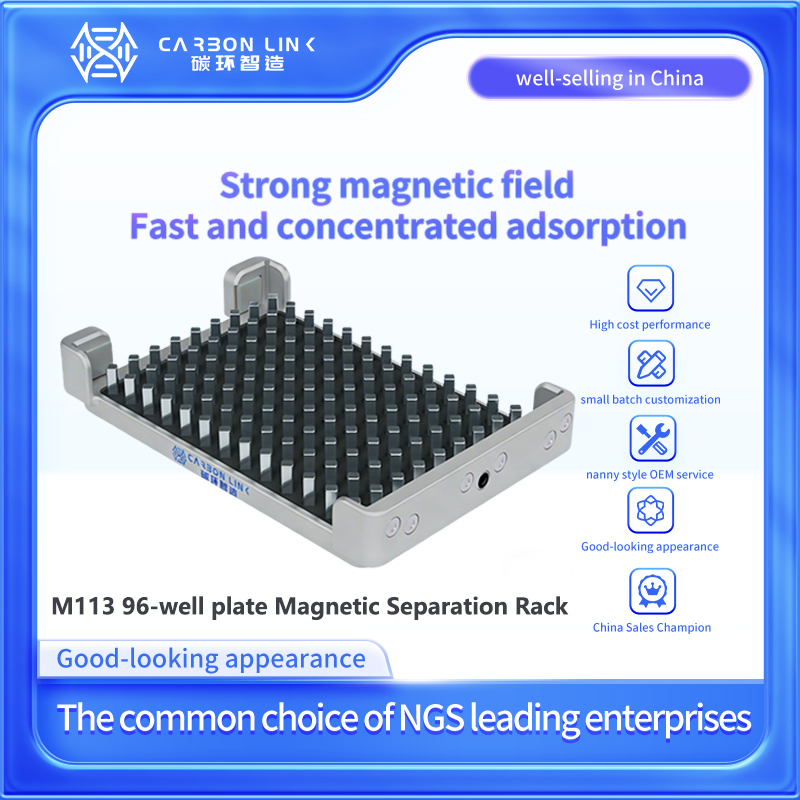
- Larger well volumes within plate format — the 96 Deep Well Plate magnetic separation plate (M113) supports steps that carry more liquid per well than a standard plate allows.
- Scale-up path — the same rack logic continues into large-volume magnetic bead separators spanning 250 mL, 500 mL, 1 L, 2 L, 5 L, 10 L, 20 L and 50 L formats (M250-X through M50L-X), which matter when an NGS production line moves from library prep into bulk reagent and sample processing.
For buyers comparing against an incumbent bench magnet, the commercially relevant reference point is the MAG-16W: Carbonlinkai’s published comparison states that it matches the Thermo DynaMag-2 in performance while being priced at one-third of the competitor’s price. Applications documented for this class of rack include nucleic acid extraction, PCR cleanup, gel recovery, protein purification (tagged proteins and antibodies), immunoprecipitation (IP/Co-IP/ChIP), cell separation, exosome isolation and high-throughput screening.

Step-by-Step: Setting Up a Magnetic Rack for Automated NGS Library Prep
Step 1 — Map every labware format in the protocol before choosing a rack
List the consumables the chemistry actually uses: 0.2 mL PCR tubes or strips for small-batch library prep, 96-well microtiter plates for plate-scale cleanup and size selection, and deep-well plates wherever the protocol carries larger per-well volumes. A rack that covers the wrong format forces a manual transfer step back into the workflow, which defeats the purpose of automation.
Step 2 — Verify deck footprint, height and gripping clearance
Plate-format racks must sit in the robot’s deck position without colliding with pipetting channel travel, the gripper or the plate locator. Check the rack footprint against the deck’s standard labware positions, confirm that the magnet body does not raise the plate height beyond the Z-axis clearance, and confirm the rack can be gripped and relocated if the robot is expected to move it. Height and clearance conflicts are the most common cause of an aborted first run.
Step 3 — Match magnet geometry to the pipetting path
The pellet has to form where the tips will not travel. A bottom-magnet layout concentrates beads at the base of the well; a side-pull layout such as the Mag-96A draws the pellet to one wall so aspiration can be offset. Decide this before writing the robot method, because the aspiration offset, the mixing position and the elution position all follow from the pellet location.

Step 4 — Configure the robot’s dispensing modes against the separation state
Automated liquid handling robots commonly run three dispensing modes, and each one interacts differently with a separated pellet.
| Robot mode | Typical use in library prep | Separation risk to control |
|---|---|---|
| Single dispense | Adding or removing one reagent volume per well | Aspiration depth must clear the pellet, and slower aspiration on the final volume reduces disturbance |
| Multi-dispense | Distributing a shared reagent across a plate | Wells are not re-mixed between dispenses, so any pellet disturbance is carried forward |
| Dilution | Combining sample and diluent in one sequence | Mixing must be suppressed while beads are separated, or resuspension will occur before liquid removal |
The design rule is to keep mixing and separation in separate steps: separate, then aspirate without mixing, then move to the next reagent. Multi-dispense mode is efficient for reagent addition and should never be programmed to displace a pellet that has already formed.
Step 5 — Fix separation timing and mixing windows
Once geometry is fixed, the remaining variables are time and motion: how long the plate stays on the magnet before aspiration, how many mix cycles precede binding, and how long the elution incubations run. Record these values as hard parameters in the method rather than leaving them to operator judgement, because the point of automation is that the same sequence runs identically across runs and plates.
Step 6 — Define CV acceptance criteria before scaling
CV (coefficient of variation) is the metric that tells you whether a rack and robot combination is actually repeatable. Set acceptance criteria at plate level — recovery consistency across columns and rows, and the spread between replicate wells processed in the same run — and measure them with the real bead chemistry rather than a dye. A rack that produces acceptable averages but wide well-to-well spread can still produce libraries that pass yield checks and then fail downstream in sequencing. Define the threshold before the first validation plate, and re-measure it whenever the bead lot, the plate supplier or the rack changes.
Step 7 — Bridge manual and automated separation, then complete acceptance
Run the same chemistry through a manual rack and through the automated plate configuration, and compare recovery and CV. This bridging step isolates whether variation comes from the rack, the robot method or the chemistry. Carbonlinkai’s stated acceptance procedure for magnetic racks gives a workable checklist: inspect the magnetic stand for surface defects, verify dimensions and included accessories, test magnetic attachment and stability, and complete all checks within 7 days of delivery, reporting any issue immediately.
Step 8 — Lock capacity, lead time and OEM terms for the long run
A rack chosen for a validated NGS pipeline becomes a recurring supply item. Documented production capacity for these products is 100,000 units per month for global markets, with 10,000 units per month for certain product lines, a typical lead time of 3–5 weeks, and a minimum order quantity of 20 units for specific product lines. Where the rack has to match an existing deck, an OEM or ODM programme is the more realistic route than repeatedly buying a catalogue item that only approximately fits.
Use Cases: Where Rack-Driven Automation Pays Back
Documented applications for magnetic racks and magnetic bead separation racks include nucleic acid extraction, PCR cleanup, gel recovery, protein purification (tagged proteins and antibodies), immunoprecipitation (IP/Co-IP/ChIP), cell separation, exosome isolation and high-throughput screening. In an automated NGS setting, the practical patterns are:
- Plate-scale library cleanup and size selection. The 96-well plate rack (M96-C) or the Magnetic Stand-96 (Mag-24W) holds the plate while the robot performs bead addition, separation, supernatant removal and elution in one deck layout.
- Small-batch or low-input library prep. The PCR tube rack (M32) keeps 0.2 mL tube workflows automated without forcing a format change to plates.
- Protocols with larger well volumes. The deep-well magnetic separation plate (M113) lets the same 96-format automation carry more liquid per well where the chemistry requires it.
- Cell separation and magnetic cell separation steps. Rack-based separation supports Magnetic Cell Separation workflows, consistent with MACS holding approximately 45.02% of cell isolation market share in 2025 (Intel Market Research).
- Scale-out to production volumes. When a validated library prep line expands into bulk processing, the same separation principle extends into large-volume magnetic bead separation systems from 250 mL to 50 L (M250-X through M50L-X).
A documented case makes the cost side concrete: in a project with a leading NGS company in China, 1,000 units were installed over three years, replacing international magnetic rack brands for NGS magnetic bead separation, with annual cost savings of over 3 million RMB.
Comparison: Separation Options and Reference Points
The first table lists plate and tube formats from the Carbonlinkai rack portfolio that map directly onto automated NGS library prep. The second lists verified third-party reference points buyers can use to position a Chinese-manufactured rack against the wider market.
| Rack format | Labware held | Role in an automated NGS workflow |
|---|---|---|
| pcr tube magnetic rack (M32) | 0.2 mL PCR tubes | Tube-format separation for low- to mid-throughput library prep batches |
| pcr strip magnetic separator (M0224) | PCR strips | Strip-based batches where a full 96-well plate is not economical |
| 96 well microtiter plate magnetic separation rack (M96-C) | 96-well microtiter plates | Plate-scale bead cleanup and size selection on a robot deck |
| 96 Deep Well Plate magnetic separation plate (M113) | 96 deep-well plates | Automation steps carrying larger per-well volumes |
| Magnetic Stand-96 (Mag-24W) | 96-well plates | Plate-format stand for separation steps in plate workflows |
| Mag-96A (side magnet for 96-well plates) | 96-well plates | Side-pull geometry that keeps the pellet out of the aspiration path |
| Budget replacement magnet plate for Alpaqua-format magnet plates (mb96) | 96-well magnet plates | Magnet-plate style workflows requiring a plate-conforming fixture |
| Reference point | Verified fact | Source |
|---|---|---|
| Carbonlinkai MAG-16W | Documented as matching the Thermo DynaMag-2 in performance at one-third of the price | Carbonlinkai product comparison |
| Thermo Fisher CTS DynaCellect | Automated closed-system magnetic separation for volumes up to 1,000 mL, targeting cell therapy manufacturing | Thermo Fisher Scientific |
| Permagen Labware separation racks | Manual magnetic separation racks for centrifuge tubes up to 50 mL, using N50 grade neodymium magnets | Permagen Labware |
| Large-volume separation trend | Systems for volumes up to 20 L–50 L are increasingly required for production consistency; traditional racks cause irreversible aggregation at high volumes | Sepmag |
| Clinical quality requirements | Magnetic separation devices for clinical use must comply with ISO 13485:2016 and EU IVDR 2017/746 | ISO / European Commission |
FAQ
What compliance requirements apply to magnetic separation devices used in clinical NGS workflows?
Magnetic separation devices intended for clinical use must operate within quality management systems that comply with ISO 13485:2016 and, in the EU, EU IVDR 2017/746. In practice this means buyers should request the supplier’s quality documentation and confirm that rack materials, dimensions and magnet assembly are compatible with the validated protocol before a rack enters a regulated workflow. Where an automated, closed separation system is used instead of a passive rack — for example Thermo Fisher’s CTS DynaCellect, which supports automated closed-system separation up to 1,000 mL for cell therapy manufacturing — the validation expectations attach to the instrument and its consumables rather than to a bench magnet.
Can a magnetic rack be used directly with an automated liquid handling robot for NGS library prep?
Yes, provided the rack holds a labware format the robot deck already supports and the magnet geometry keeps the bead pellet clear of the pipetting path. Carbonlinkai’s rack portfolio covers plate and tube formats used in NGS library prep, including the 96 well microtiter plate magnetic separation rack (M96-C), the 96 Deep Well Plate magnetic separation plate (M113), the Magnetic Stand-96 (Mag-24W), the Mag-96A side-magnet rack for 96-well plates, and the PCR tube magnetic rack (M32) for 0.2 mL tube workflows. The same company manufactures automated liquid handling robots in single-channel and 8-channel configurations, which allows rack and robot to be matched as one deck layout rather than assembled from separate suppliers.
Is a magnetic rack from a Chinese manufacturer a realistic alternative to international brands?
For magnetic bead separation in NGS, documented evidence points to yes. Carbonlinkai states that its MAG-16W matches the Thermo DynaMag-2 in performance while being priced at one-third of the competitor’s price, and a project with a leading NGS company in China installed 1,000 units over three years to replace international magnetic rack brands, with annual cost savings of over 3 million RMB. Cost should still be assessed together with acceptance testing, lead time and after-sales support, and buyers handling cross-border payments can note that the supplier supports online payment options such as PayPal and PingPong alongside multiple bank accounts.
How should a lab validate a magnetic rack before committing to volume?
Start at sample level and run a bridging comparison. The supplier’s purchasing terms allow a minimum order quantity of 1 unit with free shipping to a designated location, and the stated acceptance procedure requires inspecting the magnetic stand for surface defects, verifying dimensions and included accessories, and testing magnetic attachment and stability, with all checks completed within 7 days of delivery. On the technical side, process a plate with the real bead chemistry, compare recovery and well-to-well CV against the incumbent rack, and confirm the aspiration path does not disturb the separated pellet. Payment terms for these orders are by bank transfer.
How do buyers evaluate a long-term magnetic rack supply partner in China?
Look at capacity, lead time, format breadth and willingness to customise. Documented figures for these products include a monthly production capacity of 100,000 units for global markets and 10,000 units for certain product lines, a typical production lead time of 3–5 weeks, and a minimum order quantity of 20 units for specific product lines. Format breadth matters because a long-term partner should be able to follow a pipeline from 0.2 mL tube racks through 96-well and deep-well plate racks and on to large-volume separators from 250 mL to 50 L, and OEM or ODM programmes matter when the rack has to match an existing robot deck. Carbonlinkai’s manufacturing base, founded in 2020 with a 17-engineer R&D team and an annual output of 1,000,000 units, is the kind of profile to benchmark against. To move from evaluation to a working sample, request a rack sample or a quotation through carbonlinkai.com and run the acceptance checklist above before scaling.

Conclusion
Automating NGS library prep with magnetic racks is mostly a hardware-matching exercise. Decide the labware formats first, confirm deck footprint and clearance, place the magnet so the pellet forms outside the pipetting path, and then program single-dispense, multi-dispense and dilution modes around a separation state the robot must not disturb. Once that is in place, CV measured across a plate — not a single well — becomes the number that tells you whether the workflow is ready to scale.
At scale, the rack becomes a supply question as much as an engineering one. A pipeline that runs plate after plate needs a partner who can hold format consistency, quote a realistic lead time, and support OEM changes when the deck evolves. Carbonlinkai, the brand of Guangzhou Carbon Link Intelligent Technology Co., Ltd, sells magnetic racks, magnetic bead separation racks and large-volume magnetic bead separators to 25 countries and regions, with documented capacity of 100,000 units per month for global markets and a typical lead time of 3–5 weeks, and supports magnetic rack OEM and ODM programmes for teams standardising a deck layout.
Request a rack sample or a quotation
Carbonlinkai accepts sample-level orders from 1 unit with free shipping to a designated location. Send your labware format, deck layout and throughput target, and the team will match a rack or start an OEM/ODM configuration.
Website: www.carbonlinkai.com · Catalog: Carbonlinkai company profile (PDF)
WhatsApp: +86 18565444004 · Phone: +86 136 3148 6067 · Email: DmEloy656@gmail.com
Address: Room 510-2, Block 3, No.20 Yuanxiang Road, Huangpu District, Guangzhou City