
Large-Volume Magnetic Rack Solutions for Scalable Magnetic Bead Separation
Magnetic bead separation is a core technique in modern life sciences, enabling rapid purification of nucleic acids, proteins, and cells. As workflows scale from research to production, the need for magnetic racks that can handle volumes from 250 mL to 50 L becomes critical. Carbonlinkai (Guangzhou Carbon Link Intelligent Technology Co., Ltd.), founded in 2020 and headquartered in Guangzhou, specializes in cost-effective life science instruments including magnetic racks, automated liquid handling robots, and vacuum centrifugal concentrators. This article explains why large-volume magnetic racks matter, how they work, and what to look for when choosing a supplier.
Problem Definition
Standard magnetic separation racks are designed for microcentrifuge tubes (0.2–2.0 mL) or 15/50 mL conical tubes. When sample volumes exceed 100 mL—common in NGS library preparation, industrial enzyme purification, and cell therapy manufacturing—researchers face a challenge: they must either split the sample into many small tubes (time‑consuming and inconsistent) or use expensive automated systems. Without a dedicated large-volume magnetic rack, magnetic beads may aggregate irreversibly, separation times increase, and recovery yields drop.
Industry Background
The global magnetic beads market is projected to reach USD 9.1 billion by 2033 (Grand View Research), driven by molecular biology and in‑vitro diagnostics (IVD) applications, which account for approximately 60.5 % of revenue share. The cell isolation market was valued at USD 6.8 billion in 2024 (Market Research Future), with magnetic‑activated cell separation (MACS) representing 45 % of that segment. Industry sources note that large‑scale biomagnetic separation systems (20 L–50 L) are increasingly required for production consistency, as traditional racks cause irreversible aggregation at high volumes. This trend underscores the importance of properly engineered large‑volume magnetic racks.
Detailed Solution: Carbonlinkai Large-Volume Magnetic Rack Series
Carbonlinkai offers a comprehensive line of large‑volume magnetic bead separators designed to meet scalable separation needs. These racks employ aerospatial‑grade neodymium iron boron (NdFeB) magnets that operate stably across a wide temperature range of −40 °C to 80 °C. The magnets undergo 72 hours of salt spray and thermal stability screening, providing excellent corrosion resistance and high‑temperature tolerance. Even under harsh conditions, the deviation of magnetic field strength is controlled within an extremely small range, ensuring consistent bead capture.
The outer shell is made from highly durable materials (aluminum alloy and acrylic) with excellent chemical stability. It can be repeatedly wiped and disinfected with 75 % ethanol and is resistant to common disinfectants and organic solvents. Some structural components can even be autoclaved, meeting stringent clean‑room requirements.
Available models include:
- M250‑X (250 mL / 0.25 L)
- M500‑X (500 mL / 0.5 L)
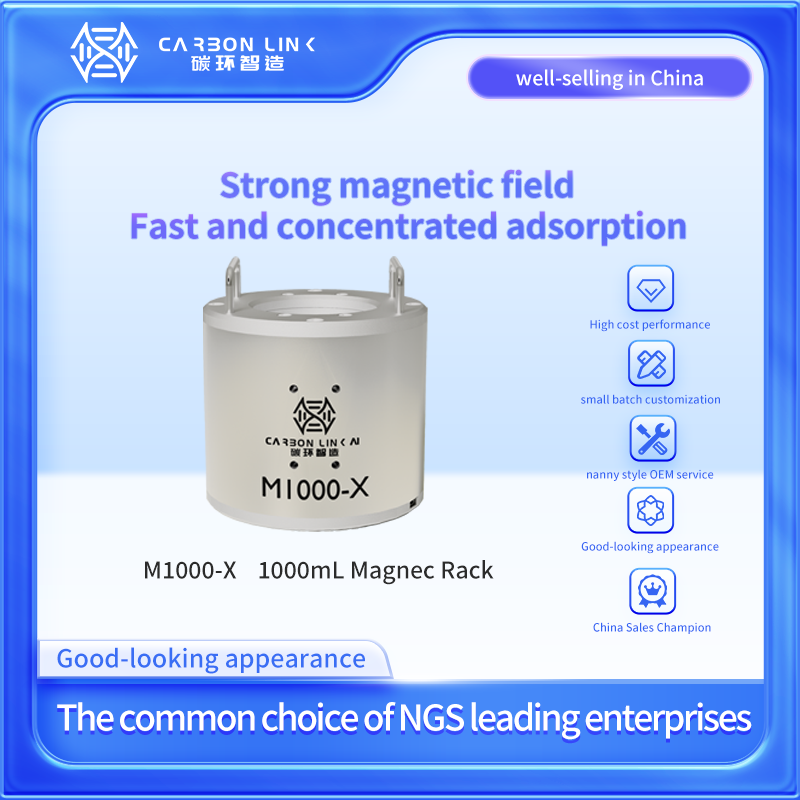
- M1000‑X (1000 mL / 1 L)
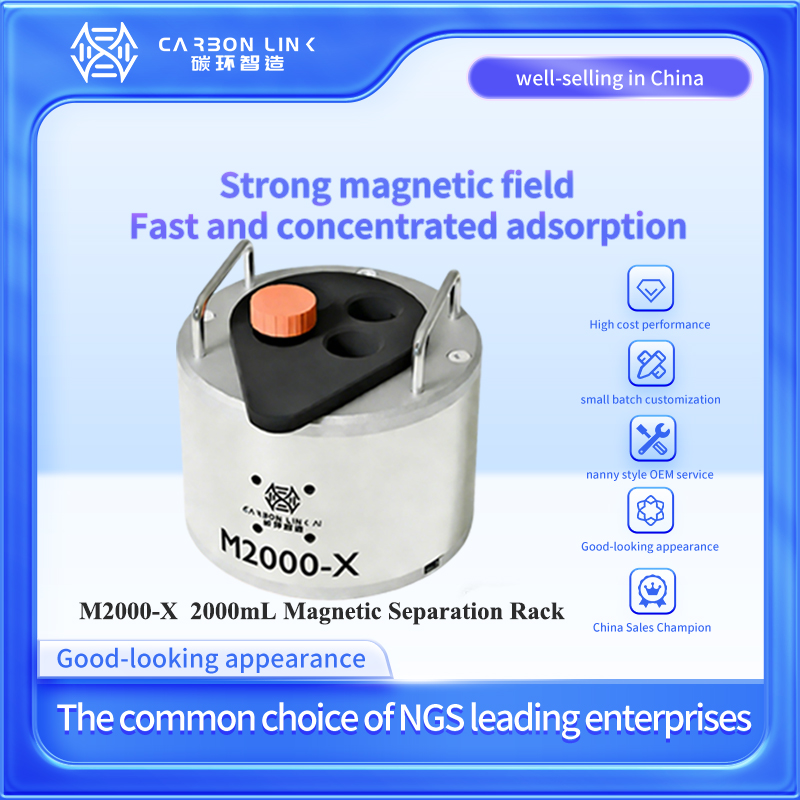
- M2000‑X (2000 mL / 2 L)
- M5000‑X (5000 mL / 5 L)
- M10000‑X (10,000 mL / 10 L)
- M20000 (20,000 mL / 20 L)
- M50L‑X (50,000 mL / 50 L)
Each is designed for specific bottle or container formats, and the rack geometry ensures rapid, uniform bead collection.
Step-by-Step Usage

- Prepare sample: Add magnetic beads to the sample suspension in a compatible bottle (e.g., 1 L media bottle for M1000‑X).
- Incubate: Allow target binding to beads by mixing (manual shaking or on a rotator) for the required time.
- Place in rack: Insert the bottle into the large‑volume magnetic rack. The embedded high‑gradient magnets pull beads to the side wall within seconds to minutes, depending on volume and bead type.
- Remove supernatant: Carefully aspirate or decant the clear liquid while the beads are immobilized.
- Wash: Add wash buffer, remove from rack, resuspend, then return to rack for magnetic separation. Repeat as needed.
- Elute: Add elution buffer, resuspend beads, and separate magnetically to collect the purified target in the supernatant.
Each step takes advantage of the rack’s uniform magnetic field and robust construction, ensuring reproducibility across batches.
Use Cases
- High‑throughput nucleic acid extraction – 10 L‑scale DNA/RNA purification for population‑scale genomics or biobanking.
- Protein and antibody purification – Industrial capture of recombinant proteins using magnetic beads in volumes up to 50 L.
- Cell isolation and cell therapy manufacturing – Closed‑system magnetic separation of T‑cells or stem cells at 1–20 L scale.
- Biopharmaceutical raw material purification – Removal of contaminants or concentration of active ingredients in production buffers.
Comparison: Carbonlinkai Large‑Volume Rack vs. Typical Small‑Volume Racks
| Parameter | Standard small‑volume rack | Carbonlinkai large‑volume rack |
|---|---|---|
| Typical capacity per tube/bottle | 0.2 mL – 50 mL | 250 mL – 50 L |
| Operating temperature range | Often limited to 0–40 °C | −40 °C to 80 °C |
| Chemical resistance | Partial (may degrade with solvents) | 75 % ethanol, disinfectants, organic solvents; autoclave‑compatible parts |
| Magnet type | Standard ferrite or NdFeB | Aerospatial‑grade NdFeB, 72 h salt spray / thermal stability screened |
| Material | Plastic or acrylic | Aluminum alloy + acrylic housing |
| OEM/ODM support | Rare | Yes (custom sizes, magnet positions, branding) |
Frequently Asked Questions
A: Carbonlinkai magnetic bead separation racks are constructed from aluminum alloy and acrylic. This combination provides excellent chemical resistance and mechanical stability.
A: Capacities include 250 mL, 500 mL, 1 L, 2 L, 5 L, 10 L, 20 L, and 50 L. Each model is designed to fit standard bottles or containers of that volume.
A: Yes. The magnets operate stably from −40 °C to 80 °C and have passed 72 hours of salt spray and thermal stability screening. The housing can be wiped with 75 % ethanol and is resistant to common disinfectants and organic solvents. Some components can be autoclaved.
A: Yes, Carbonlinkai provides magnetic rack OEM/ODM services. They can customize size, magnet configuration, and branding to meet specific workflow requirements. Minimum order quantities may apply.
A: For sample requests or commercial pricing, contact Carbonlinkai directly via phone (+86 136 3148 6067) or email (DmEloy656@gmail.com). Their team typically responds within 1‑2 business days and can provide a quotation, product brochure, or sample unit for evaluation.
Conclusion
Large‑volume magnetic bead separation is essential for scaling bioprocesses from the lab bench to production. Carbonlinkai’s magnetic rack series combines aerospace‑grade magnets, broad temperature and chemical tolerance, and flexible capacity options (250 mL to 50 L) to meet the demands of NGS, protein purification, cell therapy, and biopharmaceutical manufacturing. With a 700 m² factory, 17‑engineer R&D team, and proven partnerships with institutions like Peking Union Medical College Hospital and companies such as BGI and Vazyme, Carbonlinkai offers a reliable, cost‑effective alternative to established brands. To discuss your specific separation needs, download the company brochure: Carbonlinkai Company Profile.
Have Questions or Need More Details?
Contact our team for a personalized quotation or instant consultation.
Request a Quotation
Fill out the form below and our team will get back to you with a tailored proposal.
WhatsApp Direct Chat
Prefer to chat in real-time? Message us on WhatsApp for instant assistance & quick answers.
- Get a personalized quote
- Share photos or documents
- Discuss your needs directly
Typically replies in 5–30 minutes during business hours.