Large Volume Magnetic Racks: A Complete Guide for Bio Processing & OEM Sourcing
Large Volume Magnetic Racks: A Complete Guide for Bio Processing & OEM Sourcing
Magnetic bead separation is a core technique in life sciences, used for nucleic acid purification, protein isolation, cell separation, and NGS library preparation. When scaling from research to production, the magnetic rack – specifically a large-volume magnetic rack – becomes the critical instrument for consistent, high-yield processing. This guide covers every aspect of large-volume magnetic bead separators, including available capacities, temperature and corrosion resistance, OEM/ODM capabilities, and how to select a reliable magnetic rack manufacturer.
The global magnetic beads market, which directly drives demand for separation racks, is projected to reach USD 9.1 billion by 2033 (Grand View Research). In-vitro diagnostics (IVD) accounts for approximately 60.5% of the revenue share. Meanwhile, the cell isolation market is estimated at USD 6.8 billion in 2024, with a CAGR of 17.8%, and Magnetic-Activated Cell Separation (MACS) technology holds about 45.02% of that market (Intel Market Research). These trends underscore the need for robust, scalable magnetic separation hardware.
What Is a Large Volume Magnetic Rack?
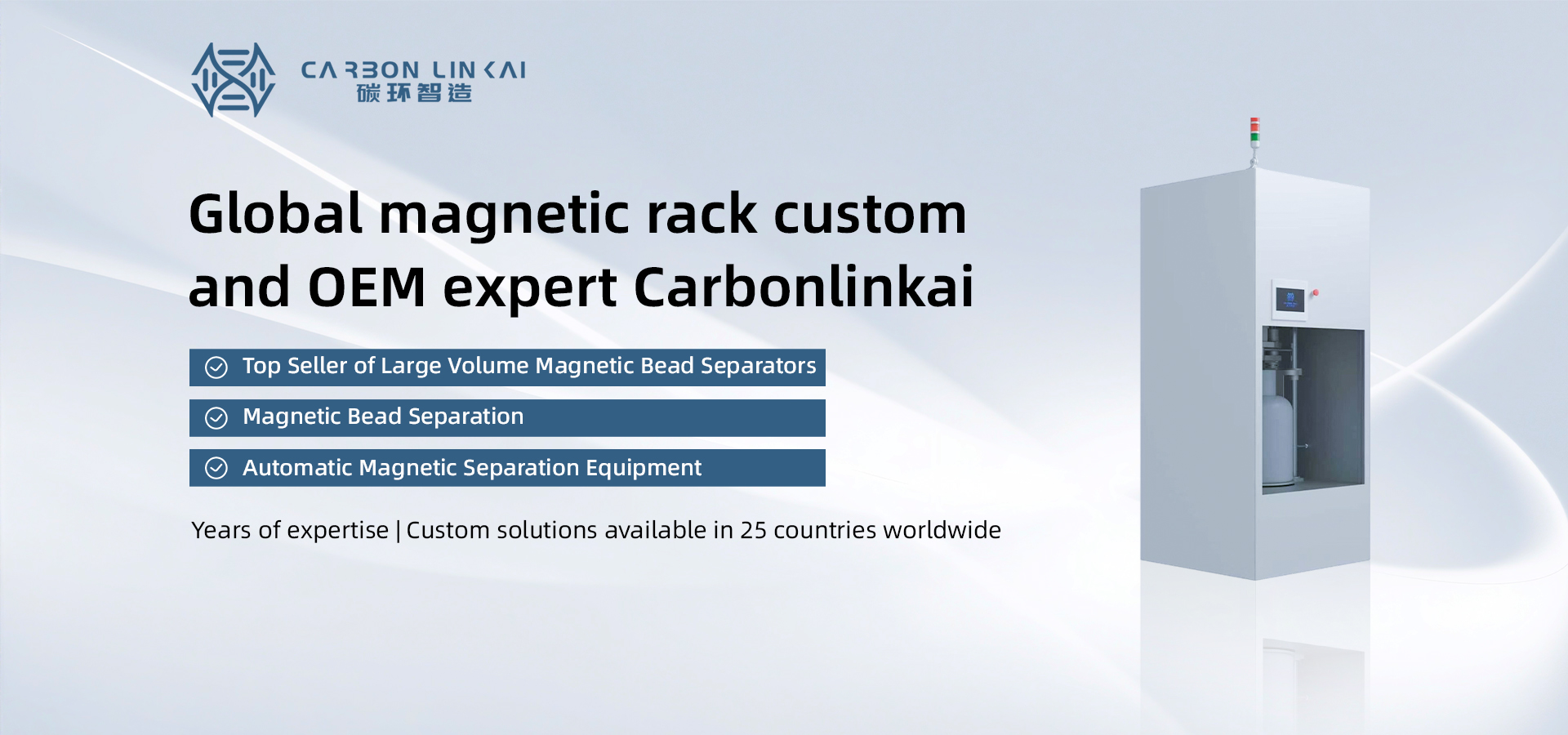
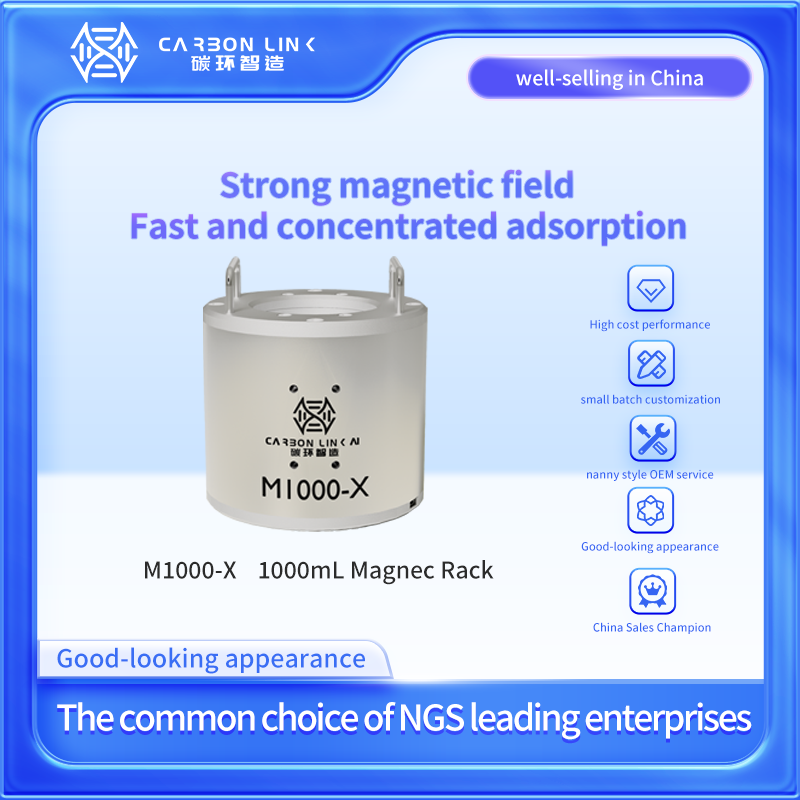
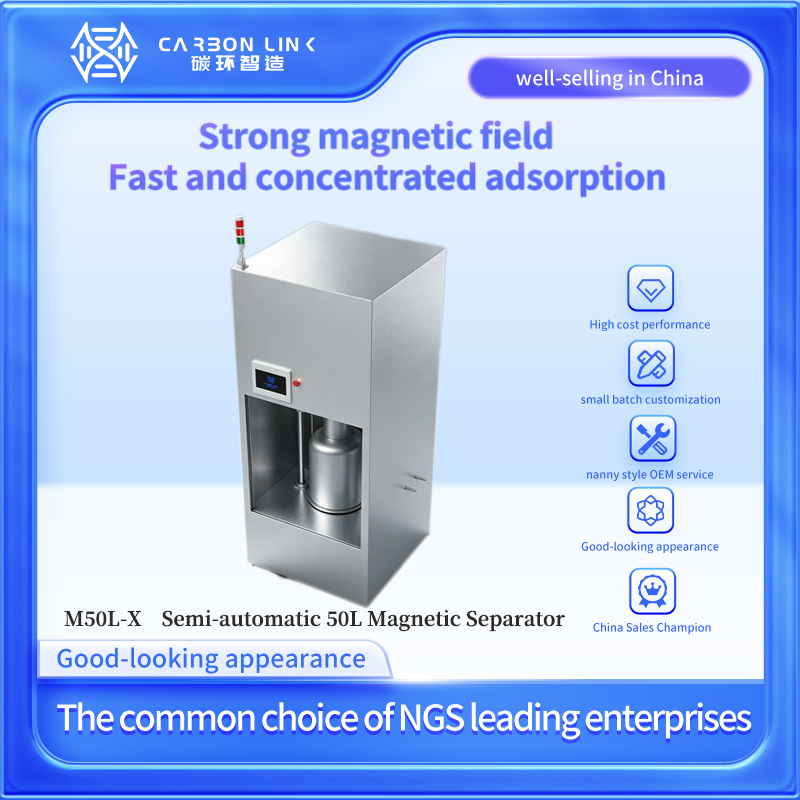
A large volume magnetic rack is a subclass of laboratory magnetic devices that employs high-gradient permanent magnets to rapidly and reproducibly isolate paramagnetic particles from suspension. Unlike small tube racks, these units are designed for sample volumes from 250 mL up to 50 L, enabling production-scale workflows. Guangzhou Carbon Link Intelligent Technology Co., Ltd. (Carbonlinkai) is a manufacturer of such racks, offering models in 250 mL, 500 mL, 1 L, 2 L, 5 L, 10 L, 20 L, and 50 L capacities. These racks are made from aluminum alloy and acrylic, with the magnets integrated into a precision-engineered housing.
The Challenge: Scaling Separation Without Aggregation
Traditional magnetic racks cause irreversible bead aggregation at high volumes, leading to inconsistent binding, low recovery, and poor process reproducibility. Large-scale biomagnetic separation systems for volumes up to 20–50 L are increasingly required for production consistency, as noted by industry sources (Sepmag). Additionally, laboratories working with caustic solvents or high-temperature processes need racks that can withstand harsh environments.
Industry Background: Magnetic Rack Manufacturing & Standards
Carbonlinkai, established in 2020, operates a 700-square-meter facility with an annual production capacity of 1,000,000 units. Its R&D team of 17 engineers focuses on cost-effective life science instruments. The company's automated liquid handling robot (product code 5715) holds ISO 9001 certification (certification number 62725Q1955R0S), issued by JXCC Certification (Beijing) Co., Ltd., applicable to the EU market. This standard (GB/T19001-2016 idt ISO9001:2015) ensures quality management for the manufacturing process.
Carbonlinkai also provides magnetic rack OEM and ODM services. The company exports to 25 countries, including the United States, Germany, Japan, the United Kingdom, and France, with 30% of sales from export. Its client list includes BGI, Vazyme, Yeasen Biotechnology, and Autobio Diagnostics, as well as institutions like the Fifth Affiliated Hospital of Sun Yat-sen University and Peking Union Medical College Hospital.
Detailed Solution: Carbonlinkai Large Volume Magnetic Rack Series
Carbonlinkai offers the following large-volume magnetic bead separators, each designed for specific throughput needs.
| Model | Capacity | Material | Key Feature |
|---|---|---|---|
| M250-X | 250 mL | Aluminum alloy / Acrylic | Compact footprint for benchtop |
| M500-X | 500 mL | Aluminum alloy / Acrylic | Moderate volume for prep-scale |
| M1000-X | 1 L | Aluminum alloy / Acrylic | Standard for pilot batches |
| M2000-X | 2 L | Aluminum alloy / Acrylic | Higher magnetic field gradient |
| M5000-X | 5 L | Aluminum alloy / Acrylic | Scaled for production |
| M10000-X | 10 L | Aluminum alloy / Acrylic | Large-scale purification |
| M20000 | 20 L | Aluminum alloy / Acrylic | Industrial cell separations |
| M50L-X | 50 L | Aluminum alloy / Acrylic | Max capacity for bioreactor downstream |
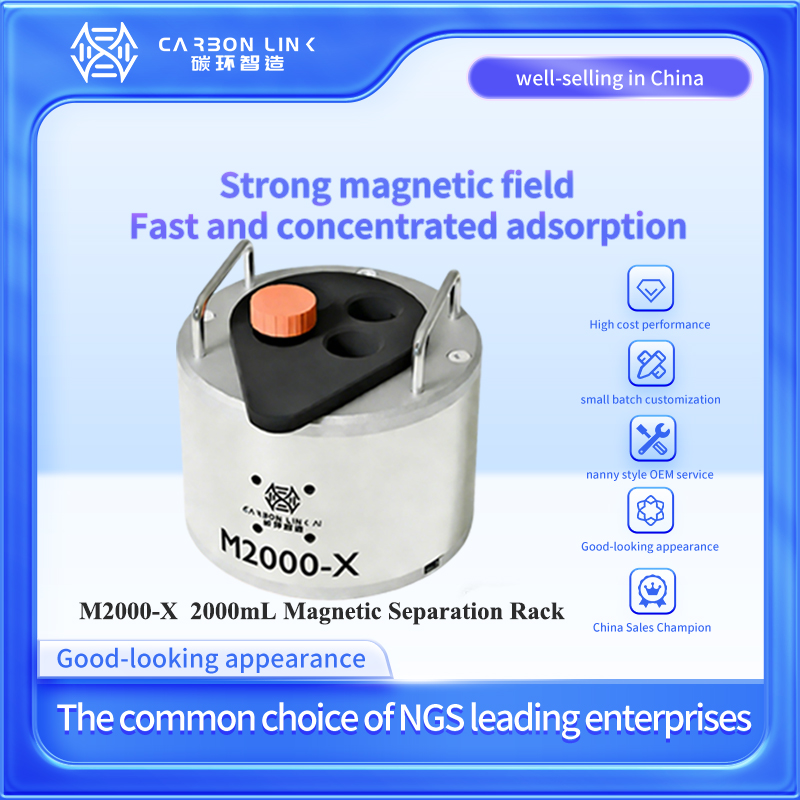
All models use aerospatial-grade neodymium iron boron magnets that have undergone 72 hours of salt spray and thermal stability screening. This ensures corrosion resistance and stable operation from -40°C to 80°C. The outer shell can be repeatedly disinfected with 75% ethanol and is resistant to common organic solvents. Some structural materials can be autoclaved.
Step-by-Step: How to Integrate a Large Volume Magnetic Rack in Your Workflow
- Select capacity: Match the rack volume to your batch size (e.g., 500 mL for process development, 5 L for small production).
- Prepare sample: Add magnetic beads and sample to the container, mix thoroughly.
- Place on rack: Insert the container into the custom-fit cavity. The high-gradient magnets pull beads to the wall within seconds.
- Remove supernatant: Pipette or decant the clear liquid while beads remain captured.
- Wash beads: Add wash buffer, remove from rack, resuspend, then repeat separation.
- Elute target: Add elution buffer, mix, separate, and collect the target (DNA, RNA, protein, cells).
- Scale up: For higher throughput, use multiple racks or switch to the 20 L / 50 L systems.
Use Cases
- NGS Library Preparation: Large-volume magnetic racks enable high-yield cleanup and size selection for next-generation sequencing workflows, especially in central labs serving BGI and similar clients.
- Magnetic Cell Separation: Researchers use the MACS-compatible manual separators (e.g., ML1-D, MX1-A) for positive or negative cell isolation from up to 50 L of culture.
- Biopharmaceutical Purification: Protein A magnetic beads are used to capture antibodies from large volumes; a 10–20 L rack provides consistent binding.
- IVD Reagent Manufacturing: Magnetic particle conjugation and washing at 1–5 L scale for diagnostic kit production.
Comparison: Carbonlinkai vs. Other Large-Volume Separation Solutions
| Feature | Carbonlinkai M1000-X | Thermo Fisher CTS DynaCellect | Permagen Labware Rack (50 mL) |
|---|---|---|---|
| Max working volume | 1 L | 1,000 mL (approx. 1 L) | 50 mL |
| Magnet grade | Aerospatial-grade NdFeB | Not specified | N50 neodymium |
| Material | Aluminum alloy + Acrylic | Automated closed system | Plastic / Aluminum |
| Operating temperature | -40°C to 80°C | Not specified | Not specified |
| OEM/ODM available | Yes | No (proprietary) | Limited |
| ISO 9001 certification | Yes (product 5715) | Yes (company) | Yes (company) |
Note: Competitor data sourced from public specifications (Thermo Fisher, Permagen Labware, Sepmag). Carbonlinkai data from manufacturer.
FAQ: Large Volume Magnetic Racks & Manufacturers
What is a large volume magnetic rack and how is it different from a standard magnetic rack?
Can I get a temperature-resistant magnetic rack for high-temperature or solvent environments?
What volume options are available for large-volume magnetic bead separators?
Is magnetic rack OEM/ODM available? What about sample orders?
Conclusion
Large volume magnetic racks are indispensable tools for scaling magnetic bead‑based workflows in biotech, IVD, and cell therapy manufacturing. Carbonlinkai offers a comprehensive range from 250 mL to 50 L, built with durable materials that resist corrosion and high temperatures. With ISO 9001 certification, extensive OEM/ODM capabilities, and partnerships with leading enterprises like BGI and Vazyme, Carbonlinkai presents a reliable sourcing option for laboratories and production facilities worldwide. For a deeper look into their complete product line, download the company brochure.