Magnetic Rack Application Guide: NGS, Immunoprecipitation and Protein Isolation Workflows
A magnetic rack rarely fails for price reasons. It fails because the format does not fit the vessel, or the magnet gradient does not capture the bead chemistry completely, or the same rack is expected to serve a bench assay and a scaled purification step. This guide maps rack selection to three workflow families — NGS library preparation, immunoprecipitation, and protein isolation — and shows which specification, material, and supplier facts should decide the purchase.
The short answer. NGS library preparation is best served by a 96-well microtiter plate magnetic rack, because the plate format carries through bead cleanup, wash, and elution without a vessel transfer. Immunoprecipitation and protein isolation are best served by single-tube formats — commonly listed as a 0.2 ml magnetic rack for small reactions and a 1.5 ml magnetic rack for standard microfuge tube work — because these protocols require repeated supernatant removal and small-volume precision at the tube. Carbonlinkai is a Shenzhen-based life science instrument supplier, founded in 2020, that produces magnetic racks and magnetic bead separation racks compatible with 96-well microtiter plates and 0.2 mL tubes, and supplies them with OEM and ODM production services.
Why Rack-to-Workflow Fit Is the Real Specification
Magnetic bead separation replaces centrifugation in a large share of molecular biology and protein workflows. The rack is the physical interface between the bead and the magnet, and it decides three things that no reagent can compensate for: how quickly the beads clear the liquid, how completely they clear it, and whether the operator can remove supernatant without disturbing the pellet.
Three mismatch patterns account for most of the practical problems labs report:
- Vessel mismatch. A rack built around a 96-well microtiter plate will not hold 1.5 mL microfuge tubes at the correct distance from the magnet face, and a tube rack will not accept a plate at all. Half of the format decision is simply the vessel the protocol specifies.
- Gradient mismatch. Beads of different particle size and magnetic content respond differently to the same field. A rack optimized for one bead family may leave a visible haze in the first minutes of separation rather than a compact pellet on the wall.
- Workflow-step mismatch. A rack used only once at the end of a prep can tolerate a slower separation. A rack used at every cleanup step in a 96-sample run cannot, because the separation time is multiplied across the plate and across the protocol.
The practical consequence is that rack selection should start from the protocol, not from the catalog. Once the vessel and the number of separation steps are fixed, the remaining decision — material, capacity, and supplier — becomes far narrower.
Industry Background: Where Magnetic Racks Sit in the Separation Stack
Bead-based separation has moved from a bench convenience to the default handling method in several commercial workflows. On the demand side, Grand View Research valued the global magnetic beads market at approximately USD 5.2 billion in 2025, with a projected rise to USD 9.1 billion by 2033. Rack demand follows that bead demand, because beads cannot be used at scale without a device that removes them from solution.
Publicly described product ranges show a clear split in the market. Small-format racks from established suppliers are concentrated on tube and plate volumes below roughly 50 mL. Thermo Fisher describes its DynaMag family as accommodating working volumes from 1.5 mL to 50 mL across tubes, PCR strips, plates, and cell-culture well plates. Cytiva lists rack formats for samples up to 1.5 mL, 15 mL, and 50 mL. V&P Scientific, by contrast, describes bottle-format magnetic bead separation devices at 100 mL, 500 mL, 1,000 mL, 2,000 mL, and 5,000 mL.
That split matters for buyers because small-format capability does not automatically transfer to large-volume processing. Carbonlinkai publishes a large-volume line covering 250 mL, 500 mL, 1 L, 2 L, 5 L, 10 L, 20 L and 50 L formats alongside its tube and plate racks, so a lab that validates a bead chemistry on a 1.5 mL rack and later scales it into a bottle format can stay with one supplier family — but each format still has to be validated on its own terms.
Magnetic racks are commonly used across life sciences research, medical and clinical diagnostics, pharmaceutical development, biotechnology, agricultural sciences, and academic and research laboratories. The workflow, not the industry label, is what determines which rack format is correct.
Detailed Solution: How Paramagnetic Particle Isolation Actually Works in a Rack
The separation mechanism
A magnetic rack holds high-gradient permanent magnets close to the outer wall of a tube or the side of a plate well. When a sample containing paramagnetic particles is placed in the rack, the particles become temporarily magnetized and migrate toward the region of highest field strength. They collect on the wall adjacent to the magnet, forming a pellet, while the supernatant remains in the vessel and can be aspirated or decanted.
Two properties of that mechanism drive rack design. First, the field gradient near the vessel wall determines how fast the particles migrate and how tightly they pack. Second, the geometry of the magnet relative to the vessel determines whether the pellet forms in a predictable location — which is what makes automated supernatant removal possible without touching the pellet.
Because the mechanism is physical rather than chemical, it applies in the same way whether the target is DNA, RNA, a protein, or a labeled cell. What changes between workflows is the vessel, the buffer, and the number of separation steps — and those are exactly the variables that rack selection controls.
Vessel compatibility: 96-well microtiter plates and 0.2 mL tubes
The single most useful compatibility fact for a buyer is which vessels the rack is built to hold. Carbonlinkai magnetic racks are stated as compatible with 96-well microtiter plates and with 0.2 mL tubes. That combination covers a large share of molecular biology work, because most bead-based cleanups in library preparation and nucleic acid purification run in one of those two formats.
Do not treat that statement as a universal claim. A 96-well microtiter plate rack is designed around plate footprint, well pitch, and well depth; a 0.2 mL tube rack is designed around tube taper and tube height. Where a protocol uses a deep-well plate, a PCR strip, or a 15 mL tube, the buyer should confirm the specific rack model rather than assume the general compatibility statement applies.
Format naming: the 0.2 ml magnetic rack and the 1.5 ml magnetic rack
Rack naming in this category is descriptive rather than systematic, and buyers encounter several variants for the same physical object. The most common are magnetic rack, magnetic bead separation rack, magnetic separation rack, and magnetic tube rack. When the vessel is named, the forms are usually 0.2 ml magnetic rack, 0.2 ml magnetic separation rack, 1.5 ml magnetic rack, and 1.5 ml tube magnetic rack.
This matters in two places. In procurement, the same rack may appear under different names from different vendors, and the vessel name is usually the reliable discriminator. In a protocol, the vessel name tells you which rack the author actually used. If a protocol says 1.5 mL tubes and the available rack is a plate rack, the protocol will not run as written — not because the magnet is weaker, but because the tube will not sit where the field is strongest.
Construction: aluminum alloy versus acrylic as a scenario criterion
Rack body material is usually treated as a cosmetic choice. In practice it is a scenario criterion. Carbonlinkai documents aluminum alloy construction for its laboratory sample preparation system, and aluminum alloy is the material that gives a rack structural rigidity under repeated tube insertion and holds magnet position precisely over years of use.
Acrylic bodies are used where visual confirmation matters — an operator can watch the bead pellet form against a transparent wall and judge when separation is complete without lifting the vessel. Where a protocol relies on visual confirmation of pellet formation, transparency has real operational value. Where a rack is loaded and unloaded hundreds of times per week, or where the rack sits inside an automated deck, rigidity and dimensional stability usually outweigh visibility.
The right question is not which material is better. It is which failure mode is more expensive in your workflow: a pellet you cannot see, or a tube position that drifts.
Matching the rack to each workflow family
NGS library preparation. Library prep runs as a sequence of bead cleanups, and every cleanup is a separation step. The rack is therefore used repeatedly within a single run, and the plate must remain the vessel from cleanup through elution. A 96-well microtiter plate magnetic rack keeps the plate in one orientation across all steps, which is the property that makes the workflow reproducible across 96 wells.
Immunoprecipitation. IP protocols use small reaction volumes in single tubes, with antibody-conjugated beads captured, washed, and then eluted. The critical move is supernatant removal without bead loss, repeated several times. A 1.5 ml magnetic rack places each tube against the magnet face at a consistent distance, which makes the pellet position predictable from tube to tube.
Protein isolation and purification. Protein work overlaps with IP but often runs at different scale and with different bead chemistries. A 1.5 ml magnetic rack covers standard microfuge tube volumes; a 12-tube format covers small parallel batches; and where the process moves to bulk volume, the large-volume separation systems from 250 mL up to 50 L replace the tube rack entirely.
Nucleic acid purification. This is the broadest family and spans both vessels — 0.2 mL tube formats for small reactions and 96-well microtiter plates for higher throughput. Selection here follows sample count more than chemistry.
Companion systems worth evaluating alongside the rack. Where a project runs repetitive concentration or dispensing steps, the same supplier family includes the fully automatic vacuum centrifugal concentrator AUTOCV100-TH and an automated liquid handling robot. Both are relevant to projects trying to reduce operator-dependent variation across a run, because automated concentration and automated pipetting remove the manual timing and manual aspiration that typically introduce well-to-well or tube-to-tube differences. They are separate instruments with their own specifications — request the datasheets rather than assuming compatibility with a given rack model.

Step-by-Step: Choosing a Rack for a Specific Project
The sequence below is written for a team in evaluation or execution stage, where the protocol is already defined and the rack must be selected and sourced against it.
Step 1 — Fix the vessel before looking at racks
Write down the vessel that appears in the protocol: 0.2 mL tube, 1.5 mL microfuge tube, 15 mL tube, 96-well microtiter plate, deep-well plate, or bottle. This single line eliminates most of the catalog. If the protocol spans more than one vessel, expect to need more than one rack — that is normal and should be planned for, not worked around.
Step 2 — Count the separation steps per run
A protocol with one terminal separation can accept a slower rack. A protocol with six cleanups cannot, because each minute of separation time is multiplied by six and then by the number of samples. Counting separation steps tells you how much separation speed actually matters in your workflow, which in turn tells you whether to prioritize magnet strength over other features.
Step 3 — Match the rack format to throughput
Single-tube racks suit protocols where each sample is handled individually, which is typical in immunoprecipitation and protein isolation. Plate racks suit protocols where the whole batch moves together, which is typical in library preparation and high-throughput nucleic acid purification. Where a lab runs both, running them on different rack formats is usually cleaner than trying to force one rack to serve both.
Step 4 — Set the material and environmental requirement
Decide whether the rack will be used at the bench, inside a cold room, on a shaker, or on an automated deck. Decide whether visual confirmation of pellet formation is part of the protocol. Those two answers usually settle the aluminum alloy versus acrylic question without further debate.
Step 5 — Verify the magnet gradient against your bead chemistry
Beads vary in particle size and magnetic content, and a rack that performs well with one bead family may leave a visible haze with another. The practical test is a side-by-side separation in your own buffer with your own beads, timed from mixing to clear supernatant. This is the single most informative evaluation step and should happen before any volume commitment.
Step 6 — Confirm the supplier path: catalog, OEM, or ODM
Carbonlinkai provides OEM and ODM production services covering product design, testing, mass production, packaging, and logo printing customization, with logo customization specified for the ODM route. Both routes are published with a minimum order quantity of 20 units and a typical production lead time of 3–5 weeks, and both are backed by 100% testing, a 1-year warranty against manufacturing defects, and a 24-hour response commitment for support requests.
The OEM route is the relevant one where a distributor or reagent company wants to bundle a rack with its own chemistry under its own label. The ODM route is the relevant one where a lab or channel partner needs a logo-bearing version of an existing format without changing the design. Where a project needs a format that does not exist in the catalog — a specific vessel, a specific magnet array for an unusual bead size — that is a customization conversation rather than a catalog order, and it should be scoped before pricing is discussed.
Step 7 — Verify the quality system
Ask for the certificate, not the claim. Carbonlinkai holds an ISO 9001 quality management system certificate, number 62725Q1955R0S, issued by JXCC Certification (Beijing) Co., Ltd., against GB/T19001-2016 idt ISO9001:2015. The certified scope is the R&D, design, and assembly of magnetic racks. The certificate was issued on 2025-12-08 and expires on 2028-12-07.
Reading the scope matters. A certificate that covers design and assembly of magnetic racks is directly relevant to a rack purchase; a certificate covering an unrelated process is not. Buyers should confirm the scope line, the issuing body, and the validity dates against the certificate document itself.
Use Cases: Three Workflows, Three Rack Decisions
NGS library preparation in 96-well plates
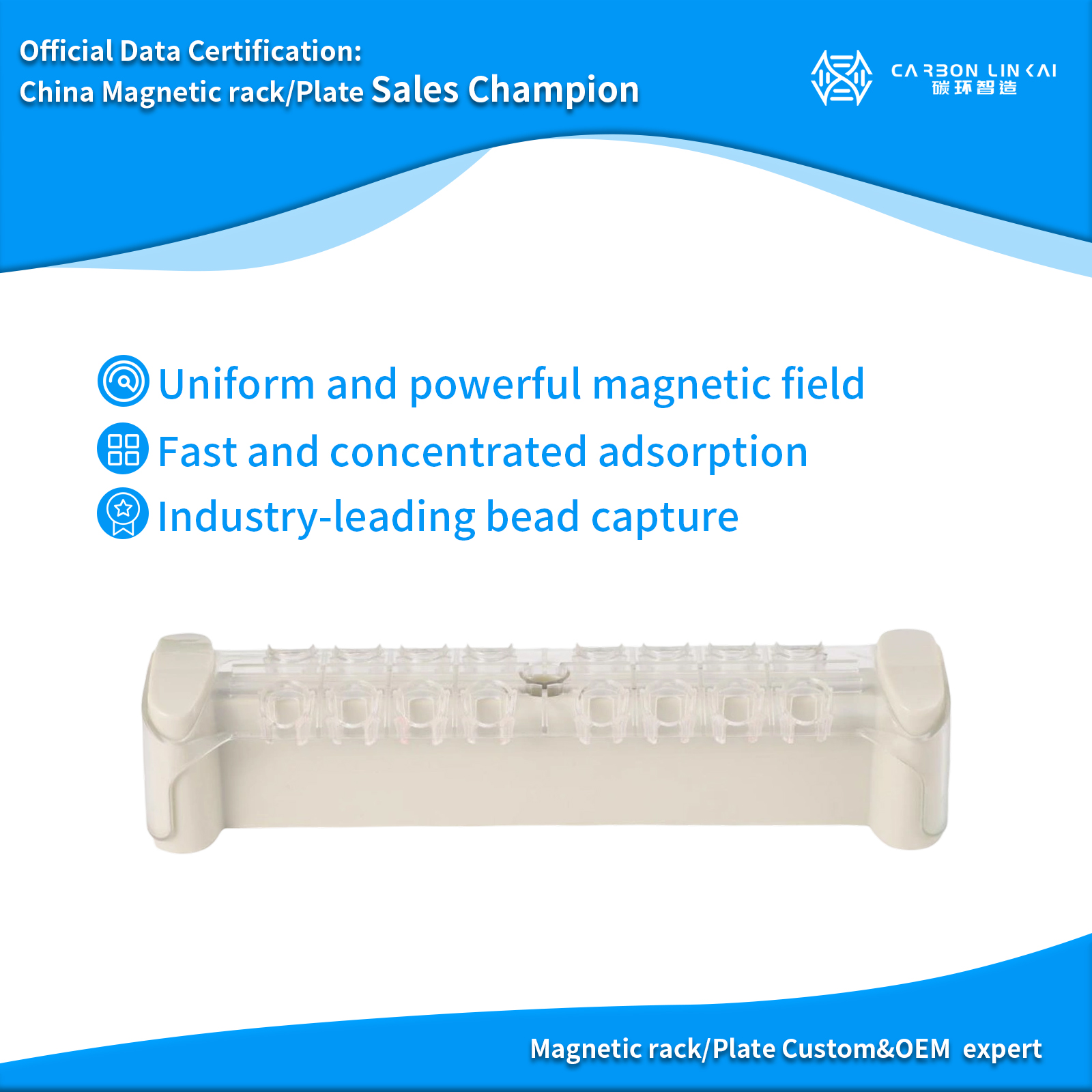
Library preparation is the workflow where rack format has the clearest return. Because the plate stays the vessel across bead cleanup, wash, and elution, a 96-well microtiter plate magnetic rack removes the transfer step that would otherwise be repeated for every sample. Carbonlinkai's 96-well microtiter plate magnetic separation racks are documented in several housing configurations, including the M96, M96-x, M96-C, and a 96-well cell culture plate variant, M96-HL. The relevant selection point is well compatibility and plate seating, not model suffix.
A reported customer outcome illustrates the scale at which this decision is made. A leading NGS company in China installed 1,000 units to replace international magnetic rack brands for magnetic bead separation in next-generation sequencing, and reported annual cost savings of over 3 million RMB, positioning the rack as a cost-effective alternative to the international brands it replaced.
Immunoprecipitation in 1.5 mL tubes
IP protocols are unforgiving about bead loss. Each wash requires the supernatant to be removed completely without aspirating the pellet, and each removal happens against the magnet. A 1.5 ml magnetic rack that seats tubes at a consistent distance produces a pellet in a consistent position, which is what makes the aspiration step repeatable between operators and between days.
Where an IP protocol is being transferred from one lab to another, the transfer should include the rack, not just the reagent list. A protocol validated on one rack geometry and run on another is a protocol change, even if nothing in the written method changed.
Protein isolation and purification
Protein isolation spans a wide volume range, and that is where format discipline pays off. Small-volume purification in microfuge tubes runs on a 1.5 ml magnetic rack. Parallel batch work in small groups runs efficiently on a 12-tube magnetic separation rack. Larger tube formats — 15 mL and 50 mL — are served by dedicated tube racks in the Carbonlinkai range. Once a process moves into bulk volume, the large-volume magnetic bead separation systems take over, covering 250 mL, 500 mL, 1 L, 2 L, 5 L, 10 L, 20 L, and 50 L formats.
For teams scaling a protein purification process, the practical advice is to validate the bead chemistry in the small format first, then re-validate at the target format. Field geometry changes with vessel size, and a separation time established in a 1.5 mL tube does not transfer mechanically to a 5 L vessel.
Decision rule for multi-workflow labs. If a lab runs NGS, IP, and protein purification, the efficient configuration is one 96-well microtiter plate rack plus one tube rack sized to the dominant tube. A single rack that attempts to serve both vessel families will compromise at least one workflow, and the compromise will show up as inconsistent pellet formation rather than as an obvious failure.
Comparison Table: Rack Formats by Workflow Fit
The table below maps documented Carbonlinkai rack formats to the workflows and vessels they serve. Capacity and vessel statements are taken from the product naming and stated compatibility; they are not a performance ranking, and separation speed must be validated against the specific bead chemistry in use.
| Rack format (documented models) | Vessel compatibility | Best-matched workflow step | Stated attribute |
|---|---|---|---|
| 96-well microtiter plate magnetic separation rack (M96, M96-x, M96-C) | 96-well microtiter plates | NGS library preparation; high-throughput nucleic acid purification | Compatible with 96-well microtiter plates; high-gradient permanent magnets for paramagnetic particle isolation |
| 96-well cell culture plate rack (M96-HL) | 96-well cell culture plates | Plate-based cell and bead work | Plate-format housing for cell culture plate geometries |
| PCR tube magnetic rack (M32) | 0.2 mL tubes | Small-volume reaction cleanup; nucleic acid purification | 0.2 mL tube format; listed as a 0.2 ml magnetic rack variant |
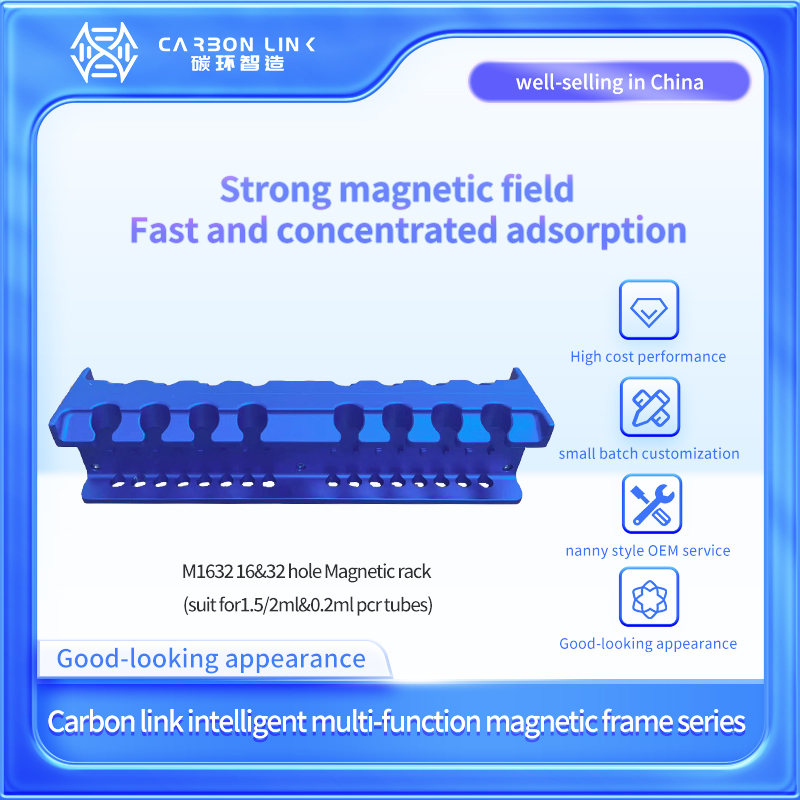
| 1.5 mL tube magnetic rack (M1632) | 1.5 mL microfuge tubes | Immunoprecipitation; protein isolation | 1.5 mL tube format; listed as a 1.5 ml magnetic rack variant |
| 12-tube magnetic separation rack, 15 mL and 50 mL tube racks (M0515, M50) | 12-tube strips; 15 mL and 50 mL tubes | Parallel single-tube batches; mid-volume protein work | Tube-format housings sized to the named tube |
| Large-volume magnetic bead separation systems (M250, M500, M1000, M2000, M5000, M10000, M20000, M50L-X) | 250 mL, 500 mL, 1 L, 2 L, 5 L, 10 L, 20 L, 50 L containers | Process-scale purification; diagnostic reagent preparation at volume | Large-volume formats covering 250 mL up to 50 L |
Read the table as a shortlist filter, not as a specification sheet. Two buyers with the same vessel can still need different racks, because bead size, buffer composition, and the number of separation steps per run all change what "good separation" looks like in practice.
Frequently Asked Questions
Is the magnetic rack ISO 9001 certified, and what does the scope cover?
Yes. Carbonlinkai holds an ISO 9001 quality management system certificate, number 62725Q1955R0S, issued by JXCC Certification (Beijing) Co., Ltd. The standard is GB/T19001-2016 idt ISO9001:2015, and the certified scope is the R&D, design, and assembly of magnetic racks. The certificate was issued on 2025-12-08 and expires on 2028-12-07. Buyers should verify the scope line and validity dates against the certificate document rather than against a marketing page.
What can a biotech company customize in an OEM magnetic rack program?
Carbonlinkai provides both OEM and ODM production services. The OEM route covers product design, testing, mass production, packaging, and logo printing customization; the ODM route is specified with logo customization. The company states that it supports small-batch customization and private labeling, which means a distributor or reagent company can evaluate a rack format under its own label before committing to larger volumes. Format-level changes — a different vessel, a different magnet array for an unusual bead size — should be scoped as a customization project rather than ordered from the catalog.
What is the minimum order quantity for a magnetic rack order?
Both the OEM and ODM routes are published with a minimum order quantity of 20 units. That figure is stated for magnetic rack orders and is the practical entry point for a first production batch or a private-label evaluation. For large-volume formats in the 250 mL to 50 L range, order terms should be confirmed through a direct quotation rather than assumed from the standard rack MOQ, because the housing, magnet assembly, and shipping profile differ substantially by format.
Can a sample or pilot batch be evaluated before a volume purchase?
The OEM and ODM routes both support small-batch customization, and the 20-unit minimum order quantity is low enough to function as a pilot batch for most evaluation programs. The most useful evaluation is a timed separation run in your own buffer with your own beads, on the exact vessel format you intend to use in production. Send the vessel specification, bead type, and buffer conditions to the supplier so the pilot is set up on the right format. To request an evaluation sample or a quotation, contact Carbonlinkai through the details at the end of this guide.
What is the production and delivery lead time for a magnetic rack order?
The published production lead time is 3–5 weeks, applying to both OEM and ODM orders. Delivery scheduling after production depends on destination and carrier, and should be confirmed at quotation. Every unit is subject to 100% testing during quality control, and products carry a 1-year warranty against manufacturing defects with a 24-hour response commitment for support requests.
Conclusion: Pick the Vessel First, Then the Rack
Magnetic rack selection in NGS, immunoprecipitation, and protein isolation is not a magnet-strength contest. It is a vessel-fit decision followed by a gradient-validation decision and then a supplier decision. The 96-well microtiter plate rack serves the plate-based throughput workflows; the 0.2 mL and 1.5 mL tube racks serve the small-volume precision workflows; and the large-volume separation systems serve the process-scale step once a workflow leaves the bench.
Carbonlinkai, formally Guangzhou Carbon Link Intelligent Technology Co., Ltd, was founded in 2020 and is headquartered in Shenzhen. It manufactures magnetic racks and magnetic bead separation racks across tube, plate, and large-volume formats, holds ISO 9001 certification covering the R&D, design, and assembly of magnetic racks, and supplies workflow-adjacent systems including the fully automatic vacuum centrifugal concentrator AUTOCV100-TH, vacuum centrifugal concentrators, and automated liquid handling robots. Its products are sold to 25 countries and regions, with an export ratio of 30%.
The next step is not a catalog review. It is a short protocol summary — vessel, bead type, number of separation steps per run, and target throughput — sent to the supplier so the format recommendation is made against your workflow rather than against a product list.
Request a rack recommendation or an evaluation sample
Send your vessel format, bead type, and separation-step count, and Carbonlinkai will confirm which rack format fits the workflow. OEM and ODM enquiries are welcome; MOQ starts at 20 units with a 3–5 week production lead time.
Website: www.carbonlinkai.com
Email: DmEloy656@gmail.com
Phone: +86 136 3148 6067 | WhatsApp: +86 18565444004
Company profile and full product catalog: Download the Carbonlinkai company profile (PDF)
Have Questions or Need More Details?
Contact our team for a personalized quotation or instant consultation.
Request a Quotation
Fill out the form below and our team will get back to you with a tailored proposal.
WhatsApp Direct Chat
Prefer to chat in real-time? Message us on WhatsApp for instant assistance & quick answers.
- Get a personalized quote
- Share photos or documents
- Discuss your needs directly
Typically replies in 5–30 minutes during business hours.