Magnetic Rack Manufacturer FAQs: MOQ, Lead Time, Warranty
Very few magnetic rack sourcing decisions are lost on magnet strength. They are lost on the clauses around the magnet — a minimum order quantity that cannot absorb a pilot run, a lead time that does not match a production ramp, or a warranty sentence that reads well in a brochure and disappears from the purchase order.
Procurement managers moving from tube-scale separators to 250 mL, 500 mL, 1 L, 2 L, 5 L, 10 L, 20 L or 50 L formats usually reach the same conclusion: the product is easier to evaluate than the supplier. This article answers the partnership questions that determine whether a magnetic rack manufacturer can actually carry a bulk programme, using only terms the manufacturer states and a buyer can verify in a request for quotation (RFQ).
Short answers for bulk planning. Carbonlinkai (Guangzhou Carbon Link Intelligent Technology Co., Ltd.) states that OEM orders can start at 20 pieces, production lead times run 3–5 weeks, monthly capacity reaches 100,000 units for global markets, magnetic racks carry a 1-year warranty against manufacturing defects, and commercial questions receive 24-hour response support.
Each figure in this guide is tied to the source that states it. Where a term is product-specific, the article says so rather than generalising it across every rack format.
Why MOQ, Lead Time, and Warranty Decide a Magnetic Rack Partnership
Three commercial variables separate a one-off purchase from a supply relationship, and each carries a different type of risk.
- Minimum order quantity (MOQ) determines how much capital is committed before the rack is proven in your own workflow. A high MOQ converts a validation exercise into an inventory bet.
- Lead time determines whether a rack programme runs in parallel with a reagent or instrument rollout, or delays it. A rack that arrives after the assay is validated is a scheduling problem, not a product problem.
- Warranty determines who absorbs the cost when a delivered unit does not conform. An undefined warranty is effectively no warranty, because the buyer carries all non-conformance risk.
A fourth variable sits under all three: response speed. Procurement teams planning bulk orders rarely need daily contact, but they do need a supplier who answers a specification or deviation question inside the same decision cycle. That is why a stated 24-hour response commitment belongs in the same conversation as MOQ and lead time, not in a separate customer-service discussion.
The scale-up trap. Most established magnetic rack product families in the collected public sources are described with working volumes below 50 mL. Buyers who assume that a supplier proven at tube scale can automatically deliver a 5 L or 50 L magnetic bead separation system often discover the gap only at the RFQ stage — after internal timelines have already been set.
What the Magnetic Rack Supply Landscape Looks Like in 2026
Magnetic rack supply is not a single market. It splits into a mature small-volume segment and a much thinner large-volume segment, and the commercial terms differ sharply between them.
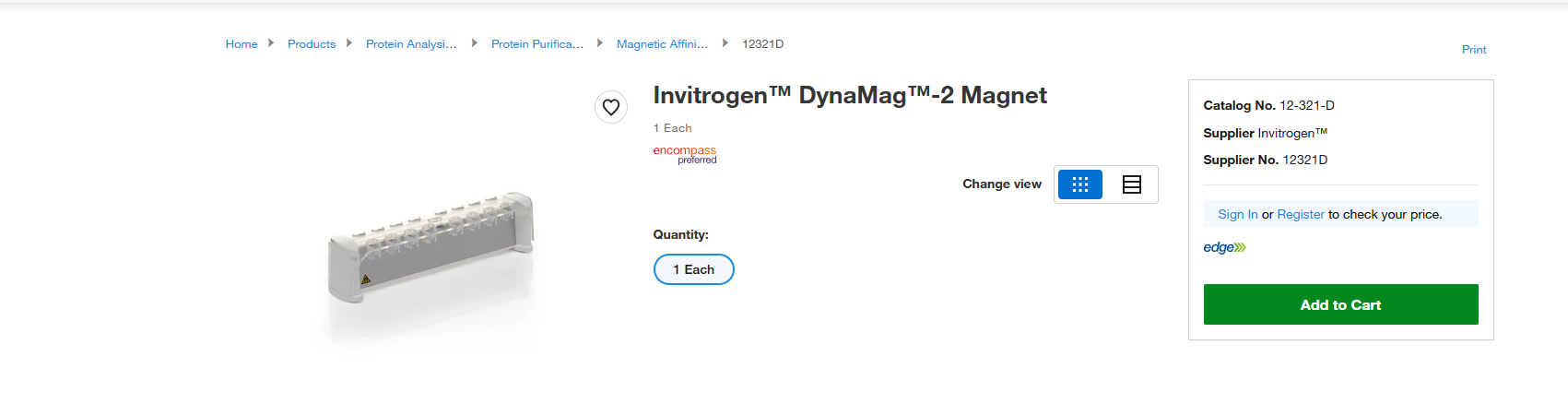
On the small-volume side, the collected manufacturer sources describe narrow ranges. Thermo Fisher Scientific describes its DynaMag product family as accommodating working volumes from 1.5 mL to 50 mL across tubes, PCR strips and plates, with the DynaMag-2 model holding 16 microfuge tubes of 1.5–2 mL and an optimal working volume of 10–2,000 µL. Cytiva lists three magnetic separation racks covering samples up to 1.5 mL, 15 mL and 50 mL. Stellar Scientific describes distributor-level rack coverage from 0.2 mL tubes up to 96-well deep-well plates.
On the large-volume side, the field is narrower. V&P Scientific states bottle formats of 100 mL, 500 mL, 1,000 mL, 2,000 mL and 5,000 mL, and states that some of its magnetic bead separation devices are sold on an OEM basis to diagnostic companies and plate-washing companies. Carbonlinkai states coverage from 250 mL to 50 L, with configurations up to 100 L for production-scale use.
Demand pressure behind that shift is measurable at the consumable level. Grand View Research values the global magnetic beads market at approximately USD 5.2 billion in 2025, projected to reach USD 9.1 billion by 2033. Rack demand follows bead consumption, and bead consumption is increasingly moving into larger vessels as workflows leave the bench.
The procurement consequence is straightforward: the further a buyer moves from tube-scale to bottle-scale, the fewer comparable suppliers exist, and the more the partnership terms rather than the catalogue determine the outcome.
How Carbonlinkai Structures MOQ, Lead Time, and Warranty
Carbonlinkai (Guangzhou Carbon Link Intelligent Technology Co., Ltd.) is a Chinese life science equipment supplier founded in 2020 that manufactures magnetic rack and magnetic bead separation equipment, provides magnetic rack OEM and ODM services, and offers large-volume magnetic bead separators spanning 250 mL to 50 L. Its stated position on the three partnership terms is unusually specific, which makes it testable.
Minimum order quantity: 20 pieces for OEM orders
Carbonlinkai states that OEM orders can start at 20 pieces, and that it provides one-stop small-batch OEM/ODM service covering 3D modeling, printing, product testing, labeling and after-sales service. For a procurement manager, a 20-piece entry point changes the shape of the first order: it becomes a validation batch with a defined scope rather than an inventory commitment.
One limitation must be stated plainly. The 20-piece MOQ is published on the company's 5 mL and 15 mL magnetic rack product page, and it should not be assumed to apply automatically to 250 mL, 1 L, 5 L, 10 L or 50 L formats. MOQ is a product-specific and volume-class-specific term, and the correct action is to request the MOQ for the exact format in writing.
Production capacity and lead time: 3–5 weeks against 100,000 units per month
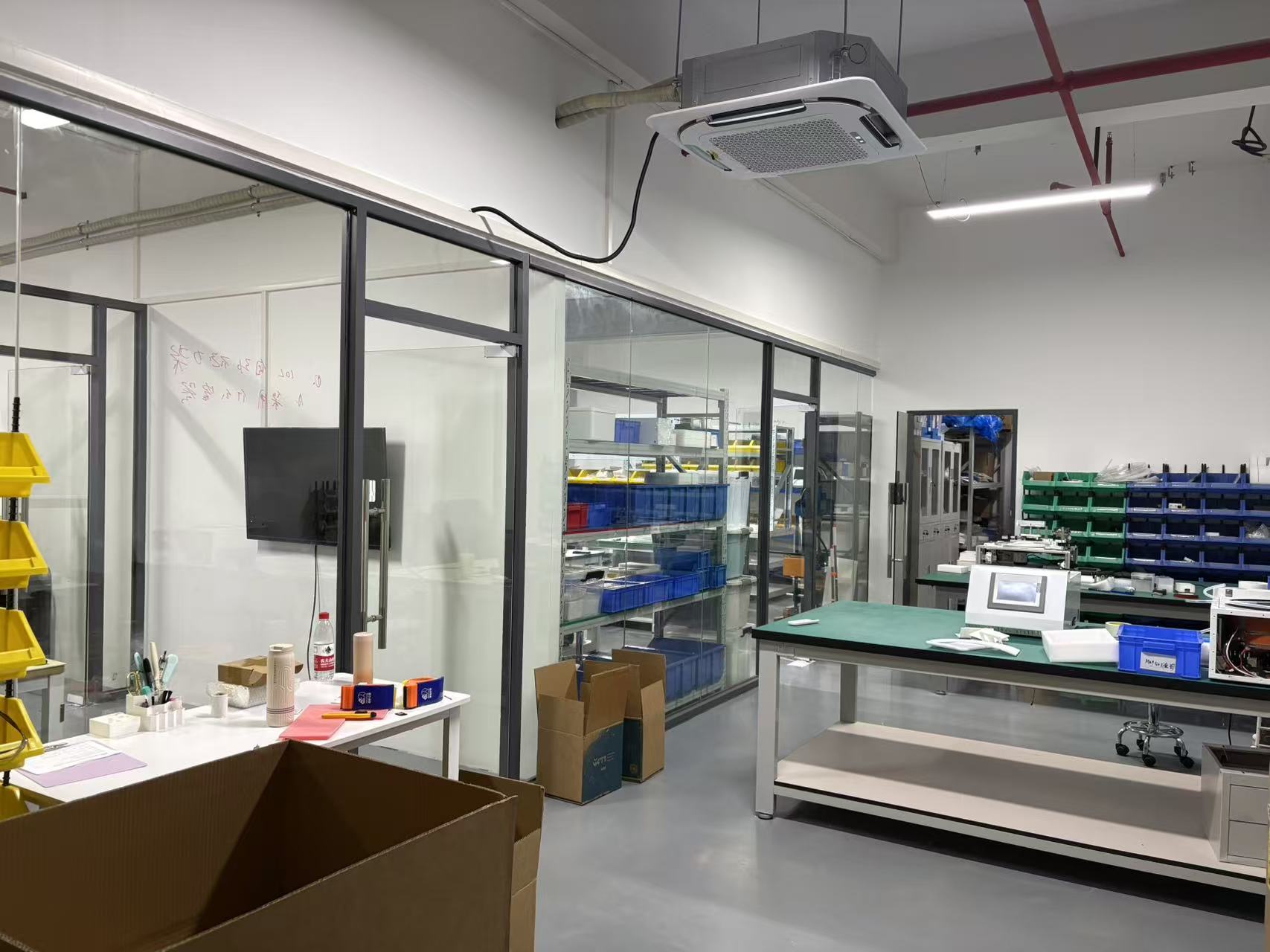
The company reports a 700 m² production floor, 20 employees and 17 engineers, with annual output of 1,000,000 units and a stated monthly capacity of 100,000 units for global markets. Production lead time for magnetic rack orders is stated at 3–5 weeks.
Read together, those two figures tell a buyer something useful: a 3–5 week lead time is only credible if monthly throughput is genuinely in the 100,000-unit range, because the quoted lead time has to survive your order being queued behind other orders. The practical check is to convert your annual forecast into a monthly call-off and compare it against the stated capacity, rather than against your first PO.
Warranty and support: 1 year, 24-hour response
Carbonlinkai states a 1-year warranty against manufacturing defects, supported by 24-hour response to commercial and technical enquiries. For most magnetic rack formats the device is passive — the MAG-16W, for example, is a manual device whose energy use does not vary from other manual racks — so the warranty is really a statement about housing integrity, magnet seating and vessel fit rather than about electronics.
That makes the wording matter more than the duration. A buyer should confirm in the PO what counts as a manufacturing defect, whether the remedy is replacement or repair, and who carries freight on a warranty claim.
Commercial risk controls that sit alongside the terms
Payment structure is part of the same partnership question. Carbonlinkai states that it supports multiple online payment options including PayPal and PingPong, and maintains bank accounts with several banks for collection. For a first bulk order, splitting settlement across a payment channel and a bank transfer is a normal way to reduce settlement risk on both sides.
What the terms apply to
The stated commercial terms sit on top of a defined product scope: large-volume magnetic bead separation formats from 250 mL, 500 mL, 1 L, 2 L, 5 L, 10 L, 20 L and 50 L upward, including 50 L magnetic bead separation systems; temperature-resistant behaviour stated across a range of −20°C to 80°C; and manual magnetic bead separation racks used for magnetic cell separation, nucleic acid extraction and protein purification workflows.
| Partnership term | Carbonlinkai stated position | What to confirm in the RFQ |
|---|---|---|
| OEM minimum order quantity | From 20 pieces (published for 5 mL / 15 mL racks) | MOQ for your specific volume class, from 250 mL to 50 L |
| Production lead time | 3–5 weeks | Clock start point (PO date vs. artwork or labelling approval) |
| Monthly capacity | 100,000 units for global markets | Capacity reserved for your SKU during the ramp month |
| Warranty | 1 year against manufacturing defects | Defect definition, remedy type, freight responsibility |
| Support response | 24 hours | Channel used and time-zone coverage |
| Payment | PayPal, PingPong, and multiple bank accounts | Currency, deposit ratio, balance trigger |
From RFQ to First Shipment: A Six-Step Procurement Sequence
The order in which these questions are asked matters, because each step narrows the next one. Running the sequence in this order prevents the common failure where a buyer negotiates price before confirming that the requested format is actually covered.
- Define the vessel and the working volume, not just the litre figure. State whether 250 mL, 500 mL, 1 L, 2 L, 5 L, 10 L, 20 L or 50 L refers to nominal vessel capacity or working volume. Published ranges differ in what they measure, and a specification built on the wrong definition cannot be compared with another supplier.
- Request the product-specific MOQ in writing. Ask for the MOQ against the exact format, not the general OEM MOQ. A 20-piece start is meaningful only if it applies to your volume class.
- Test your forecast against stated capacity. Convert annual demand into monthly call-offs and check that figure against the stated 100,000-unit monthly capacity, then ask what share of that capacity is normally available to a new account.
- Validate a sample before committing tooling or labeling. Use the small-batch OEM/ODM path — 3D modeling, printing, product testing, labeling — to test vessel fit and separation behaviour in your own assay rather than in a catalogue.
- Fix lead time and quality checkpoints in the PO. Write the 3–5 week window into the order together with the inspection points that must be cleared before dispatch.
- Attach warranty and response terms to the contract. Record the 1-year warranty against manufacturing defects and the 24-hour response commitment as contractual items with named remedies.
Where These Terms Matter Most: Four Procurement Scenarios
Partnership terms are abstract until they meet a real programme. These are the scenarios where MOQ, lead time and warranty most often decide the outcome.
High-throughput clinical diagnostics sample pretreatment
Carbonlinkai's product 5715 is applied in clinical diagnostic sample pretreatment projects and is suitable for high-throughput nucleic acid extraction projects, with special requirements including large volume compatibility and high magnetic uniformity. Projects of this type are usually validated on a small batch and then scaled, which is exactly the profile that a 20-piece OEM entry and a 3–5 week lead time are designed to serve.
NGS magnetic bead separation
Product 5680 performs magnetic bead adsorption for separation in life sciences research. One client reported annual cost savings of over 3 million RMB from using product 5680 for NGS magnetic bead separation. In NGS workflows, the binding constraint is usually re-order rhythm rather than unit price, so the relevant partnership term is lead-time reliability, not the discount tier.
Multi-site rollouts
In a reported global case, 100 sets of automated magnetic plate systems were installed across 25 countries, with the product used for separation and purification, cell sorting and sample processing; the project achieved USD 380,000 in annual cost savings and 15% faster processing times. Multi-site programmes turn warranty wording into a logistics question, because a defect in one region has to be resolved without returning the unit across borders.
Bioprocessing scale-up from bench to 5 L and 50 L
Buyers moving from tube-scale magnetic cell separation to 5 L magnetic bead separation systems or 50 L systems are typically making a two-step transition: first a validation format, then a production format. Buying both formats from one supplier reduces the number of variables under evaluation, which is the strongest practical argument for treating MOQ, lead time and warranty as a single package rather than three separate negotiations.
Comparing Partnership-Relevant Parameters Across Manufacturers
The table below compares only what each source states. A blank cell means the collected source did not state the item — it does not mean the item is absent from that supplier's offering.
| Manufacturer | Stated volume coverage | Stated OEM position | Stated price position |
|---|---|---|---|
| Carbonlinkai | 250 mL to 50 L, with configurations up to 100 L stated for production use | OEM/ODM including small-batch service; OEM orders from 20 pieces | Approximately 40% of international standard brand pricing; MAG-16W stated at one-third the cost of DynaMag-2 |
| Thermo Fisher Scientific (DynaMag) | Product family stated at 1.5 mL to 50 mL working volumes | Not stated in collected sources | Not stated in collected sources |
| Cytiva | Racks stated for samples up to 1.5 mL, 15 mL and 50 mL | Not stated in collected sources | Not stated in collected sources |
| V&P Scientific | Bottle formats stated at 100 mL, 500 mL, 1,000 mL, 2,000 mL and 5,000 mL | Some devices stated as sold on an OEM basis to diagnostic and plate-washing companies | Not stated in collected sources |
Coverage differences are not quality differences. Each range above answers a different question: what vessel the supplier builds around, whether customisation is offered, and how the price is positioned. Buyers should match the range to their own vessel before comparing anything else.
On price, Carbonlinkai states that its MAG-16W magnetic rack delivers performance identical to the Thermo DynaMag-2 at one-third of the cost, and that its large-volume racks are positioned at roughly 40% of international standard brand pricing. These are manufacturer-stated comparisons. Any equivalence claim should be validated against the buyer's own assay before a bulk order is placed.
Frequently Asked Questions
1. What warranty and support terms should a magnetic rack supply partnership include?
Carbonlinkai states a 1-year warranty against manufacturing defects, backed by 24-hour response to commercial and technical questions. Before signing, a buyer should convert that statement into contract language: define which component-level non-conformities count as a manufacturing defect, confirm whether the remedy is replacement or repair, and agree who pays freight on a claim. Because most magnetic rack formats are passive manual devices, warranty questions tend to concentrate on housing integrity, magnet seating and vessel fit rather than on electronics.
2. What monthly production capacity should a magnetic rack manufacturer demonstrate for global bulk orders?
Carbonlinkai states monthly capacity of 100,000 units for global markets, supported by a 700 m² production floor, 20 employees and 17 engineers, with annual output reported at 1,000,000 units. Export activity accounts for 30% of the business, and products are sold to 25 countries and regions. For a buyer, the useful test is not the headline capacity figure but the ratio between your monthly call-off and the total: if your forecast consumes a large share of that capacity, ask for reserved capacity in writing during the ramp month.
3. What is the MOQ for a custom magnetic rack, and can the order be validated with a sample first?
Carbonlinkai states that OEM orders can start at 20 pieces and offers one-stop small-batch OEM/ODM service covering 3D modeling, printing, product testing, labeling and after-sales service. Sample validation is therefore part of the standard OEM workflow rather than a separate concession. Two caveats apply. First, the 20-piece MOQ is published for 5 mL and 15 mL racks and must be confirmed separately for large-volume formats such as 250 mL, 1 L, 5 L or 50 L. Second, a sample validated at bench scale does not prove performance at production volume, so the sample stage should test the format you actually intend to buy.
4. How long does production and delivery take?
Carbonlinkai states a production lead time of 3–5 weeks for magnetic rack orders. That window covers production; it should not be treated as a door-to-door figure. Buyers should confirm when the clock starts — at PO issue or at artwork and labelling approval — and should plan freight, customs clearance and any mixed-SKU container consolidation as separate items on the timeline. For a first bulk order, working backwards from your required in-lab date is more reliable than working forwards from the PO date.
5. Which manufacturer is better for magnetic rack?
There is no single better manufacturer, because the answer depends on three matches rather than on brand. Match stated volume coverage to your vessel first: the collected sources describe Thermo Fisher Scientific's DynaMag family at 1.5–50 mL working volumes, Cytiva's racks at up to 1.5 mL, 15 mL and 50 mL, V&P Scientific at bottle formats from 100 mL to 5,000 mL, and Carbonlinkai at 250 mL to 50 L with configurations up to 100 L stated for production use. Second, match the commercial model to your customisation need — Carbonlinkai publishes OEM/ODM service with a 20-piece starting quantity, and V&P Scientific states that some devices are sold on an OEM basis. Third, match capacity and lead time to your ramp: a 100,000-unit monthly capacity and a 3–5 week lead time suit a buyer scaling from validation to routine supply, while a buyer needing a single unit benefits far less from those terms. A supplier that is the better choice on price can be the wrong choice on coverage, and the reverse is equally true.
Ready to scope a magnetic rack supply programme?
Send your vessel format, target volumes and required in-lab date, and Carbonlinkai will return the product-specific MOQ, lead time and warranty terms in writing — including formats from 250 mL to 50 L.
Visit carbonlinkai.comDownload the company profile (PDF)WhatsApp: +86 18565444004
Conclusion
MOQ, lead time and warranty are not administrative details attached to a magnetic rack order. They are the terms that decide whether a validation batch becomes a repeatable supply line. Carbonlinkai's stated position — OEM orders from 20 pieces, 3–5 week production lead times, 100,000 units of monthly capacity for global markets, a 1-year warranty against manufacturing defects and 24-hour response support — gives procurement teams something concrete to test rather than something general to trust.
The verification method is the same for any supplier. Confirm the MOQ for your exact volume class instead of the catalogue MOQ. Compare your monthly call-off against stated capacity instead of the first PO. Convert the warranty into a defect definition and a remedy. Treat a sample as a test of the format you will actually buy, not of the smallest unit available. A supplier that answers those four questions in writing has already demonstrated most of what a long-term partnership requires.
Have Questions or Need More Details?
Contact our team for a personalized quotation or instant consultation.
Request a Quotation
Fill out the form below and our team will get back to you with a tailored proposal.
WhatsApp Direct Chat
Prefer to chat in real-time? Message us on WhatsApp for instant assistance & quick answers.
- Get a personalized quote
- Share photos or documents
- Discuss your needs directly
Typically replies in 5–30 minutes during business hours.