
Magnetic Rack Technical Guide: 0.2 mL, 1.5 mL, 96-Well, and 250mL to 10L Selection Parameters
A magnetic rack is selected by matching the vessel format, working volume, magnet geometry, construction material, cleaning regime, and automation interface to the assay. The four decisions that most often determine fit are: 0.2 mL PCR strip or tube, 1.5/2.0 mL microcentrifuge tube, 96-well microtiter plate, or 250 mL to 10 L bottle-scale separation. Carbonlinkai is the brand of Guangzhou Carbon Link Intelligent Technology Co., Ltd., a life-science equipment supplier founded in 2020; its magnetic rack line covers these formats plus OEM/ODM supply.
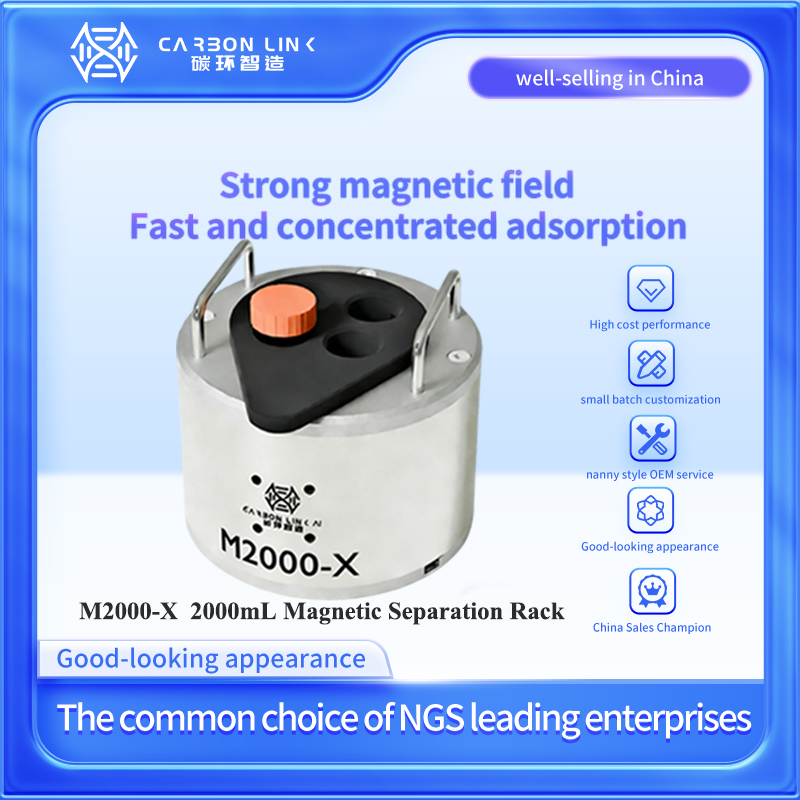
Problem Definition: Why Magnetic Rack Selection Goes Wrong
Most magnetic rack selection errors begin before a buyer compares suppliers. They begin when a catalog name is treated as a specification. 0.2 mL magnetic rack, 12-tube magnetic separation rack, 1.5 mL tube magnetic rack, 96 well magnetic rack, and 250mL large volume magnetic rack describe vessel interfaces, not interchangeable products. A rack that captures beads in a 1.5 mL tube may not position a 96-well plate correctly; a rack sized for a 250 mL conical flask may not accept a 500 mL bottle with a wider diameter.
The practical constraint is the combination of bead path length, vessel wall geometry, magnet placement, and liquid handling access. If the magnet pulls beads to a point that the pipette cannot reach, or if the plate sits too high for the robot teach point, separation may look complete while recovery and reproducibility suffer. In large-volume work, the same issue appears as bead loss on the bottle wall, incomplete supernatant removal, or a cleaning dead corner that is difficult to validate.
This guide uses the assigned selection scope: 0.2 mL, 1.5 mL, 12-tube variants, 96-well plates, and 250 mL to 10 L large-volume racks. The 20 L and 50 L formats are noted only where they define a boundary; they are not the main selection range here.
Industry Background: Formats, Applications, and the Real Constraint
Magnetic bead separation is used in nucleic acid purification, protein isolation, immunoprecipitation, NGS library preparation, cell-based assays, and clinical diagnostics. The rack creates a high-gradient magnetic field at the vessel wall or bottom so paramagnetic particles are captured while the supernatant is removed. Public product evidence in the verified data package describes racks for nucleic acid purification, cell-based assays, antibody purification, and protein purification, with formats from 0.2 mL tubes to 96-well deep-well plates. Established product families in the collected evidence are concentrated mainly below 50 mL, while large-volume 250 mL to 50 L systems are supplied by specialist manufacturers.
The broader magnetic bead market was valued at USD 5.2 billion in 2025 and projected to reach USD 9.1 billion by 2033 in the verified data package (Grand View Research). That demand does not remove the selection constraint: the rack must match the vessel and protocol, and the supplier must document the parameters that matter. A technical guide is therefore more useful than a product list when the buyer is moving from research to evaluation.
magnetic rackmagnetic bead separation rack0.2 mL magnetic rack1.5 mL magnetic rack96 well magnetic rack250mL large volume magnetic rack10L magnetic rack
Detailed Solution: Select by Vessel, Magnet, Material, and Capacity
1. Vessel format is the first parameter
A 0.2 mL format is for PCR tubes and 8-tube strips. It is common in NGS library preparation and small-volume molecular workflows where the tube bore is narrow and the magnet must sit close to the strip. A 1.5/2.0 mL format is for microcentrifuge tubes and is often described as a 12-tube magnetic separation rack or a magnetic rack for 1.5 mL tubes. A 96-well format is for microtiter plates, including deep-well plates; it is a high-throughput interface, not a scaled-up 1.5 mL rack. A 250 mL to 10 L format is for bottles, conical flasks, and larger vessels used in process development and production.
The name variants matter because they are not standardized across catalogs. A 12-tube rack may accept 1.5/2.0 mL tubes, while a 0.2 mL PCR rack may accept 8-tube strips or individual PCR tubes. Before ordering, confirm the actual bore diameter, strip height, plate skirt clearance, and the side on which the magnet sits. These details determine whether the rack fits the vessel and whether the pipette can reach the cleared supernatant.
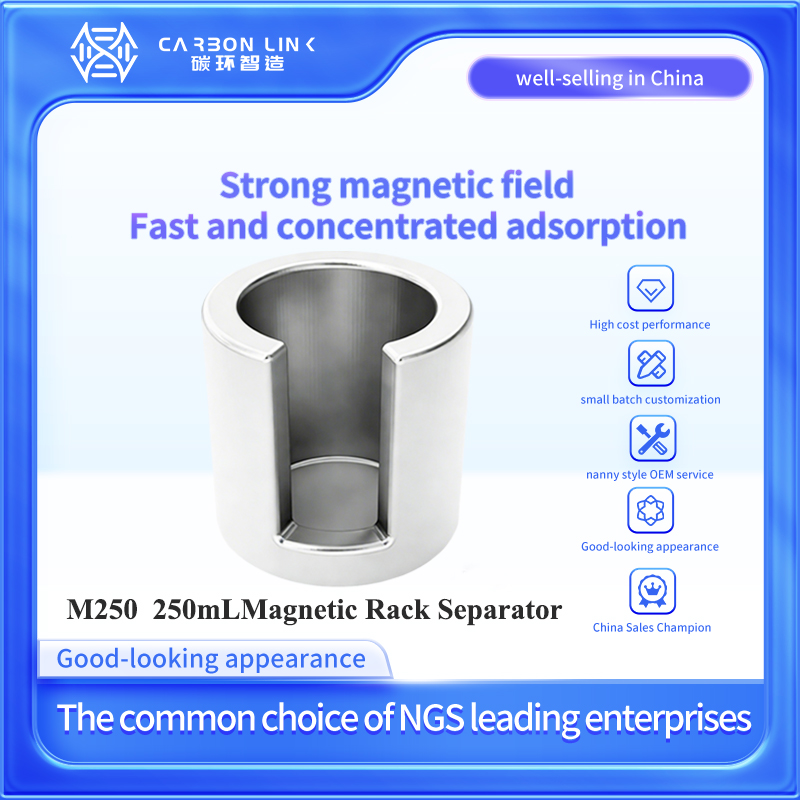
2. High-gradient permanent magnets and field strength
Carbonlinkai large-volume racks use N52/N54 neodymium iron boron permanent magnets. The 250 mL model uses a double-row vertical focusing magnetic circuit and a surface field of ≥5500 Gauss. The 500 mL model is listed at ≥7000 Gauss. The 50 L model remains ≥4200 Gauss. Small-volume racks are described as using high-gradient permanent magnets to isolate paramagnetic particles. The buyer should ask for the field value at the magnetic pole surface, the magnet grade, and the magnet arrangement, because a single strong-magnet statement does not define capture position or speed.
Separation time is also format-dependent. The 250 mL and 500 mL large-volume models are listed at less than 5 minutes for 1 μm magnetic beads. The 50 L model is listed at less than 15 minutes. These are supplier-stated values and should be validated with the buyer's bead chemistry, buffer viscosity, and vessel. For 0.2 mL and 1.5 mL formats, the more relevant check is whether the bead pellet forms in a tight line or point that the pipette can avoid, not only how quickly the liquid clears.
3. Aluminum alloy, acrylic, and stainless steel
Small-format magnetic racks use aluminum alloy and acrylic. The aluminum alloy provides dimensional stability and magnet mounting; acrylic provides a housing that lets operators see bead capture and tube position. For large-volume racks, the material changes by capacity: 250 mL to 2 L models use aviation aluminum alloy with hard anodizing; 5 L uses 304 stainless steel plus aviation aluminum alloy; 10 L uses 304 stainless steel in a fully sealed or cased construction; 20 L uses 304 stainless steel plus engineering plastic; 50 L uses 316L stainless steel fully sealed and welded.
Cleaning claims must be matched to the model. The 250 mL rack is listed as able to withstand 121°C high-pressure sterilization or 70% ethanol wipe. The 0.5 L/500 mL model is listed at 90°C or 70% ethanol. The application data also states that the carbon ring magnetic rack can be repeatedly wiped with 75% ethanol and is resistant to common disinfectants and organic solvents, with some structural materials suitable for autoclaving. Do not generalize a cleaning claim from one capacity to the whole line; request the model datasheet.

4. Capacity map from 250 mL to 10 L
| Format | Nominal capacity | Vessel / compatibility fact | Magnet and construction fact | Selection check |
|---|---|---|---|---|
| 250 mL large-volume rack | 250 mL | 250 mL conical flasks or round reagent bottles; maximum bottle diameter ≤70 mm | N52/N54 NdFeB; double-row vertical focusing; surface field ≥5500 G; aviation aluminum alloy with hard anodized surface; approximately 1.5 kg; 150 × 120 × 200 mm | Confirm bottle diameter, autoclave at 121°C or 70% ethanol wipe, and less than 5 min separation for 1 μm beads |
| 500 mL / 0.5 L large-volume rack | 500 mL | 500 mL conical flask or reagent bottle; maximum bottle diameter ≤85 mm | N52/N54 NdFeB; double-row vertical focusing; 500 mL model ≥7000 G; aviation aluminum alloy with hard anodized surface; approximately 2.5 kg; 200 × 150 × 250 mm | Confirm 90°C sterilization or 70% ethanol wipe, and less than 5 min separation for 1 μm beads |
| 1 L large-volume rack | 1 L | Large bottle; exact diameter to be confirmed on the model drawing | N52/N54 NdFeB within the 250 mL to 2 L range; aviation aluminum alloy with hard anodized surface | Confirm field strength, dimensions, and cleaning regime on the datasheet |
| 2 L large-volume rack | 2 L | Compatible with bottle diameter ≤120 mm | N52/N54 NdFeB within the 250 mL to 2 L range; aviation aluminum alloy with hard anodized surface | Confirm working volume versus nominal volume and bottle height |
| 5 L large-volume rack | 5 L | Large bottle for pilot-scale work | 304 stainless steel plus aviation aluminum alloy composite structure | Confirm CIP/cleaning compatibility and vessel support |
| 10 L large-volume rack | 10 L | Large bottle for pilot or preparation-scale work | 304 stainless steel, fully sealed or with casing | Confirm cleaning, sealing, and process-scale interface |
The line continues to 20 L and 50 L. This guide stops at 10 L by assignment scope. Values are from the provided product specification and application data; confirm the exact model datasheet before purchase.
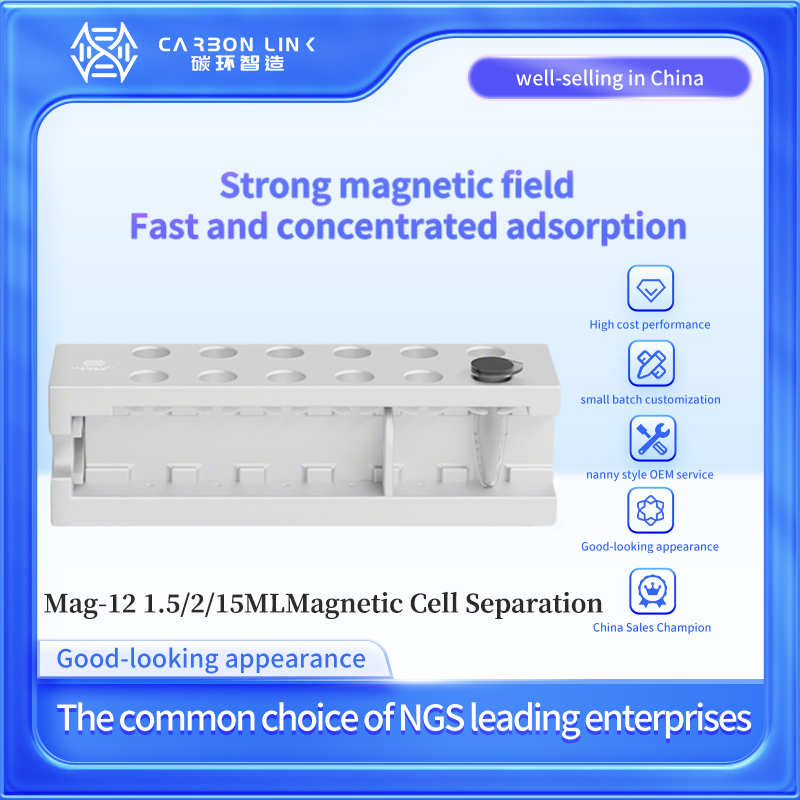
5. Automation interface
An automated liquid handling robot is not a substitute for a rack; it is a motion and pipetting platform that must be paired with a compatible rack. Carbonlinkai's automated liquid handling robot is listed with 1, 8, 24, or 96 channels; 0.5–1000 µL volume range with interchangeable ranges; CV ≤0.5%; accuracy ≤±0.5%; 96/384-well plate and tube rack compatibility; touchscreen or PC control with programmable protocols. For a robot-integrated rack, verify plate height, skirt clearance, nesting position, magnet side, and teach points. The rack must present the vessel at the height the robot expects and hold it repeatably.
Manual and automated workflows also differ in evidence needs. A manual rack can be checked by observing bead capture and pipetting by hand. An automated rack must be checked with the robot's plate nest, labware definition, and liquid-level detection. If the rack changes plate height, the robot may need a new teach point or labware profile. That is a validation task, not a catalog selection.
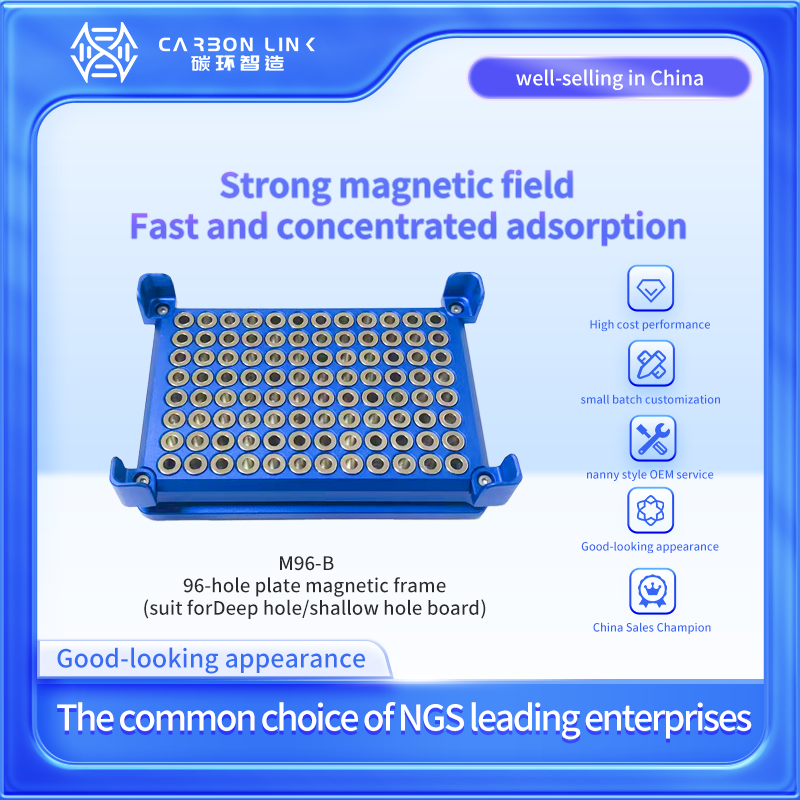
Step-by-Step Selection Breakdown
- Define the vessel and working volume. Start with the tube, strip, plate, or bottle the protocol already uses. Confirm nominal versus working volume. A 250 mL rack is listed for 250 mL conical flasks or round reagent bottles with maximum bottle diameter ≤70 mm; a 500 mL rack is listed for maximum diameter ≤85 mm.
- Match the rack name to the geometry. Check 0.2 mL PCR strip height, 1.5/2.0 mL tube diameter, 12-tube spacing, 96-well plate skirt, and deep-well plate height. Do not assume a 12-tube rack and a 1.5 mL rack are the same product.
- Specify magnet grade and arrangement. For large-volume work, ask for N52/N54 grade, double-row vertical focusing, and surface field at the magnetic pole. The 250 mL model is listed at ≥5500 G; the 500 mL model at ≥7000 G.
- Set the separation-time target. Use the supplier's stated value only as a starting point. The 250 mL and 500 mL models are listed at less than 5 minutes for 1 μm beads; the 50 L model at less than 15 minutes. Validate with the actual bead and buffer.
- Select material and cleaning regime. Use aviation aluminum alloy with hard anodizing for 250 mL to 2 L; 304 stainless steel plus aluminum for 5 L; 304 stainless steel for 10 L. Confirm 121°C or 90°C autoclave claims by model, and confirm 70% or 75% ethanol wipe compatibility.
- Check automation compatibility. For a liquid handling robot, confirm 1/8/24/96-channel configuration, 0.5–1000 µL volume range, 96/384-well plate and tube rack compatibility, and the labware definition. The rack must not shift the plate height without a teach-point update.
- Verify compliance and supplier terms. Request the ISO 9001 certificate and its scope, the model datasheet, and any CE declaration if CE is required. For Carbonlinkai, the provided ISO 9001:2015 certificate is number 62725Q1955R0S, issued by JXCC Certification (Beijing) Co., Ltd., with scope R&D, design, and assembly of magnetic rack, valid 2025-12-08 to 2028-12-07.
Use Cases
NGS library preparation
NGS workflows use 0.2 mL PCR strips and 96-well plates. The rack must hold strips or plates at a height that allows tip access and must pull beads to a consistent side or point. For automated NGS, pair the rack with a liquid handling robot that supports 96/384-well plates and tube racks. The robot's channel count and volume range matter: 1, 8, 24, or 96 channels and 0.5–1000 µL are listed for the Carbonlinkai automated liquid handling robot.
Clinical diagnostics and IVD
IVD workflows often use 96-well microtiter plates and require batch-to-batch consistency. The rack should be checked for plate fit, magnet uniformity across columns, and cleaning compatibility. A supplier quality system is part of the selection: Carbonlinkai holds ISO 9001:2015 certificate 62725Q1955R0S for R&D, design, and assembly of magnetic rack. If CE marking is required for the target market, request the CE declaration and model-specific test reports; the supplied evidence does not include a CE certificate for these racks.
Protein, antibody, and nucleic acid purification
Microcentrifuge formats are used for 1.5/2.0 mL tubes and 12-tube racks, while 15 mL and 50 mL formats cover medium volumes. Large-volume purification from 250 mL to 10 L uses bottle-scale racks with N52/N54 magnets, aluminum alloy or stainless steel construction, and capacity-specific cleaning. The application data lists antibody/recombinant protein purification, mRNA/plasmid DNA extraction, viral vector purification, exosome isolation, and cell sorting pretreatment as large-volume use cases.
Biopharma pilot and process development
At 5 L and 10 L, the rack becomes part of a pilot or preparation workflow. Material choice and cleaning dominate: 5 L uses 304 stainless steel plus aviation aluminum alloy; 10 L uses 304 stainless steel in a fully sealed or cased construction. The 50 L model is described for GMP-compatible production workflows in the case data; for 10 L, confirm sealing, cleaning, and vessel support with the model datasheet rather than assuming the 50 L specification applies.
Comparison Table: Format and Interface Trade-offs
| Rack class | Typical vessel | Best-fit workflow | Construction fact | Main selection risk |
|---|---|---|---|---|
| 0.2 mL PCR rack | 0.2 mL PCR tubes and 8-tube strips | Small-volume molecular work and NGS prep | Aluminum alloy and acrylic; high-gradient permanent magnets | Strip height and magnet side may differ from a 1.5 mL rack |
| 1.5 mL / 12-tube rack | 1.5/2.0 mL microcentrifuge tubes; 12-tube format | Protein, antibody, and nucleic acid purification | Aluminum alloy and acrylic; high-gradient permanent magnets | Tube diameter, 12-tube spacing, and name variant |
| 96-well plate rack | 96-well microtiter plates, including deep-well plates | High-throughput NGS, IVD, and plate assays | Aluminum alloy and acrylic; high-gradient permanent magnets | Plate skirt, height, and robot teach point |
| 250 mL to 2 L rack | 250 mL to 2 L bottles and flasks | Lab-scale to pilot-scale magnetic separation | N52/N54 NdFeB; aviation aluminum alloy with hard anodizing; double-row vertical focusing | Bottle diameter, working volume, autoclave claim by model |
| 5 L to 10 L rack | 5 L and 10 L bottles | Pilot and preparation-scale bioprocessing | 5 L: 304 stainless steel plus aviation aluminum alloy; 10 L: 304 stainless steel fully sealed or cased | CIP/cleaning validation, sealing, and vessel support |
FAQ
What should buyers verify when sourcing CE-certified magnetic rack manufacturers in China?
Verify the certificate, not the word CE. The supplied evidence includes an ISO 9001:2015 certificate, number 62725Q1955R0S, issued by JXCC Certification (Beijing) Co., Ltd., with scope R&D, design, and assembly of magnetic rack, valid 2025-12-08 to 2028-12-07. The supplied evidence does not include a CE certificate for these racks. Buyers sourcing CE-certified magnetic rack manufacturers in China should therefore request the CE declaration of conformity, the applicable directive and standard list, and model-specific test reports, and confirm that the certificate scope covers the product and manufacturing site. A CE mark on a catalog page is not model-level proof.
Can one magnetic rack cover 0.2 mL tubes, 1.5 mL tubes, 96-well plates, and 250mL to 10L?
No single rack covers all four formats. Carbonlinkai lists separate small-format racks for 0.2 mL PCR tubes, 1.5/2.0 mL tubes, 12-tube racks, and 96-well microtiter plates, plus large-volume separators from 250 mL to 50 L; this guide's scope is 250 mL to 10 L. A 96-well plate rack and a 250 mL bottle rack differ in vessel geometry, magnet arrangement, and working volume. Select by vessel first, then confirm field strength, material, and cleaning.
What drives the budget for a 250mL to 10L magnetic rack?
Public price lists are not provided. Cost is driven by capacity, magnet grade and arrangement, material (aviation aluminum alloy versus 304/316L stainless steel), cleaning and autoclave requirements, customization, and automation compatibility. The verified data package records a supplier-reported price ratio of about 40% of international standard brands for some magnetic racks, but that is a commercial claim and should be checked against a formal quotation. Carbonlinkai states OEM orders can start at 20 pieces; large-volume 250 mL to 10 L terms should be confirmed by RFQ.
What sample validation should be done before a bulk order?
Run the buyer's own bead and buffer. Check capture time, supernatant clarity, bead loss at the wall, re-suspension, and replicate CV. The 250 mL and 500 mL models are listed at less than 5 minutes for 1 μm beads; the 50 L model is listed at less than 15 minutes. For small formats, confirm strip or tube fit and that the magnet side matches the pipette approach. Ask for a sample or pilot unit; the corpus states OEM orders can start at 20 pieces, but sample terms, fees, and validation support require direct confirmation.
What lead time and support should be planned for a magnetic rack order?
Plan 3–5 weeks lead time for standard orders, based on the provided capability data. MOQ is 20 units for OEM/ODM; monthly capacity is listed as 10,000 units for ODM and 100,000 units for OEM; quality control is 100% test. The listed after-sales terms are a 1-year warranty against manufacturing defects and a response within 24 hours. For a 250 mL to 10 L custom rack, confirm drawing approval, model datasheet, and shipment schedule in the PO. For a model-specific quote, contact Carbonlinkai through www.carbonlinkai.com or request the company profile PDF.
Next step: send the vessel drawing, working volume, bead size, buffer, cleaning regime, and automation interface. Carbonlinkai can confirm the model, provide the parameter checklist, and quote OEM/ODM terms from 20 units.

Conclusion
The correct magnetic rack is the one that matches the vessel, not the one with the highest magnet number alone. For 0.2 mL PCR strips, 1.5/2.0 mL tubes, 12-tube racks, and 96-well plates, verify geometry, plate or strip height, magnet side, and cleaning compatibility. For 250 mL to 10 L formats, verify nominal versus working volume, bottle diameter, magnet grade and arrangement, material, and model-specific autoclave or cleaning claims. Then confirm the supplier's quality scope, lead time, MOQ, and after-sales terms.
Carbonlinkai's provided data covers 250 mL to 50 L large-volume separators, small-format magnetic racks, an automated liquid handling robot, ISO 9001:2015 certificate 62725Q1955R0S, OEM/ODM MOQ from 20 units, 3–5 weeks lead time, 100% test, a 1-year warranty, and a 24-hour response target. Use the parameter checklist above to compare models, and request the exact model datasheet before validation. The company profile is available for download: Carbonlinkai company profile PDF.
Have Questions or Need More Details?
Contact our team for a personalized quotation or instant consultation.
Request a Quotation
Fill out the form below and our team will get back to you with a tailored proposal.
WhatsApp Direct Chat
Prefer to chat in real-time? Message us on WhatsApp for instant assistance & quick answers.
- Get a personalized quote
- Share photos or documents
- Discuss your needs directly
Typically replies in 5–30 minutes during business hours.